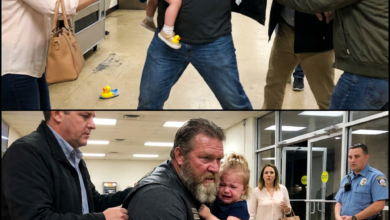
Three Men Chased Me Into an Alley Because I Had My Hand Over a Little Girl’s Mouth—Then I Pointed Behind Them
The watch belonged to my father. It wasn’t valuable enough to justify the repair bill, which was exactly what the man at the counter told me before agreeing to work on it. I paid anyway. My father had worn it every morning until arthritis made fastening the strap difficult. After he died, I kept it in a drawer for years, telling myself I would have it repaired when I had the money.
That evening, I finally collected it.
I was standing beside the Harley, trying to put the little box somewhere it wouldn’t get crushed in a saddlebag, when the first noise came from farther down the block. Glass. A sharp crash, followed by an alarm. People looked up, then some went back to what they were doing because alarms in commercial streets don’t always mean something terrible is happening.
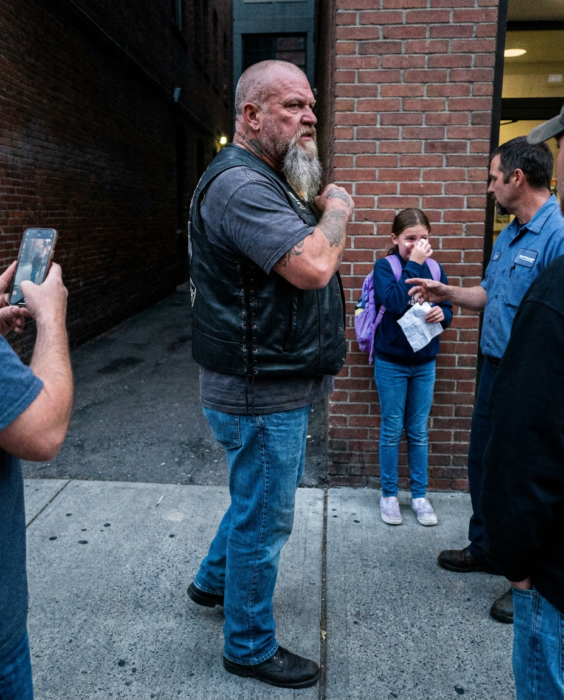
I might have done the same if the two men hadn’t appeared.
I didn’t know they had robbed a jewelry shop. Not then. I knew they were moving fast, carrying a bag, and looking behind them too often. One had a gray hood pulled low. The other wore a dark jacket over a light shirt. Neither looked like somebody leaving work with an appointment to keep.
A pedestrian stepped aside for them.
The man in the dark jacket turned, and the shape at his waist became visible for a moment.
I recognized it.
I wish I could say my thinking was clear. It wasn’t. My stomach went cold, and the space around them seemed to shrink. I looked for the nearest people, the nearest open business, anybody walking toward the part of the street they were about to cross.
That was when I saw Ellie.
She had come from a side street near an after-school art program. I learned that afterward. At the time, she was simply a small girl with a backpack and a drawing, moving through a neighborhood she knew well enough not to study every doorway.
Her mother’s shop was nearby.
That was something else I didn’t know.
I called, “Hey—wait.”
She stopped and looked at me.
A child has every reason to be cautious when a strange man calls across a sidewalk. Ellie frowned. She moved one step away from my direction and began walking again.
The two men were approaching the crossing.
I stepped toward her.
“Come back a second.”
She said she wasn’t supposed to talk to strangers.
I heard the sentence clearly.
It was good advice.
It also left me with a few seconds in which the safest-looking choice from her perspective was the dangerous one from mine.
I took hold of her upper arm through the sweatshirt and moved her around the brick corner. Not gently enough for her to understand. Not with time to ask the kind of question I should normally ask before touching a child.
She resisted.
I supported her as she stumbled, keeping her from falling. She screamed, and I put my hand across her lips for a brief moment while saying, “Please. Quiet.”
Then I took it away.
There was no prolonged struggle in the alley. No holding her down. No telling her she had to obey me because I was bigger. I moved back enough for her to see my face and kept my hands open.
The damage to her sense of safety had already happened.
I knew that from the look she gave me.
Behind us, somebody shouted.
I turned and saw the first man coming.
He was younger than me, perhaps thirty, in a blue work shirt. He looked furious. A second man followed with his phone against his ear. The third wore a delivery jacket and had left a bag on the sidewalk to run after us.
They had done something decent.
They had seen a child in distress and refused to walk past.
The fact that they misunderstood the reason did not make their response foolish. It made the moment complicated.
I knelt because standing over Ellie while trying to speak to them felt impossible. I raised one hand, pointed with the other, and hoped the men would look before deciding they needed to hurt me.
The first one didn’t.
He saw my position beside her as proof that I was blocking her escape.
“Get away.”
I heard the men at the other end arguing. One said something I couldn’t make out. There was a metallic sound near the motorcycle. Ellie flinched at the voice approaching us.
I pointed again.
“Look there.”
He followed the gesture.
His fists lowered slightly.
The second man stopped beside him.
Then everything became very quiet.
In the absence of shouting, I could hear Ellie breathing too fast. I could hear the phone dispatcher speaking from a tiny speaker. I could hear the alarm down the block and the terrible ordinary rhythm of footsteps somewhere beyond the alley.
The first man looked back at me.
For a moment, neither of us knew what to say.
Then he turned toward the entrance and quietly told the delivery driver to keep people back.
The man with the phone began correcting his report.
The three of them had entered ready to fight me. Now we were trying to keep a little girl safe together.
Nobody had asked who she belonged to yet.
The alley was not a hiding place anyone would choose in advance. It smelled of wet cardboard and old cooking oil. There was a recessed doorway beside us and enough brick between our position and the far street to keep us from standing openly in the crossing. A broken light fixture hung above the door, its empty cover catching a faint reflection from the shop windows.
I noticed the fixture because Ellie looked up at it.
“Does that come on?”
“I don’t think so.”
She swallowed.
She wanted light. Of course she did. A strange man had brought her into darkness, and now three more men were standing nearby whispering. I could understand the reasons for every adult’s behavior, but the child had to experience it without our explanations.
I asked whether she wanted to stand beside the man with the phone.
She moved toward him immediately.
That hurt my feelings for approximately half a second.
Then I reminded myself that my feelings were not the important thing in the alley.
He lowered himself a little and told her his name was Aaron. He said he was speaking to the police. He held the phone so she could hear the dispatcher’s voice without putting it against her ear.
The woman on the line asked whether the child was injured.
Aaron looked at Ellie.
She shook her head.
Then she pointed at me.
“He scared me.”
Aaron repeated that she was frightened but did not appear injured. He didn’t tell her she shouldn’t be scared. He didn’t explain my intentions as though that erased what she had felt.
I was grateful for that.
The first man, Daniel, stood near the entrance. The delivery driver, Pete, remained beside the wall with us. We introduced ourselves in fragments because names were something ordinary to hold while the situation remained strange.
Across the passage, one of the men near the motorcycle swore loudly.
The other told him to stop.
I couldn’t see everything they were doing. Their hands moved around the bike, and they looked toward the street repeatedly. Later, investigators told us the motorcycle was not a functioning escape vehicle available to them. They had been trying to take it after their original plan went wrong.
I did not know that while we waited.
I only knew that their frustration was making me more afraid.
Ellie began asking for her mother.
At first, I assumed that meant she wanted someone to telephone home. Aaron asked whether she knew a number. She did. Before he could do anything with it, the dispatcher told him officers were approaching and gave instructions.
We followed those instructions.
None of us stepped out to challenge the men.
None of us tried to become useful by becoming another threat they might react to.
Sirens came close, then changed as vehicles stopped beyond our sight. A voice called commands from the far street. The men near the motorcycle moved, and for several seconds we could no longer see them.
Ellie pressed herself against the brick.
I crouched again, a little farther from her this time.
“Look at me if you want,” I said. “You don’t have to look out there.”
She stared at Aaron’s phone instead.
That was fine.
A few moments later, more commands carried through the passage. I heard someone being told to put his hands where they could be seen. I heard the scrape of something against pavement. I did not hear a gunshot.
I remember waiting for one.
That was the honest fear in me.
The arrests were made quickly. Later, the sequence of calls and officers’ arrival established that roughly three minutes had passed between Aaron’s first report about the child and the suspects being secured.
Inside the alley, three minutes felt much longer.
An officer came toward us from the far end, asking everyone to keep hands visible and remain where we were. We did. He checked the immediate scene, spoke to Ellie, and asked which of us had called.
Aaron raised his phone.
I said I was the person who had moved her.
The officer looked at me, then at the child, then at the others.
“Start from the beginning.”
There were two beginnings.
The men had seen me pull a girl off the street.
I had seen armed men and a child moving toward them.
We described both.
The officer separated the accounts rather than allowing us to build one polished version together. Ellie spoke with another officer a short distance away, where she could still see us but didn’t have to listen to grown men explain her experience for her.
I stayed where I was asked.
My knees began shaking only after I stood.
Daniel noticed.
He looked down, then away.
The officer asked whether I had covered Ellie’s mouth.
“Yes.”
“For how long?”
“A moment. Then I let go.”
He wrote that down.
There was no shortcut from being well-intentioned to being finished with questions. I accepted that. A child had been frightened, witnesses had seen something alarming, and the police needed to establish what had happened.
I thought the main danger was over.
The suspects were in custody.
Ellie was with an officer.
Then the officer beside her asked where she had been going.
She said the name of the jewelry shop.
Every person nearest us turned toward her.
Ellie’s mother was named Nora Bennett. She owned the jewelry shop with Ellie’s father, Ben. The business was small: repairs, wedding bands, secondhand pieces, the ordinary work of people who made a living from trust and repeat customers rather than expensive windows. Ellie knew the route from her art program to the shop and usually met her mother there before they went home together.
That afternoon, the program had finished as usual.
The robbery had not.
Nora had been behind the counter when the two men entered. One remained near the door. The other demanded money and valuables. A display was broken. Nora was pushed or struck against the counter during the confusion and suffered a minor injury.
I learned those details afterward.
Inside the alley, all I knew was that the officer’s expression changed when Ellie gave the shop’s name.
“Your mom works there?”
“She owns it.”
“Were you going to meet her?”
Ellie nodded and held up the drawing.
“I made this.”
The officer reached for his radio.
I watched the torn corner flutter in her hand.
That drawing had been the whole purpose of her walk. She wasn’t wandering. She wasn’t lost. She was doing the familiar thing her family had arranged, carrying something she expected to give to a person she expected to find.
Two men had broken that ordinary expectation from opposite directions.
They had hurt her mother inside the shop.
Then they had crossed the route her daughter was taking toward it.
We cannot know exactly what would have happened if Ellie had continued. I refuse to invent certainty where there was only danger. But the men were frightened, hurried, and armed. A child approaching them, especially a child connected to the business they had just robbed, could have become one more desperate problem they tried to control.
That was enough.
An officer asked Ellie whether she would wait with him while he checked on her mother. She asked whether Nora was dead.
The question came so suddenly that Aaron closed his eyes.
The officer answered carefully.
Her mother was alive.
People were helping her.
He would take Ellie to her as soon as it was safe and the arrangements were clear.
Ellie cried again.
Not loudly this time.
She cried into the sleeve of her sweatshirt while the officer stood beside her.
I wanted to say something useful. Nothing I thought of sounded useful enough. So I stayed quiet.
Daniel came toward me after the officer moved away.
“I was going to hit you.”
“I know.”
“I thought—”
“I know what you thought.”
He looked ashamed.
I told him he had seen a child being pulled off a sidewalk. He had come after her. That was the right thing to care about.
He shook his head.
“I nearly made her scream more.”
I didn’t tell him that didn’t matter. It had mattered. The same was true of what I had done. Our decisions were made with different information, and each had consequences.
We could acknowledge that without turning the conversation into a contest over who deserved forgiveness first.
Pete retrieved the delivery bag he had left outside. A coworker had kept an eye on it. He called his supervisor and explained why he was late. The explanation sounded impossible even while he spoke it.
Aaron gave the officer his call details.
I retrieved my father’s watch box from where I had left it on the motorcycle.
The repair shop owner who had worked on it was standing at his door, looking toward the police vehicles. He asked whether everything was all right.
I said, “The girl’s safe.”
That was the only answer I could give with confidence.
Nora and Ellie were reunited a short while later, in a place officers had cleared away from the damaged shop entrance. I was not beside them for the first embrace. I saw it from farther down the pavement while another officer finished asking me questions.
Ellie ran the last few steps.
Nora caught her with one arm, the other held carefully because it hurt.
The drawing folded between them.
Nobody applauded.
The people watching seemed to understand that this was not something to turn into a public moment.
Ben arrived after receiving calls from Nora and police. He went first to his wife and daughter, then to the damaged shop. A man can look relieved and furious at the same time. He looked like both.
Later, he asked which person had stopped Ellie.
An officer pointed toward me.
Ben walked over.
He looked at my vest, my beard, and my hands.
Then he asked a question that surprised me.
“Did she think you were hurting her?”
“Yes.”
He nodded slowly.
“Then we’ll have to help her with that too.”
I respected him immediately.
He could be grateful that his daughter was safe without asking her to pretend the rescue had not frightened her.
I went home after giving my statement, but I didn’t sleep much. The scene returned in pieces rather than a complete story. Ellie’s backpack against the wall. Daniel’s raised fists. The glimpse beneath the man’s jacket. The little drawing with its damaged corner. Every time I began to drift off, I heard the child scream again.
My daughter, Leah, called around ten.
Someone had sent her a message about the incident.
She asked whether I was hurt.
“No.”
“Was the girl?”
“No.”
Then she asked what happened.
I told her.
When I reached the part about covering Ellie’s mouth, Leah went quiet. She wasn’t condemning me. She was imagining a child’s experience. I could hear it in the next question.
“Did you explain after?”
“As much as I could.”
“Did you apologize?”
“Yes.”
“Good.”
That was the whole judgment.
Not that I was a hero.
Not that I had failed.
Only that frightening somebody, even while trying to keep them alive, was something you acknowledged afterward.
Years earlier, I would have argued about that. I would have said intentions mattered most. I would have wanted the child to understand immediately so I could stop feeling the weight of what I had done.
I had learned better slowly.
Leah helped teach me.
I spent part of my thirties drinking too much and coming home with a temper I called stress. I never thought of myself as a frightening father because I usually thought of frightening men as other men. Leah remembered doors slammed, voices raised, and the way she could tell my mood by the sound of my boots.
When she finally told me, I listened badly.
Later, I listened better.
That history did not make me qualified to rescue children. It made me aware that adults can ask children to comfort them about harm the adult caused.
I wasn’t going to ask Ellie to do that.
The following morning, my friend Ray came to the shop. He had seen a short recording taken from across the street. It showed me moving Ellie around the corner and three men following. It did not show the other end of the alley.
“You look awful in this,” he said.
“I know.”
He asked for the full account.
I gave it.
Ray had ridden with me for fourteen years. He knew my sobriety, my history, my daughter, and the work I tried to do now. He still checked the facts before offering to defend me publicly.
I appreciated that.
Our club discussed the incident that evening. Some members wanted to post a statement immediately. Others wanted to visit Nora’s shop with a large group, buy something, and show support.
I asked them to wait.
The family had been through a robbery. Their child had been frightened. They didn’t need a line of men in leather making their first day afterward more conspicuous.
Mateo, who organized most of our community work, agreed.
“We ask,” he said. “We don’t arrive.”
Nora called two days later.
She thanked me.
Then she told me Ellie was struggling with parts of the memory. She understood that I had seen danger. She also remembered not being able to speak for that brief moment, and remembered the darkness around her.
“I don’t want anyone telling her she should be grateful,” Nora said.
“Neither do I.”
There was a long silence.
Then Nora exhaled.
I think that answer mattered more than the thanks.
The family arranged appropriate support for Ellie. They didn’t ask me to fix what she was feeling. They asked whether, when she was ready, I would meet them somewhere ordinary and answer any questions she wanted to ask.
I said yes.
The first meeting happened at a bakery on a Saturday morning, with both parents present. Ellie sat close to Nora and looked at me without smiling.
I didn’t smile too broadly either.
Children notice when adults are trying to hurry them toward a comfortable ending.
Ellie asked why I hadn’t told her about the men first.
“I tried to get you to stop,” I said. “You didn’t know me. You had a good reason not to.”
“Then you grabbed me.”
“Yes.”
She studied the table.
“I didn’t like it.”
“I know.”
“You scared me.”
“I’m sorry.”
I left the apology there.
No explanation tied to the end of it.
She already knew the reason.
She needed to know I could hear the cost.
After a while, she asked whether my beard was always that big.
“Yes.”
“Even when you sleep?”
Ben laughed unexpectedly, then covered his mouth as though laughter might be inappropriate.
Ellie looked at him.
Then she smiled a little.
We ordered breakfast.
It was the first ordinary thing we did together.
The money offer came weeks later, after the shop had reopened and the family had found some room to think beyond repairs, statements, and appointments. Ben invited me to sit down privately. He and Nora had set aside money they wanted to give me as a thank-you. They had talked about a savings account bearing my name, or an account I could open and control myself.
I said no.
Ben assumed I was being polite.
I wasn’t.
The amount was substantial enough to help me. I had bills, a motorcycle that always needed something, and retirement savings that looked thinner when I examined them. Refusing did not come from having more than I needed.
It came from not wanting Ellie’s safety to become a transaction I collected.
Ben looked frustrated.
“We need to do something.”
“You’re doing things,” I said. “For her. For Nora. For your shop.”
He shook his head.
“That’s getting back to where we were.”
I thought about the alley.
The broken light.
Ellie asking whether it came on.
Then I asked him to walk with me.
We went in daylight, with no child present and no reason to create a scene. The passage looked smaller than it had that evening. Ordinary doors. Ordinary bins. A route people used because it connected two busy streets.
Above the recessed doorway, the same damaged fixture remained.
Ben looked up.
“That’s been out for months.”
“How many others?”
He didn’t know.
Neither did I.
We began asking.
Local merchants, residents, property owners, and the appropriate city staff helped identify where lighting was absent, damaged, or insufficient. Fourteen alleys in that part of the neighborhood needed work.
Some were simple repairs.
Others required agreements over access, power, installation, and maintenance.
The money Ben and Nora had wanted to give me became the beginning of a lighting fund instead. Other people contributed. The club raised money and offered practical help where it was useful. Qualified contractors handled electrical work. Property owners and city representatives worked through permissions.
Nothing happened overnight.
One location stalled because nobody could establish who was responsible for a fixture. Another needed a different arrangement because the first plan would have disturbed a nearby apartment. A merchant complained about the proposed brightness.
We listened.
Light that made one person feel safe should not make another person unable to sleep.
Mateo kept the budgets.
Ray handled volunteer schedules.
I carried ladders, moved equipment, attended meetings, and discovered that wanting fourteen alleys lit was easier than arranging for fourteen alleys to stay lit.
That second part mattered most.
There had to be someone to notice when a lamp failed, someone to report it, and an agreed way to pay for repair. We had all seen what happened when a fixture became scenery nobody believed belonged to them.
The club argued over publicity.
A member wanted to call the project “Grizzly’s Lights.” I told him no. Ben wanted my name included somewhere because that had been the point of the original gift.
I said the point could change.
Nora settled it.
“Then let it be about the streets.”
That was enough.
As the work progressed, Ellie sometimes accompanied her parents to see completed locations. Nobody took her into the original alley before she wanted to go. Nobody staged a photograph with me standing over her beneath the new fixture.
She visited it months later in daylight.
Her parents stayed close.
I stood near the entrance.
She looked up at the lamp, then along the passage, then at me.
“It works now?”
“Yes.”
“At night?”
“Yes.”
She nodded.
That was all.
I didn’t ask whether she felt better.
She would decide what the visit meant.
By the time the fourteen locations were complete, the project belonged to more people than any of us could count. Residents reported faults. Merchants checked fixtures when closing. Volunteers helped maintain the communication between people who otherwise rarely spoke.
Lighting could not promise that no crime would happen.
We never claimed it could.
But people could see the route ahead of them.
Ellie understood that without needing a report.
One evening, as her family passed a newly lit passage, she looked at the bright pavement and said, “You can tell where it goes now.”
Nora told me afterward.
I carried that sentence longer than any thank-you.
Ellie called me “Uncle Alley” for the first time about a year after the robbery. We were at a neighborhood cleanup, and I had managed to lose a pair of gloves I had been holding thirty seconds earlier. She found them inside the open box of rubbish bags and brought them to me with the expression children reserve for adults who clearly need supervision.
“Here, Uncle Alley.”
I looked at Nora.
She looked at Ellie.
Ellie shrugged.
“What?”
“Nothing,” I said.
The name stayed.
It wasn’t a title anybody gave me at a ceremony. It wasn’t a reward I asked the child to supply. It arrived during an ordinary morning, when she had become comfortable enough to make fun of me.
That was why I liked it.
The family and I stayed in touch. Sometimes I visited the shop. Sometimes they attended a club fundraiser. There were long stretches when nobody needed anything from anyone, which may be the healthiest part of a relationship that begins in an emergency.
Ellie grew.
She stopped carrying drawings to the shop and began carrying homework. Later, she asked whether jewelry repair was difficult and sat beside Nora learning how patience looked when it had a small tool in its hand.
I didn’t ask her to tell the alley story.
Other people sometimes did.
Nora learned to answer, “She can decide.”
Ellie learned to say no.
Both answers pleased me.
Daniel, Aaron, and Pete remained part of the neighborhood project too, in different ways. Aaron helped with community notices. Pete connected us with several business owners. Daniel volunteered during two work weekends and brought coffee on a third when his shoulder prevented him from lifting.
He and I spoke about that first evening only once more.
“I still think about nearly hitting you,” he said.
“I still think about scaring her.”
We stood beside a stack of boxes while a contractor checked equipment nearby.
Neither of us had a perfect answer.
We didn’t need one to keep helping.
The robbery case moved through its own long process. The family dealt with things they did not discuss publicly. The shop’s damaged display was replaced. Nora’s injury healed. Trust took longer than the glass.
Ben installed changes recommended for the business.
Nora returned to work on days when she still felt uneasy.
Ellie took the familiar route again when her parents and she were ready.
Life resumed through decisions, not through a single declaration that everyone was safe now.
I still have my father’s watch.
The repair lasted.
Sometimes, when I fasten it, I remember that I would not have been on that block at that hour if I had postponed the repair one more week.
I don’t turn that into a theory about destiny.
People are somewhere when something happens.
What matters is what they can do with what they see.
Years later, I met Ellie and Nora outside the shop at closing. It was almost the same hour as the robbery, with daylight thinning between the buildings. Ellie was taller, her backpack slung over one shoulder, talking quickly about something that had happened in class.
She greeted me without stopping the story.
“Hey, Uncle Alley.”
Then she kept explaining it to her mother.
No flinch.
No glance toward my hands.
Just recognition.
Nora locked the door. Ben was still inside finishing a repair and would follow them shortly. I walked with them as far as the corner because I was heading toward my motorcycle.
The lamp in the original passage had switched on.
Ellie looked down the alley.
She could see the opposite street.
She could see the doorway and the clear stretch of pavement.
Nothing waited in the darkness because the darkness was no longer there.
She pointed.
“Still working.”
“Still working,” I said.
Nora took her daughter’s hand, though Ellie was old enough to pretend she didn’t need it.
She didn’t pull away.
I stopped beside the Harley and watched them continue along the sidewalk. My father’s watch showed a few minutes past seven. Somewhere down the block, a shopkeeper pulled a shutter closed.
The alley light held steady.
Follow this page for more biker stories about misunderstood choices, unexpected kindness, and the ordinary people who keep showing up when someone needs them.