A Ten-Year-Old Girl Smashed a Bakery Window and Took Nothing—Then I Noticed the Man She Wouldn’t Stop Watching
The morning had started with a leaking faucet at my house and a message from the hardware store saying the replacement part had finally arrived. I nearly stayed home. My right knee was aching, and the sky over Dayton had the washed-out look it gets before a chilly afternoon rain. I took the Harley anyway, mostly because a short ride sometimes made it easier to begin a day I was already irritated with.
I parked on a commercial block where the businesses still knew one another by first names. There was Tom’s bakery, a pharmacy, a laundromat, a small barber shop, and several stores that had survived by doing ordinary work without much margin. I had serviced motorcycles two streets away for most of my adult life. When a door stuck or a shelf came loose, people occasionally asked whether I had a tool that could help.
That didn’t make me the block’s unofficial policeman. I was a mechanic with a motorcycle and a history of giving advice before checking whether anybody wanted it. My club had spent years teaching me the difference between showing up and taking over. We collected groceries, built ramps when qualified volunteers could supervise, and gave rides to appointments. Sometimes the useful thing was carrying a box and keeping your mouth shut.
Tom was sixty-three. His bakery opened before most of the neighboring stores, and he usually looked as though the day had already lasted too long by lunchtime. I had seen him slip extra rolls into bags for customers who counted their coins carefully. I had also seen him argue over a disputed catering deposit with enough heat to send everybody else toward the far end of the counter. He was kind, but he wasn’t made of endless patience.
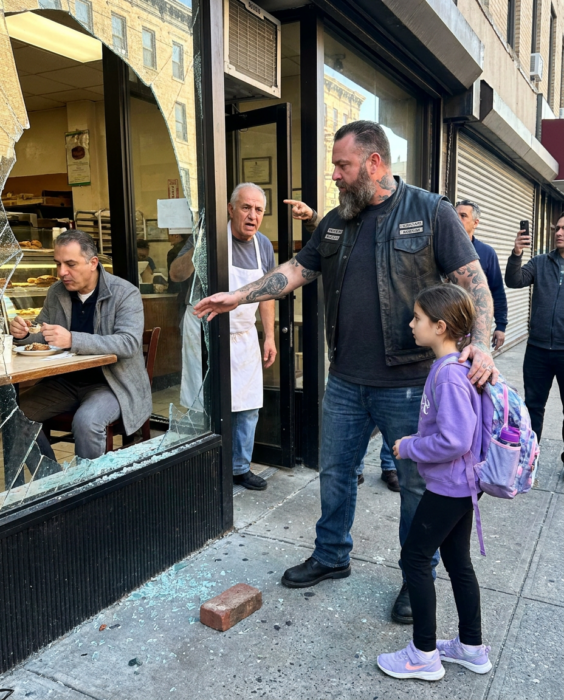
When the window broke, I was still beside my bike. I turned toward the sound and saw Emma lowering her empty hand. The impact itself had already happened. That distinction mattered later when an officer asked me what I could testify to. I didn’t see the brick leave her hand. I saw the fallen brick, the broken glass, and the child standing where a child should not have been standing.
Tom came out before I reached her. His face had gone red around the ears. He stopped a few feet away, looking from the ruined display to Emma as if the connection between the two refused to make sense. A passerby began telling him what he ought to do. Another person asked whether the girl was hungry. She shook her head at that, almost angrily.
A pharmacy assistant named Renee brought out a chair after seeing the scrape on Emma’s ankle. Emma wouldn’t sit until Renee positioned it where she could still see the front table. That was the first practical clue that her refusal to move had a purpose. Renee helped her step onto clear pavement, checked the scrape, and asked whether there was glass in her shoe. Emma said she didn’t think so.
While Renee stayed with her, I went toward the elderly woman outside the pharmacy. She was trying to gather herself with the stubborn dignity of somebody accustomed to being independent. She told me her name was June. She was eighty-four. Emma lived with her during the week because the girl’s mother worked early shifts and was helping care for another relative across town. None of that came out neatly; I learned it in pieces.
At first, June thought I was there to tell her what Emma had done. She began apologizing before I asked a question. Her fingers trembled against the opening of her purse. She kept saying she would make arrangements, though she had no idea what a replacement window cost. I told her we would deal with the glass later. I asked why she was looking through her bag.
“My envelope,” she said.
Her monthly benefit had arrived in her account that morning. She had gone to the bank and withdrawn the cash she used for certain household bills and groceries. Keeping part of her money in envelopes made budgeting easier for her. It wasn’t a system anybody had imposed. She had used it for years, and Emma helped write the categories on the paper when June’s hands were stiff.
June had counted the cash, put it in a folded envelope, and wrapped a blue rubber band around it. Then she and Emma walked along the block toward the pharmacy. June stopped near the bakery entrance when somebody asked whether she had dropped a receipt. She reached for the paper he held out. Afterward, the envelope was gone.
She couldn’t be certain of the exact moment. That frightened her almost as much as losing the money. People had already suggested she might have left it at the bank or placed it in a different compartment. She had searched everywhere twice. Emma had searched too. Yet the more June insisted it had been with her, the more gently people began speaking to her, as though gentleness could disguise their doubt.
My mother had experienced that tone near the end of her life. I remembered using it myself. Once she said somebody had changed an appointment, and I told her she had probably written down the wrong day. She had written it correctly. I found the office’s rescheduling message a week later and apologized to a woman who had already learned not to bother arguing with me.
I wasn’t going to make June prove her competence before I listened.
She pointed toward the bakery. “Emma says she saw him.”
I helped her stand while Renee came back to us. June took Renee’s arm, and we walked slowly toward the broken window. Emma watched our approach, then looked inside again.
The customer at the corner table was putting on his jacket.
Tom met us at the doorway. He had called the police about the damage and was trying to keep customers away from the broken display. A tray of rolls remained behind the ruined pane, but nobody would be eating them. Tiny fragments had reached farther than I expected. One glittered against the dark surface of a chocolate cake, and Tom saw me notice it.
“That whole section,” he said. “Gone.”
I nodded. I wasn’t going to tell him his loss didn’t matter because somebody else might have suffered a worse one. Emma had done real damage. She could have injured herself or another person badly. Renee was cleaning the scrape on her ankle while a woman moved her stroller around the debris. There would be consequences even if every word the girl said turned out to be true.
But first there was a man preparing to leave.
I asked him to wait. He looked at June, then at Emma, then at me. His expression settled into irritation.
“I’ve paid for my food.”
“That isn’t what we’re asking about.”
He lifted both hands briefly. “Then what is this?”
Emma spoke from the chair. “You took Grandma’s money.”
The sidewalk seemed to quiet, though traffic still moved behind us. Tom looked sharply at the man. The customer gave a small, incredulous laugh. He said he didn’t know the girl or her grandmother. He said he had come in for coffee and was being accused because a destructive child needed a reason for what she’d done.
It was a plausible answer to people who had arrived after the glass broke.
June looked down. I saw the doubt beginning to fold her inward. Emma had watched an adult take something and was now watching other adults weigh his calm voice against her frightened one. She said she had tried to tell a man outside the laundromat. He thought she meant her grandmother had lost the money. Another person told her to find the shop owner.
By the time she reached Tom, he was serving a line at the counter. She said something about the man taking her grandma’s money. Tom heard “money” and assumed she wanted to buy something without paying. He told her he would be with her in a minute. She waited near the doorway while the customer ate his cake.
Tom closed his eyes when she described that part.
“I didn’t hear you,” he said.
“I know.”
That answer landed harder than an accusation would have. Emma wasn’t trying to make him feel worse. She was telling him what had happened.
The customer said he shouldn’t have to stay while a child invented a story. He moved toward the door, where I stood far enough aside that I wasn’t touching him or forcing a confrontation. I asked again that he wait for the officers. Tom added, “They’re already coming.” The man’s eyes went toward the rear of the bakery.
He asked to use the restroom.
Tom told him it was temporarily unavailable because staff were clearing the area near the damaged display. That was partly true; his assistant had already moved equipment into the back passage. The man said he would find one elsewhere. He reached into his jacket, and June made a small sound.
The edge of a blue rubber band showed around a folded envelope.
It was visible only briefly. He pushed the packet deeper into the jacket before most people saw it. Emma leaned forward so quickly that Renee put a hand on the chair to keep it from tipping.
“That one.”
The man told her plenty of people used envelopes. He was right about that. A blue rubber band wasn’t proof of theft. I could feel the temptation to stop listening and decide the matter myself. I had spent enough years regretting decisions made at that speed. I kept my hands open and told Tom to mention the accusation when he spoke to the dispatcher again.
A patrol car arrived before the customer made another attempt to leave. Two officers came toward the crowd. One stayed with the man and June; the other asked Tom about the window. Emma immediately began explaining, then stopped when she saw the brick at the officer’s feet. For the first time since I arrived, she looked less certain that the adults would hear anything beyond what she had broken.
The officer crouched a little to speak at her level. She asked Emma whether she was hurt and who was with her. She didn’t tell the girl that everything was forgiven. She also didn’t begin by demanding an apology. She collected the account, then went inside to ask Tom whether his camera covered the front entrance.
He said it did.
The bakery’s camera had been installed after somebody stole a tip jar the previous winter. It sat behind the counter, aimed toward the door and the nearest tables. Tom had complained that the angle included too much of the window and not enough of the cash register. That morning, the imperfect angle was exactly what mattered.
I stayed on the sidewalk while the officer and Tom reviewed the recording. I didn’t see the first playback. I saw Tom’s shoulders go rigid, then watched him look through the window at June. The officer returned and asked her about the receipt the man had handed her.
June explained it again.
The man interrupted. The officer told him she was speaking to June.
A few minutes later, he was in handcuffs.
Emma began crying then. Not when Tom shouted, not while strangers filmed her, not when Renee cleaned the scrape. She cried when the officer secured the man and she no longer had to keep him in sight.
I thought we had reached the end of the terrible part.
Then the officer checked the large zippered wallet taken from his jacket, opened one compartment, and paused.
There was more than one envelope inside.
I didn’t stand over the officer’s shoulder while she examined the wallet. Nobody invited the crowd to inspect what had been found. She moved away from the gathering, and her partner kept the arrested man beside the patrol car. I learned the contents afterward through June, through follow-up questions, and through what investigators eventually shared with the people involved.
There were six additional folded envelopes.
Some had first names written on them. One carried a grocery list. Another had an amount marked in large, careful numbers. The man had packed them into a long zippered organizer along with cards, receipts, and June’s envelope with its blue rubber band. It was the sort of wallet somebody might use for travel documents, roomy enough to conceal paper without drawing attention.
Emma had noticed the blue band because she had put it there herself.
Earlier that morning, June’s fingers had been too stiff to stretch it around the envelope. Emma did it at the bank counter and drew a small star beside the amount. June told the officer about the star before being shown the envelope. That detail helped establish which packet was hers without requiring anybody to trust the brick-throwing child merely because she sounded sincere.
The camera supplied another part.
Tom’s recording showed the man near June at the entrance, offering a scrap of paper and reaching toward her open bag while her attention shifted. It also showed Emma turn back and watch him. The images weren’t perfect. A passerby briefly blocked part of the view. But the sequence supported the account she had been trying to give before she broke anything.
The man had then walked into the bakery and paid with cash.
It was later established that some of June’s money had been used for that purchase. At the time, we could only see the sequence and the envelope. Emma’s understanding—that he was eating cake with her grandmother’s money—had been correct. Yet the officers still had to document it properly, rather than treating a crowd’s certainty as a substitute for evidence.
Tom went behind the counter and took the man’s payment out of the till to identify it for the officer. His hands shook so much that he dropped a coin. He left it on the floor. The customer’s plate was still on the corner table, with a fork resting in a patch of lemon filling. Nothing about it looked sinister. That ordinary little plate bothered me more than the handcuffs.
June asked whether she could have her money back.
The officer explained that it needed to be documented first. She would be told how recovery would proceed. June nodded, trying to look as though she wasn’t worried, but then asked the same question another way: she needed groceries before the weekend, and the pharmacy was holding something she had come to collect.
I offered to cover what she needed that day.
She refused immediately.
The answer wasn’t pride in some simple, admirable form. She had spent the last hour being doubted, watched, and discussed. Accepting money from another stranger felt like another piece of control leaving her hands. I gave her my name, told her where I worked, and said the offer could remain open. Then I stopped talking.
Tom came outside with a chair for her. He positioned it beside Emma and set a bottle of water on the clear section of pavement. He didn’t offer a speech. He asked June whether she wanted him to telephone somebody.
She asked for Emma’s mother.
While they made the call, I helped the bakery assistant tape off the damaged area. We used what Tom had in the back, working under his directions. The people who had filmed the girl drifted away. A few stayed to give statements. The man who said she ought to be made to pay asked whether June needed a ride. She said her daughter was coming.
That afternoon, investigators began identifying the people connected to the other envelopes. It took more than reading names. Some packets contained only initials. Some owners had reported their losses; others had assumed they had misplaced the money and told nobody. Receipts, available recordings, witness accounts, and the contents of the organizer helped make the connections.
All six were older people who had been along the same shopping corridor that morning.
I learned that days later, when June called to say she wasn’t the only one. Her voice changed as she told me. Being one of several victims didn’t restore the money by itself, but it relieved something she hadn’t named: the fear that she had become too confused to manage her own life.
The investigation eventually connected the man to repeated thefts targeting older customers around their monthly cash-withdrawal routines. It had been going on for roughly two years. That conclusion came from work done after the arrest, not from an officer glancing into a wallet. Earlier complaints were reviewed. People were contacted. A pattern that had looked like separate losses began to take shape.
One man had stopped going out alone after his cash disappeared. A woman had accused a nephew, then quietly withdrawn the accusation without ever repairing the relationship. Another had skipped a necessary purchase because she could not explain the missing money to anyone. These weren’t stories I overheard all at once. They came later, when the people affected chose to tell them.
The recovered money from that morning was eventually returned to all seven owners, including June, after the necessary identification and documentation. Older losses were a different matter. An arrest couldn’t put every missing dollar back into every envelope.
That was the part nobody on the sidewalk had understood yet.
Emma had made the adults look. Now we had to decide whether looking was all we intended to do.
Emma’s mother, Rachel, arrived while Tom was still arranging for the damaged window to be secured. She came in work shoes, with a jacket thrown over her uniform, and stopped so abruptly at the sight of the glass that I thought she might fall. Emma stood up to meet her, then began explaining too quickly. Rachel held both her shoulders and told her to slow down.
She listened to June first, then the officer, then Tom.
Only after that did she turn back to Emma.
“You could have been hurt.”
“I know.”
“Someone else could have been hurt.”
Emma looked toward the pastry display and the pavement beyond it. Renee had already told Rachel about the scrape and recommended that it be checked properly if there was concern about retained glass. Rachel nodded, visibly working to keep relief from becoming anger. Her daughter had protected her grandmother and endangered herself in the same few minutes. There wasn’t a tidy feeling available for that.
Tom said he didn’t intend to demand payment from the family.
Rachel looked startled, then ashamed. “We can make arrangements.”
“I’m not asking.”
He didn’t say the window was nothing. It was a substantial loss. He had to discard exposed food, cancel several orders that depended on the display, and pay for an urgent temporary covering before the replacement could be fitted. He told Rachel those facts because he wanted Emma to understand what had happened without believing the family would lose grocery money over it.
Emma apologized.
This time nobody had to prompt her.
Tom crouched carefully, one hand braced against the doorframe. “I should have listened when you came in,” he said. “That part belongs to me.”
She wiped her nose on her sleeve.
“But next time,” he continued, “I want you to keep talking. Find another person. Get someone to call the police. Don’t put yourself in broken glass.”
“What if they don’t listen?”
He took a breath before answering.
“Then we need to do better.”
I was grateful he didn’t hand a ten-year-old the responsibility of designing a perfect emergency response. Emma had made a dangerous choice. The adults around her had also failed to recognize what she was trying to report. Both things could be true without one erasing the other. Tom seemed to understand that, even while staring at the board that would cover his window.
Over the following days, June’s immediate needs were met through family help while the recovered money was processed. Rachel accepted a small grocery contribution only after our club offered it without conditions or publicity. June insisted on recording the amount, because that was how she kept track of things. We told her there was no debt. She wrote it down anyway, under a heading marked “help.”
When she received her envelope back, she called me from Rachel’s kitchen. I could hear Emma in the background asking whether the blue band was still there. It was. June said she had counted the money twice and then felt foolish for counting a third time. I told her to count it as many times as she wanted.
She laughed at that.
It was the first easy sound I had heard from her.
The other six owners recovered their cash too, though not everyone wanted to be identified publicly. One man came into the bakery to thank Tom and then grew uncomfortable when a customer recognized him from a neighborhood post. Tom asked people to give him space. After that, he made a point of stopping conversations that turned victims into local attractions.
Emma’s picture had already appeared online beside claims that she had attacked the bakery for refusing her free food. Rachel asked for those posts to be corrected or removed. Some people did it. Others left the original up and added a comment nobody was likely to read. The same block that had watched a child break glass now had to learn how much damage adults could do with a careless sentence.
Tom declined an interview that wanted him to repeat the story while Emma stood beside the new window. He said she had school. That was the explanation he gave, and it was enough. Later, privately, he told me he didn’t want her spending the next several years known only as the girl with the brick.
The replacement glass arrived on a Thursday.
I stopped by after work while the installer finished. Tom stood outside with his hands in his apron pockets, looking at a window that made the shop appear normal again. Then he showed me a small notice he had printed.
“Thank you to the little girl who broke this window.”
I looked at him.
“You sure?”
He nodded, then turned the paper over to show me a second line explaining that the thanks were for refusing to abandon her grandmother when nobody listened. He didn’t include Emma’s name. The notice sat low on the inside of the glass, where people could read it without turning the whole storefront into a monument.
Some customers objected anyway. Tom listened, because a broken window was not an act he wanted other children copying. Then he explained the choice behind the sign. He wasn’t thanking the brick. He was acknowledging the child he had initially dismissed. The discussion was awkward, which probably made it more useful than a statement everybody could applaud without thinking.
The Sunday pastries came from a separate conversation.
Tom told Rachel that Emma could choose one pastry every Sunday until she turned eighteen. No photograph, no requirement to tell the story, no obligation to bring anyone into the shop. Rachel asked whether that was too much. Tom said he had made longer commitments to suppliers he liked less.
Emma chose a plain cinnamon roll the first Sunday.
She paid for June’s tea from coins in her own pocket.
The club’s camera idea sounded simple when I mentioned it at our next meeting. The bakery’s recording had helped expose a theft that might otherwise have become another argument about an elderly woman’s memory. Other stores along the block had blind spots or no cameras at all. Several owners had already asked what they could afford.
“We could help them get equipment,” I said.
Our treasurer, Ray, closed his notebook.
“With what money?”
That was where the good feeling ended. We had already committed most of our available funds to repairing a member’s damaged roof and supporting a community food drive. Those promises had been made before Emma’s story drew attention. Ray wasn’t going to move money away from people who had quietly waited because a broken bakery window made a stronger story.
He was right.
I didn’t like hearing it.
For a few minutes, I argued that the block had older customers who deserved protection. Ray asked whether the man waiting beneath a leaking roof deserved less. That shut me up. The brotherhood part of helping people is sometimes a room full of men refusing to let you become careless with somebody else’s sacrifice.
We started again with a smaller question: what could each of us actually offer?
One member knew a licensed installer. Another could help local businesses review reasonable equipment options. Several volunteered their own money. I had set aside cash for a cosmetic repair to my Harley that had been bothering me longer than it mattered. I left the scratched part alone and contributed that amount.
Nobody was pressured to match it.
We approached the store owners individually. Some welcomed the idea. One refused. Another worried about recording customers unnecessarily. The installer explained placement, access, and the limits of what a system could accomplish. We let the owners decide. I had no desire to turn help into an excuse to control somebody’s shop.
The work happened over several weekends.
By the time it was finished, every business along that short commercial row that chose to participate had a functioning camera system suited to its premises. The club and local supporters covered the agreed costs. Qualified people handled the installation. We carried ladders, moved boxes, fetched coffee, and stayed out of tasks we didn’t know how to do safely.
Tom wanted to hang our club name in the window.
Ray said no.
“Put your opening hours there,” he told him. “That helps people more.”
The cameras were only part of what changed. The merchants began talking to one another about incidents instead of assuming a missing envelope belonged to somebody else’s private problem. Pharmacy staff made space for a person to report a concern without having to explain it across a busy counter. Tom reminded his employees that a child trying to speak about an adult deserved a moment of attention.
Nothing became perfect.
There were still misunderstandings. People still forgot bags and mislaid cash. A camera angle could still miss something. But the block became a place where the first response to an elderly customer’s concern wasn’t automatically, “Are you sure you had it?”
June noticed that before anyone mentioned the new equipment.
At the pharmacy, someone asked whether she wanted a chair while she waited. She said no, and they accepted the answer. At the bakery, Tom spoke directly to her instead of asking Rachel what June needed. These were small things, but June had spent enough time being treated as fragile to recognize the difference between consideration and being quietly removed from her own decisions.
One of the other victims asked me to accompany him on his first return to the block. His name was Arthur, and he had begun avoiding the area after losing money there. I said yes. We walked at his pace. When we reached the bank, he told me he could manage from there.
I waited outside.
He came back carrying a receipt and looking annoyed by the weather. That ordinary irritation pleased me more than a grateful speech would have. He had gone somewhere he had stopped trusting, completed his business, and returned with enough room in his mind to complain about the cold.
At the bakery, he bought his own coffee.
He didn’t tell Tom what the morning had cost him.
He didn’t have to.
Later that month, Emma came out of the shop with her Sunday pastry and found me checking a loose mirror on the Harley. She asked whether the new cameras could hear people.
“Some systems can,” I said. “These aren’t there to listen to you.”
She thought about that.
“Then people still have to.”
I tightened the mirror, put the wrench away, and looked at her.
“Yes,” I said. “They do.”
I still visit the bakery on some Sundays, though not every Sunday. Emma’s visits aren’t an event anybody should have to perform for an audience. Sometimes she comes with June. Sometimes Rachel brings her after a shift. There are weeks they don’t come at all, and Tom saves nothing dramatically in a special box. The offer remains there whenever she wants it.
During the first few months, she always checked who was sitting at the front table.
I noticed because I checked too.
Eventually, she stopped. I realized it one morning when she was busy arguing with Tom about whether a blueberry muffin counted as a pastry. He said it did. She said the rule was unclear. June sat nearby stirring tea, smiling at a disagreement ordinary enough to be a gift.
The criminal case took time. There were appointments, statements, and developments that belonged to investigators and the people directly involved. The evidence helped establish what had happened, but it didn’t erase two years of losses or restore every relationship damaged by suspicion. June sometimes asked about the woman who had blamed her nephew. I didn’t always know how things were going.
One afternoon, that woman and her nephew came into the bakery together.
They sat at the front table.
I was by the door with a loaf under my arm, and I nearly left before she recognized me. She introduced him, then changed the subject to the weather. He carried her shopping bag when they went out. I didn’t ask whether they had forgiven everything. They were walking together. For that afternoon, that was what I could see.
Tom’s little notice stayed in the window until the paper began fading.
People still stopped to read it. Some came in to ask about the story. Tom usually gave them the short version, then asked what they wanted to order. He had a business to run. Emma had a childhood to continue. The most important things on that block did not need to remain suspended in the afternoon when the glass broke.
He kept his promise about the pastries.
When Emma turned twelve, she discovered the almond croissants and became offended that nobody had told her about them earlier. At thirteen, she sometimes gave June half without making a production of it. By fifteen, she came in with homework and stayed long enough to ask Tom questions about the shop while he cleaned the counter.
That was five years after the window.
I was sixty-six by then, with more gray in my beard than I had room for and a knee that complained about every temperature change. June was eighty-nine. She walked more slowly and let Rachel handle some errands, but she still checked her own receipts. Emma no longer wrote the amounts on envelopes unless June asked.
The cameras had needed maintenance and updates. The club helped where it could, and the shop owners had learned to budget for upkeep. Ray still reminded us that installing something once wasn’t the same as taking responsibility for it forever. Nobody argued with him as much anymore. We had all become acquainted with the work that follows a good intention.
On Emma’s fifteenth birthday weekend, Tom put a small candle in her cinnamon roll.
She looked at it, laughed, and asked whether he was getting tired of feeding her for free.
“Three more years,” he said.
“You’re counting?”
“I run a business.”
He brought June her tea, then went back behind the counter before either of them could thank him. I sat near the window with coffee growing cold between my hands. Outside, a child pressed both palms against the glass to look at a row of decorated cookies.
Emma noticed first.
She waved the child toward the door and called to Tom that somebody wanted to ask a question. It wasn’t urgent. It wasn’t a crime. Just a small voice that might otherwise have been lost beneath the noise of a busy shop.
Tom stopped wiping the counter.
“What would you like to know?” he asked.
Emma turned back to her grandmother. June pushed the sugar bowl toward her, and the spoon made a soft sound against the table.
Outside, my Harley waited beside an unbroken window.
Follow this page for more biker stories about overlooked voices, unexpected kindness, and ordinary people who stop long enough to make a difference.