Her Father Was in the Coffin, and I Was the Biker She Blamed—Forty-One Days Later, She Came Running to the Gate
Evan joined our club because his wife bought him a used touring bike for their tenth anniversary and then told him he needed friends who knew more about it than he did. That was how he introduced himself at the garage: not as a man searching for freedom, but as a husband whose wife wanted him out of the house for a few hours without requiring a hospital visit afterward.
He was thirty-five when he died.
He worked maintenance at a packaging plant, repaired things for neighbors, and spoke about his daughter with the mild disbelief of someone who couldn’t quite understand how he had been trusted with something so important. Emily was already six when I first met her. She wore a yellow raincoat and corrected me when I called the frog on its pocket a turtle.
Evan laughed for so long that she became offended.
“It’s obviously a frog.”
“It is,” I said.
That was how we became friends.
Not the motorcycles.
The willingness to admit she was right.
Over the next two years, Evan and I rode together often. Short rides, usually. Breakfast, an errand, a stretch of road before one of us needed to be back. He had no appetite for making Rachel wonder where he was. At intersections, I could hear his bike idling beside mine. At diners, he checked the time before ordering a second coffee.
I used to tease him.
“Your supervisor calling?”
He would hold up his phone.
“Eight years old. Terrible management style.”
Then he would answer.
I had a daughter of my own, but she was grown by then, and our relationship carried dents I had put there. I drank too much when she was young. I called anger honesty and absence hard work. It took years, sobriety, and several conversations I would rather have avoided before she trusted me with ordinary parts of her life again.
Evan knew that history.
He didn’t congratulate me for getting sober as though the people I hurt had become irrelevant. He asked how my daughter was. He remembered when she had an appointment. Once, after I complained that she hadn’t returned a call, he asked whether I had given her something she actually needed to answer.
I sat with that question for a while.
He had a way of saying useful things without sounding like he had prepared them.
The morning of the crash, we met at a gas station outside our town in western Pennsylvania. The plan was a late breakfast and a loop through the hills before heading home. Rachel had plans that afternoon. Evan had promised Emily he would help assemble a model bridge she had been working on for school.
He showed me a photograph.
The bridge leaned noticeably to one side.
“Engineering problem,” he said.
“Major?”
“She says it’s artistic.”
We left after coffee.
I remember the cup being too hot.
I remember Evan brushing crumbs from his gloves.
I remember the weather improving, with sunlight beginning to show through a low gray sky.
Memory saves useless details when it cannot bear the important ones.
The road narrowed as we came down through a wooded section. There was a bend, a limited view ahead, and a truck approaching from the other direction. We were not racing. The evidence later supported that. But a situation doesn’t need reckless speed to become unforgiving when something essential fails at the wrong moment.
My front brake lever lost pressure.
I felt it immediately.
I tried to reduce speed with what remained available, but the distance ahead was shrinking faster than I could manage. The bike was not doing what it should. I looked toward the shoulder, then toward Evan.
He had noticed.
His head turned.
His left hand moved.
Then he changed his line.
I remember pieces after that: the movement of his motorcycle across my path, contact between the bikes, my own machine veering toward the shoulder, gravel, the violent sound behind me.
I remember being on the ground.
I remember trying to stand.
I remember not being able to.
A driver who had been behind us stopped. Another person called emergency services. The truck driver got out, pale and shaking. People were moving toward Evan.
I shouted his name.
Nobody answered in his voice.
At the hospital, an investigator asked what happened. I told him the brake failed. I told him Evan had moved toward me. I told him I believed he was trying to keep me out of the truck’s path.
Then I said the part that made it difficult to breathe.
“I think he saved me.”
The investigator wrote it down.
He didn’t confirm it.
He said they needed to examine the motorcycles, review available recordings, and establish the sequence.
I nodded.
That was reasonable.
It was also the beginning of a waiting period in which the family had a death, I had fragments, and an eight-year-old had no version of events that could make her father come home.
Rachel came to the hospital before I was discharged. She looked at the bruises on my face and the sling supporting my arm, then sat beside the bed without taking off her coat. For several minutes, neither of us spoke. There are conversations people imagine beforehand and then discover they do not have language for when the other person is actually there.
She asked whether Evan had been conscious when I reached him.
I told her I hadn’t been able to reach him immediately.
That answer hurt her.
It hurt me to give it.
I would not invent a comforting exchange we never had.
She asked whether he had said anything.
I told her the last thing I clearly remembered before the crash was a short warning on the road. Not a farewell. Not a final declaration of love. Evan had expected to return home. That was what made every ordinary sentence from that morning so difficult to carry.
Rachel nodded and looked at the floor.
“The police said they’re still working on it.”
“Yes.”
“Did you tell them everything?”
“Everything I can remember.”
She studied my face.
I knew she wanted more.
I also knew that what I believed had happened was not the same as a completed reconstruction. I told her Evan had moved toward me after realizing my motorcycle wasn’t slowing properly. I said the investigators had my account and were examining whether the physical evidence supported it.
I did not say, “He died because he saved me.”
Not then.
That sentence sounded like a verdict I had written for myself.
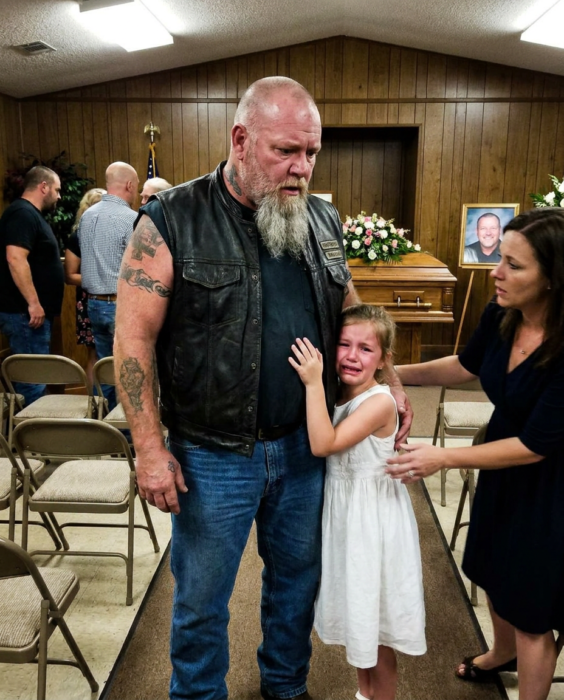
At the funeral, Emily had already built another verdict.
I had left her father.
Children fill gaps. Adults do too. The difference is that adults often make their inventions sound official. Emily had heard people say Evan and I rode together. She had seen me injured but alive. She had heard somebody say I was lucky.
Lucky looked cruel beside a coffin.
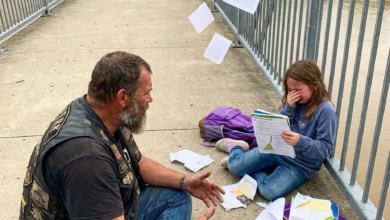
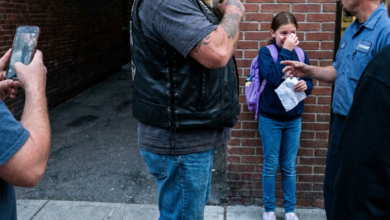
She approached me before the service began. At first, I thought she wanted to ask something. Then I saw her face. Her mother called her name from behind a row of chairs, but Emily was already moving.
Her fists struck my vest.
“You left him.”
I stood still.
The pain in my ribs sharpened.
I didn’t deserve punishment from a child, and she didn’t need to become responsible for administering it. But there was no time to turn the moment into a lesson. Rachel reached us quickly. The blows ended as Emily’s anger collapsed into crying.
I knelt.
She leaned against me.
Her mother remained close enough to take her whenever she wanted.
I held her carefully and said I was sorry.
That apology contained more than one thing. I was sorry her father was dead. Sorry she had to stand in that room. Sorry she had been left with a story in which the man beside her had abandoned someone she loved.
I was also sorry that I had no words capable of fixing it.
When she moved away, I let her.
I didn’t ask her to forgive me.
During the service, I stayed near the back. One of our club brothers, Cal, sat beside me. He watched the door as though he expected somebody to tell us to leave. Nobody did.
Afterward, he asked whether I wanted him to explain things to the family.
“What things?”
“What you told the police.”
I shook my head.
He became frustrated.
“They’re looking at you like you did something.”
“I was there.”
“That doesn’t make you guilty.”
“No.”
“Then stop acting like it does.”
I couldn’t answer him.
Survivor’s guilt is not a conclusion reached by evidence. It is a feeling that keeps presenting itself as evidence. I knew that later, when I spoke with someone who understood it. At the funeral, I only knew I could not endure a conversation in which defending myself seemed to require explaining the dead man’s choices.
Rachel found me near the exit.
She asked about food the next day. People had offered meals, but she couldn’t manage strangers coming into the house or waiting for her to make conversation.
“Could you leave something outside?”
“Yes.”
“Please don’t knock.”
“I won’t.”
She looked exhausted enough that even gratitude seemed like work.
I told her she didn’t have to thank me.
The next afternoon, I stood outside the gate with a box containing what she had requested. Soup. Bread. Fruit Emily would eat. I set it beneath the sheltered post and sent a brief message.
Delivered. No need to answer.
Emily watched from an upstairs window.
I could see only part of her face.
I raised one hand.
She stepped away.
I remained for a few minutes because Rachel had said she might come out if she felt able. Then I left.
The ritual began there.
Not with a vow.
Not with a promise of forty days.
Just one agreed visit, followed by another.
By the second week, Cal told me the waiting was wearing me down.
He was right.
But the investigation was still unfinished, and the silence inside that house was larger than anything I knew how to say.
Some days, Rachel asked for practical things. A light bulb. A grocery item she had forgotten. A ride arranged through someone else because she did not want to be in my truck yet. I accepted that boundary. Other days, she said nothing was needed, but I could come by at the usual time if I wanted.
I always checked.
If she had said stop, I would have stopped.
Grief did not give me permission to stand outside a family’s home indefinitely and call it devotion.
That distinction mattered to Cal. He asked about it more than once, and I showed him the messages because he was worried I was turning my guilt into something Rachel had to manage. I didn’t resent him for asking. Brotherhood is sometimes a man checking whether you are doing harm while believing you are doing good.
For forty days after the funeral, I came to the gate.
Usually only briefly.
I stood on the public side, where Rachel had asked me to leave things. I didn’t enter unless she invited me for a particular task, and during those weeks she never did.
Emily rarely came outside.
Once she opened the front door, saw me, and closed it again.
Another time, she stood behind Rachel while her mother collected a box. She looked at the sling on my arm, then at my face.
“Does it hurt?”
“A little.”
She looked down.
“Good.”
Rachel began to speak.
I shook my head gently.
Emily was allowed to have a feeling I didn’t enjoy. Her mother would help her understand what to do with it. I didn’t need to turn that sentence into proof of either my suffering or her cruelty.
I went home afterward and sat in the garage.
The Harley was not there.
It remained part of the investigation.
Its empty place on the floor bothered me more than I expected. The stain beneath the usual parking position looked like something left by a body that had been removed.
I started seeing a counselor.
I told almost nobody at first.
Then Cal asked why I was unavailable on Thursday afternoons, and I answered honestly. He nodded and said he could cover the errand I had promised to do.
No speech.
No joke.
Just a practical adjustment.
The investigator contacted me several times. He checked details, asked about the motorcycle’s maintenance, and requested records. I gave him what I had. I had not noticed a problem before the ride. That fact mattered, but it did not settle every question about responsibility or what could have been prevented.
There were separate issues.
Mechanical failure.
The movement of the motorcycles.
The truck’s position.
The sequence of contact.
What I remembered.
What physical evidence showed.
I learned not to collapse them into one sentence because I wanted an answer.
On the forty-first day after the funeral, Rachel received the preliminary reconstruction material that could be released to the family. It included a clear explanation of the sequence, supported by the examination of the motorcycles, roadway evidence, witness accounts, and a recording from a vehicle behind us.
It was not the end of every insurance or legal matter.
It was enough to answer the central question.
My front braking system had failed.
Evan had noticed my difficulty.
The recording showed him turning toward me, adjusting his path, and moving across the developing collision line. The contact between our motorcycles changed my direction toward the shoulder. His own path carried him into the place where he could no longer avoid the truck.
The report did not turn that into a heroic speech.
It described movement, timing, damage, and consequence.
Rachel understood what those descriptions meant.
Evan had intervened.
I had survived because he did.
She read the relevant pages more than once. Then she found my statement, the one given at the hospital. I had described the same sequence before the recording and mechanical findings confirmed it.
Emily sat across the kitchen table.
She did not read every technical page. She was eight. Rachel explained what the diagrams showed in words her daughter could understand and answered the questions she could answer.
Emily asked why I hadn’t told her.
Rachel called me.
I had just arrived outside the gate.
“Stay there,” she said.
I thought she was angry.
She was.
But anger was only part of it.
The front door opened.
Emily ran down the path with a folded page in her hand. Rachel followed several steps behind.
The child reached the gate and looked up at me.
“Daddy saved you?”
I nodded.
She struck my vest once.
Then she grabbed it with both hands and began crying.
This time, she pulled me toward her.
I knelt outside the gate while Rachel opened it. Emily put her arms around my neck before I had finished lowering myself. The folded paper fell onto the path. I held her carefully, listening to the way she tried to speak through tears, and understood that the report had not removed her grief.
It had changed where she aimed it.
“Why didn’t you tell me?”
I looked at Rachel.
She wanted the answer too.
I said I had told the investigators everything I remembered. I had told Rachel the part I could describe without pretending my belief was already established. But I had not known how to say the full sentence to Emily.
“It sounded like I was saying your dad made the choice that killed him.”
Rachel’s face tightened.
“And you thought that would be blaming him.”
“Yes.”
I looked down.
“If I stood beside his coffin and said he died saving me, it would sound like I was asking everyone to forgive me because of something he couldn’t explain anymore.”
For a moment, nobody spoke.
Then Rachel said, “You should have let us ask.”
She was right.
I could understand why I had stayed quiet without deciding silence had been wise. I had been frightened of using Evan’s death to defend myself. But the family had also needed information, and I had made part of that decision for them.
“I’m sorry,” I said.
Rachel nodded.
“Come inside.”
Those were the words I had imagined for weeks.
When she finally said them, I felt no triumph.
Only the fear of entering a place Evan should have been.
His boots remained near the back door. A mug sat on the shelf he had built. The half-finished model bridge rested on a table beneath the window.
Emily saw me looking at it.
“We didn’t finish.”
I asked whether she wanted help.
“Not today.”
“Okay.”
That answer had to mean something. Help was not a claim on every unfinished thing Evan left behind.
Rachel made tea. I offered to do it, and she said she wanted something ordinary to do with her hands. We sat at the kitchen table with the report between us.
She asked questions.
I answered where I could.
Where I couldn’t, I said so.
I did not describe Evan as making a calm, fully considered sacrifice in the last seconds of his life. Nobody could know every thought he had. What the evidence showed was that he saw trouble, moved toward it, and changed the outcome for me.
That was enough.
It fit the man we knew.
Emily asked whether he had been scared.
“I think anybody would have been.”
She considered that.
“Then he was brave.”
“Yes.”
“Because brave means scared too.”
“Yes.”
She nodded as though a difficult piece had finally found somewhere to fit.
Later, Rachel asked about the forty visits.
“Why every day?”
I told her I had said I would help, and afterward I was afraid that giving her space would become an excuse to disappear. So I asked what she wanted and tried to do exactly that.
“Did you think it made things even?”
“No.”
“Good.”
There was no amount of soup, groceries, or standing at a gate that could balance Evan’s life. We both knew it.
Emily went to her room after a while. Rachel and I remained at the table.
She looked toward the hallway.
“I still get angry that you’re here.”
“I know.”
“And I’m glad you are.”
I nodded.
Those feelings could exist together.
The next practical problem arrived before any emotional conclusion. Rachel was returning to work. Evan had usually handled the school drop-off because his shift began later. The temporary arrangements relatives had made were becoming difficult.
She asked whether I knew anyone reliable who could help.
I said, “Me.”
She looked at my arm.
“When you’re cleared to drive.”
“Yes.”
“In the truck.”
“Yes.”
“No motorcycle.”
“Of course.”
“We put you on the school’s pickup list.”
“Yes.”
She kept adding conditions.
I agreed.
This was not a dramatic adoption of a dead man’s role. It was an arrangement between adults trying to make a child’s morning work.
Emily appeared in the doorway before we finished.
“Would you take me?”
“If your mom wants that.”
“And if I want it?”
“That too.”
She looked at Rachel.
Her mother nodded.
Emily walked to the table, picked up the folded page from the report, and slid it back into the folder.
Then she said, “Don’t be late.”
I almost laughed.
Evan would have.
Instead, I told her the exact time I would arrive.
The first school morning began with me sitting outside the gate eleven minutes early. I had checked the truck, the seat belt, and the route so many times that there was nothing left to check without inventing a problem. Rachel opened the door at the agreed time, carrying Emily’s lunch and reminding her about a form in the front pocket of her backpack.
Emily came out wearing red sneakers.
She stopped beside the passenger door.
“Daddy used to put my bag in the back.”
I opened the rear door.
She handed it to me.
Then she climbed in.
We drove without much conversation. I didn’t put on music. I didn’t ask whether she was happy. At the first intersection, she told me which turn Evan usually took.
I took it.
At school, I followed the drop-off instructions, waited until she was with the staff member, and drove away only after she turned toward the entrance.
That afternoon, Rachel texted.
She said the morning had gone well.
I read the message three times.
The arrangement continued.
For the next ten years, I became the person responsible for her school-morning ride. There were ordinary interruptions—illness, a truck repair, a day another approved adult covered—but I did not treat those as reasons to loosen the commitment. If I could not come, Rachel knew ahead of time and a safe alternative was arranged.
Emily should never have had to stand at the window wondering whether an adult had remembered her.
The route changed as she grew.
Elementary school became middle school.
Middle school became high school.
The lunch box disappeared.
The backpack grew heavier.
The conversation changed from spelling words to friendship problems, from friendship problems to exams, and from exams to what she wanted her life to look like after graduation.
Some mornings, she said almost nothing.
That was fine.
Being available did not require her to perform closeness for me.
At twelve, she told me I drove like an old man.
“I am becoming one.”
“You were one already.”
I nodded gravely.
“Then I’m improving.”
She rolled her eyes.
I carried that tiny insult all day like a gift.
There were difficult mornings too. She once shouted that I wasn’t her father during an argument about leaving on time. I said she was right, and that her mother had still asked me to make sure she reached school.
We drove in silence.
That evening, she called.
“I didn’t mean it like that.”
“You don’t have to take the truth back.”
She was quiet.
Then she said, “I meant I was mad.”
“I understood.”
We spoke about the lateness separately.
Grief did not cancel ordinary expectations.
Ordinary expectations did not cancel grief.
Rachel eventually met someone. It took time, and it was her decision to tell Emily, then to tell me. I offered no opinion she hadn’t requested. She had the right to build a life that was not a permanent waiting room around Evan’s absence.
The man she married was named Paul.
He was kind.
He did not compete with a photograph.
He also did not treat me as a threat because I drove Emily to school. Over time, our arrangements adjusted around work and family needs, but the morning responsibility remained mine through her school years because it worked for everyone involved.
I was grateful for that trust.
When Emily learned to drive, we practiced in the truck first. We used proper instruction and quiet places, with Rachel’s agreement. The first time she drove herself to school, I remained at home holding a coffee I forgot to drink.
She texted when she arrived.
There.
I stared at the single word.
Ten years of mornings had led to one morning in which she did not need me to deliver her safely.
I was proud.
I was also sad.
Both feelings could exist together.
Emily left for college at eighteen. She chose a program in education after working with younger students during her last two years of school. People sometimes wanted that decision to be connected neatly to her father’s death, as though every good thing she became needed to emerge from the worst thing that happened.
She corrected them.
“I like teaching.”
That was enough.
I helped carry boxes into her first room. Paul assembled a shelf. Rachel made the bed while Emily pretended not to care how it looked. I stood holding a lamp until somebody told me where to put it.
There was a small photograph of Evan on the desk.
Nobody had to make room for him by removing anyone else.
He already belonged.
During her first semester, Emily called occasionally from the walk between buildings. Sometimes she wanted advice. Sometimes she wanted to complain about a class. Sometimes she simply wanted someone to answer while she finished a long day.
I answered when I could.
When I couldn’t, I called back.
Those were habits I had learned before I understood how much they mattered.
She visited during breaks. She talked about friends, work placements, and the strange experience of being responsible for children who looked as young as she must once have looked to me.
One afternoon, she asked whether I remembered the funeral.
“Yes.”
“All of it?”
“More than I want to.”
She sat across from me in the garage.
“I remember hitting you.”
“I know.”
“I’m sorry.”
I shook my head gently.
“You were eight.”
“I still hurt you.”
“A little.”
She looked down.
I let her apologize because she was an adult now and wanted to understand something she had done. I also told her she did not owe me fourteen years of gratitude in exchange for surviving a terrible afternoon.
She nodded.
Then she asked the question that still lived beneath the others.
“Do you ever wish he hadn’t done it?”
I looked toward the open garage door.
There was no easy answer.
I wished the brakes had not failed.
I wished the truck had not been there at that moment.
I wished Evan had come home and finished the bridge with her.
I wished a hundred things.
But asking whether I wished he had not helped me placed a choice in front of me that he had already made under circumstances neither of us could change.
“I wish he were here,” I said.
Emily nodded slowly.
“Me too.”
That was the truth we could share without solving it.
Four years after she left for college, she sent me the graduation details. A time, an address, parking instructions, and a message asking whether I needed help finding somewhere to stay.
I told her I could manage.
Then another message arrived.
Don’t wear the boots with the broken lace.
I looked down at the boots beside the door.
She knew me too well.
At the ceremony, I arrived with Rachel and Paul. I was sixty-three by then, my beard mostly gray and my knees less cooperative than they had been outside the funeral chapel. I wore a clean shirt and a jacket that made me feel as though I had borrowed somebody else’s shoulders.
An usher checked our tickets.
“Family seating is this way.”
I followed Rachel.
Only after we sat did I notice the label on the row.
Family.
For a moment, I could not look away from it.
Evan should have been there.
That remained true.
It did not make my place false.
Emily crossed the stage carrying herself with a confidence I could still recognize as the older version of a girl demanding that I not be late. Her name was called. Rachel stood. Paul applauded. I rose more slowly, because my knee objected, and clapped until my hands hurt.
Afterward, Emily found us outside.
She hugged her mother first, then Paul.
Then she came toward me.
For one strange second, I saw the white dress, the loose ribbon, and the child crossing the funeral room.
This time, she was wearing a graduation gown.
She tapped my chest once with her fist.
Softly.
Then she put her arms around me.
“You came back,” she said.
I held her carefully.
“I kept coming.”
Follow this page for more biker stories about difficult promises, quiet loyalty, and the people who stay long after the flowers are gone.