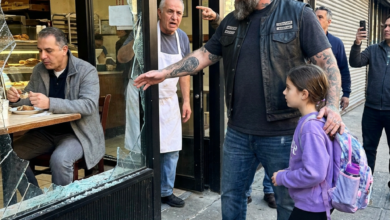
I Pulled a Four-Year-Old Girl From a Woman Screaming “Give Me Back My Daughter”—Then Asked the Crowd to Call the Police on Me
Before I tell you what happened after the officers arrived, you need to know why Manny hesitated. People have asked me about that more than anything else. They want the version where a brother sees your vest, trusts you immediately, and stands beside you without a question. Manny knew me too well for that. He had seen me mistake anger for certainty, and he had once helped my daughter carry her things out of my house.
I spent fourteen months in prison when Erin was twelve. It started with a fight outside a bar, though calling it a fight makes it sound more equal than it was. Another man said something ugly, and I decided that gave me permission to keep swinging after he was down. He survived. I served my sentence. Erin grew older while I sent her birthday cards that arrived with the return address of a correctional facility.
When I came home, I thought being physically present would settle the debt. I took overtime, repaired the bathroom, and bought her a used bicycle with new tires. I was good at objects. A loose chain told you what was wrong. A child sitting across the dinner table could tell you she was fine while quietly deciding never to need you again. It took me years to understand that distinction.
Manny stayed through most of those years. He was shorter than me, broad through the shoulders, with a laugh you could hear over an idling engine. He also had the nerve to tell me when I was being a fool. Once, after I complained that Erin never called, he asked how many times she had called before she stopped. I didn’t speak to him for a week because I knew the answer.
That September, Erin was coming down from Phoenix for a weekend. She had agreed to stay with me, which mattered more than I admitted. I changed the sheets twice, bought the brand of cereal she used to like, and then called to ask whether she still liked it. She laughed at that. A week earlier, she had laughed at something I said without any strain in it, and I’d been carrying the sound around ever since.
Manny offered to meet me at the terminal because he knew I’d get there too early. He had a pickup, useful if Erin brought more luggage than could fit behind me on the Harley. His wife needed him to collect a prescription first, so I parked alone, took my helmet inside, and sat beneath a clock that was six minutes slow. Erin texted that traffic had delayed the bus. I answered, “Take your time,” as though she were driving it.
The terminal wasn’t the biggest one in town. It handled several intercity routes and a local shuttle connection, with a narrow waiting room and a separate boarding area behind glass. School had let out across the city. Some passengers were still wearing work uniforms. A toddler slept across two seats while his father balanced a paper tray of fries on his knees. The place smelled of hot concrete whenever the doors opened.
I first noticed the little girl because of her shoes. Erin had wanted yellow boots at that age. Her mother said they were impractical, so I bought them anyway and then discovered I had bought them a size too small. This girl’s shoes had ducks instead of flowers. She was standing beside the woman when I saw them, rubbing one toe against the other and looking toward the front entrance.
The woman crouched briefly, said something I couldn’t hear, and lifted her. The girl didn’t put her arms around the woman’s neck. That registered with me, but barely. Children get tired. They get sulky. I wasn’t going to build a conclusion out of a four-year-old’s posture. When the girl asked about her mother, I assumed the woman was taking her to meet someone.
Then she asked about her backpack. The woman told her it was already with Mommy, but a minute later said they would collect it on the bus. I looked over. The woman caught me looking and smiled, the sort of tight smile adults exchange when a child is asking the same question for the tenth time. I nodded. That nod stayed with me afterward. I had nearly helped her make the scene look ordinary.
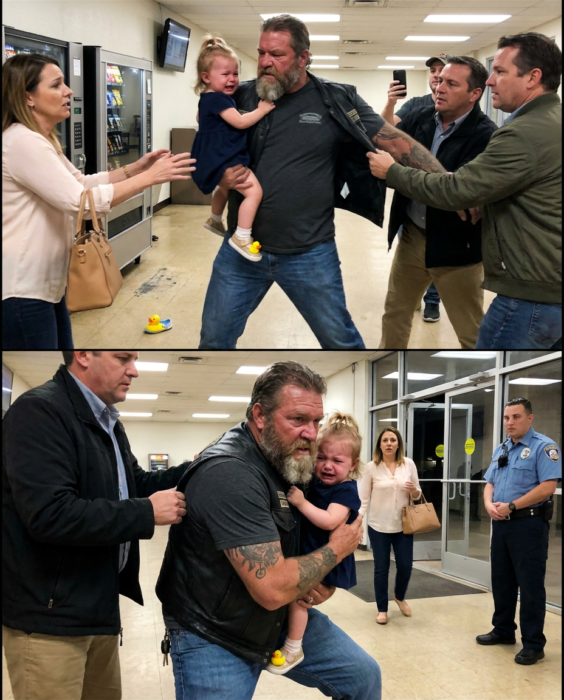
The girl turned toward the older passenger and tried to speak. The woman’s hand went across her mouth, and everything I had explained away lined up differently. I moved before I had a complete plan. That is the honest version. I didn’t know about a crime ring or a border or any other missing children. I knew a small child was trying to ask for help and an adult was preventing it.
When I stepped in front of them, the woman tried to go around me. I moved with her and asked the girl whether she knew her. The woman told me to get out of the way, then pulled the child tighter. I reached for the girl, taking care to support her back and legs. The woman’s arm slipped away as I lifted. One yellow shoe dropped, and the screaming began.
Later, people asked why I hadn’t found the guard first. I have asked myself that too. He was at the ticket counter, beyond several rows of people, while the woman was three steps from the boarding entrance. I made a choice in that space. It could have been a terrible mistake. Once I had the child, the only sensible thing left was to stop moving and call someone who could determine what was true.
Manny entered while two men had hold of me. He heard the woman call herself the mother. He saw me with a frightened child. His hesitation lasted only a few seconds, but I could see our history in his face. He knew my hands could hurt somebody. He also knew I had spent years learning to keep them still. Then he looked at the girl, and something changed.
“Who are you asking for?” he said gently.
She lifted her face just enough to answer.
“Mommy.”
The woman interrupted before he could ask another question, and Manny turned toward her. That was when he noticed she had moved farther from us than any of the people trying to help her.
The man on my right had a delivery-company shirt and a wedding ring pressed into the skin of my wrist. He kept telling me to loosen my grip. I told him I would hand the girl to an officer, and he said that wasn’t my decision. From where he stood, he was right. A stranger holding a child doesn’t get to make himself the authority merely because he sounds certain.
I tried to tell him about the hand over her mouth. He answered that mothers sometimes had to control frightened children. I tried to tell him what she had called the woman. He said I was making excuses. The girl began crying harder as our voices rose, so I stopped arguing and repeated the one request that didn’t depend on anybody believing me: “Call the police.”
Someone already had. A woman near the ticket desk held a phone against her ear and gave the dispatcher the address. I could hear her describing me. Large man. Leather vest. Child in his arms. She was trying to be useful, and she was telling the truth about what she could see. I wanted to tell her more, but the man behind me pulled my collar again and I lost the breath.
Manny put himself beside us without grabbing anyone. “Let the officer sort it out,” he said. “He’s staying here.” That last part mattered. He said it to the men holding me, then looked directly into my face. I nodded. There would be no running, no shove toward daylight, no brother arriving to help me escape. He was giving the crowd a reason to stop tightening its hands.
The woman pointed at Manny’s vest and shouted that we were together. Several people backed away from him. One man raised his phone higher, apparently deciding that two bikers made a better recording than one. Manny took off his sunglasses and kept both hands visible. “Yes,” he said. “I know him. I’m also asking you to wait for the police.”
The girl was trying to get her breath. I shifted her upright instead of holding her curled against me, leaving her face uncovered. Her fingers remained caught in my shirt. I told her my name was Frank. I asked whether she was hurt. She shook her head, then looked past me toward the woman and pressed her lips together so firmly that her chin wrinkled.
“Give her back,” the woman said again, but now she was near the edge of the circle.
The security guard, a man named Luis, had been checking a dispute at the ticket window when the shouting started. He came toward us with his radio out. For a moment he looked exactly like everyone else: eyes on my size, then my hands, then the child. Manny pointed past him toward the woman’s position near the entrance.
Luis asked her to remain where she was. She told him the bus was about to leave. He answered that the departure could wait. She said she needed to make a call, though her phone stayed inside her bag. A few passengers began speaking over one another, offering explanations nobody had verified. Luis repeated his instruction and stepped between her and the front doors.
That movement altered the room. Until then, every person had been looking inward at me. Now some of them looked outward, toward the woman. She moved back toward the restrooms as though she had simply chosen another place to stand. The delivery driver felt the change before he understood it. His grip eased, and he asked her the child’s name.
“Sophie,” she said.
The girl shook her head against my chest.
The woman corrected herself immediately. “Sophia. We call her Sophie.” She sounded impatient, offended that she should have to explain a family nickname to strangers. It might have worked if the child hadn’t lifted her face and said, clearly enough for the driver to hear, “That isn’t my name.”
He let go of my wrist.
The first officer arrived less than a minute later, followed by his partner. I learned their names afterward: Vega and Collins. Vega approached slowly and told me to set the girl down beside him. I explained that she was clinging to my shirt. He said he understood, then spoke to her himself. I bent until her feet touched the floor and opened my arms.
She wouldn’t release the collar.
Vega didn’t pull her away. He crouched, introduced himself, and asked whether she could stand beside him while he talked to me. She stared at his uniform, then at the woman. Collins moved to keep the woman separated from us. Only then did the girl loosen her fist, one finger at a time. My shirt stayed stretched out where she had held it.
Her name was Lily.
Vega asked her who the woman was. Lily said she didn’t know. The woman began shouting that children say strange things when they’re frightened. Collins told her to stop answering for the girl. He asked for identification, and she opened her handbag so abruptly that Luis took a step closer. What happened next occurred beyond my clear view, behind two passengers and a row of seats.
I heard Luis call out. Then I heard running shoes on the floor.
Collins went toward the rear hallway, and the woman disappeared through a service door near the restrooms. I did not see him catch her. I learned later that an employee had opened the door from the other side, and she used the gap to get into a passage leading toward the loading area. Collins and Luis stopped her near the rear exit.
In the waiting room, nobody cheered. The delivery driver stared at the floor. A woman lowered her phone. Somebody finally picked up the yellow shoe and placed it on the seat beside Lily. Vega asked me to sit apart from her while another officer came inside. My hands were shaking now that they had nothing to hold.
For a few seconds, I thought the worst part was over. The child had an officer beside her. The woman hadn’t escaped. Everybody could stop guessing.
Then Vega asked Lily where her mother was.
“At the other buses,” she said. “The lady said she would take me.”
Lily couldn’t give the officers an address. She was four. She knew her mother’s first name, Naomi, and that their car had a scratch shaped like a moon on one door. She knew her backpack was pink and that she wasn’t supposed to cross a parking lot alone. When Vega asked which bus place she meant, she pointed toward the wall as though the building itself were blocking the answer.
I sat several seats away while an officer photographed the red marks on my wrist. He asked whether anybody had struck me. I said I had been grabbed and shoved, but I couldn’t honestly identify each person who had done what. The delivery driver offered his name without being asked. He looked sick. I told him to give his account accurately and leave the rest to the officers.
Manny found my helmet under a chair. The coffee cup had tipped over near the machine, and a cleaner was working around the spill with a yellow bucket. Ordinary tasks continued in pieces. A bus driver asked whether passengers could board. A man wanted his suitcase, which had been left inside the circle. The room was settling, but Lily still watched every open door.
An officer brought water in a small paper cup. Lily held it with both hands and didn’t drink. She asked whether her mommy had left without her. Vega told her they were looking for her mother. He didn’t promise a time. I appreciated that more than I can explain. There are moments when adults comfort themselves by giving children promises nobody in the room can keep.
The other terminal was a little over a mile away, roughly two kilometers. I knew it as the place where some regional routes connected with the city shuttle. I learned later that Naomi had gone there after picking Lily up from preschool. They were traveling to stay with Naomi’s sister for a few days. Lily still wore her school clothes because they had headed directly from pickup to the station.
Naomi was at the ticket counter when Lily disappeared. The line had shifted around a luggage cart, and she turned to retrieve a document from her bag. That was the gap. I didn’t hear this from an officer interrogating her in front of strangers. Naomi told me pieces of it weeks later, stopping whenever she reached the moment she looked down and found empty space beside her.
At our terminal, the officers’ radios began supplying fragments. A missing-child report. A mother at another station. Clothing that matched. Nobody announced the connection to the crowd. Vega moved Lily farther from the boarding area and asked a female officer to sit with her. He came over to me and said they had a possible parent to contact.
Manny exhaled so hard his shoulders dropped. Mine didn’t. I was still watching Lily ask the officer whether she had done something bad. She had heard grown-ups shouting, seen hands pulling at me, and watched a woman run. Whatever explanation eventually appeared in an incident report, a four-year-old had experienced it as something she had caused. The officer told her firmly that she wasn’t in trouble.
Erin called then. Her bus had reached the terminal, but the driver was waiting outside while boarding access was cleared. I answered with a voice that sounded unfamiliar to me. She asked whether I was there. I told her yes. She asked why police were around the building. I said, “Something happened inside,” and realized how many times I had given her that answer after something I had done.
“Are you hurt?” she asked.
“A little.”
“Did you hurt somebody?”
I looked at Lily’s yellow shoe on the chair. “I don’t think so.”
There was a pause long enough to remind me that trust doesn’t grow back evenly. Erin said she was coming in when the driver allowed it. She didn’t hang up angry. She didn’t tell me she knew I must have done the right thing, either. She stayed on the line until an officer needed my attention, and that was more useful than a declaration of faith.
Naomi arrived with an officer from the other terminal. I saw her before Lily did: a young woman with one sleeve twisted, a pink backpack hanging from her hand, and a face so emptied by fear that she seemed older than she was. She stopped just inside the doorway. Nobody had to point out her child. Lily stood up, spilling the untouched water onto her socks.
The officer beside Lily let her approach after Vega signaled. Naomi dropped to her knees. Lily ran the few steps between them and struck her chest with both arms open. The backpack slipped from Naomi’s fingers. She checked Lily’s face, her hands, the back of her head, then held her again, making a small broken sound that I had no business listening to but couldn’t shut out.
Lily kept saying, “I waited.”
That was what the woman had told her to do. Wait while Mommy finished. Come along to where Mommy would meet her. I learned the fuller account through Naomi later, after Lily had spoken with people trained to listen to children. In the station, all I heard was those two words, repeated against her mother’s shoulder.
Naomi looked toward me when Vega explained that I had stopped the woman. Her eyes went to my torn shirt and then to my hands. She thanked me, but she also pulled Lily closer. Both reactions made sense. A mother who had just lost sight of her daughter didn’t owe instant ease around the enormous stranger who had carried her through another frightening scene.
An investigator came to speak with Vega while Naomi and Lily moved into an office. I couldn’t hear most of the conversation. I only caught the request to preserve the terminal’s camera recordings and a question about earlier dates. Luis went still beside the desk.
Later, we learned why.
The woman had brought other children through that terminal before.
The full story did not arrive that afternoon. I want that understood, because the short version makes it sound as though one frightened child spoke and an entire criminal operation fell apart before the evening buses left. There were interviews, warrants, different agencies working together, and periods when Naomi knew almost nothing beyond the fact that Lily was home. I knew less than she did.
What I could provide was small. I remembered where the woman stood, which direction she moved, what Lily asked, and the point at which her hand covered the girl’s mouth. The investigator had me repeat the sequence without filling gaps. When I said the woman looked as though she was searching for an exit, he asked what I actually saw. I corrected myself: she stepped backward toward the front doors.
That distinction mattered. My suspicion had been useful in the moment, but suspicion wasn’t a finished account. The older passenger gave her own statement. She remembered Lily beginning to speak to her, though she hadn’t heard every word. The delivery driver described the name the woman supplied and Lily’s reaction. Manny described the movement toward the doors. Each of us held a different piece.
The camera nearest the vending machines had an awkward angle. It showed bodies and movement but no clear view of the woman’s hand against Lily’s face. Another camera caught the approach to the boarding entrance. Luis told me this later when I returned for a follow-up interview. The recordings helped establish the sequence, but they didn’t make witnesses unnecessary. For once, the things I had heard mattered as much as what everybody had seen.
Investigators eventually established that the woman had taken part in moving children for a trafficking group operating across the border. I learned that from the information Naomi was permitted to share and from a later briefing for witnesses. The investigators believed she had collected three other children during the preceding month. I never saw all the evidence, and I won’t pretend I know the details of every case.
Two children were found during the investigation that followed her arrest. Information she provided helped investigators locate them, though other evidence and other people’s work were involved. Their families were notified privately. There wasn’t a public reunion where reporters stood around waiting for tears. There were rooms with closed doors, relatives arriving in borrowed cars, and adults trying to remember how to speak to children they had feared they would never see again.
Including Lily’s family, three families were reunited.
The case involving the other child remained active when those reunions happened. That fact kept any of us from treating the news like a victory parade. Naomi said it plainly the first time people began talking about a celebration: “Another mother is still waiting.” Nobody at our table had an answer for that. We put the food away and let the conversation change.
By then, a video of me had traveled farther than my name ever had. It began after I took Lily. The woman’s scream was clear. My request for police was partly covered by other voices. Somebody posted it with a claim that I had tried to abduct a child. Copies survived even after the original was removed. Strangers found the motorcycle shop where I worked and called to ask why it employed me.
My boss, Dale, told me to stay home for two days while he handled the calls. He wasn’t punishing me. Customers were arriving to argue, and his apprentices didn’t deserve to spend their workday defending a man whose story they hadn’t witnessed. He paid me for the time. On the second morning, I sat at my kitchen table with a swollen wrist and felt the old instinct to go outside and settle things myself.
Manny came over with breakfast. He put his keys on the table and said, “You’re not going anywhere angry.” Then he sat down. We ate eggs that had gone cold during the drive, and I admitted I was furious at him for hesitating in the terminal. He nodded as though he had expected it.
“I saw you holding a kid,” he said. “I asked.”
“You know me.”
“I know all of you.”
That hurt because it was fair. Brotherhood had never meant he had to erase what I’d done before. It meant he could stand beside me while still making sure a frightened child was safe. He hadn’t helped me fight the crowd. He had helped keep the scene still long enough for somebody with the right authority to sort it out.
Erin stayed through the weekend. On Saturday she helped me replace the stretched shirt because I kept wearing it around the house without noticing. She found the cereal in the cabinet and laughed, then stopped laughing when she saw there were three boxes. We talked longer than we had in years. Some of it was about Lily. Most of it wasn’t.
Naomi called Sunday afternoon. Lily had remembered the man with the big beard and wanted to know whether the people had hurt his arms. I told Naomi they were sore but healing. She asked whether I would be willing to meet them later, somewhere quiet, when Lily was ready. I said yes. Then she thanked me again, and this time neither of us tried to hurry past the silence afterward.
The first meeting happened at a public park, with Naomi’s sister there and Erin sitting beside me. I left the vest on the back of my chair. Lily stayed behind her mother at first, studying my beard as if deciding whether I was the same person. She had both yellow shoes on. Seeing them together nearly undid me, which was embarrassing enough that I concentrated on opening a bottle of water.
Naomi had brought a coloring book. Lily sat at the far end of the picnic table and drew while the adults talked about things that didn’t require her to repeat the story. Erin asked about preschool. Naomi’s sister complained about the heat. I said very little. After a while, Lily pushed a green crayon toward me and asked whether I knew how to draw a bus.
I drew something that looked like a refrigerator with wheels. She studied it, added several windows, and handed it back. “Now it’s a bus,” she said. That was the entire exchange. Nobody photographed it. Nobody asked her to hug me. When it was time to leave, she waved from behind Naomi’s leg, and I went home feeling as though I had been given something fragile to look after.
The terminal manager contacted me several weeks later. The investigation had exposed problems beyond a single camera angle. Staff were unsure who should take charge when a child was reported missing, and workers at neighboring terminals had no consistent way to coordinate. The manager wanted passengers’ accounts of how the room had reacted. I told him the first problem was that everybody, including me, had been acting on incomplete information.
He asked whether I would attend a meeting. I almost refused because “security meeting” sounded too much like something that required a badge or a clean history. Erin told me to go and describe what I had seen. “You don’t have to become someone else to be useful,” she said. I wrote that on the back of an envelope before leaving, then felt foolish and put it in my pocket anyway.
The meeting included Luis, dispatch staff, a child-safety specialist, and a police liaison. I wasn’t made their commander. I was invited as a community adviser, one person who had experienced what happened from the middle of the room. When someone praised my intervention as a model, I stopped him. “The model is noticing sooner,” I said. “Before a kid ends up between four adults pulling in different directions.”
That became the useful part of my involvement. I could describe how easy it had been to hear a child ask for her mother and supply an innocent explanation without checking. I could also describe how dangerous it was to turn one odd detail into certainty. No diaper bag did not prove anything. A family nickname did not prove anything. Preventing a distressed child from speaking, combined with the rest, demanded attention.
The safety specialist shaped those observations into training. Staff learned whom to notify, how to keep a situation observable, and how to involve police without turning a waiting room into a mob. I spoke for ten minutes, then let people who knew the work answer questions. At the end, Luis said the thing he regretted most was being occupied at the counter while the child tried to speak.
I told him I had been close enough to hear her and still nearly let her leave.
The terminal eventually installed forty additional cameras across its waiting areas, boarding access, corridors, and approaches. It took months of approvals, funding, installation, and adjustments. The cameras were part of the changes, not a guarantee. The public-address system was upgraded too, with a clearer procedure for urgent lost-child announcements and communication between staff. Luis showed me the controls only after they had been tested.
Other terminals in the county asked for the training. I joined the sessions without charging, usually on days off, wearing a plain shirt and carrying the same notebook. Manny drove when my wrist still bothered me. At first he sat near the door. Later he helped arrange chairs and collect questions for the specialist. He never introduced me as the man who had saved three families.
He introduced me as Frank.
At the third session, a ticket clerk asked whether she should worry about offending a parent by checking a concern. Before the specialist answered, I remembered the smile I had exchanged with the woman beside the vending machines. I said, “I was more worried about looking rude than I was willing to admit.” The clerk nodded, and wrote something down.
Afterward, Manny handed me my helmet. “You ready?” he asked.
I said yes, then saw Naomi waiting near the reception desk with Lily. They hadn’t come for the class. Lily had brought a drawing she wanted me to have, and this time the bus had two yellow circles beside it.
“Those are my shoes,” she explained.
I keep the drawing in my kitchen, where it gets a little morning light and no attention from customers or visitors unless I point it out. The bus is green. The people are sticks. I have an enormous gray beard and arms that reach almost to the bottom of the page. Naomi told me Lily had started drawing the scene several different ways while working through what happened. This was the one she chose to give away.
There are no men pulling on my vest in it. There is no woman reaching toward her. Lily put herself beside her mother and placed me a little way off, with my hands open. I don’t know whether that arrangement was deliberate or just the place she found on the paper. I leave it alone. Adults had already spent enough time deciding what her actions meant without asking her.
The delivery driver came to one of the training sessions months later. His name was Aaron. I had remembered it from the statement but hadn’t expected to see him again. He stood near the back until the room emptied, then came over and apologized for the marks he had left on my wrist. He said he still replayed the moment Lily shook her head.
“I thought I was helping,” he said.
“You were trying to.”
“That isn’t the same.”
“No.”
We shook hands carefully. I didn’t tell him everything was fine, because it hadn’t been. He didn’t ask me to absolve him. Before he left, he asked the specialist about volunteering at a family-support event. I watched them exchange contact information, then went outside to where Manny was waiting beside the bikes.
The case continued long after the first good news. There were hearings, delays, and things the families could not discuss. Naomi sometimes missed a planned visit because an appointment had exhausted her or Lily had had a bad night. I stopped asking whether they were “back to normal.” That phrase expected them to return to a place that no longer existed. I asked whether they needed anything for that week.
Usually, they didn’t.
Once, Naomi needed a ride to collect her car after a repair. Manny took her in the pickup while I stayed with Erin and Lily at the park. Lily asked why my motorcycle was so loud. I told her engines made different sounds. She decided mine sounded like a grumpy lawn mower. Erin laughed so hard she had to sit down, and I pretended to be offended because both of them seemed to enjoy it.
Erin comes more often now. That change has its own slow history. One afternoon she told me she was glad people had finally seen another side of me. I said I wished she had seen it sooner. She looked at me for a while, then answered, “I did. I just needed it to stay.” There wasn’t anything useful I could say back. I put another cup on the table and asked whether she wanted coffee.
I still pass the terminal on my way to work. Sometimes Luis is near the entrance, and we lift a hand without stopping. Sometimes the new speakers crackle with a boarding announcement. Once, I heard a staff member calmly helping a father find the counter where his family was waiting. No panic. No circle of strangers. Just a person noticing confusion and stepping in before it grew.
People still send me the old video. Some want my reaction. Some want permission to repost it. I tell them Lily is a child, and the worst afternoon of her life isn’t material I own. If they want to share something, they can share the training information. A few are disappointed. Most understand when they have had a moment to think.
The last time I saw Lily, she was carrying her own pink backpack with both straps over her shoulders. Naomi stood close enough for their hands to meet whenever Lily reached sideways. They were leaving the park as I fastened my helmet. Lily called my name, then waited until I turned.
“Mommy knows where I am,” she said.
“I can see that.”
She took Naomi’s hand.
Follow this page for more biker stories about difficult choices, unexpected kindness, and the quiet people who keep showing up when someone needs them most.