Part 2: The Garbage Collector Father Was Denied by His Son in Front of Classmates — At School Appreciation Day, One Envelope Changed Everything
Part 2
Mason did not tell his mother what happened that morning.
He almost did.
That afternoon, he stood in the kitchen while she stirred spaghetti sauce, her nurse scrubs still wrinkled from a twelve-hour shift. The words came close when she asked why he was quiet.
But shame has a way of defending itself.
It convinced him silence was easier.
So Mason only shrugged and said school was fine.
His mother, Angela, watched him longer than usual.
“Fine is not a feeling,” she said.
“It is today.”
She let him go because parents also get tired, and tired love sometimes has to choose which battle can wait until tomorrow.
Earl came home late that night.
Mason was supposed to be asleep, but he heard the back door open. He heard his father remove his boots on the mat, one at a time, because Angela hated mud on the floor. He heard the washing machine lid open.
Earl always washed his work clothes separately.
Mason used to think that was because his mother asked him to.
Now he wondered if it was because Earl knew the smell bothered everyone before anyone had to say it.
Through the cracked bedroom door, Mason heard Angela ask, “You okay?”
Earl answered too fast.
“Long route.”
That was all.
No complaint.
No mention of the curb.
No mention of the son who had erased him in daylight.
Mason turned toward the wall and hated the relief he felt.
For two weeks, nothing changed on the surface.
Earl still left before sunrise with a thermos of black coffee and a lunch packed in the same dented cooler. He still checked Mason’s bike tires on Saturdays. He still sat at the kitchen table after dinner, reading the city paper and asking about homework in a way that sounded too casual.
“How’s that science board coming?”
“Fine.”
“You need poster glue?”
“No.”
“Need me to drive you to the store?”
“I said no.”
Earl nodded, like no was a full answer.
Mason hated how patient he was.
Patience made guilt heavier.
At school, the boys did not let the moment die.
One of them, Tyler Jennings, made a garbage truck sound whenever Mason passed his locker.
Another called him “Trash Prince” under his breath.
Mason laughed once because laughing seemed safer than reacting.
Mr. Carter noticed that too.
He noticed more than students wanted teachers to notice.
He noticed Mason stopped raising his hand, though he knew the answers. He noticed Mason threw away the lunch Angela packed and bought cafeteria food with money Earl had slipped into his backpack. He noticed Mason kept his jacket on during class even when the room was warm.
Most of all, he noticed the paper Mason wrote for the unit on hidden heroes.
The assignment was simple.
Write about someone whose work matters even when others overlook it.
Most students chose firefighters, nurses, soldiers, grandparents, or famous activists.
Mason wrote about nobody.
He turned in a page with three sentences.
Some jobs are just jobs. People should not have to pretend everything is special. Sometimes work is just what you do because you have no better option.
Mr. Carter read it twice.
Then he wrote only one comment.
Come see me after class.
Mason arrived with his jaw set.
“I know it’s short.”
“It is.”
“I can redo it.”
“You can.”
Mason waited.
Mr. Carter leaned back in his chair.
“My father cleaned offices at night,” he said.
Mason blinked.
The sentence had no warning.
Mr. Carter continued.
“When I was your age, I told a friend he was a security guard because that sounded better to me. My father heard me.”
Mason looked at the floor.
“What did he do?”
“He pretended not to.”
That answer made Mason look up.
Mr. Carter folded his hands.
“Sometimes the people who love us most give us time to become less cruel.”
Mason’s face tightened.
“I am not cruel.”
Mr. Carter did not argue.
He simply held Mason’s three-sentence essay.
“Then write the truth.”
The next day, a flyer appeared in every homeroom.
Westbrook Appreciation Day.
Students were invited to honor someone whose daily work made the community better.
Parents, guardians, relatives, neighbors, school staff, local workers, and community helpers were welcome.
Mason stared at the flyer.
He shoved it into his binder.
That evening, Earl found it while looking for the permission slip Mason had forgotten to sign.
“You got a ceremony coming up?”
“It’s nothing.”
“Says family invited.”
“It’s not for parents.”
Earl looked at the paper.
“It says parents.”
Mason grabbed it too quickly.
“I mean, it’s optional.”
Earl nodded slowly.
“Okay.”
That word again.
Okay.
It did not accuse him.
That made it worse.
Three days before the ceremony, Mr. Carter asked Mason to stay after class again.
Mason expected another lecture.
Instead, Mr. Carter held a sealed envelope.
“This is from your father,” he said.
Mason froze.
“My dad?”
“Yes.”
“What did he say?”
Mr. Carter’s voice softened.
“He said you might not want it. He asked me to hold it until Appreciation Day.”
Mason stared at the envelope.
“Why would he give it to you?”
“Because I asked him to speak at the ceremony.”
Mason felt heat rush into his face.
“You what?”
“I invited local workers to share short stories about their work.”
Mason stood.
“He is not coming.”
Mr. Carter was quiet for a moment.
“He already said no.”
That should have relieved Mason.
It did not.
“Then why the envelope?”
Mr. Carter looked at him carefully.
“Because some people still show up even when they do not enter the room.”
Mason left without answering.
But the sentence followed him all the way home.
Part 3
Appreciation Day filled the auditorium with the soft chaos of families trying not to look emotional.
A crossing guard sat in the front row wearing her orange vest. The school custodian, Mr. Lewis, stood near the aisle, embarrassed by the applause students gave him. A cafeteria worker hugged three girls who had made her a poster covered in drawings of pancakes.
Mason sat with his class halfway back.
His mother had come straight from the hospital, still in scrubs, hair pinned badly, eyes tired but proud. She waved when she saw him.
Earl was not there.
Mason told himself he was glad.
Then he hated himself for checking the doors every few minutes.
Mr. Carter stepped to the microphone.
He spoke about work people notice only when it stops being done. Clean hallways. Safe crossings. Warm food. Working lights. Trash collected before the neighborhood wakes.
Mason stared at his shoes.
Trash collected.
There it was.
Small.
Public.
Impossible to hide from.
Mr. Carter invited students to present envelopes to the people they honored. Some contained letters. Some held drawings. One held a coupon for “one month of no eye-rolling,” which made the room laugh.
Then Mr. Carter called Mason’s name.
Mason’s stomach dropped.
He did not move.
Tyler whispered, “Go on, Trash Prince.”
This time Mason did not laugh.
Mr. Carter waited.
Angela turned in her seat, confused.
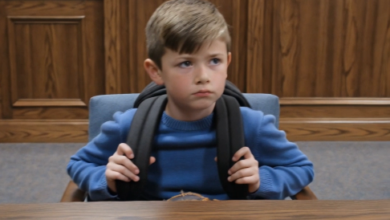
Mason stood slowly and walked toward the stage.
The auditorium lights made everything look too clear.
Mr. Carter handed him the sealed envelope.
“This was entrusted to me,” he said into the microphone, “by someone who could not be here in person.”
Mason looked at him sharply.
Mr. Carter lowered his voice, but the microphone still caught part of it.
“You do not have to read it aloud.”
That gave Mason an exit.
A private door.
He almost took it.
Then he looked at Tyler, who was smirking near the aisle. He looked at his mother, whose brow had folded with concern. He looked at the empty seat beside her.
And he opened the envelope.
Inside was not a letter.
Not at first.
It was a photograph.
An old one.
Mason at age six, asleep in a hospital bed after an asthma attack, one hand clutching a toy fire truck. Earl sat beside him in a plastic chair, still wearing his sanitation vest, head bowed, one gloved hand resting near Mason’s blanket.
Mason’s throat tightened.
He remembered the hospital.
He did not remember Earl being there.
Behind the photograph was a note in Earl’s blocky handwriting.
Mase,
Mr. Carter said the school was honoring work. I am not much for speeches. I pick up what people leave out. That is the job.
But I wanted you to know something in case I never said it right.
Mason stopped reading silently.
The room waited.
Mr. Carter reached to turn off the microphone.
Mason shook his head.
Then he began to read aloud.
“When you were little, you asked why I smelled like garbage. I told you it was because the city needed someone to keep mornings clean.”
A few people laughed softly.
Mason continued.
“That was partly true. The other part is I stayed on that route because city insurance covered your inhalers when private work did not.”
Angela covered her mouth.
That was the first twist.
Mason looked at his mother.
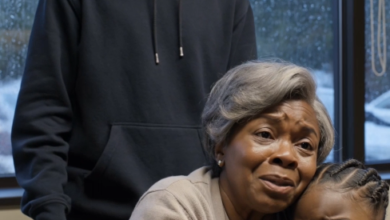
She was crying already.
He kept reading.
“I missed your kindergarten Thanksgiving play because I was working overtime after your hospital bill came. I stood in the back hallway for the last song. You wore a paper feather hat and waved at somebody else’s dad by mistake.”
Mason remembered that play only as a blur of parents and lights.
He did not know Earl had been there.
That was the second twist.
“I kept every school drawing you threw away because one day I figured you might want proof you were a kid who made things before you became a kid worried about looking cool.”
Students shifted in their seats.
Some smiled.
Some looked down.
Mason’s hands shook.
The note continued.
“I know what happened outside school. I heard you.”
The auditorium changed.
Mason could not breathe for a second.
Mr. Carter stepped closer, but Mason kept going.
“I am not writing this to make you feel bad. Thirteen is a hard age. Folks laugh before they understand. I did that too once.”
Mason swallowed.
“I want you to know I am not ashamed of my job. I am only sorry my job became something you felt you had to carry.”
That sentence broke something in him.
His father had been the one denied.
And still, he apologized for the weight of being seen.
Mason wiped his eyes with his sleeve.
The room was quiet now.
Not school quiet.
Human quiet.
The final page held a list.
Not of complaints.
Of names.
Mrs. Alvarez, insulin needles found in trash, call clinic disposal program.
Mr. Lewis at school, broken bin wheel, fix before rain.
Old man on Parker Street, newspaper pile means check porch.
Community center, extra route after storm, do not charge.
Westbrook Middle, make sure back bins are cleared before breakfast club.
Mason frowned through tears.
“What is this?”
Mr. Carter spoke softly.
“It is your father’s route notebook.”
Angela stood slowly.
She seemed to recognize it.
Earl had carried a small black notebook in his vest pocket for years. Mason thought it held pickup codes and addresses.
It did.
But it also held people.
The third twist came from Mr. Lewis, the custodian.
He stood from the side aisle.
“Your dad comes early after football games,” he said. “Helps me clear overflow before students arrive. Never puts it on a report.”
Mason stared at him.
The crossing guard raised her hand.
“He moved a dead branch from the corner last winter before the kids came through.”
A cafeteria worker said, “He found lunch trays thrown near the bins and washed them himself because he said school dishes should not go to landfill.”
Soft laughter moved through tears.
Then Angela spoke.
“He turned down a private hauling job when you were nine,” she said to Mason. “It paid more. But the hours changed, and he would have missed your therapy appointments.”
Mason looked at her.
“You never told me.”
“Your father asked me not to.”
“Why?”
Angela’s face broke.
“Because he did not want you feeling expensive.”
That was the fourth twist.
Earl had built his whole work life around Mason’s health, school schedule, and sense of normalcy, then stayed quiet so his son would not grow under the debt of it.
The fifth twist arrived when Mr. Carter reached into the envelope and pulled out a smaller sealed card.
“This part was for you only,” he said.
Mason took it.
He opened it with shaking fingers.
Inside was a photo of Earl standing beside a brand-new pair of sneakers. The same sneakers Mason wore that morning.
On the back, Earl had written:
Found them on sale after overtime. If they help you stand taller, good. Just do not let them make you look down.
Mason bent forward.
The auditorium blurred.
Those sneakers he had used to separate himself from his father had been bought with the work he was ashamed of.
For the first time, Mason understood the full shape of the morning at the curb.
Earl had not waved to embarrass him.
He had waved because he was proud to see his son standing in front of a school he helped keep clean, wearing shoes he bought with hands the world did not clap for.
Mason looked toward the auditorium doors.
Then he turned to Mr. Carter.
“Is he here?”
Mr. Carter hesitated.
“He is outside.”
Mason stepped away from the microphone.
Then he ran.
Students turned in their seats as he pushed through the side doors and down the hallway.
Outside, near the service drive, the sanitation truck was parked by the dumpsters.
Earl stood beside it, talking quietly with a driver, his vest bright in the afternoon sun.
He turned when he heard the door open.
Mason stopped ten feet away.
His father’s face went cautious.
“Mase?”
The boy’s mouth trembled.
“I read it.”
Earl nodded.
“You didn’t have to.”
“Yes, I did.”
For a second, neither moved.
Then Mason crossed the distance and wrapped both arms around his father’s waist.
Earl froze.
His gloved hands lifted, uncertain.
Then he held his son carefully, like something returned that he had not been sure he was allowed to ask for.
From the doorway, teachers and students watched.
Tyler stood near the back, no longer smiling.
Mason did not care.
His face pressed against the vest that smelled like diesel, rain, and hard work.
For the first time, he did not pull away.
Part 4
Earl did not come into the auditorium right away.
Mason asked him to.
Earl shook his head.
“I am working.”
“You are always working.”
Earl smiled faintly.
“That is unfortunately accurate.”
Mason wiped his face, embarrassed by the tears and not yet mature enough to stop caring who saw them.
“I want them to know.”
Earl looked toward the school doors.
“They know enough.”
“No,” Mason said. “They know what you did. I want them to know who you are.”
That sentence made Earl look away.
Men like Earl often know how to carry refrigerators, flooded furniture, broken bins, and sleeping children. They do not always know how to carry honor without trying to set it down.
Mr. Carter stepped outside.
“Mr. Reed,” he said, “the students would be grateful if you came in.”
Earl looked at his work gloves.
“I smell like route.”
Mr. Carter smiled.
“It is Appreciation Day.”
Angela appeared behind Mason.
Her eyes were red.
“Come inside, Earl.”
He studied her face.
Maybe he saw years there.
Hospital bills.
Early shifts.
Nights when both of them were too tired to speak kindly but did anyway because a child was sleeping in the next room.
Finally, Earl removed his gloves and tucked them into his back pocket.
“All right,” he said. “But nobody makes me give a speech.”
Naturally, everyone applauded when he entered.
Earl hated it.
Mason could tell by the way his shoulders tightened. But he kept walking, one step behind his son, not because he was ashamed, but because he still believed the day belonged to the children.
Mr. Carter offered the microphone.
Earl shook his head.
The auditorium laughed gently.
Then Mason took it instead.
He looked at the rows of faces.
Students who had laughed.
Teachers who had not known.
Parents who suddenly understood that the man in the neon vest had been part of their children’s mornings for years.
Mason’s voice shook.
“This is my dad,” he said.
Only four words.
But they landed where they needed to.
Earl lowered his head.
Angela cried openly now.
Tyler looked down at his shoes.
After the ceremony, students came to shake Earl’s hand. Some did it because teachers were watching. Some did it because they meant it. Earl treated both the same.
The next morning, Mason waited outside school near the curb.
When the sanitation truck came by, he did not hide.
Earl stood on the back step, surprised to see him.
Mason lifted one hand.
“Morning, Dad!”
A few students turned.
Mason felt the old heat rise in his face.
This time, he let it pass through.
Earl’s smile came slowly.
“Morning, son.”
The truck moved on.
Tyler stood near the stairs.
For a moment, Mason expected another joke.
Instead, Tyler said, “My uncle works nights at the water plant.”
Mason looked at him.
“Okay.”
“My mom says it is why our faucets work.”
Mason nodded.
“That sounds important.”
Tyler shrugged.
“Yeah.”
It was not an apology.
Not fully.
But thirteen-year-old boys often begin repair with sideways facts.
Mason accepted the attempt without making it easy.
In the weeks that followed, Westbrook changed in small ways.
A student group asked to visit the city sanitation yard for their community systems project. Mr. Carter assigned a new essay titled The Work We Stop Seeing. The cafeteria started sorting waste better after Earl explained what contaminated recycling meant.
Mason hated that his father became interesting to everyone for a while.
He also loved it.
One Saturday, Earl took him along the route for a short volunteer cleanup sponsored by the city. Mason wore gloves, old jeans, and a vest too large for him.
At first, he gagged at the smell.
Earl laughed.
“Breathe through your mouth.”
“That makes it worse.”
“Then suffer educationally.”
Mason rolled his eyes.
But after an hour, he began to see what Earl saw.
The unopened bills in trash bags.
The broken toys.
The medicine bottles.
The wedding photographs thrown out after moves or divorces.
A city’s waste was not just filth.
It was evidence that everyone had private messes.
Earl lifted one bag carefully from beside an elderly woman’s home.
“She used to leave three bags,” he said. “Now only one. Means her grandson stopped coming Sundays.”
Mason looked at the porch.
“How do you know?”
“I notice patterns.”
“Do you check on her?”
“When the paper stacks up.”
Mason shook his head softly.
“You really do that?”
Earl shrugged.
“Route teaches you who disappears.”
That sentence stayed with Mason longer than the smell.
Months later, when winter came, Mason wrote his hidden heroes essay again. This time it was eight pages.
He wrote about his father.
Not like a saint.
Like a man.
A man with sore knees, rough jokes, quiet pride, and a notebook full of people the city forgot to thank. A man who smelled like work because work had paid for inhalers, shoes, science boards, and a life Mason had mistaken for ordinary.
Mr. Carter gave it an A.
But at the bottom, he wrote something Mason liked better than the grade.
This tells the truth without making it pretty. That is harder.
Mason brought the essay home and left it on the kitchen table.
Earl read it after dinner.
Slowly.
At one point, he took off his glasses and rubbed his eyes.
Mason pretended to look for cereal in the pantry.
When Earl finished, he folded the pages carefully.
“You made me sound better than I am.”
“No,” Mason said. “I made you sound like you.”
Earl nodded once.
That was all.
But later, Mason found the essay tucked inside the black route notebook, between the pages where Earl wrote addresses, pickup changes, and the small signs that told him somebody on his route might need help.
Years passed.
Mason grew taller than Earl. He played baseball badly but with enthusiasm. He stopped buying sneakers for the wrong reasons. He still cared what people thought sometimes, because growing up does not cure every fear.
But he never denied his father again.
On graduation day, he wore a navy gown and a pair of polished shoes Earl had bought for the occasion. Not expensive. Clean. Good enough.
When the principal asked students to stand and thank the people who helped them get there, Mason stood first.
He turned toward the back row, where Earl sat in a pressed shirt, hands folded over the program.
“My dad works before most people wake up,” Mason said. “So I could have mornings worth waking up for.”
The room applauded.
Earl looked embarrassed.
Mason grinned.
It was fair.
Afterward, outside the school, Earl handed him a small envelope.
Mason laughed.
“Another one?”
“Open it later.”
Mason opened it in the car anyway.
Inside was a photo from Appreciation Day, taken by Mr. Carter. Mason was hugging Earl beside the sanitation truck, face pressed against the neon vest.
On the back, Earl had written:
The day you saw me.
Mason held the photo for a long time.
Then he placed it in his wallet, behind his license, where important proof belongs.
Follow this page for more heartfelt stories about quiet people whose love is hidden inside ordinary work.