The $300 Warning Lights Installed for a Deaf Welder Saved Two Hearing Men — And the Sign Nobody Read Now Hangs Above Her Crew
I followed the motorcycles to Mercer Iron & Cycle because curiosity is stronger than dignity when you have spent eighteen years watching the same market gate.
The garage sat inside an old brick trolley-maintenance building on East Third Street, squeezed between a roofing warehouse and an abandoned furniture factory. Its windows were high and dusty. A faded hand-painted sign hung over the steel doors. Behind the building, freight trains dragged their wheels along the rails with a metallic groan you could feel through the ground.
Elena arrived in Mason’s pickup.
She had refused to ride on the back of a motorcycle. Rook accepted that without argument. He had learned enough from his daughter to understand that helping someone did not grant you ownership of their choices.
Inside, the garage smelled of hot steel, motor oil, old leather, and burnt coffee. Two motorcycles waited on lifts. Sparks fell behind a welding curtain. An air compressor kicked on with a violent shudder that made Elena glance toward the floor before anyone else turned toward the sound.
She felt it.
Rook noticed.
So did Earl Boone.
Earl was sixty-two, narrow as a fence rail, with white hair and a cigarette permanently parked behind his right ear. He had welded pipeline in Alaska, ship hulls in Louisiana, and enough motorcycle frames in Ohio to believe nobody under forty had earned the right to advise him.
He examined Elena over his safety glasses.
“This the girl?”
“This is Elena Ruiz,” Rook said.
Earl spoke while looking at Rook instead of her. “She understand shop rules?”
Elena watched his lips, caught only part of the sentence, and waited.
Rook’s expression hardened.
“Ask her.”
Earl shifted his feet. “I don’t sign.”
“You know how to point at a rule sheet.”
That was Rook. Few words. Heavy ones.
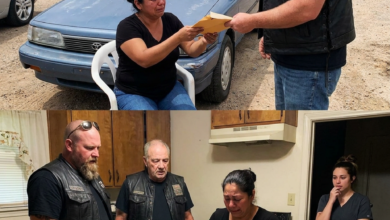
Elena produced a folded envelope from inside her jacket. It contained two welding certificates from Sinclair Community College, reference letters, photographs of railings she had fabricated with her father, and rejection emails from nine shops.
Earl read every page.
His face revealed nothing.
The last photograph showed Elena at seventeen beside her father, Tomas Ruiz, both wearing raised welding helmets. Tomas was short, broad, and smiling. His hand rested on the same steel workbench Elena now kept in a rented storage unit because she had been forced to sell nearly everything else after he died.
“He any good?” Earl asked.
Elena read his lips that time. She took the photograph, pointed to the gate visible behind them, and wrote on Rook’s notepad: County courthouse restoration. Dad did all twelve sections.
Earl’s cigarette shifted between his lips.
He knew that gate.
Everybody in local fabrication did.
Then Mason rolled the test frame from behind a shelf. It was a custom hardtail chassis with a hairline fracture beside a reinforced joint, the kind of repair that punished heat distortion and exposed poor control. Earl had already prepared the metal but had not completed the weld because the customer had changed the design.
“Six minutes,” Earl said.
Rook signed the instructions. Elena nodded.
Mason remained unconvinced. “We should start her with scrap.”
“She says she’s a welder,” Rook replied. “Give her a welder’s test.”
Elena removed her denim jacket. Beneath it she wore a plain gray work shirt. She tied back her hair, inspected the machine settings, checked the ground clamp twice, and cleaned a spot on the table that Earl had intentionally left dusty.
Then she placed two fingers against the steel.
Not dramatically.
Not for show.
She was reading the shop.
Vibrations traveled through the table from the compressor, grinders, lift pumps, and passing freight train. Elena waited until the compressor cycle ended, adjusted the amperage, lowered the helmet, and began.
The arc flashed.
Her hands became still.
That was the first thing I noticed. The second was the speed. She did not rush, yet no movement was wasted. The torch traveled with the controlled patience of a needle closing skin. Her left hand remained close enough to sense what the metal was doing without entering danger.
At four minutes, Mason unfolded his arms.
At five, Earl removed the cigarette from behind his ear.
At six, Elena stopped, cleaned the joint, and stepped back.
Nobody spoke for several seconds.
Earl bent toward the bead with a light. He examined the tie-in, checked the heat-affected area, and ran one dirty fingernail along the edge. Then he turned the frame and studied the opposite side.
“Well?” Mason asked.
Earl looked personally offended.
“It’ll hold.”
Rook waited.
Earl sighed. “It’s cleaner than mine would’ve been at that angle.”
Elena could not hear him.
Rook signed the words.
Her eyes closed.
Just for a moment.
Then she opened them and asked the question that made the room uncomfortable: Does that mean I have a job, or only that I passed a test?
Rook did not answer immediately because Mercer Iron & Cycle did not belong solely to him. The club owned part of the building, the business supported six families, and their insurance policy listed strict rules about machine operators and audible alarms.
Brotherhood meant Rook could not simply command agreement.
He had to earn it.
They met around the scarred wooden table in the back room. Elena waited outside with me while voices rose behind the door. I could not make out every word, but I heard “liability,” “communication,” “insurance,” and “what happens if she gets hurt?”
Mason worried about a forklift approaching behind her.
Earl worried about gas leaks and fire alarms.
A younger mechanic named Toby worried he would say something wrong and be sued.
Then Rook said something quieter.
The room fell silent.
Years later, Mason told me the exact words.
“We already built this shop for men with bad knees, bad backs, and worse habits. Don’t tell me one set of lights is where brotherhood gets too expensive.”
Rook emerged twenty minutes later.
He signed to Elena that the welding job would be hers for a thirty-day trial if they could make the garage safe.
She did not celebrate.
She asked for paper.
Then she drew a rough plan: amber lights for moving equipment, red strobes for fire, blue lights for evacuation, mirrors near blind corners, and small vibration pagers linked to the central alarm.
Earl looked over her shoulder.
“Who taught her that?”
Rook translated.
Elena wrote: A shop that fired me after I suggested it.
The price for the essential lights, wiring, and relay came to $297.43.
Mason stared at the total.
Rook pulled three hundred-dollar bills from the emergency cash envelope and placed them on the table.
“Install it Monday.”
That was the seed.
None of us knew what it would become.
Elena’s first month did not unfold like one of those clean stories where kindness fixes everything before lunch.
It was rough.
On her second day, Toby approached from behind and tapped her shoulder while she was grinding a bracket. Elena spun so quickly that the tool struck the table and sent sparks across the floor. Nobody was hurt, but Mason shut down the bay and blamed the communication problem.
Elena blamed herself.
Rook blamed the lack of a rule.
By noon, every workbench displayed a simple gesture protocol: step into Elena’s sightline, flash the bench lamp once, wait for eye contact, then approach. No grabbing. No surprises.
The rule helped everybody.
Earl had hearing loss from forty years around machinery but had never admitted it. Toby wore ear protection and often missed shouted instructions. The flashing bench lamps soon replaced half the yelling that had made the garage exhausting.
Still, some men resisted.
A parts supplier arrived and asked Rook whether Elena was “the diversity hire.” Rook pointed toward three frames she had repaired that week and asked him which weld he wanted to cut apart first.
The supplier declined.
A customer saw Elena wearing a welding hood and demanded that Earl redo her work. Earl dragged over the customer’s cracked exhaust bracket, placed it beside one of his own welds, and asked the man to identify hers.
He guessed wrong twice.
“Then pay the lady,” Earl said.
That was how respect grew inside Mercer Iron & Cycle—not through speeches, but through metal that held.
Elena arrived before everyone except Rook. She swept her bay, checked the gas lines, inspected each power cable, and placed one palm against the main worktable when the freight train passed behind the building.
Rook asked her why she always did that.
She signed: My father said steel tells you what it needs before it breaks. Most people just wait for the sound.
Rook stood still after reading her hands.
Hannah had once told him something similar about people. His daughter was thirty-one by then, living in Columbus and teaching deaf children. Inside Rook’s vest, sewn behind the rough club patch, was a small strip of yellow fabric cut from the dress Hannah wore on her first day of school.
That was the contradiction I had glimpsed at the market.
A giant biker carried a piece of a little girl’s dress against his heart.
Hannah had lost her hearing after meningitis. Rook, then twenty-eight and still drinking too much, had refused to accept the specialist who said lip-reading would be “good enough.” He attended night classes, learned American Sign Language badly, then stubbornly, then fluently.
His marriage did not survive those years.
His relationship with Hannah nearly didn’t either.
Rook had been quick-tempered, ashamed of his helplessness, and convinced that providing money was the same as being present. When Hannah was twelve, she signed something during an argument that changed him.
You keep demanding that I enter your world. You have never asked how to enter mine.
Rook stopped drinking two months later.
He never claimed sainthood. He still carried the arrest record. He still woke from dreams about his younger brother bleeding on a barroom floor. He still struggled to apologize with words.
But he learned to listen with his eyes.
That was why he saw Elena.
The $300 warning system took two days to install. Rook, Mason, Toby, and Elena ran conduit across the ceiling. Red LED strobes went over each exit and welding bay. Amber lights connected to the forklift beacon. Blue lamps linked to the evacuation circuit.
The equipment was cheap, industrial, and ugly.
It worked.
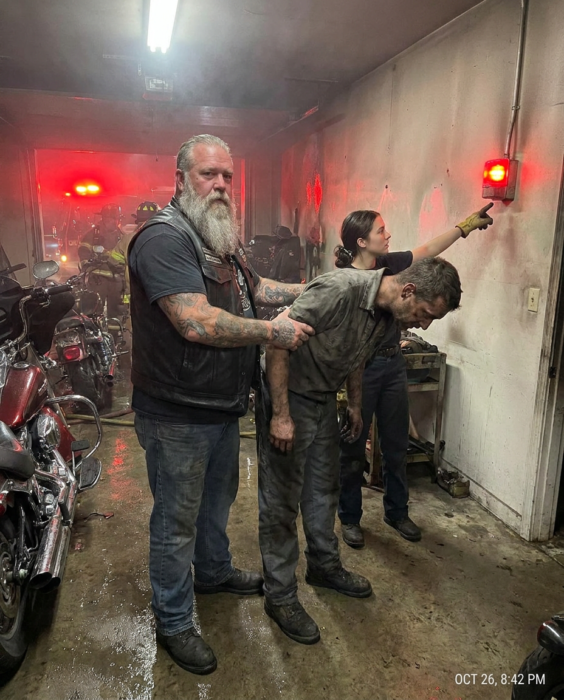
During the first test, the audible alarm screamed while red lights burst across the brick walls. Elena did not react to the horn, but the red flashes struck every reflective surface around her. She shut off the machine, secured the torch, and reached the assembly point before Toby.
Mason checked his watch.
“Twelve seconds faster.”
Elena smiled.
The next test came without the horn.
Everybody moved faster.
That bothered Mason enough to run it again. He discovered that mechanics wearing ear protection saw the lights before they recognized the siren. Earl admitted he had not heard the second alarm at all.
The accommodation built for Elena had revealed weaknesses surrounding everyone else.
But the crisis that nearly ended her job came in week five.
A lifting fixture failed while she was positioning a touring frame. The steel shifted several inches and struck the corner of her table. Nobody was injured, but Mason found that Elena had modified the fixture with a temporary spacer.
He was furious.
“You change shop hardware, you tell me.”
Elena could not follow his angry mouth. He spoke too fast and turned away between sentences. She tried to sign to Rook, but Mason interpreted her urgency as defensiveness.
Then he said the word she understood perfectly.
“Dangerous.”
Elena went pale.
Every previous dismissal had begun with that word.
She removed her gloves, folded them, and placed them on the table. Her hands shook so hard she could barely open her locker.
Rook stepped between her and the door.
He did not block her path. He simply stood where she could see him.
“Wait,” he signed.
Mason lifted the failed fixture. Underneath it, they found a fatigue crack through an old repair. Elena had felt the unstable vibration and inserted the spacer to keep the frame from falling while searching for someone to inspect it.
She had prevented the accident.
Her mistake was not the repair.
It was assuming she could find help before the cracked steel gave way.
Mason looked at the fracture. Then he looked at Elena’s gloves.
His anger drained into shame.
He signed the only two words he had learned confidently.
My fault.
Elena stared at him.
Then she picked up a marker and wrote on the steel table: Our fault. Need visual stop-work signal.
By the end of the day, every employee knew a raised fist followed by crossed forearms meant shut down all moving equipment immediately.
Six weeks later, that signal would not be enough.
Because the fire began where nobody was looking.
It happened on a Thursday afternoon in late August, three months after Rook first saw Elena’s cardboard sign.
The temperature outside was ninety-four degrees. Every fan in Mercer Iron & Cycle ran at full speed, pushing hot air through the welding bays. Earl and Elena were fabricating a sidecar mount near the front. Rook had left to collect bearings from a supplier.
Mason and Toby worked in the rear storage area.
A delivery driver had stacked oily shop towels too close to an aging battery charger. The charger’s internal wiring overheated, but the first spark remained hidden behind a steel shelving unit.
The towels began to smolder.
No flame yet.
Only smoke.
The building’s fire alarm should have detected it. The nearest smoke sensor did, but when the control panel sent power to the old siren circuit, a corroded relay failed.
The horn produced one weak chirp.
Then nothing.
Earl did not hear it.
Neither did Elena.
Mason and Toby were using impact tools behind a closed fire door. Even if the horn had worked normally, their hearing protection and the tools’ hammering might have buried the sound.
For eleven seconds, the building continued as usual.
Then every red light flashed.
Elena saw the first pulse reflected in the polished frame beneath her hands. She stopped welding, raised her hood, and scanned the shop. The lights fired again—front bay, east exit, office corridor, ceiling above the paint cabinet.
Red.
Red.
Red.
Earl stared upward, confused.
Elena smelled smoke.
She slammed the emergency cutoff and crossed her forearms, but Mason and Toby could not see her through the rear door. She ran toward it while Earl reached for the extinguisher.
The third flash struck the narrow window.
Mason noticed.
He shut down his tool and pulled out one earplug. No horn. No shouting. He almost returned to work, assuming it was a faulty visual test.
Then gray smoke curled beneath the storage-room ceiling.
“Toby!”
Toby looked up.
A stack of tires stood between them and the main exit. Smoke thickened above it. The battery charger sparked again, and fire climbed through the oily towels fast enough to turn hesitation into a trap.
Mason grabbed Toby’s shoulder and pointed toward the rear door.
It would not open.
A warped lower hinge had jammed against the concrete threshold.
They pulled together.
Nothing.
Outside the storage room, Elena reached the window and saw them. Mason struck the glass with his palm and pointed toward the fire. Toby moved behind him, coughing into his sleeve.
Earl shouted for them to get down.
They could not hear him.
Elena could not hear him either.
The audible world had become useless.
Only movement remained.
She pointed at Mason, closed one fist, and pulled downward—the club’s signal for the manual floor latch on the rolling parts gate. Mason understood. He dropped beside the jammed door, found the emergency release cable, and pulled.
The door lifted four inches before the warped track caught.
Smoke poured through the gap.
Toby lay flat and tried to force his shoulders beneath it, but his work jacket snagged. Mason dropped beside him and pushed.
The fire reached a plastic container.
It burst.
Not an explosion like a movie. A hard flash. Hot smoke. A sheet of orange climbing toward the rafters.
Earl emptied one extinguisher into the base while Elena ran to the hydraulic frame jack. She dragged its long steel handle toward the door, slid the flattened end beneath the gap, and signed for Mason to move back.
He understood one gesture.
Wait.
Elena braced both boots against the floor and pulled upward. The bar flexed. The door rose another inch.
Earl joined her.
Then another mechanic.
The gap widened.
Toby crawled first. Mason followed, one hand protecting the back of Toby’s head as sparks dropped around them. They cleared the door just as a burning shelf collapsed across the space where they had been kneeling.
The sprinkler line activated thirty seconds later.
Water hammered the flames.
The fire department arrived in five minutes. By then the staff stood outside beneath the flashing blue evacuation lamps, soaked, blackened with smoke, and alive.
Mason sat on the curb with his palms against his knees.
Toby vomited beside a drain.
Elena stood several feet away, trembling so violently that Earl wrapped a moving blanket around her shoulders. A firefighter examined her hands, expecting burns, but found only a red pressure mark from the jack handle.
Rook returned while hoses still crossed the street.
He saw the smoke, the engines, and his brothers on the curb. His face emptied. He abandoned his Harley in the road and ran toward them with his helmet still clipped beneath his chin.
Mason stood.
Rook grabbed his vest.
“What happened?”
Mason pointed toward the red lamps still flashing behind the wet windows.
“The siren failed.”
Rook looked toward Elena.
Mason’s voice broke.
“Her lights didn’t.”
That should have been the ending.
A deaf welder’s safety system saved two hearing mechanics. The insurance investigator confirmed the failed alarm relay. The fire marshal wrote that the visual warning reduced evacuation time and likely prevented severe injury.
Newspapers would have had enough.
But the real twist came the following morning, when Rook opened the damaged control box and found that the $300 system had not survived by accident.
Someone had rebuilt it after hours.
And that someone had known the siren was dying.
The garage remained closed while inspectors examined the fire damage.
Rook, Mason, Earl, Elena, and I stood beneath the open service door the next morning. Wet ash coated the concrete. Burnt plastic hung in the air. Sunlight crossed the blackened storage wall and stopped at the homemade visual-alarm controller mounted inside a steel cabinet.
Its cover was open.
Fresh wiring ran through the older circuit.
The fire marshal pointed to a small secondary relay and asked who had installed it.
Mason said the electrician had not.
Rook looked at Elena.
She lowered her eyes.
He signed: Did you change this?
Elena nodded.
Mason’s shoulders tightened. Modifying a fire circuit without authorization could have voided the insurance policy. It could also have failed at the worst possible moment.
Rook asked when.
Three weeks earlier, Elena had felt an irregular pulse through the worktable during a scheduled alarm test. Everyone else heard a normal horn. The warning lights flashed, but their rhythm lagged slightly behind the vibration of the siren circuit.
She reported it to Earl.
Earl checked the control panel, found nothing obvious, and assumed the old relay was merely noisy. The next service inspection was already scheduled.
Elena did not trust it.
Her father had taught her to use redundant triggers on industrial gates: if one signal weakened, another circuit should still respond. She bought a used relay for eighteen dollars, built a protected secondary connection on her own bench, and asked Earl to inspect it.
Earl had inspected it.
He had also helped her install it.
Mason turned toward him. “You knew?”
Earl removed the unlit cigarette from behind his ear.
“I knew the light circuit would fail if that old siren relay burned open.”
“And you didn’t tell me?”
“I was going to.”
“When?”
Earl had no answer.
The brotherhood cracked there.
Mason accused Earl of risking the entire shop. Earl accused Mason of ignoring equipment because it still made the expected noise. Toby, his face pale from the previous day, asked whether anyone cared that he would have died if Elena had followed procedure and done nothing.
Voices rose.
Elena could not follow them.
She stood in the center of the men she had helped save, watching their mouths move too quickly, while the same old conclusion formed around her: the deaf worker had become the problem again.
She picked up her cardboard employment sign from beside her locker.
Rook had preserved it after the market. The words were softened by rain and fingerprints, but they remained visible.
Elena placed it on the table.
Then she removed her garage key.
She believed she was being fired.
Rook saw it.
He slammed one tattooed palm against the table so hard that everybody stopped talking. The sound meant nothing to Elena, but the vibration reached her hands through the steel.
She looked up.
Rook signed slowly enough for every man to watch.
The fire started because we accepted an old alarm. The warning worked because she did not.
Mason began to object.
Rook held up one finger.
Then he faced Elena.
You should not have installed it secretly. Earl should not have helped secretly. I should have made a clear reporting path you could use without waiting for someone to translate. Those failures belong to all of us.
Elena’s hands moved.
Am I fired?
Rook’s reply came immediately.
No. You are leading the rebuild.
The shop fell silent.
Mason rubbed both hands over his face. Then he walked to Elena, stopped inside her line of sight, and used the signs he had practiced with Hannah through video calls.
You saved me. I was wrong. I am sorry.
His hands were clumsy.
The meaning was not.
Elena cried for the second time since I had known her. Mason did too, though he would later insist that smoke irritation lasted longer than expected.
The rebuild changed more than the damaged wall.
Mercer Iron & Cycle installed a certified visual and audible alarm network with battery backup, vibration alerts, illuminated equipment-status panels, and emergency signals at every workstation. Employees received basic sign-language instruction. Every warning procedure had to function for a worker who could not hear, a worker wearing ear protection, and a visitor who knew nothing about the building.
The fire marshal asked permission to use the layout during a regional safety meeting.
A local reporter heard the story.
Her article began with the sentence: A safety system installed for one deaf welder became the only warning two hearing mechanics received.
That line traveled.
Fabrication shops called from Springfield, Kettering, Middletown, and Richmond. Some owners wanted equipment recommendations. Others asked whether the changes were expensive.
Rook gave them the original number.
“Two hundred ninety-seven dollars and forty-three cents.”
Then he gave them the number that mattered.
“Two men.”
Within six months, fourteen workshops in the region had installed visual alarms or upgraded existing systems. One machine shop hired its first deaf apprentice. A cabinet factory created color-coded forklift warnings. A vocational school asked Elena to demonstrate how she read welding current through sight and touch.
People called Rook a hero.
He refused the word.
People called the club generous.
He refused that too.
“We hired the best welder available,” he told a television reporter. “Took us four months longer than it should’ve because nobody read her sign.”
Elena stood beside him with crossed arms.
The reporter asked Rook whether he had saved her.
Rook looked toward Elena, then toward Mason and Toby beneath the new red lights.
“No,” he said. “Get the story right.”
Three months became a year.
Elena became Mercer Iron & Cycle’s lead welder after Earl retired from full-time work, though he continued appearing every Tuesday with coffee and advice nobody requested. He claimed he came to inspect her welds.
She claimed he came because his wife wanted him out of the kitchen.
Both were correct.
Elena trained six apprentices over the next two years. Four could hear. Two were deaf: Marcus Bell, a former auto-body student from Columbus, and nineteen-year-old Sophie Nguyen, whose high school counselor had advised her to choose “a quieter career.”
Elena brought Sophie into the shop on her first day and placed her hand against the main welding table when the freight train passed outside.
Steel trembled beneath their palms.
Elena signed what her father had taught her.
It speaks before it breaks.
Rook watched from the office doorway.
His beard had grown whiter. His knees made stairs difficult. The patch inside his vest still held the strip of yellow fabric from Hannah’s childhood dress, but there was now another small object in the inner pocket: a photograph of Elena standing between the six apprentices beneath the red warning lamps.
Every Saturday morning, he still rode to Webster Street Market.
He bought peaches from me, bad coffee from the north stall, and flowers he pretended were for the clubhouse. Before leaving, he paused near the eastern gate where Elena once stood.
For several months, faint marker stains remained on the pavement where rain had dissolved parts of her sign.
Rook always looked down.
He never lingered long.
The old cardboard sign no longer belonged at the market. Elena had framed it in scrap steel with a clean TIG-welded border and hung it above the fabrication bay.
The original message remained under glass.
Beneath it, someone added four words in black marker.
WE READ IT NOW.
Nobody admitted writing them.
I suspected Mason because the lettering leaned left, just like the labels on his tool drawers. Earl blamed Toby. Toby blamed Rook.
Rook only smiled.
Whenever visitors toured the garage, they stopped beneath that frame. Most read the first sentence about deafness, then the second sentence about work. Some photographed it. Some became quiet.
Elena never gave speeches beside it.
She handed visitors a helmet.
Then she showed them what she could do.
Five years after that rainy morning at Webster Street Market, I attended the opening of Mercer Iron & Cycle’s expanded fabrication building.
Fourteen workshops had adopted similar visual safety systems by then. The county vocational program had created a welding track accessible to deaf students. Elena served on its advisory board, though she still preferred the garage floor to meeting rooms.
Rook arrived late on his Harley.
The V-twin rolled against the brick walls, deep and uneven. He parked beneath the new red warning lamps, lowered the stand, and climbed off more carefully than he once had.
Elena met him near the entrance.
She was thirty now, wearing a dark work shirt with LEAD WELDER stitched above the pocket. Marcus and Sophie stood behind her with the other apprentices.
Rook signed: Boss keeping everybody busy?
Elena answered: Boss is waiting for an old biker to stop blocking her door.
He laughed so hard his beard lifted.
Mason called everyone beneath the framed cardboard sign. The edges had faded further, and the glass carried tiny flecks of grinding dust despite Elena’s attempts to keep it clean.
A new brass plate had been mounted below it.
It listed no donor names.
No heroic titles.
Only a date, the original cost of the first warning system, and two words:
TWO LIVES.
The ceremony ended without a ribbon. Elena struck an arc instead. White light filled the bay. Her apprentices watched her hands, the molten pool, and the signals reflected from the equipment panels.
Above them, the red lamps waited.
Rook stood beside me with his scarred arms folded.
“Best welder you ever hired?” I asked.
He watched Elena complete the bead.
“Best person we almost missed.”
Outside, eight Harleys started one after another. The sound rolled across East Third Street while the warning lights inside the garage flashed through their weekly test.
This time, everyone saw them.
Follow the page for more true-hearted biker stories where rough hands, quiet courage, and one unexpected chance change entire communities.