A Woman Begged Strangers Not to Bargain Over Her Only Car — Then One Biker Learned Why She Needed Exactly $4,200
I should explain something about Cole Maddox.
He didn’t buy things impulsively.
The man kept receipts for spark plugs. He wrote fuel mileage in a notebook and could tell when a tire had lost two pounds of pressure by the way the handlebars answered his hands. In twenty-three years of riding with the Iron Lanterns, I had never seen him hand a stranger thousands of dollars without checking what he was buying.
That afternoon, he never even lifted the Toyota’s hood.
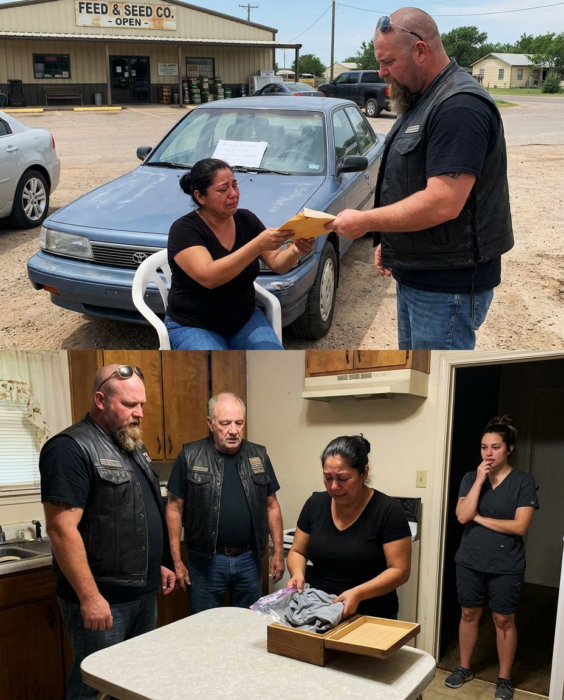
Teresa signed the title on the car’s roof. Cole signed beneath her name, took the key, and watched her fold the money into the inner pocket of her purse.
“University office still open?” he asked.
“For another hour.”
“Go pay it.”
“I need to take the bus.”
Cole held out the Toyota key.
“Take the car.”
She blinked. “It’s yours.”
“Until I say otherwise, I’m lending it back.”
Cole said it flatly, as if lending a newly purchased car to its former owner was a normal sales condition.
Teresa gripped the key but didn’t move.
“Why are you doing this?”
He glanced at the nursing notice still resting on the hood. “Because deadlines are mean little things.”
That was as much tenderness as Cole could tolerate in public.
Teresa drove away while I followed Cole into Miller’s. He bought coffee, black electrical tape, and a package of shop towels he didn’t need. At the register, he stared through the window at the empty chair she had left behind.
“You remember Route 35?” he asked.
I did.
We had been returning from a charity ride near Chillicothe eight years earlier. Rain had passed over the highway, leaving the asphalt black and reflective. Bear had been driving the club’s old support pickup because his injured knee couldn’t handle the Harley that week.
The rest of us were ahead of him when Cole saw a bicycle spinning in the ditch.
A girl lay near the shoulder.
A pickup that should have stopped was disappearing through the intersection.
Bear swung our support truck across the nearest lane and turned on its hazards. We formed a wall of motorcycles behind it. I called 911. Cole knelt beside the girl and kept her eyes on the clouds while Bear pressed both hands over the wound in her thigh.
We carried medical kits now.
Back then, we carried tools, water, and bad habits.
Bear had stripped off his gray work shirt, torn it from collar to hem, and twisted one half into a pressure bandage. The girl screamed once. After that, she stared at Cole while he talked about anything that might keep her conscious.
He told her the clouds looked like horses.
She told him one looked like a nurse’s hat.
When paramedics arrived, they moved fast. Police took our statements. An officer told us the girl’s mother was on her way, so we left before traffic backed up farther.
We never learned her name.
Bear returned to the hospital two days later, but privacy rules stopped him at the desk. He left a phone number that was never called.
For years, he carried that silence like a stone.
Bear was our club president then. He had served as an Army mechanic, spent three ugly years drinking after his son died, and rebuilt his life inside the Iron Lanterns garage one sober day at a time. He looked impossible to hurt, which meant most people never noticed how carefully he remembered the people he couldn’t save.
Route 35 bothered him most.
Every August, on the date of the crash, Bear rode past the site alone. Sometimes Cole followed from a distance. Neither man spoke about it.
Now Cole stood beside a pallet of dog food and whispered, “That was her.”
“I think so.”
“No. It was her.”
He remembered the girl saying she wanted to help people when she grew up. He remembered Bear telling her she first had to stay alive long enough to grow up.
Cole pulled out his phone and called him.
Bear answered after three rings.
“You busy?” Cole asked.
“I’m rebuilding a carburetor.”
“Leave it.”
Silence.
Cole never told Bear to abandon a machine halfway through a repair.
“What happened?” Bear asked.
“We found the bicycle girl.”
The line stayed quiet so long I checked whether the call had disconnected.
Then Bear said, “Alive?”
“She’s in nursing school.”
A metal tool hit concrete on the other end.
Cole told him about Teresa, the Toyota, and the $4,200 tuition balance. He did not tell him what we planned because no plan existed yet.
Bear created one in seven words.
“Get her address. Bring the title home.”
By six that evening, fourteen Iron Lanterns stood inside our garage. Nobody had summoned them formally. News moved through a club faster than smoke under a closed door.
Cole placed the signed title on the workbench.
“It’s legally mine,” he said.
Mason “Tank” Callahan scratched his beard. “Then legally, you bought a Toyota.”
A few men laughed.
Cole didn’t.
“She walks if we keep it.”
The laughter stopped.
Bear arrived last. At sixty-one, he was slower than he had been eight years earlier, but he still filled the doorway. His beard had turned white. A surgical scar divided one knee, and the faded leather vest on his back carried twenty-nine years of rain, road grit, and names sewn in memory.
He looked at the title.
“Girl really became a nurse?”
“One year left,” Cole said.
Bear rested both palms on the bench.
“Then we don’t let her stop.”
We began with the obvious answer: return the car.
It wasn’t enough.
Teresa had sold the only valuable thing she owned to solve one bill. The next semester would bring another. Elena still needed books, licensing fees, uniforms, transportation, and months of clinical work that left little time for paid shifts.
“If we hand back the keys,” I said, “we postpone the cliff.”
Bear nodded.
“Then we move the cliff.”
We emptied the emergency envelope. Cole added the four hundred dollars he hadn’t spent. Tank promised the profit from a brake job. I offered the money from our next charity breakfast.
Bear listened.
Then he removed an old metal cashbox from the cabinet beneath his desk. Inside were donations we had been saving to replace the leaking garage roof.
He counted every bill.
“We can tolerate rain,” he said.
By midnight, we had $11,860.
It was generous.
It still wasn’t a plan.
Then our youngest member, Marcus Reed, spoke from the back of the garage. Marcus had been quiet because he was an emergency department nurse and understood the numbers better than any of us.
“You don’t need a collection,” he said. “You need a scholarship.”
Twenty men turned toward him.
Marcus explained that a properly managed education fund could accept community donations, support Elena’s final year, and continue for future nursing students. A local nonprofit could administer it while we raised money through rides, repair days, and business sponsors.
Bear stared at the water dripping through the roof into a bucket.
“What do we call it?”
Marcus shrugged. “Ask the girl.”
Bear shook his head.
“No. Name it before she knows.”
He looked down at the torn seam inside his old vest, where a gray thread still marked the place his work shirt had once caught when he yanked it off beside Route 35.
“The Elena Alvarez Nursing Fund.”
That night, the first pledge went into a coffee can.
Forty dollars.
It came from Bear.
It was all he had in his wallet.
The next morning, Teresa woke at 4:25 and dressed for work in the dark.
She believed the Toyota no longer belonged to her, so she left its key on the kitchen counter. She tied her work shoes together, hung them over her shoulder, and put on an older pair for the walk.
Elena was asleep in the second bedroom.
Teresa had returned from the university with a stamped receipt and told her daughter that an anonymous community grant had covered the overdue balance. It was the first serious lie she had ever told her.
Elena hugged her.
Teresa waited until the girl released her before turning away.
At 4:52, she opened the front door.
Twenty-seven motorcycles were parked along her street.
Their engines were off.
Bear believed roaring into a working neighborhood before dawn was a good way to turn kindness into nuisance. The men stood silently beside their bikes while weak porch lights flickered on behind curtains.
The Toyota sat in Teresa’s driveway.
A red ribbon was tied around the steering wheel.
Cole waited beside it with the title in one hand.
Teresa froze on the porch.
“No,” she said.
Cole walked toward her. His boots sounded heavy against the cracked path.
“You paid the school?” he asked.
“Yes.”
“Good.”
He held out the title.
She wouldn’t take it.
“I sold that car.”
“We changed our mind.”
“You can’t change your mind after paying me.”
“Sure we can.”
“That money is already gone.”
“We don’t want the money.”
Her face tightened with embarrassment. “I’m not accepting charity.”
Bear stepped away from the line of bikers.
In daylight, he was frightening to people who did not know him. Six-foot-four. Barrel chest. White beard. Old burns on one forearm. The skull ring on his right hand looked cruel until you saw him use that same hand to repair a child’s bicycle.
He stopped several feet from Teresa.
“This isn’t charity,” he said.
“What is it?”
“A debt.”
“I don’t know you.”
“No. But I might know your daughter.”
Teresa glanced toward Elena’s bedroom window.
Bear asked about the Route 35 accident.
The color left her face.
“How do you know about that?”
Cole told her.
Not everything. Just the rain, the spinning bicycle, the truck across traffic, and the shirt torn into strips.
Teresa gripped the porch rail.
For eight years, she had imagined those riders as faceless men who appeared during the worst ten minutes of her life and vanished before she could thank them. Now they stood in front of her house, older and broader, carrying the smell of leather, coffee, and cold morning air.
“You were there?” she whispered.
Bear nodded.
“The man who tore his shirt?”
“That was me.”
Teresa stepped backward.
Then she ran inside.
Several brothers looked at one another. A curtain moved in the neighboring house. Somewhere down the block, a dog began barking.
Bear did not follow.
“She doesn’t owe us a reunion,” he said.
But Teresa returned carrying a cedar box.
She placed it on the porch rail and opened the brass latch with both hands. Inside lay hospital paperwork, a cracked bicycle reflector, a small photograph of fifteen-year-old Elena wearing a leg brace, and a piece of gray fabric folded inside a clear plastic bag.
Brown stains shadowed the cloth.
One edge was torn.
On the remaining chest pocket, the name FRANK had been embroidered in dark blue thread.
Bear’s knees weakened.
He recognized the shirt.
His late wife, June, had stitched that name before he left the Army. He had worn the shirt through fifteen years of repair work, then ripped it apart beside a bleeding child without thinking twice.
The paramedics had sent one bloodstained strip home with Teresa because it was tangled with Elena’s belongings.
Teresa had washed nothing.
She couldn’t.
For eight years, she kept the cloth to remind Elena that strangers had stopped.
Bear reached toward the plastic bag but pulled his hand back before touching it.
“I thought she died,” he said.
Teresa stared at him. “What?”
“At the hospital, they wouldn’t tell me anything. Nobody called. I went back twice.”
“I never got your number.”
Bear looked down.
“All these years,” he said. “I thought we were too late.”
Teresa’s anger disappeared.
She stepped off the porch and wrapped both arms around a man twice her size.
Bear went rigid.
The club president who had reset shattered bones on the roadside, buried six brothers, and once walked away from a burning garage with his beard singed did not know where to put his hands.
Finally, he rested one palm between Teresa’s shoulders.
Elena appeared in the doorway.
She wore university sweatpants and an old nursing-school T-shirt. Her dark hair was tied into a loose knot, and a pale surgical scar ran along the outside of her left knee.
“What’s happening?” she asked.
Teresa released Bear.
Nobody answered.
Elena noticed the cedar box. Then the cloth.
She looked at Bear’s face.
“You,” she said.
Bear swallowed.
Elena had been drifting in and out of consciousness on Route 35, but she remembered his eyes. She remembered his hands covered in blood. Most of all, she remembered his voice ordering her to keep looking upward.
“You told me the clouds were moving,” she said.
Bear nodded. “They were.”
“You said I had to keep watching until the ambulance arrived.”
“I needed your eyes open.”
Elena crossed the yard slowly.
Every man lowered his gaze, giving her privacy inside a street full of witnesses.
When she reached Bear, she did not hug him.
She touched the FRANK stitched into the torn pocket.
“I became a nurse because of you.”
Bear’s jaw moved, but no words came.
Then Elena saw the car, the ribbon, and the signed title in Cole’s hand. She looked at her mother’s walking shoes hanging from one shoulder.
Understanding struck all at once.
“You sold the car?”
Teresa whispered, “You needed the tuition.”
“You said there was a grant.”
“There is now,” Marcus said.
He stepped forward with a folder containing the nonprofit application, the club’s first deposit, and a letter promising to cover Elena’s remaining education costs.
Elena opened it.
Eleven thousand eight hundred sixty dollars.
Her expression hardened.
“No.”
Cole frowned. “No?”
“I can’t take this.”
“You can,” he said.
“I won’t.”
She thrust the folder back toward Marcus.
“My mother sold the car because I refused to borrow more money. I won’t let twenty-seven strangers drain their savings either.”
“We’re not strangers,” Tank said.
Elena looked along the line of patched vests.
“You don’t know me.”
Bear finally found his voice.
“We knew you when staying alive was your whole job.”
“That doesn’t mean you owe me a degree.”
“No,” he said. “It means we know you finished the first assignment.”
She shook her head and backed toward the doorway.
Bear’s face closed.
He had expected resistance from Teresa. He had not expected Elena to refuse the very future her mother had sacrificed the car to protect.
The folder remained in Marcus’s hand.
The title remained in Cole’s.
And the woman who had sold everything she could afford to lose stood between her daughter and twenty-seven bikers, realizing that love had pushed all of them toward the same impossible wall.
Then Elena said something none of us expected.
“If you’re serious, don’t make a fund for me.”
She pointed at the proposed name.
“Make it for the next person whose mother has nothing left to sell.”
We moved the conversation into Teresa’s kitchen because the neighbors had begun gathering on their porches.
Twenty-seven bikers could not fit inside. Five of us entered. The rest waited quietly along the street, drinking coffee from paper cups and answering questions from children walking to the school bus.
Elena placed the scholarship folder on the kitchen table.
She had inherited her mother’s refusal to bend, but hers came sharpened by three years of clinical training. She asked Marcus about administration costs, donor restrictions, eligibility rules, tax reporting, and whether any promise we made could survive after public attention faded.
Marcus answered what he could.
When he couldn’t, he admitted it.
Elena respected that.
“We can cover your final year now,” Bear said. “Build the fund later.”
“No.”
Teresa closed her eyes. “Elena.”
“No, Mom. You shouldn’t have sold the car. They shouldn’t sacrifice their roof. I can defer.”
“You’ll lose your clinical placement.”
“I’ll apply again.”
“After three and a half years?”
“I won’t take food out of someone else’s mouth.”
Cole leaned against the refrigerator. The appliance was covered with Elena’s exam schedules, family photographs, and reminder notes written on pharmacy receipts.
“Nobody said anything about food,” he muttered.
Elena pointed through the window toward the motorcycles.
“That emergency money belongs to your members.”
Cole folded his arms. “Our members voted.”
“Before knowing me.”
Bear reached for the folder.
“Maybe she’s right.”
The room turned toward him.
Cole’s expression darkened. “Bear.”
“She doesn’t want rescue,” Bear continued. “She wants structure.”
He looked at Elena.
“Tell us how.”
She sat down.
That was the real beginning.
Elena proposed a condition: the club could cover her urgent balance only if she repaid the fund through volunteer hours after graduation. Future recipients would make the same promise. Not money. Service.
For every semester of assistance, each nurse would give a set number of hours to free clinics, blood drives, roadside safety classes, or community health events.
The fund would not simply pay tuition.
It would multiply the moment on Route 35.
Marcus stared at her as if she had opened a locked door.
“That could work.”
Elena pulled a notebook toward her. “Then the fund shouldn’t carry my name.”
Bear disagreed.
She held up one finger.
“I’m not finished.”
She asked Teresa to bring the torn shirt from the cedar box. Then she removed the protected fabric and spread it gently across the table.
The material was faded, stiff in places, and missing nearly half its body. FRANK remained visible above the pocket.
“What did this cost you?” Elena asked Bear.
“A shirt.”
“What did it give me?”
“Time.”
“Then call it the Torn Shirt Nursing Fund.”
Silence settled across the kitchen.
Not because the name was polished.
Because it wasn’t.
It described exactly what had happened: an ordinary object had become medical equipment because a stranger refused to wait for someone more qualified.
Bear ran a thumb across the embroidered name.
“The shirt belongs to you.”
Elena shook her head.
“The story belongs to whoever needs it.”
By noon, Marcus had contacted the nonprofit where his hospital administered community education grants. The director agreed to meet us that afternoon.
By evening, the Torn Shirt Nursing Fund existed on paper.
By the next morning, it existed online.
We expected donations from club members and perhaps a few local businesses. Cole planned a benefit ride. Tank offered free motorcycle safety inspections for anyone who donated. Miller’s Feed & Hardware placed a jar beside its register.
Then a local reporter saw the motorcycles outside Teresa’s house.
Her first story showed Bear holding the torn shirt while Elena stood beside him in nursing scrubs. Teresa’s handwritten car sign appeared in the photograph.
The headline spread.
Donations arrived from people we had never met.
A retired teacher sent twenty dollars with a note saying a nurse had once held her hand through chemotherapy. A truck driver sent seventy-five because bikers had stayed with him after a winter crash. An anonymous donor transferred $4,200—the exact price on Teresa’s sign.
Within a week, the fund held $38,000.
Within a month, it passed $100,000.
The club garage roof still leaked, but local roofers replaced it for free.
Cole’s Toyota purchase created another problem.
Legally, the car still belonged to him until the title transfer was reversed. He took Teresa to the county office and signed it back.
The clerk examined the paperwork.
“You bought it Thursday and gifted it back Friday?”
Cole nodded.
“Why?”
“Bad fit.”
The clerk looked through the window at the six-foot-five biker and then at the midsize Camry.
“That makes sense.”
Teresa laughed so hard she had to sit down.
It was the first time we heard her laugh.
The scholarship paid Elena’s tuition, but the club’s involvement did not end with a check. Brothers drove her to early clinical rotations when the Toyota needed repairs. Marcus helped her prepare for emergency-department interviews. Bear attended a nursing-school simulation and nearly knocked over a plastic skeleton when an alarm sounded behind him.
He never admitted being startled.
Elena began volunteering at the club’s roadside first-aid classes. She taught riders how to control bleeding, recognize shock, and speak calmly to injured people until paramedics arrived.
During the first class, she held up Bear’s torn shirt.
“This worked eight years ago,” she said, “but I’m going to show you something cleaner.”
Bear sat in the front row.
He took notes.
The real twist arrived four months before Elena’s graduation.
She was completing a night shift in the emergency department when paramedics brought in an unconscious motorcyclist injured on Interstate 75. The man had a white beard, an Iron Lanterns vest, and an old surgical scar across one knee.
Bear.
A driver changing lanes had clipped his Harley. Bear avoided the car but struck the median. His helmet saved his head, yet a broken rib had damaged an artery inside his chest.
Elena heard his name over the radio.
She ran to the trauma bay.
Professional rules meant she could not lead the treatment of someone she knew, but she prepared equipment, summoned the right team, and gave the trauma surgeon the information that mattered: Bear took blood-thinning medication after a recent heart procedure.
None of us knew about the medication.
Bear had told nobody because he feared the club would make him stop riding.
That detail changed the treatment.
Minutes mattered.
So did memory.
As the team worked, Bear opened his eyes once. Bright hospital lights reflected in them. His breathing was shallow.
Elena leaned close.
“Look at the ceiling,” she told him. “Keep your eyes open until help gets here.”
Recognition moved across his face.
“The clouds,” he whispered.
“They’re still moving.”
Eight years earlier, Bear had torn his shirt to buy a bleeding girl enough time for an ambulance.
Now that girl stood in an emergency room, buying time for him.
Bear survived surgery.
The surgeon later told us another fifteen minutes might have changed the ending. The internal bleeding had been difficult to detect at first, and knowing about the blood thinner pushed the team to act before his blood pressure collapsed.
Elena refused credit.
She said the paramedics recognized the danger. The trauma team performed the procedure. The surgeon saved him.
Marcus disagreed.
“You supplied the fact that moved everybody faster.”
“I knew because he complained about bruising during our safety class.”
“You listened.”
“That’s the job.”
Marcus smiled. “Exactly.”
Bear spent six days in the hospital.
On the second day, he woke fully and found the torn shirt displayed inside a temporary frame on the windowsill. Elena had placed it there after Teresa brought it from home.
“You carrying that thing everywhere now?” he asked.
“Only when stubborn men refuse to disclose their medication.”
Bear grunted.
Elena adjusted his blanket.
“You saved my life.”
“Long time ago.”
“I helped save yours.”
“So they tell me.”
“That makes us even.”
Bear studied the ceiling.
“No.”
“No?”
“You’ve still got twenty years of nursing ahead. I only tore one shirt.”
She smiled. “Then try not to make me cut another one off you.”
He promised nothing.
While Bear recovered, the Torn Shirt Nursing Fund approved its first three applicants.
One was a single father working nights as a hospital orderly. One was a forty-seven-year-old home health aide trying to become a registered nurse after raising four children. The third was a young woman from rural Kentucky whose family car had broken down twice during her first semester.
Elena reviewed none of their financial records. The nonprofit handled that. She met each recipient only after selection and explained the service pledge.
“Somebody stopped for me,” she told them. “You repay this by stopping for somebody else.”
All three agreed.
The fund’s symbol became a simple strip of gray fabric folded like a bandage. We avoided club logos because Bear did not want the scholarship to become an advertisement for the Iron Lanterns.
“Put the nurses first,” he said.
The club still raised most of the early money.
Our first official benefit ride began at the stretch of Route 35 where Elena had been struck. More than four hundred motorcycles arrived. So did ambulances, nurses, teachers, factory workers, and families who had never attended a motorcycle event.
Teresa drove the blue Toyota at the front of the procession.
Cole rode beside her.
When they reached the hospital, Elena stood outside in her student uniform. Bear, still using a cane, waited near the entrance.
The crowd expected a speech.
Bear hated speeches.
He walked to the microphone, unfolded Teresa’s original sales sign, and held it up.
The cardboard read:
“$4,200. PLEASE DON’T BARGAIN. I NEED EXACTLY THIS AMOUNT.”
Bear looked at the people gathered around him.
“She needed a number,” he said. “You gave her a future.”
Then he stepped away.
Eleven words.
That was Bear’s entire speech.
The ride raised $76,000.
Teresa continued working at the packaging plant, but she no longer walked. The Toyota remained stubbornly reliable. Its dent stayed above the rear wheel because Teresa refused to repair it.
“That dent is part of the story,” she told Cole.
He understood.
Elena graduated the following May.
Not merely graduated.
She finished first in her class.
At the ceremony, Teresa sat between Bear and Cole. Twenty-six other bikers filled the row behind them, their leather cuts creaking whenever they shifted in the narrow seats.
Some parents stared.
One security guard approached before the program began and asked whether the group had tickets.
Bear silently raised twenty-seven printed tickets.
He had stored them in alphabetical order.
When Elena’s name was announced as valedictorian, Teresa gripped Bear’s hand. The skull ring pressed into her fingers, but she did not release him.
Elena walked to the podium.
She spoke about technical knowledge, discipline, and the private courage required to sit beside frightened people without making promises medicine could not keep. Then she looked toward the row of bikers.
“When I was fifteen, strangers stopped on a highway,” she said. “They did not know whether I was important. They did not ask whether my family could repay them. They saw blood, fear, and a few disappearing minutes. So they stopped.”
Bear lowered his head.
Elena continued.
“My mother later sold the only car she owned because I was eleven months from finishing this degree. Another stranger paid her full price without bargaining. He returned the car, returned the money, and brought back the men who had saved me.”
Cole rubbed one tattooed thumb across his knuckles.
“That is why I don’t believe care begins in a hospital. It begins the moment someone decides another person’s life is worth interrupting their own.”
The auditorium stood.
Bear remained seated.
His knee was still healing, he claimed.
Nobody challenged the lie.
After graduation, Elena accepted a position in the emergency department of the same hospital that treated her after the bicycle crash. On her first official shift, she placed a small framed photograph inside her locker.
It showed Bear’s torn gray shirt beside Teresa’s car sign.
Beneath it she kept two objects: a clean trauma dressing and the Toyota’s spare key.
The shirt represented the person who stopped.
The key represented the person who refused to let her mother walk.
Cole never spoke publicly about buying the car. When reporters called him generous, he became irritated.
“I bought a vehicle,” he said. “Turned out the previous owner needed it more.”
But I knew what he had done.
He had recognized a precise number as the sound of a door closing.
Then he put his boot in the doorway.
Years passed, but the ritual never changed.
Every August, on the anniversary of Elena’s accident, the Iron Lanterns rode Route 35 at sunrise. We no longer went there because Bear feared a child had died.
We went because she had lived.
Elena joined us in the Toyota whenever her hospital schedule allowed. Teresa sat in the passenger seat, holding coffee for both of them. The old dent still caught the sunrise above the rear wheel.
At the crash site, engines went quiet.
Bear placed one clean gray bandage beside the guardrail. Rain and wind usually carried it away within days, but the act was never meant to last.
It only had to be done.
The Torn Shirt Nursing Fund grew beyond anything we had imagined. Local hospitals matched donations. Former recipients organized blood drives. Nursing students volunteered at motorcycle safety events, rural clinics, homeless shelters, and senior centers.
Each scholarship came with a small square of gray fabric.
No expensive plaque.
No polished trophy.
Just cloth.
By the fifth year, thirty-two nurses had completed training with help from the fund. Together, they had contributed more than nine thousand service hours.
Elena supervised the emergency department’s new nurses. She became known for catching details other people missed: an elderly patient answering too slowly, a child guarding one side of his abdomen, a motorcyclist embarrassed to admit he took medication that increased bleeding.
She listened before alarms forced everyone else to pay attention.
Bear eventually stopped riding on two wheels. His knee worsened, and the crash made his family ruthless about safety. The club converted a Harley touring bike into a three-wheeled trike for him.
He complained for six months.
Then he named it Second Opinion.
Teresa retired from the packaging plant. At her farewell party, coworkers collected money to repaint the Toyota. She thanked them and declined.
The faded blue paint stayed.
So did the handwritten sign, now sealed inside a clear frame at the scholarship office. The ink had softened with age, but the amount remained visible.
$4,200.
The number that once represented desperation now became the fund’s annual giving challenge. Every spring, local businesses formed teams and competed to raise exactly that amount for one nursing student.
Cole always donated anonymously.
We always recognized his handwriting.
One December night, I visited Elena during a quiet hour in the emergency department. She was sitting beside a frightened teenager who had crashed a bicycle on icy pavement.
The boy kept trying to close his eyes.
Elena pointed toward a ceiling tile shaped like an arrow.
“Keep looking up,” she told him. “Tell me what that looks like.”
“A road,” he whispered.
“Good. Stay on it.”
Behind the glass doors, Bear watched with both hands resting on his cane.
He didn’t interrupt.
He didn’t need to.
The blue Toyota finally stopped running seventeen years after Cole bought it and returned it on the same day.
Its engine failed in the hospital parking lot after Teresa arrived to watch Elena finish another night shift. By then, Elena was the emergency department’s clinical director. The Torn Shirt Nursing Fund had supported eighty-six nurses across Ohio and Kentucky.
Cole offered to replace the engine.
Teresa refused.
“It finished its job,” she said.
The club towed the car to our garage, where it sat beneath the roof that donations had repaired years earlier. We removed the driver’s door, dent and all, and mounted it inside the scholarship office.
Teresa’s original sign hung behind the glass.
Bear’s torn shirt hung beside it.
At the dedication, Elena brought her mother to the front. Cole stood several feet away, hoping nobody would mention him.
Teresa did anyway.
“This man paid my price when everyone else treated my fear like a discount,” she said.
Cole stared at the floor.
Then Elena handed him the Toyota’s worn key.
He closed his scarred fingers around it.
Bear, now white-haired and leaning heavily on his cane, looked at the door, the shirt, and the nurses crowding the room.
“Not bad for a dented car,” he said.
That evening, we rode Route 35 one more time.
Bear led on his trike. Cole followed. Elena rode in the support vehicle with a trauma kit secured beneath her seat.
At the old crash site, we stopped.
Elena placed a clean bandage beside the guardrail. Bear stood next to her while trucks moved through the fading Ohio light.
“You still see clouds?” he asked.
She looked upward.
“They’re still moving.”
Engines started one by one.
Then we went home.
Want the next full biker story? Drop FRANK below and follow the page—another unforgettable ride is coming soon.