A Barefoot Ten-Year-Old Ran Three Kilometers Behind an Ambulance — Then a Biker Found His Past Inside the Driver’s Uniform
Noah refused to lie down until somebody showed him where Evelyn had gone.
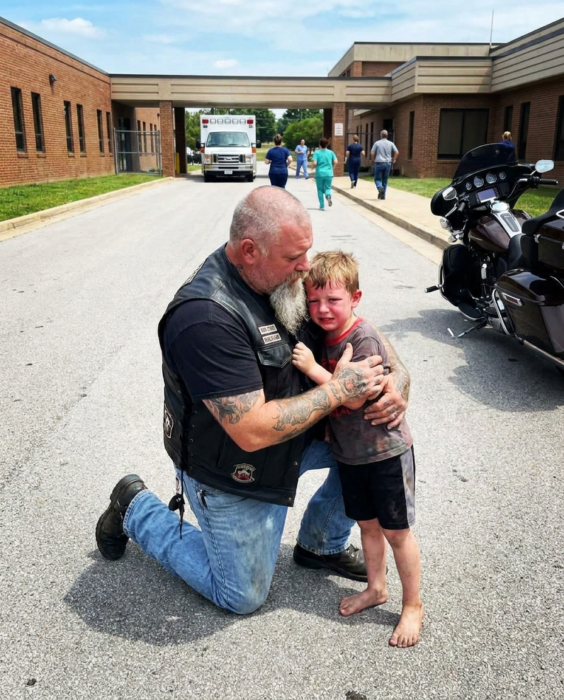
The nurse could not bring him into the treatment area, but she found a chair near the doorway and promised to return with updates. Rook placed Noah there, then knelt to inspect his feet.
The soles were raw.
Tiny stones remained embedded near one heel. A crescent-shaped cut crossed the ball of his right foot, and dirt filled the shallow scrapes along both arches.
Noah watched Rook clean them with sterile water.
“Are you a doctor?”
“No.”
“You know how to do this.”
“I know road rash.”
“Is that what this is?”
“Smaller version.”
Noah accepted that.
A nurse applied ointment and bandages. When she asked where his shoes were, he explained that one sandal strap had snapped while he was walking home from school the previous week.
“Why didn’t you wear the other pair?”
“I only have those.”
Rook’s hands stopped.
Noah immediately added, “Grandma was going to buy some. She didn’t forget.”
The defense came too quickly.
Children living close to poverty often protect adults from accusations nobody has made.
Rook asked about school, food, neighbors, and whether Evelyn took medicine. Noah knew more about her routine than most ten-year-olds should. He reminded her to take blood-pressure pills. He checked the front-door lock. He heated canned soup on evenings when arthritis made her hands stiff.
They took care of each other.
It was not neglect.
It was a household balanced on two people, one old and one young, with no room for either to fall.
The social worker discovered that Evelyn had temporary guardianship documents naming a church friend who had died the previous year. No current backup guardian existed.
If Evelyn remained hospitalized, Noah might enter emergency foster placement.
He overheard that phrase.
“What’s foster placement?”
Rook looked at the social worker.
She answered carefully. “A safe family who can look after you while your grandmother gets treatment.”
“I can stay home.”
“You can’t stay alone.”
“I know how to cook eggs.”
“That isn’t the issue.”
Noah’s breathing accelerated.
Rook sat beside him.
“Nobody’s moving you tonight.”
The social worker looked at him. “We cannot promise that.”
Rook turned slowly.
“I can.”
“Are you a relative?”
“No.”
“Licensed foster parent?”
“No.”
“Then you cannot promise anything.”
She was right.
Rook knew it.
He still did not withdraw the promise.
Instead, he called his wife, Mara.
Mara Mercer had spent twenty-two years married to a man who turned ordinary errands into emergency projects. She listened while Rook explained Noah’s situation.
“We still have an active foster certification,” she said.
They had completed the process two years earlier to care for a club member’s grandchildren during a custody crisis. Their home remained approved pending a routine renewal check.
Mara called the county office.
Paperwork began moving.
While she handled Noah, Rook returned to Aaron.
The young paramedic stood near the ambulance bay completing reports. Sparrow’s patch rested on the clipboard beside him.
“You carry that every shift?” Rook asked.
Aaron nodded.
“Your dad gave it to you?”
“No. You did.”
Rook frowned.
“At the funeral. You handed me his cut. Mom couldn’t look at it, so I removed one patch before she packed everything away.”
Aaron turned the small cloth over.
The back held old black thread and a faint rust-colored stain.
“He wore it the night he died.”
Rook knew.
The stain was probably from the clubhouse floor or the support truck. He remembered holding Sparrow against his chest while Cole drove through rain. He remembered begging a man who was already unconscious to remain angry, remain stubborn, remain anything except gone.
We blamed the ambulance delay.
We also blamed ourselves.
Sparrow had complained of pressure in his chest earlier that evening. He called it indigestion. We believed him because accepting the easier explanation required less courage.
By the time he collapsed, time had already narrowed.
Aaron became a paramedic because he believed faster care might change somebody else’s ending.
He had spent seven years working inside the same understaffed district that failed to reach his father.
“One ambulance for forty thousand people?” Rook asked.
“One staffed ambulance,” Aaron clarified. “There’s an old backup vehicle, but the transmission is gone, the electrical system fails inspections, and there’s no budget to replace it.”
“What happens when you’re on a call?”
“Neighboring districts cover if available.”
“And if they’re not?”
Aaron looked toward the doors through which Noah had been carried.
“People wait.”
Rook picked up Sparrow’s patch.
“We’re done waiting.”
Evelyn’s stroke was severe.
A clot blocked blood flow to the left side of her brain. The ambulance arrived within the treatment window, and the emergency team administered medication before transferring her for a procedure.
Those minutes saved her life.
They did not leave her unchanged.
The neurologist met Noah, Rook, Mara, and me inside a consultation room shortly before midnight. Evelyn was stable, but her right side remained weak. Speech came slowly. Rehabilitation would take months.
Noah understood only part of it.
“Can she come home tomorrow?”
“No,” the doctor said.
“Next week?”
“Probably not.”
“Will she walk?”
“We hope she’ll regain some movement.”
“That means you don’t know.”
The doctor nodded. “It does.”
Noah stared at the floor.
Mara reached toward him but stopped, allowing him to choose the distance.
He moved closer on his own.
That night, Noah went home with Rook and Mara under an emergency kinship-like foster arrangement approved through the county. They were not related, but the social worker documented the connection through Evelyn and the club’s immediate involvement.
Noah carried only his purple school bag.
Rook retrieved the broken sandals from Evelyn’s house.
The left strap had torn completely away from the sole. The right sandal was worn paper-thin near the heel. They were too small.
Rook placed them in his saddlebag anyway.
The next morning, Mara bought Noah two pairs of sneakers, socks, pajamas, and school clothes. Noah thanked her for everything except the shoes.
He held the new sneakers but would not put them on.
“Wrong size?” she asked.
He shook his head.
“Wrong color?”
“No.”
“What is it?”
Noah looked toward the saddlebag where Rook had stored the sandals.
“Grandma promised.”
Mara understood.
Accepting new shoes felt like admitting Evelyn might not return to fulfill that promise.
She placed the box beside his bed.
“They’ll wait.”
Noah wore borrowed slippers to the hospital.
Evelyn opened her eyes during the visit. Her right arm remained still. One side of her mouth sagged. When she saw Noah, tears gathered near her temple.
He approached carefully.
“I stayed with bikers.”
Evelyn tried to speak.
Only a few sounds emerged.
Noah nodded as if he understood.
“They bought shoes, but I didn’t wear them.”
Rook stood in the doorway.
Evelyn saw the leather cut and fear entered her face. She could not ask who he was or why her grandson lived in his house.
Rook removed the vest.
“My wife Mara is caring for Noah,” he said. “County approved. He’s safe.”
Evelyn’s gaze stayed fixed on him.
“No one’s taking him away,” Rook continued.
Her fingers moved against the blanket.
Noah placed his hand over hers.
The crisis should have ended there. Evelyn lived. Noah had shelter. Rehabilitation had begun.
Then the county caseworker called.
The Mercers’ foster certification required renewal. A decades-old assault conviction on Rook’s record had triggered additional review. He had earned it during a bar fight at twenty-two, completed probation, and avoided serious trouble for more than thirty years.
The review still mattered.
Until it finished, Noah might be moved.
Rook did not ask the club to intimidate anyone. He hired a family-law attorney, submitted every record, and accepted home inspections.
Noah overheard another call.
That evening, he packed his school bag.
Mara found him near the back door.
“Where are you going?”
“If I leave before they come, you won’t get in trouble.”
“You’re ten.”
“I ran to the hospital.”
“That does not qualify you for independent living.”
He gripped the bag strap.
“Everyone leaves after they promise.”
Mara sat on the floor so she would not tower above him.
“Your grandmother didn’t leave.”
“She’s in the hospital.”
“She survived.”
“My mom left.”
“She died, honey.”
“She still left.”
Mara’s face tightened.
There was no clean answer.
She held out her hand.
Noah did not take it.
Rook entered from the garage carrying the broken sandals and a small repair kit. He sat at the kitchen table without speaking.
He cleaned the soles.
He cut two leather straps from an old motorcycle bag.
He punched holes, threaded them through the sandals, and fastened them with small brass rivets. The repair was ugly. Strong, though.
Noah watched.
Rook placed the sandals on the floor.
“Things break,” he said. “Doesn’t mean they’re finished.”
Noah unpacked his bag.
Two days later, the placement was approved.
The next problem was money.
Evelyn’s pension barely covered rent. Medicaid helped with medical care, but long-term in-home assistance was limited. Returning Noah to her house would require ramps, bathroom modifications, therapy transportation, and daily caregiving support.
The club held a meeting.
Some members offered money. Others offered labor. One suggested Evelyn enter a nursing facility while Noah remained permanently with the Mercers.
Rook rejected decisions made without her.
“She has half her body working,” he said. “Not half her rights.”
Marcus, our former Army medic, arranged for a patient advocate to communicate with Evelyn using picture boards and simple questions.
She wanted rehabilitation.
She wanted Noah home eventually.
She accepted help.
That became the plan.
Aaron visited the clubhouse two weeks later.
He arrived without the ambulance and wore civilian clothes. Sparrow’s patch remained in his shirt pocket.
The building still held traces of his father. An old photograph showed Sparrow rebuilding a carburetor. His initials were scratched beneath a workbench. A dent in the refrigerator came from the night he tried opening a bottle against its handle and lost.
Aaron touched the dent.
“I forgot this place smelled like oil.”
“And bad decisions,” Cole said.
Aaron smiled.
It was the first time we saw Sparrow in his face.
Rook showed him the broken sandals, now repaired with motorcycle leather. They sat beside the box of new sneakers Noah still had not worn.
“What do shoes have to do with an ambulance?” Aaron asked.
“Nothing.”
“Then why are they on the meeting table?”
“Because a kid ran three kilometers behind yours.”
The club had begun researching the cost of a second ambulance. A new fully equipped unit exceeded anything we could raise quickly. A reliable refurbished vehicle cost less but still required hundreds of thousands of dollars once equipment and staffing were included.
Buying a truck would not solve everything.
The district needed paramedics, maintenance funds, licensing, insurance, and long-term operating support.
Rook hated complicated kindness.
You could repair a motorcycle, hand it over, and know it ran.
Systems ate good intentions.
Aaron explained the reality.
“If you donate an ambulance without a staffing plan, it becomes another dead vehicle behind the station.”
“What does a workable plan cost?”
Aaron gave him the number.
Silence followed.
Tank leaned back. “We’d need every club in three counties.”
“Then call them,” Rook said.
We formed the Sparrow Second Unit Fund.
Aaron objected to the name.
“My father wasn’t the only person who waited.”
“No,” Rook said. “But he’s the one we remember.”
The campaign began with a benefit ride. Then restaurants hosted collection nights. Construction companies donated. A local foundation offered matching funds if the district committed to hiring and training additional staff.
The town council hesitated.
Budgets were tight. Ambulance calls were expensive. Officials feared accepting a vehicle would create obligations they could not sustain.
They were not wrong.
Rook attended the council meeting wearing a clean shirt instead of his cut. Noah sat beside Mara in new sneakers for the first time.
The repaired sandals rested in his backpack.
Aaron presented response-time data. When the district ambulance was already occupied, average waits doubled. During severe weather, they grew longer.
A council member asked whether one delayed death justified permanent spending.
The room chilled.
Aaron reached into his pocket and placed Sparrow’s patch on the table.
“My father died ten years ago while the ambulance was somewhere else,” he said. “I don’t know whether a faster response would have saved him. That uncertainty is what I’ve carried into every shift.”
He looked toward Noah.
“Evelyn Carter lived because we were available. Her grandson ran behind us because we had no safe way to take him. While we treated her, this district had no ambulance left.”
The council approved the staffing commitment by one vote.
Fundraising accelerated.
Noah contributed first.
He arrived at the clubhouse with a plastic bag of coins—$14.36 from chores and returned bottles.
Rook refused.
Noah pushed the bag toward him.
“You let me help Grandma.”
“This is different.”
“No. Somebody else might have a grandma.”
Rook accepted one penny.
He returned the rest.
“Every fund needs a first dollar.”
“That’s not a dollar.”
“Inflation.”
Noah rolled his eyes.
The penny went into a display case with Sparrow’s patch.
Six months after the hospital gate, the club reached its fundraising target. A regional medical foundation covered the final gap. The district purchased a refurbished ambulance with modern cardiac equipment, stroke-response supplies, and safer seating for family members when protocols allowed.
Aaron inspected it before delivery.
The new unit arrived during a community ceremony.
Rook refused the oversized presentation key.
“Real key works?”
The administrator handed it over.
Rook gave it directly to Aaron.
The crowd expected him to start the ambulance.
Instead, Aaron walked toward Noah.
“You do it.”
Noah climbed into the driver’s seat under supervision. His feet did not reach the pedals. He turned the ignition key.
The engine started.
No siren.
No flashing show.
Just a steady diesel rumble.
Aaron stood beside the open door with tears in his eyes.
Ten years earlier, the club drove his father toward a hospital and arrived too late.
Now his hand rested on the door of a vehicle meant to prevent someone else from inheriting the same memory.
Evelyn spent four months in inpatient rehabilitation.
Speech returned unevenly. She could form short sentences, though fatigue stole words. Movement came back in her right leg before her arm. With a brace and therapist support, she learned to stand.
Noah visited every afternoon he could.
He wore the new sneakers but carried the repaired sandals inside his backpack. Evelyn had promised to replace them, and in his mind that promise remained tied to her recovery.
One day, she pointed toward the bag.
“Why… keep?”
“You were going to buy new ones.”
Evelyn looked at his shoes.
“Got new.”
“Rook bought them.”
She worked through the sentence slowly.
“Promise… completed.”
Noah shook his head.
“You didn’t buy them.”
Evelyn raised her left hand and pointed toward Rook in the doorway.
“Asked… help?”
“No.”
“Help… came.”
Noah considered that.
Evelyn tapped the backpack.
“Keep old. Wear new.”
He did.
The club renovated her house. Volunteers built a ramp, widened two doorways, installed grab bars, lowered kitchen shelving, and rearranged the living room.
Rook paid a licensed contractor to inspect everything.
“No hero carpentry,” he said.
A caregiving fund covered morning assistance while Evelyn rebuilt independence. Mara and Rook remained Noah’s official foster family during the transition, but Evelyn shared decisions and visited their house every weekend after discharge.
Nobody treated her as if paralysis erased motherhood.
After one year, Evelyn could walk short distances with a quad cane and an ankle brace. Her right arm remained limited. She needed help with some daily tasks.
She returned home.
Noah did too.
The Mercers did not disappear.
They became godparents in every way except the religious paperwork. Noah spent weekends at the clubhouse, learned basic motorcycle maintenance, and called Mara whenever Evelyn’s health frightened him.
The second ambulance entered service the same month.
Its first major call involved a factory worker experiencing chest pain while the original unit transported a crash victim thirty miles away.
Aaron drove the new ambulance.
The patient survived.
Aaron later placed the dispatch record beneath Sparrow’s patch for one night, then removed it because medical privacy mattered.
Rook asked only one question.
“In time?”
Aaron nodded.
“In time.”
Those words settled something none of us could name.
The district tracked results over the next five years. Response delays during overlapping emergencies fell sharply. The second unit assisted with strokes, cardiac events, workplace accidents, difficult births, and winter crashes.
It was never called Sparrow’s ambulance officially.
Everyone called it that anyway.
Noah grew stronger too.
At eleven, he began running with his school athletics club. His coach noticed he had endurance but panicked whenever he heard a siren.
They worked slowly.
He learned to stop, breathe, and remind himself that an ambulance moving away did not always mean abandonment.
For his first organized three-kilometer race, Evelyn waited near the finish using her cane. Rook stood beside her with the broken sandals looped over one forearm.
Noah crossed the line wearing proper running shoes.
He did not collapse.
He walked directly to his grandmother.
She hugged him with her functioning left arm.
Aaron attended in uniform between calls. Sparrow’s patch remained in his pocket.
After the race, Noah asked why he still carried it.
Aaron answered, “So Dad gets to finish the shift.”
Noah opened his backpack and showed him the sandals.
“So Grandma gets to finish the walk.”
Aaron nodded.
They understood each other.
The hospital gate changed after Noah’s run.
A covered bench appeared near the entrance. A telephone connected directly to hospital security. The ambulance service created clearer procedures for minors found alone during family emergencies.
Those changes were smaller than a second ambulance.
They mattered.
Rook visited the gate every year on the anniversary of Evelyn’s stroke. He never organized a ride. He simply parked his Harley, sat on the bench, and checked whether the telephone worked.
Noah usually joined him.
At first, they spoke about Evelyn. Later, they spoke about school, motorcycles, fear, and the difference between running toward someone and running from what might happen.
Rook gave few answers.
He was better at staying.
The broken sandals eventually became too fragile to carry every day. Noah cleaned them and placed them inside a clear case at the clubhouse.
Beside them sat Sparrow’s patch and the penny from the ambulance fund.
Three objects.
A pair of shoes that failed.
A piece of cloth carried through ten years of grief.
One cent that helped buy nothing but represented everyone who chose to add more.
New club prospects heard both stories together.
Sparrow did not survive the drive.
Evelyn did.
The difference was not moral. It was not proof that one person deserved life more. It was time, medicine, circumstance, and whether help happened to be available.
That truth kept us humble.
Aaron became station supervisor. He trained new paramedics never to promise outcomes.
“Promise effort,” he told them. “Promise presence. Don’t promise what a body will do.”
He kept Sparrow’s patch inside a protective sleeve, still carried over his heart.
The second ambulance accumulated scratches, repaired panels, and thousands of miles. Each mark meant it had gone somewhere.
Rook liked that.
“Clean machines haven’t worked,” he said.
Every year, the club funded part of its maintenance. The town funded the rest. What began as a donation became shared responsibility.
That was the only reason it lasted.
Ten years after Noah collapsed at the hospital gate, he returned in an emergency-medical uniform.
He was twenty.
Tall now. Strong. Still fast.
Evelyn sat beneath the covered entrance in a wheelchair, her cane resting across her lap. She had regained enough movement to live mostly independently, though age had complicated what the stroke began.
Rook stood beside her.
His beard had turned white. His knees hurt. His Harley had three wheels now, though he referred to it as “temporary” after four years.
Aaron waited near the ambulance bay.
Noah had completed his emergency medical technician training and chosen Beckford for his first job.
During orientation, Aaron handed him a small radio, gloves, and a station key.
Rook gave him nothing.
“You forgot the ceremony gift,” Noah said.
Rook pointed toward the clear case inside the station lobby.
The broken sandals had been moved there for the day. Sparrow’s patch lay beside them. The penny rested beneath both.
“You already kept it,” Rook said.
Their first shift together remained quiet until late afternoon.
Then a call came from County Road 8.
An elderly man had fallen. His granddaughter was alone with him.
Aaron drove the original ambulance.
Noah followed in the second.
Two vehicles.
No waiting.
As they pulled away, Evelyn watched the lights disappear through the gate. Rook rested one scarred hand on her wheelchair.
Years earlier, a boy had chased those lights because he believed love meant never allowing distance.
Now he rode inside them.
The broken sandals remained behind glass.
Their straps were still repaired with leather cut from an old motorcycle bag. Dust from the three-kilometer run remained embedded near the soles because Noah refused to let anyone scrub it away.
That dust proved the distance.
The second ambulance proved it did not need repeating.
Its siren faded toward County Road 8.
This time, help was already coming.
Want another full biker story? Drop SPARROW in the comments and follow the page—more unforgettable stories of brotherhood are coming soon.