The Old Man Was Asked to Leave the Restaurant for “Not Having Enough Money” — Minutes Later, the Manager Realized He Was the One Who Once Saved Him
The old man carefully folded his napkin, stood up from the table before finishing his meal, and quietly said, “It’s alright… I understand,” after the manager told him he couldn’t afford to stay.
Every fork stopped.
The restaurant wasn’t loud to begin with, but now it fell into a kind of silence that didn’t feel polite. It felt… watchful.
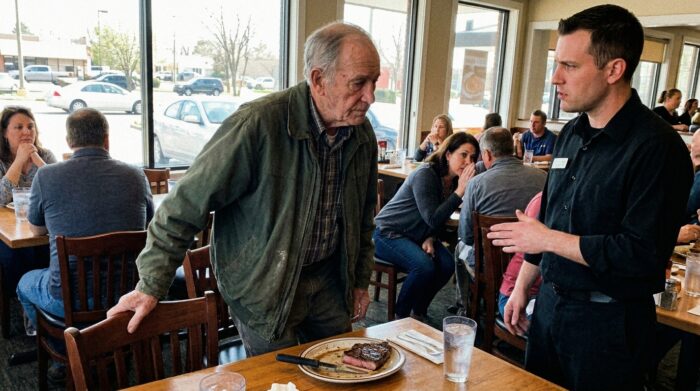
The place was one of those mid-range American diners trying to look upscale—polished wood tables, soft jazz in the background, servers dressed in black aprons pretending this wasn’t just another long shift.
And right there, near the center window, stood the old man.
He didn’t look dangerous.
But he didn’t look like he belonged either.
His coat was worn at the sleeves. Not torn—just… tired. The kind of fabric that had been cleaned too many times and had stopped remembering what new felt like. His shoes were polished, but unevenly. His hands—large, slightly trembling—rested gently on the back of the chair, as if asking permission to leave.
“You should have checked the menu first,” the manager said, not loudly, but loud enough.
Enough for people to hear.
Enough for people to look.
A woman at the next table leaned toward her husband.
“He ordered the steak,” she whispered.
Of course he did.
That made it worse.
The most expensive thing on the menu.
The old man didn’t argue.
Didn’t explain.
Didn’t even look embarrassed in the way people expected. No raised voice. No defensive gestures. No sudden panic.
That was what made some people uncomfortable.
Because if he wasn’t ashamed… then what was he?
“Sir, we can’t just give away food,” the manager added, his tone tightening slightly. “You need to settle the bill.”
The old man nodded once.
Slow. Thoughtful.
Then he reached into his coat pocket.
For a second, the room held its breath.
Was he going to pull out money?
Or nothing at all?
His fingers searched… paused… then withdrew empty.
A few people shifted in their seats.
Someone scoffed softly.
There it was.
The confirmation.
The story everyone had already written in their heads.
A man who didn’t belong.
A man who tried to take advantage.
A man who thought kindness was weakness.
“Then I’ll step outside,” the old man said quietly.
And something about the way he said it—so calm, so final—made it feel less like he was being removed…
and more like he was choosing to disappear.
The strange part wasn’t that he left.
It was how he left.
No rush.
No shame.
No apology repeated more than once.
Just a small nod to the server who had brought him the plate, as if thanking her for something larger than a meal.
“Sorry,” she whispered as he passed.
He gave a faint smile.
“It’s alright, miss.”
That was the first detail that didn’t fit.
Most people in that situation either got defensive… or broke.
He did neither.
Outside, the afternoon light was soft. The kind that makes everything look a little kinder than it really is. The old man stood near the glass window, not walking away immediately.
Just standing there.
Looking in.
At the table he had just left.
At the half-finished plate.
At the world that had decided, in a few seconds, who he was.
Inside, the manager exhaled sharply and turned away.
“Some people…” he muttered.
But the sentence didn’t finish.
Because something small caught his eye.
The napkin.
Folded neatly.
Too neatly.
The manager walked back toward the table, almost without thinking. He picked it up, unfolded it once.
Then paused.
There was something inside.
A small, thin envelope.
Old. Slightly yellowed at the edges.
Not money.
Not exactly.
He hesitated.
Then opened it.
Inside was a photograph.
Faded.
Worn.
The kind people carry for years without replacing.
The image showed a younger man—maybe in his twenties—lying on a hospital bed, eyes closed, oxygen mask pressed against his face. Next to him stood another man, older, holding his hand.
Not smiling.
Just… there.
The manager frowned slightly.
There was something about the photo.
Something familiar.
But memory is a strange thing.
It doesn’t arrive all at once.
It knocks.
Softly.
He flipped the photograph over.
There were words written on the back.
Faded ink.
Shaky handwriting.
“You stayed when no one else did.”
That was the second detail.
And now… something shifted.
Not in the room.
Inside him.
Because suddenly, the way the old man had stood… the way he had looked… the quietness, the restraint—
It didn’t feel like weakness anymore.
It felt like something else.
Something… deliberate.
The manager looked toward the window.
The old man was still there.
Not leaving.
Just waiting.
As if time, for him, moved differently.
The memory didn’t come back as a full picture.
Not at first.
Just fragments.
A hospital smell.
White lights.
A beeping sound that wouldn’t stop.
And fear.
So much fear.
The manager—back then just a young man with nothing but stubborn pride—had been in a car accident. Late night. Rain. One bad decision too many.
The doctors had done what they could.
But there had been a night…
A long, quiet night…
when things had almost ended.
And most people had gone home.
Friends.
Even family.
Because waiting is hard when you don’t know if it matters.
But someone had stayed.
A man.
Not family.
Not close.
Just… there.
Sitting in the chair beside the bed.
Through the night.
Through the silence.
Through the moments when it looked like there might not be a morning.
The manager’s hand tightened around the photograph.
His breath shortened slightly.
Because now the face in the picture…
wasn’t unfamiliar anymore.
It was just older.
Worn.
Changed by time.
But unmistakable.
The old man.
The one he had just asked to leave.
The realization didn’t hit like a shock.
It sank.
Slowly.
Heavier with every second.
Because what made it unbearable wasn’t just recognition.
It was the silence.
The old man hadn’t said anything.
Not when he walked in.
Not when he ordered.
Not when he was questioned.
Not even when he was asked to leave.
No “You don’t remember me.”
No “I saved you.”
No demand.
No reminder.
Just… acceptance.
That was what made it hurt.
Because it meant one thing.
He hadn’t come for recognition.
He hadn’t come for gratitude.
He had just come… like any other person.
And been judged.
Like he didn’t matter.
The manager looked up.
The old man was still outside.
Standing quietly.
Waiting for nothing.
And everything.
The door opened quickly.
Too quickly.
A few heads turned.
The manager stepped outside, the photograph still in his hand.
For a moment, neither of them spoke.
The street noise felt distant.
Muted.
Like the world had stepped back to let something else happen.
The old man looked at him.
Calm.
No anger.
No expectation.
Just that same quiet presence.
The manager swallowed.
“I… I didn’t realize,” he said.
It sounded small.
Too small.
The old man glanced briefly at the photo in his hand.
Then back at him.
“You weren’t supposed to,” he replied.
Simple.
No bitterness.
That was the hardest part.
The manager’s voice tightened slightly.
“You should’ve said something.”
A pause.
The old man’s eyes softened… just a little.
“And what would that change?”
No accusation.
Just a question.
One that didn’t need an answer.
Inside the restaurant, people were watching through the glass now.
Curious.
Uncomfortable.
Quiet.
The manager looked down at the photograph again.
At the younger version of himself.
At the man beside him.
The man who had stayed.
Then he looked up.
And for the first time, he didn’t see a poor old man.
He saw someone who had once chosen to sit in a hard chair all night…
for a stranger.
“Please,” the manager said, his voice steadier now. “Come back inside. Dinner’s on me.”
The old man smiled faintly.
Not wide.
Not dramatic.
Just enough.
“I already had what I came for,” he said.
And then—
he turned.
Slowly.
And walked away.
No rush.
No hesitation.
Just a man continuing his day.
The manager stood there for a long time after that.
The door behind him still open.
The photograph still in his hand.
And inside, the table with the untouched meal…
felt heavier than anything on the menu.