Part 2: An Orphan Asked to Borrow a Dad for Graduation So Someone Could Teach Him to Tie a Necktie — Then an Entire Biker Club Arrived Wearing Theirs Crooked
Part 2 — The Things a Letter Could Not Ask For
The envelope arrived on a Monday while I was replacing a rear brake line.
I remember that because a spot of brake fluid landed on the corner, and for the next four days I hated myself for not washing my hands before touching it. Ben had drawn a little square around the address, as if neatness might increase the chances of an answer.
There were no spelling jokes to make. No adorable mistakes for adults to share. He had worked hard on that letter, and you could see the effort in the places where he erased whole sentences and began again.
Along the bottom, beneath Ruth’s phone number, he added something I had not read aloud to the club.
I already have a dad. I only need help doing what he was going to do.
I folded the paper and put it inside my vest.
That was the part I carried into Ruth’s house the following afternoon.
Her porch sagged at one corner, but every board had been swept. Tomatoes grew in plastic buckets, and somebody had painted a small wooden sign for each variety. Through the screen door I could hear a radio, the clink of dishes, and a boy asking whether he should put his shoes on.
Ruth opened the door before I knocked twice.
“You’re taller than I expected.”
“I get that.”
“Good. The top kitchen cabinet sticks.”
It was an introduction I understood.
I fixed the cabinet before we discussed anything else. A loose hinge needed two turns of a screwdriver. Ruth inspected my work, then pointed me toward a chair that looked too small to survive our meeting.
Ben watched from the hallway.
He wore a school T-shirt, jeans, and socks with a hole over one heel. His expression was not excitement. It was the caution of someone who had already imagined being disappointed.
Ruth called him in.
“This is Mr. Mercer.”
“Rook is fine.”
“Not until I know whether you’re staying for supper,” she said.
She was not hostile. She was measuring me.
We talked while Ben lined three toy cars along the edge of the table. Ruth had worked in a school cafeteria for twenty-eight years. Her son Daniel repaired commercial refrigerators. His wife, Claire, had driven a city bus.
They died on an icy road while returning from an anniversary dinner. Ben had been asleep at Ruth’s house, wearing pajamas with construction trucks on them.
He still lived in the same bedroom.
Ruth told me these things plainly. She did not lower her voice as though the dead became more dead when children heard their names.
“Daniel had bought that tie for a job interview,” she said. “Ben wants to wear it Thursday.”
“I don’t have to,” Ben interrupted.
Ruth looked at him. “You’re allowed to want it.”
He stared at the toy cars.
The tie itself lay inside a shoe box on the kitchen counter. Navy blue, narrow silver stripes, a small worn patch on the lining. A red thread secured a repair near the pointed end.
I asked whether I could pick it up.
Ben nodded.
It weighed almost nothing. He watched my hands as if it weighed everything.
He had tried following a tutorial on Ruth’s phone. The screen kept turning off, the man in the video went too fast, and the mirrored image confused him. Ruth tried helping, but her arthritis made the tight folds difficult, and neither of them had learned the knot properly.
A teacher offered him a clip-on.
It was a kind offer.
It was not the same tie.
That distinction was the entire story to Ben, though adults had kept treating it like a clothing problem.
I told them I needed practice too. Ruth studied me over her glasses.
“Can you do this?”
“I can learn.”
“That wasn’t my question.”
I understood then. She was not asking about a necktie.
She wanted to know whether I would still be there when the task became inconvenient, when Thursday required leaving work, when a grieving child behaved like a grieving child instead of making adults feel appreciated.
“Yes,” I said. “Thursday at eight. Earlier if you need.”
Ben pushed one toy car forward.
“Do you have kids?”
“A son. Daniel.”
He looked up at the name.
“My dad was Daniel.”
“I know.”
“Do you see yours?”
There were plenty of easy answers. He lives out of town. We’re both busy. Families are complicated.
I used none of them.
“Not much. I wasn’t a good father when he needed me.”
Ruth stopped wiping the table.
Ben asked, “Did you die?”
“No.”
“Then you can still call him.”
He returned to the cars, apparently finished with the matter.
I sat with that sentence longer than he knew.
My drinking had not taken everything at once. It took evenings, then weekends, then credibility. By the time I got sober, my son had learned to build a life around the space where my promises failed.
Eleven sober years mattered.
They did not refund his childhood.
When I left Ruth’s house, Ben followed me to the porch with the two dollars from his letter. I had returned them on the table.
“You forgot.”
“No charge.”
He frowned. “I have more in my bank.”
“I believe you.”
“Then why won’t you take it?”
“Because teaching somebody isn’t always a job.”
He considered that, then tucked the money into his pocket.
At the gate, Ruth stopped me.
“Don’t make him your second chance,” she said quietly.
The sentence landed where it belonged.
“He’s not,” I told her.
She held my eyes a moment longer.
“Then come Thursday for him.”
Part 3 — The Knot We Could Not Get Right
By Tuesday night, I owned four neckties and disliked all of them.
One was too slippery. One was too short. One had tiny golf clubs on it, which our treasurer, Mae, found hilarious because I had never voluntarily walked that far without a motorcycle nearby.
The fourth was burgundy, plain, and inexpensive.
I practiced with it beneath the clubhouse bathroom light.
Wide end across. Around. Up through the loop. Down through the front.
My fingers knew brake fittings, throttle cables, welding clamps, and how to open a stubborn jar without asking. Silk turned them into strangers.
After the seventh attempt, I came out wearing a knot the size of a walnut and a narrow end hanging below my belt.
Moose looked up from his coffee.
“Good. The tie can check your oil.”
Twenty-four of us belonged to the High Plains Riders. Twenty-two men and two women, ranging from a thirty-year-old forklift mechanic to a retired mail carrier who claimed weather was mostly a matter of attitude.
They laughed until Mae told them to try.
Within fifteen minutes, our meeting room looked like a discount menswear store after a small earthquake.
Moose could tie a perfect knot because his mother had made him wear one to church. Hector knew three different knots and could explain none without making them sound like transmission repairs. June, a former bus driver, tied hers in ten seconds and offered no sympathy.
Walt had kept his funeral tie knotted for nine years.
“Nine?”
“It still works.”
“So does my porch light,” Mae said. “I turn it off sometimes.”
For a while, the room was only laughter, coffee, and grown people learning something ordinary.
Then Moose asked where the boy’s father was.
I told them.
I did not read the letter. Ben had asked for help, not an audience. But I shared the request, with Ruth’s permission, and explained Thursday.
The laughter settled.
Walt looked down at the knot he had refused to undo.
“My dad did this one,” he said.
Nobody made another joke about it.
His father had died nine years earlier. The last surviving piece of instruction was still looped around Walt’s neck.
He unfastened the tie slowly and placed it on the table.
“Show me again,” he told June.
On Wednesday afternoon, I returned to Ruth’s for a practice session. Ben had arranged two chairs before the hallway mirror. He had also washed his hair, which made me feel worse about arriving with chain grease behind one ear.
We tried the knot together.
The first attempt came apart.
The second left the wide end near his stomach.
On the third, I corrected him too quickly.
“No, not over. Under. Hold it there—”
Ben dropped both ends.
His expression closed.
“I know.”
I had heard that tone in my own son years earlier, usually just before I mistook embarrassment for disrespect.
This time I stopped.
“Want a minute?”
“No.”
He pulled at the tie again. The old lining caught on his thumbnail, and a tiny thread lifted near Ruth’s repair.
Ben went pale.
He took it off, folded it badly, and returned it to the box.
“I don’t want to wear it.”
Ruth stepped out of the kitchen but stayed back.
“That’s okay,” I said.
“I don’t want to go either.”
“That’s your decision to talk through with Grandma.”
“You can leave.”
So I did not deliver a speech. I did not tell him his father would be disappointed or proud or watching. I set my practice tie on the chair and walked to the porch.
Ruth joined me after a minute.
Behind her, Ben’s bedroom door closed.
“The seam is fine,” she said. “He thinks anything belonging to them has to stay exactly the same.”
I understood the box differently then.
The watch that no longer worked. The tie folded along old creases. The photograph handled only at the edges.
Ben was not preserving possessions.
He was trying not to lose anything twice.
Ruth sat beside me.
“People gave him so much after the accident. Food. Toys. School supplies. He thanked everybody until his mouth hurt.”
She watched a car pass.
“Now he thinks needing something is how you wear people out.”
I looked at my motorcycle by the gate.
The letter’s promise to return me had seemed like a child’s misunderstanding. It was also a bargain. He would make his need brief. He would be easy. He would not ask for more than anyone could bear.
“Should I still come tomorrow?”
“I’ll ask him.”
She did, and Ben said he would think about it.
Back at the clubhouse, I told the others I might not be attending after all. Mae was sorting tools for a Thursday morning repair visit at a housing complex for older residents. Four riders had arranged leave from work. Two had bought ties.
Moose said, “Maybe we show up and prove—”
“No,” I interrupted.
He stopped.
“If he says no, we respect it.”
The room grew uncomfortable. We were good at moving toward trouble. Waiting outside another person’s decision was harder.
Hector leaned against the workbench.
“We can still keep the morning clear.”
That was the first useful thing anyone said.
We rearranged the repair visit with the residents, moving the nonurgent work to afternoon. Mae called every household herself. Nobody was abandoned for a more photogenic act of kindness.
Two riders swapped shifts. June arranged a school-approved meeting area through Ruth, contingent on Ben wanting to come outside. The principal said the ceremony itself had assigned seating, but the side lawn would be available afterward.
We kept the motorcycles out of the children’s footpath.
We planned no banners.
No fundraising.
No public reading of the letter.
Then Mae looked at my crooked burgundy tie.
“Leave it.”
“I was going to fix it.”
“Maybe don’t be the only person having trouble.”
We discussed it carefully. We did not want Ben to think we were imitating him. The idea had to be an invitation, something he could laugh at or reject, not a joke built around his grief.
Ruth approved.
“He likes being useful,” she said. “Let him decide what to do with you.”
At nine that night, my phone rang.
Ben was on the line.
“Can we try once more?”
“Of course.”
“Without the fast part?”
I looked at the knot hanging from our bathroom mirror.
“We can take all morning.”
Part 4 — One Guest Inside, Twenty-Three Outside
I reached Ruth’s porch at seven fifty-five Thursday morning.
Ben had been waiting since seven-thirty.
He opened the door wearing his white shirt untucked, black pants a little too long, and a look of cautious accusation.
“You’re early.”
“Trying something new.”
Ruth handed me coffee.
Ben had placed the blue tie beside my burgundy one. The shoe box sat open, and for the first time, the watch and photograph were not hidden beneath tissue paper.
We stood before the mirror.
This time, I did not reach around his shoulders or take the fabric from his hands. I stood beside him and used my own tie.
We moved together.
He watched my reflection, then looked down at his fingers.
When he lost the loop, we loosened both knots and began again. When I forgot a step, he reminded me. We spent fourteen minutes doing something a practiced man could finish in thirty seconds.
It was the fourteen minutes he had asked for.
At last, Ben tightened the knot.
It held.
The triangle leaned toward his left shoulder, and the pointed end stopped a little above his waistband. It was not a magazine picture. It was his father’s tie around his own neck, tied by his own hands.
I lifted a finger.
“May I straighten—”
“Don’t.”
I stopped.
Ben studied himself.
“His was like that.”
Ruth went to the drawer.
She looked at a photograph, smiled in a way that hurt, then slipped it inside her purse.
“We’ll bring this.”
Ben turned toward me.
“Do I have to return you before lunch?”
That was when the letter finally became a person standing in front of me.
I explained that I was coming as his guest, not renting myself out under a contract. Ruth had invited me to lunch. If Ben wanted, I could stay.
He nodded quickly.
Then he asked whether I would get in trouble for missing work.
“I arranged it.”
“With your boss?”
“I’m the boss.”
“Then who tells you no?”
Ruth raised her hand.
Ben laughed.
It was the first full laugh I had heard from him, and the sound changed the kitchen more than any promise I could have made.
We drove separately to school. Ben rode with Ruth. I followed on my Road King, the burgundy tie tucked inside my vest until I parked.
The school had balloons beside the entrance and a paper banner made by children. Parents carried bouquets, flowers from grocery stores, cameras, diaper bags, and younger siblings already complaining about the heat.
Nobody barred the door because I wore leather.
One father looked at me twice. A little girl asked whether my motorcycle was louder than her uncle’s truck. The receptionist checked my name against the guest list, smiled, and directed me to the gym.
Ordinary courtesy can be its own surprise.
Ben’s teacher, Ms. Alvarez, met us at the hallway corner.
“You figured out the tie.”
“Mostly,” Ben said.
She did not touch it.
“Looks like yours.”
He stood a little straighter.
Inside the gym, Ruth sat beside me with her purse in her lap. The chair on her other side held Ben’s jacket until the students entered. Nobody announced what I was doing there. Nobody described me as a substitute father.
I was simply a person in his row.
The ceremony was exactly what an elementary-school ceremony should be. The microphone squealed. A child waved for too long. Someone forgot which direction to walk. The principal spoke about middle school while half the parents checked where their own children were sitting.
Ben found us.
He looked at Ruth first.
Then me.
Then at the crooked knot below my beard.
He smiled and turned toward the stage.
I had imagined feeling useful. Instead, I felt ashamed for every time I had believed showing up required a grand gesture.
My son had not needed grandeur either.
He had needed a chair occupied.
When Ben’s name was called, Ruth gripped my arm so hard her ring pressed into the skin. He walked across the stage with his shoulders stiff and his tie leaning left.
I clapped.
Not louder than everybody else.
Long enough for him to hear.
Afterward, we waited while students collected artwork and parents searched for lost jackets. Ben returned carrying his certificate in a folder with one bent corner.
“Did you see?”
“Yes.”
“The whole thing?”
“Every step.”
He nodded, satisfied in a way I could not yet trust myself to look at directly.
Then the sound came through the open exit doors: a handful of engines entering the visitor lot, settling into low idle, then cutting off. The riders had waited at a diner nearby until the school gave the signal.
Ben looked at me.
Outside, twenty-three members of the High Plains Riders were removing helmets.
With me, the whole club was there.
No one had revved for attention. No one had blocked an exit. June and Mae stood nearest the lawn, talking with the principal while the others gathered beside their parked motorcycles.
Every rider wore a tie.
Every tie was crooked.
Some leaned left. Others leaned right. Moose’s stopped several inches above his belt. Walt’s old funeral tie hung in a loose knot he had finally learned to make himself.
Ben stopped on the steps.
“Are they laughing at me?”
I crouched so he did not have to look up.
“No. They’re willing to look silly with me.”
He scanned the faces.
“Why?”
“Because I told them somebody was teaching me. They wondered if there was room for a few more beginners.”
“If I don’t want to?”
“We thank you for inviting me, and they go eat lunch.”
His shoulders loosened.
For several seconds, he said nothing.
Then he pointed at Moose.
“That one needs help.”
Part 5 — The Knot His Father Had Refused to Fix
Moose was built like a refrigerator with boots.
He had a shaved scalp, a tattoo of a wren on his neck, and a beard that made small children either avoid him or ask whether birds lived inside it. That morning he wore a yellow tie patterned with tiny blue squares.
He could have tied it perfectly.
Instead, he had left the knot off-center and the ends mismatched, then waited without touching either.
Ben approached him cautiously.
“I can show you mine,” he said.
“Please.”
Moose knelt on the edge of the grass.
Twenty years earlier, I had watched him carry a motorcycle engine across a garage. Seeing him hold still while an eleven-year-old explained a knot required a different kind of strength.
Ben untied his father’s tie.
Ruth’s breath caught beside me.
Then he draped it around his collar and began again.
“Keep this side longer.”
Moose followed.
“No, your other longer.”
“Got it.”
“You don’t.”
“Also true.”
Ben laughed.
It spread through the group without turning him into the joke. Parents nearby smiled. A few children came closer, inspecting the motorcycles from behind the boundary the school had marked.
The principal stood beside Ruth.
“How many relatives does he have?” she asked quietly.
Ruth looked at the riders.
“I’ll need a bigger Christmas list.”
We took no photograph until Ben asked for one.
He wanted Ruth in the middle. Then he wanted me beside her, and Moose near the back because “he takes up too much picture.” The others arranged themselves around us, adjusting only their positions, not their ties.
Before the camera clicked, Ruth took the old photograph from her purse.
“I think you should see this first.”
The picture showed a young man on a front porch wearing a white shirt and the blue striped tie. Beside him stood a woman with her arm around a small boy.
Daniel. Claire. Ben.
Daniel’s tie leaned sharply left.
At first, I assumed he had struggled with the knot too.
Ruth turned the photograph over.
In Claire’s handwriting were five words:
Ben’s first knot. Dad’s lucky tie.
“He was five,” Ruth said. “Daniel was getting ready for an interview. Ben insisted he could help.”
Ben studied the image.
“I remember standing on a chair.”
“You kept wrapping the tie around his finger. It took forever.”
“Mom laughed.”
“She did.”
Ruth’s thumb moved along the photograph’s edge.
“Daniel knew how to tie it correctly. He had a clean knot before you asked to do it. When you finished, I told him he could straighten it in the car.”
She paused.
“He said, ‘Then it wouldn’t be the one Ben made.’”
Moose stopped smiling.
Ruth continued.
“He went to the interview like that. Got the job too, though your mother said it was probably despite the tie.”
Ben touched the crooked triangle at his collar.
For three years, he had been trying to protect a possession.
Now he knew his father had once protected something Ben had made imperfectly.
I looked at the knot below my beard and thought about my son’s school projects, the cabinets I had repainted after he helped, the wheels I had straightened without noticing how proud he was of having installed them himself.
There are errors you cannot travel backward to correct.
You can only recognize them when they appear again, wearing somebody else’s face.
Ben held the photograph out to me.
“Can mine stay like this?”
“It already belongs to you.”
He slipped the picture into his certificate folder.
Then he turned to the club.
“You don’t have to keep yours wrong.”
Mae rested a hand over her tie.
“I’m considering making it my style.”
June nodded. “Less pressure.”
Walt said nothing. He simply touched the knot he had made that morning, the one no longer preserved in the shape of his father’s hands.
Ben noticed.
“Was yours somebody’s?”
“My dad’s.”
“Mine too.”
They stood beside each other for a moment, a boy of eleven and a man of seventy-two, looking at two ties.
No one explained the moment.
No one needed to.
We walked to the picnic tables on the side lawn. Ruth had packed sandwiches, assuming she would feed three people. Hector called a nearby deli and ordered enough for the rest, along with extra portions for the school staff still cleaning the gym.
Ben sat between Ruth and me.
For the first few minutes, he kept checking whether everyone had food. Then he remembered he was hungry and ate two sandwiches himself.
Halfway through lunch, he put his two dollars on the table.
“This still isn’t enough.”
I pushed the money back.
“Keep it.”
“You all missed work.”
“Some swapped shifts. Some retired a long time ago and keep reminding us.”
Walt raised his hand.
Ben did not smile.
I could see him trying to calculate what he owed. It frightened me more than his question about borrowing a father. A child should not have to balance a ledger every time an adult is kind.
So I made it plain.
“You don’t owe us for coming.”
“Not even later?”
“Not even later.”
He looked at Ruth.
She nodded.
The money disappeared into his pocket.
A few minutes later, Ben asked a question too softly for the others.
“If I want help again, do I write another letter?”
I wanted to say anything, anytime, forever. The promises were ready in my throat, large and shiny and easy.
Ruth was watching me.
I chose a smaller one I could keep.
“I’ll be at bicycle Saturday next week. Ten in the morning. Grandma knows where.”
“Even if my bicycle isn’t broken?”
“Especially then. We could use somebody who knows about knots.”
He considered the offer.
Then he opened his folder, took out a pencil, and wrote the time in the corner of his certificate’s protective sleeve.
Ten in the morning.
Not a lifetime.
A next time.
Part 6 — Saturday Was the Real Test
Graduation gave us a photograph.
Saturday tested whether it meant anything.
I arrived at the garage at nine-fifteen, swept the entrance, and set two chairs beside the workbench. At ten, Ruth’s car turned into the lot.
Ben stepped out carrying his helmet and the blue tie in a small bag.
His bicycle worked perfectly.
We spent the morning repairing somebody else’s.
A seven-year-old named Tyler had tangled a shoelace around his pedal. Ben helped unwind it, then sat on an overturned bucket and showed him how to shorten the loops so they would not catch again.
He was patient in a way I had not been during our first lesson.
When Tyler got frustrated, Ben said, “We can do the slow part.”
I looked down at the wrench in my hand.
Some sentences return sooner than you expect.
Ruth drank coffee with Mae and stayed where Ben could see her. There were no secret outings, no promises made around his guardian, no assumption that motorcycles and good intentions qualified anyone to take over a child’s life.
We learned the family’s rhythm.
Ben came some Saturdays and missed others. He had friends, homework, a dentist, a grandmother who expected chores done, and days when he wanted nothing to do with adults.
We let him have those days.
That summer, Ruth developed trouble with her knee. June drove her to two appointments. Hector repaired the broken porch board. I learned that Ben hated raisins, loved weather maps, and could identify half the birds in our lot by sound.
None of those things appeared in his letter.
They were what staying long enough to know somebody revealed.
I called my son that summer.
He did not answer, so I left a message.
I did not mention graduation. I did not tell him how helping Ben had changed me. My son was not required to applaud the father I had finally learned to be around someone else’s child.
“I’ve been thinking about your graduation,” I said. “You were right about what you needed. I’m sorry I wasn’t there.”
Then I stopped talking.
Three days later, he replied by text.
Thanks for saying that.
Nothing more.
I did not ask for more.
In August, Ben invited me to a school-supply night with Ruth. He introduced me to his new counselor.
“This is Rook. He taught me how to tie a tie.”
“Not accurately,” I said.
“He’s getting better.”
The counselor asked if I was his grandfather.
Ben shook his head.
“My grandma is my grandma. My dad is my dad. Rook is Rook.”
I had never been given a title that fit better.
We kept our crooked ties in the clubhouse. Not as trophies. They hung near the loaner helmets, available whenever somebody needed one.
Walt brought his home.
He wore it to his granddaughter’s school concert that fall, tied fresh that morning. He sent us a photograph afterward. The knot was still slightly uneven.
He looked pleased.
By winter, Ben no longer checked the lot before entering to make sure my motorcycle was there. He came through the door, said hello, and expected an answer.
That quiet expectation was the thing I worked hardest not to break.
Part 7 — Somebody to Hold the Other End
A year later, Ben asked me to come to the elementary school again.
Not for his graduation. He was finishing sixth grade and had returned to help Ms. Alvarez set up chairs for the next group of fifth graders.
I parked where I had parked before.
Ruth waited by the side entrance, holding a tray of cookies and complaining that every school event required somebody to wash more dishes than seemed reasonable.
Ben came down the hallway wearing a clean polo shirt.
No tie.
He looked taller. Most children do when you look away for a second.
“There’s somebody I want you to help,” he said.
A younger boy stood near the water fountain holding a red necktie. His mother was parking the car after finishing an overnight shift. He had tried making the knot himself and pulled it so tight he could not undo it.
Ben crouched beside him.
“Can I?”
The boy handed it over.
I watched Ben work the small knot loose with the same careful attention he once gave the blue tie in Ruth’s shoe box.
Then he draped the red fabric around his own neck.
“Do what I do. We’ll go slow.”
The younger boy looked at me.
“Does he know how?”
“Better than I did.”
Ruth nudged my elbow.
She had brought something else besides cookies.
Inside a clear sleeve was Ben’s original letter. I had given it back to her after graduation because it belonged to their family. She had asked whether I wanted a copy.
I said yes.
Under his original request, Ben had recently added another sentence.
You don’t have to be a dad. You just have to stay until I get it.
I read it while he showed the boy how to pass the wide end through the loop.
The first attempt failed.
They began again.
No one rushed them.
Through the gym doors came the scrape of chairs, a squealing microphone, a parent calling for a missing jacket. Beyond the windows, morning light caught the chrome of my Road King.
Nothing extraordinary was happening.
A child needed help.
Another child knew how to offer it.
When the knot finally held, the younger boy grinned and ran toward his mother. It leaned slightly to the right.
Ben made no move to straighten it.
He turned back to me.
“Can you take Grandma’s tray? She says her knee hurts, but she won’t say it twice.”
I took the cookies.
Ruth took my arm.
As we entered the gym, my phone vibrated in my vest pocket. A message from my son.
He had sent a photograph of a leaking faucet, followed by a question.
You free Saturday afternoon?
I stood still long enough that Ruth asked whether something was wrong.
“No,” I said. “Something needs fixing.”
I answered before putting the phone away.
Two o’clock. I’ll bring tools.
Ben had gone ahead to save three chairs. He put his folder on one, Ruth’s purse on the next, and looked back to make sure we were coming.
I walked toward him.
This time, nobody was borrowed.
Follow our page for more biker stories about ordinary promises, unexpected family, and the quiet difference made by people who keep showing up.
PROMPT 1 — Post Image, Two Scenes
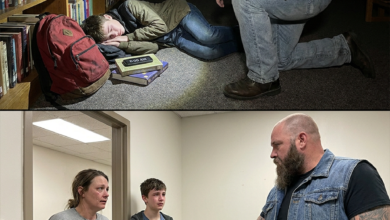
Create a vertical 4:5 composite containing two candid smartphone photographs stacked top and bottom, with consistent characters and ordinary American surroundings. Top scene: inside a modest grandmother’s home in Amarillo, Texas, Jack “Rook” Mercer, a 57-year-old white American male biker, six-foot-five, approximately 278 pounds, imposing broad shoulders, shaved head, thick gray-streaked beard, weathered face, visible sleeve tattoos, knuckle tattoos and a small neck tattoo, scarred hands, plain black leather vest without lettering or logos over a clean pale-blue shirt, faded jeans, motorcycle boots and a chain wallet, kneels beside eleven-year-old white American boy Ben Carter at a narrow hallway mirror; Rook demonstrates a knot using his own burgundy tie while Ben concentrates on tying an old navy-blue tie with silver stripes, visibly crooked and slightly short, both faces serious and gentle, Ben’s 69-year-old grandmother Ruth standing nearby in a floral blouse, watching with wet eyes, worn furniture and breakfast dishes in the background. Bottom scene: outside an elementary school after a fifth-grade promotion ceremony, the same biker Rook remains a central figure beside Ben and Ruth, with the other twenty-three adult members of his motorcycle club gathered informally behind them, twenty-two men and two women in the complete group including Rook, rugged leather vests, varied beards and tattoos, every rider wearing a visibly crooked necktie; Ben smiles cautiously while demonstrating the knot to a huge biker kneeling on the grass, parked cruiser motorcycles well behind the group, unposed family gathering with no banners or performance staging. raw candid smartphone photography, authentic unedited Facebook snapshot, accidentally captured by an ordinary bystander, imperfect framing, awkward natural angle, consumer phone camera auto-exposure, natural deep focus, harsh everyday lighting, realistic skin and fur imperfections, mild digital noise, subtle JPEG compression, limited dynamic range, ordinary colors, unstaged real-life atmosphere, not cinematic, not polished, not professional, no HDR, no bokeh, no studio lighting, no artificial AI appearance. No text, no logo, no readable writing, no dates, no watermark; any visible papers or school signs must face away or remain illegible.
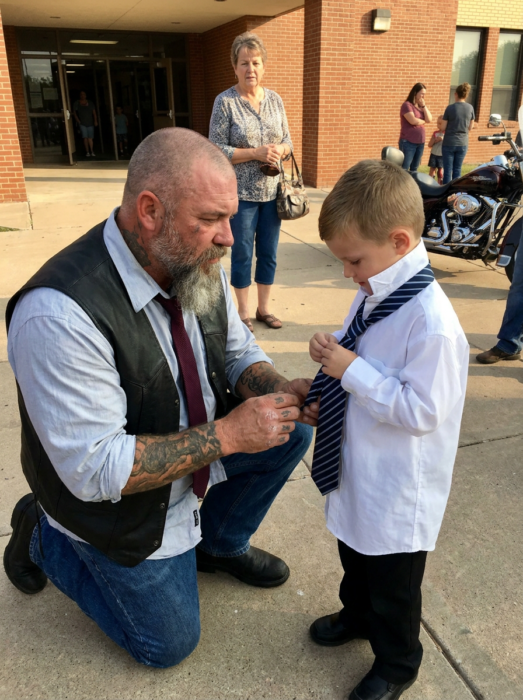
PROMPT 2 — Thumbnail, One Scene
Create a vertical 4:5 single-scene candid smartphone photograph outside an ordinary elementary-school entrance in Amarillo, Texas, capturing the striking contrast of a huge intimidating biker kneeling at eye level with a small boy to help him learn a necktie knot on graduation morning. The central biker is Jack “Rook” Mercer, a 57-year-old white American man, six-foot-five, approximately 278 pounds, barrel-chested and broad-shouldered, shaved head, thick gray-streaked beard, weathered sun-beaten face, visible sleeve tattoos, knuckle tattoos and a small neck tattoo, scarred hands, plain black leather vest without lettering or logos over a pale-blue shirt, faded jeans, heavy motorcycle boots, chain wallet and silver ring; his own burgundy tie hangs visibly crooked. Eleven-year-old white American boy Ben Carter wears a slightly oversized white shirt, black trousers and his late father’s worn navy-blue tie with narrow silver stripes. Ben is holding both ends of his tie with intense concentration while Rook demonstrates on his own tie, allowing the boy to do the work himself; Rook’s expression is patient and restrained, Ben’s face shows uncertainty mixed with relief. Grandmother Ruth, 69, stands a few feet behind them holding a small purse and a closed certificate folder, quietly watching. A parked Harley-style touring motorcycle, ordinary parents and school doors provide natural background context, without a crowd blocking the entrance. Camera taken casually from an imperfect standing height, tight enough to clearly show both faces and the crooked ties, no collage, one continuous scene only. raw candid smartphone photography, authentic unedited Facebook snapshot, accidentally captured by an ordinary bystander, imperfect framing, awkward natural angle, consumer phone camera auto-exposure, natural deep focus, harsh everyday lighting, realistic skin and fur imperfections, mild digital noise, subtle JPEG compression, limited dynamic range, ordinary colors, unstaged real-life atmosphere, not cinematic, not polished, not professional, no HDR, no bokeh, no studio lighting, no artificial AI appearance. No text, no logo, no readable writing, no dates, no watermark.