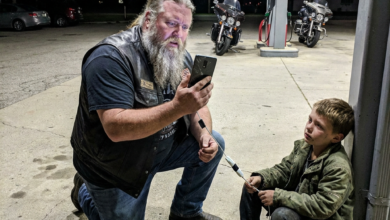
A Sixteen-Year-Old Worked Sixty Hours a Week and Slept on His School Library Floor — Then a Biker Learned Whose Son He Was Protecting
I did not tell Angela that Sunday.
That decision was not simple.
Ethan and I sat in the recovery center’s parking lot before the visit, the Harley cooling beneath us with soft metallic clicks. He had refused to ride behind me until I produced a spare helmet. Even then, he asked me to stop one block away so Angela would not wonder why her son had arrived with a biker.
“I can take the bus from here,” he said.
“You already rode with me.”
“She can’t see you.”
“Why?”
Ethan studied the center’s brick entrance.
“She knows bikers.”
He said it like a warning.
I waited near the reception area while he signed in. Patients entered the visiting room one at a time, some nervous, some smiling too hard. Then Angela appeared in plain gray slacks and a blue sweater.
Four years had changed her.
At Murphy’s, she had worn her dark hair tied high, shouted drink orders over live music, and moved through crowded tables with the balance of someone who could avoid six swinging elbows while carrying glasses.
The woman at Ridgeway was thinner. Her hair had begun graying near the temples. There were deep lines around her mouth.
But it was Angela.
She had saved Brick on an icy December night by refusing to return his keys. She had called a taxi for Rook after his father’s funeral. She had hidden Grizzly’s motorcycle behind the bar when he tried to leave after six whiskeys.
She had also saved me.
I rarely told that part.
Nine years earlier, my wife served me divorce papers at Murphy’s. I drank until the room tilted and demanded my Harley keys. Angela slipped them beneath the bar, called Dean, and stood between me and the back exit.
I threatened her job.
She called me pathetic.
I hated her for three hours.
I thanked her the next morning.
Ethan entered the visiting room. Angela’s whole face opened when she saw him. She checked his height, hair, shoes, and hands as mothers do when they have only forty-five minutes to measure a week.
“Are you eating?” she asked.
“Too much. Aunt Cheryl cooks every night.”
“What did she make yesterday?”
“Meatloaf.”
There had been no meatloaf.
Ethan had eaten a discarded chicken sandwich after his closing shift.
They sat opposite each other. Angela talked about group counseling, kitchen duty, and reaching five months without substances. Ethan described school and removed every hardship from the story.
He was good at it.
Too good.
After the visit, Angela hugged him and whispered something I could not hear. Ethan nodded. He remained upright until the locked door closed behind her.
Then his shoulders dropped.
Outside, I asked where his aunt really was.
“Arizona, maybe.”
“When did she leave?”
“Five months ago.”
The same week Ethan began sleeping at school.
His aunt had promised Angela she would care for him, then left after losing her apartment. She gave Ethan forty dollars and told him she would call once settled.
She called twice.
The family house remained in Angela’s name, but utilities fell behind. Ethan used his wages for property tax installments, food, bus fare, laundry, and his mother’s approved Sunday snack from the visitor vending machines.
He kept the address alive because it anchored him to the school district and his mother to the belief that home still waited.
That evening, I brought Ethan to the Iron Hollow clubhouse.
He refused at first.
“Your club drinks.”
“Not during meetings.”
“Mom said bikers lie.”
“She was talking about us specifically.”
That earned half a smile.
Twelve men sat around the long table when we arrived. Brick, Grizzly, Rook, Sparks, and the others had all known Angela. Four men placed their motorcycle keys on the table before Ethan entered.
The gesture confused him.
Brick explained.
“Your mom took mine during an ice storm. I told her I could ride.”
“You couldn’t?”
“I couldn’t stand.”
Grizzly tapped a scar on his forehead.
“She locked my bike behind Murphy’s after my brother died. I tried climbing the fence. She sprayed me with the soda gun.”
Even Ethan laughed at that.
Then Dean spoke.
“She kept us alive.”
Ethan’s smile disappeared.
Dean asked what he needed.
“Nothing.”
The same answer.
Sparks slid a yellow legal pad across the table.
“Fine. What would prevent the school, your job, and the state from changing your situation without your consent?”
Ethan understood numbers and systems. He began listing risks.
Unaccompanied minor.
Unsafe housing.
Excessive work hours.
Possible educational neglect.
No authorized adult for medical decisions.
No official transportation to Ridgeway.
Each item was a door that could close.
We needed legal guardianship. Safe housing. School cooperation. Reduced work hours without destroying Ethan’s income. And we needed to preserve Angela’s treatment without building everything on another lie.
Brotherhood sounds loud from outside.
Inside, it often looks like twelve tired men arguing over forms.
The first plan failed within forty-eight hours.
Dean offered his spare bedroom and temporary guardianship. Ethan refused because Dean lived outside the school district. Moving could trigger enrollment questions, disrupt his advanced classes, and force him to explain everything.
Rook’s house was closer, but his adult son had an unresolved legal issue that might complicate a guardianship background check.
Grizzly volunteered an apartment above his repair shop. It had no occupancy permit.
Brick suggested we ignore the law for seven months.
Sparks nearly threw a calculator at him.
We contacted Marisol Vega, a family-law attorney who had helped the club before. She met Ethan privately, reviewed his mother’s treatment status, and explained the truth.
At sixteen, Ethan could not simply choose a guardian without court involvement. Angela retained parental rights, but she would need to consent to a temporary arrangement unless a court found an emergency.
If officials discovered he had concealed five months of living alone, an investigation was likely.
“Will I lose Sunday visits?” he asked.
“Not automatically.”
“That means maybe.”
“It means I won’t lie to you.”
Ethan’s jaw tightened.
“If Mom knows, she’ll leave Ridgeway.”
“Maybe,” Marisol said. “But every day this continues, someone else may discover it without a plan ready.”
The school almost did.
On Tuesday morning, the librarian found food wrappers behind the reference shelves. She reported a suspected pest problem. Maintenance scheduled a deep inspection for Wednesday night.
Ethan could not sleep there again.
I told him after his second work shift. We stood beneath the fast-food restaurant’s fluorescent sign at 10:40 p.m. He smelled of fryer oil, sanitizer, and exhaustion.
“Where am I supposed to go?” he asked.
“The clubhouse tonight.”
“No.”
“Why?”
“If anyone sees me, they’ll ask.”
“People already ask.”
“Nobody important.”
He turned toward the bus stop.
I caught his backpack strap, not his arm.
“Kid.”
“Let go.”
“You can hate me indoors.”
He stared at my hand until I released the strap.
Then he ran.
Ethan did not go home. He did not go to the school. His phone went straight to voicemail before midnight.
We searched.
Twelve Harleys spread across Knoxville, engines moving through streets damp from an early frost. We checked the library, bus terminal, fast-food locations, public park, and the vacant house beside his address.
Nothing.
At 1:17 a.m., a freight train sounded near Riverside.
I remembered seeing black dust on Ethan’s shoes.
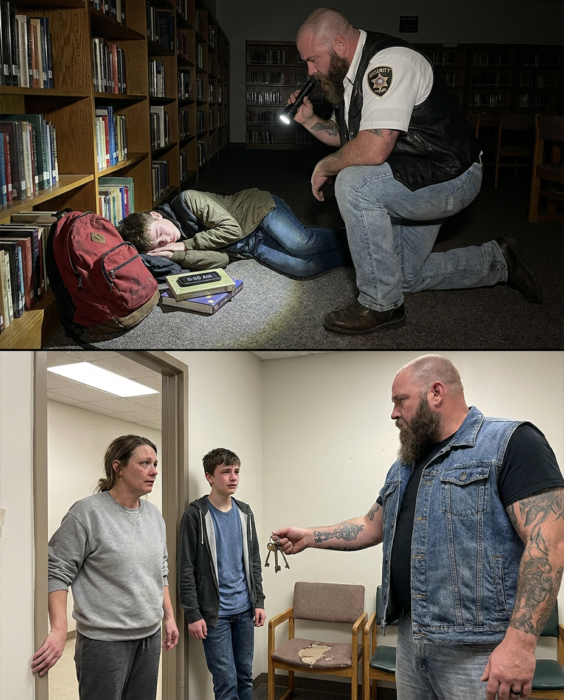
The abandoned freight depot stood half a mile from the school. Brick found the red backpack inside first. I found Ethan behind a stack of wooden pallets, trying to sleep beneath flattened cardboard.
He did not apologize.
Neither did I.
“You said you wouldn’t report me,” he said.
“I didn’t.”
“You brought lawyers.”
“I brought options.”
“You brought people who can take me away.”
His voice cracked on the final word.
That was the first time he sounded sixteen.
I sat on the dirty floor across from him. Cold moved through my jeans. Rats scratched somewhere behind a wall.
“My mother went into foster care at twelve,” I said. “Three homes. Two schools. One family that locked food after dinner. She spent her life expecting every door to close.”
Ethan looked at me.
“I know why you’re scared.”
“No, you don’t.”
“You’re right.”
Simple answers sometimes leave room for truth.
He rubbed both eyes.
“If they move me, I can’t visit Mom. If I don’t visit, she’ll think I quit on her. Everybody quits on her.”
“You didn’t.”
“I’m all she has.”
“That’s too heavy.”
“I can carry it.”
He had been carrying it for five months. The evidence surrounded us: a child sleeping in an abandoned depot after working ten hours because he considered adult help more dangerous than cold concrete.
I called Marisol.
She arranged emergency accommodation at a youth transitional apartment run by a licensed nonprofit. Ethan could stay temporarily without entering foster placement while a safety plan was developed.
He agreed only after written confirmation that Sunday transportation would continue.
At dawn, I drove him there.
The apartment was clean but institutional: gray bedding, locked medicine cabinet, laminated rules. Ethan stood in the doorway holding everything he trusted inside one backpack.
“This isn’t home,” he said.
“No.”
“Don’t tell Mom.”
I did not promise.
On Thursday, the school counselor summoned Ethan after his manager accidentally emailed work verification showing sixty-hour weeks. Questions began.
Where did he sleep?
Who signed medical forms?
Why did his aunt not answer?
Ethan repeated the address and his prepared answers. The counselor heard the gaps.
By Friday, the school had filed a mandatory report.
Child services scheduled an interview.
The system had found him.
That Sunday, Ethan refused to visit Ridgeway.
He said his mother would see the fear on his face.
I told him missing the visit would frighten her more.
At the center entrance, he stopped.
“I can’t lie today.”
“Then don’t.”
“She’ll leave.”
“Then we stand in the door.”
Ethan looked at me.
“We?”
I opened my jacket.
Beneath the security uniform, I wore the Iron Hollow cut.
“Every brother she ever stopped from riding.”
The visiting-room doors unlocked.
Angela stepped through.
Ethan began crying before she reached the table.
The lie was over.
Angela knew immediately.
Mothers can recognize bad news before it has language.
She touched Ethan’s face, then looked at me standing by the wall in my black leather cut. Her eyes moved to the Iron Hollow patch.
“Wade?”
“Hello, Angela.”
She had not heard my voice in almost five years, yet she remembered it.
“What happened?”
Ethan tried.
He got as far as “Aunt Cheryl left” before his breathing broke. Angela held both his hands. He looked down at their joined fingers and told her everything.
The disconnected electricity.
The broken window.
The sixty-hour weeks.
The library floor.
Five months.
Angela did not interrupt.
That frightened me more than shouting would have.
When Ethan finished, she stood so abruptly the chair struck the wall.
“I’m leaving.”
He grabbed her sleeve.
“Mom, no.”
“He was alone.”
“I’m okay.”
“You slept on a floor.”
“I’m okay.”
“You worked nights.”
“I’m still in school.”
Each answer made her more desperate. Shame moved across her face like a physical illness.
“I did this.”
“No,” Ethan said.
“I left you.”
“You went to get better.”
“I left you with someone who left.”
A Ridgeway counselor approached, but Angela pulled away.
“I need discharge papers.”
Ethan placed himself between his mother and the locked door.
He was six inches shorter.
He did not move.
“If you leave now, I lose you anyway.”
Angela froze.
Ethan’s voice shook, but the words came clearly.
“I lied because I knew you’d do this. I knew you’d choose me over finishing. But I need you to finish so when I come home, you’re actually there.”
No parent should need permission from a child to recover.
No child should have to give it.
Yet there they stood.
Angela lowered herself into the chair. Ethan knelt in front of her. For several minutes, neither spoke.
Then Angela looked at me.
“Why are you involved?”
I removed four motorcycle keys from my pocket and placed them on the table.
Brick’s.
Grizzly’s.
Rook’s.
Mine.
Angela recognized the worn leather fob attached to mine. She had confiscated that key the night my divorce became an excuse to die on a motorcycle.
“You kept these before,” I said. “We’re keeping him now.”
She covered her mouth.
The other bikers entered one by one.
Ridgeway allowed it because the counselor understood that recovery sometimes requires seeing the structure waiting outside. Twelve large men in leather formed a line along the wall. Some had gray beards. Some still carried scars from years Angela prevented from ending early.
Brick spoke first.
“You saved me on the ice-storm night.”
Grizzly went next.
“You hid my bike after Tommy’s funeral.”
Rook said, “You called my wife instead of letting me drive.”
Dean placed a folder on the table.
Inside was the plan.
The club had located a one-bedroom apartment five blocks from East Ridge High. A legal adult had to live there with Ethan, so I volunteered to occupy the smaller room until Angela completed treatment.
The arrangement was not casual.
Marisol had prepared a petition for temporary consensual guardianship. I had completed a background check, home inspection, fingerprinting, and training. The nonprofit agreed to supervise. The school accepted a stability plan. Ethan’s work hours would be reduced to twenty, with the club scholarship fund replacing enough lost income to cover his expenses.
Angela could retain parental rights.
Sunday visits would continue.
The guardianship would end after seven months, subject to her treatment completion and court approval.
Angela read every page.
“You did this in a week?”
“Sparks doesn’t sleep,” Dean said.
Sparks adjusted his glasses.
“Four hours is sufficient.”
It was not.
Angela looked at me. “Why you?”
“School district. Night schedule. Empty house. Clean record.”
“That isn’t what I asked.”
I met her eyes.
“Because you once stood between me and a door when I was too broken to know what waited outside.”
That answered it.
But one obstacle remained.
The treatment center had documented Angela’s addiction, and the state attorney questioned whether consensual guardianship protected Ethan sufficiently. A child-services representative recommended licensed foster placement until the court completed its evaluation.
Ethan’s face emptied.
The legal hearing occurred three days later.
I wore a clean shirt beneath my cut. Marisol told me to remove the vest. Ethan asked me to keep it on.
The state presented facts: a minor had lived alone five months, worked excessive hours, slept in a school, and concealed his circumstances. Those facts were true.
Marisol presented the plan.
School continuity.
Safe housing.
Supervised guardianship.
Medical authorization.
Reduced work.
Guaranteed transportation.
Angela testified by video from Ridgeway.
Then the judge asked Ethan what he wanted.
He stood beside Marisol wearing the navy school sweater he had slept in. His hands trembled at his sides.
“I want my mom to finish treatment,” he said. “I want to stay at my school. I want to keep visiting her. And I want adults to stop making me choose only one.”
The judge studied him.
Temporary guardianship was granted.
Seven months.
I became legally responsible for a boy who had spent five months hiding from every adult in authority.
Outside the courtroom, Ethan handed me his library card.
“What’s this?”
“You’ll need it.”
“For what?”
He looked toward our new apartment.
“To prove I live somewhere else now.”
Living with Ethan taught me how invisible survival can become.
He woke before my alarm, made his bed with military precision, and checked the front door three times before leaving. He kept food inside his backpack even though the apartment cabinets were full.
The first week, I found six oatmeal packets beneath his mattress.
I did not remove them.
I placed six more beside them.
Trust does not grow when adults keep proving they can take things.
The apartment was small. Ethan had the bedroom. I slept in a converted dining alcove behind a folding divider. My Harley occupied one parking space and angered the upstairs neighbor at six each morning.
Ethan complained that the exhaust disturbed his calculus.
I installed a quieter baffle.
The club found this hilarious.
His work hours dropped from sixty to twenty. At first, he paced during the empty evenings as if idleness were danger. I gave him garage invoices to organize, but Sparks stopped me.
“He needs to be sixteen.”
None of us knew what that meant.
We tried.
Brick taught him to change motorcycle oil. Rook took him to a minor-league baseball game. Grizzly introduced him to weight training but became furious when Ethan attempted every exercise like an exam.
The school counselor arranged tutoring, although Ethan needed sleep more than academics. His ranking moved from fourth to seventh during the first month.
He considered that failure.
I considered it evidence he had stopped doing homework during restaurant breaks at midnight.
Every Sunday, we rode or drove to Ridgeway.
Angela looked healthier each week. Color returned to her face. Her hands stopped trembling. She spoke honestly about relapse triggers, shame, and the years following an injury when prescriptions became dependence and dependence invited alcohol.
Ethan told fewer lies.
At first, he reported only safe facts: grades, work schedules, meals. Gradually, he admitted anger. He told Angela he hated visiting the library because the carpet smell brought back those nights. He told her he sometimes woke thinking I had discovered him again.
Angela listened without defending herself.
Recovery is not an apology repeated until pain disappears.
It is staying in the room after the apology fails.
The fourth month brought trouble.
Ethan’s aunt Cheryl returned from Arizona. She had learned that guardianship came with a modest support stipend and claimed she had always intended to resume care.
She petitioned the court.
Ethan panicked. Cheryl was family on paper. I was a tattooed school guard from a motorcycle club.
Paper can be cruel that way.
Cheryl’s attorney described Iron Hollow as a possible “high-risk social association.” Photographs from charity rides showed leather vests, bars, and motorcycles. The opposing filing questioned whether my environment supported a minor.
Angela blamed herself again.
Ethan prepared to run.
I recognized it because his oatmeal packets disappeared.
The night before the hearing, I found him packing the red backpack.
“Where?”
“Doesn’t matter.”
“It matters to me.”
“They’ll send me with her.”
“Maybe.”
“She left.”
“I know.”
“She gave me forty dollars.”
“I know.”
“She didn’t call on my birthday.”
His voice rose on the last sentence.
I sat on the floor, blocking neither the door nor his path.
“You can run,” I said. “I’ll follow. We’ll both be tired when court starts.”
He stared.
“You can’t joke about this.”
“I’m not. My knees are terrible.”
The backpack lowered.
At the hearing, Murphy’s Roadhouse owner testified first. He brought employment records proving Angela’s history at the bar and explained how often she had protected customers from driving intoxicated.
Then four Iron Hollow members testified.
Brick described waking in a taxi while freezing rain covered the highway he intended to ride.
Grizzly described Angela locking his motorcycle away during acute grief.
Rook described the night she called his wife.
I described my divorce and the key she kept.
The club was not evidence against us.
The club was evidence that Angela’s judgment had preserved lives long before addiction damaged her own.
Cheryl’s petition failed after the court reviewed her abandonment, unstable housing, and financial motive. My guardianship continued.
Outside, Ethan did not celebrate.
He asked Angela by video whether family could leave and still call itself family.
She answered carefully.
“Yes. That is why staying has to be an action, not a word.”
Ethan carried that sentence.
At five months, his grades returned to the top five. At six, he received a university summer-program invitation. The fee was more than he could pay.
Iron Hollow established the Angela Cole Safe Ride Scholarship.
She objected to the name.
Dean refused to change it.
The fund came from annual rides, restaurant donations, and taxi-company sponsorships. It supported students whose education had been interrupted by caregiving, homelessness, parental treatment, or family crisis.
Ethan became its first recipient.
He accepted only after Sparks showed him the anonymous selection score.
Pride ran in that family.
Seven months after I discovered him, Angela completed Ridgeway’s program.
We waited outside.
Twelve motorcycles lined the road, but none were running. Angela disliked unnecessary noise.
Ethan stood at the center holding flowers purchased with his own money. I carried the apartment keys.
When Angela stepped through the doors, she stopped.
The club was there.
Murphy’s owner was there.
Her counselor was there.
Ethan walked toward her.
For five months, he had slept on a library floor to preserve that moment. For seven more, he had lived inside rules, hearings, visits, and fear.
He did not run.
Neither did she.
They met halfway.
Angela held him for a long time. Then she reached toward me.
I placed the apartment keys in her hand.
She closed her fingers around them.
Once, she had kept mine because I was not safe to ride.
Now I gave her keys because she had become safe to come home.
Angela returned to Murphy’s Roadhouse three weeks later.
Not as a bartender.
As manager.
The owner had struggled with staffing, inventory loss, and unsafe alcohol service. Angela understood every weakness in the building. More importantly, she knew the difference between serving a customer and helping one destroy himself.
Her policies were strict.
No one visibly intoxicated received motorcycle keys.
Free water sat at every club table.
Taxi numbers appeared on receipts.
A rideshare fund covered customers who claimed they could not afford transportation. Iron Hollow financed the first year.
Angela kept a wooden lockbox behind the bar. Anyone could surrender keys without explanation and retrieve them the next day.
Four old keys were mounted above it.
Mine was one.
Ethan and Angela remained in the apartment until she built stable income and savings. I moved back to my house but kept the folding divider because Ethan joked that it was the only wall I had ever respected.
Sunday visits changed into Sunday dinners.
Ridgeway had allowed forty-five minutes. Home allowed burned casseroles, unfinished homework, arguments over laundry, and silence that did not need supervision.
That was recovery too.
Ethan completed high school ranked third in his class.
At graduation, Angela cried before his name was called. Iron Hollow occupied two rows near the rear because our combined shoulders blocked other families’ view.
We kept quiet until Ethan crossed the stage.
Then twenty bikers forgot every instruction.
He earned a scholarship to study social policy and education. His application essay described institutions after dark: schools, libraries, restaurants, treatment centers, and the people who keep them functioning when official hours end.
He did not write that adults saved him.
He wrote that adults finally listened.
Before college, Ethan visited the school library with me. The carpet had been replaced. The reference shelves had moved. Nothing looked exactly as it had at eleven that night.
He stood between the rows for several minutes.
Then he handed me his old library card.
The plastic had curved from months inside the wallet beneath his head. His photograph was scratched. One edge had separated.
“You keep it,” he said.
The club had it laminated between clear acrylic sheets and mounted inside a simple wooden frame. Beneath it, Sparks added a small metal plate:
FIVE MONTHS. ONE FLOOR. NO MORE.
The frame hangs inside the Iron Hollow clubhouse beside Angela’s four keys.
One object represents the roads she stopped us from taking.
The other represents the floor her son no longer needed.
Years later, Ethan returned to East Ridge High School.
Not to sleep.
He came as a graduate intern working with the district’s student-support office. His job was to help identify teenagers whose grades, jobs, attendance, or perfect behavior concealed unstable housing.
He asked different questions.
Where do you charge your phone?
Where do you wash your work uniform?
Who signs your forms?
Where do you go after closing?
Most students could answer without thinking.
Some could not.
The school created a confidential support program offering temporary housing referrals, meals, transportation, laundry access, and legal guidance without forcing students to tell their stories repeatedly.
The library became part of it.
A small overnight emergency room was never approved—insurance people nearly fainted at the suggestion—but the district established crisis protocols so a student discovered after hours would meet a trained advocate before police or placement decisions were made.
Ethan helped write them.
Angela remained sober.
Every year on the anniversary of her Ridgeway graduation, she closed Murphy’s early and served dinner to the Iron Hollow Riders. Nobody paid. Nobody drank alcohol.
Before leaving, each rider placed his motorcycle key inside the wooden box for one minute.
Not because he was impaired.
Because remembering protection matters before you need it again.
I eventually retired from night security. On my final patrol, Ethan walked the building beside me. At eleven, we entered the dark library.
He stood where I had found him.
“You were going to report me,” he said.
“I was.”
“What changed?”
“You asked me not to.”
“That’s a terrible security policy.”
“It was.”
He smiled.
The framed copy of his library card now hangs near the entrance to the student-support office. The original remains at the clubhouse beside four motorcycle keys.
People ask why bikers framed a worn school card.
I tell them Angela Cole called taxis for us hundreds of times so nobody died riding home. At least four brothers remained alive because she took their keys when they hated her for it.
Then her sixteen-year-old son slept on a library floor for five months because he believed being discovered meant losing his mother.
She once stood between us and the road.
So we stood between him and the system.
Comment KEYS and follow the page for more biker stories about hidden courage, chosen family, and the people who refuse to leave.
The library lights stay on now.