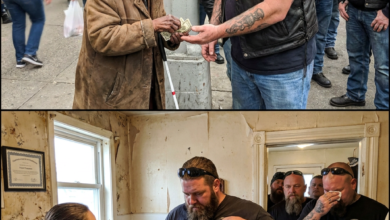
An Old Man Waited at the Airport Every Friday for Six Years—Then Two Soldiers Walked Through the Arrival Gate Carrying His Son’s Name
I met Walter on a Friday because most important things in his life had started or ended on that day.
Ethan was born on a Friday morning during a snowstorm. He graduated high school on a Friday evening. He enlisted on a Friday without telling his parents until the papers were signed.
The casualty officer arrived on a Friday too.
Walter told me these things slowly over airport coffee. He never volunteered more than one memory at a time, and if I asked too many questions, he turned toward the arrival doors and closed himself off.
So I learned to wait.
Waiting was Walter’s language.

He had worked as a custodian at Fairborn High School for thirty-two years. Students remembered him repairing locker doors, keeping spare gloves for children who came to school without them, and placing pencils on teachers’ desks before exams.
He did not talk much.
Ethan had been the same.
Father and son communicated through small tasks: holding a flashlight, changing oil, clearing snow before the other woke, leaving half a sandwich in the refrigerator without admitting it had been saved.
When Ethan joined the Army, Walter objected only once.
“You sure?”
“Yes.”
“Then do it right.”
That was their entire argument.
Ethan became the soldier who checked other men’s gear twice. He wrote home irregularly but called his mother every other Sunday. Evelyn filled the silence. Walter stayed close to the phone and pretended he was not listening.
During Ethan’s final call, he asked about the old truck.
Walter told him the transmission was failing.
“I’ll fix it when I get back,” Ethan said.
The truck remained beneath a canvas cover in Walter’s garage.
Six years later, its tools still waited on the bench.
The official notification said Ethan went missing during a convoy operation in a mountainous region. Hostile activity complicated recovery. Search teams found damaged equipment and partial remains belonging to other service members, but nothing conclusively matched Ethan.
At first, Walter and Evelyn believed the next knock would bring their son home.
Then weeks became months.
The Army sent updates until there were no updates left. Calls became letters. Letters became annual reviews. During the second year, a determination board changed Ethan’s status to presumed deceased.
Walter attended by phone.
He asked one question.
“Where is my boy?”
Officials explained probabilities, terrain, blast patterns, and legal standards.
Walter repeated the question.
Nobody answered it.
The folded flag arrived in a wooden case. Walter stored it unopened in the closet. When the Army offered a memorial service without remains, he declined.
Evelyn did too.
They created their own ritual instead.
Every Friday they drove to the airport. Ethan had flown home through that terminal after his first deployment, wearing civilian clothes and carrying a green duffel. Evelyn believed that if he ever returned without documents or warning, he would come through the same doors.
Walter made the first sign from a piece of cardboard cut from a television box.
Evelyn rewrote it when rain blurred the letters.
At first, airport employees assumed they were meeting a scheduled flight. By the tenth week, people began recognizing them. Some offered food. Others asked questions Walter refused to answer.
The couple stood there anyway.
In the fourth year, Evelyn’s cancer returned.
Chemotherapy weakened her so badly that Walter pushed her through the airport in a wheelchair. She held the sign on her lap. When passengers in uniform appeared, she tried to stand.
Her final visit came two weeks before she died.
She pressed the sign into Walter’s hands and said, “If one of us is still here, Ethan has someone waiting.”
Walter kept going.
That fact spread through the Iron Ravens after our president, Dean “Rook” Mercer, first noticed him. Rook was a massive man with a long gray beard, a scar across his scalp, and the kind of stillness strangers often mistook for menace.
He had lost his younger brother overseas.
When he heard Walter’s story, he opened his leather cut and showed me a faded medical-unit patch sewn against the inner lining.
“Can you look into it?” he asked.
I knew what he meant.
I also knew what he was asking could take months and end with nothing.
Military archives did not open because a motorcycle club knocked. Privacy rules mattered. Classified operational details stayed protected. Old records contained errors, mismatched case numbers, and names removed from public copies.
“We may hurt him again,” I said.
Rook glanced toward Walter.
“He’s already standing in it.”
The club voted that night.
Not on whether to help. That part was settled.
We voted on how far we were willing to go.
Travel costs. Legal requests. Research assistance. Contacting former service members who might not want their memories reopened. Supporting Walter if the answer proved final.
Everyone raised a hand.
Brotherhood sounds impressive when engines are running. It sounds different in a quiet room when men agree to stay through paperwork, disappointment, and another person’s grief.
I took the grocery bag of records home.
At 2:00 a.m., I found the first inconsistency.
Ethan’s casualty summary listed Task Force Raven as the recovering element. A logistics attachment placed the surviving wounded with Task Force Resolute.
Different commands.
Different filing systems.
One missing bridge.
I circled both names and wrote a question in the margin.
Who came home?
The first two months gave us nothing.
I submitted a Freedom of Information Act request. It returned with entire paragraphs blacked out and three attachments missing. I appealed. The appeal disappeared into a queue.
A former clerk told me records from that deployment had been reorganized twice.
Another said the unit designation I was searching might have changed mid-operation.
Every answer created another door.
Most stayed closed.
Walter never asked about progress. He continued arriving each Friday with Ethan’s sign. If I joined him, he nodded. If six bikers stood behind him, he nodded once more.
He did not want hope sold back to him in weekly installments.
Then Rook made a mistake.
A local reporter saw the club at the airport and asked why we were there. Rook answered honestly but briefly. The newspaper published a small story about Walter’s vigil.
By Monday, the airport received complaints that the Iron Ravens were staging a publicity event in the arrivals area. One traveler claimed the leather vests made families uncomfortable. Management asked us to reduce our numbers.
Bear Sullivan wanted to protest.
Rook refused.
“This is Walter’s ground,” he said. “Not ours.”
The following Friday, only Rook and I entered the terminal. The others waited outside beside their Harleys, engines silent.
Walter had read the article.
“You told them,” he said.
Rook removed his sunglasses. “I answered a question.”
“I didn’t ask to become a story.”
“No, sir.”
“People look at me now.”
“They looked before.”
“Not like I’m pathetic.”
Walter’s voice cracked on the last word.
Rook accepted every bit of his anger.
He did not defend the club or explain intentions. He stood with his arms at his sides until Walter finished, then apologized.
“We made your wait about us,” he said. “That was wrong.”
Walter studied him.
“Will you still come next week?”
“Yes.”
“Then stand farther back.”
We did.
That was the first test.
The second came when my old military contact, Charles Wynn, found a reference to two wounded soldiers evacuated from the blast area. Their names were sealed because the document involved medical records.
Charles could not legally give them to me.
Bear suggested searching reunion groups and public award citations. Sam, our accountant, built a timeline from unit newsletters. Rook contacted a veterans’ legal clinic for help obtaining redacted witness summaries through proper channels.
We worked carefully.
No stolen records.
No impersonation.
No harassing families.
Five months after the search began, the veterans’ clinic obtained a partial after-action report. I opened it at the clubhouse while rain struck the metal roof.
The report described a convoy struck at 14:32. The lead vehicle was disabled. A second vehicle hit an explosive device while maneuvering. Fire spread. Small-arms fire continued from high ground.
Ethan Harper exited his vehicle.
That line was clear.
He moved toward the burning transport despite orders to seek cover. He removed one injured soldier, returned, and pulled out a second. Both were evacuated.
Ethan went back again.
After that, the report became uncertain.
Visibility dropped. Ammunition inside the wreck began cooking off. The team withdrew to a defensive position. When they returned, Ethan was gone.
No confirmed remains.
No confirmed capture.
No final eyewitness account attached.
My hands shook.
For years, Walter had imagined dozens of possibilities. Wounded. Captured. Lost without identification. Unable to return.
The report gave him courage but no ending.
Rook read it twice.
“We tell him.”
I disagreed.
“Not until we find the two survivors.”
“He deserves this much.”
“He’ll hear that Ethan survived the first blast and went missing afterward. That could make him wait another six years.”
The room divided.
Bear wanted the truth released immediately. Denise believed incomplete information could cause harm. Sam argued Walter owned every fact about his son, even painful ones.
Brotherhood bent.
Nobody shouted at first. That made it worse. Voices stayed low and hard. Men who trusted one another on highways began questioning motives.
Finally, Rook removed his cut and laid it on the table.
“We don’t protect Walter by becoming another office that decides what he can know.”
Silence followed.
He was right.
We met Walter at his house the next morning. The old truck remained covered in the garage. Ethan’s tools hung above the workbench.
Walter read the report standing up.
When he reached the line about the two rescued soldiers, he sat on a wooden stool. His thumb moved over Ethan’s name.
“He got out?” Walter asked.
“Yes.”
“And went back?”
“Yes.”
“For two men?”
“Yes.”
“Where are they?”
“We don’t know yet.”
Walter looked toward the covered truck.
“Find them.”
That became the mission.
We traced evacuation logs, award announcements, veterans’ association lists, and old hometown articles. One candidate had died in a car accident. Another refused to speak. A third had served in the wrong company.
Then Charles found a medical-transfer code associated with an Indiana hospital.
It led to Aaron Mills.
I called at 8:11 on a Tuesday night.
A man answered.
I introduced myself and asked whether he had served near the location in Ethan’s report.
The line went quiet.
Then I said Ethan’s name.
Aaron inhaled sharply.
“Who are you?”
“A veteran trying to help his father.”
Another silence.
“His father is alive?”
“Yes.”
Aaron began crying.
Not loudly. Not dramatically. Just a man’s breathing breaking apart over a telephone after six years.
“I wrote to them,” he said. “I wrote three times.”
“No letters arrived.”
“I told the casualty office.”
“The statements were filed under another unit.”
“Oh God.”
“Aaron, did Ethan pull you out?”
“He pulled both of us out.”
“Who is the other man?”
“Daniel Ruiz.”
“Is he alive?”
“He has three kids.”
There it was.
Two men had gone home.
Their rescuer had not.
And the father waiting every Friday knew neither name.
Aaron’s letter had remained inside the bottom drawer of his desk.
He had written it during rehabilitation, when one leg was held together by metal and sleep came only in fragments. The first casualty officer said the family could not receive unverified operational details. A second office promised to forward the letter after review.
Months passed.
Aaron sent another copy.
Then another.
Nothing came back.
He assumed silence meant the Harpers hated him for surviving.
Daniel Ruiz had a different story. After the blast, he spent weeks sedated and underwent several surgeries. When he recovered enough to give a formal statement, he was attached temporarily to the medical unit that evacuated him.
His testimony received the medical unit’s case number.
Ethan’s file carried the original unit’s number.
A database migration separated them permanently.
Paperwork did what the explosion had not.
It erased the connection between three men.
When I reached Daniel in North Carolina, he asked me to repeat Walter’s name. His wife began crying in the background.
Daniel had searched for the family online, but Ethan Harper was not a rare name. Operational secrecy prevented him from posting details publicly, and his requests through official channels produced no response.
He had kept one photograph.
It showed Ethan sitting on an armored vehicle two weeks before the mission, holding a dented metal cup. Aaron stood on one side. Daniel stood on the other.
On the back, Ethan had written: “Three idiots waiting for coffee.”
Daniel mailed us a copy.
Walter stared at it for nearly an hour.
“That’s his handwriting,” he said.
He touched Ethan’s face but asked no questions.
We arranged a meeting for the next Friday at the airport. Aaron would fly from Indianapolis. Daniel would arrive from Charlotte. Both insisted on wearing dress uniforms, though neither uniform fit exactly as it once had.
We told Walter that two witnesses had been found.
We did not tell him how they would arrive.
That decision scared me. Airports had become sacred ground to him. Surprising a grieving man there could be cruel. Denise wanted us to prepare him fully.
Walter overheard the argument.
“If they came home because of Ethan,” he said, “I want to meet them where I’ve been waiting.”
So Friday remained.
The club arrived early. Twelve Harleys rolled into the parking garage, their exhaust echoing against concrete until Rook raised one fist. The engines shut down one after another.
Inside, Walter stood in his usual place.
He wore the brown coat Evelyn had bought him. The fourth version of Ethan’s sign trembled in his hands.
Passengers emerged.
A business traveler.
A family with balloons.
A college student dragging a broken suitcase.
Then Aaron Mills came through the doors.
He walked with a limp and wore a row of ribbons above his breast pocket. Beside him was Daniel Ruiz, broader, younger-looking, with a scar rising past his collar.
They saw the sign.
Both stopped.
The terminal continued moving around them, but the three men remained still.
Aaron saluted first.
Daniel followed.
Walter lifted the sign higher, as though they might be unable to read it.
“Which one of you knew my boy?” he asked.
Aaron’s salute shook.
“Both of us, sir.”
Walter looked behind them.
I saw him do it.
After six years, after the report, after every official word, some part of him still expected Ethan to step through the doors last.
Nobody came.
The doors closed.
Walter’s knees gave way.
Rook moved, but Aaron and Daniel reached him first. They caught the old man beneath his arms and lowered him carefully to the floor.
The sign slipped from his fingers.
Daniel picked it up.
“Sir,” Aaron said, his voice breaking, “your son brought us home.”
Walter grabbed the front of Aaron’s uniform.
“Did he suffer?”
Aaron looked at Daniel.
Truth passed between them.
“He was hurt,” Daniel said. “But he was standing. He got us both clear.”
“Why did he go back?”
“There was a radio call from the vehicle. He thought someone else was inside.”
“Was there?”
“We never knew.”
Walter closed his eyes.
Then Aaron told him Ethan’s final known words.
“Keep them awake. I’m going back.”
No grand speech.
No farewell.
An instruction.
That sounded like Ethan.
Walter sat on the airport floor between the two men his son had saved. Around them, strangers stopped. Some lowered their phones when Rook looked up. Airport employees formed a quiet barrier to give them space.
Aaron handed Walter the original letter.
Six years late.
Walter unfolded it with both hands. The page contained Ethan’s actions, the location of the blast, and a sentence Aaron had rewritten three times because no words felt sufficient:
“I have a wife and daughter because your son chose my life twice.”
Daniel crouched beside them.
“My youngest is named Ethan,” he said.
Walter looked at him.
“How old?”
“Four.”
“Does he like trucks?”
“He sleeps holding one.”
For the first time since I met him, Walter smiled.
It lasted only a second.
Then Daniel mentioned something absent from every report we had received.
As Ethan approached the vehicle for the final time, Daniel saw him disappear behind a rock shelf on the eastern side of the road—not west, where the recovery teams had concentrated their search.
I felt the floor tilt beneath me.
“Did you include that in your statement?” I asked.
“Yes.”
That statement had never reached Ethan’s file.
The two soldiers had not only brought Walter the truth.
They had brought us a location.
The new search did not begin quickly.
Nothing involving governments, foreign terrain, old combat sites, and unidentified remains begins quickly.
Daniel’s archived statement had to be authenticated. Coordinates had to be reconstructed from maps no longer in standard use. The original mission route had changed names. Landslides and seasonal flooding altered the landscape.
The Department of Defense reopened Ethan’s recovery assessment.
Walter received a formal letter.
He read only the first paragraph before handing it to me.
“Are they looking?”
“Yes.”
“Then keep the rest.”
Hope had become something sharp to him.
He handled only what he needed.
Aaron and Daniel began visiting Marlow. They brought their families the first time. Aaron’s daughter, Grace, was nine. Daniel’s children were eleven, seven, and four.
The youngest, Ethan Ruiz, carried a red toy truck.
Walter knelt before him and asked permission to see it.
The boy handed it over.
Walter turned the plastic wheels with his thumb and said, “My Ethan liked trucks too.”
From then on, the surviving soldiers stopped feeling like witnesses and began feeling like pieces of a family rearranged by absence.
Aaron helped uncover the old truck in Walter’s garage. Daniel replaced the battery. Rook changed the cracked belts. I cleaned the fuel system.
Walter stood nearby holding Ethan’s original wrench.
The engine failed three times.
On the fourth attempt, it started.
Walter placed one hand on the hood as though feeling a pulse.
Every Friday, he still went to the airport.
That surprised people.
He now knew Ethan would not walk through the gate. He had heard the final words. He had met the men who survived. Yet he continued carrying the sign.
When I asked why, he gave me the answer later, outside the terminal.
“My wife waited here too,” he said. “Until Ethan comes home, I’m waiting for both of us.”
The sign’s meaning had changed.
It was no longer an invitation.
It was a promise.
Eleven months after Daniel revealed the eastern location, a recovery team found fragments of military equipment beneath collapsed rock. Among them was an identification plate matching Ethan’s vehicle assignment.
Further excavation uncovered human remains.
DNA testing took weeks.
Walter gave a sample. So did a distant relative on Evelyn’s side to confirm personal items associated with the site. Then another official car arrived at Walter’s house.
This time, the officers did not bring a presumption.
They brought certainty.
Ethan had been found.
Walter listened without moving. When the officer finished, he asked whether his son would come through Dayton.
“Yes, sir.”
“What day?”
The officer checked the schedule.
“Friday.”
Word spread quietly.
The club did not contact reporters. The airport coordinated a private transfer route, but Walter asked to stand in the public arrivals area one final time.
He brought the yellowed sign.
Rook wore his cut over a white shirt. Aaron and Daniel arrived in uniform. Dozens of veterans gathered without banners. Airport employees who had watched Walter wait for six years lined the corridor.
No one cheered.
The aircraft landed shortly after sunset.
A military honor guard received the casket. It was covered with the American flag and moved through a secured passage adjoining the same arrival doors Walter had watched every week.
Walter stood straight.
The sign rested against his chest.
When the casket appeared, his mouth opened, but no sound came.
Six years of waiting ended in four measured footsteps.
Aaron stood on Walter’s left. Daniel stood on his right. Rook and I remained behind them with the club.
The honor guard stopped.
An officer approached Walter.
“Mr. Harper, Sergeant Ethan Harper is home.”
Walter touched the flag with his fingertips.
Then he placed the sign on top of the casket.
For a moment, nobody moved.
He bent close and whispered something meant only for his son.
Later, he told me the words.
“Your mother waited as long as she could.”
At the funeral home, Walter asked the director to open the casket only far enough for him to place two objects inside. The recovered remains were treated with care and privacy. Nobody except the family and the honor guard entered.
Walter carried Ethan’s old wrench.
And the sign.
The funeral director warned him the cardboard might bend.
Walter shook his head.
“It’s done its job.”
The sign had been rewritten four times. Evelyn had drawn the first letters. Walter had strengthened the faded strokes after she died. Airport rain had stained one corner. Tape held together another.
It went into the casket beside Ethan.
The wrench went in too.
Aaron and Daniel attended the funeral with their families. Grace placed a photograph beneath the flowers. Little Ethan Ruiz left his red toy truck near the headstone until Walter gently returned it.
“Keep it,” he said. “He’d want you playing.”
The military fired the salute.
A bugle sounded.
Walter did not collapse.
He stood with Rook’s scarred hand beneath one elbow and Daniel’s hand beneath the other. When the folded flag was offered, he accepted it.
This time, he opened the case.
The following Friday, Walter did not go to the airport.
Maria at the coffee shop still prepared his usual drink before remembering he would not arrive. A security officer glanced toward his empty place several times.
The arrivals doors opened.
Passengers came home.
Nobody held Ethan’s name.
Rook and I rode to Walter’s house instead. The Harley engines rumbled down the quiet street, then fell silent at the curb.
Walter was inside the garage.
The old truck’s hood stood open. He held one of Ethan’s smaller wrenches, not using it, just feeling its weight.
On the workbench sat the folded flag.
Beside it was Aaron’s letter.
“You miss the airport?” I asked.
“No.”
He looked toward the open garage door.
“Yes.”
Both answers were true.
Friday had structured his grief for six years. Without the drive, the parking ticket, the coffee, the sign, and the closing doors, time became shapeless.
So we gave Friday a new ritual.
At 4:30 each week, one member of the Iron Ravens visited Walter. Sometimes we worked on the truck. Sometimes we drank coffee. Sometimes nobody said anything for an hour.
Aaron called on the first Friday of every month.
Daniel brought his family every few months. Young Ethan grew attached to Walter and began calling him Grandpa Walt after asking permission in the serious way children ask questions they already hope will be answered yes.
Walter said yes.
The old man who had waited for one son found himself surrounded by the lives that son had preserved.
He attended Grace’s school concert.
He watched Daniel’s oldest daughter graduate.
He taught little Ethan how to check tire pressure and made him promise never to crawl beneath a vehicle without jack stands.
At the airport, employees placed no permanent memorial where Walter had stood. He did not want strangers turning the spot into a display.
Instead, Maria kept one small photograph behind the coffee counter.
It showed Walter, Evelyn, and Ethan before deployment.
Once a year, on the anniversary of Ethan’s return, the Iron Ravens rode to the airport before dawn. We parked, walked inside, and stood quietly near the arrival gate.
No sign.
No speeches.
Just leather creaking, boots shifting on polished tile, and the doors opening for other families.
Then we rode to the cemetery.
Walter came in the truck.
Walter lived four more years.
He spent them differently from the six before.
He no longer watched every passing uniform. He stopped keeping the porch light on until sunrise. He finally repaired the old truck and drove it to Aaron’s home in Indiana, then to Daniel’s in North Carolina.
The truck completed both journeys.
So did Walter.
When he died at eighty-two, his instructions were short. No elaborate service. No long obituary. He wanted Ethan’s photograph near the casket, Evelyn’s wedding ring in his coat pocket, and the Iron Ravens to escort him from the church.
Aaron and Daniel carried him.
Their sons walked behind.
At the cemetery, Walter was buried between Evelyn and Ethan. The headstones formed one straight line.
His marker contained no explanation of the airport, the reports, or the six years of Fridays.
Only three words beneath his name:
HE KEPT WAITING.
After the service, Rook gave Aaron a small envelope Walter had left behind. Inside were two copies of the same note, one for each survivor.
It read:
“Do not spend your life apologizing for coming home. Ethan did not pull you out for that.”
Aaron folded his copy slowly.
Daniel pressed his against his chest.
That evening, our club returned to Dayton International Airport. We stood where Walter once held the sign as the final flight arrived.
A young soldier walked through the doors.
His mother screamed his name and ran toward him.
Rook turned away, pretending to study the departure board.
Nobody mentioned the moisture in his beard.
Outside, our Harleys started one by one. The V-twin rumble filled the parking garage, deep and rough, then softened as we reached the road.
Follow the page and drop ETHAN below to receive the next full biker story about loyalty, sacrifice, and the long road home.
This time, nobody was left waiting.