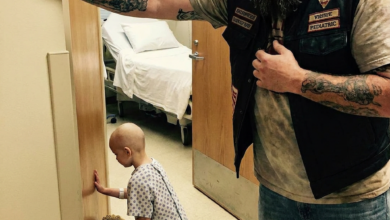
An Elderly Woman Unzipped a Biker’s Leather Vest in a Crowded Supermarket—Then the Warning Beneath His Shirt Reopened a Forty-Year-Old Debt
The old woman grabbed my leather vest in the middle of a crowded Ohio supermarket and pulled the zipper down before I could stop her, while half the store stared as if she had lost her mind—or I was about to hurt her.
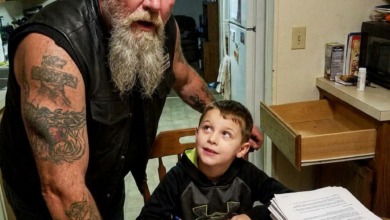
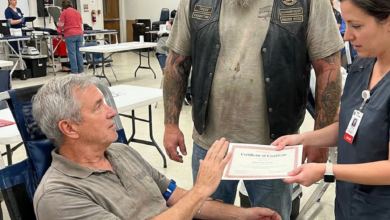
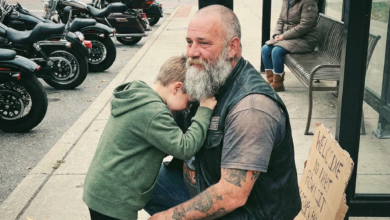
My name is Wade “Gravel” Mercer. I was fifty-nine years old, six-foot-four in my boots, and heavy enough that strangers usually moved their carts before I reached them. My beard hung gray over a faded black shirt, my arms were covered in old ink, and the leather cut on my back carried twenty-seven years of road dust, rain, funeral rides, and names I did not explain to strangers.
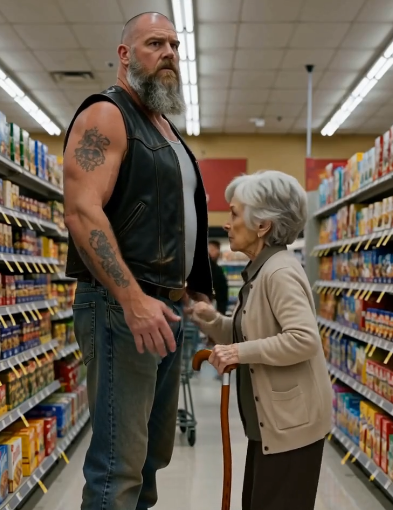
So when a woman who could not have weighed a hundred pounds stepped into my path near the canned soup aisle, nobody expected her to put both hands on me.
Especially me.
“Sir,” she said, staring at my chest. “Stand still.”
I thought she wanted help reaching a shelf. Then her fingers closed around my zipper and pulled it down in one sharp motion.
A jar hit the floor somewhere behind us.
A young father dragged his daughter back. A store employee raised his phone. Two men near the freezer aisle turned their carts sideways, watching me with the tight expressions people wear when they think trouble has chosen a place to happen.
The old woman ignored every one of them.
She pushed the sides of my vest apart, leaned toward the thin fabric covering my left chest, and whispered, “How long has it been doing that?”
I looked down.
A small amber light was blinking through my shirt from the cardiac monitor resting over my implanted device. There was no siren. No dramatic alarm. Just three faint vibrations I had mistaken for my phone buzzing against the inside pocket of my cut.
The woman’s face changed.
Not fear.
Recognition.
Her name, I would learn, was Eleanor Whitmore. She was seventy-eight, walked with a carved wooden cane, and had spent thirty-six years working night shifts as a cardiac nurse. Retirement had taken the uniform from her, but it had not taken the habit of counting breaths, reading skin color, or noticing the tiny mechanical warnings everyone else missed.
“You’re gray around the mouth,” she said. “Sit down.”
“I’m always gray.”
“Your beard is gray. Your lips should not be.”
The employee with the phone told her to step away from me. Eleanor did not even turn her head.
Instead, she pressed two fingers against my wrist.
Her fingers were cool. Mine were not.
“Pulse is irregular,” she said. “Do you have pain?”
“No.”
“Pressure?”
I started to say no again, but the fluorescent lights above us suddenly looked too bright. The soup labels blurred. The floor shifted under my boots as if the entire building had leaned several inches to the left.
Eleanor caught my forearm.
She should not have been strong enough.
“Chair,” she snapped.
That single word moved the whole aisle. Someone brought a folding chair from the pharmacy counter. Another person called emergency services. The young father who had pulled his daughter away now cleared the carts from around me, while Eleanor knelt beside my boots and kept talking in the calm, flat voice of someone who had stood between frightened people and death more times than she could count.
I did not know her.
At least, I did not think I did.
But as she opened my vest farther to help me breathe, her eyes dropped to a small patch sewn inside the leather, hidden where no stranger would normally see it.
The patch was old, hand-stitched, and crooked. It showed a red tow truck beneath two words:
BENNY’S GARAGE.
Eleanor stopped counting my pulse.
Her hand began to tremble.
“Where did you get that?” she whispered.
I looked at her face, and something buried beneath forty winters moved inside my memory: a wrecked station wagon, snow blowing across Route 20, a teenage boy whose blood had soaked through my gloves, and a woman in white running through hospital doors.
Before I could answer, Eleanor looked directly into my eyes.
“You carried my son.”
Then my chest vibrated again.
This time, the amber light turned red.
I remember the ambulance more clearly than I remember falling.
The rear doors shut, muting the supermarket noise, and a paramedic named Curtis cut open the collar of my shirt while another attached wires to skin that had already seen its share of scars. Eleanor stood outside the doors with one hand around her cane and the other pressed against her mouth.
She looked smaller without the fluorescent aisle around her.
Still, she did not leave.
Curtis asked when my implanted cardiac device had last been checked. I told him six months. That was not true. He asked whether I had ignored any earlier warnings. I told him no.
That was not true either.
The first warning had come three weeks earlier while I was riding east of Sandusky with eight members of the Iron Lanterns. It had felt like a strange flutter beneath my ribs, followed by a vibration against my chest. I blamed the cold. The second came in my garage while I was replacing a cracked fuel line on my Road King. I blamed the tool in my shirt pocket.
Men like me become talented liars when the person we are lying to is ourselves.
I had received the implant four years earlier after collapsing beside my Harley at a charity ride. The cardiologist called the device a guardian. I called it a box of wires that reminded me I was no longer thirty.
My brothers called it insurance.
“You miss another appointment,” our club president, Elias “Preacher” Boone, had told me, “and I’ll tow your bike myself.”
“You touch my bike, I’ll bury your truck.”
“Then show up.”
I did not.
That morning at Miller’s Market, I had come alone because the clubhouse refrigerator was empty and nine grown men had somehow decided coffee, mustard, and half a jar of pickles counted as provisions. We were preparing for our annual winter supply ride to the veterans’ shelter outside Toledo.
I had a list in my pocket written by Preacher’s wife, June.
Bread. Coffee. Canned stew. Soap. Apples.
At the bottom, she had added: And make Wade buy something green.
I was standing near the soup because I had forgotten whether green beans qualified when Eleanor saw the warning beneath my shirt.
The hospital in Beckford was fifteen minutes away. During that ride, the paramedics confirmed that one of the leads connected to my device was malfunctioning. My heart was not stopping, but its rhythm was unstable, and the implant was failing to correct it consistently.
Curtis said Eleanor might have bought me the difference between an orderly procedure and something far worse.
I stared at the ceiling.
“Lucky she noticed.”
Curtis tightened a strap across my waist. “That wasn’t luck.”
At the emergency entrance, the doors opened to freezing air and the sound of motorcycles.
Low engines.
Heavy pipes.
A V-twin rumble rolling beneath the ambulance bay roof like distant thunder.
Preacher had arrived with seven Iron Lanterns before the ambulance did. He was sixty-two, broad through the shoulders, and wore his white beard braided with a brass ring his granddaughter had given him. Beside him stood Deacon, Mouse, Rooster, Cal, Amos, Stitch, and a prospect we called Sunday because he was always late except on Sundays.
They had learned what happened from a supermarket employee who recognized my vest.
Preacher watched the gurney roll past.
He did not ask whether I was okay.
He looked at my face, glanced at the monitors, and said, “Six months, huh?”
I closed my eyes.
“Not now.”
“That means you lied.”
“Still not now.”
His boots followed the gurney until a nurse stopped him at the secured doors. When I looked back, I saw the others standing behind him in a rough black line.
And beyond them stood Eleanor.
She had followed in a taxi.
Hours later, after tests, scans, and a conversation with a cardiologist who did not enjoy my sense of humor, they admitted me overnight. The lead would need to be replaced. It was not considered open-heart surgery, which everyone repeated as though using smaller words made hospitals less frightening.
The procedure was scheduled for the next morning.
I told the club to go home.
Nobody moved.
“Shelter ride’s Saturday,” I said.
Preacher folded his arms. “It’ll survive.”
“So will I.”
“That remains under review.”
Eleanor sat near the window with her cane resting across her knees. She had barely spoken since arriving. Every few minutes, her eyes returned to the inside of my vest, now folded on a chair beside the bed.
Finally, she asked if she could see the patch.
I did not answer at once.
Nobody outside the club had seen it in years. It was not one of the patches displayed on my back. It was sewn into the lining, close to the heart, where rain and sunlight could not eat the faded red thread.
I reached for the vest.
Preacher picked it up first and handed it to me carefully. Whatever anger he had about my missed appointments could wait.
I turned the leather inside out.
Eleanor touched the crooked tow truck with one fingertip.
“My husband stitched this,” she said.
“I know.”
The room went silent.
Preacher looked from her to me. He had known me for twenty-seven years, yet he had never heard the story behind that patch.
None of them had.
Eleanor lifted her eyes. “Then you are the young man from Route 20.”
“I was young once.”
“You had black hair.”
“I had poor judgment too.”
Her mouth opened, but no sound came out. She reached for the chair beside the bed and sat as if her knees had stopped trusting her.
“What happened after the hospital?” she asked. “Where did you go?”
I looked at the red truck stitched into the leather.
“County jail, eventually.”
Sunday shifted near the door. Mouse stared at the floor.
Eleanor did not flinch.
“For what?”
I rubbed my thumb over the patch my younger hands had carried through four decades of rain.
“For what happened before I found your boy.”
In February 1986, I was nineteen years old and angry at nearly everything.
My father had left when I was twelve. My mother worked double shifts at a packaging plant and still came home with red notices folded beneath the sugar bowl. I had quit school, bought a used shovelhead motorcycle that leaked oil onto every driveway it touched, and joined three older riders who confused loyalty with obedience.
We were not a club.
We were frightened young men wearing leather.
That winter night, I had been drinking at a tavern outside Norwalk. Not enough to forget my name, but enough to believe I could ride through lake-effect snow. A man at the bar insulted my motorcycle. I answered with a chair.
The sheriff’s deputy arrived before I could leave.
I escaped through the kitchen, started the bike, and rode east with one mirror missing and blood drying across my knuckles. The temperature was below freezing. Snow erased the lane markers as quickly as my headlight found them.
I should have stopped.
I did not.
Near a closed farm stand on Route 20, I saw a station wagon angled in the ditch. Its headlights were still on, shining into tall weeds covered with ice. One front wheel had folded inward.
I shut down the motorcycle.
For several seconds, there was only wind ticking against the hot engine.
Then I heard someone knocking.
The driver’s side door was crushed. Inside, a boy around seventeen was trapped behind the steering wheel. He had blood in his hair, and his breath fogged the windshield in small, weakening clouds.
His name was Benjamin Whitmore.
Benny.
He had borrowed his father’s station wagon to deliver medicine to his grandmother in Bellevue. A truck had crossed the center line during the whiteout, forcing him into the ditch. The truck did not stop.
There were no mobile phones. The nearest house was more than a mile away. Benny could not feel his right leg, and the station wagon smelled sharply of gasoline.
“Don’t leave,” he said when I pulled at the damaged door.
“I’m not leaving.”
“You’re bleeding.”
“Not all of it’s mine.”
That did not comfort him.
I used a tire iron to bend the upper frame enough to reach through. The door would not open, so I climbed through the broken rear hatch. Glass cut my palms. My jacket caught on exposed metal. Benny made a thin sound when I freed the seat belt from his shoulder.
I told him to look at me.
His pupils were uneven.
That scared me more than the gasoline.
“I need my mom,” he said.
“Then stay awake.”
I wrapped him in my leather jacket and used the tow strap from the station wagon to brace his injured leg. I had no medical training. I had only watched my mother wrap factory injuries at our kitchen table.
When I tried to move him, Benny screamed.
I stopped.
He apologized.
That was the part I remembered most. A teenage boy trapped in a freezing car apologized for making noise.
“You yell all you want,” I told him. “Just keep talking.”
A passing snowplow finally saw my motorcycle’s headlight pointed toward the road. The driver radioed for help, but the ambulance was delayed behind a collision. Benny’s breathing became wet and shallow.
I could not wait.
The plow driver helped me pull him through the rear hatch. We laid him on the wide passenger floor of the snowplow, still wrapped in my jacket, and drove toward Beckford County Hospital.
The plow could not move fast. Snow pressed against the windshield like sheets being thrown from a roof. I knelt beside Benny, holding pressure against the wound near his ribs with one hand while gripping an overhead rail with the other.
He told me about his mother.
She was a nurse. She worked nights. She hated motorcycles. She kept his third-grade spelling trophy above the refrigerator even though the plastic eagle had broken off.
He told me about his father’s garage.
Benny’s Garage.
His father had named it after him when he was born and had painted a small red tow truck on the sign because Benny loved trucks. The boy planned to run the place one day.
“You ride motorcycles?” he asked.
“Sometimes.”
“Dad says motorcycles are coffins with handlebars.”
“Your dad sounds cheerful.”
Benny tried to laugh.
Then he stopped breathing.
I shouted his name. I pressed on his chest the way I had seen actors do on television, badly and too fast. The snowplow driver screamed into the radio while I counted numbers that kept collapsing in my mouth.
Benny coughed.
A thread of breath returned.
When we reached the hospital, the emergency team rushed through the doors. Eleanor was already there, wearing white shoes and a blue cardigan over her uniform because someone had called her from the garage.
She ran beside the stretcher.
I remember her face.
I remember trying to give her Benny’s wallet.
I remember blood on my hands.
Then a deputy grabbed me from behind.
The tavern owner had reported the fight. The deputy recognized my motorcycle description from the radio call. He thought I had caused the crash until the snowplow driver began shouting.
They handcuffed me in the emergency entrance.
Eleanor saw it happen.
Her son disappeared through the doors while the young man who had carried him inside was pushed against a wall.
She came toward me, but I shook my head.
“Go with your boy.”
“What’s your name?”
“Doesn’t matter.”
“It matters to me.”
“Wade.”
The deputy pulled me away before I could give her my last name.
Benny survived seven hours of surgery. His spleen was removed. His leg was repaired with metal pins. The doctors told Eleanor that the pressure I kept against his side and the crude support around his leg had prevented him from bleeding faster during transport.
I did not hear any of that then.
I spent three nights in county jail and later pleaded guilty to assault for the tavern fight. The judge gave me six months because it was not my first arrest. By the time I was released, my mother had moved to Indiana, the tavern had changed owners, and the garage I rented had sold my motorcycle to cover the unpaid bill.
I thought Route 20 was finished with me.
Then a package arrived.
Inside was my leather jacket, repaired and cleaned as well as blood-stained leather could be cleaned. There was also a hand-sewn patch showing a red tow truck.
The letter contained only four lines.
Wade,
Our son is alive.
If you ever need a place to stand, come to Benny’s Garage.
—Thomas and Eleanor Whitmore
I folded the letter.
Then I put it away.
I was nineteen, proud, ashamed, and convinced that accepting kindness created a debt I could never repay.
So I never went.
Eleanor listened without interrupting.
The hospital room had grown dark beyond the window. My club brothers stood along the walls, silent enough that I could hear the monitor beside my bed clicking through each uncertain beat.
When I finished, Eleanor closed her eyes.
“You thought we were offering charity.”
“I didn’t know what you were offering.”
“A job.”
I looked at her.
“Thomas needed another mechanic,” she said. “Benny couldn’t walk for months. My husband said anyone who could pull a boy from that wreck could be taught to rebuild an engine.”
I tried to smile. “He had more confidence than evidence.”
“We waited.”
Those two words landed harder than accusation.
Eleanor told me that Thomas had kept my repaired jacket hanging in the garage office for weeks before mailing it. Every time a motorcycle passed outside, he looked through the window. Benny asked hospital employees whether anyone knew a young rider named Wade.
Nobody did.
My arrest record listed an address where I no longer lived. The tavern owner refused to help. The deputy remembered only my first name.
By the time I was released, the Whitmores had lost the trail.
“Benny remembered your voice,” Eleanor said. “For years, whenever he heard a motorcycle outside the garage, he thought it might be you.”
I stared at the blanket across my legs.
“What happened to him?”
Eleanor looked toward the window.
“He grew up.”
She said it like a miracle because it was one.
Benny walked again after eleven months of therapy. He limped when the weather changed, but he finished school, studied automotive engineering at a community college, and eventually took over the garage.
He married a woman named Kathleen. They had two daughters.
“He kept a photograph of the snowplow above his desk,” Eleanor said. “Not the wreck. The plow. He said it reminded him that rescue rarely arrives looking the way people expect.”
Preacher turned his face away.
Eleanor continued.
Benny expanded the garage from three service bays to twelve. He offered discounted repairs to nurses, firefighters, veterans, and anyone traveling through town with a child in the car. Every February, on the anniversary of the crash, he repaired one stranger’s vehicle for free.
He called it Wade’s Day.
I could not speak.
Eleanor reached into her handbag and removed an old photograph protected by a clear plastic sleeve. A man in his late forties stood beneath a sign showing a red tow truck. His right leg leaned slightly outward. Beside him were two grown daughters, a smiling woman, and Thomas, older but still broad through the chest.
The man was Benny.
“When was this?”
“Eleven years ago.”
The question I had avoided formed anyway.
“Is he still alive?”
Eleanor’s fingers tightened around the photograph.
“No.”
The cardiac monitor continued its patient clicking.
Benny had died seven years earlier from pancreatic cancer. He was fifty-one. He had known for less than six months.
During his final weeks, he asked Eleanor whether she had ever found Wade. She told him no.
“He said you probably became someone who kept moving,” Eleanor whispered. “He said not to be angry with you.”
“I should have gone.”
“Yes.”
Her honesty hurt, but I respected it.
“I should’ve written.”
“Yes.”
“I thought staying away erased what I’d been.”
“No,” she said. “It only erased where we could reach you.”
Preacher left the wall and stepped closer to my bed. He knew there was more beneath those words than a missed reunion. He had watched me leave parties before cake was served, funerals before families gathered, and hospitals before anyone could say thank you.
I had built an entire life around arriving when needed and disappearing before I could become known.
The Iron Lanterns had accepted that habit until then.
Preacher picked up the old patch.
“You’ve carried their name forty years,” he said. “That isn’t leaving.”
“It isn’t showing up either.”
Nobody argued.
Eleanor turned the photograph over. On the back, Benny had written a date and one sentence:
If Wade ever comes home, tell him the lift is still open.
My throat closed.
At that moment, a nurse entered to prepare me for the morning procedure. She checked the device readings, adjusted medication, and explained that I could have one visitor remain overnight.
Preacher said he would stay.
Eleanor said she would.
They looked at each other.
“She’s seventy-eight,” Preacher told me. “Tell her.”
“She saved my life.”
“She started it. I’m finishing the shift.”
Eleanor studied him, then pointed at the chair.
“Do you know how to read ventricular telemetry?”
“No.”
“Then move.”
Preacher moved.
That was how Eleanor Whitmore, the woman whose son I had carried through a snowstorm four decades earlier, spent the night beside my hospital bed counting the beats of the heart she had saved in a supermarket.
But that was not the only reason she had been in Miller’s Market.
At two in the morning, she opened her handbag again.
This time, she removed a set of keys.
A small red tow truck hung from the ring.
“Benny left instructions,” she said. “For the garage.”
I looked at her.
“What instructions?”
“If we ever found you, you were to be given one choice.”
She placed the keys on the blanket.
“You can keep running.”
Then she tapped the red truck with one finger.
“Or you can finally come see what my son built from the life you carried through that storm.”
The procedure took less than two hours.
A damaged lead was removed and replaced. The doctors adjusted the implanted device, tested it twice, and told me I had been fortunate. Another few days of ignoring the alerts could have ended differently.
When I woke, Preacher was standing near the bed with a paper cup of coffee. Eleanor sat beside the window, asleep with her chin against her chest.
The keys remained on the bedside table.
“You going?” Preacher asked.
“To the garage?”
He nodded.
“I don’t know.”
He drank his coffee.
“You know.”
The club arranged the rest.
For once, I did not argue.
Two days later, after the hospital released me with more instructions than I intended to remember, Preacher drove me to Benny’s Garage in the club’s old pickup. My motorcycle remained at Miller’s Market because the cardiologist had forbidden me to ride for several weeks.
Six Iron Lanterns followed on their Harleys.
Eleanor sat between Preacher and me in the pickup, holding her cane upright like a staff. She wore a red scarf and had brought the old photograph.
The garage stood on the western edge of Beckford, half a mile from Route 20. The original building was still there, red brick darkened by weather, but Benny had added a larger steel structure behind it.
Above the main bays hung the same red tow truck.
The winter wind carried the smell of rubber, oil, and exhaust. Air tools rattled inside. A radio played somewhere beneath the rising and falling hum of engines.
When we entered, the work stopped.
A woman around forty came out of the office. She had Eleanor’s eyes and Benny’s uneven stance.
Her name was Rachel Whitmore.
Benny’s younger daughter.
She had been running the garage with her sister since his illness. Eleanor had called her from the hospital, but she had not told the employees why we were coming.
Rachel looked at my leather cut.
Then she looked at my face.
“You’re Wade.”
I nodded.
She crossed the floor and wrapped both arms around me.
I stood still.
My hands remained at my sides because I did not know where to put them.
“You’re late,” she said against my chest.
“Yeah.”
“About forty years.”
“Traffic.”
She laughed once, then began to cry. I looked over her shoulder at Preacher. He pointed firmly at her back, ordering me without words to return the embrace.
So I did.
The garage office was almost unchanged from the photograph. A metal desk sat beneath the window. Shelves held repair manuals, invoices, and coffee mugs with chipped handles. Above Benny’s desk hung a framed picture of an orange county snowplow pushing through a white wall of snow.
Beside it was an empty nail.
Rachel reached into a cabinet and removed a wooden frame.
Inside was a copy of the letter her grandparents had mailed me in 1986. Beneath it was a handwritten list titled WADE’S DAY.
Forty names filled the page.
One for every year since the crash.
Each name belonged to someone whose vehicle Benny had repaired for free on February 18. A widowed mother. A veteran traveling to Cleveland. A teacher whose engine failed during a snowstorm. A young couple living in their car. A hospice nurse. A farmworker. A father driving his daughter to chemotherapy.
Forty people.
Forty repairs.
Forty times a man I had known for less than one hour had turned survival into an open door for someone else.
“He never stopped expecting to find you,” Rachel said. “Even after he got sick.”
She opened the bottom desk drawer and took out a small cassette recorder. The plastic was scratched, and a strip of masking tape on the back carried my name.
My knees weakened.
Rachel placed it on the desk.
“He recorded this three days before he died.”
Eleanor did not move closer. Neither did the club.
They left the choice to me.
I pressed play.
Static filled the room.
Then a man cleared his throat.
“Wade, if this reaches you, it means Mom finally found you—or you finally got tired of hiding.”
Benny’s voice was deeper than the teenager’s voice in my memory, but the rhythm was the same. Careful. Slightly breathless.
“I don’t know what happened to you after that night. For a long time, I wondered whether you remembered me. Then Dad said a man doesn’t tear his hands open saving someone and simply forget. He said maybe remembering was the reason you stayed away.”
I stared at my scarred palms.
“You told me to keep talking, so I did. I talked through surgery, rehab, marriage, two daughters, and more bad coffee than any man deserves. I built a garage. I made mistakes. I buried Dad. I got sick. That is a life, Wade. An entire life. You carried the first piece of it through the snow.”
The recording paused while Benny caught his breath.
“You don’t owe me that life. Hear me? You don’t owe me.”
I shut my eyes.
“But if you’re listening, I’m asking for one thing. Stop leaving before people can thank you. Gratitude isn’t a chain. Let somebody remember you while you’re still in the room.”
The cassette clicked.
Then Benny’s voice returned, softer.
“The lift is open, brother.”
The tape ended.
No one spoke.
Outside, one of the Iron Lanterns started a motorcycle to move it away from a service bay. The engine’s low pulse traveled through the office wall.
Eleanor placed the keys beside the recorder.
“They are not ownership keys,” she explained. “Rachel and her sister own the garage. That little key opens the old cabinet beneath the workbench.”
Rachel smiled through wet eyes. “Dad kept something there for you.”
We crossed the original service bay. The workbench bore decades of dents and burn marks. Beneath it stood a narrow steel cabinet painted gray.
I used the small key.
Inside was a leather jacket.
My leather jacket.
The one I had worn on Route 20.
I had assumed the Whitmores mailed back the original, but Thomas had sent me another jacket from the garage. Mine had been too badly torn and soaked to wear. He had repaired it anyway, stitch by stitch, then stored it inside the cabinet.
The right sleeve still bore a dark mark.
The back had a long seam where metal tore it open.
On the inside, Thomas had sewn a second red tow-truck patch.
Below it, Benny had later added seven words:
HE STAYED UNTIL I COULD GO HOME.
I touched the stitching.
Then I sat on the concrete floor.
Nobody rushed toward me. Bikers understand that some falls do not require hands. Sometimes a man needs to reach the ground because he has spent too many years holding himself above it.
Eleanor lowered herself onto a stool across from me.
“I saw the alert because of Benny,” she said.
I looked up.
“After his crash, I specialized in cardiac care. I wanted to understand every monitor and every warning because I could not bear the thought of missing the sign that someone needed help. That became the rest of my career.”
The circle closed quietly.
I had carried her son because I noticed a light in a ditch.
She had saved me because she noticed a light beneath my shirt.
Neither of us had planned it.
Neither debt belonged to one person anymore.
Recovery made me irritable.
I could not ride. I could not lift anything heavy. I could not reach above my shoulder without June or Eleanor threatening to report me to the cardiologist.
The Iron Lanterns rotated visits to my garage. They pretended to need tools, coffee, or advice. What they were really doing was making certain I did not ignore another warning.
Preacher taped my appointment schedule to the refrigerator.
I removed it.
He taped another copy to the bathroom mirror.
I removed that one too.
Then Eleanor wrote the dates on the inside of my vest with a fabric marker.
I surrendered.
Three weeks after the procedure, Rachel invited me back to Benny’s Garage. A minivan belonging to a widowed nurse needed brake work, new tires, and a replacement alternator she could not afford.
It was February 18.
Wade’s Day.
I stood in the old service bay wearing coveralls over my healing chest while Rachel’s mechanics did the heavy work. My job was mostly to hand them tools and complain that they were using the wrong ones.
By noon, six Iron Lanterns had arrived.
By two, there were fourteen.
Mouse brought tires donated by a supplier. Preacher paid for the alternator before anyone could stop him. June filled the office with sandwiches. Eleanor sat behind Benny’s desk, answering the phone as if she had never retired.
When the nurse came to collect the minivan, Rachel told her the bill had been covered.
“By whom?” the woman asked.
Rachel pointed toward me.
I took one step backward.
Eleanor struck the floor with her cane.
Stay.
The nurse came closer. She had two children waiting beside the office door. Her eyes were exhausted in the way only night-shift eyes become exhausted.
“Thank you,” she said.
I looked at the repaired jacket hanging beside Benny’s photograph.
“You’re welcome.”
It did not trap me.
It did not turn me into a better man than I was. It did not erase jail, fights, missed appointments, or forty years of silence.
It simply stayed in the room between us.
That summer, the Iron Lanterns made Benny’s Garage the starting point for their annual veterans’ supply ride. Rachel worried that customers might be intimidated by thirty motorcycles filling the lot.
Instead, people came early.
Some brought canned food. Some brought blankets. Several came because Benny had once repaired their vehicles on Wade’s Day.
Eleanor stood beneath the red tow-truck sign wearing a black denim vest the club had made for her. The back patch did not say Iron Lanterns because she was not pretending to be a biker.
It said:
NURSE ON DUTY.
She loved it.
On the morning of the ride, I arrived on my Road King. The doctors had cleared me, the device had been checked twice, and Preacher had personally inspected the emergency information card in my wallet.
I shut down the engine.
Eleanor walked over and placed her fingers against my wrist.
“You know that machine monitors me now,” I said.
“Machines get lazy.”
“So do retired nurses.”
She pressed harder.
“Pulse is steady.”
“Told you.”
“You lie.”
“Occasionally.”
She reached toward my zipper.
I stepped back.
The entire parking lot laughed.
Then Eleanor rested her palm over the red truck patch hidden inside my vest. I covered her hand with mine.
“Benny would have liked this,” she said.
“He built it.”
The motorcycles started one by one.
Thunder rolled across the garage windows. Chrome trembled. Exhaust clouded the cold morning air. Children covered their ears and smiled while riders loaded supplies into trailers.
Before mounting my bike, I looked at the photograph above the office desk.
Benny stood beneath the red tow truck, leaning slightly on the leg we had feared he would lose.
The lift was still open.
And this time, I had shown up.
Eleanor became part of our club without ever joining it.
Every Thursday, one of us took her to lunch. She refused to ride on the back of a motorcycle, claiming she had spent too many years repairing men who believed helmets were optional. Preacher offered her a sidecar.
She called it a bathtub with wheels.
He bought one anyway.
The first time she rode in it, she complained from Benny’s Garage to the county line. On the return trip, she asked him to go faster.
The following February, Wade’s Day repaired five vehicles instead of one. Rachel’s sister created a small foundation in Benny’s name. The Iron Lanterns supplied labor, parts, and enough loud opinions to make every meeting last twice as long as necessary.
My name remained on the event.
I asked them to remove it.
Eleanor refused.
“Running again?” she asked.
So I let it stay.
I also began telling younger riders the truth about Route 20—not the polished version, but all of it. The tavern. The fight. The jail sentence. The fear that kept me from walking into Benny’s Garage.
A rescue does not make every choice before it noble.
A leather vest can cover courage, shame, damaged machinery, and a warning light at the same time. People are built that way too.
But I never said those words aloud as a lesson. Bikers tend to distrust lessons delivered cleanly.
Instead, every February 18, I hung my repaired jacket in the original service bay. Beneath it, we placed the snowplow photograph and Benny’s old cassette recorder.
Then we opened the doors.
Four years after Eleanor pulled down my zipper in Miller’s Market, she was eighty-two and walked more slowly. Her hands had begun to shake even when she was not frightened.
Still, she attended Wade’s Day.
That morning, she stood beside me while a young mechanic repaired the car of a single father whose daughter needed regular treatment in Cleveland. Snow drifted beyond the open bay, light and steady.
“You ignored another appointment?” Eleanor asked.
“No.”
She looked at me.
“Only moved it.”
“Wade.”
“Two days.”
She lifted her cane.
“I rescheduled it. Already done.”
The cane lowered.
“Good.”
We watched the mechanic fit the final wheel. Nearby, Preacher poured coffee, Rachel explained paperwork, and children drew red tow trucks on scrap invoices.
Eleanor leaned her shoulder against my arm.
“My son waited a long time for you.”
“I know.”
“He would forgive the delay.”
“I know.”
“Have you forgiven it?”
I listened to the air tools, the leather creak of club members moving through the bay, and the muffled idle of a Harley outside.
“Working on it.”
She nodded.
That answer was enough.
When the repaired car rolled away, the little girl in the passenger seat pressed her hand against the glass. I raised mine.
Snow gathered briefly on the tire tracks before the next vehicle pulled into the bay.
Above us, the red tow truck swayed in the winter wind.
Inside my vest, the monitor remained quiet.
The light had been seen in time.
Follow our page for more powerful biker stories about brotherhood, hidden courage, second chances, and the ordinary people who discover the hearts beneath the leather.