He Donated Blood 200 Times and Refused Every Award — Then a Biker Opened His Mother’s Old Notebook and Understood Who Had Saved the Man’s Daughter
My mother’s notebook lay on the workbench for three days before I took it back to the donor center. I did not want to leave it where a spark or a spill could ruin it, so I slipped it into a plastic sleeve first. Then I checked that sleeve twice on the ride over. I had owned the notebook for twelve years without opening it. Once I knew what was inside, I was afraid of losing a page.
Her name was Margaret Price. She wrote dates in blue ink and used red only when an appointment had been moved. The first entry was from the year I finished school. The last came shortly before she became ill. She had made eighty-seven donations over twenty years, according to the count she wrote inside the back cover.
There were no speeches in it. On one page, beside a date, she had noted that rain had flooded the road near the clinic. On another, she had written a reminder to buy coffee afterward. A folded bus timetable marked the middle. When my mother still drove, she had often offered people rides; I could not tell from the notebook whether she had taken the bus herself that day or carried the timetable for someone else.
I remembered her telling me to drink water before I left for long rides. I remembered a small bandage on the inside of her elbow once, though I couldn’t place the year. When I asked what had happened, she said she had been to an appointment and changed the subject to whether I had eaten. That was how she talked. She was interested in other people’s plans and rarely offered her own unless they needed to know.
Ray met me at the donor center entrance. He did not reach for the notebook until I handed it to him. Even then, he glanced at a few pages and closed it.
“These dates won’t tell us who received anything,” he said.
“I know.”
He said there might not be a way to learn more. Donation and recipient records were protected, and thirty years was a long time. The clinic where my mother gave blood had changed systems. The hospital had changed names. Ray could help me find the right person to ask about a proper process, but he could not look up Daniel’s daughter or my mother on his own.
I told him Daniel wanted an answer only if my mother’s family could properly authorize any information about her. Ray reminded me that Daniel’s daughter would also need to decide whether she wanted her old medical records reviewed. Daniel’s wish was not enough for everyone involved.
We went inside and spoke to the donor center manager, a woman named Carla Nguyen. I introduced myself as Margaret’s son, showed her the notebook, and told her why I had brought it. Carla listened, then carefully separated what I knew from what I hoped.
I knew my mother had donated on dates she had recorded. I knew Daniel’s daughter had needed blood thirty years earlier. I did not know whether any of my mother’s donations went to her, even if the dates were close. Carla made that plain. I was glad she did. The notebook had begun to feel like an answer simply because I wanted it to be one.
Carla offered to contact the hospital’s records office about whether any consent-based inquiry was possible. She said it could take time and might end with no result. If it went forward, the families would need to speak for themselves. She would not give one family the other’s private information because I wore a vest and had a story to tell.
I liked her at once.
I called Daniel later that day. He asked first whether I had eaten after donating. Ray must have told him I had made an appointment while I was there. I said I had, and that I wanted to ask him something about the past. I told him I had found my mother’s donation notebook. I told him a date was close to his daughter’s hospitalization, then added what Carla had said: proximity was no proof.
Daniel let me finish. He did not ask for the notebook or a photograph of it. He asked whether my mother was alive. When I said she had died twelve years earlier, he gave me his condolences.
“I’m sorry you can’t ask her,” he said.
That was the first time I understood I wanted an answer for two reasons. Daniel had searched in his heart for a stranger. I wanted to learn something true about my mother while there was still a chance to ask people who had known her.
Daniel’s daughter called me the following week. Her name was Hannah. I was at the garage, crouched beside a motorcycle with a loose mirror, when my phone rang. She introduced herself and said her father had told her about Margaret’s notebook.
Hannah remembered very little of the hospital stay itself. She remembered a stuffed dog with one bent ear, her mother sleeping in a chair, and the smell of the soap the nurses used. Most of what she knew came from her parents. She was grateful for the care she had received, but she had never felt that a stranger owed her an introduction because of it.
“My dad’s been carrying this longer than I have,” she told me.
She wanted to help him find an answer if one existed. She was willing to ask the hospital about her own records and sign the forms needed for its staff to review them. She also wanted to understand what might be shared. I told her Carla was the person to ask. Hannah laughed and said she had already written Carla’s number on the back of an envelope.
After that, the waiting began.
The first month went toward finding out which office held records from the hospital as it had existed thirty years earlier. The second brought questions about what could still be verified. Carla explained each step to the families without promising a result. An old ledger or a date alone would not establish that Margaret’s donation had reached Hannah. The staff needed a reliable link through the records they still held.
I carried on with my days. Our club rode a charity route in April. The garage got busy when warmer weather brought neglected bikes out of sheds. Ray kept volunteering, though he stopped giving me a hopeful look every time I walked into the donor center. I had asked him not to. Hope was making me read news into every phone call.
Daniel continued his appointments when eligible. On days he came in, Ray offered him water and spoke about ordinary things: a road closure, Hannah’s children, whether the center had changed its crackers again. Daniel did not ask him to check the records. He knew Ray couldn’t.
I visited Hannah and her family one Sunday after she invited me for lunch. Daniel was there, cutting grapes for his youngest grandchild. The other child wanted to know whether my motorcycle could pull a trailer and how loud it was when it started. Hannah’s husband brought extra chairs from the porch.
I learned that Hannah coordinated volunteers for a neighborhood food program. She kept a wall calendar full of collection days and school events, with different colors for each child. Her father had given blood for thirty years after her illness, but he had not spent those years speaking only about the hospital. Their family had grown around it.
After lunch, Daniel walked me to my bike. He said he had been thinking about the unknown donor. For years, he had pictured a person who somehow knew Hannah needed help. He understood now that donors usually did not know who would receive their blood. That made him think about all the appointments he had made without knowing who might benefit.
“I used to call it paying someone back,” he said. “I don’t suppose it works that neatly.”
“No,” I said. “I don’t think it does.”
He put a hand on the bike seat, careful of the hot parts. “I’m still glad I went.”
So was I. There were people who needed blood today, regardless of what an old file revealed. When Ray organized the club’s next group visit, I helped make the calls. I did not mention Daniel’s story to persuade anyone. I asked who was interested, gave them the center’s information, and let them decide.
By the fourth month, Carla said the hospital had located material that might help. She was precise with that word: might. There were further checks to make, and neither family had seen the underlying records. Hannah submitted another form. My sister, who was also Margaret’s child, spoke to the relevant office about what we could authorize concerning our mother. She wanted an answer too, but she made me promise I would phone her before telling the club.
Six months after I first found the notebook, Carla asked us to come in.
Carla met us in a private room at the donor center. Daniel and Hannah sat on one side of the table. My sister, Beth, sat beside me on the other. Ray waited outside; he said this part belonged to the families unless we wanted him there.
Carla explained the work that had been done. The hospital’s old records and the blood service’s archived information had been reviewed by staff authorized to handle them. The families had signed the necessary consents for the limited information Carla was about to share. She was careful not to spread other patients’ details across the table.
Then she told us they had verified it. One of Margaret Price’s donations had been among the blood products Hannah received during her treatment at four years old.
Daniel closed his eyes. Hannah reached for his hand.
I looked at Beth. Our mother had never mentioned Hannah, but there was no reason she could have known her name. Margaret had made an appointment, donated, gone home, and perhaps reminded me to eat dinner that evening. The person on the other side of her gift had been a frightened four-year-old whose father would go on to make two hundred appointments of his own.
Carla left us time to sit with it. Nobody asked for anything else from the file.
Daniel was the first to speak. He asked Beth whether their mother had talked about donating at home. Beth shook her head. She had known Margaret attended the center occasionally, but she had not known it had been eighty-seven times.
“She wrote down every date,” I said. “I brought the book, if you want to see it.”
Daniel did. I took it from my bag and opened it to the page Carla had identified as the relevant donation. My mother’s handwriting looked exactly as it did on her grocery lists: neat, slightly slanted, with the date underlined. There was a note about needing to pick up flour afterward.
Daniel touched the edge of the page without covering the writing.
Hannah leaned forward. “She didn’t know me?”
“No,” Beth answered. “She’d have told us if she did.”
Hannah nodded. I could see she was trying to imagine Margaret as a person rather than a name attached to a record. I told her my mother kept a spare cardigan in her car for cold buildings and could never pass a table of used books without stopping. Beth told her Margaret sang while washing dishes but would refuse if anyone asked her to sing a whole song.
Daniel listened to all of it. He did not say that meeting us settled the debt he had carried. He asked what Margaret had done for work, whether she liked children, and how long she had lived in Dayton. Those were questions we could answer.
Then he told us about four-year-old Hannah. She had been stubborn about wearing the hospital socks and wanted her stuffed dog on the bed even when there was barely room. He remembered holding a cup to her lips and being relieved when she complained that the water tasted strange. An ordinary complaint had sounded to him like a promise that she was still herself.
Hannah groaned at the sock story. Beth smiled. For a few minutes, the room held two families talking about people they loved.
When it was time to leave, Daniel asked if he could photograph the notebook page. I asked Beth, and she agreed. He took one picture and put the phone away. He thanked us for allowing the inquiry, then asked me to tell him if I ever wanted the photograph removed. I told him it was all right.
Outside, Ray stood near the door with his volunteer badge clipped to his shirt. Daniel went over and shook his hand. Ray had not discovered the answer; Carla and the records staff had done that work. Daniel knew it. He thanked Ray for giving us the right phone number and for letting the families find out in their own time.
I called the club after I called my sister again that evening. Walt would usually have been the person making that call; I was Walt, and for once I had no short version ready. I told them Margaret had donated blood eighty-seven times. I told them one of those donations had reached Daniel’s daughter thirty years earlier. Then I went quiet while the men who remembered my mother tried to recall what she had said about the donor center.
None of them remembered her mentioning it.
For the next few weeks, people wanted to do something for Daniel and for my mother. I understood the impulse. I felt it every time I passed the keepsake box in the garage. A rider suggested a plaque. Someone else wanted to call a reporter. Ray stopped both conversations early.
Daniel had refused recognition for years. Margaret had kept her donations mostly to herself. Their choices deserved more thought than our first burst of feeling.
I went to Daniel’s house to ask what he wanted. Hannah was there with her children, and Beth came with me. We sat around the dining table after the kids had gone outside. Daniel had printed the picture of Margaret’s notebook page. It was tucked inside a book, where he could look at it without having it on display for visitors.
He said finding her name had changed the way he thought about his first donation. He had made that appointment because he wanted to answer an act of kindness. For thirty years he had imagined one stranger across from him. Now he knew Margaret’s name, and he knew she had donated many times. Her appointments had helped people she never met, not only Hannah.
“She wasn’t keeping a score with us,” he said.
Beth told him Margaret would have been pleased that Hannah had grown up and had children. She also said our mother would probably have asked about his grandchildren before anyone had a chance to thank her.
That made Daniel laugh. It was the first easy laugh I had heard from him since Carla’s meeting.
Ray joined us later with an idea. The donor center had been asking community groups to help bring in new donors. Instead of putting Daniel or Margaret on an award, we could organize a drive. Ray thought their combined story might encourage people who had been curious about donating but had never made an appointment. No one’s private information would be used without agreement. The center would handle eligibility, appointments, and donations as it always did.
Daniel considered it. He still did not want a ceremony about his two-hundredth donation. He was willing to let the campaign carry his first name alongside Margaret’s if it made room for the people who would come after them. Hannah said she would help plan it. Beth and I agreed our mother’s name could be used.
We called it the Daniel and Margaret Blood Drive. Ray checked every piece of wording with both families. The short account said that Margaret had donated eighty-seven times over twenty years, that one of her donations helped Hannah, and that Daniel had gone on to donate two hundred times across thirty years. It did not imply that a single donation alone had saved Hannah or that every donor would learn who received their blood. Carla made sure we understood that.
The first event filled its available appointments. Some people came on motorcycles; most did not. A teacher came after school with a colleague. A mechanic from another shop brought his sister. Several people registered for the first time, and the staff explained what the process involved before anyone made a decision.
We had imagined one big day. The center asked us to think in months instead. Donations were needed beyond a single event, and appointments had to fit staffing and supply needs. Hannah became the volunteer coordinator for the campaign. She handled sign-ups, reminders, and the simple questions people felt shy asking. For anything medical, she sent them to trained staff.
I watched her work one Saturday at a community hall. She stood beside an information table with a folder of appointment times. Daniel arrived carrying coffee for the volunteers. For a moment I saw the four-year-old he had described, refusing hospital socks and asking for her stuffed dog. Then her children came running toward her, and she crouched to hear what they had found outside.
Our club helped set up chairs, transport supplies the staff had asked us to carry, and guide visitors to the correct entrance. Ray made sure no rider stood over a nervous first-time donor telling them to be brave. He said people deserved room to decide. Daniel agreed with him.
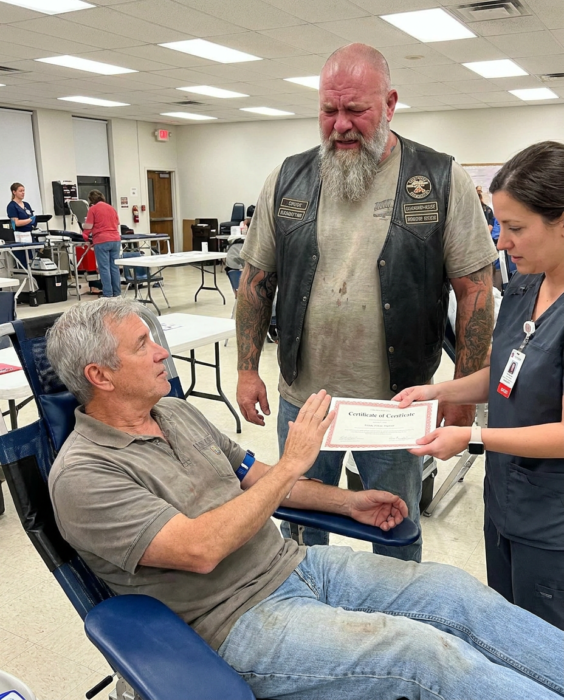
By the end of the first year, the campaign had helped collect more than 4,000 units through a series of donor events. Carla gave us the center’s verified total after the final event was recorded. Daniel asked for the number, wrote it on a small card, and put it in his wallet. He declined another certificate.
I still have Margaret’s notebook. It lives on a shelf inside my house now, away from the oil and dust of the garage. Beth borrowed it once to read all eighty-seven entries. She brought it back with a few photographs of our mother I had never seen: Margaret at a picnic, Margaret holding Beth’s first child, Margaret standing beside my motorcycle with her hands on her hips because she thought I had parked too close to her roses.
Daniel has a copy of the one page we agreed he could keep. Sometimes he brings it to campaign planning meetings in the book where he stores it, though he rarely takes it out. He no longer has to wonder whether the donor was real or whether she would have wanted to know Hannah lived. He knows Margaret was a woman who liked used books and sang badly over the dishes. It is a small amount to know about a person. To him, it is enough to say her name.
The campaign has a routine now. Hannah reviews the center’s needs before choosing dates. Ray checks that our volunteers understand their jobs. Club members show up for the work they signed up to do and leave the clinical decisions to the staff. Daniel helps fold tables at the end of an event. He is still quicker at stacking chairs than I am.
He also still gives blood when the center says he is eligible. Reaching two hundred did not make him stop. He no longer counts aloud unless Hannah asks where he is. She keeps track because she knows dates matter to him, even when he pretends they don’t.
At one event, a new donor asked Daniel why the campaign used two names. He pointed to the short account on the table and said Margaret had helped his daughter years ago. The donor read it, then asked if Daniel had known her. Daniel said he had met her son and daughter, which was as close as he could come.
I was standing nearby with a box of cups. He looked over at me and added that he wished he could have met Margaret too. I told him she would have liked his grandchildren. Then I took the cups where Ray needed them.
Most days are like that. We do the work, tell a little of the story when someone asks, and go home. The old notebook does not explain why Margaret first made an appointment. Daniel’s two hundred donations cannot be assigned to two hundred faces. We know the one connection the records confirmed. That is enough to keep us turning up.
On the anniversary of the day Carla gave us the answer, Beth and I visited our mother’s grave. We brought flowers from the grocery store because those were the ones Margaret bought for other people. Daniel asked if he might come too. He arrived with Hannah, who stayed a little way back with me while he spoke to the stone.
I could not hear what he said. I did not try to.
Afterward, the four of us went for coffee. Hannah showed Beth pictures of her children, and Daniel asked me whether I had fixed the motorcycle mirror that had been loose the day she first called. I told him I had, though it had taken me far longer than it should have.
That afternoon, Ray needed help setting up the next donor event. I rode to the hall and found Daniel already there, carrying a folded table with another volunteer. He set it down, checked that its legs were secure, and went back for chairs.
Follow this page for more biker stories about the people we meet, the quiet work they do, and the lives connected along the way.
Ray handed me a stack of chairs. I took my share.