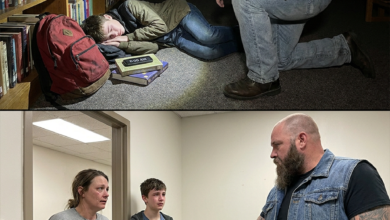
A Tattooed Biker Waited Outside an Elementary School Every Morning With a Pink Lunchbox — Then His Daughter Asked What Would Happen If She Got in Trouble
Part 2 — After I Leave
I told her the food was hers.
She could eat what she wanted, bring home what she didn’t, and tell us if something tasted wrong. Lunch wasn’t a test she could fail.
I said it quietly, because the gate wasn’t a place for an eight-year-old to have her history explained to strangers.
Nora looked at the box.
Then she looked at Ms. Ramirez.
Her teacher nodded toward the classroom, giving her time to decide when to move. I watched my daughter walk through the gate with both hands around the handle.
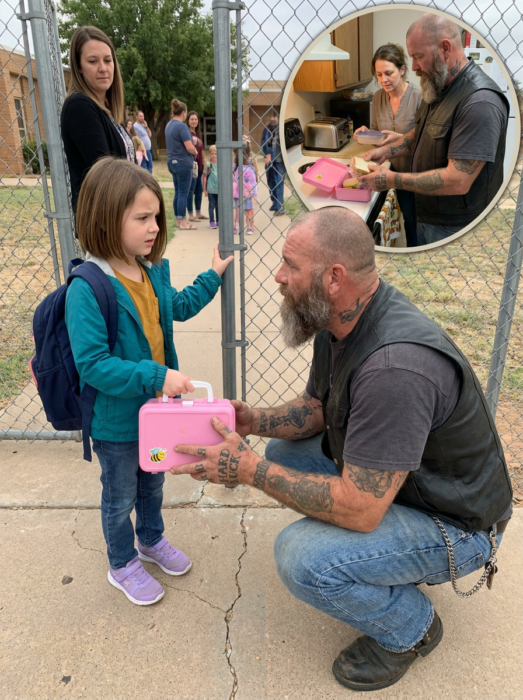
Only after she turned the corner did I realize I had been holding my breath.
When Nora first came to live with us, she called me Mr. Jack.
Not because we asked her to. She’d heard somebody introduce me that way and kept the name as if it came with instructions.
Tess was Tess.
My mother, who lived in the little apartment attached to our house, became Grandma Elsie almost immediately. Elsie accepted the promotion without making a speech.
I was happy to wait.
Tess and I had spent a long time going through the process of becoming parents this way. We had answered questions, attended training, made changes to our house, and learned that wanting to help a child didn’t make us experts on what that particular child needed.
Nora arrived with two bags and an opinion about the curtains.
“They look itchy,” she told Tess.
They did.
We changed them the next weekend.
That was the first thing she asked us to change. The questions about food took longer.
At our first dinner together, she sat at the table without touching her plate.
We thought she didn’t like what we’d made.
Tess offered another choice.
Nora shook her head.
I asked whether she wanted a smaller fork.
Another shake.
Finally, she looked at Elsie and whispered, “Can I start?”
We had already said dinner was ready. To us, that meant everyone could eat.
To her, it apparently hadn’t answered the question.
Elsie passed the butter and said yes.
Nora ate quickly, then watched the serving dish until Tess offered more.
She refused.
Later, I found her standing in the kitchen doorway while the rest of us cleaned up.
She wasn’t asking for anything.
She was checking where the leftovers went.
We learned in pieces.
Not in one terrible confession at the dinner table. Not because we sat her down and asked her to describe everything she’d survived.
A question about whether breakfast happened on weekends.
A cracker hidden inside a shoe.
An apology after she dropped a piece of toast.
The adults who had cared for her before she entered foster care had sometimes withheld food and sometimes failed to provide it. We knew that from the history shared with us.
Knowing it on paper was different from hearing a child ask whether being sick meant she didn’t get dinner.
Tess called the professionals already helping Nora.
We asked questions. We listened. We changed things when our good intentions didn’t work the way we’d imagined.
We made food available in predictable ways, and we didn’t turn what she saved into an argument about whether she trusted us.
That was our family’s work with people who knew her. It wasn’t something I invented because I’d fixed enough engines to believe I could fix a frightened child.
There were mistakes.
One evening, I found crackers tucked behind a cushion and said, without thinking, “You don’t need to do that anymore.”
Nora went still.
I heard myself a second too late.
What I meant was there would be more food.
What she heard was that I had found her doing something wrong.
I sat on the floor, a few feet away, and told her she wasn’t in trouble. Tess helped us find a better place for food she wanted to keep nearby.
I apologized.
Nora watched me put the crackers where she’d chosen.
She didn’t thank me.
She didn’t need to.
For a while, she asked permission for things I had never thought required it.
A second apple. Water before bed. The last pancake.
Then one Saturday she marched into the kitchen, opened the cupboard, and complained that we had bought the wrong crackers.
Tess waited until she left the room before leaning against the refrigerator and crying.
I understood.
Our daughter had finally been annoyed about food instead of afraid to ask for it.
School brought a different problem.
Home had meals she could see being made. School meant leaving the house and hoping the arrangements still included her after she was gone.
There was food at school. Her teacher made sure she knew how to get it.
But Nora worried about the lunch she’d brought from home even when it was already in her backpack.
She checked it at the bus stop.
She checked it again when she arrived.
One morning, she asked if I could bring it instead.
I had just finished a night shift and was standing in the kitchen with a cup of coffee warming my hands.
“To school?” I asked.
She nodded.
“Why?”
She pulled at the cuff of her sleeve.
“So you have to remember after I leave.”
I put down the coffee.
That was how it started.
Not with a parenting book, not with a dramatic promise, and not because she couldn’t carry a lunchbox.
She wanted one part of the morning that showed I had thought about her when she wasn’t there.
I could do that.
So the next school day, I stood by the gate.
Part 3 — The Morning I Wasn’t There
For the first few weeks, the hardest part was the schedule.
I worked nights maintaining equipment at a food-processing plant. Tess left early for her bookkeeping job. Elsie handled breakfast and the bus, and I collected the lunchbox after my shift.
Some mornings Tess packed it.
Some mornings I did.
Nora knew that. She wasn’t asking one person to become every part of her life. She was asking whether I would still do the part I’d said I would do.
I reached the gate smelling faintly of machine oil, with my beard flattened on one side from the helmet strap.
A few parents began saying hello.
One father asked whether I was delivering something his wife had ordered. A little girl wanted to know why my lunchbox had a bee.
“Because it’s hers,” I said, pointing toward Nora.
The little girl considered that and decided it was an acceptable explanation.
Adults generally took longer.
At home, I set two alarms. I wrote the school mornings on the same calendar where Tess kept appointments. I learned which containers fit inside the pink box and which made the lid bulge.
I also learned that cutting a sandwich into triangles did not make it taste better on every day of the week.
Nora had strong views.
She liked apples but objected to slices that had turned brown. She liked cheese unless it touched something wet. One Friday, she requested a sandwich with the crusts left on because her friend said crusts made you taller.
By Monday, she had reconsidered.
Those were the parts I liked best.
A complaint about a sandwich could just be a complaint about a sandwich.
But I got too comfortable with how well the mornings were going.
I started thinking that if I kept arriving, the rest would follow in a straight line.
Children don’t recover on a maintenance schedule.
Neither do fathers, apparently.
The men in my riding club began noticing how carefully I protected the school mornings.
The High Plains Riders weren’t strangers to family responsibilities. Most had children, grandchildren, bad knees, and jobs that didn’t care about the weather.
Still, a few thought I was making the arrangement bigger than it needed to be.
“You know schools have lunch,” Mick told me one evening while we checked a tire.
“I know.”
“Then leave it in her bag.”
“She asked me to bring it.”
“You going to do that until she’s eighteen?”
I tightened something that was already tight.
“I haven’t planned that far.”
Mick wasn’t trying to be cruel. He’d watched me trade shifts, skip morning rides, and turn down overtime I could have used.
He saw a man building his whole day around a plastic box.
I saw my daughter looking for me after the bus doors opened.
We didn’t settle the argument that night.
Then the club scheduled an early Friday departure for its annual memorial ride.
My younger brother Pete had ridden with us before he died. His name was one of the reasons we made that trip, and I had never missed the departure.
That year, the departure overlapped with the handoff.
Mick offered to take the lunch.
He meant it kindly.
But Nora barely knew him, and I wasn’t going to surprise her with a substitute at the gate just because the substitute had good intentions.
I said I’d join the ride farther along the route.
Mick looked disappointed.
So did I.
Missing the first stretch with my brother’s friends wasn’t nothing.
I called the road captain, worked out where I could safely join them, and told Nora the plan for that Friday’s lunch.
She listened, then asked if Pete had liked bees.
I said I didn’t remember having that conversation with him.
She told me I should have asked.
She was right about that.
The ride worked out.
I delivered the lunch, joined the others later, and let myself feel both things: glad I’d been at the gate and sorry I’d missed a part of the morning that mattered to me.
Then, on a wet Tuesday, the truck got a flat tire.
I was using the truck because the roads were slick. The lunchbox sat upright on the passenger seat, and I was far enough from school that I couldn’t simply carry it the rest of the way.
I pulled over safely.
Then I looked at the clock.
The bus hadn’t arrived yet.
I called the school office first and explained the delay. Ms. Ramirez would meet Nora and tell her where I was. Tess was already at work but answered when I called her next.
Then I called Mick.
He lived closest.
He said he’d come.
There was no lecture about sandwiches.
While I waited, I pictured the gate, the bus, my daughter stepping down and looking first for the bike, then for me, then for the box.
I had told the school what happened.
I had done the sensible things.
My hands still shook when I tried to open a message from Tess.
She’s inside with her teacher. She’s safe.
I read it three times.
Mick arrived in his pickup. We secured my truck and left the tire for later.
He drove. I held the lunchbox on my knees.
When we reached school, the gate was closed and the classrooms were already busy.
I checked in at the office.
Nora sat beside Ms. Ramirez, her backpack still on both shoulders.
She saw the box.
Then she saw me.
I expected her to ask where I’d been.
Instead, she whispered, “Did you get tired of doing it?”
Part 4 — Worse Than Glue
I set the lunchbox on the office table and crouched in front of her.
“No,” I said. “I didn’t get tired of doing it.”
Her eyes stayed on the bee.
“Then why weren’t you there?”
“The truck had a flat tire. I called the school, and Mick brought me.”
She nodded as though she understood the words.
Her hands didn’t relax.
Ms. Ramirez quietly moved a chair closer so I didn’t have to stay on my knees. She told Nora she’d be at the desk if we needed her.
There was a school lunch available. Her teacher had offered it. Nobody had left my daughter without food while I dealt with a tire.
But she’d barely looked at what was offered.
She had been waiting for an answer only I could give.
I sat down.
“I was coming,” I said. “The whole time. I was late, but I was coming.”
Nora pulled one backpack strap tighter.
“Even about yesterday?”
I hadn’t known there was an about yesterday.
“What happened?”
She’d spilled glue during an art project. Then she’d told the teacher another child did it because she was embarrassed.
Later, she admitted it was hers.
Ms. Ramirez had helped her clean up and talked with her about telling the truth. There was a note for us in her folder.
Nora hadn’t shown it to us.
She thought I had found it anyway.
I looked toward the pink box.
All those mornings I’d been saying I remembered, and somewhere inside her fear there was still another question: remembered what?
The child.
Or the thing she’d done wrong.
I asked if she’d thought the lunch wasn’t coming because of the glue.
She nodded.
“If you were mad,” she said, “you wouldn’t have to.”
I put my hands flat on my knees because I didn’t trust them to stay still.
For a moment, every sentence in my head was about the adults who had taught her that.
None of those sentences belonged in front of her.
What she needed was an answer about today.
“Being upset with you doesn’t change whether you get lunch,” I said. “We can talk about the glue. You still eat.”
She looked at me then.
“Dinner too?”
“Dinner too.”
“What if it’s worse than glue?”
The office clock clicked.
Someone at the front desk answered the phone.
I had to swallow before I could reply.
“Food doesn’t get taken away because you’ve done something wrong.”
Nora studied my face for the exception.
I couldn’t blame her.
In her old home, meals had sometimes depended on whether an adult was pleased with her. Other times, there simply hadn’t been anyone making sure she ate.
She had learned to ask carefully, save quietly, and notice how much was left.
The question about counting wasn’t about crackers.
It was about whether leftovers would be used to prove she hadn’t needed a meal in the first place.
The question about tomorrow wasn’t a child’s attempt to make me spoil her.
It was a child trying to discover which parts of this house were allowed to stop.
I opened the lunchbox when she nodded that she wanted me to.
A sandwich. Carrot sticks. An apple. Crackers in the container.
Ordinary things.
I could have packed a feast, and it wouldn’t have answered her more clearly.
“I made the sandwich this morning,” I told her. “Grandma washed the apple. Your mom found the container lid I lost.”
“Under the toaster,” Nora said.
“Apparently that’s where lids go to retire.”
One corner of her mouth moved.
I pointed to the crackers.
“I count these to see what fits. Not to decide what you deserve.”
She reached for the handle.
Then stopped again.
“Can I still have some later if I’m hungry?”
“Yes.”
The answer wasn’t a reward for explaining herself. She would have had food later even if she hadn’t found the words.
I sat with her until she was ready to go back to class.
She didn’t throw her arms around my neck.
She didn’t announce that everything made sense now.
She asked if the apple was a crunchy one.
I said I hoped so.
That was enough for that morning.
Outside, Mick waited in his truck with the heater running.
He saw my face and reached over to turn the radio down.
“She okay?”
“She will be.”
“You?”
I stared at the school doors.
“I told her I’d be there.”
“You called. You came.”
“I wasn’t there when she got off the bus.”
Mick waited a moment.
Then he said, “Brother, you can’t make the road promise for you.”
I almost snapped at him.
He’d been the one asking why I didn’t leave the box in her bag. He’d been the one who thought I was turning lunch into something too complicated.
But that morning he had left his own plans, driven across town, and waited without asking Nora to explain anything to him.
He wasn’t telling me the promise didn’t matter.
He was telling me I couldn’t keep it by pretending nothing would ever go wrong.
I thought of Pete.
After my brother died, I had become the man who checked his phone too often and hated being late to things nobody else was timing.
I’d called it being dependable.
Sometimes it was.
Sometimes it was fear wearing work boots.
Nora needed me to keep showing up. She also needed a plan that didn’t collapse whenever one man got a flat tire.
I looked at Mick.
“Thanks for coming.”
He put the truck in gear.
“Wasn’t going to leave you standing there.”
Part 5 — Dinner Still Happened
Tess had dinner half ready when I woke that afternoon.
Nora sat at the kitchen table drawing a bus with windows too small for the people inside it. Elsie was shelling peas into a bowl and pretending not to listen.
Tess looked at me over our daughter’s head.
We had already spoken by phone.
I kissed her cheek and asked what needed doing.
“Potatoes,” she said.
I washed my hands.
For a while, we let dinner be dinner.
Nobody asked Nora to retell the morning for Grandma. Nobody turned the spilled glue into a family hearing.
Later, Tess sat beside her and looked at the note from school.
They talked about telling the truth. Nora explained that she’d thought her classmate would be angry about the glue.
Tess said there was room to apologize and fix what she could.
Then we ate.
Nora watched that sequence more closely than any explanation we gave her.
A mistake had been discussed.
Dinner still happened.
Afterward, she asked for another potato.
Tess passed the bowl.
The next evening, we talked about the mornings.
Not by announcing that the handoff had become a problem and needed to stop. It was helping in some ways. We wanted Nora to have something to hold onto when a day changed.
We’d spoken with her counselor, and we included Nora in the parts she could help decide.
I told her I still planned to come to the gate.
I also told her trucks got flat tires, people got sick, and sometimes a grown-up needed another grown-up to help.
She looked concerned.
“Do you have another grown-up?”
“Several. They complain, but they’re available.”
Tess gave me a look.
I corrected myself.
“They’re glad to help.”
Nora considered this.
We named the people she already knew and what would happen if I was delayed. The school would know. Her teacher would stay with her while the plan was sorted out. Lunch would still be available.
Nobody would expect her to solve it.
She asked whether Grandma could bring the pink box.
Elsie said she could.
“Even if it’s raining?”
“I own a coat.”
That settled something.
We didn’t put a complicated chart on her wall or ask her to memorize phone numbers while she was frightened. We kept the plan simple enough to talk through again when she wanted.
And she wanted.
Several times.
The following morning, I arrived early.
Not because arriving early could cancel what had happened, but because I could.
Nora got off the bus and looked at the box.
I handed it to her.
“I remembered.”
She touched the handle.
“What if your truck breaks again?”
“Then we use the plan.”
“Okay.”
She opened the latches anyway.
I let her.
At work, I spoke to my supervisor about the end of my shift. I couldn’t keep agreeing to extra jobs five minutes before I needed to leave and then treating the resulting rush as an emergency.
We worked out clearer coverage.
It meant less overtime for a while.
Tess and I went through the budget at the same kitchen table where Nora drew buses. We postponed replacing a chair and stopped pretending every expense could be handled next month.
It wasn’t a sacrifice Nora needed to hear about.
She hadn’t ordered herself into a family with a difficult schedule.
We were the adults who had chosen to make room.
Mick helped in ways that made more sense after he understood that.
He checked my spare tire while I slept. Another club member helped cover a repair job I’d already promised a customer. The road captain stopped assuming an early departure worked for everybody.
Nobody brought twenty motorcycles to the school gate.
Nora didn’t need a ceremony about her lunch.
She needed the morning to be boring enough that she could think about something else.
The first sign came on a Thursday.
I arrived with the box, and she wanted to tell me about a classmate who claimed turtles could take off their shells.
“That would be terrible,” she said.
I agreed.
She took the handle while explaining how she’d correct him, and only after she’d gone through the gate did I realize she hadn’t checked inside.
The next day, she checked twice.
I nearly let that disappoint me.
Then I remembered she wasn’t taking a test I was grading.
Neither was I.
There were other things I had to learn.
Once, while Tess made pancakes, Nora said the woman who’d cared for her before had sometimes made them in funny shapes.
I felt a quick, ugly wish to be the only home associated with something good.
I kept it to myself.
“What shapes?” Tess asked.
Nora described one that was supposed to be a rabbit but looked like a boot.
We laughed.
She was allowed to remember that.
Loving us didn’t require her to turn every part of her old life into something she wasn’t allowed to miss.
I thought about the first time she’d called me Dad, months earlier, from the hallway because she couldn’t reach a towel.
Not during an adoption celebration. Not while someone had a camera ready.
She’d needed a towel.
I’d brought it.
Then I’d stood in the kitchen for a minute, holding the cupboard door open after I’d forgotten what I meant to get.
Tess had walked past and closed it gently.
“I heard,” she’d said.
I’d nodded.
The next morning, I went back to the gate with the pink lunchbox.
There was still work to do.
That didn’t make what had changed any less real.
Part 6 — She Was Still Having a Day
By winter, I could recognize the children on Nora’s bus by their backpacks before I saw their faces.
The one with the dinosaur always came off running.
The one with the silver stars usually remembered something halfway to the gate and went back to ask the driver.
Nora still came near the end.
Some mornings she looked for the motorcycle first. Other mornings she spotted my beard above the parents and waved before her feet reached the sidewalk.
The box stayed pink.
The bee lost a piece of one wing.
I offered to replace the sticker, and Nora informed me that bees could have difficult lives too.
We left it alone.
I wasn’t always on the Harley. Wind, rain, and bad roads sent me in the truck. Once I walked from the repair shop after leaving the bike there overnight.
Nora asked where it was.
I told her.
Then she took the lunchbox.
That used to have been the kind of change that could unsettle a whole morning. Now, sometimes, it was only a question about a motorcycle.
Sometimes was enough.
She still had hard days.
A substitute teacher. A change in the lunch schedule. A school announcement that made her think something she’d counted on was being canceled.
We talked with the people helping her, kept listening, and didn’t mistake one easy week for the end of everything difficult.
But the ordinary complaints kept coming.
Too many carrots.
Not enough cheese.
An apple with a suspicious spot.
I found myself smiling while she accused me of packing a banana that had clearly already given up.
Tess said I was enjoying parenthood in unusual ways.
She wasn’t wrong.
One afternoon, Nora came home with half her sandwich still in the box.
She set it on the counter and stood beside it.
I could see her waiting.
“What happened?” I asked.
“I wasn’t that hungry.”
“All right.”
“Emma had pretzels.”
“Were they good?”
“She let me have two.”
I opened the box to clean it while Nora watched.
I didn’t count the bites.
I didn’t remind her what food cost.
We had other times to teach her about money without making a half sandwich carry the whole lesson.
“What’s for dinner?” she asked.
Tess answered from the stove.
Nora went to wash her hands.
I stood at the counter with the box open, and for once it was just a box that needed washing.
A week later, the school held an afternoon display of the children’s writing.
Tess and I went together. I wore my vest because I’d ridden over, and Nora immediately used me as a place to hang her jacket.
Her page had a drawing of our house.
The garage was larger than the house itself, which I considered a fair architectural decision. Tess disagreed.
Grandma stood in the doorway holding something Nora said was either a bowl or a hat.
She hadn’t decided.
In the corner, there was a tiny pink rectangle with a handle.
Ms. Ramirez asked Nora if she wanted to read her sentence to us.
Nora nodded.
“My dad brings my lunch after I go away.”
She paused, then read the next line.
“He knows I am still having a day.”
I looked at Tess.
She looked at me.
Neither of us said anything quickly enough, so Nora explained that it meant I had to remember her even when I was somewhere else.
“I understood, bug,” I said.
“Then why are you looking like that?”
“Allergies.”
Tess stepped on my boot.
I corrected myself.
“Because I like what you wrote.”
Nora accepted that and asked whether we wanted to see the class hamster.
We did.
The page came home the following week. Nora put it on the refrigerator herself, using three magnets because two made the corner curl.
We didn’t photograph it for the club.
I told Mick she’d had a good week. He asked if the bee still had its wing missing.
I said yes.
“Good,” he said. “Adds character.”
The next morning, Nora took the lunchbox without opening it.
Then she turned back to ask whether I could put fewer carrots in tomorrow.
I told her we’d negotiate.
She rolled her eyes and went inside.
Part 7 — The Box Could Stay Closed
The Tuesday after spring break, I nearly packed Nora’s lunch into my own work bag.
I caught the mistake before leaving the kitchen and stood there laughing quietly at myself.
After all those months of treating the pink box like a piece of equipment the world depended on, I’d almost carried it back to the plant.
Tess leaned against the doorway.
“You tired?”
“Yes.”
“Then come home and sleep after the gate. I’ll handle the store.”
I kissed her and checked the box once.
Just once.
The morning was clear enough for the Harley. I secured the lunch for the ride, took the familiar streets, and parked where I always parked.
The engine settled into silence.
I carried the box to the gate.
Around me, parents were having the usual arguments about jackets, water bottles, and whether a child could possibly have forgotten a project mentioned every day for a week.
I used to think those people looked burdened.
That morning, I mostly thought they looked lucky to have ordinary things to argue about.
Then I remembered how Nora had spoken to me about the carrots and decided we were getting our share.
The bus arrived.
Dinosaur backpack first.
Silver stars a little later.
Then Nora, talking to Emma so intently that she almost walked past the place where I stood.
She saw me and stopped.
“Morning, bug.”
“Morning, Dad.”
I held out the lunchbox.
“I remembered.”
She took it with one hand.
“Can you get me at the side door today? We’re showing the gardens.”
“Tess is picking you up. She knows.”
“Okay.”
That was all.
No second question to check whether Tess really knew.
No request to hear the whole plan again.
Just okay.
I didn’t point it out.
A good morning wasn’t something she needed to perform twice so I could feel better about it.
She shifted the lunchbox and started telling me about a seed she’d planted before the break. She was worried Emma’s would sprout first because Emma had spoken to hers more politely.
I asked whether an apology might help.
Nora considered that.
“Maybe.”
Behind her, Ms. Ramirez lifted a hand.
The gate was open. Her friend was waiting. There was a whole day Nora wanted to get to.
She leaned against me for a quick hug, her cheek pressing into the leather at my side.
Then she pulled away.
I had the sudden urge to hold her another second.
Not because she needed it.
Because I did.
So I let her go.
She didn’t open the latches.
She didn’t weigh the box in her hands.
She walked toward Emma with the pink handle hooked over her fingers, telling her friend she intended to apologize to a bean.
I stayed until Ms. Ramirez had them both.
Then I turned toward the motorcycle.
There would be other difficult mornings. I knew that now without feeling it canceled the good one.
There would be school days when I brought the box and days when Nora eventually decided she’d rather carry it herself.
When that happened, I wanted to hear her.
I hadn’t started coming to the gate so she would need me standing there forever.
I’d started because she needed to know she stayed in somebody’s mind after leaving the house.
At the bike, I took out my phone and sent Tess a message.
Good morning. She’s inside.
Then I looked back once.
Nora had reached the classroom doorway. Emma said something that made her laugh, and she lifted the box out of the way so another child could pass.
The bee still had a damaged wing.
The white handle was scuffed.
Inside was food she might eat, complain about, or leave unfinished.
She wasn’t checking.
The lunchbox swung beside her.
Follow our page for more biker stories about steady love, second chances, and the small promises that help someone feel remembered again.