A Nine-Year-Old Sold His Father’s Biker Boots for $15 to Buy Medicine — The Name Hidden Inside Ended a Seven-Year Betrayal
Eli tried to refuse the money four times.
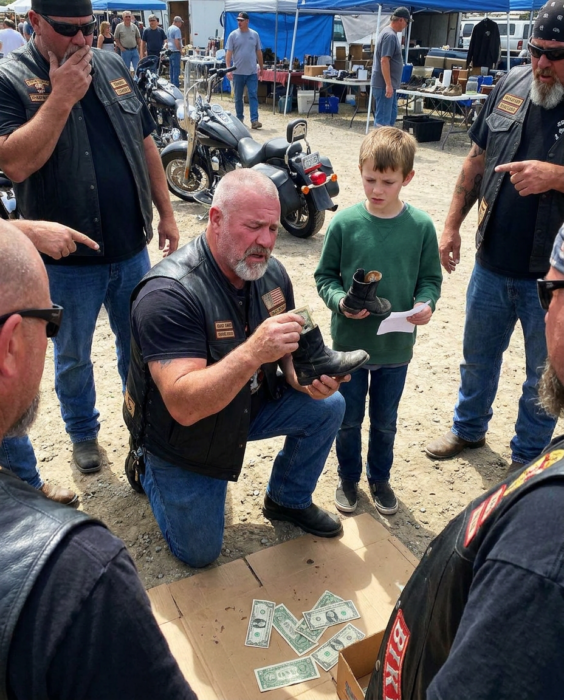
Rook solved the argument by placing fifteen dollars in the boy’s hand and asking him to sell us one shoelace. The remaining cash, he said, was payment for information about an old friend.
Eli considered that.
Children who grow up counting coins understand transactions better than gifts. Gifts can create debts nobody explains until later.
He removed the least damaged lace.
Rook accepted it solemnly.
“Deal.”
The rest of the money went into an envelope marked for Ruby. Eli placed it inside his sweatshirt and lifted the boots against his chest.
We walked him to the pharmacy first.
The prescription was for an antibiotic and fever medication. Ruby had seen a doctor at a community clinic, but their insurance status was tangled after the family moved counties. The pharmacist knew them. She looked relieved when Eli produced the receipt.
Rook paid for everything before the boy could open the envelope.
He added a thermometer, electrolyte drinks, cough medicine approved for Ruby’s age, and two boxes of crackers. Mason purchased children’s pain reliever, then stared at the label for so long that the pharmacist gently showed him how to read the dosage chart.
Eight bikers carrying medicine through a pharmacy attract attention.
Rook ignored it.
Outside, Eli refused a ride because he did not have a helmet. We left the motorcycles with two brothers and took a city bus instead.
That is how the Iron Lantern Motorcycle Club followed a nine-year-old home at twelve miles per hour.
Eli and Ruby lived with their mother, Marisol Vega, in a converted roadside motel along West Broad Street. Half the rooms had plywood over their windows. The neon sign no longer worked. Weekly rent was collected through a metal drawer beneath the office window.
Eli stopped at Room 17.
“Mom might be mad.”
“At you?” I asked.
“At everybody.”
He knocked in a pattern: three quick taps, two slow.
The chain moved.
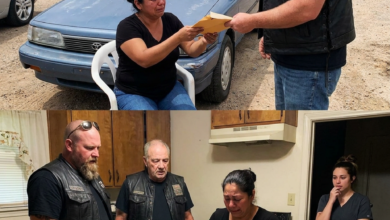
Marisol opened the door wearing a grocery-store uniform and socks with holes at both heels. She was thirty-four but looked older. Exhaustion had cut dark lines beneath her eyes.
Her gaze found the medicine.
Then the bikers.
Then the boots.
She gripped the doorframe.
“Where did you get those?”
Eli began explaining, but Marisol stepped into the walkway and pulled him against her. Relief turned immediately into fear.
“You left before I woke up.”
“Ruby needed medicine.”
“You never leave without telling me.”
“I tried to help.”
“You could have disappeared.”
The last word broke inside her.
Rook removed his sunglasses.
“Ma’am, he was trying to sell the boots at the flea market.”
Marisol looked at him.
“Who are you?”
Rook opened his leather cut enough to show the Iron Lantern patch.
Her face emptied.
She recognized it.
Behind her, Ruby coughed from the mattress. The room contained one blanket, a hot plate, two plastic milk crates used as chairs, and a box fan with its front grille removed.
The fan did not work.
No bed frame.
No table.
No dresser.
Ray’s old photograph stood against the wall inside a cracked plastic frame. He wore our club cut and the same boots Eli held.
Rook’s voice became quiet.
“We rode with Ray.”
Marisol stepped backward.
For several seconds, nobody entered. We stood beneath the motel balcony while traffic passed on West Broad Street, carrying the smell of rain and diesel through the broken parking lot.
Then Ruby called for her mother.
Marisol let us inside.
The girl looked small beneath the blanket. Her cheeks were flushed, but she was alert enough to stare at eight enormous men crowding the doorway.
Rook knelt beside the mattress and kept his distance.
“This your medicine?”
Ruby nodded.
“Your brother earned it.”
Eli looked at the floor.
Marisol prepared the first dose while Mason repaired the fan. I found a loose electrical connection and a burned switch. The fan was finished, but nobody said so yet.
Rook sat on a milk crate.
“Marisol, we searched for Ray.”
She froze with the medicine spoon in her hand.
“We searched seven years.”
“You didn’t find him?”
“No.”
Her expression changed from fear to disbelief.
“He died the night he disappeared.”
The words entered the room without force.
That made them hit harder.
Rook leaned forward.
“How do you know?”
“Because police called me four months later.”
The body had been recorded as an unidentified man after a highway rollover during a severe storm. Ray had carried no wallet. Fire destroyed part of his clothing. His fingerprints were misfiled under the wrong case number.
For four months, he remained unidentified.
Eventually, a county investigator matched a dental record submitted through a missing-person report Marisol had filed in another jurisdiction. By then, she had buried him quietly with help from a victim-assistance fund.
“Why didn’t you call us?” Mason asked.
Marisol looked toward the club photograph.
“I did.”
Nobody spoke.
She had called the number Ray kept taped inside a kitchen cabinet. A man answered. Marisol explained who she was and said Ray was dead.
The man told her Ray was no longer a member.
Then he hung up.
Rook’s hands closed slowly.
“What man?”
“I don’t know.”
His voice had been deep. Older. He knew Ray’s road name. He said the club wanted nothing from a thief.
Marisol never called again.
The missing emergency money surfaced in my memory.
So did the man who had accused Ray.
Luke “Crow” Mercer.
Rook’s younger brother.
Rook left the motel room without speaking.
I followed him into the parking lot. Rain had begun again, soft and cold. He stood beside a rusted railing with his fists closed, staring toward the highway.
Luke had died three years earlier from liver failure.
He could not answer questions.
That did not make the questions disappear.
Mason came outside carrying the broken fan motor.
“You thinking what I’m thinking?”
Rook nodded.
Luke had been treasurer when Ray vanished. He reported $4,800 missing from the emergency fund. He also claimed Ray owed gambling money to a motorcycle-parts dealer in Cincinnati.
We believed him because he was Rook’s brother.
Blood became proof.
Ray became convenient.
Rook struck the railing once with the side of his fist. Rust fell onto the wet concrete.
“Not here,” I warned.
He looked toward Room 17 and unclenched his hand.
Inside, Marisol told the rest.
Seven years earlier, Ray left home during a thunderstorm after receiving a call from Luke. He told Marisol a brother was in trouble near Route 33 and promised to return before Eli woke.
He wore the black boots.
That was the last time she saw him alive.
At 11:42 p.m., a minivan carrying a couple and three children hydroplaned near an unfinished bridge approach. It struck the barrier, rolled down an embankment, and landed partially submerged in a drainage channel.
Ray saw the broken guardrail.
He stopped.
A truck driver later told investigators that Ray slid down the muddy slope before emergency crews arrived. He pulled the father through a shattered window. Then he returned for the oldest daughter.
The van shifted deeper.
Ray returned a third time.
He freed the mother and reached for the youngest child, but the current moved the vehicle. A section of debris struck Ray and carried him beneath the floodwater.
Firefighters recovered all three children and both parents alive.
Ray’s body was found nearly a mile downstream.
His motorcycle disappeared from the roadside before investigators completed the scene. Police assumed a passerby stole it. Without the motorcycle, wallet, or recognizable club cut, the unidentified body remained disconnected from our missing-person reports.
Marisol opened a plastic folder.
Inside were the police report, death certificate, newspaper clippings, and a letter from the rescued family. The youngest child had drawn a motorcycle beside five stick figures.
The family’s surname was Dalton.
They had attempted to locate Ray’s relatives after learning his identity, but Marisol moved between shelters and temporary rooms. Letters were returned. Phone numbers changed.
She preserved the folder.
She also preserved the boots.
A paramedic recovered them from a debris pile after the flood. One boot still contained mud when Marisol received them. She cleaned both and placed them under the bed.
“They were supposed to go to Eli,” she said. “When he was grown.”
Eli looked sick.
“I’m sorry.”
Marisol pulled him against her.
“You were helping Ruby.”
“I sold Dad’s boots.”
“You brought them back to the men who knew him.”
That stopped everyone.
Eli had not known the club’s name. He chose an ordinary flea market and a price based on a prescription.
Yet the boots returned to us.
Mason sat against the wall. His large hands hung between his knees. He had spent seven years referring to Ray as a runner.
“What did Ray say about us?” he asked.
Marisol considered the question.
“He said the club was the family that taught him how to stay.”
Nobody looked at Mason.
Rook studied the old photograph.
Ray had joined the Iron Lantern at twenty-two after a juvenile record, addiction treatment, and several years drifting between jobs. Club discipline helped him remain sober. Marriage and fatherhood changed him further.
He stopped attending late-night parties.
He sold his custom chopper for a safer touring bike.
Some brothers claimed Marisol controlled him. Others said Ray had become soft.
The truth was less dramatic.
Ray had become a father.
Rook picked up the death certificate. His thumb covered the date.
“We put him out after he died.”
Marisol did not understand.
“His name was on our memorial wall,” I explained. “We removed it when we thought he stole from us.”
Eli’s eyes moved across our patches.
“You called my dad a thief?”
No one answered quickly enough.
He stood between the mattress and the door, still holding the boots.
“He saved those people.”
“Yes,” Rook said.
“And you said he stole?”
“Yes.”
“Why?”
“Because we believed the wrong man.”
Eli’s face tightened.
Children understand betrayal without legal language.
“You were supposed to be his brothers.”
Rook took the accusation without defending himself.
“You’re right.”
Eli opened the door.
“Leave.”
Marisol touched his shoulder.
“No, Mom. They were mad at Dad while we had nothing.”
Rook rose.
Every man followed.
At the threshold, he turned toward Marisol.
“Ruby’s medical bills are covered. Rent too, if you allow it.”
“We don’t want guilt money,” Eli said.
Rook looked at him.
“Neither did Ray.”
The door closed.
We stood outside with fifteen hundred dollars still inside Marisol’s envelope and the broken fan motor in Mason’s hand.
That could have been our ending.
Pay the bills. Repair the room. Put Ray’s name back.
Easy gestures.
But guilt does not become honor merely because men spend money.
First we had to prove what happened.
Then we had to find the five strangers alive because Ray returned three times.
And before that, Rook had to open the club ledger bearing his dead brother’s handwriting.
The old ledgers were stored beneath the clubhouse bar inside a steel cabinet.
We returned after dark. Nobody drank. Nobody played music. Rain ticked against the windows while Rook unlocked seven years of dust.
Luke’s records filled three binders.
At first, everything appeared ordinary: charity deposits, utility payments, funeral collections, and emergency withdrawals. Then Mason found a series of transfers routed through a repair business that had closed shortly after Ray disappeared.
The owner was Luke’s gambling contact.
Ray had not taken $4,800.
Luke had.
Ray discovered the missing money and confronted him. That explained the late-night call. Luke told Ray he was stranded near Route 33 and needed help before Rook learned the truth.
Ray rode into the storm for him.
Phone records obtained during the original investigation showed one final call from Ray’s number to Luke at 10:58 p.m. It lasted twelve seconds.
Luke told us that call never occurred.
The timing placed Ray minutes from the rollover.
He had likely left Luke after the confrontation and encountered the broken guardrail on his way home.
The motorcycle remained missing.
Mason remembered Luke suddenly owning a newer truck several weeks later. Luke claimed insurance money paid for it. Nobody checked.
Rook closed the ledger.
His brother had stolen from the club, lured Ray into the storm, moved or sold Ray’s motorcycle after the accident, and blamed him before anyone discovered the financial theft.
Worse, Luke had answered Marisol’s call.
He knew Ray was dead.
He allowed us to hate him anyway.
Brotherhood broke in two directions that night: one man betrayed us, and the rest of us chose the comfortable lie he supplied.
Rook removed Luke’s photograph from the clubhouse wall.
He did not destroy it.
He placed it face down on the table.
“Truth stays whole,” he said. “Even when it’s ours.”
We contacted the county investigator named in Marisol’s folder. Retired Detective Ellen Price remembered the rollover because of the identification failure. She located archived evidence, rescue reports, and photographs.
One image showed Ray’s damaged club cut caught in river debris. Fire and water had destroyed the back patch, but a piece of the Iron Lantern emblem remained near the shoulder.
Another photograph showed tire tracks beside the highway where Ray parked.
Detective Price also traced his motorcycle. A salvage-yard record showed that Luke sold a damaged Harley under a handwritten bill of sale three days after Ray vanished.
The proof was complete.
Ray had been dead while we accused him.
He had been a hero while we erased him.
Rook called an emergency club meeting.
Forty-one current and former members attended. Some had ridden from Indiana, Kentucky, and West Virginia. Ray’s empty place on the memorial wall was visible behind the president’s chair.
Rook did not hide Luke’s guilt.
He read the ledger entries.
He displayed the salvage document.
He played the investigator’s recorded explanation.
Then he stood beneath the blank space and removed his president’s patch.
“This happened under me.”
Nobody moved.
“I trusted blood over evidence. I let anger become a verdict. If the club believes I cannot carry this patch, vote tonight.”
Mason rose first.
“Put it back on.”
Rook shook his head.
“Vote.”
The discussion lasted two hours.
Men shouted. One brother argued that Rook could not have known Luke lied. Another said leadership meant responsibility beyond intention. A former member admitted that he had repeated rumors about Ray in three states.
The final vote kept Rook as president.
It did not absolve him.
His first act after the vote was to create an independent audit policy for all club money. His second was to restore Ray’s membership record. His third was to forbid anyone from describing the restoration as charity toward Ray’s family.
“We owe a debt,” he said. “Call it that.”
Finding the Dalton family took four days.
The parents had moved to Tennessee. Their three children were adults: Emma, twenty-six; Joshua, twenty-three; and Lily, nineteen. Lily had been two years old during the rollover—the child Ray tried to reach during his third trip.
Emma became a nurse.
Joshua worked as an electrician.
Lily studied emergency management because she grew up hearing that strangers and first responders had entered floodwater for her family.
They knew Ray’s name.
Their parents spoke it every anniversary.
When Rook called Emma, he explained who we were and what we had believed. He did not soften it.
“We called him a traitor for seven years.”
Emma remained silent.
Then she said, “Our family calls him the reason we’re alive.”
The Daltons came to Ohio the following weekend.
Before meeting Marisol, they visited the clubhouse. Lily carried the water-damaged drawing she had made as a child. Emma carried a binder of medical records and newspaper stories. Joshua carried a sealed envelope.
Inside was $4,800.
Their parents had saved it slowly after learning that Ray had been accused of stealing the same amount. They hoped someday to clear the debt if evidence could not.
Rook pushed the envelope back.
“He never took it.”
“We know,” Joshua said. “But his children lost seven years.”
The money became the first deposit in the Ray Walker Family Fund.
It paid Ruby’s remaining medical bills.
Then it paid for something larger.
A bed.
The Daltons met Marisol and her children in Room 17.
Emma entered first. She wore blue hospital scrubs after driving through the night from Tennessee. Joshua followed with a toolbox. Lily stood at the doorway holding the old drawing.
Marisol recognized the surname before anyone explained.
Her hand covered her mouth.
“You were in the van.”
Emma nodded.
“All five of us.”
Eli looked at Lily.
“My dad went back for you?”
“I was two.”
“Do you remember him?”
“No.”
The honesty mattered.
Lily did not manufacture a childhood memory for emotional effect. She knew Ray through her parents’ account, police reports, and the empty chair her family set at Thanksgiving each year in honor of the stranger who never left the water.
She handed Eli the drawing.
A large stick figure stood beside a black motorcycle. Five smaller figures held its hands. Above them, in a child’s uneven writing, was a name Lily had learned later.
Ray.
Eli sat on the mattress.
For seven years, he had heard fragments: his father went away, his father died in an accident, his father had friends somewhere. Marisol withheld details because grief already occupied too much of their room.
Now three adults stood before him because Ray had chosen to return.
Emma told him how Ray pulled her through a broken rear window when she was nineteen. Joshua remembered a tattooed arm reaching through muddy water. Their father remembered Ray shouting that another child remained inside.
“He could have stayed on the road,” Joshua said. “He could have waited for the fire department.”
“But he didn’t,” Eli whispered.
“No.”
“Three times?”
“Three times.”
Rook stood against the wall.
Eli looked at him.
“You didn’t know?”
“We should have.”
That answer differed from saying no.
Rook refused the comfort of ignorance.
While the families talked, club members transformed the empty motel room next door. The owner agreed to rent both rooms at a reduced rate after the Iron Lantern guaranteed six months in advance.
We connected them through an interior door.
Mason assembled two beds.
Grinder repaired the electrical outlets.
Joshua installed a ceiling fan.
Claire Hale brought bedding. Emma stocked a medicine cabinet. Lily helped Ruby choose a lamp shaped like a moon.
No expensive show.
No cameras.
Useful things.
The Ray Walker Family Fund covered Ruby’s specialist appointment. Her persistent cough was linked to asthma worsened by mold around the motel window. The club relocated the family to a clean two-bedroom apartment before winter.
Marisol did not accept the help passively.
She negotiated.
She demanded that rent support last only until she completed a medical billing certificate. She insisted on signing repayment terms for part of the moving cost, though the fund later redirected her payments toward another family.
Rook respected her more each time she argued.
Eli began visiting our garage on Saturdays. At first, he sat near the door with Ray’s boots beside him. He did not trust us fully.
He should not have.
Trust offered too quickly would have made our apology cheap.
Rook taught him to sort washers. I showed him how to clean tools. Mason let him press the button on the parts washer. Each lesson ended at the same time so Eli knew when his mother would collect him.
Predictability became our language.
Three months after the flea market, the club held Ray’s memorial ceremony.
Hundreds attended. Riders arrived from four states. The Daltons stood beside Marisol, Eli, and Ruby.
Ray’s photograph returned to the wall.
Under it, the club mounted his original membership number and a small metal plate cut from one of Luke’s falsified ledger covers. We used the metal because Rook wanted the lie physically present beneath the corrected truth.
No one erased Luke from history.
His photograph moved to a private archive with an account of what he had done. Rook said forgetting betrayal only prepares a place for it to return.
Then he brought out Ray’s boots.
Eli thought they would be buried or displayed immediately.
Rook handed them to him.
“They’re yours until you’re ready.”
Eli looked down at his small sneakers.
“They’ll never fit.”
“Not yet.”
Seven years later, they still did not fit comfortably. Eli grew tall but inherited Marisol’s narrower feet.
At sixteen, he worked as a paid mechanical apprentice in our garage. His hands carried small scars from metal edges and stubborn bolts. He could rebuild a starter motor, mount a tire, and detect an uneven idle faster than men twice his age.
Ray’s boots remained too large.
That became right somehow.
Eli was not required to fill them.
On his sixteenth birthday, he cleaned the leather for the final time. He preserved every road scar and left the red stitching untouched.
Then he placed the boots in a glass case beneath Ray’s photograph.
The metal plate inside the heel remained visible through an angled mirror.
Beside the case sat the original piece of cardboard from the market.
Fifteen dollars.
That price had purchased medicine.
The boots had purchased back the truth.
Every August, the Iron Lantern rides Route 33 to the section of highway where Ray stopped.
We do not block traffic. We do not rev engines beside the marker. We park at a nearby rest area and walk the final quarter mile.
The Daltons join when they can.
Marisol attends most years. Ruby brings flowers. Eli carries a cleaning cloth and wipes road dirt from the small memorial plaque mounted beyond the guardrail.
Rook always goes last.
He stands where Ray’s motorcycle tracks appeared in the evidence photograph and looks down the embankment. Age has bent his shoulders slightly, but he remains an enormous man—gray beard, scarred hands, tattoos fading beneath weathered skin.
On the fifth anniversary of learning the truth, Eli stood beside him.
“Did you hate my dad?”
Rook answered carefully.
“I hated the man I thought he became.”
“That’s not what I asked.”
Rook looked toward the drainage channel.
“Yes.”
Eli absorbed the word.
“Do you hate Luke?”
“Some days.”
“Wasn’t he your brother?”
“Still was.”
Eli waited.
Rook continued.
“People can be your brother and still do something terrible. Ray could be gone and still deserve the truth. Both things stay true.”
Eli nodded.
He understood complicated families.
At the garage, Eli keeps the old red shoelace Rook bought for fifteen dollars. It hangs from a nail above his workbench beside the dog-eared pharmacy receipt Marisol saved.
His first weekly paycheck was more than the boots’ asking price.
He stared at it for several minutes.
Then he bought Ruby a desk for her bedroom.
She no longer needed the original antibiotic. Her asthma was controlled. She played trumpet in her middle-school band, an instrument loud enough to annoy every neighbor in their apartment building.
Rook attended her first concert.
He wore a clean shirt over his neck tattoos and sat in the front row. When Ruby missed a note, he applauded before anybody else.
Marisol completed her certification and found work in a pediatric clinic. She became the person who helped parents untangle insurance problems before prescriptions reached the pharmacy counter.
The Dalton children remained part of their lives.
Emma helped Ruby understand her inhaler. Joshua mentored Eli through electrical certification. Lily brought high-school students to the garage for emergency-preparedness workshops.
Five lives saved on a flooded highway became more than a number.
They became people around the same table.
Ray never saw it.
His boots did.
The boots remain inside the Iron Lantern clubhouse today.
One toe carries the flat mark of thousands of gear changes. The right calf still bears its exhaust burn. Red thread crosses the repaired sole, and Ray’s name remains scratched into the heel plate.
Nobody polishes away the damage.
Eli refuses.
“Those marks are witnesses,” he says.
At sixteen, he is the youngest paid apprentice in our garage. He arrives after school, changes into coveralls, and begins by sweeping the same floor Ray once swept as a prospect.
Rook watches him without trying to turn him into his father.
That matters.
Eli likes electrical work more than engines. He drinks tea instead of coffee. He hates long rides and may never become a club member.
Nobody pressures him.
Belonging is not another boot he must fill.
On Saturdays, children sometimes enter the clubhouse with their parents and stop beside the glass case. They stare at the worn leather, the small cardboard price marker, and the photograph of Ray smiling beside an old Harley.
Eli tells them the simplest version.
“My dad stopped.”
If they ask for more, he explains that Ray saw a wreck during a storm. He went down the embankment three times. Five people came home because he did.
He rarely speaks about the seven years of blame.
Rook does that part.
“I was wrong,” he tells them. “Being certain didn’t make me right.”
One evening, after closing the garage, Eli found Rook alone beside the case. The old biker’s fingers rested against the glass.
“My dad forgive you?” Eli asked.
Rook did not pretend to know.
“Can’t ask him.”
Eli unlocked the case and removed the boots. For a moment, Rook looked afraid that the boy might take them away.
Eli set them on the floor.
Then he placed his own smaller work boots beside them.
Two pairs.
Different sizes.
Same road dust.
“You came back for us,” Eli said.
Rook’s eyes filled, but he did not cry.
“Too late.”
“Still came.”
They locked the case again.
Outside, eight Harley engines started beneath the evening sky while Ruby’s laughter carried from Marisol’s car across the parking lot.
Follow the page for more biker stories about hidden sacrifices, broken brotherhood, and ordinary objects that bring long-buried truths home.
Ray’s boots stayed where everyone could see them.