A Biker Tore Down Every Missing-Child Poster in Town—Then Police Learned the Girl Was Hiding From the Man Who Printed Them
Part 2
My name is Grant Mercer.
Rook is the name on my vest, though I have never been good enough at chess to earn it honestly. A club brother gave it to me because I spent most group rides at the rear, watching intersections and counting helmets.
“Rooks guard the edges,” he said.
That explanation fit better over time.
I started volunteering with Harbor House four years before Sophie arrived. Harbor House was not the building’s legal name, and I will not describe where it stood. Even after the case ended, women and children continued using it.
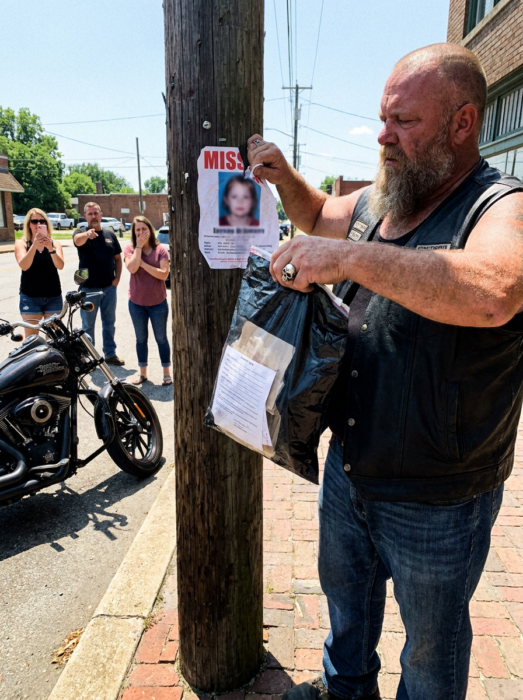
Some locations remain safe because people resist the urge to prove they know them.
My connection began with my younger sister, Naomi.
Twenty-two years earlier, Naomi fled a man who controlled her money, tracked her mileage and broke her wrist during an argument. When she entered a shelter, I reacted badly.
I found the man.
I hit him.
He called police, portrayed himself as the victim and used my arrest to tell a family-court judge that Naomi’s relatives were violent. My actions complicated her case and nearly exposed the shelter where she stayed.
I spent four months in county jail.
The man deserved accountability.
What I gave him was leverage.
Naomi eventually secured a permanent protection order and rebuilt her life. Years later, she became a victim advocate. When I apologized, she told me something I did not want to hear.
“You were trying to save me in the way that made you feel strongest.”
She needed transportation, witnesses, legal help and someone who could follow a safety plan.
I had given her my anger.
When Harbor House needed volunteers to repair a fence, Naomi sent me. The director, Claire Benton, watched me work for three hours before allowing me inside the administrative entrance.
She explained the rules.
Never post photographs.
Never discuss residents.
Never follow a resident after a shift.
Never bring club members without authorization.
If a child says something concerning, tell an advocate rather than conducting your own investigation.
I followed every rule.
Over time, they trusted me with exterior security checks, vehicle inspections and accompaniment during public appointments. I did not carry a weapon on shelter assignments. My size was enough, and the purpose was presence, not confrontation.
Sophie arrived with Maya on a Monday.
I knew almost nothing about them. Maya had bruising near one wrist. Sophie wore blue glasses and carried a green backpack decorated with a cloth fox.
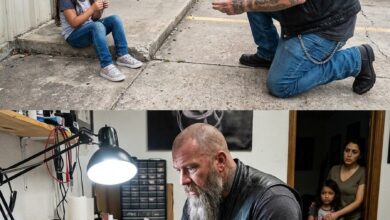
She asked whether my motorcycle was loud.
“Yes.”
“Can you make it quiet?”
“Yes.”
I pushed the Harley the final twenty yards without starting it.
That was our only conversation before the posters appeared.
Darren had been served with an emergency protection order after an incident witnessed by a neighbor. The order granted Maya temporary custody and prohibited him from contacting or locating them outside approved legal channels.
Darren responded publicly as a grieving father.
He told coworkers Maya had disappeared with Sophie. He avoided mentioning the order. He printed a poster using a school photograph and described Sophie as “missing and possibly endangered.”
The wording stopped just short of claiming police had issued an alert.
It looked official enough.
He included no case number, agency name or investigating officer.
Only his phone number.
Most people did not notice the difference.
The first report reached Harbor House through Maya’s former coworker. Within two hours, staff identified twenty-three copies around town and online images suggesting many more.
Claire contacted the police department. An officer confirmed there was no active missing-child case involving Sophie. Yet removing every physical copy would take time, and public correction required care.
A statement saying Sophie was safe could confirm she remained nearby.
A statement saying nothing would allow the search to grow.
Claire told me to document and remove what I could while police and attorneys handled the rest.
I began with the gas station, then Market Street.
The first poster made me angry.
Darren had used a photograph of Sophie smiling, cropped closely enough that her school uniform was not visible. Beneath it, he wrote that she might be afraid to ask for help.
The man she feared had made himself the help.
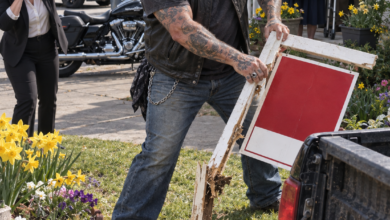
I tore the page down and crushed it.
Dana Cole filmed me.
I heard her calling me heartless. I saw phones rise. I wanted to explain everything.
Then I remembered Naomi.
Protection was not the thing that made me feel strongest.
It was the thing the survivor needed.
So I kept my mouth shut.
By noon, my face was online.
By evening, strangers had found my shop.
And while thousands of people demanded that I return Sophie’s posters, Darren began receiving the first location tips.
Part 3
I removed fifty-eight posters the first day.
Each one required a photograph, street location and time. I stored the copies in contractor bags marked with tape so police could trace how the campaign spread.
The job sounded simple until people began following me.
A college student filmed from his bicycle and asked whether I hated children. A man outside a hardware store shoved my shoulder. Two women stood between me and a poster until the store owner confirmed I had shown him documentation from an attorney.
I never showed the protection order publicly.
It contained names and details people did not need.
At a diner, the manager refused to remove the flyer from her window.
“What if she’s really missing?”
I gave her the police non-emergency number.
“Call them.”
“Why won’t you tell me?”
“Because calling them is safer.”
She called.
An officer confirmed the poster was not connected to an authorized alert. The manager removed it herself and apologized.
That was poster seventy-one.
Not everyone checked.
Some people printed more copies after seeing the viral video, believing the removal proved a conspiracy. One neighborhood page offered a reward. Another user enlarged Sophie’s photograph and asked school employees to watch for her.
The attempt to protect her was making her more visible.
Police requested that I come to headquarters Thursday afternoon.
I arrived on my Harley with five bags strapped inside a club brother’s pickup. Officers met me in the parking lot because several reporters were waiting near the lobby.
Detective Nora Reed handled the interview.
She asked whether I knew Sophie.
“I’ve met her.”
“Where is she?”
“Ask Harbor House’s attorney.”
“You understand how that sounds?”
“Yes.”
She asked why I removed the posters before police completed their review.
“Because every minute they stayed up gave him more eyes.”
“Who?”
I did not answer until the shelter attorney arrived.
Once confidentiality and protective procedures were established, we showed Detective Reed the court order and communications documenting Darren’s behavior. Harbor House confirmed Sophie and Maya were safe without revealing their address to officers who did not require it.
Detective Reed examined the posters.
The private phone number stood out.
Legitimate public alerts usually direct information to law enforcement, an official tip line or an identified investigating agency. Darren’s poster routed everything to Darren.
Detective Reed called the number from an unlisted police line.
A man answered immediately.
She said she might have seen Sophie downtown.
Darren asked where, what she wore and whether Maya was nearby. He did not tell her to contact police.
He asked her to send photographs.
That call changed the tone of the room.
Police contacted Darren and instructed him to stop distributing misleading materials. He claimed parental rights and insisted Maya had kidnapped Sophie.
The court order contradicted him.
Officers warned that using public tips to locate protected individuals could violate the order if he approached them. Darren promised to speak with his attorney.
He continued collecting information.
We learned later that twenty-seven people contacted his number. Most offered sympathy or asked whether the poster was legitimate. Five reported possible sightings.
Two sightings concerned Sophie.
The first came from a cashier who believed she saw Sophie inside a pharmacy. She was mistaken.
The second came from a retired teacher near East Ashford Elementary.
She saw a girl with blue glasses and a green backpack getting into a gray shuttle vehicle. She called Darren and described the time, intersection and partial license plate.
She thought she was reuniting a family.
Darren thanked her.
Harbor House did not know about the call.
Neither did police.
On Friday morning, Darren drove from another county toward East Ashford. Traffic cameras later documented his route. His phone searched the school name, nearby parking lots and dismissal times.
At 10:18, he stopped at a gas station three miles from the school and purchased binoculars, tape and a dark baseball cap. Investigators later found removable magnetic material in his vehicle that could obscure identifying markings.
At 10:51, he entered the school zone.
That same morning, I was removing poster 137 from a laundromat bulletin board. A woman recognized me and began shouting.
“You’re helping whoever took her!”
My phone rang.
It was Claire from Harbor House.
Her first words emptied the room around me.
“He found the school.”
I left the poster hanging and ran to my motorcycle.
Claire ordered me not to approach the school.
Police had been alerted after Maya’s former coworker noticed Darren had stopped responding and contacted his brother, who mentioned he was “bringing Sophie home.”
I wanted to ride there.
Every part of me believed arriving faster meant protecting better.
Claire said, “Grant, do not bring another unknown adult or motorcycle into a school lockdown.”
She was right.
I remained beside my Harley in the laundromat parking lot, staring at poster 137 while parents received emergency messages and patrol units closed roads.
At 11:04, Detective Reed located Darren’s SUV behind a church three hundred yards from the school entrance.
He was still inside.
Officers boxed in the vehicle and ordered him out. He initially refused, filming through the windshield and claiming police were protecting a kidnapping.
After eleven minutes, he complied.
No weapon was found in his hands. A firearm registered to him was secured inside a locked case in the cargo area, violating a prior surrender provision connected to the protection order.
His phone displayed Sophie’s school photograph and the retired teacher’s message.
Police arrested him for violating the protective order and related offenses. The school remained locked down until officers confirmed the threat had ended.
Sophie never saw him.
That should have felt like victory.
Instead, I looked at the poster and imagined what would have happened if the teacher’s tip had been more precise.
Good intentions had brought Darren within three hundred yards.
And the entire town had helped print the map.
Part 4
Darren’s arrest revealed why the posters appeared so quickly.
He had not worked alone, though most helpers did not understand the danger.
He sent a digital template to church contacts, coworkers and community groups, telling them Maya had suffered a breakdown and abducted Sophie. He attached a partial custody document that omitted the protective order entered days later.
Several people believed him.
One coworker printed eighty copies at an office-supply store. A church volunteer distributed them to businesses. Neighborhood administrators approved the post because Darren’s profile contained years of ordinary family photographs.
Abuse rarely erases every image of happiness.
That helped his story.
The police investigation found messages in which Darren described the protection order as a “temporary misunderstanding” and asked friends not to contact law enforcement because officers had “taken Maya’s side.”
He specifically requested that sightings go directly to him.
That was not accidental.
Darren understood that police would verify the court order before sharing information. Private citizens would not.
He turned community compassion into an intelligence network.
The retired teacher who reported the correct sighting was devastated. She contacted police voluntarily and provided her phone.
“I thought the little girl was lost,” she said.
Detective Reed told her something important.
“You were deceived. Now help us document how.”
The teacher’s message became evidence, but she was not publicly named. Maya did not blame her.
“She saw a child and tried to help,” Maya said through her attorney. “He built the lie.”
The criminal charges included violations of the protection order, stalking-related conduct and unlawful possession connected to the firearm restriction. The exact case developed through evidence beyond the posters: prior threats, electronic tracking attempts and recorded communications.
Darren’s attorney argued he believed he was exercising parental rights.
The judge reviewed the order.
It clearly prohibited attempts to locate or approach Maya and Sophie outside authorized court procedures.
Darren had been served.
He had signed the receipt.
The posters were not an emotional mistake made by a confused father. They were part of a deliberate workaround.
My viral video created another issue.
Online users had identified my workshop, motorcycle plate and club affiliation. Some called the shop threatening to damage it. Others promised to “rescue” Sophie themselves if they found her.
Harbor House temporarily moved Maya and Sophie to another protected placement—not because Darren had learned the shelter location, but because public attention increased general risk.
I had removed the posters to protect them.
The backlash still forced them to move.
That truth hurt.
Claire reminded me that safety work rarely produces a clean result. The goal was not to control every consequence. It was to reduce danger with the information available.
My club wanted to respond publicly.
Several members drafted statements defending me. One included details proving my role at Harbor House.
I deleted it.
“Why are we letting people call you a child predator?” Luis asked.
“Because my reputation doesn’t need a confidential address.”
“We wouldn’t give the address.”
“You give one detail, they ask for two.”
The brotherhood’s test was silence.
Men accustomed to answering insults had to watch my name dragged through town without defending it. They guarded the workshop at night, not from Darren but from strangers who believed they were avenging Sophie.
No patches appeared at Harbor House.
No riders followed Maya.
Nobody posted photographs.
We stayed quiet until the police department, prosecutor and shelter legal team prepared a public advisory that protected the family’s location.
Maya made the final decision.
She allowed authorities to state that Sophie had never been missing, that mother and child were safe under a valid protection order, and that private posters had directed tips to a restricted parent.
No current photograph appeared.
No school was named.
No shelter was identified.
The advisory instructed citizens who encounter private missing-person posters to verify them with law enforcement and send location information to police rather than an unconfirmed personal number.
It also explained that custody disputes and protection orders can make direct contact dangerous.
The police chief held a press conference.
He stood beside Claire and Detective Reed. I remained off-camera.
A reporter asked why police had not immediately told the public the posters were false.
Claire answered.
“Because correcting a dangerous lie carelessly can reveal the truth that lie is hunting.”
That sentence spread farther than my video.
The advisory received more than four hundred thousand shares across police, shelter and news pages.
Then the apologies began.
Thousands of people returned to the video and admitted they had judged me. Dana Cole, the bakery owner who recorded it, removed her original caption and posted a correction.
She came to my workshop with a box of pastries.
“I’m sorry,” she said.
“You saw what you saw.”
“I told people what it meant.”
That distinction mattered.
Dana asked whether I wanted to record a response.
“No.”
“People should hear from you.”
“They heard from the shelter.”
The story was not about proving I was good.
It was about teaching people where to send the next phone call.
Part 5
Darren remained in custody while the court addressed violations and the underlying family case.
Maya testified remotely under protective procedures. Sophie did not appear in open court. A trained child specialist handled necessary interviews so she would not have to repeat her experience for every agency.
The evidence showed Darren had used the posters after losing lawful access.
He was convicted of violating the protection order and related stalking conduct. The firearm violation produced an additional consequence because the court had specifically ordered him to surrender weapons during the protective period.
The family court continued restrictions on contact.
No ruling erased the need for future safety planning.
Sentences end.
Risk does not always end with them.
Maya and Sophie relocated outside Ashford. Even I was not told the new address, and I did not ask.
Months later, a letter reached Harbor House.
The envelope contained no return location. Inside was a drawing of a black motorcycle beside a house with enormous walls. A tiny girl stood behind one window.
Above the biker, Sophie had drawn a speech bubble.
It contained no words.
Claire asked whether that bothered me.
“No.”
Silence had protected her.
I kept the drawing inside my workshop toolbox rather than displaying it publicly.
The police advisory changed local practice. Schools reminded staff never to confirm student identities or schedules to private callers. Businesses were encouraged to verify missing-person materials before displaying them.
The city created a simple review contact for private flyers involving children or vulnerable adults.
It was not a system for suppressing legitimate searches. It was a way to confirm where tips should go.
Official alerts remained urgent.
Private posters required verification.
The distinction seemed small until people understood what Darren had done.
Dana organized a meeting for Market Street businesses. Detective Reed explained that no shopkeeper should investigate a family situation personally. If a poster seemed suspicious, they should photograph it, contact law enforcement and avoid calling the private number.
One owner asked whether removing a poster could destroy evidence.
Detective Reed answered yes.
That was why I had photographed and preserved all but the first copy.
The crushed first poster stayed in police evidence through trial.
Its creases showed my anger.
The remaining 139 showed restraint.
After the case, police offered to return them. I declined. Maya’s attorney requested secure destruction after all appeals and retention requirements ended.
Sophie’s face did not need to become memorabilia.
Harbor House expanded its digital-safety program. Volunteers helped survivors disable location sharing, audit children’s devices and identify photographs containing school or neighborhood clues.
I attended training.
At fifty-four, I learned how much information hides inside an ordinary picture: a uniform color, a bus number, a reflection in a window, a store receipt on a counter.
Protection no longer meant only standing near a door.
Sometimes it meant noticing what a photograph accidentally revealed.
The Black River Saints funded secure transportation repairs for Harbor House, but we did it through a grant administered by the shelter. No motorcycle-club logo appeared on the vehicles.
Luis complained that nobody would know we helped.
“That’s the point,” I said.
He stared at me.
“You’re getting annoying.”
Naomi, my sister, heard about the exchange and laughed.
Years earlier, she had accused me of helping in the way that made me feel strongest. Now I was finally learning to help without needing my name attached.
The public apologies continued for weeks.
Some were sincere.
Some treated the reversal as entertainment: first I was a monster, then a hero. Both versions flattened the truth.
I was a volunteer who received an instruction, lost my temper with one poster and completed the assignment while frightened for a child.
Nothing about that required a legend.
The most meaningful apology came from the retired teacher whose tip led Darren toward the school.
She asked to meet through Harbor House.
Claire arranged it without Maya or Sophie present.
The teacher carried a printed copy of the police advisory, folded into quarters.
“I saw the video of you tearing posters down,” she told me. “I thought you were stopping us from helping.”
“I know.”
“When I called him, he cried.”
Darren had thanked her repeatedly and said she might be saving his daughter’s life.
The teacher covered her face.
“I gave him the school.”
I did not tell her it was fine.
It was not.
But guilt without direction helps nobody.
“Next time,” I said, “call police.”
She lowered her hands.
“There won’t be a next time.”
“There will. Different kid. Different poster.”
She nodded.
That was the lesson Maya wanted shared.
Not that every father was dangerous.
Not that every poster was false.
Only this:
A child’s location should never be handed to an unverified stranger because a piece of paper asked nicely.
Part 6
I returned to Harbor House the week after Darren’s sentencing.
My first assignment was not security.
A donated washing machine had stopped draining.
I spent three hours on the laundry-room floor while a six-year-old resident asked whether tattoos could be washed off. I told him only the bad ones.
He inspected my arms and asked which were bad.
“Most of them.”
He found that answer satisfactory.
Claire scheduled me for evening exterior checks again. Nothing ceremonial happened. No one applauded when I arrived.
That helped.
At 8:00, I checked gates and vehicle lights. At 9:00, I carried bottled water to the second floor. At 10:00, I pushed my Harley beyond the last occupied window before starting it.
The ritual remained ordinary.
Dana’s bakery began donating unsold bread to Harbor House through a food-rescue program. She never asked which residents ate it.
The retired teacher volunteered with a verified child-search organization, distributing only law-enforcement-approved materials.
People can be wrong and still become useful afterward.
My club stopped calling the poster removal my “famous ride.” I threatened to assign anyone using that phrase to clean the clubhouse bathrooms.
It worked.
A year later, Detective Reed called about another private poster. An adult woman had left voluntarily, but an estranged partner was portraying her as endangered.
This time, businesses contacted police before sharing it.
The poster never spread.
No biker needed to tear anything down.
Claire sent me a message:
THAT IS WHAT SUCCESS LOOKS LIKE.
There was no photograph attached.
No name.
No location.
Just a dangerous search that failed before it began.
I printed the message and kept it beside Sophie’s silent drawing.
Some evidence belongs in public.
Some proof belongs in a locked toolbox.
Part 7
Three years after the video, people still recognize me occasionally.
They ask whether I am the biker who tore down the missing-child posters.
I say yes.
Some apologize. Some want photographs. A few repeat the sentence that made the story spread:
“The girl wasn’t missing. She was hiding.”
That sentence is accurate.
It is also incomplete.
Sophie was living, learning and trying to sleep without asking whether her father had found her. Maya was rebuilding bank accounts, work records and ordinary routines. Harbor House staff were managing danger without announcing themselves.
The posters threatened all of that.
Darren had taken a tool associated with hope—a child’s photograph beneath the word missing—and reversed its purpose. Instead of helping a safe adult find a vulnerable child, it helped a restricted adult search for protected people.
That was why I tore them down.
Not because I hated the girl.
Because too many people cared before they verified who was asking.
Sophie’s current location remains unknown to me. Claire says she is doing well. That is enough.
The framed drawing still rests inside my toolbox. In it, the motorcycle is too large, the house has twelve windows and the biker’s arms reach nearly to the roof.
He is not smiling.
Children rarely draw me smiling.
But the speech bubble above his head remains empty.
For years, I believed protecting someone meant making the loudest threat in the room.
Sophie taught me otherwise without ever knowing it.
Sometimes protection is taking the hatred.
Sometimes it is refusing to answer.
Sometimes it is pulling down one more poster while the whole street calls you cruel.
Every Thursday evening, I park behind Harbor House, remove my leather vest and begin the security walk.
No reporters wait.
No apology messages follow.
Just a locked gate, a quiet hallway and families whose names I do not need.
They are safe. That is the answer.
Follow our page for more unforgettable biker stories about dangerous misunderstandings, quiet courage and the rough-looking protectors who keep secrets so vulnerable people can survive.