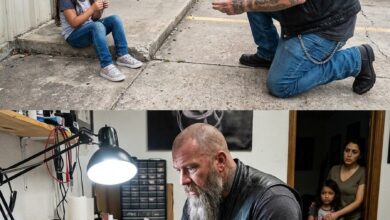
A Twelve-Year-Old Girl Flushed Every Bottle of Her Grandmother’s Medicine While the Old Woman Screamed—Then Her Tattooed Biker Uncle Read the Name on the One Label She Had Saved
Part 2
My name is Cole Mercer, though everyone in the Iron Vale Riders calls me Rook. I run a motorcycle repair shop near Route 4 and spend more time rebuilding old engines than talking about feelings.
Ruth is my mother.
Lily is my sister Carla’s daughter, and she has lived three blocks from Mom since she was born. Carla worked the evening shift in the laundry department at Miami Valley Hospital, so Lily stayed with her grandmother most weekdays until nearly ten.
The two of them were close, but they were also alike in the worst possible way.
Both believed surrendering an argument meant surrendering dignity.
Mom had raised three children after my father left. She survived factory layoffs, a winter without reliable heat and my own worst years without asking anybody for pity. When I wrecked a motorcycle at twenty-eight and became dependent on prescription painkillers during recovery, Mom was the person who took my bottles, counted each tablet and drove me to treatment after I finally admitted I needed help.
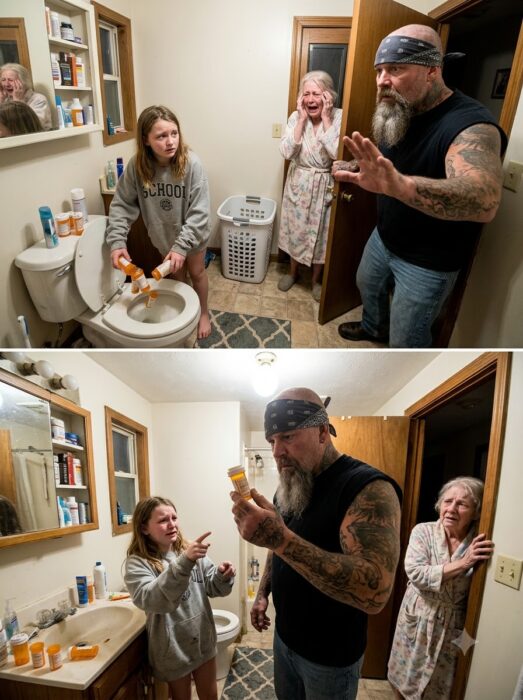
I had been sober for seventeen years.
That history explained why I took medication labels seriously. It also explained why Mom hated appearing confused about them. Her eyesight had deteriorated from macular degeneration, but she still wanted to manage her own house, money and prescriptions.
Accepting Lily’s help already felt like a concession.
Admitting Lily had caught a dangerous error felt worse.
At the hospital, Mom was placed in a monitored cardiac unit. A nurse collected the surviving bottle and my photographs, while a clinical toxicology team reviewed the other patient’s medication list.
The doctors avoided promises. They explained that Mom’s slow heart rate and abnormal rhythm could improve once the drugs cleared, but the stress on her heart and kidneys needed to be watched.
Lily heard only one word.
“Damage.”
She sat beneath the waiting-room television with my leather vest still wrapped around her shoulders. The bottom almost touched the floor.
“I flushed them,” she whispered. “What if the doctors needed them?”
“They have the label and the photographs.”
“But I destroyed evidence.”
“You stopped Grandma from taking another dose.”
“I should’ve called someone.”
“You tried to tell an adult twice.”
She looked toward the hospital doors. “She thought I was stupid.”
I wanted to say Mom hadn’t meant it.
That would have been easy. It also would have been dishonest.
“She didn’t listen,” I said. “That was wrong.”
The Iron Vale Riders began arriving after Carla called Bear, our road captain. Six men in black leather came through the hospital entrance carrying coffee, phone chargers and a sweatshirt for Lily.
The security guard stiffened when he saw them.
Bear noticed and stopped everyone near the vending machines rather than crowding the nurses’ desk. For the next nine hours, the most intimidating group in the building sat quietly beneath a poster asking visitors to wash their hands.
Brotherhood sometimes sounds like forty engines under an overpass.
That night, it sounded like men speaking in whispers outside Room 614.
Carla reached the hospital at 7:40 p.m. She hugged Lily first, then asked me exactly what had happened. I showed her the photograph of Marian’s name.
Carla stared at it.
“I picked up the bag,” she said. “The outside receipt had Mom’s name.”
That detail mattered.
The store had not simply handed Ruth a bag intended for Marian. Someone had placed Marian’s four bottles inside packaging printed for Ruth. The sealed bag had passed a barcode scan at the register and again when it was assigned to a delivery driver.
The pharmacy manager called the hospital shortly before midnight. He described the incident as an isolated packaging error and promised to conduct an internal review.
Then the hospital pharmacist returned.
Marian Mercer, the woman whose pills Mom had taken, had not received a random prescription. She had received Mom’s regular medication, relabeled inside a delivery bag bearing Marian’s information.
This was not one misplaced bag.
Two patient profiles had been crossed inside the system.
Worse, Marian’s hospital records showed she had missed nine days of essential heart treatment because she believed the bottles delivered to her were correct.
One woman had been harmed by taking medication she did not need.
The other had been harmed by not receiving medication she did need.
The hospital pharmacist filed an urgent report with the Ohio Board of Pharmacy and the regional health department. The store was instructed to preserve dispensing logs, camera footage, delivery records and software audit trails.
At 1:12 a.m., Mom’s monitor sounded.
Three nurses entered her room.
The doors closed before we could see what was happening.
Lily grabbed my tattooed hand and whispered, “She took them because she believed everybody except me.”
For the first time that night, I had no answer.
Part 3
Mom’s heart rhythm had shifted again.
The nurses adjusted her treatment while a physician ordered more tests. We stood behind the glass as she lay beneath a thin hospital blanket, looking smaller than the woman who had once dragged me out of a bar by my ear.
Lily watched every movement.
When the alarm stopped, she did not relax.
A cardiologist met us in a consultation room shortly after two in the morning. He explained that the medication error had slowed Mom’s heart and disrupted its electrical conduction. Dehydration and kidney stress had made the effects harder on her body.
He believed she would recover.
But not immediately.
“She may need monitoring for several days,” he said. “Then follow-up over the next few months.”
Carla asked the question none of us wanted to hear answered.
“What if Lily hadn’t stopped her tonight?”
The doctor folded his hands. “Another week could have produced a very different outcome.”
Lily lowered her face into my vest.
That should have been the end of the immediate crisis. Mom was alive. The wrong medicine had stopped. Doctors knew what they were treating.
It wasn’t the end.
At 6:30 that morning, the state investigator assigned to the pharmacy report called Carla. The store’s dispensing system had flagged an identity conflict nine days earlier, but the warning had been manually overridden.
The employee who approved it told investigators she had been trained to compare three fields: patient name, full birth date and address. Yet the store’s delivery software displayed only the surname and birth year on its quick-match screen.
Both patients were named Mercer.
Both were born in 1949.
The software placed them beside each other in a filtered list, and an employee working two positions during a staff shortage selected the wrong profile. The bottles printed for Marian were routed into Ruth’s order. When another employee noticed the count did not match, she corrected the outer bag—but not the medication inside it.
That explained the exchange.
It did not explain the number investigators found next.
The store’s internal complaint log contained twelve delivery reports from the previous six months involving wrong addresses, unfamiliar medication names or missing prescriptions. Most had been closed after replacement deliveries were sent.
They had not been classified as medication errors.
They had been classified as customer-service complaints.
Two customers had been hospitalized during that period. One was an eighty-one-year-old man whose sudden confusion had been blamed on dehydration. The other was a woman recovering from surgery who developed severe dizziness and an abnormal pulse.
Neither hospital had known their medication bags came from the same pharmacy.
Bear heard that and wanted to ride to the store.
So did I.
A dozen Iron Vale members were already waiting outside the hospital. One angry sentence from me could have put twelve motorcycles in the pharmacy parking lot before sunrise.
“We don’t threaten anybody,” I told them. “We don’t block the doors. We don’t give their lawyers a story about dangerous bikers.”
Bear crossed his arms. “Then what do we do?”
“We wait until the state tells those patients to get checked. If they need rides, we drive them.”
Waiting felt weak.
It wasn’t.
By that afternoon, the health department issued a targeted notification through physicians and emergency contacts. Patient privacy rules prevented the club from seeing names, but the hospital social worker asked whether we could provide transportation after several older residents said they had no way to reach urgent medication reviews.
The first person Bear drove was a retired school cook named Dorothy. She held her prescription bag against her chest during the entire ride and asked him three times whether the appointment would cost money.
The second was the eighty-one-year-old man’s son.
The third was a woman who recognized me from the tattoo shop and began crying before she entered my truck.
We did not examine bottles. We did not offer medical advice. We carried bags, opened doors and sat in waiting rooms when people asked us to stay.
Lily remained at the hospital beside Mom.
On the second evening, Ruth woke fully and asked to see her alone. Carla hesitated, but Lily’s advocate said the decision belonged to the child.
Lily entered.
Through the glass, I saw Mom reach for her hand. Lily kept both hands in her sweatshirt pocket.
Mom spoke for nearly a minute.
Lily did not answer.
Then Mom started crying.
My mother rarely cried. She had not cried at my father’s funeral. She had not cried when I entered treatment. She had not cried when doctors explained her eyesight would never return.
But she cried in front of the girl she had dismissed.
Lily finally sat down, though she still didn’t take Mom’s hand.
When she came out, I asked what Grandma had said.
“She said I was right.”
“That’s good.”
“She also asked me to forgive her.”
“What did you say?”
Lily stared through the glass.
“I said I’m still mad.”
That was the honest answer.
Then the state investigator called again. The audit team had found something inside the pharmacy’s records that changed the case from negligence to concealment.
Three employees had warned management about the same identity-matching defect months earlier.
Someone had marked every warning “resolved.”
The defect was still active.
Part 4
The pharmacy closed voluntarily the next morning. By noon, a printed notice covered the front doors, and a security officer stood outside directing patients to other locations.
Nobody from our club went there.
That restraint mattered because television crews arrived before lunch. Reporters wanted pictures of angry families, frightened seniors and somebody powerful enough to blame. A row of patched bikers shouting outside the store would have swallowed the real story.
The story belonged to the patients.
And to Lily.
Investigators reconstructed what had happened from software logs, employee interviews and camera footage. The store belonged to a regional chain that had expanded its home-delivery service without increasing overnight staffing. When the new delivery software failed to import full addresses consistently, employees were told to use a faster manual screen.
That screen displayed surname and birth year.
Managers knew duplicate matches appeared. They believed employees could catch them by opening a second page, but rising prescription volume turned the extra verification into something people skipped.
Then one supervisor created a shortcut.
If the outer bag barcode matched the customer scheduled for delivery, the system allowed the order to leave—even when the bottles inside had been created under another patient profile.
The pharmacy had built a locked front door with an open window beside it.
The twelve prior complaints should have triggered a formal medication-error review. Instead, managers issued refunds, replaced prescriptions and categorized the incidents in ways that did not automatically alert corporate safety officers or state regulators.
The two earlier hospitalizations had seemed unrelated because no one connected them to incorrect medicine.
Lily made the connection because she read one first name.
The girl everybody told knew nothing had noticed the detail a computer, several technicians and multiple managers failed to stop.
Mom remained in the cardiac unit for five days. Her rhythm gradually stabilized, but she left with a portable monitor and a schedule of follow-up appointments. Doctors warned that full recovery could take months.
Marian Mercer’s condition was more complicated. Missing her correct medication had worsened an existing heart problem, but she also began improving once doctors understood why.
Marian asked to meet us.
The meeting took place in a hospital family room. She was seventy-five, wore a blue robe and walked with a rolling oxygen tank. Her son guided her to a chair across from Mom.
For several seconds, the two women only looked at each other.
Each had swallowed the other’s identity from an orange bottle.
Marian spoke first. “Your granddaughter saved both of us.”
Mom glanced at Lily. “I know.”
Marian reached into a clear evidence bag and removed one empty container the investigators had already documented. It carried Ruth’s name.
“I didn’t read it either,” she said. “My son picked up the bag. The pharmacy had never been wrong before.”
Her son shook his head. “We assume the label is safer than our own eyes.”
Lily studied the floor. “I read it.”
“Yes,” Marian said. “You did.”
The state expanded the review to every home-delivery prescription processed through that location during the previous six months. Twelve patients were recalled for assessment. Most had caught their errors before taking anything. Four had swallowed at least one incorrect dose. Three, including Ruth and Marian, required hospital care.
The two earlier unexplained hospitalizations were officially linked after physicians compared symptoms, laboratory results and the newly recovered dispensing records.
That revelation brought relief to the patients’ families.
It also brought anger.
Bear wanted somebody arrested. Carla wanted the chain’s executives on television admitting exactly what they had done. I wanted to drag the supervisor into Mom’s hospital room and make him explain why my niece had needed to flush medicine to be heard.
But the employee who had selected the wrong profile was twenty-two years old, working a double shift and covering a position for which she had received limited training. She had made the final click.
She had not designed the defect.
She had also reported two near-misses before the incident. Her supervisor told her the software update would fix them.
It never did.
The responsibility was larger than one frightened technician.
The Board of Pharmacy suspended the store’s dispensing authority pending corrective action. The chain was ordered to notify affected patients, fund medical reviews and rebuild its identity-verification process.
The new procedure required three independent matches before medication could leave the counter: full legal name, complete date of birth and verified address, followed by a final barcode confirmation tied to the bottles rather than only the outer bag.
For high-risk home deliveries, a second staff member had to sign electronically.
The shortcuts disappeared.
Yet none of that answered the question waiting at Mom’s house.
When Ruth returned home, the bathroom trash can still held four lids. The toilet where Lily had emptied the bottles looked ordinary.
Mom stood in the doorway and asked Lily to come inside.
Lily stopped several feet away.
Mom pointed toward the toilet.
“You tried to save me,” she said.
Lily’s jaw tightened. “You called me a killer.”
“I did.”
“And you didn’t listen.”
“I didn’t.”
Mom’s voice broke, but she did not ask Lily to make her feel better.
“I was wrong,” she said. “You get to be angry as long as you need.”
Lily remained silent.
Then she removed the surviving empty bottle from her backpack and placed it on the sink.
She had carried it for six days.
Not as a weapon.
As proof that she had known what she saw.
Part 5
Mom’s recovery lasted four months.
During the first weeks, she tired after walking from the bedroom to the kitchen. A home-health nurse checked her blood pressure and heart rhythm. Carla organized the appointments, while I installed a second handrail beside the porch steps.
Lily did not immediately resume their old evening routine.
She stayed with Mom, brought her water and watched game shows from the opposite end of the couch, but she refused to touch the new prescription bags. Every bottle reminded her of the bathroom and the accusation.
Nobody forced her.
A pediatric counselor later explained that Lily’s distress did not come only from seeing Grandma become ill. It came from correctly identifying danger, asking adults for help and being taught by their reactions to distrust her own judgment.
That damage did not disappear when the doctors praised her.
Mom had to rebuild what she had broken.
She began with small things.
When Lily said she was cold, Mom did not tell her the room was warm. She brought a blanket. When Lily said a homework instruction looked wrong, Mom asked her to explain instead of dismissing her. When Lily didn’t want a hug, Mom kept her hands to herself.
The changes looked ordinary.
They were not.
The pharmacy’s final investigation found twelve documented mismatches, though not every mistake resulted in a patient receiving or swallowing the wrong medicine. The store remained closed until staff were retrained, the delivery software was replaced and an outside auditor verified the new safeguards.
Regulators also required the chain to review similar complaints at its other locations.
Marian recovered slowly. The eighty-one-year-old man whose confusion had been blamed on dehydration improved after his physicians corrected his medication. The surgical patient received a revised diagnosis and follow-up care.
No single dramatic courtroom scene fixed everything. There were administrative hearings, insurance disputes, civil claims and months of letters written in language ordinary families struggled to understand.
The Iron Vale Riders found a useful place inside that mess.
We created a transportation fund through an existing community charity. Riders drove older residents to medication-review appointments only when requested by hospitals, families or social workers. A retired nurse from our club’s auxiliary taught us where helping ended and medical advice began.
Bear learned to say, “I can drive you,” instead of, “Here’s what you should take.”
That distinction mattered.
The brotherhood was tested again when one member posted the pharmacy manager’s home address in a private group. I made him remove it immediately.
“We protect people,” I said. “We don’t send a mob to somebody’s house.”
“He almost killed your mother.”
“A broken system nearly killed her. Threatening his family won’t fix it.”
The member left angry.
He returned the next morning with a box of large-print magnifying sheets for seniors.
Mom attended the state hearing using a cane. Lily sat beside her, holding the empty evidence bottle inside a clear bag.
When Mom testified, she did not blame an overworked technician. She described the sealed delivery bag, her poor eyesight and the confidence that made her reject her granddaughter’s warning.
Then she said the sentence Lily needed to hear in front of strangers.
“My granddaughter read the label correctly. I was the adult, and I refused to listen.”
Lily lowered her face, but I saw her wipe one eye.
Afterward, a reporter asked whether she felt like a hero.
“No,” Lily said. “I felt scared.”
“What made you pour out the medicine?”
“She was about to take it again.”
“Would you tell other children to do the same?”
Lily looked toward her counselor before answering.
“I’d tell them to find another safe adult, call for help and keep the label. I only flushed it because I thought nobody was coming.”
That answer was better than any speech an adult could have written.
Four months after the hospitalization, Mom’s cardiologist removed the portable monitor. Her rhythm had returned close to baseline, and the other effects were resolving.
She celebrated by taking Lily to the diner beside my repair shop.
When the waitress brought coffee, Mom placed her new prescription bag on the table.
Lily froze.
Mom slid it toward her but did not let go.
“Will you check it with me?”
Not for me.
With me.
Lily opened the bag. Together, they read the full name, birth date and address before comparing the bottles with the printed list provided by Mom’s doctor.
Everything matched.
Mom took her medicine.
Then she raised the water glass toward Lily.
“To my doctor.”
Lily rolled her eyes.
But she smiled.
Part 6
The empty bottle never went back into the bathroom.
After the investigation ended, Lily asked for it. She cleaned the outside, removed the personal information and placed it in a small wooden shadow box I built at the motorcycle shop.
Beside it, she put a handwritten card:
READ THE WHOLE LABEL.
The box hung in Mom’s kitchen—not as decoration, but as a memory neither of them was allowed to rewrite.
Every Sunday evening, they sat at the table beneath it. Mom opened the pharmacy bag while Lily held the printed medication list. Carla joined by video call when work kept her away.
They checked together.
If something looked unfamiliar, an adult called the pharmacist or physician before Mom took it. Nobody guessed. Nobody substituted. Nobody told Lily she was too young to notice a name.
The routine took less than five minutes.
Trust took longer.
Some evenings, Mom still became defensive when Lily questioned something. She would inhale, look at the shadow box and start again.
“Show me what you see,” she would say.
That sentence became their repair.
The Iron Vale Riders continued offering rides to older patients. We did not wear white coats, distribute medical instructions or pretend our motorcycles made us experts. We showed up when somebody needed transportation, a second set of ears at an appointment or help carrying groceries after discharge.
Lily sometimes organized the ride schedule from a desk in my shop. She used colored markers and wrote every phone number twice.
Bear called her “Chief.”
Mom called her something else.
“My doctor.”
Lily always corrected her. “I’m not a doctor.”
Mom would nod. “No. You’re the person who made the doctor possible.”
The state later adopted stronger reporting requirements for dispensing complaints involving patient identity. The pharmacy chain expanded its three-layer verification process beyond the suspended store.
Those changes appeared in official documents full of technical language.
At Mom’s house, the change was simpler.
A twelve-year-old girl spoke.
This time, the adults stopped and listened.
Part 7
Six months after the bathroom incident, I parked my Harley beneath Mom’s carport on a cold Saturday morning. The V-twin settled into silence, and I heard laughter through the kitchen window.
Mom was standing at the counter making pancakes.
Lily sat at the table beneath the shadow box, reading a label through a plastic magnifier. Four new prescription bottles stood in a neat row.
“Full name?” Mom asked.
Lily answered.
“Birth date?”
Lily read it.
“Address?”
“Still this house, unless you secretly moved.”
Mom tapped her with a dish towel.
The girl who had once been unable to explain herself between sobs was now correcting her grandmother without fear. The woman who had once mistaken age for wisdom was listening without defending herself.
I set a bag of groceries on the counter.
Mom looked at my leather vest. “You riding today?”
“After breakfast.”
Lily held up one bottle. “I checked everything.”
“I figured you would.”
Mom placed a pancake in front of her, shaped roughly like a heart. It was uneven, slightly burned and too large for the plate.
Lily examined it.
“Doesn’t look medically accurate.”
“My doctor complains too much.”
They laughed again.
Before leaving, I looked at the empty bottle in its wooden frame. It represented nine dangerous days, a child nobody believed, two women hospitalized and a system that had hidden twelve warnings beneath harmless words.
Yet the bottle was empty.
That mattered.
Outside, Bear and four riders waited beside their motorcycles. We were taking an elderly patient to a follow-up appointment because winter bus service had been canceled.
Lily stepped onto the porch and waved.
Mom stood behind her, one hand resting on the new rail.
Then she bent toward her granddaughter and asked, loudly enough for me to hear, “Doctor, did I pass inspection?”
Lily pretended to think.
“Barely.”
The engines started one by one, deep and steady beneath the gray Ohio sky. As I pulled away, I saw the two of them return inside together.
This time, Grandma followed her doctor.
Follow this page for more biker stories about misjudged courage, ordinary heroes and rough-looking riders who arrive when vulnerable people need someone willing to listen.