A Tattooed Biker Repaired a Crying Six-Year-Old’s Broken Rose Necklace—Then Recognized the Pendant He Had Made for the Girlfriend Who Vanished Seven Years Earlier and Realized the Child Might Be His Daughter
Part 2
Seven years earlier, Elena Morales worked the late shift at a twenty-four-hour diner three blocks from the first Black Lantern shop. I met her because she brought coffee to six exhausted bikers without spilling a drop, then told my club president to move his boots off her clean booth.
Nobody spoke to Bear that way.
Elena did.
She was five-foot-three, stubborn as rusted steel and unimpressed by my motorcycle, my tattoos or the stories other people told about me. She cared that I tipped properly, listened when she spoke and always walked the dishwasher to her car after midnight.
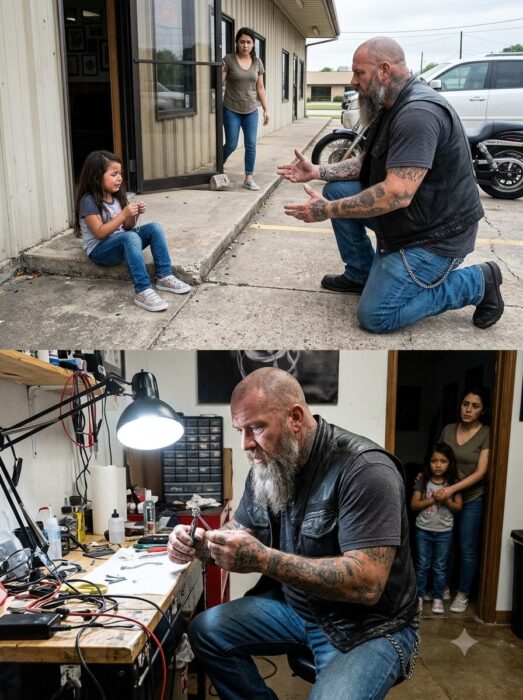
We dated for eleven months. I was not an easy man to love. By then, I had been sober for five years, but my past still followed me: a short jail sentence for fighting, debts from a failed repair garage and a habit of shutting down whenever happiness began to feel permanent.
Elena knew all of it.
She also knew I made small pieces of jewelry when insomnia kept me awake. The rose took four nights, two burned fingertips and most of my patience. I gave it to her because roses had grown beside her grandmother’s porch in Laredo.
The final evening we spent together, Elena barely touched her food. She kept pressing a hand beneath her ribs and studying my face as if trying to memorize it.
“There’s something I need to tell you,” she said.
My phone rang. It was Bear calling about a club brother whose truck had broken down outside Katy. I promised Elena I would return in an hour.
I never got the chance.
Her apartment was empty the next morning. A maintenance man said two movers had come before sunrise with paperwork authorizing them to remove everything. Her sister, Marisol, refused to let me inside and said Elena had met somebody who could offer her a better life.
Then came the message.
Don’t find me. Don’t call my family. You scare me.
It arrived from Elena’s phone. Those twelve words kept me away because the worst thing a man like me can do is decide a woman’s “no” doesn’t count.
I learned much later that Elena never sent it.
Back in the tattoo shop, I showed Detective Lena Alvarez the old message while Sophie spoke with a forensic interviewer. Alvarez photographed it, recorded the number and told me not to contact anyone connected to the Whitmore family.
“Can you get her out?” I asked.
“If she’s being held, we will. But a child’s statement starts an investigation. It doesn’t let us kick down a door without corroboration.”
That answer felt too slow, yet it was honest.
Sophie had given them the name Rosa Delgado. Forty-three minutes after officers issued a request to locate her car, Rosa walked into a police substation near Gulfgate with bruised wrists, a cracked phone and a story she had been preparing to tell for months.
Rosa had worked in the Whitmore household for eleven years. Elena was legally married to Julian Whitmore, but according to Rosa, the marriage had become a cage. Elena’s phone and identification had been taken. Every call was monitored. When she tried to leave with Sophie, Julian threatened to use his family’s attorneys to declare her unstable and separate her permanently from her child.
During the previous month, the locks had changed.
Elena was confined to an upstairs suite whenever visitors were present. Sophie could enter for supervised visits, but Rosa noticed the girl smuggling food and folded notes under her shirt.
The broken necklace was not an accident. A security guard had grabbed Sophie’s backpack when she and Rosa left for a supposedly routine pediatric appointment. The chain caught on the zipper and snapped, but Rosa drove away before he could stop them.
She brought Sophie to Black Lantern because Elena had hidden my old card inside the child’s stuffed rabbit.
Rosa had not abandoned her. She had drawn the gray security SUV away, called 911 and surrendered herself as a witness before returning to the estate could erase the evidence.
That should have been enough for me to breathe.
It wasn’t.
By noon, twelve Iron Lantern Riders had gathered outside my shop. Their engines rolled against the brick buildings like distant thunder. Bear looked at the drawing, heard the address and reached for his helmet.
“We ride to River Oaks,” he said.
“No.”
He stared at me.
“We stand outside,” he replied. “Nobody touches anybody.”
“A dozen patched men outside that house gives their lawyers a reason to call us the threat. It gives them time to move Elena.”
The hardest thing I asked my brothers to do that day was nothing.
Bear’s jaw tightened. One by one, the engines went quiet.
Then Detective Alvarez called. Officers had reached the Whitmore mansion for an initial welfare check.
Julian’s attorney was already waiting at the gate.
And he claimed Elena Morales had left Texas three months earlier.
Part 3
The Whitmore estate stood behind a limestone wall, two electronic gates and enough cameras to watch every car on the street. The first officers were allowed into the foyer but not beyond it. Julian presented a typed statement supposedly signed by Elena, saying she had entered a private treatment program out of state.
There was one problem.
The signature looked right.
The date didn’t.
Sophie had spoken with her mother through a locked bedroom door the night before. Rosa confirmed it. But a wealthy family claiming an adult woman had voluntarily entered treatment created enough fog for lawyers to slow everything down.
Not forever. Just long enough to be dangerous.
Detective Alvarez asked me to come to the station and identify Elena in photographs. I sat beneath a humming fluorescent tube while she placed six recent images on the table. Four came from public charity events. One showed Elena entering a black SUV eighteen months earlier. The last was a grainy still taken from Rosa’s phone three weeks before.
Elena stood behind an upstairs window.
She was thinner. Her hair had been cut to her shoulders, and one hand pressed against the glass. Around her neck hung no necklace.
“I need you to be certain,” Alvarez said.
“That’s her.”
“What makes you certain?”
I pointed to Elena’s right hand. Her smallest finger had never straightened fully after a childhood fracture. In the picture, it curved inward exactly as I remembered.
Alvarez bagged the photograph.
An officer then asked for a DNA swab. Sophie’s relationship to me did not determine whether Elena deserved protection, but paternity could affect emergency placement and expose false statements in documents naming Julian as Sophie’s biological father.
I agreed.
The cotton swab took fifteen seconds. The waiting felt longer than seven years.
Outside the interview room, Sophie sat beside a child advocate, wearing the repaired necklace. She touched the silver rose whenever a door opened. When she saw me, she didn’t run into my arms. Real children do not always recognize the emotional cue adults expect.
She looked at my beard and asked, “Does it hurt to have that much face hair?”
I almost laughed.
“Only in soup.”
That earned half a smile.
Her advocate allowed us ten supervised minutes in the lobby. Sophie told me her mother had taught her how to identify my shop logo. She had practiced my name silently because saying it inside the house was forbidden.
“Why?” I asked.
“Mama said Mr. Julian thinks you’re a criminal.”
“I have been in trouble.”
“She said that part was true.”
That sounded like Elena.
Then Sophie leaned closer. “Mama also said you don’t leave people behind on purpose.”
I had no answer for that.
The first major break came from something small. Rosa remembered that Elena’s prescription refills were delivered to the mansion by a private pharmacy. The treatment-center story claimed she had been out of state for three months, yet the pharmacy had delivered medication in Elena’s name to the River Oaks address twice during that period.
The second break came from Sophie’s drawing.
The dark windows were not childish decoration. She had colored them black because motorized shutters covered the upstairs glass whenever guests arrived. Building plans obtained through the city showed those shutters had been installed during a renovation recorded as “storm protection,” along with a reinforced interior door absent from older plans.
A judge approved a limited search and emergency welfare warrant late that afternoon.
I learned about it while standing inside Black Lantern with twenty-three men who wanted to help and could not.
Bear paced between the tattoo chairs. Tank called a lawyer he trusted. Luis brought food nobody ate. Two prospects watched the street in case the gray SUV appeared, under strict instructions to record and call police rather than follow it.
Brotherhood is easy when the job is lifting a motorcycle or paying a hospital bill.
That day, brotherhood meant obeying my no.
At 5:18 p.m., unmarked vehicles entered River Oaks from different directions. A domestic-violence response unit and emergency medical crew waited nearby. Detective Alvarez warned me not to call, not to ride past and not to post anything online.
I put my phone faceup on the counter.
For forty-seven minutes, it did not ring.
Then the screen lit.
Alvarez’s voice was calm, which frightened me more than shouting would have.
“We entered the property,” she said. “The family is cooperating now.”
“Did you find Elena?”
A pause.
“We found the upstairs suite.”
My hand tightened around the counter.
“And?”
“The room is empty.”
Every man in the shop stopped moving.
Alvarez continued. “But the bed is warm, there’s food on the tray and we found the broken half of Sophie’s backpack zipper.”
Someone had moved Elena after the first welfare check.
On the bedroom wall, officers found a bank of camera monitors. One feed showed the front gate. Another showed the stairs. A third showed the hallway outside the suite.
The recording from that afternoon contained the sound of a woman struggling to breathe and a man ordering security staff to take her through the garage.
The time stamp was twelve minutes before police entered.
The Whitmores had not sent Elena out of Texas three months earlier.
They had moved her across Houston less than an hour ago.
Part 4
The vehicle was a black medical transport van registered to a private elder-care company owned through one of the Whitmores’ holding firms. Gate-camera footage showed it leaving the estate, but the rear plate had been covered with a temporary paper tag.
Police issued an alert.
That was when Bear made the mistake I had been afraid of.
He had ordered two club members to watch the major exits from River Oaks. They did not interfere with traffic, but one of them spotted a black van matching the description turning west onto Westheimer and began following it.
Alvarez learned within minutes.
“If your people make contact,” she told me over the phone, “they could turn a rescue into a hostage situation.”
I called Bear.
“Pull them off.”
“They have the van.”
“Pull them off, brother.”
“We can stay back.”
“No. Give police the location and disappear.”
The line went silent except for the rumble of his engine.
Then Bear said, “Understood.”
The riders transmitted the van’s location, turned into a gas station and stopped. Patrol units took over without the driver realizing he had been seen.
The van eventually entered the underground garage of a private medical office near the Energy Corridor. The clinic had no sign on the street and no active license for inpatient treatment. Julian’s family used it for executives who wanted medical care without public records.
Police obtained an expanded warrant while officers maintained surveillance. That delay lasted fifty-three minutes.
I counted every one.
At 8:06 p.m., the domestic-violence unit entered with emergency medical personnel. They found Elena in a locked recovery room, wearing borrowed clothing, without identification, money or a phone. A sedative had been prepared but not administered.
She was conscious.
She told police her name. She asked for Sophie. Then she asked whether a man named Mason Barrett still owned a tattoo shop.
Alvarez called me from the hallway.
“She’s alive.”
My knees hit the cracked vinyl chair before I knew I was falling. Bear grabbed my shoulder, but neither of us spoke.
Elena was taken to a hospital under a protected identity. Sophie was brought there later by her advocate, but I was not allowed to join them. I had no legal status, and Elena needed to decide who entered her room.
That boundary hurt.
It was also right.
Over the following weeks, investigators reconstructed the missing seven years. I learned the details through statements released to the attorneys, Elena’s later conversations with me and evidence presented during the criminal hearings.
The morning after our last dinner, Elena discovered she was pregnant. Before she could tell me, Julian Whitmore arrived at her apartment with screenshots suggesting I had been arrested again and messages appearing to show that I wanted nothing to do with a baby.
They were forged.
Julian had met Elena months earlier through a charity where she volunteered. He portrayed himself as the patient, respectable man who could protect her from me. His family arranged an apartment, medical appointments and legal advice. By the time Elena questioned the story, her phone had been replaced, her sister had been pressured and every route back to me had been filtered through people loyal to Julian.
The message ordering me to stay away had been typed by someone using Elena’s phone.
Marisol had not invented her warning either. She had been told I threatened Elena and that any contact from me should be reported. Years later, when she finally began to doubt the story, Julian’s attorney produced documents claiming Elena wanted no relationship with her old life.
Elena married him eleven months after Sophie’s birth.
At first, the control looked like comfort: a driver, private doctors, household staff and accounts she did not have to manage. Then the doors narrowed. Her name disappeared from the bank accounts. Her calls were monitored. Attempts to leave became proof, according to Julian, that she was unstable.
The literal locks came later.
When Sophie turned five, Elena tried to take her to a women’s shelter. Security intercepted them before they reached the gate. Julian told Elena that the Whitmore name would beat a tattooed ex-convict and an “unwell mother” in any courtroom in Texas.
That was when Elena began teaching Sophie about the rose.
She did not know whether I would believe the child. She only knew I had made the pendant before anybody around her had reason to forge it.
The necklace was not proof of every crime.
It was a path toward someone outside the cage.
Julian and two employees were arrested. His parents were investigated separately; one later claimed they believed Elena’s isolation was medical care. The courts would decide how much they knew.
But before any hearing began, a nurse finally entered the family room where I had been waiting and said Elena would see me.
I stepped into her hospital room expecting the woman I remembered.
The woman in the bed was older, thinner and staring at me as if I were both rescue and accusation.
Her first words were not romantic.
“Why did you stop looking?”
Part 5
There was no answer that could erase seven years.
“Because the message said you were afraid of me,” I told her. “I thought leaving you alone was the one decent thing I could still do.”
Elena looked toward the window. “I wrote you seventeen letters.”
“I never got one.”
“I know that now.”
She did not reach for me. I did not touch her.
After a while, she said, “Sophie thinks you’re her father.”
“I think I might be.”
“She’s right.”
Those words did not turn us into a family. They created paperwork, fear and responsibilities that neither of us could safely rush.
A court ordered formal paternity testing. Child Protective Investigations ran a background check on me, inspected my apartment and interviewed people from my club. They found the old assault conviction, my years of sobriety and every unpaid parking ticket I had forgotten.
For three weeks, I visited Sophie only with an advocate present.
We built things during those meetings. Nothing important at first. A cardboard motorcycle. A crooked birdhouse. A bracelet made from blue and silver beads.
Sophie asked blunt questions.
“Did you know about me?”
“No.”
“Would you have wanted me?”
“Yes.”
“Even if I cried a lot?”
“I know bikers who cry more.”
She considered that answer before nodding.
The DNA result arrived on a Thursday morning. Probability of paternity: greater than 99.99 percent.
I read the page three times.
Then I folded it, placed it in my vest pocket and finished the appointment I had scheduled. The customer wanted his deceased brother’s handwriting tattooed across his forearm. Grief does not give a man permission to abandon the person already sitting in his chair.
Afterward, I rode to the supervised residence where Elena and Sophie were staying.
Sophie was coloring at a kitchen table. Elena stood behind her with one hand on the chair. I placed the folded result between them.
Elena did not look surprised.
Sophie sounded out the longest word, then frowned. “What does it mean?”
“It means I’m your father,” I said.
She stared at me.
Then she looked at Elena. “Do I have to call him Dad now?”
“No,” Elena said. “You call him what feels safe.”
That answer saved us from pretending.
For two months, she called me Mason. Then Crow. Then, accidentally, Dad when she fell off a scooter and shouted for help. Neither of us mentioned it afterward.
The criminal case moved slowly. Julian’s attorneys challenged the search, attacked Rosa’s credibility and described Elena’s confinement as voluntary medical protection. Video from the mansion contradicted them. So did pharmacy records, altered documents, camera footage and the driver of the transport van, who accepted a plea agreement.
The forged message from Elena’s phone was traced to an account used by Julian’s former assistant. Copies of Elena’s letters were discovered in a locked cabinet inside his home office.
They had never been mailed.
Marisol came to Houston carrying a grocery bag full of apologies and left Elena’s residence forty minutes later in tears. Reconciliation could not be ordered by a judge. Elena agreed to therapy with her sister eventually, but trust returned in teaspoons.
The Iron Lantern Riders paid for what insurance did not cover: trauma counseling, a family-law attorney, secure transportation and six months of rent at an address not connected to the club.
They never arrived as forty motorcycles surrounding a frightened woman.
They sent invoices, grocery cards and one plumber.
Bear apologized to Alvarez for the unauthorized surveillance. She told him his tip helped locate the van, but his decision could have wrecked the operation.
He accepted both truths.
My relationship with Elena remained complicated. We did not resurrect our old romance simply because a DNA report joined us. She needed control over her own life, not another man making choices on her behalf.
I helped when she asked.
I left when she needed space.
Several months after the rescue, the court granted Elena full temporary custody of Sophie under a protective order. I received a structured parenting schedule that expanded gradually. Julian’s legal claim to paternity was voided after the evidence of fraud and the DNA results were reviewed.
One afternoon, Sophie brought the rose necklace back to my workbench.
The clasp I had repaired was holding. But she pointed to the slightly mismatched link I had used.
“Can you make it look like it was never broken?”
I could have.
Instead, I called Elena and asked what she thought. She came to the shop, examined the chain and told Sophie the decision belonged to her.
Sophie rolled the mismatched link between her fingers.
“Leave it,” she said. “That part is how I found him.”
So I polished the silver rose, strengthened the remaining links and left one tiny piece visibly different.
Not damage.
Evidence.
Part 6
Every second Saturday, Sophie came to Black Lantern while Elena attended counseling nearby. She sat at the reception desk doing homework beneath framed tattoo designs while machines buzzed behind closed doors.
At first, customers stared.
A little girl with purple pencils looked strange beside men in leather cuts and women choosing skulls, snakes and memorial dates. Sophie stared back until they stopped.
She became the only person allowed to put stickers on Bear’s helmet. He pretended to hate them. Within a year, half the club had tiny silver roses hidden somewhere on their motorcycles.
I created a new ritual at the jewelry bench.
Whenever a parent brought in a child’s broken chain, bracelet or cheap metal keepsake, I repaired it without charge. Jenna kept a jar near the register for replacement clasps, and the club quietly refilled it whenever supplies ran low.
We called it the Rose Jar.
No sign explained why.
Elena rebuilt her life in smaller steps. She opened her own bank account, replaced her identification, returned to work part-time and rented a two-bedroom duplex with windows she could open herself. Some mornings, ordinary choices exhausted her more than captivity had.
She once stood in a grocery aisle for twenty minutes because nobody was telling her which cereal to buy.
Sophie chose both boxes.
The criminal proceedings ended eighteen months after the day Sophie appeared outside my shop. Julian accepted a plea agreement after key motions failed and the transport driver testified. Two employees also pleaded guilty to charges connected to the restraint and removal. Civil orders prevented further contact with Elena and Sophie.
Money did not protect the Whitmore family from every consequence.
But neither did one courtroom repair everything.
Elena continued therapy. So did Sophie. Eventually, so did I.
During one session, I admitted that I still punished myself for obeying the forged message. My counselor asked what I would tell Sophie someday if somebody she loved ordered her to stay away.
I said I would tell her to respect the boundary.
Then I added, “But verify that the voice is really theirs.”
On Sophie’s eighth birthday, I made her a second pendant. It was a smaller rose with six perfect petals and one deliberately bent inward.
She compared it with Elena’s original.
“You made the same mistake.”
“No,” I said. “This time I knew what I was doing.”
She put both roses on one chain: her mother’s tarnished flower and her own brighter one, joined by the mismatched repaired link.
The broken chain had become a family record written in silver.
Part 7
Three years after Sophie first sat outside Black Lantern, she still came to the shop on Saturdays. She was taller, louder and no longer afraid of gray SUVs.
Elena sometimes joined us for lunch. We became good co-parents before we became anything else, and we never promised Sophie a reunion shaped like a movie ending. Elena had spent too many years inside somebody else’s version of her life.
She deserved to write her own.
One rainy afternoon, I found Sophie at my jewelry bench with protective glasses sliding down her nose. She had clamped a strip of practice copper between two padded jaws and was attempting to cut a flower.
The petals leaned in five different directions.
“It’s ugly,” she said.
“It’s honest.”
“That’s not the same as pretty.”
“No,” I said. “Sometimes it’s better.”
Elena stood in the doorway holding three paper cups of coffee and hot chocolate. The original rose rested against her throat. She had chosen to wear it again, not because it belonged to our old relationship, but because it belonged to the night her daughter carried a way out.
Sophie lifted her copper flower.
“Who do you think needs this?”
Elena looked at me. I looked at the child who had once believed she needed permission to call for help.
“Someone who’s trying to find the right door,” I said.
Sophie filed three tiny diagonal marks beneath the lowest petal.
Outside, rain ticked against the Harley tanks lined beside the curb. Inside, tattoo machines buzzed, leather creaked and the Rose Jar rattled when Bear dropped another handful of clasps into it.
Sophie’s repaired necklace caught the work light.
The different link was still visible.
The broken chain had led us home.
Follow this page for more biker stories about broken things made whole, quiet courage, and ordinary people who choose to stay. Some roads lead back home.