A Biker Stood Up When the Pastor Asked for Objections—Then My Groom Recognized the Death Notice That Said I Had Been Gone for Eight Years
Adrian put his hand over mine.
Not tightly.
That was what made it difficult to pull away.
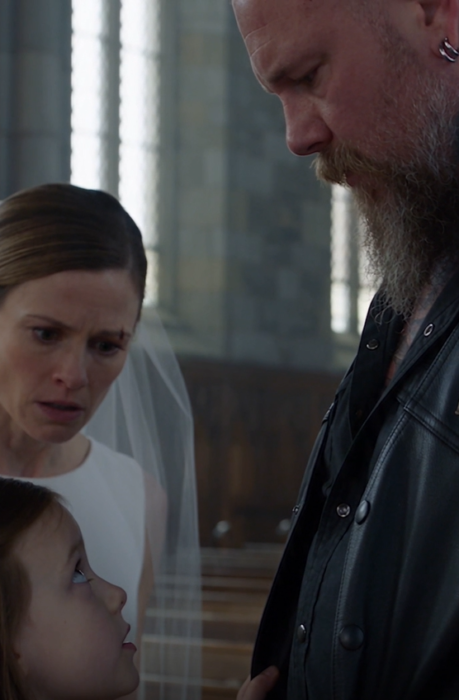
Around us, guests sat with their programs open. The pastor stood between two arrangements of white lilies, waiting for somebody to explain why the man in leather had a copy of my death notice.
I stared at the signature.
My fiancé’s name.
Dr. Adrian Vale.
Below it, a date eight years old.
“This isn’t what you think,” he said.
Dean stayed beside the third pew.
My brother was bigger than I remembered. His beard had gone gray at the chin. Tattoos climbed above his collar, but the small crooked bird on his wrist was the same one he got when I was sixteen.
Elsie stood in front of him.
Seven years old.
Her flower basket hung from one elbow.
“Mommy, why is he crying?”
Dean turned away.
I had not seen him cry since our mother died.
Adrian answered her.
“He’s confused, sweetheart. Come here.”
She looked at me instead.
That was the moment I pulled my hand free.
“Let Ruth take her outside.”
Adrian’s aunt stood immediately.
Adrian opened his mouth, then closed it.
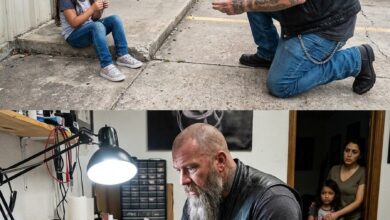
Dean stepped aside so they could pass. He never touched my daughter.
The pastor lowered his book.
“We’re stopping the ceremony.”
Adrian said there was no need.
I said there was.
My voice sounded thin, but it carried.
In the small room behind the sanctuary, Dean laid the paper on a table.
I read the words again.
The notice said I had died while receiving care after a road collision. It named a private service and described further information as confidential.
There was no cause of death.
No official registration number.
Still, it looked frighteningly complete.
My brother had received it in prison.
He kept the envelope too.
I asked why he had believed it.
He looked at me as though the answer embarrassed him.
“A doctor signed it. I was locked up. You’d asked me to stay away.”
Those three facts had built a wall nobody needed to guard.
I had helped lay the first brick.
“I wrote twice,” he said.
“To me?”
“To the clinic. Asking where you were buried.”
Adrian leaned against the doorframe.
“Dean, you’re upsetting her.”
My brother looked at him.
“I thought she was in the ground.”
For a second, I remembered the last letter I had sent Dean.
The anger.
The sentence I couldn’t take back.
Maybe Adrian knew more than I wanted him to know.
Maybe the paper was somebody’s terrible mistake, and my brother’s arrival was exposing something I had spent eight years avoiding.
I hated myself for considering it.
Then Adrian said, “Mara asked for distance.”
Distance.
Such a reasonable word.
I looked at Dean.
He nodded once.
“She did.”
Neither of them was lying about that.
Outside, someone started moving the reception flowers. Glass scraped across a cart.
I could hear our wedding being dismantled.
Dean kept his hands flat on his knees.
He wasn’t asking for an embrace.
He was waiting to learn whether I wanted him in the room.
I asked Adrian one question.
“Did you tell him I was dead?”
He looked toward the hallway before answering.
Why did the man I was about to marry need to check who might hear the truth?
When we were children, Dean folded the bottom corner of every note he left me.
Not to hide anything.
To make sure I looked twice.
Our mother started it. Grocery lists, birthday cards, school excuses. A little folded triangle meant the important part might be underneath.
Dean once left a note saying he had eaten my last chocolate bar.
Under the corner, he wrote that he had bought three more.
I forgave him before he came home.
We had another habit.
Three taps against the doorframe.
Then one with a thumbnail.
Our signal when neither of us wanted to explain a bad day through a closed door.
Still here.
At fourteen, I called it childish.
At twenty-seven, I wished somebody would do it.
Those were the memories that came back in the church office.
Not the collision.
Not prison.
A folded corner and the sound of my brother asking without pushing.
Dean had learned about the wedding from a former neighbor in Zanesville.
She saw our photograph in a local engagement announcement and called him.
At first, he thought she was being cruel.
Then she sent the picture.
He recognized my left eyebrow, where a childhood fall had left a narrow break.
Four days later, he drove past the church to make certain it existed.
He contacted the clinic.
Nobody would discuss a former patient.
He contacted an investigator through the attorney who helped him after his release.
They told him not to confront anybody alone.
He came to the ceremony anyway.
“I sat in the back,” he said.
“I saw.”
“I wasn’t going to say anything unless I was sure.”
He became sure when I tucked a loose strand of hair behind my ear.
Our mother did it that way.
Two fingers.
A small turn of the wrist.
I wanted to laugh at the idea that my hand could prove something a document had denied.
Instead, I cried.
Dean reached toward the tissue box, then stopped.
“Can I?”
I nodded.
He passed it across the table.
That careful permission hurt more than if he had grabbed me.
He had spent years being told I was gone.
I had spent years choosing not to ask where he was.
Adrian said we needed to leave before the guests turned this into gossip.
I looked at the doorway.
He had placed himself where everyone had to pass him.
I hadn’t noticed how often he did that until I wanted a different way out.
The pastor offered us separate rooms.
Adrian refused his.
“I’m her family.”
Dean looked down.
He had no answer ready.
For eight years, Adrian had been the person who signed school forms with me, sat through Elsie’s fevers, and knew which bills frightened me.
Dean had a motorcycle, a prison record, and an envelope.
I understood how the room looked.
After his release, Dean held a memorial beside the river where we used to fish. Three friends came. There was no grave to visit, so he left flowers on the water.
He told me that without looking up.
I wondered how many times he had apologized to someone who was still breathing.
That didn’t mean I understood what happened.
I asked Dean whether he still had my last letter.
He nodded.
“All of them.”
Adrian’s expression changed so slightly I might have missed it yesterday.
What had my brother kept that my fiancé believed was gone?
The county had no record of my death.
That should have settled something.
Instead, Adrian used it to make the whole accusation seem less serious.
“It was a communication error,” he said.
His attorney sent an explanation two days later.
Adrian had signed many clinic notifications. An administrative employee had used the wrong patient information in a letter intended for another family.
The document Dean received was not a state death certificate.
That was true.
It was a death notification on clinic letterhead.
Its authority came from a doctor’s signature and the fact that the recipient was a man in prison with little ability to investigate.
Adrian said he never knew it had been mailed.
He also produced a letter from me.
I recognized every word.
I wanted no visits.
No calls.
No messages through relatives.
I was alive, furious, and asking him to stay away.
But that last part wasn’t on the page Adrian supplied.
The copy ended at my signature.
I sat with my new attorney, Lena Ortiz, and watched her read it.
“Did you write this?”
“Yes.”
“Did you ask him to tell your brother you were dead?”
“No.”
“Did you ever say anything like that?”
I looked at the carpet.
Once.
During a session, after a letter from Dean arrived.
I said, “Tell him he doesn’t have a sister anymore.”
Lena waited.
“It wasn’t an instruction.”
“I understand. I need to know what can be quoted back to you.”
Adrian had helped me after the collision.
That was also true.
He arranged treatment, helped me find housing, and spoke gently when I couldn’t bear my own name.
For a little while, I wondered whether he really had been caught between an angry patient and an angry brother.
Then he offered the original staff member as the likely source of the error.
Donna Keene.
A receptionist who left the clinic years earlier.
Lena located her.
Donna remembered me.
She remembered Dean’s letters too.
She had not typed the death notice.
She had, however, copied my request for temporary distance into the file.
Temporary.
Lena asked her to explain.
“The original said she needed time,” Donna said. “Not that she wanted him erased.”
She remembered a folded corner.
Donna also remembered me asking for an envelope and a duplicate sheet. I had mailed Dean a copy of my request to Adrian, with a short note explaining that I needed space.
I couldn’t face writing everything directly to my brother.
But I had wanted him to know exactly what I asked.
My skin went cold.
I asked Dean to bring his letters.
He arrived at Lena’s office carrying them in a plastic shopping bag beneath his leather jacket.
He had prison mail receipts.
Copies of requests.
The original envelope from the clinic.
He also had a return envelope that had never reached me.
On the back, in his careful block writing, were four words.
Tell her I’m still here.
I put the envelope down before my hands crushed it.
An administrative error might explain one piece of paper.
It could not explain why every later request met the same silence.
Who had decided that my anger should last longer than my consent?
The clinic’s financial records told a different story.
Not immediately.
Not because Lena asked one perfect question.
It took formal requests, my signed authorizations, and an accountant willing to read years of transactions I had never understood.
I had inherited an interest in a small rental property from our grandmother.
Adrian helped manage it while I recovered.
I signed a limited authorization.
Then another document I thought replaced the first.
At twenty-seven, I could barely open an overdue bill without shaking. He made paperwork feel like something kind people took away.
The property was sold.
I knew that.
He told me repairs had become too expensive.
What I didn’t know was that the buyer was connected to a company he partly owned.
Or that money from the sale moved through accounts he described as treatment expenses and management costs.
Lena did not promise all of it could be recovered.
She asked for copies.
Then more copies.
Among them were charges for appointments I never attended.
Some were dated after Adrian and I began living together.
He had stopped being my doctor by then.
That was what he always told me.
Apparently the billing system remembered differently.
Dean stared at the spreadsheet.
“He needed you alone.”
I wanted to argue.
Not because the records were harmless.
Because accepting the explanation made ordinary memories feel contaminated.
Adrian helping with groceries.
Adrian taking Elsie to the park.
Adrian saying he would handle the hard things.
I didn’t want those afternoons to disappear too.
Lena said they didn’t have to.
“Someone can do something useful and still misuse the power it gives them.”
I wrote that sentence down.
At home, I put it beside the photograph Elsie drew for Father’s Day.
Both belonged to the life I was trying to understand.
I refused to tear up her picture just because the man smiling in it had deceived me. Her memory was not another document for adults to rewrite.
The false notice had cut off the person most likely to question the sale.
Dean knew the property.
He helped our grandmother repair it.
He knew I wasn’t the sort of owner who would sell without asking what happened to her tenants.
He was also a potential witness to the grandmother’s intentions, recorded in correspondence Adrian never requested.
One tenant had kept her letters.
Dean remembered her name.
That was how the investigation found the promise of an independent valuation.
There had been none.
The sale price wasn’t merely disappointing.
It had been chosen between people who benefited from my not understanding it.
Then Donna found an old clinic email in records preserved through her employment dispute.
Adrian had instructed staff to route every communication from Dean directly to him.
No response without approval.
It was dated after the death notice.
After the supposed administrative mistake.
After he said he knew nothing about it.
I read the date aloud.
Dean stared through the window.
He had spent that month making a wooden picture frame in a prison workshop.
For a sister he believed was dead.
I put my hand on the table near his.
Not touching.
Available.
He moved his fingers against mine.
If Adrian had needed my brother silent to control my past, what had he planned to gain by becoming my husband?
Adrian filed for a protective order against Dean.
His application described a threatening man who disrupted a wedding, approached a child, and produced confidential medical material.
All three things sounded different when stripped of their context.
He also asked for emergency arrangements concerning Elsie.
His daughter.
That was the part I had been too frightened to think through.
He was not simply a fiancé I could stop seeing.
He was the person whose name appeared beside mine on her birth certificate.
Lena told me what papers to keep and what questions belonged with a family attorney.
Nobody promised I could take Elsie wherever I wanted.
Nobody handed her father immediate control because he asked first.
We followed the temporary arrangements the court put in place.
I stayed with Ruth.
Adrian’s aunt.
She loved him. She also looked at the records without asking me to apologize for them.
That made her house feel safer than any speech about loyalty could have.
She put clean sheets on the spare bed and showed Elsie where she kept cereal.
Then she asked whether I wanted company or a closed door.
I chose the door.
She knocked before opening it the next morning.
Such a small thing.
I slept longer than I had in months.
Adrian called it interference.
He said Dean had convinced me to reinterpret my life.
Then his attorney supplied the police report from the collision.
I read my own statement.
The signature at the bottom was mine.
Dean had been convicted after seriously injuring another driver.
Everyone knew that part.
The report also said he had been driving.
My hands began to sweat.
Adrian sent a message through the approved channel.
Remember what happens when old stories change.
I showed Lena.
I didn’t answer.
At work, I made an error on a purchase order and spent ten minutes crying in a supply closet.
I supervised a small medical-equipment warehouse. I knew inventory counts, delivery windows, and how to calm an angry supplier.
Yet one sentence from Adrian could turn me back into the woman waiting for him to explain what she was capable of.
My manager gave me the afternoon.
I hated needing it.
Dean waited across the street from Lena’s office, beside his Harley.
He was respecting the temporary distance we’d agreed on while the application was reviewed.
He did not come over when he saw me.
He lifted one hand.
I walked to him.
“There’s something I have to say.”
He took off his sunglasses.
“I know.”
“No. You don’t know what he has.”
My brother looked older than forty-five.
“I know what happened, Mara.”
A bus pulled away from the curb. We waited while its engine drowned the space between us.
Then he said, “Talk to your lawyer before you talk to me.”
That was not the answer I expected.
I had thought he would tell me to stay quiet.
He had done that once.
This time, he pointed toward the office door.
“Do it right.”
I went back inside.
Lena closed the door behind me and put away the wedding photographs.
For the first time, I told somebody who was not Adrian or Dean what I had done on the night that changed our lives.
How much of my brother’s punishment had I allowed him to carry because admitting my part frightened me more than losing him?
I had been driving.
Not Dean.
I had been drinking.
He knew it when he got into the passenger seat. He should have taken the keys. I should never have held them.
The man in the other car lived.
He spent months in rehabilitation.
There is no version of this story in which our family’s suffering cancels his.
After the collision, Dean told officers he was the driver.
He had an older record and a terrible instinct for making himself the wall between me and consequences.
I let him.
When investigators questioned me, I supported his account.
I was twenty-seven.
Old enough to know exactly what a lie was.
Adrian met me during the aftermath.
At first, he helped me sleep, eat, and get through appointments without falling apart.
Then he became the only person I told the full truth.
Dean was sentenced.
I wrote to him.
Some letters begged forgiveness.
Others blamed him for deciding before I could decide.
That anger embarrassed me now.
It had also been real.
He had tried to save me by making another terrible choice, then expected me to live inside it.
The last letter asked for time apart.
Above my signature, I wrote that I couldn’t keep answering him.
Under the folded corner, I wrote something else.
Tell him I’m alive. Tell him this isn’t forever.
Adrian said he would convey my wishes.
Later, he told me Dean wanted nothing more to do with me.
He said my brother had finally understood how much pain our relationship caused.
When Dean stopped writing, I believed him.
Or I let myself believe him.
That difference mattered.
I could have searched.
I could have contacted the prison myself.
I didn’t.
I was ashamed. I was angry. I wanted a life that didn’t begin with the worst thing I had done.
Adrian gave me one.
Then he made sure its doors opened through him.
Lena listened without promising an easy result.
She arranged separate legal advice about my statement and the old case.
I would have to tell the truth through people who understood what it could cost.
Dean agreed to do the same.
His conviction didn’t vanish because I finally became honest.
Neither did the injury to the man we had hurt.
We began the process anyway.
I told Elsie only what she needed to know: I had made a serious mistake before she was born, and adults were helping me answer for it.
She asked whether that meant I was going away.
I said I would tell her the truth as I learned it.
Then I kept doing that.
When I next saw my brother, we sat at opposite ends of Ruth’s kitchen table.
“You shouldn’t have done it,” I said.
“I know.”
“I shouldn’t have let you.”
“I know that too.”
No forgiveness speech.
No touching music.
Ruth’s refrigerator clicked on.
Outside, Elsie asked whether somebody could help with her bicycle chain.
Dean started to stand.
Then he looked at me.
I nodded.
He went outside.
Through the window, I watched him kneel beside a child he had never known existed.
His knuckles were scarred.
His hands were gentle.
Both things were true.
I realized Adrian hadn’t invented all my guilt.
He had found guilt already there and built his power around it.
Could I take responsibility for what I had done without giving him permission to decide the rest of my life?
The first public confrontation happened at the hearing on Adrian’s application against Dean.
There were other proceedings ahead.
Financial claims.
Professional complaints.
Questions concerning Elsie.
Lena had warned me that one room would not resolve all of them.
I understood.
I still dressed as though the right shoes might keep my knees steady.
Dean sat beside his attorney.
Adrian sat across the aisle.
Without wedding flowers between us, he looked ordinary.
That frightened me in a new way.
I had imagined evil should become easier to recognize once you had a name for it.
Instead, he straightened a stack of papers the same way he used to straighten Elsie’s homework.
His attorney described concern.
Dean’s record.
My emotional state.
The disruption at the church.
Dean answered questions about standing up.
Yes, he knew he was interrupting.
Yes, he had contacted an investigator.
No, he hadn’t threatened Adrian.
No, he hadn’t touched Elsie.
Then Adrian testified.
He said my request for separation from Dean was clear and lasting.
He said the death notice was an administrative failure he had not approved.
He said my brother’s arrival had reopened wounds.
Lena asked whether he had received Dean’s later letters.
He said he could not remember individual items.
She showed the instruction routing them to him.
He said that was routine patient protection.
Then she showed my original request.
The copy Adrian’s attorney had supplied.
Flat.
Cropped.
Ending beneath my signature.
“Is this the complete communication you relied upon?”
“Yes.”
“Did Mara ask you to tell Dean she was alive?”
“Not in that letter.”
I held the edge of my chair.
Dean looked at the floor.
Lena placed a second envelope on the table.
Dean had kept a carbon copy of my letter.
I used a duplicate pad then because I rewrote everything before sending it. One copy went to Dean before Adrian told me he would handle all further contact.
The copy Adrian supplied came from his file.
Dean’s retained the folded bottom corner.
Lena had disclosed it beforehand.
There was no surprise document.
Donna had already given a statement describing the original request. The dated mailing helped establish when Dean received his copy.
Lena had warned me that a familiar fold was not proof by itself.
I understood.
The fold mattered because it told us where to look. Other records had to do the rest.
Only a man who had believed he could explain it away.
She asked about the missing section.
Adrian answered too quickly.
“She wrote that underneath the flap because she was ambivalent.”
The room became still.
Lena looked at him.
“What did she write?”
He hesitated.
Then he said, “That it wasn’t forever.”
“You just testified that her request was clear and lasting.”
“I meant clinically.”
“You also said she hadn’t asked you to say she was alive.”
Adrian looked toward me.
For a second, I saw the familiar invitation.
Let me explain you to yourself.
I didn’t move.
Lena unfolded the corner.
The judge read the words.
Then Dean’s attorney introduced the preserved correspondence and the death-notice envelope.
No gasp.
No applause.
Just paper placed beside paper.
The application against my brother was denied.
The judge did not decide every other allegation.
She didn’t have to.
Outside, Adrian called my name.
I kept walking.
What else had he called ambivalence when he meant a choice he didn’t intend to honor?
The death notice had not been an accident.
The later investigation established that through staff instructions, document records, and correspondence Adrian kept in an archived account.
He had reviewed the wording.
He had authorized its delivery.
He had continued receiving Dean’s requests afterward.
The money took longer.
An independent review traced the property sale and the fees charged against my accounts.
Some losses could be recovered.
Others became claims that would take years.
Adrian faced criminal proceedings arising from the false documents and financial conduct. His professional license became the subject of a separate case.
He ultimately accepted a plea.
I won’t turn the court dates into a clean ending they weren’t.
There were mornings I couldn’t remember which folder belonged to which attorney.
There were nights Elsie cried because she missed her father.
I did not tell her she shouldn’t.
The arrangements concerning contact were handled through the court, with professionals involved.
Her feelings were allowed to remain her own.
Dean and I corrected our accounts of the collision through counsel.
That process brought consequences and uncertainty.
It did not restore the years he lost.
The injured man sent word through his attorney that he wanted accurate records and no contact from us.
We respected that.
I began making payments through the agreed channel.
Small amounts.
Regularly.
A promise was not going to repair what a lie had done.
I stopped treating promises as payment.
Some months I wanted to explain how difficult things had become.
Then I remembered that the person receiving those payments had not chosen my difficulties.
I made the transfer, saved the receipt, and went to work.
There were better places for my explanations than inside somebody else’s loss.
Dean found a larger rental with room for Elsie to visit.
He put a secondhand table near the window and complained about the price of chairs.
Ordinary complaints.
I loved them.
The first time he invited us for dinner, he burned the garlic bread.
Elsie scraped it with a butter knife.
“Mommy does this too.”
“Family recipe,” he said.
I laughed before I could stop myself.
Then I cried.
He kept serving spaghetti.
He didn’t make the moment into something I had to explain.
After dinner, Elsie found the crooked bird tattoo on his wrist.
“Is that Mommy?”
“It was supposed to be.”
“It looks like a chicken.”
“Artist had limitations.”
She took a washable marker from her bag and added one long leg.
Dean let her.
I watched his face.
There were years I would never know.
There were people we could never become again.
But his hand was on the table.
Mine was beside it.
Nobody was deciding whether we were allowed to touch.
Weeks later, I went to his apartment alone.
I had no emergency.
No document.
Nothing to ask him to fix.
At the door, I tapped three times.
Then once with my thumbnail.
Inside, a chair moved.
He opened the door wearing reading glasses I hadn’t known he needed.
“Hey, Cricket.”
I held up a paper bag.
“Bought too much bread.”
He looked inside.
Three loaves.
Then he stepped back.
On the table was a note with its bottom corner folded.
I already knew what that meant.
Still, I opened it.
Stay for supper.
Underneath:
You don’t have to earn this.
I sat down before he asked again.
What might we become if we finally stopped disappearing for each other?