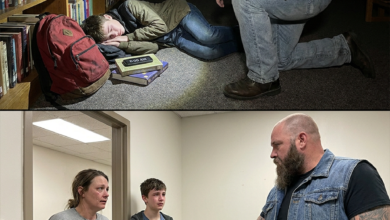
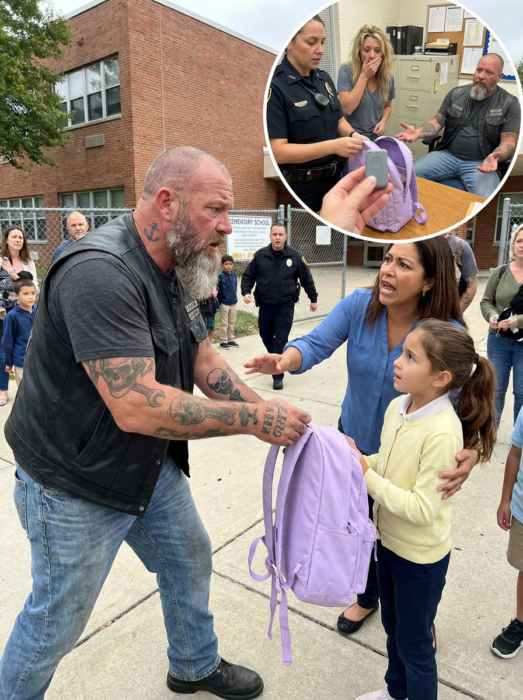
A Biker Ripped a Ten-Year-Old Girl’s Backpack Off Outside Her School — Then the Object Hidden Inside Explained Why Her Mother Had Been Afraid to Go Home
Part 2 — The Things Naomi Wanted to Keep
Naomi liked the classroom fish because they never asked her why she was quiet.
We had two: a fat orange one the children called Pickles and a smaller white one named Snowplow for reasons nobody could explain. Every afternoon, a different student checked the feeding chart. Naomi always read the instructions twice before tipping anything into the water.
That Tuesday, I told her she did not have to be so worried about doing it perfectly.
She looked up and said, “I know.”
Then she checked a third time.
A teacher learns to notice patterns without pretending every pattern is a diagnosis. Naomi apologized when another child bumped her chair. She asked permission to throw away a broken pencil. Once, when our classroom door slammed in the wind, she went completely still and watched my hands.
I had documented the changes and spoken with our counselor. The adults responsible for supporting the family were involved. What I knew was deliberately limited: Naomi and her mother, Leah, had left their home, and dismissal required particular care.
I was not entitled to every private detail in order to treat them gently.
Leah had arrived at school eight days earlier wearing the same sweatshirt she wore to parent conferences and a steadiness that looked expensive. She spoke with Principal Bennett behind a closed door. When she came to collect Naomi, she smiled and asked whether her daughter had remembered her spelling notebook.
Naomi said she had.
Neither cried.
At the time, I mistook that composure for evidence that the worst part had passed.
I learned later what the night before had looked like. Leah had waited until her husband left the house, packed what she could manage, and called someone who knew how to help. Naomi chose the lavender backpack, her school shoes, and the paper fish she had been making at our art table.
She wanted her regular things.
Not a new identity. Not a dramatic escape costume. Her own notebook with the bent cover, the familiar zipper, the water bottle with the scratched lid.
The backpack had been a birthday gift from her father.
That complicated nothing about who was responsible for what happened. It complicated a great deal about how a child felt.
Naomi remembered him teaching her to skip stones. She remembered the funny voice he used for the dog. She also remembered standing in a doorway while he shouted at her mother, trying to decide whether being good enough could make the shouting stop.
Leah did not ask her to forget the good memories. She told her they could love a memory and still need to be safe from the person inside it.
I did not hear that conversation until much later.
That afternoon, Naomi stayed after the bell long enough to finish a sentence in her notebook. It read, A shelter is a place that protects something.
She asked whether protects needed another letter.
I showed her.
Across the street, Callum Rourke parked his Harley in a marked space and removed his helmet. He wore a charcoal T-shirt beneath a plain leather vest. His beard was gray around the chin. A small anchor was tattooed at the side of his neck, and the backs of his hands carried older ink softened by sun and work.
He had come to collect his granddaughter, Iris, from an after-school reading session.
His daughter, Beth, normally collected her. A shift change at the clinic had made that impossible, and she had added her father to the approved pickup list the previous week.
He carried the confirmation on paper even though the office had already told him it was in the system.
I know this because he later unfolded it on my desk with the concentration of someone handling a document far more valuable than it looked.
He was not taking Iris on the motorcycle. Beth had arranged for her sister to meet them in a car. His job was to sign the child out, wait with her, and get the details right.
At fifty-six, he was practicing being dependable in small, verifiable ways.
His past included a theft conviction, years of drinking, and a daughter who had learned not to expect him when he said he would come. Sobriety had not made those years disappear. Fourteen steady years had earned him invitations again, then Sunday dinners, then finally his name on a school form.
He was early.
Because he was early, he stood beside the public forecourt while our students assembled near the dismissal benches. Because his motorcycle was across the street, he could see a man in a gray jacket approach the low wall where several backpacks rested.
At first, he thought the man was a parent.
There was nothing theatrical about him. Clean clothes. Ordinary shoes. A phone in one hand. He did not look around as though expecting to be caught.
Cal watched him handle a lavender backpack and put something small inside.
Then the man left it there.
He did not speak to a child. He did not ask a teacher a question. He walked across the street and remained beside a blue car, watching the dismissal area.
That was when Cal stopped waiting quietly for the office door to open.
Inside, I reminded Naomi to collect her bag.
She put one strap over her shoulder.
Her mother had just entered the pickup lane.
Part 3 — The Sound of Keys on Concrete
There are moments a person remembers in fragments rather than order.
A school bus exhaling at the curb. Naomi lifting her backpack. A man calling something I could not make out. The scrape of a boot. My student’s shoulder turning sharply as the bag came free.
I heard myself shout before I recognized my own voice.
“Security!”
Cal held the lavender bag by its top loop. He had pulled it away from the shoulder on which it hung, not lifted the child, but that distinction belonged to a slower examination. In the moment, all I saw was a large adult using sudden force near a ten-year-old.
Naomi stumbled into my side.
I caught her.
He stopped so abruptly the bag swung once and struck his leg.
“Put it down.”
He lowered it.
“Back.”
He stepped away.
Our security officer, Mr. Alvarez, reached us from the crossing. I told him what I had seen, keeping Naomi behind me. Cal’s hands were empty except for his helmet, which Alvarez asked him to place beside the bag.
Cal complied.
“Somebody put something in it,” he said.
Alvarez positioned himself between Cal and the children.
“You can explain over here.”
“The gray jacket. Across the street.”
I looked.
A blue car pulled away from the curb.
I saw a man’s profile through the windshield, then nothing useful.
Naomi’s mother had left her car with another staff member guiding vehicles around it. She ran the last few steps. Naomi reached for her without letting go of my cardigan.
“What happened?”
“A man pulled her backpack off,” I said.
Leah looked at Cal. Her eyes moved to the bag.
Then Naomi said, “He said somebody touched it.”
Cal began describing the gray jacket. Leah’s expression changed before he finished.
“Blue car?”
“Yes.”
“Was the back window taped at the corner?”
“I couldn’t tell.”
She dropped her keys.
I will always remember that little metallic sound. Not a scream. Not a collapse. A set of keys hitting concrete while her whole body seemed to rearrange itself around a new fear.
Principal Bennett arrived and took charge of clearing the entrance. Another teacher moved students inside or completed their verified pickups. Alvarez called police. I accompanied Leah and Naomi to the counselor’s office while Cal remained outside with security.
He did not try to follow us.
In the office, our nurse asked Naomi where she hurt. Her shoulder was sore where the strap had moved, but she had not fallen. The nurse checked her carefully. Leah asked before touching the shoulder, and Naomi nodded.
That small exchange stayed with me too.
A child who had just lost control over what happened to her body was being given one decision back.
Naomi wanted her bag.
I said the adults were checking it.
“Did I get in trouble?”
“No.”
“Then why can’t I have it?”
“Because somebody may have put something in it without asking.”
She considered that.
“Did he steal something?”
“We don’t know yet.”
It was tempting to promise that everything was fine. I did not know that. I could promise only that she was with her mother and that we would tell her what we could, when we knew it.
Outside the glass partition, Cal sat on a low bench with his elbows on his knees. He looked too large for the school furniture. A folded sheet of paper lay between his fingers.
I assumed it was his identification.
It was Iris’s pickup form.
A staff member brought his granddaughter to a separate office, and Beth was called. Cal asked security to tell Iris he was there and had not forgotten her.
Nothing in that request excused what he had done.
It made him a person instead of a silhouette.
Officer Elena Ruiz arrived first. She spoke with Leah, then with me, then with Cal.
He told her what he had seen.
He did not say he recognized a bomb. He did not say he knew the man’s intentions. He described a small object, a bag, an adult leaving without a child, and the way the adult watched from the opposite curb.
“I called out,” he said. “She didn’t hear me.”
“Why didn’t you step in front of the child and ask her to wait?”
He looked down.
“I should have.”
The officer let that answer stand.
“Did you intend to hurt her?”
“No.”
“Do you understand she was frightened?”
“Yes.”
From the counselor’s chair, Naomi could see his boots through the glass. She stared at them while Leah spoke softly with Principal Bennett.
I moved my chair to block the view and asked whether she wanted water.
She asked for her spelling notebook instead.
The police photographed the bag as it lay, then took custody of it. Leah gave permission for it to be examined. Nobody dumped the contents onto a school desk for everyone to inspect. Nobody allowed parents to crowd around with cameras.
That helped.
Naomi’s possessions remained hers, even when adults had urgent questions.
A second officer came in to review the exterior camera recording. Principal Bennett sat beside him. On the screen, the man in the gray jacket paused at the dismissal wall.
Leah saw his face.
She said his name once.
Daniel.
Then she put her hand over her mouth and turned away from the monitor.
The officer did not ask her to watch again.
Outside, Cal’s daughter arrived still wearing her clinic badge. She looked at her father, the police, and the lavender backpack being carried into a side room.
For one awful moment, I watched an adult woman wonder whether the man she had finally trusted had become unreliable again.
Cal saw it too.
He stayed seated.
“Ask them what happened,” he told her. “Don’t take only my word.”
Part 4 — The Thing She Had Carried
Officer Ruiz asked Leah to step into the principal’s office.
Leah asked me to come with her.
Our counselor, Mrs. Bell, remained with Naomi. Through the partly open door, I could hear her asking whether Naomi wanted to draw or simply sit. The child chose sitting.
The officer placed a photograph on the desk.
It showed a small electronic device found inside the backpack, separate from Naomi’s school supplies. The officer described it as a location-tracking device. She did not tell us which addresses it might already have reported or promise it had never sent anything. Those questions required examination.
Leah recognized the type.
“Daniel used things like that with his equipment,” she said.
Her husband ran a small contracting business. He spoke about keeping track of tools and trailers. She had never imagined looking for the same kind of object among her daughter’s pencils.
Now she could imagine little else.
“Can he see where we are?”
“We’re taking that seriously,” Ruiz said. “We’re not going to guess.”
She explained what the police would retain and what information they would need. She helped Leah contact the advocate who was already assisting her. The discussion moved away from the desk where a child could overhear it.
I will not describe where Leah and Naomi were staying or where they went afterward. Even in telling a story about someone being found, the place they kept for themselves deserves to remain theirs.
What mattered was that the bag had been stopped before that afternoon’s journey home.
It did not erase the danger. Daniel knew the school. He had demonstrated that he would use it to reach beyond its gates. The family needed a new plan, not a congratulatory speech.
Leah sat down.
“I checked the car,” she said. “I changed so many things.”
Ruiz did not ask why she had missed the backpack.
“Someone else made a decision to do this,” she said. “Let’s keep responsibility there.”
Leah began crying then, silently and with visible irritation at herself. She pressed tissues flat between both hands as though she could make the tears orderly.
I had seen her attend conferences, bring cupcakes with the ingredients labeled, and remind Naomi to say thank you. I had mistaken competence for an absence of fear.
She had been afraid while doing all of it.
For months, Daniel had demanded explanations for small delays. A late grocery trip became an accusation. A phone turned face down became evidence. Once, when Leah tried to leave an argument, he blocked the door and took her keys.
She had told herself each episode was an exception until the exceptions became the schedule.
The night before she left, Naomi had stood in the hallway holding her school shoes. Not wearing them. Holding them, ready to follow wherever her mother could go.
That was the image Leah described to me.
Not the broken object in the kitchen. Not the words Daniel shouted.
Her daughter already prepared to run.
When we returned to the counselor’s office, Naomi was still sitting very straight. She looked at her mother first, then at me, trying to read what the adults had decided.
Leah sat beside her.
“The police found something in your backpack that can be used to follow where it goes,” she said carefully. “You did not put it there.”
Naomi looked at the floor.
“Was it Daddy?”
Leah took a breath.
“We saw him touching your bag on the school camera. The police are finding out everything they can.”
“Did it tell him?”
“We don’t know everything yet. We’re making a plan.”
Naomi’s hands began to shake.
“I brought it.”
“No.”
“I picked it up.”
“You picked up your schoolbag.”
“I was going to bring him home.”
The words came out flat, as if she were reporting a rule she had broken.
Leah moved closer but waited until Naomi leaned into her before putting an arm around her shoulders.
“You were coming home,” she said. “That is all you were doing.”
Naomi shook her head.
“If I didn’t use his present—”
“You did nothing wrong by loving a present.”
The room became very still.
It was not the tracker that held us there. It was the sight of a child trying to make herself responsible for an adult’s decision because responsibility seemed easier to carry than helplessness.
Leah touched the edge of Naomi’s sleeve.
“You don’t make him choose things,” she said. “I don’t either.”
For the first time since the gate, Naomi cried.
Mrs. Bell moved the tissue box closer. I sat with my hands in my lap. There was no useful speech for me to add.
Outside, the police reviewed the remaining footage. Cal’s account matched the visible sequence: Daniel approached the bag, handled it, crossed the street, and watched. The footage also showed exactly how Cal had taken the backpack.
One fact did not cancel the other.
The principal documented the child-safety incident involving Cal as well as the unauthorized access to Naomi’s belongings. Ruiz took his statement, the family’s statements, and the information needed to locate Daniel. She explained that further investigation, including records connected to the device, would be necessary.
There was no immediate confession.
No courtroom appeared that evening to arrange a perfect ending.
Weeks later, Leah told me investigators had linked the device to Daniel, adding that evidence to the footage and her existing reports. But that afternoon, our certainty was smaller and enough to act on.
An adult had interfered with a child’s bag.
A frightened mother had been right to ask for help.
A little girl had done nothing wrong.
Before leaving, Naomi asked whether she had to thank the man outside.
Leah looked at Mrs. Bell, then answered herself.
“No. You don’t owe anybody a thank-you while you’re scared.”
Through the glass, Cal stood when an officer spoke to him. He did not look toward our door as if waiting for a reward.
He picked up his helmet.
Then he sat back down to wait for his daughter.
Part 5 — The Paper in His Other Hand
I spoke with Cal the following afternoon in the principal’s office.
He had asked to give us a written apology for Naomi, which we would share only if Leah wanted us to. The principal made clear that the account would be recorded and that he was not to approach the family independently.
“I understand,” he said.
His hands looked different resting on a school desk. They were broad and marked with old burns, a mechanic’s hands with nails cleaned carefully but impossible to make new. The tattoo at his neck was an anchor. Beneath his vest, his shirt smelled faintly of laundry soap and motor oil.
I asked what he had thought was inside the bag.
“I didn’t know.”
“Then why did you grab it?”
He stared at the corner of the desk.
“I saw the man put something in. Saw him waiting across the street. I wanted it stopped before it got in the car.”
“You could have hurt her.”
“I know.”
He did not turn the sentence into a defense.
The difference mattered to me.
Outside the office, children were returning library books and negotiating over places in line. Cal listened to their voices before speaking again.
“My sister had somebody who wouldn’t leave her alone,” he said. “Years ago. I learned to notice someone waiting when they ought to have gone.”
“Did she teach you to grab things off children?”
He looked up.
“No.”
The question was harsh. I had spent the night remembering Naomi stumbling into me. Cal had spent the night, he told me, seeing the same moment.
“I wasn’t thinking enough about how she’d feel,” he said. “I was thinking about that man.”
There it was: not an explanation that made the choice perfect, but an honest account of its limits.
His sister was alive and living in another state. She had rebuilt her life with help from people who had more patience and better judgment than he had at the time. Cal had once believed being useful meant being the biggest person in a room.
Recovery had challenged that belief.
So had fatherhood.
“I used to show up loud,” he said. “And miss the things that needed me quiet.”
I knew from the school records that his daughter had only recently added him to Iris’s pickup list. I asked why the paper copy had mattered so much.
He rubbed the fold with one finger.
“Because she asked.”
He did not mean the office.
Beth had spent her childhood listening to her father say he would arrive after work, after a ride, after one more drink. Cal did not describe those years as adventures. He described them as evenings his daughter had learned to stop watching the driveway.
When he got sober, Beth did not immediately come back.
He made amends where he could. Paid what he owed. Kept visits short when she asked. Accepted holidays without invitations. Fourteen years later, being allowed to collect his granddaughter was not a trophy.
It was a responsibility he knew could be withdrawn.
“Iris was still inside,” he said. “Even when security stopped me, I needed her to know I hadn’t gone.”
He asked the principal whether his granddaughter had been frightened by the police.
“She was worried about you,” the principal said. “Her mother explained what she could.”
Cal nodded once.
The note he wrote to Naomi contained five sentences.
I scared you when I took your backpack. I am sorry. I had seen someone put something in it, but I should have tried harder to tell you before I touched it. You did nothing wrong. You do not have to write back.
He signed it Cal.
Not Knox. Not a road name. Not a title designed to make him impressive.
Leah accepted the note. She waited until Naomi asked about him again before offering to read it.
By then, a short video from the gate had begun circulating among parents. It showed the grab and my shout. It did not show Daniel at the wall. It did not show the device.
The police and school did not respond by exposing Naomi’s life to correct a stranger’s reputation.
Neither did Cal.
His club, the Copper Ridge Riders, wanted to help. One member proposed sharing the full story online. Another wanted to find the man who had planted the device. Several called Cal furious that people were describing him as a thief.
He told them to stop.
I know because Beth later showed us the message he asked the club secretary to distribute.
Do not post about the child. Do not look for her father. Police have what I saw. She doesn’t owe us a public story.
One rider argued that silence made him look guilty.
Cal replied that Naomi had already carried enough that week.
That was the test of the brotherhood, not whether they could arrive together in leather. They had to tolerate being misunderstood without buying clarity with a child’s privacy.
They did.
No motorcycles lined the school fence. No men stood outside Daniel’s business. No photograph of Naomi appeared on the club’s page.
Instead, the members asked what the school actually needed.
Principal Bennett mentioned that our counselor’s emergency supplies had run low: notebooks, plain backpacks, toiletries, spare clothing in ordinary sizes. The club purchased what was on the list and delivered it through the office.
Nothing bore a club logo.
Nothing required a child to pose with a donor.
Cal did not come to that delivery.
He was at his granddaughter’s reading session, sitting in the chair Beth had asked him to occupy.
When I passed the library, Iris was sounding out a difficult word. He leaned forward, listening, his hands flat on his knees.
For once, being useful meant not moving until somebody asked.
Part 6 — A Fish for the Next Refrigerator
The next week, we moved the dismissal bags.
It was not a grand reform with a ceremony. We changed where belongings waited, reviewed adult access around the forecourt, and made sure the staff responsible for dismissal had the information they needed without circulating the family’s private history.
Principal Bennett did not blame the youngest aide or congratulate us for a danger we had nearly sent home. She asked what had allowed an unfamiliar adult to handle a child’s possessions without being challenged.
Then we changed that.
Leah met with the advocate and the police separately from school. New protections and arrangements followed. I knew enough to carry out my part, not enough to narrate theirs.
Daniel did not arrive at our gate again during those weeks. That absence was welcome, but nobody called it proof the problem was over. The investigation continued. So did the work of giving a mother and child days that belonged to them.
For Naomi, the difficult moments were often small.
A zipper made her freeze.
A substitute teacher asking everyone to leave their bags outside the classroom made her grip both straps.
Once, when I said we were going to check the lost-and-found basket, she asked who would be allowed to touch what was inside.
I explained the ordinary procedure. Then I asked whether she wanted Mrs. Bell to join us.
She said yes.
Adults sometimes want a child to recover on a schedule convenient for everyone else. We want the right apology, the right conversation, the right new backpack to bring back the child we remember from before.
Naomi still laughed at the fish.
She still checked the feeding chart three times.
Both could happen on the same day.
The police returned her notebook and most of her ordinary belongings after the necessary documentation. Her lavender bag remained with them longer, then was returned to Leah when they no longer needed to retain it.
Leah asked Naomi what she wanted to do with it.
There was a new orange backpack available. There was no requirement to reclaim the old one and no requirement to throw it away. Naomi could decide.
She chose the orange one for a while.
The paper fish came back folded inside her spelling notebook. One fin had creased under the weight of the books. Naomi smoothed it carefully before handing it to her mother.
“I made this before,” she said.
“Before what?”
Naomi shrugged.
Leah did not make her explain.
The fish was blue, with uneven scales and a wide tail. On its back, Naomi had written: For our fridge wherever it is.
That was what she had been afraid of losing along with the bag.
Not a device she did not know existed. Not evidence. A small thing she had made for the next place she and her mother would call home.
Leah held it against her chest.
“I saved a spot,” she said.
A few days later, Naomi asked whether Cal really meant that she did not have to write back. I told her yes.
“What if I want to?”
“Then your mom can help decide how.”
The note reached him through the office with Leah’s permission. Naomi had written three lines.
I was scared. Next time use words first. My shoulder is okay now.
His reply was one sentence.
You’re right, and I’m glad your shoulder is better.
He did not ask to meet.
He did not add a description of what might have happened without him.
Naomi read the sentence twice and tucked it into her notebook.
When I saw Cal at a later pickup, I told him only that she had received it. He nodded and went back to listening while Iris described a book.
There are moments when you can see a person resisting the urge to make a story about himself.
That was one of them.
Part 7 — The Bag She Chose to Carry
Three months after the incident, Naomi brought the lavender backpack to school again.
Leah had had the loosened strap stitching repaired. There was a little difference in the thread color, visible if you looked closely. Naomi told me she liked the bag’s pockets better than the orange one’s.
That was her entire explanation.
I accepted it.
The backpack contained a library book, a lunchbox, a sweater, and a cardboard model of a fish habitat we had been working on for science. The model was too large, so she carried it separately, complaining all morning that the fake seaweed kept falling over.
It was a good complaint.
At dismissal, she stood beside me while Leah finished speaking with the office. We kept her belongings with us, and no one treated that as a special request.
Across the forecourt, Cal waited for Iris.
He wore his leather vest and carried his helmet by the strap. His motorcycle was parked out front, but Iris’s aunt was there in a car for the ride home, as arranged. I watched him check the time, then put the phone away when his granddaughter appeared.
He noticed Naomi.
He did not approach.
She noticed him noticing and looked up at me.
“You can wave if you want,” I said. “You don’t have to.”
She considered this for a moment, then raised one hand.
Cal raised his.
Leah came through the office door and saw the exchange. She put a hand lightly against Naomi’s back, then removed it when her daughter shifted the cardboard habitat.
“Can we show him?” Naomi asked.
“If you want to.”
They walked over together.
I remained close enough to hear without making a meeting of it.
Naomi held up the model. “The fish isn’t real.”
Cal examined it with complete seriousness.
“Good. He’d be having a rough afternoon.”
She smiled.
“This part is the shelter. So he can get away if he’s tired of the other fish.”
“Everybody needs a spot.”
“He still has to come out to eat.”
“Sounds fair.”
Nothing was said about the tracker.
Nothing was said about forgiveness.
Leah thanked him for giving his statement and leaving the family’s information private. He said he was glad Naomi had people around her who knew what to do.
Then he looked at the model tipping sideways in her hands.
“Would you like me to carry that to the door?”
Naomi thought about it.
“No. Can you hold the door instead?”
“Absolutely.”
He walked ahead, opened the heavy glass door, and stepped out of the way. He did not reach for the model when a cardboard reed fell against its edge. He did not catch her backpack by the loop because one strap sat crooked.
He waited.
Naomi carried the habitat through carefully. Leah followed. Beyond the doorway, Iris called to her aunt about stopping for groceries, and a bus driver checked the last row of seats.
School ended the way school ends on thousands of ordinary afternoons.
A child went home with her mother.
A grandfather went to meet his family.
Before getting into the car, Naomi turned and called, “Bye, Cal.”
“Bye, Naomi.”
The lavender bag rested on both her shoulders.
This time, nobody took it away.
Follow our page for more biker stories about misunderstood moments, difficult choices, and the quiet work of making someone feel safe again.