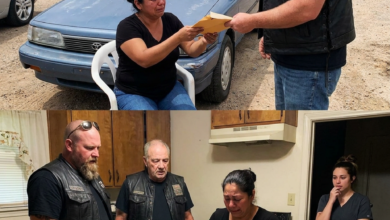
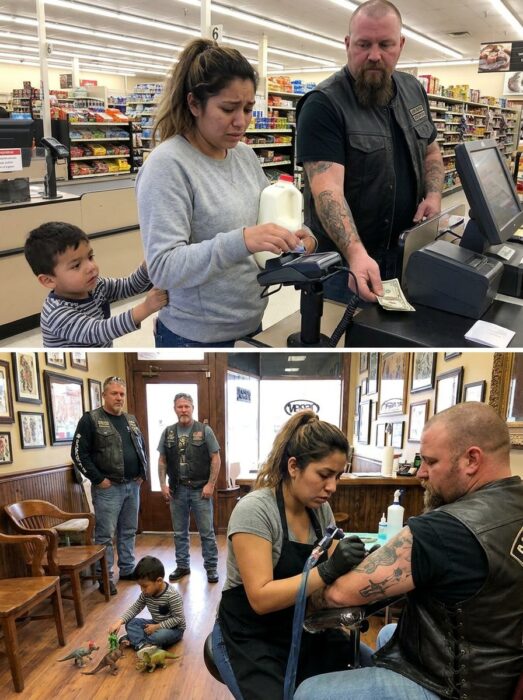
A Biker Quietly Paid the Twelve Dollars a Crying Mother Needed for Milk—Then One Bruise Led Him to the Daughter of the Man Who Had Saved Him at Seventeen
Part 2 — The Boy Behind Gabriel’s Tattoo Shop
I was seventeen when Gabriel Morales found me sleeping behind his tattoo shop.
My father had thrown me out after I broke his nose.
That sentence makes the story sound simpler than it was. He had been drinking, my mother had been trying to get past him, and I had stepped between them. He swung first. I swung harder. When the police arrived, my mother said she had fallen because she was afraid of what he would do after they left.
I packed one backpack and walked away.
For three weeks, I slept wherever the police were least likely to find me: beneath loading docks, inside an abandoned van, and behind a row of businesses on Watkins Street. Morales Ink occupied the last unit. Its back door vent released warm air that smelled of disinfectant, cigarette smoke, and green soap.
Gabriel found me there before sunrise.
He was sixty-one then, a compact Mexican American man with silver hair combed straight back, reading glasses hanging from his neck, and forearms covered in tattoos older than most customers entering his shop.
He nudged my boot with a broom.
“You alive?”
“Trying to sleep.”
“That wasn’t the question.”
I sat up.
Gabriel studied the swollen knuckles on my right hand, the backpack beneath my head, and the empty food wrappers beside me. He did not ask for my story.
“Back room has a couch,” he said.
“I don’t need charity.”
“Good. Couch needs cleaning.”
He unlocked the door.
I followed because cold pride is still cold.
The back room contained two broken chairs, boxes of tattoo supplies, a utility sink, an old sofa, and a small refrigerator humming louder than my first motorcycle. Gabriel told me I could sleep there for three nights if I swept the shop before opening.
Three nights became six weeks.
He paid me for cleaning, errands, and minor repairs. He taught me how to sterilize surfaces, how to speak to frightened customers, and how to recognize the moment somebody wanted to change their mind but felt embarrassed to say it.
“A tattoo can wait,” he told me. “Regret doesn’t.”
Gabriel was one of the first adults I met who understood that control could disguise itself as generosity. He never told me what I owed him. He gave me choices small enough to believe.
Coffee or water.
Couch or floor.
Leave tonight or stay until morning.
When I stole twenty dollars from his register during my second week, he knew before closing.
He did not call the police.
He placed an empty envelope on the counter.
“Put it back when you can.”
I denied taking anything.
Gabriel adjusted his glasses.
“If you want to lie, choose somebody who hasn’t told the same lies.”
I returned the money three days later.
He kept the envelope pinned above the sink as a reminder. There was no lecture. Somehow, that felt heavier.
Gabriel also drew constantly. Dragons, roses, saints, serpents, military insignia, family names, and memorial pieces filled his sketchbooks. One evening, he saw me drawing a crude road with wings on a paper towel.
He redrew it on proper paper.
The wings followed the curve of the road. A small black rook chess piece stood at the center because I had spent evenings playing chess against him and losing.
“That’s you,” he said.
“A bird?”
“The piece.”
“Rooks move straight.”
“And protect what’s behind them.”
When I turned eighteen and found full-time work at a motorcycle garage, Gabriel inked the design on my left shoulder. He refused payment.
Years later, after I began riding with the Iron Saints, he embroidered a version onto a small cloth patch for the inside of my leather cut. It was not an official club insignia. It belonged only to us.
That was how I got my road name.
Gabriel attended the night I received my club patch. He stood at the back, arms folded, and told everyone he still considered me an unreliable janitor.
I visited him for years.
Then life separated us by inches that became miles. I moved across Memphis, worked longer hours, and spent weekends riding. Gabriel closed the shop early more often. His calls became less frequent.
The last time we spoke, he said his health was failing.
I offered to visit.
He said, “Next week.”
There was no next week.
Gabriel died after a stroke two days later. The funeral notice appeared online after the service had already taken place. I rode to Morales Ink, but the windows were covered with brown paper and a bank notice had been taped inside the door.
I assumed the shop was lost to medical debt.
I stood in the alley behind it for twenty minutes.
Then I left.
Two years later, I met his daughter because she could not afford milk.
At Harper’s Market, after the police read Elena’s name, I showed her the faded patch inside my vest.
She touched the stitched rook.
“My father drew that.”
“Yeah.”
“He had a photograph of you.”
I looked at her.
“In the shop?”
“At home. You were skinny.”
“Was seventeen.”
“You looked angry.”
“Was that too.”
Elena’s son Mateo stepped closer and examined my vest. He asked whether his grandfather made all the patches.
“Just the important one,” I said.
Elena’s eyes changed. Gratitude disappeared beneath fear when she looked toward the parking-lot exit.
“He’ll come back.”
The officer assured her that patrol units were searching for her estranged husband, Derek Voss. He had an active warrant for violating probation and a court order connected to another assault.
That did not make Elena feel safe.
A warrant was paper.
Derek knew where she slept.
I called Preacher, president of the Iron Saints. I told him we needed a place for a mother and child before sunset.
He asked one question.
“Safe or invisible?”
“Both.”
The club owned neither a shelter nor a secret compound. What we had was a network: veterans, nurses, mechanics, church volunteers, lawyers, and two former members who operated transitional housing for families escaping abuse.
Preacher called them.
Within fifteen minutes, a domestic-violence advocate was speaking privately with Elena. She explained confidentiality, transportation, restraining orders, emergency housing, and the danger of returning home for possessions.
Elena looked at me.
“I don’t know you.”
“No.”
“You knew my father.”
“Long time ago.”
“That doesn’t mean I should trust you.”
“No.”
It was the correct answer.
Gabriel had taught me never to turn help into another form of control.
So I stepped away while Elena made her own decision.
She accepted transport to the safe house only after learning the advocate—not the Iron Saints—would control the address and access. Two female volunteers drove Elena and Mateo in an unmarked minivan. I followed at a distance because she asked me to bring the groceries.
The milk cost less than five dollars.
It had already changed everything.
Part 3 — The Knife Beneath the Parking-Lot Light
The confrontation in the parking lot lasted ninety-three seconds.
I know because the supermarket’s security camera recorded it from the moment Derek appeared until he ran. On video, ninety-three seconds looks brief.
Inside it, time stretched.
Elena reached the silver SUV at 2:17 p.m. She placed two grocery bags near the rear door and helped Mateo climb into his booster seat. Derek stepped from behind the neighboring pickup before she could fasten the buckle.
He had been waiting.
Later, police determined he had attached a low-cost tracking device beneath Elena’s SUV. She had changed phone numbers and stopped using social media, but he still knew where she went.
Derek seized the grocery bag containing the milk.
“You used my money?”
Elena told him the money belonged to her.
He pulled the bag hard enough to tear it. The milk struck the pavement but did not break. Apples rolled beneath the SUV. A loaf of bread landed near his shoe.
Mateo began crying.
Derek grabbed Elena’s bruised wrist.
I was forty yards away.
I told the 911 dispatcher a domestic assault was happening at the north end of the parking lot. Then Derek shoved Elena against the passenger door.
I closed the distance.
“Let her go.”
Derek turned toward me.
He did not appear surprised. That meant he had seen me follow.
“You her new boyfriend?”
“No.”
“Then walk away.”
“No.”
He released Elena and opened the folding knife. The blade was short, perhaps three inches, but distance makes a knife dangerous, not length.
I stopped beyond his reach.
My hands remained open.
Behind me, Elena pulled Mateo from the vehicle and crouched between two cars. I shifted sideways so Derek would need to pass me to reach them.
The dispatcher asked whether I could move to safety.
“Two people behind me,” I said.
“Do not engage the suspect.”
“Not engaging.”
Derek stepped forward.
I stepped backward, keeping the same distance while blocking his path.
He called me a coward for refusing to fight. Then he insulted my club, my mother, and every patch on my vest. He wanted a reaction. Men like him often do. If I swung, he could become the victim in whatever version he told later.
I gave him nothing.
“You go through me,” I said.
Derek lifted the knife.
The supermarket doors opened behind us. Shoppers watched. Several phones appeared. Denise shouted that police were coming.
Derek glanced toward the road.
Sirens grew louder.
He ran.
Boone later asked why I did not chase him.
Because Elena and Mateo were still there.
Because a fleeing armed man can become more dangerous when cornered.
Because protecting someone does not always mean catching the person who frightened them.
I stayed.
Elena’s knees gave out after Derek disappeared. I knelt several feet away, keeping my hands visible.
“Can I come closer?”
She nodded.
Mateo clung to her sweatshirt. His plastic dinosaur had fallen beneath the SUV. I retrieved it slowly and placed it on the pavement beside him.
The toy was missing one leg, but Mateo held it as though nothing else could survive without it.
Police arrived. Officer Rachel Kim directed units toward the drainage road where Derek had fled. Officer Jamal Brooks took my phone and kept the 911 call connected until dispatch confirmed officers had the description.
An ambulance evaluated Elena. She refused transport, fearing the cost.
The paramedic explained there would be no charge for the assessment. He documented swelling around her wrist and a bruise along her shoulder.
The officers asked about previous incidents.
Elena looked at the ground.
Derek had assaulted her before. He had threatened to take Mateo. He had controlled their bank account, monitored mileage on the SUV, and used the tattoo shop as leverage whenever she tried to leave.
She had obtained a temporary protective order six months earlier but withdrew the request for a longer order after Derek threatened one of her coworkers.
That coworker lost a tire the following night.
No one proved Derek caused it.
Fear did the rest.
The police photographed Elena’s injuries and recovered the tracking device. Security preserved the store video. Denise provided a statement. So did three customers.
For once, the evidence did not depend only on Elena being believed.
That mattered.
Derek was arrested two days later outside a motel in Southaven after an officer recognized the SUV he had borrowed. Police recovered the folding knife, narcotics, and another tracking device. He was held on the outstanding warrant and faced additional charges connected to assault, stalking, weapons possession, and violating the temporary order.
Elena did not feel relieved when she heard.
She became quieter.
“Jail isn’t forever,” she said.
The advocate agreed. Safety planning continued. Locks were changed at her apartment, though she did not immediately return. Her employer adjusted her schedule. Mateo’s preschool received updated pickup instructions. An attorney petitioned for a renewed protective order.
The Iron Saints did not guard the safe house.
Doing so would have revealed its location.
Instead, we repaired the minivan used by the shelter, donated three child seats, and raised money for emergency hotel rooms when the house reached capacity. Preacher reminded every member that Elena was not club property and Gabriel’s kindness had not purchased our authority over his daughter.
That tested us.
Boone wanted Derek’s motel address.
Rook at seventeen would have wanted it too.
I told him no.
“If you find him,” I said, “you weaken her case.”
“He put a knife on you.”
“This isn’t about me.”
“Brother, he could’ve—”
“Still not about me.”
Boone threw his gloves against the clubhouse wall and walked outside.
He returned ten minutes later.
“What does she need?”
“Boxes moved from her apartment after police clear it.”
“When?”
“Saturday.”
“I’ll bring the truck.”
That was brotherhood in its least glamorous form: swallowing anger, following rules, lifting furniture.
On Saturday, police allowed Elena to collect her belongings while Derek remained in custody. We arrived without motorcycles because the noise and club colors might draw attention. The Iron Saints wore plain work shirts and moved everything in forty-two minutes.
At the apartment, I found an old framed photograph wrapped inside a towel.
Gabriel stood outside Morales Ink beside a skinny teenager with long hair, hollow cheeks, and an expression sharpened by distrust.
Me.
In the photograph, Gabriel held the winged-road drawing against my shoulder.
Behind it, he had written:
Marcus had nowhere to sleep. Tell him the back room remains his if he ever gets lost again.
The note was dated eight months before Gabriel died.
I had not known.
Elena had not known either.
But the greatest thing Gabriel left behind was not the photograph.
It was locked inside the closed shop.
Part 4 — The Debt Hidden Inside Morales Ink
Morales Ink stood on Watkins Street beneath the same faded red awning I remembered, but the windows were covered and weeds had grown through cracks in the parking lot.
A bank notice remained inside the front door.
Elena believed the property no longer belonged to her family.
After Gabriel’s stroke, Derek had handled the paperwork. He told her the shop was mortgaged beyond its value and convinced her to sign documents allowing him to negotiate with the lender.
Derek claimed the bank had foreclosed.
He was lying.
Maya Bennett, an attorney connected to the domestic-violence program, searched county records. The building still belonged to Gabriel’s estate. A commercial loan encumbered it, but no foreclosure had been completed.
Derek had borrowed $84,000 against the property using documents that listed him as manager of a business he never owned. Elena’s signature appeared on a personal guaranty.
She said she had never signed it.
The signature looked close.
Too close.
Derek had practiced.
The lender began foreclosure proceedings after payments stopped, but notices went to a post-office box controlled by him. Elena never received them. The brown paper covering the windows hid a shop that was not yet lost.
Time remained.
Not much.
Maya filed objections based on suspected fraud and improper notice. A forensic examiner compared the guaranty signature with Elena’s verified records. The court temporarily paused foreclosure while investigators reviewed the loan application.
The club gathered at the Iron Saints garage the night Maya explained the situation.
“We can pay the arrears,” Preacher said.
It was not that simple. The balance exceeded what our emergency fund could cover, and paying it without resolving ownership could benefit Derek or acknowledge a fraudulent obligation.
“We need the records inside the shop,” Maya said. “Ledgers, estate papers, correspondence—anything showing Gabriel’s ownership and Elena’s role.”
Police had sealed keys recovered from Derek as evidence. Elena did not know where Gabriel kept duplicates.
I did.
Fifteen years earlier, Gabriel hid an emergency key inside the hollow base of the metal ashtray behind the shop. He said burglars never stole objects that smelled worse than they did.
The ashtray was still there.
We entered lawfully with Elena, Maya, a locksmith, and an investigator documenting every step. The electricity had been disconnected. Sunlight cut through gaps in the brown paper, revealing dust suspended above tattoo chairs draped in plastic.
The shop smelled faintly of green soap.
For a moment, I was seventeen again.
The counter where I had stolen twenty dollars remained near the front. The envelope Gabriel pinned above the sink was gone, but the thumbtack remained.
Elena stood near his station.
“I hated this place when I was a kid,” she said.
“Why?”
“He worked all the time.”
Gabriel had raised Elena’s older brother after their mother died, but Elena lived primarily with an aunt in Nashville because Gabriel’s hours were unstable. Father and daughter loved each other across weekends, missed calls, and promises delayed by work.
Elena believed Gabriel had chosen the shop over her.
I had believed the shop was how he saved people.
Both could be true.
We searched the filing cabinets. Most financial folders were missing. Derek had removed computer drives and client records, though encrypted backups later proved intact.
Behind Gabriel’s station, Elena found a floorboard with fresh screws.
Boone wanted to pry it open.
Maya stopped him until the investigator photographed it.
Beneath the board sat a steel document box.
Inside were the shop deed, Gabriel’s will, old tax returns, insurance records, and a notebook listing informal debts owed to him. Several names were crossed out even though no payment had been recorded.
Mine was one of them.
Marcus Kane—six weeks’ room, food, $20 register. Paid by staying alive.
I sat on the floor.
Nobody spoke.
Beneath the notebook lay a sealed envelope addressed to Elena.
She opened it with shaking hands.
Gabriel apologized for being better at helping strangers than speaking honestly to his own daughter. He wrote that the shop belonged to her if she wanted it, but that she owed him nothing if she chose another life.
Then he mentioned Derek.
Gabriel had begun suspecting that Derek was using the business to obtain loans. He had confronted him but suffered the stroke before meeting an attorney. Copies of bank correspondence and recordings from the shop’s security system were stored on a small external drive taped beneath the document box.
The drive contained video of Derek removing files.
It also captured an argument.
Derek demanded that Gabriel sign business-transfer papers. Gabriel refused. Derek threatened to keep Elena and Mateo away from him.
“I know what you do to her,” Gabriel said on the recording. “She tells me she walks into doors. Doors don’t leave finger marks.”
Elena stopped the video.
She covered her mouth but made no sound.
Her father had known.
He had tried to intervene.
The recording did not solve everything, but it connected the forged loan, the missing files, Derek’s control, and Gabriel’s final attempt to protect the shop. Investigators added it to the financial-fraud case.
The lender eventually agreed that Elena should not be held responsible for a guaranty she had not signed. Insurance and restitution proceedings addressed part of the outstanding loss. A community development fund offered a legitimate restructuring loan secured only after independent counsel reviewed every page with Elena.
The Iron Saints contributed labor, not ownership.
We replaced broken plumbing, repaired electrical wiring, repainted the walls, and restored Gabriel’s tattoo stations. Club members held fundraisers, but every dollar passed through the legal nonprofit, not my hands.
Elena made every decision.
The first was difficult.
She wanted the shop.
Not because Gabriel had left it to her.
Because she was a licensed tattoo artist.
I had never known.
Part 5 — The Daughter Who Inherited the Needle
Elena learned tattooing from Gabriel during summers in Memphis.
She began by sweeping floors, the same as I had. At fourteen, she practiced lines on synthetic skin. At sixteen, she could shade a rose more cleanly than many adults who called themselves professionals.
Gabriel kept her drawings in a portfolio beneath his station.
When Elena married Derek, she stopped tattooing.
He said customers stared at her. He accused male clients of flirting. He appeared at the shop unannounced and started arguments whenever she worked late. Eventually, Gabriel asked her to take time away until the conflict settled.
It never settled.
Derek isolated her from the shop, then from Gabriel, then from friends who questioned the bruises. By the time Gabriel died, Elena had not held a tattoo machine in four years.
At the safe house, she began drawing again.
First on napkins.
Then in a sketchbook the advocate bought for Mateo, who surrendered it after discovering his mother could draw motorcycles better than dinosaurs.
Elena designed a small image of a gallon of milk with wings. She laughed when she showed it to me.
“That’s terrible,” I said.
“You paid twelve dollars. You don’t get artistic control forever.”
“Was twenty.”
“You got change.”
“Didn’t.”
“The cashier gave it to me.”
“So you owe me eight.”
That was the first time I heard her joke.
Recovery did not arrive as a single brave decision. It appeared in ordinary choices reclaimed one by one: what time she woke, which clothes she wore, who knew her address, whether Mateo could have chocolate cereal, and whether she wanted my club involved in the shop.
Sometimes she said no.
We respected it.
When she said yes, we arrived.
A year passed between Harper’s Market and the reopening of Morales Ink. During that year, Derek remained in custody for part of the time, then entered a plea agreement covering the assault, stalking conduct, probation violation, and related charges. The financial investigation continued separately.
Elena obtained a long-term protective order and sole temporary custody. A court-monitored process governed any future contact involving Mateo.
There was no cinematic moment when fear vanished.
Elena still checked beneath her SUV.
She still sat facing restaurant entrances. Sudden shouting froze her hands. When an unfamiliar number called, she sometimes let the phone ring until silence returned.
But she kept moving.
At the shop, we removed the brown paper from the windows. Sunlight reached Gabriel’s station for the first time in two years. Dust revealed circles where ink bottles had once stood.
Preacher rebuilt the front counter.
Boone repaired the sign.
Maya helped Elena form a new company that Derek could not access. An accountant installed financial controls requiring independent review for major transactions. The domestic-violence program referred two apprentices seeking stable work.
Elena refused to turn the shop into a monument.
“My father hated quiet rooms,” she said. “This place should work.”
Before reopening, she found one last item inside Gabriel’s document box: the original drawing of the winged road and black rook.
The paper had yellowed. Ink lines had faded.
Gabriel had written my name beneath it.
Elena compared it with the patch inside my vest. The cloth was frayed, stained with rain and road dust, but the design remained recognizable.
“I want the first appointment,” I said.
“We aren’t open.”
“That’s why it’s first.”
She asked what I wanted tattooed.
I rolled up my left sleeve. Gabriel’s original design had blurred after fifteen years. The road remained, but one wing had lost definition.
“Finish his line.”
Elena understood.
On reopening morning, twenty-seven Iron Saints parked along Watkins Street. We shut the engines off together. The sudden silence felt heavier than the V-twin rumble that came before it.
Inside, Elena prepared her station.
Her hands shook while she opened sterile equipment. She checked each item twice. Then a third time.
“You can wait,” I told her.
“No.”
“You can stop.”
“I know.”
That answer meant she was ready.
Mateo sat near the reception desk with Denise from Harper’s Market, who had become one of Elena’s regular supporters. Maya stood beside the front window. Preacher pretended to examine framed flash art while watching everything.
Elena placed the stencil beside Gabriel’s old tattoo.
The new design did not cover his work. It extended it. One road became two, joining beneath the rook. Along the border, she added twelve tiny marks.
“Those for dollars?” I asked.
“They’re miles.”
“Between what?”
“The register and the parking lot.”
That distance was not twelve miles.
Elena knew.
Tattoo artists are allowed to bend maps.
The machine began buzzing.
For two hours, Elena followed Gabriel’s old lines and added her own. I smelled green soap and heard leather creak whenever club members shifted outside. Mateo occasionally came close to inspect his mother’s progress.
When she finished, Elena wiped the skin and placed a mirror beside my shoulder.
The rook stood at the center of two roads.
One led backward.
One continued.
She had transformed Gabriel’s first design into a patch-shaped memorial framed by the twelve small marks. It was the first tattoo completed at the reopened Morales Ink.
And it was mine.
Elena’s voice caught when she asked whether I approved.
I studied her father’s lines beneath hers.
“Your old man would complain about the shading.”
“He complained about everything.”
“Means it’s right.”
Outside, a reporter asked why I had become involved after paying for one stranger’s groceries. I looked through the shop window at Elena sterilizing her station while Mateo arranged plastic dinosaurs along the counter.
“Gabriel gave me a place to sleep when I was seventeen and nobody wanted me,” I said. “Fifteen years later, I paid twelve dollars for his daughter’s milk and nearly walked away.”
I paused.
“Twelve dollars. That was the distance between me and leaving the daughter of the man who saved me alone in that parking lot.”
Part 6 — What the Club Did Not Put on a Patch
The Iron Saints never made a commemorative patch for what happened.
Preacher rejected the idea before anyone formally suggested it.
“Elena’s life isn’t club merchandise,” he said.
Instead, we established a quiet emergency fund through the shelter that had protected Elena and Mateo. It covered groceries, transportation, replacement identification, phone deposits, and the small expenses that often determine whether someone can leave an unsafe home.
The fund was called Twelve More.
Elena chose the name.
We did not put it on T-shirts. We did not post photographs of recipients. Club members contributed twelve dollars at every monthly meeting, though most gave more.
Denise kept the original supermarket receipt inside a frame at Morales Ink. She blacked out Elena’s payment information and highlighted nothing. Customers who asked about it heard whatever portion Elena wished to tell.
Some days, she told the whole story.
Other days, she said only, “Someone stayed.”
Mateo grew comfortable around the club slowly. At first, Harley engines frightened him because Derek’s shouting often followed loud sounds. We never started motorcycles near him without warning.
One Sunday, he asked to sit on mine while it remained parked.
I placed him on the seat and kept both hands around his waist.
“Can it go fast?” he asked.
“Yes.”
“Are we going fast?”
“No.”
“Why?”
“Your mom said no.”
He considered this.
“Mom makes rules.”
“Best kind.”
A month later, Elena allowed me to ride him once around the closed shop lot at walking speed. Mateo wore a properly fitted helmet. Preacher walked beside the motorcycle like an anxious grandfather.
Elena filmed from the doorway.
The bike barely moved.
Mateo thought he was flying.
Boone continued attending court dates, though Elena never asked him. He sat in the last row without wearing club colors and left before she could thank him.
One afternoon, she caught him outside.
“Why do you keep coming?”
Boone looked embarrassed.
“Rook said you shouldn’t sit alone.”
“He could come.”
“Shop’s open.”
“So?”
“He has an appointment.”
Elena smiled.
“You’re terrible at lying.”
“Yeah.”
She handed him a coffee.
Brotherhood did not save Elena.
It made sure empty chairs remained filled while she saved herself.
Part 7 — The Milk in Gabriel’s Refrigerator
On the first anniversary of Morales Ink reopening, Elena closed the shop early.
She invited the Iron Saints, Denise, Maya, Officer Brooks, the shelter staff, and everyone who had helped without asking to own the ending.
Near sunset, she placed twelve gallons of milk inside the shop refrigerator.
Nobody understood.
Then twelve mothers from the safe-house program arrived with their children. Each left with groceries, a store card, and contact information for legal assistance. No cameras were allowed.
Elena had used part of the shop’s first profitable month to fund it.
I stood beside Gabriel’s old counter while Mateo handed out plastic dinosaurs donated by a toy store. Every dinosaur had all four legs now.
Elena approached and examined the healed tattoo on my shoulder.
“One line faded.”
“Road wear.”
“Bad aftercare.”
“Artist error.”
She struck my arm lightly.
Above the sink, the empty envelope I once used to return Gabriel’s stolen twenty dollars had been placed beneath glass. Elena had found it inside one of his ledgers.
Gabriel had written something on the back that I never saw:
The boy returned what he took. Someday he will return more.
I read the words twice.
Then I looked around the shop.
Preacher was repairing a loose chair. Boone was carrying grocery boxes. Denise was showing a mother how to apply for the market’s employee-assistance program. Maya sat with another woman reviewing documents no one would pressure her to sign.
Mateo opened the refrigerator.
“Mom,” he called, “why do we have so much milk?”
Elena looked at me.
“Because somebody was twelve dollars short.”
That evening, I rode home along Highway 51 with Gabriel’s design beneath my sleeve and Elena’s twelve marks around it. The Harley’s engine pushed its uneven rhythm through the dark, one hard beat following another.
At a red light, I thought about how close I had come to staying in line, collecting my coffee, and never noticing the bruises.
Twelve dollars.
Forty yards.
Ninety-three seconds.
Sometimes the distance between passing someone and truly seeing them is smaller than anyone wants to admit.
I no longer buy milk without remembering Elena’s trembling hands removing it from the counter. I no longer hear a cashier say someone is short without looking up.
Morales Ink still opens every Tuesday through Saturday.
A small brass bell rings above the door. Gabriel’s chair remains near the back, but Elena uses it now. The winged road hangs on the wall without my name beneath it because the design no longer belongs to one runaway boy.
It belongs to every person who enters believing there is nowhere left to go.
On Friday evenings, I park my Harley beside the shop and wait until Elena turns off the lights. I do not escort her because she is helpless.
I ride behind her because she asked.
Mateo waves through the rear window. Elena checks her mirror once, sees one headlight following at a respectful distance, and drives toward the home she chose for herself.
I keep the milk cold.
She keeps the door open.
Follow our page for more powerful biker stories about misunderstood riders, quiet protection, and the small choices that become someone else’s road home.