A Biker Opened My Father’s Casket in Front of Everyone at His Funeral—But the Empty Box Wasn’t What Made My Mother Stop Crying
My mother’s bracelet stopped moving.
That is what I remember first. Not the empty casket or the woman behind us whispering Jesus into a tissue. Just the little gold links lying still against my mother’s wrist.
Then she said, “Wade, you don’t understand.”
He kept one hand on the lid.
“Help me.”
The funeral director, Mr. Harlan, asked everyone to move into the reception room. Nobody moved until he asked again. Folding chairs scraped. A man from my father’s old job carried the flower arrangement out as if clearing a doorway after an accident.
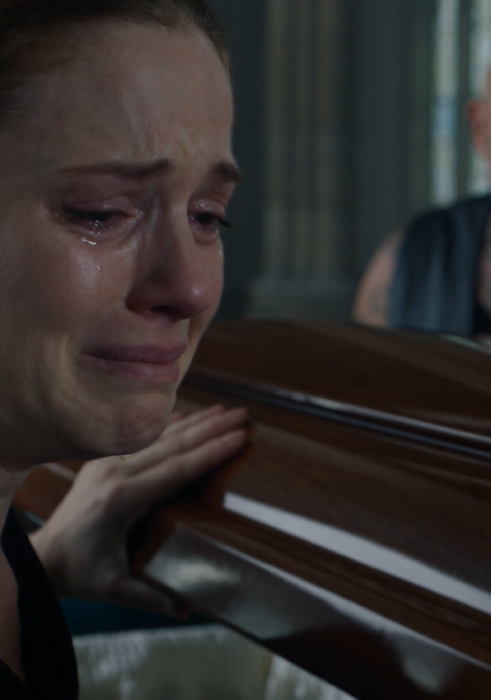
My mother bent toward me.
“June, go with Aunt Beth.”
“Where’s Daddy?”
Her fingers tightened around her purse.
“Please don’t make this worse.”
I thought she meant I had caused it.
For years, that was the part I couldn’t explain without feeling nine again.
Aunt Beth took my hand. She was Wade’s wife, a school cafeteria manager who kept peppermint candies in the pocket of every coat she owned. She didn’t tell me everything would be fine.
She said, “You’re coming with me.”
Behind us, Wade asked Mr. Harlan whether he had ever received my father’s remains.
“No.”
“Did Claire know that?”
“Yes.”
My mother made a small sound.
I turned back.
“The service was commemorative,” Mr. Harlan said. “Mrs. Mercer requested a closed casket for the family burial.”
“You told me Daddy was inside,” I said.
My mother looked at the carpet.
Then she said something that made me doubt everything I had heard the night before.
“You’ve been playing his old messages, sweetheart. Remember?”
I had.
There were three on her phone. One about groceries. One asking where she’d put the registration. One in which he said, Tell Junebug I found her mitten.
Maybe she’d been playing them too.
Maybe the taps had come from an old recording.
Wade looked toward me, and for one awful second I thought he believed her.
Then his phone rang.
He answered without taking his eyes off my mother.
“Yes. I’m still here.”
He listened.
“No, don’t call her. Send it to the detective.”
My mother stood up.
“What detective?”
Wade finally lowered the casket lid.
“The one who called me about Danny’s death certificate.”
Nobody answered him.
Outside, rainwater clicked down a loose gutter. Mr. Harlan’s receptionist came to the doorway holding a cordless phone and looking as though she wished it belonged to somebody else.
When the police arrived, they did not arrest my mother.
They separated the adults and asked questions.
Aunt Beth stayed beside me. A detective named Elena Ruiz crouched near my chair and asked whether anyone had told me what to say.
“No.”
“Did you see your father last night?”
“No.”
“Then what makes you certain it was him?”
I started to whistle.
Halfway through, I couldn’t.
My mouth shook too much.
Detective Ruiz waited until I could breathe again.
Then she asked the question nobody in my family wanted answered.
“June, did your mother know you were outside her bedroom?”
Before my father disappeared, Saturday mornings smelled like sawdust and burnt toast.
He repaired restaurant equipment for a living, but he built little things when he was happy. Shelves that leaned. Birdhouses with doors too small for the birds my mother wanted. A wooden step stool with my name crooked across the top.
The star came from a scrap of maple.
He carved it while Wade worked on his Harley in the garage. Five uneven points. A little brass screw underneath. Daddy showed me how one point swung aside to reveal a space barely big enough for a key.
“For important things,” he said.
“Like diamonds?”
“Like a spare key when somebody locks himself out.”
Wade laughed without looking up.
Daddy tapped his wedding ring against a coffee can three times.
I whistled back.
“Still here, Junebug,” he said.
My mother came out carrying toast on a paper towel. She leaned against him while he ate the darkest piece.
That is the memory I kept.
Not because it excused anything.
Because the happiness had been real, and losing that truth would have left me with nothing.
Eleven weeks after he vanished, I sat in the funeral home office watching rain slide down the glass.
Detective Ruiz asked my mother for permission to speak with me separately. Aunt Beth stayed. My mother waited in the hall.
I told Ruiz about the bedroom door.
The taps. The whistle. My mother saying, Not yet.
I had left that part out before.
“Why?” Ruiz asked gently.
“Because it sounded like I was listening on purpose.”
She wrote something down.
Then she asked about the wooden star.
“It was supposed to be in my drawer,” I said.
“Who put it in the casket?”
“I don’t know.”
Later, Wade told me why he had come late.
He had not spent the morning deciding whether to disrupt a funeral. An insurance investigator had contacted him after he questioned the death paperwork. A signature supposedly belonging to him appeared on an identification statement.
Wade had identified nobody.
There had been no body.
My father’s rented fishing boat had been found drifting near the Kentucky shore of the Ohio River. His jacket was aboard. So was his wallet. Search crews found neither him nor another passenger.
The family was told the insurance company had accepted documentation confirming his death.
It hadn’t.
It had accepted a packet containing a fabricated recovery report and a falsified death record. We learned the details much later, when investigators laid the documents beside the genuine missing-person file.
Wade had been furious before he reached the funeral home.
Then I had given him a reason to be afraid.
Mr. Harlan returned carrying a thin folder. He put it on the desk, opened it, and turned the first page toward Detective Ruiz.
My mother’s signature sat beneath a description of the service.
Ceremonial casket. No human remains.
Under that was another line, written in her own hand.
My daughter must not be told.
Why had she needed me to believe Daddy was inside?
By evening, my mother had a lawyer.
His name was Peter Voss. He wore a navy suit and spoke so softly that everybody leaned toward him.
He said Claire Mercer was a grieving woman who might also be the victim of financial fraud.
He had paperwork.
That mattered.
At nine, I thought paperwork was what adults used when they wanted a story to stop changing.
Voss showed investigators an authorization naming a claims consultant my mother had hired after the search ended. The consultant had promised to help with bills, insurance questions, and the records my mother said she could not bear to examine.
Someone had used my father’s business email.
Someone had submitted the false documents.
Someone had opened an account in my mother’s name.
My mother looked smaller while Voss explained it.
“I signed what they put in front of me,” she said.
For the first time since the casket opened, Wade sat down.
He did not apologize.
But he stopped looking at her as if the answer was already on her face.
Then Mr. Harlan admitted he had helped conceal the empty casket.
My mother had told him I was refusing to accept the death. She said a symbolic burial would let me understand that Daddy was gone.
He had agreed to the service. He had also allowed mourners to assume something he knew was false.
“I thought I was helping a child,” he said.
Wade looked at him.
“You could’ve asked the child.”
Mr. Harlan took off his glasses.
His mistake was real. So were the consequences for his business when the complaints came later. But he had not supplied the insurance documents.
Suspicion shifted toward the consultant.
The man’s office number no longer worked.
His website had disappeared.
Even I could understand that part.
A stranger had taken advantage of us.
That was a story in which my mother could hold me again without my body becoming stiff.
She tried outside the interview room.
“Come here, baby.”
I went.
Her coat smelled like the lavender sachets she kept in her drawers. I pressed my face against it and almost started crying from relief.
Then her phone buzzed.
She pulled away before the second vibration.
On the screen was a message preview.
I read only five words.
You said after the funeral.
My mother turned the phone facedown.
“Work,” she said.
She had not worked since Daddy disappeared.
I told Detective Ruiz about it when she came back.
She did not tell me I had caught my mother lying.
She asked where I had been standing and whether I was certain of the words.
By the following afternoon, investigators had located the claims consultant.
He was an ordinary tax preparer in Indiana whose name and photograph had been stolen. He had never met my mother.
Her lawyer’s explanation had pointed toward a man who did not exist.
But the account did.
The bank had required someone to verify it in person.
If a stranger had stolen my mother’s identity, who had stood at that counter wearing her face?
The bank recording did not show a woman being tricked.
It showed my mother arriving twelve days before the funeral.
She wore the cream coat I loved because its buttons looked like little pearls. She handed over identification, answered questions, and signed documents while a teller turned a monitor toward her.
There was no stranger beside her.
The million-dollar payment arrived later.
Some of it moved again within hours.
At the time, nobody explained all that to me. I learned the sequence from the records when I was older. What I understood then was that my mother had stopped saying someone stole her identity.
Now she said she had followed instructions.
“From whom?” Wade asked.
Her lawyer ended the conversation.
Detective Ruiz came to Aunt Beth’s house that evening. My mother had agreed I could stay there while the adults sorted things out.
That was how they described it.
Sorting things out.
As if we had opened the wrong kitchen drawer.
Ruiz asked whether Daddy knew anyone near a place called Cedar Hollow Cabins.
I shook my head.
Then Wade said, “Wait.”
He took his phone out and scrolled through old photographs.
There was Daddy beside a porch railing. Me in a yellow swimsuit. A lake behind us.
We had spent a weekend there two summers earlier.
I remembered the screen door sticking.
I remembered Daddy carrying me over gravel because I had lost a sandal.
My mother had said we could never afford to go back.
A payment from her new account had gone to the cabins.
Not for our old vacation.
For the current month.
Wade leaned forward.
“Which cabin?”
Ruiz did not answer.
She asked him not to go there.
He looked offended for half a second. Then he looked at me and nodded.
“I’ll stay put.”
He did.
That matters to me now.
My uncle did not ride into the dark and solve a crime because he was large and angry. He sat at Aunt Beth’s table drinking coffee he had forgotten to sweeten while people with radios checked an address.
Near midnight, Ruiz called.
Wade stepped into the laundry room.
I followed as far as the hallway.
“Yes,” he said.
Then nothing.
His free hand opened against the wall.
“Is he hurt?”
More silence.
“Does he know about June?”
I leaned against the doorframe so hard it left a square mark on my arm.
When Wade came out, he crouched in front of me.
He did not smile.
That frightened me more than if he had cried.
“They found your dad.”
“Can I see him?”
“Soon.”
“Was he lost?”
Wade swallowed.
“No, honey.”
“Did somebody keep him there?”
He looked toward Beth.
Then back at me.
“Not the way you’re thinking.”
Daddy was alive.
The room should have become beautiful.
Instead, I saw how carefully my uncle was choosing every word.
If nobody had locked the cabin door, why hadn’t my father opened it?
My mother filed her complaint the next morning.
She said Wade had threatened her at the funeral. She said he had frightened me into believing my father was alive. She described his tattoos, his temper, and a bar fight from eighteen years earlier as though they were three parts of the same warning.
The fight had happened.
Wade had broken a man’s jaw. He had served his sentence and spent years carrying the shame into places where nobody knew his name.
My mother knew exactly where to press.
A deputy came to Aunt Beth’s house.
Wade gave his statement on the porch while I watched from the kitchen.
He kept both hands visible.
That was the detail that stayed with me.
His own porch.
His wife behind the screen.
And his hands held carefully where a stranger could see them.
The deputy left without arresting him. But the complaint became part of the custody argument, and my mother’s lawyer asked that Wade have no unsupervised contact with me while the allegations were reviewed.
By then, Daddy’s survival was confirmed.
My mother changed her story again.
She said he had manipulated her.
She said Wade was helping him.
She said I needed to come home before they taught me to hate her.
When she arrived to collect me, Beth called the caseworker already assigned to our family.
Nobody pulled me through a doorway.
Nobody shouted.
That almost made it worse.
My mother stood in the kitchen holding my pink overnight bag.
“June. Shoes.”
“I want to see Daddy.”
“You will.”
“When?”
“When it’s safe.”
From the porch, Wade said, “Claire, don’t.”
She turned.
“There. That voice. That’s what I’ve been telling them.”
He stepped back.
I saw what it cost him.
Then she told me we were leaving town for a while.
She called it a fresh start.
The caseworker asked where.
My mother gave an address in Florida.
It was not the address on the airline reservation investigators had found while tracing the insurance money.
There were two tickets.
One for her.
One for me.
A connecting flight continued outside the country.
She had booked them before the funeral.
The caseworker asked my mother to sit down.
My mother said she did not have to answer any more questions.
Then she looked directly at me.
“Do you want to stay with people who broke your father’s funeral?”
Until that moment, I had been afraid of choosing wrong.
Something in me became still.
“There wasn’t a funeral,” I said.
Her face changed.
Beth moved beside me, close enough for my shoulder to touch her apron.
An emergency family-court order followed. I stayed with her while the adults argued about responsibility, safety, and where I belonged.
That evening, Wade left a paper bag outside my bedroom.
Inside was the wooden star.
He had retrieved it from the casket after police documented it.
The little compartment stood open.
The key was missing.
What had my mother taken before she tried to take me away?
My father looked thinner in person.
That was the first unfair thing.
I had imagined him unchanged, waiting somewhere with his arms open. Instead, he sat in a room at a county office wearing a sweatshirt I had never seen.
A counselor stayed with us.
Wade waited outside.
Daddy stood when I came in.
I stopped near the door.
He sat again.
“Hi, Junebug.”
“Don’t.”
He nodded.
His eyes filled, but I was tired of adults crying before they answered questions.
“Why didn’t you call me?”
He rubbed his palms against his knees.
“Because I was scared.”
“Of what?”
“What I’d done.”
He had helped plan it.
Not everything my mother did afterward. Not every document. But enough.
His repair business was failing. He had borrowed money, hidden overdue bills, and told my mother they were closer to losing the house than they actually were.
She had suggested disappearing.
At first, he said, it was supposed to be temporary. They would collect the insurance money, move, and find a way for him to join us under another name.
Even at nine, I heard the hole in that explanation.
“How was I supposed to not know you?”
He covered his mouth.
“I didn’t think far enough.”
That answer made me angrier than any clever lie could have.
He had not been chained in the cabin.
He had a phone.
He could have walked into a police station.
Instead, he had let shame become a room he kept choosing to stay inside.
My mother sent money, groceries, and warnings. If he came back, she said, he would go to prison. If he contacted me, she would tell authorities he had threatened us.
Some of those warnings were manipulation.
Some were simply consequences.
He knew the difference.
He stayed anyway.
“What changed?” I asked.
“The funeral.”
He had agreed to a private memorial someday. My mother told him it would help me stop asking questions.
Then he saw the public announcement online.
His photograph.
The service time.
The promise of a burial.
He called her.
That was the conversation I had heard.
He tapped his ring because she had put the phone down while they argued. He heard movement near her bedroom door and hoped, for one weak moment, that it might be me.
But he still did not say my name aloud.
Wade found him because Daddy finally called his brother after the insurance investigator began asking questions.
He had given Wade the cabin address that morning.
Too late to stop the funeral quietly.
Soon enough to make the empty casket impossible to ignore.
“Did you put my star in there?” I asked.
He shook his head.
My mother had taken it from my drawer.
Inside it had been a key Daddy used for a storage unit holding business records and the original notes they had made together.
He had told her to destroy those notes.
She said she had.
“Why’d you believe her?” I asked.
Daddy looked at his empty hands.
“I needed to.”
If both my parents had needed the lie, who had been thinking about me?
The first time I saw both my parents in court, they sat on opposite sides.
There was nothing grand about the room.
A water stain marked one ceiling tile. Somebody’s phone vibrated inside a purse until the clerk looked up. Wade wore a borrowed jacket over a shirt buttoned wrong at the wrist.
The hearing concerned the insurance company’s effort to preserve money and property while its case proceeded. By then, investigators had collected bank records, messages, cabin payments, and my father’s statement.
The criminal cases were moving separately.
I was there because the lawyers had discussed whether I might need to identify the star and explain where it had been kept. In the end, they used photographs and adult testimony.
I sat beside Beth.
I was grateful nobody asked me to stand.
My mother’s lawyer said she had been drawn into a plan her husband created. He emphasized the false statements Daddy had admitted making.
Daddy did not deny them.
That mattered.
Then the company’s lawyer asked about the missing key.
My father explained the star’s compartment.
He had made it from scrap maple. The brass screw underneath held the pivot. The key had opened a storage unit where he kept old business files.
My mother watched the table.
The lawyer showed him a photograph of the empty compartment.
“Was that key still inside when you last saw it?”
“Yes.”
“Did your wife know where it was?”
“Yes.”
My mother’s lawyer stood.
There were objections and careful answers. Nothing moved as quickly as it does when people retell it.
During a break, Daddy passed close to our row under the direction of his attorney.
He stopped several feet away.
I had the star in both hands.
He tapped his wedding ring against the wooden rail.
Three times.
I did not whistle.
His hand dropped.
“I know,” he said.
My mother stood so suddenly her chair legs caught the carpet.
“Don’t do that,” she said.
Everyone looked.
“Don’t stand there acting like you came back for her.”
Her lawyer touched her sleeve.
She pulled away.
“You were supposed to wait until the money cleared.”
The room became very quiet.
Daddy looked at her.
“It cleared Tuesday.”
“You called Wade before I could move the rest.”
Her lawyer said her name sharply.
But she was looking at the star.
“And you told me that key was the only copy.”
My father’s attorney moved him away from us.
The judge returned shortly afterward. The lawyers addressed what had happened. My mother did not take back the words.
Her outburst did not solve the case by itself.
The records mattered more.
So did the search investigators had already obtained for the storage unit after finding its rental payments among Daddy’s business expenses.
Inside were original planning notes, copies of documents, and envelopes my mother had moved there after emptying his desk.
She had preserved what she believed could keep him obedient.
He had preserved messages for the same reason.
Each had kept evidence against the other.
Neither had kept me safe.
When the hearing resumed, my mother stared at her hands.
For once, nobody offered an explanation on her behalf.
What would either of them have saved if they had loved me more than they feared each other?
Justice took longer than the funeral.
There were postponed dates, amended filings, and afternoons when Aunt Beth came home carrying folders she put facedown on the kitchen counter.
My parents both pleaded guilty to charges arising from the scheme.
Their roles were different. So were their sentences.
My father’s cooperation mattered. It did not erase his participation. My mother’s control of the documents, transfers, and attempted departure mattered too.
The insurer recovered a substantial part of the payout. Other money was gone. Restitution remained after the headlines stopped.
Nobody became rich.
The house was sold.
For a while, I thought losing it meant my mother had finally taken the last thing.
Then Beth asked what color I wanted my bedroom.
I said I didn’t care.
She brought home three paint cards anyway and left them beside my cereal bowl.
I chose green.
Wade painted badly around the outlets.
He let me help.
He also told me the truth about the complaint my mother had made. Investigators had found no support for her claim that he threatened her, but he did not use that conversation to pretend he had never frightened anyone in his life.
“I used to give people reasons,” he said.
“What changed?”
“Got tired of being the reason somebody stepped back.”
He kept taking me to school.
Some mornings he used Beth’s old sedan. On dry afternoons, with permission, proper gear, and a route he could have driven asleep, he took me home on the Harley.
He never revved it outside my classroom.
He knew I had already had enough people looking.
I saw my father again under the arrangements the court approved. Rebuilding anything with him happened slowly.
Sometimes we talked for forty minutes.
Sometimes I wanted to leave after five.
He learned not to make his disappointment my job.
My mother wrote letters.
Some blamed him.
Some blamed fear.
One, much later, said simply that she had made choices she could not ask me to misunderstand.
I kept that one.
I did not know what keeping it meant.
On my eleventh birthday, Wade repaired the wooden star.
He did not make the points even. He did not sand away the little dent from where it had struck the casket.
He replaced the missing key.
This one opened Beth’s front door.
I turned it over in my hand.
“What if I lose it?”
“We’ve got another.”
“What if I mess up?”
He looked toward the kitchen, where Beth was trying to keep the cake from sliding off its plate.
“Door still opens.”
That night, I put the star in the drawer beside my bed.
Not under my pillow.
Not where I could grab it if somebody disappeared.
Just in the drawer, beside ordinary things.
Years later, when I left for college, Wade stood in the driveway with my last box against his chest. His beard had gone almost entirely white.
He handed me the star.
“You taking this?”
I nodded.
Then I tapped my ring against his motorcycle tank.
Three times.
He looked at me before he whistled.
Would I ever stop checking whether love was still there?
Maybe.
For that morning, hearing him answer was enough.