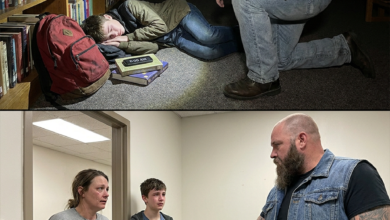
Part 2: A Biker Grabbed a Teenage Boy by the Collar Inside My Store — Then I Saw the Message That Made Him Afraid to Leave
Part 2 — The Photograph Beside the Bus
The child beside the bus was Eli’s younger brother.
He told me that before I had time to ask. Nine years old. Ben. Usually home by four, unless the neighbor who watched him stopped at the grocery store first.
The message under the photograph told Eli what would happen if he came outside without money.
I won’t repeat it. The words weren’t clever. They were the kind of ugly that gets its power from knowing where someone smaller waits after school.
“Is that today?” I asked.
“I don’t know.”
His voice broke on know.
Wade moved his hands away from his pockets, as if he wanted there to be no question about what he was doing. “Can somebody check on his brother?”
“Yes,” I said. “I can call.”
Eli gave me his mother’s number. The first attempt went unanswered. On the second, she picked up with machinery humming behind her.
She worked at a commercial laundry across town.
I told her my name, where her son was, and that he was standing beside me. I said police were on their way because there had been an incident, and we also needed to make sure his younger brother was safe.
I heard a door close at her end.
“What happened to Eli?”
“He was grabbed by an adult. The adult has let go and is waiting here.”
Wade didn’t interrupt to improve that description.
“Is he hurt?”
“He says his neck doesn’t hurt. He’s frightened. Can you check on Ben while we wait?”
She could. She would. She was leaving work now.
I handed the phone to Eli.
He held it with both hands.
“Mom,” he said, then stopped.
Whatever she answered made him turn away from the customers. His shoulders began moving under the gray hoodie, though he kept trying to stand as if he wasn’t crying.
I asked everyone who wasn’t buying something to give us space.
Most did.
One man complained that we’d all seen what happened and there was no reason to protect the biker. I told him I wasn’t protecting anybody from an account of what they’d done.
I was giving a fifteen-year-old room to speak to his mother.
The folded paper was still on the floor.
I pointed it out when the first officer arrived. I told her I’d seen it in Eli’s hand but hadn’t read it. She asked him what it was.
He looked at the register.
Then at me.
“Something I wrote.”
Officer Renata Cole asked whether he would leave it where it was while she spoke with us. He nodded.
Her partner stayed near the entrance and spoke to the customers who had witnessed the grab. Wade gave his name again and didn’t complain when he was asked to stand apart from Eli.
The story began separating into things we knew and things people had decided.
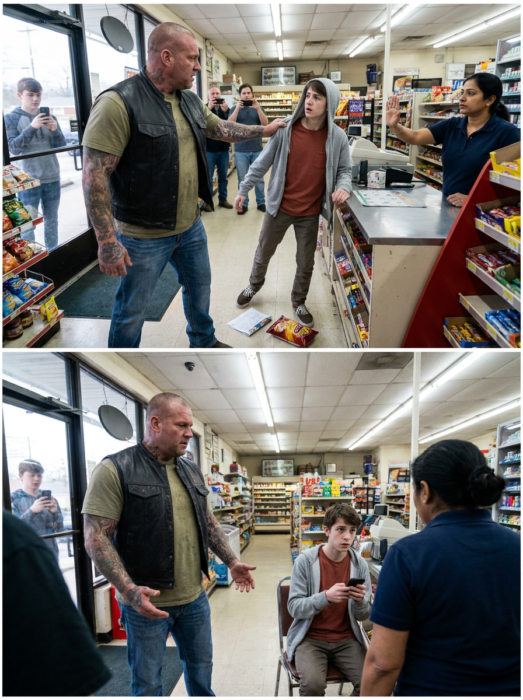
I knew Wade had grabbed the sweatshirt near the collar and pulled Eli sideways. I knew he released it when I told him to. I knew Eli had been approaching my register, and I knew there had been somebody recording through the front window before the crowd inside started filming.
I didn’t know why.
Not all of why.
Officer Cole looked at the paper with Eli’s acknowledgment. Then she asked whether he had brought a weapon.
He said no.
Nothing we saw suggested otherwise, but by then my mouth had gone dry.
The paper was a demand for money.
Eli had written it before coming in. He had been about to hand it to me.
I sat down on the stool behind my counter.
For six years, I had carried the memory of another afternoon when someone demanded the money in that drawer. That man had shown a weapon. My husband had found me afterward sitting on the floor with the register still open.
I hadn’t known that a folded piece of paper could bring back the smell of that day.
Wade saw me sit.
His expression changed.
He hadn’t only interrupted something in the boy’s life. He’d interrupted something that had been coming toward mine.
Eli tried to apologize, but the words tangled.
“I wasn’t going to hurt—”
“You were going to frighten me,” I said.
He looked down.
“Yes.”
I needed that answer. Not because I wanted to punish him in front of strangers, but because the photograph on his phone did not make me disappear from the story.
Officer Cole asked if I wanted someone to cover the register.
I called my husband.
While we waited, Eli’s mother called back. Ben was safe with their neighbor. The photograph had been taken earlier, not from someone standing beside him at that moment.
That didn’t make the threat harmless.
It did let Eli breathe.
His knees seemed to loosen all at once. I pulled a chair around the end of the counter and asked whether he wanted it.
He sat.
Wade stayed where the officer had asked him to stay.
Outside, the space beside the ice machine was empty. Whoever had been filming there had gone.
My security camera had kept recording.
I looked at the small black lens above the shelves and thought about the first thing Wade had told the woman with her phone.
Keep your camera running.
He hadn’t wanted the afternoon erased.
He had wanted something stopped before it went any further.
Part 3 — Thirty Seconds
Danielle Turner arrived wearing a green work shirt and a coat she’d put on inside out.
I noticed the seam running down her sleeve. She didn’t.
She went straight to Eli, knelt in front of his chair, and put both hands on his face. He tried to look away. She waited until he looked back.
“Ben is home,” she said. “He’s with Mrs. Alvarez.”
Eli nodded.
“He’s safe right now.”
Another nod, smaller this time.
Then she stood and looked at Wade.
“Did you put your hands on my son?”
“Yes.”
“Why?”
Officer Cole asked if they could take the accounts one at a time. Danielle stayed beside Eli, one hand on the back of his chair.
Wade told us what he had heard.
He’d stopped for fuel and coffee on his way home from a job repairing a loading dock. Near the entrance, he passed Eli and two older teenagers.
He didn’t know them.
One had a phone. The other was standing close enough to Eli that the boy had to turn sideways to get past.
Wade heard Eli say, “Leave Ben out of it.”
That was what made him look.
The answer came with a laugh and a reference to money from the register. Then Eli went through the door, pale and shaking, while the young man with the phone stayed outside near the window.
“I thought maybe it was some stupid dare,” Wade said.
“What changed?” Officer Cole asked.
“The paper. The way he was holding it. He looked at the guy outside before he walked toward her.”
Toward me.
I remembered that glance now. At the time, I’d thought he was checking whether someone was coming in behind him.
Wade had called out.
I hadn’t heard it over the door chime and a customer asking about a pump. Eli either hadn’t heard or hadn’t been able to stop.
So Wade reached for him.
“I should’ve used my voice sooner,” he said.
Danielle looked at the crease near Eli’s shoulder where the fabric had bunched.
“You scared him.”
“I know.”
She didn’t tell him that was all right.
Neither did I.
He explained that he’d pulled Eli sideways, away from the register and out of the other teenager’s view through the window. Then he put himself between the boy and that phone.
He hadn’t checked where my security cameras pointed.
He hadn’t needed a hidden corner.
“I wanted him looking at a person in the room,” he said. “Not waiting for the next order from outside.”
It was an explanation, not proof by itself.
But the store footage showed the young men near the entrance before Wade walked in. It showed the phone already raised outside before he touched Eli. It showed Eli approaching the counter with the paper.
We preserved the whole recording.
Not a version edited to make Wade look good. Not a version beginning with his hand on the collar and ending before he released it.
The whole thing.
My husband, Arun, arrived while we were going through the sequence. He took over at the register and brought me water without asking whether I needed it.
He remembered the afternoon six years earlier.
So did I.
That made the next part harder to hear.
Eli wasn’t being asked to explain himself to a room full of customers. The officer gave him and Danielle space, and some of what I learned came later, when his mother chose to tell me.
But he said one thing in front of us all.
“They said thirty seconds.”
Danielle’s hand stopped moving across his shoulder.
Thirty seconds to walk up, hand over the paper, and give them what they wanted. Thirty seconds he had been staring at as if nothing existed after them except punishment.
I won’t pretend the number was magical.
He could have stopped before entering. He could have asked me for help. He could have called his mother days earlier.
Those possibilities were real.
So was the fear that had made them feel unavailable to him.
On his phone were demands stretching back weeks. Small amounts at first, then larger ones. Messages arriving before school, after work, late enough that the light from the screen woke his mother through the gap beneath his door.
She had thought he was staying up with friends.
He had told her he was.
Wade stood with his hands loose at his sides while Eli talked. His face had gone still in a way I hadn’t seen when people were shouting at him.
Officer Cole asked him whether he had anything else relevant to add.
He looked at Danielle before answering.
“I don’t know your boy,” he said. “I heard enough to think he needed stopping. That’s all I knew when I touched him.”
No claim that he had understood every message. No story about seeing a criminal destiny in a stranger’s eyes.
He had seen a frightened teenager move toward my register under somebody else’s direction.
And he had reacted too roughly.
Both parts stayed in his statement.
Before leaving that evening, Danielle asked Eli whether he wanted to say anything to Wade.
The boy looked down at his shoes.
“You pulled hard.”
Wade nodded. “I did.”
Then Eli said, “They couldn’t see me after.”
“No.”
“I didn’t know if I was allowed to stop.”
Wade’s mouth tightened.
He took a moment before answering.
“You were allowed.”
Eli looked at him then.
For the first time since he entered my store, he wasn’t checking the window.
Part 4 — A Debt That Kept Changing
Danielle came back four days later, without Eli.
She asked whether I had ten minutes. I said I did, though I needed a moment before I could sit across from her in the little office behind the counter.
Arun stayed out front.
Danielle brought a notebook with a bent cover. Eli had given her permission to show me one page.
It was a list of money.
Twenty dollars. Twelve. Eight. Thirty-five.
Some amounts had been crossed out and written again. Beside one entry, in smaller handwriting, he’d put birthday.
“He kept track,” she said. “He thought there would be an end.”
The supposed debt began with a phone knocked from a desk at school.
Eli said it had been an accident. The other boy said the screen was ruined and named a price. Then he added money for the days Eli hadn’t paid, money for borrowing from someone else, money for having to ask twice.
The number changed whenever Eli got close.
Danielle had seen him stop buying lunch and thought he was saving for a bicycle part. When she asked why his birthday money was gone, he said he’d bought something online.
He hadn’t wanted her to see the messages.
At first, he was embarrassed.
Later, he was frightened.
By the time the demands reached an amount he couldn’t gather, telling her felt like introducing his family to people he had been trying to keep away from them.
He was wrong about that.
But he’d built the wrong idea one quiet day at a time, until it felt like a fact.
The photograph of Ben hadn’t been the first mention of his brother. It was the first one Eli had shown an adult.
Danielle rubbed her forehead.
“I asked him why he didn’t tell me.”
“What did he say?”
“That I already had enough.”
She looked toward the office door as though her son might be standing outside it.
“I hate that he thought being my child was something else I had to afford.”
I didn’t know what to say to that.
My own daughter was twelve. I thought about every time I’d answered a question while counting stock, every time I’d said not now and assumed there would be a later.
That wasn’t proof Danielle had missed some obvious sign. It was just a reminder of how much a child could leave out while answering everything you asked.
She told me Eli had been shown where to stand in the store and warned that the phone outside needed to see him. That recording would have belonged to the same people who kept changing what he owed.
The money wasn’t going to make him free.
I understood why Wade had moved him away from the window.
The camera he had interrupted wasn’t mine. It was another piece of pressure aimed at a boy who already believed every movement was being judged by someone who could hurt his brother.
Pulling him out of that frame hadn’t erased the paper he’d written.
It hadn’t erased the fear he’d brought toward my counter.
But it had interrupted the demand to keep performing while a phone watched from outside.
For a few seconds, someone else had taken up the whole picture.
A huge man in a leather vest, letting every camera see his own face.
Danielle closed the notebook.
“The police have the messages,” she said. “The school has what it needs. We’re getting advice about all of it.”
She didn’t ask me to withdraw my account.
She didn’t ask me to say her son had only come in for candy.
“I wanted you to know why,” she said. “Not to tell you it didn’t happen.”
I appreciated the difference.
The first time someone suggested that Eli couldn’t be blamed because he’d been afraid, I had felt an anger that surprised me. Fear didn’t make a stranger standing behind a register less human.
Danielle hadn’t come to ask me to accept that bargain.
She had come to let both truths sit at the same table.
Her son had been threatened.
Her son had nearly threatened me.
We talked about what would happen next without pretending we controlled all of it.
There were separate questions about the older teenagers, about the grab, and about what Eli had intended to do. Adults with the appropriate roles were dealing with those questions.
Meanwhile, Danielle needed to get two children to school and keep her job.
Their neighbor helped with Ben. A relative handled some pickups. The school worked with her on a plan so Eli wasn’t being left alone with the same boys while the reports were being examined.
None of that happened as neatly as the sentence makes it sound.
A message arrived from another account. A ride fell through. Eli spent one morning in the bathroom insisting he was sick, and Danielle had to work out whether he was ill, frightened, or both.
But he showed her the new message.
That was different.
He told her when the ride fell through.
That was different too.
Before she left, Danielle asked whether I would ever be willing to hear from him.
“Not today,” I said.
She nodded immediately.
“Okay.”
I expected her to look disappointed. Instead, she seemed relieved to have a real answer instead of a kindness I didn’t mean.
That evening, I found the chair we’d given Eli still beside the office door.
Arun asked whether I wanted it moved back.
I looked at the seat, then at the register.
“Tomorrow,” I said.
I wasn’t ready to turn the afternoon into a lesson or a happy ending.
But I had stopped thinking of the boy as only the paper on the floor.
Part 5 — What Wade Wouldn’t Put Online
Wade came back the following Saturday and bought a coffee.
He waited until the line was gone before asking whether I wanted him to stop coming in.
I hadn’t expected the question.
“No,” I said. “But if something like that ever happens again, use your voice.”
He looked down at the cup.
“Yes, ma’am.”
By then, a short clip of the grab had spread beyond the people who were in the store. It began with his hand closing on Eli’s collar and ended before I told him to let go.
I didn’t blame anyone for being disturbed by it.
I had been disturbed while standing six feet away.
But people were attaching things to those seconds that the seconds didn’t show. That he’d punched Eli. That he’d dragged him outside. That he’d fled before police arrived.
None of those things had happened.
I gave the investigators the full recording and my account. Publicly, I corrected the claims I could correct without identifying Eli or displaying his messages.
Wade’s club wanted more.
The Flint Creek Riders had known him for years. Several members thought the fastest way to repair his name was to post everything and let people see what the kid had nearly done.
One rider had a nephew who’d been injured during a robbery. He wasn’t willing to talk about Eli only as a victim.
Another was furious that Wade had spent the evening being treated like a danger when he thought he’d prevented one.
Wade understood both men better than they expected.
He’d been in prison.
He told me that himself, standing beside the coffee station while Arun checked a delivery.
At nineteen, he’d driven a car for men he knew were going to commit a robbery. He hadn’t been tricked about their purpose. He’d wanted their approval badly enough to ignore what it would cost someone else.
It cost a store clerk a great deal.
It cost Wade years he could not get back.
He didn’t tell me the details of the robbery, and I didn’t ask. What mattered was that he did not describe himself as an innocent man ruined by a misunderstanding.
“I chose it,” he said.
“Is that why you stopped Eli?”
“Part of it.”
He rubbed his thumb around the rim of the cup.
“Other part was his face.”
Wade remembered being young enough to confuse someone giving orders with someone taking responsibility. The men who sent him had not stood beside him when the consequences arrived.
He had spent a long time learning that.
But he wasn’t going to tell a fifteen-year-old his life was over because he’d come frighteningly close to doing something terrible.
“Mine wasn’t over either,” he said. “Took work. Still does.”
That was the first hopeful thing anybody had said about those thirty seconds that didn’t depend on pretending they had never happened.
The club meeting was harder than the conversation at my coffee station.
I heard about it from Wade and later from Ruth, their treasurer. She came into the store often and had no patience for versions of events that made everybody sound more noble than they’d been.
There had been raised voices.
Someone called protecting Eli’s privacy a strange reward for almost robbing me. Someone else said Wade should release the recording before he lost more work.
One customer had already asked him to stay off a repair site until the incident was clarified. A second had canceled an estimate.
He wasn’t wealthy enough for that to be a symbolic sacrifice.
Still, he said no to posting the boy’s face with the note.
“The people investigating have it,” he told them. “Nina has it. We don’t need to put the kid on a poster.”
“You’re going to let people think you beat him?”
“I can tell the truth about my hands without telling everybody his whole life.”
Ruth said the room stayed unhappy.
Nobody suddenly discovered the perfect sentence that made the disagreement disappear.
What changed it was a practical question.
Eli’s mother had asked whether Wade would be willing to speak with him again, if Eli wanted that and the arrangements were made with the adults helping the family.
The club ran a small supervised workshop for teenagers several afternoons a month. Wade sometimes volunteered there.
This wasn’t a request to hide him in a clubhouse or give him a motorcycle.
It was a request for somewhere he could spend an afternoon without somebody collecting money from him.
The man whose nephew had been hurt said he couldn’t be the one to work with Eli.
Wade said he didn’t have to.
Ruth checked with the program coordinator. Danielle was included in the conversation. The same rules, sign-in, supervision, and expectations would apply to Eli as to every other teenager.
He wouldn’t get a free pass.
He wouldn’t be turned into a warning display either.
When I heard that, I realized how close I’d come to imagining the only choices were forgiveness without conditions or permanent exclusion.
There were other things people could do.
Three weeks after the incident, Eli asked through his mother if he could apologize to me.
This time, I said yes.
We met before the afternoon rush, with Danielle beside him and Arun nearby.
Eli didn’t bring flowers.
He brought a page he’d written himself and asked whether he could read it because he was afraid he’d forget the words.
I told him he could.
He began by saying he’d planned to frighten me.
Not that I’d misunderstood.
Not that the older boys made my fear irrelevant.
He said he’d been scared, and he’d been wrong to bring that fear to my counter.
Then he looked up.
“I don’t want you to be scared when I come in.”
I held his gaze.
“That will take time,” I said.
He nodded.
For once, somebody had given him an answer he didn’t have to pay to change.
Part 6 — The Terms Didn’t Change
The first workshop Eli attended, he spent most of the afternoon sorting washers.
Ruth told me that when she came in for milk.
He had expected to be handed something complicated, maybe as a test. Instead, Wade showed him the bins, explained the labels, and stayed at the other end of the bench helping two boys with a bicycle wheel.
Nobody asked Eli to tell his story.
Nobody made him introduce himself by the worst thing he’d almost done.
When he finished early, he asked what he owed for being there.
Ruth said Wade looked at him for a moment before answering.
“Nothing. The program’s free.”
“For today?”
“For everybody.”
Eli checked with Ruth afterward.
She gave him the same answer.
I thought about the list of crossed-out amounts in his notebook.
An adult could say something clearly and still need to say it again before a frightened child believed the terms weren’t going to change.
At home, things improved unevenly.
Eli started showing Danielle messages before answering them. Sometimes he still tried to handle a problem alone and admitted it only after it became bigger.
She got angry.
Then they kept talking.
Ben wanted to know why his brother no longer walked him home every day. Danielle explained what she could without giving a nine-year-old the job of monitoring danger.
Their neighbor kept doing pickups.
The school and police continued handling the reports. There were conversations the family didn’t share with me, and I didn’t need access to them to care about what happened next.
I knew the older teenagers were being identified and questioned. I knew Eli wasn’t expected to sit beside them and work things out alone.
That was enough for my part of the story.
My own fear didn’t disappear on schedule.
One afternoon, a customer unfolded a receipt too quickly near the register, and I felt my shoulders rise before I understood why.
Arun took over while I went into the office.
I was angry afterward. Not at the customer. At the idea that understanding Eli’s situation should have made my body grateful and calm.
It hadn’t.
Wade knew something about that, though he didn’t try to compare his past with mine.
When he came in, he kept his hands visible and his voice ordinary. He bought coffee. He paid. He didn’t turn every visit into an apology I had to receive.
That helped more than another speech would have.
A month later, Ruth invited Arun and me to an open afternoon at the workshop. Our daughter Leena wanted to come because they were fixing donated bicycles, and hers made a noise she considered embarrassing.
We went.
Eli was there, working beside another teenager while Wade stood within earshot.
He saw me and stopped moving.
I lifted my hand in greeting.
He lifted his back.
Then Leena asked whether someone could fix her bicycle, and the room gave us a problem small enough to handle.
Wade brought over a stand.
Eli helped steady the bike while another volunteer checked the wheel. His hands were still unsteady when he first took hold, but they settled as the job became clear.
At one point, Wade reached past his shoulder for a tool.
Eli flinched.
Wade stopped immediately.
“Coming past on your left,” he said, stepping back before trying again.
No one else seemed to notice. I did.
Helping the boy wasn’t going to erase the moment he’d frightened him. Wade was learning that in small movements, not by declaring himself forgiven.
Later, Eli carried a paper cup of water toward me.
He set it on the table rather than pressing it into my hand.
“Ruth said you might want one.”
“Thank you.”
He nodded.
For a moment, we stood without anything useful to say.
Then he asked whether Leena had always talked that much about bicycles.
“Only when she’s awake.”
He laughed.
It was the first time I’d heard him laugh.
Not a relieved sound after a threat passed. Not something forced because an older boy was watching.
Just a laugh at an ordinary answer.
Across the workshop, a Harley started outside, its low rumble coming through the open door. Eli glanced toward it, then returned to the wheel he was helping fix.
No one had called his name.
He could finish what he was doing.
Part 7 — A Different Piece of Paper
Four months after the afternoon with the folded note, Eli came into the store alone.
I recognized his gray hoodie before his face.
For a second, I was back behind the counter with my hand near the alarm. Then he looked up, saw me, and gave a small wave.
I waved back.
He carried a grocery list.
I knew that because he held it open rather than folded, and because he checked it three times while walking between the milk cooler and the bread shelf.
His mother had apparently trusted him with eggs.
That required more concentration than anything else.
He set the groceries on the counter carefully, keeping the eggs away from the edge. There was a small grease mark on one cuff from the workshop.
“How’s the bike?” he asked.
“Leena says it’s perfect.”
“Wade said she’d find another noise.”
“She has.”
He smiled.
I rang up the items.
The store was ordinary around us: coffee heating too long, a delivery truck idling outside, somebody deciding between two bags of chips as if the difference required serious research.
Eli looked toward the window once.
A boy his age stood beside two bicycles near the rack, eating something from a paper bag. When he saw Eli look, he held up the bag in an offer.
Not a command.
Eli shook his head and turned back to me.
He counted out the money his mother had given him. Then he waited while I counted the change.
There was no trembling this time.
I put the receipt beside the bag.
He didn’t pick it up immediately.
“Can I ask you something?”
“Yes.”
His fingers rested on the counter, not hiding, not reaching.
“Do you still think about it when I come in?”
I could have given him the easy answer.
Instead, I told him the truth.
“Sometimes.”
He nodded.
“But I think about you helping fix my daughter’s bicycle too.”
He looked up.
“And I think you’re going to break those eggs if you put the milk on top.”
He moved the carton quickly.
We both smiled, though neither of us pretended the conversation had been entirely about groceries.
The people investigating that afternoon had their records. Danielle had people advising her. The older teenagers’ actions were not something the club had taken into its own hands.
I wasn’t going to hand you a neat courtroom ending I hadn’t witnessed.
What I had was a boy standing at my register, making a small purchase, with a friend waiting outside who didn’t frighten him.
Wade came in as Eli was lifting the bag.
They exchanged a nod.
No grand reunion. They’d seen each other two days earlier.
Wade held the door so Eli could get the groceries through without tipping them. He kept his hands off the boy’s shoulders.
“See you Saturday?” he asked.
“If Mom says yes.”
“Ask her.”
Eli went outside.
Through the window, I watched him settle the bag into a bicycle basket while his friend held the handlebars steady.
Wade came over for coffee.
He didn’t ask whether I thought he’d saved the boy. He asked whether the fresh pot was the one on the left.
I pointed.
The security camera above the shelves kept recording. It had recorded the grab, the paper, the chair, and a mother arriving in a coat turned inside out.
Now it recorded a man paying for coffee.
Outside, Eli checked the eggs one last time, laughed at something his friend said, and eased his bicycle away from the rack.
Nobody held up a phone.
Nobody told him how many seconds he had.
He left at his own pace.
Follow our page for more biker stories about second chances, difficult choices, and the people who stay to help after everyone stops watching.