A Biker Broke the Lock and Carried Every Christmas Present Out of the House Next Door—The Following Morning, His Entire Club Came Back
The biker broke the lock on the house next door and carried out every Christmas present beneath the tree while I stood at my kitchen window telling the police exactly what he looked like.
He was impossible to miss.
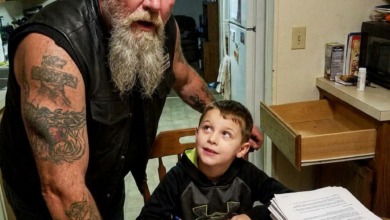
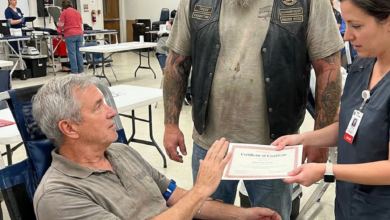
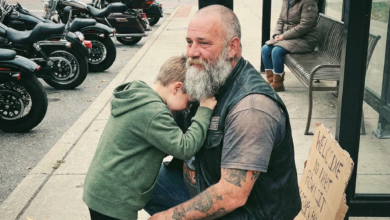
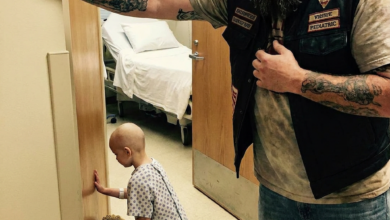
Six foot four, perhaps. Broad shoulders beneath a black leather vest. A gray beard hanging over a faded sweatshirt. Tattoos across his knuckles, heavy boots on the porch, and an expression so hard that I felt foolish for having waved at him earlier that month.
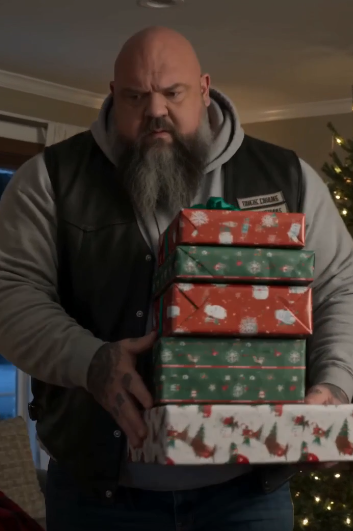
The first box he carried out was wrapped in red paper with little white reindeer.
I recognized it because seven-year-old Noah had shown it to me that morning. He had shaken it carefully, then held it against his ear.
“I think it’s a train.”
Now the man was taking it.
“Please hurry,” I told the dispatcher.
Snow had started falling over our little street in southern Ohio, soft enough to look harmless. Across the road, somebody’s inflatable snowman had collapsed halfway onto its face. There was a wreath on the house the biker had entered.
There were children’s boots beside the door.
He stepped over them carrying another armful.
My name is Evelyn Brooks. I was sixty-nine that Christmas, retired from the county library, widowed, and entirely too willing to believe that keeping an eye on the neighborhood made me useful.
That afternoon, I thought it finally had.
The man set the gifts inside a large open tote in the driveway. He wasn’t hurrying toward a getaway car. He was arranging the boxes without stacking them, checking each one against something on his phone.
That frightened me more.
A person who believed he could take his time was a person who expected nobody to stop him.
I opened my front door.
“Put those back.”
He turned immediately.
Up close, his face looked older than I expected. Weathered cheeks. A pale scar near his chin. Eyes that moved past me toward my hallway before returning to mine.
“Are the kids with you?”
I tightened my grip on the door.
“You don’t need to know that.”
He nodded once, as though I had given him an answer he deserved.
Behind me, Noah appeared in his socks.
“That’s ours.”
The biker looked down at the red package in his arms.
I have never forgotten the change in his expression. It was small, hardly more than a tightening beside one eye, but for a second he looked like the person being robbed.
Noah stepped toward the porch. I put my arm across the doorway.
“Stay inside, sweetheart.”
The boy stared past me.
“Mom said we could open them tonight.”
The biker lowered the package carefully into the tote.
“I know.”
That was when I became furious.
He knew.
He knew there were children. He knew it was Christmas Eve. He knew those presents mattered, and he was standing in our driveway taking them anyway.
“The police are coming,” I told him.
“Good.”
A blue-and-red reflection moved across the wet pavement before the cruiser came into view.
The biker stepped away from the gifts and lifted his empty hands. His phone remained on the porch rail, its speaker faintly crackling.
Someone was trying to speak through it.
I couldn’t make out the words.
The officer parked, opened his door, and looked from the broken lock to the boxes. I began explaining before he reached the sidewalk.
Then the biker said the mother’s name.
“Leah told me to move them.”
“You expect us to believe that?”
He looked at the phone on the rail.
“No,” he said. “I expect you to ask her.”
When the officer lifted one red box, the biker told him to stop, and Noah asked why his mother’s voice was coming from the phone.
Leah Carter had moved into the house beside mine in October with two children, four suitcases, and a kitchen table that came apart while the movers were carrying it.
I brought a screwdriver.
She looked at it, then at me, and laughed in the startled way people laugh when they haven’t planned to trust anyone that day.
We put the table together on the kitchen floor.
Noah handed us screws. His little sister, Ruby, who was four, sat inside an empty box announcing that she was driving to Florida.
Leah was thirty-four. She wore her hair tied back so tightly that I wondered whether it hurt. She worked early shifts at a hotel laundry and checked her phone whenever a car slowed outside.
I noticed.
I did not ask.
People who have spent years behind a library desk learn that silence can be an invitation if you stop trying to fill it.
Eventually, she told me there was a husband she had left.
Not an ex-husband yet. Paperwork was moving more slowly than fear.
She did not tell me everything he had done. She told me enough: broken things, threats, money withheld, the way he could lower his voice and make everyone in a room stop breathing normally.
His name was Mark.
Noah didn’t mention him unless somebody else did first.
Ruby asked whether Daddy knew where their new kitchen was.
Leah said they were being careful.
I began watching the street more often.
That is how I first met the biker.
His name was Thomas Vale, though the men who rode with him called him Brick. He volunteered with a local church that helped families move furniture and collected winter supplies.
He came one Saturday with two other riders to fix the porch rail and bring a dresser that had been donated. Their motorcycles rumbled past my window, followed by an old pickup carrying furniture under a tarp.
I expected noise.
Instead, Thomas knocked softly because Leah had said Ruby sometimes napped in the afternoon. He asked where she wanted the dresser before unloading it. When Noah tried to help carry a drawer, Thomas found something lighter for him without making him feel useless.
I liked him that day.
Then I saw him destroying a lock, and every small kindness vanished beneath what I thought I understood.
The house was not a secret shelter. It was a temporary rental arranged with help from a community organization. Leah knew that staying safe involved more than keeping an address private.
By December, that had become painfully clear.
A letter arrived from Mark.
Then flowers.
Then an expensive coat in Noah’s size.
Leah didn’t let the children wear it. She called her advocate, a woman named Marisol, and kept the packaging for the people helping her.
I thought the gifts were manipulation.
I did not understand that something meant to be carried away could also become a way of following.
A few days before Christmas, Marisol helped Leah arrange another place to stay. There had been new messages and a car Leah believed she recognized near her workplace.
The move was supposed to happen quietly after the holiday.
I was helping with the children while Leah worked and met with the people coordinating it. Thomas’s club had offered transportation for furniture when the time came.
That Christmas Eve, six presents appeared through the church’s seasonal delivery program.
They were beautifully wrapped. The tags carried the children’s names. The outer delivery slip had the same small blue church emblem as other donations Leah had received.
She called the program coordinator.
The boxes appeared to match a late contribution that had been added to the route. Nothing about the wrapping looked unusual. The children were delighted, and for one morning, Leah let herself be delighted too.
Noah brought his red package to my house before she left.
“Not opening,” he assured me. “Just visiting with it.”
At noon, Leah took the children back next door for lunch. When she brought them to me afterward, the gifts were under the tree again.
She asked whether I could keep them until four.
There was one last appointment with Marisol.
“Of course,” I said.
She hugged me longer than usual.
Then she left.
An hour later, Thomas arrived alone.
He knocked at her front door, called her phone, and walked around the side of the house. I watched him return to his pickup, take something from the cab, and go back to the rear entry.
I heard the lock give.
By then, I was already dialing.
The officer’s name was Daniel Ruiz. He listened to me first because I was the person who had called.
I told him about the lock, the presents, the children in my house.
Thomas stood beside the pickup with his hands visible and his shoulders lowered. He didn’t interrupt, even when I called him a thief.
That silence made me feel certain.
Then Officer Ruiz picked up the phone from the porch rail.
“Ma’am, who am I speaking with?”
Leah’s voice came through thin and shaky.
“Leah Carter. That’s my house.”
He moved a few steps away to speak with her. Thomas remained where he was.
“What did you do?” I asked.
“Should’ve knocked on your door first.”
“That’s not an answer.”
“No.”
I wanted him to become angry. Anger would have fitted the man I had described to the dispatcher. Instead, he looked toward my open front door.
“Can somebody stay with the kids?”
“They’re fine.”
Noah was standing behind the screen.
He did not look fine.
I closed my mouth.
My friend Pat, who had come over to borrow a roasting pan, took Noah’s hand and led him back toward the kitchen. Ruby followed with a piece of ribbon she had found somewhere.
Officer Ruiz returned.
Leah had confirmed that she authorized Thomas to enter and remove the newly delivered gifts. He had reached her by phone after initially finding the house empty.
She told him where a spare key should have been.
It wasn’t there.
The rear lock had been sticking for weeks, and the spare key had ended up in a bag already packed for the move. Thomas had forced the lock after Leah agreed that he could get inside.
That did not make everything he had done wise.
Officer Ruiz asked why he had not waited for assistance, especially if he believed the packages might matter to an investigation.
Thomas looked at the tote.
“Thought getting them away from the kids came first.”
“The children weren’t inside.”
“I know that now.”
He had tried to call me too, using a number Leah provided. My phone had been busy with the emergency call.
The misunderstanding was almost absurd when Officer Ruiz laid it out. Three adults trying to reach each other, all convinced the other person needed to understand something immediately, and none of us standing in the same room.
But authorization did not explain the gifts.
“What’s wrong with them?” I asked.
Thomas looked toward the officer before answering.
“There’s a problem with the delivery.”
Officer Ruiz told him not to handle anything else.
A second cruiser arrived. Then Leah’s car turned into the street, with Marisol in the passenger seat.
Leah got out before the engine had fully settled.
She ran to my door.
Noah met her in the hallway, and she held both children so tightly that Ruby complained she couldn’t breathe. Leah loosened her arms immediately, kissed their heads, and looked at me over them.
“They’re all right?”
“Yes.”
She nodded, then nodded again.
I had seen that expression before, on people who had been given good news but could not yet persuade their bodies to accept it.
Outside, Officer Ruiz asked everyone to keep the driveway clear. He spoke with Thomas and another officer beside the open tote.
I could see the presents through my window.
Six boxes.
Every gift beneath Leah’s tree had come in that delivery. The smaller things she had bought herself were still hidden in a closet, unwrapped until she had time and privacy.
Thomas had not known that when he carried the packages out.
To him, he was removing a particular batch.
To Noah, watching from my doorway, he had taken Christmas.
The boy stood beside his mother.
“Did I do something?”
Leah crouched immediately.
“No.”
“Because I shook it?”
“No, sweetheart.”
Thomas heard from the porch.
His head lowered.
Leah told the children that the adults needed to check the packages. She did not tell them they were dangerous. She did not invent a story about naughty lists or Santa making mistakes.
“We’re sorting something out,” she said. “You didn’t cause it.”
Then she asked Pat to keep them in the kitchen for a few minutes.
When they were out of earshot, she turned toward the driveway.
“I called the coordinator,” she told me. “Those boxes weren’t supposed to be on our route.”
“But you checked.”
“I checked what they had in front of them.”
Her voice broke.
Marisol put a hand on the back of a chair, waiting rather than reaching for her.
“A donor changed the instructions,” Leah said. “He used another name.”
I understood then that she knew who had sent them.
I still did not understand why Thomas had looked at a child’s Christmas present as if it were something he needed to keep himself from throwing.
Thomas had been at the church storage room when the delivery coordinator found the discrepancy.
A late donor had arranged a separate set of six packages for Leah’s children and insisted they travel together. He described himself as a relative helping anonymously.
The volunteer handling the donation did not know the family’s history.
The address had come from the donor, not from the church.
That fact was what first stopped the coordinator.
Then another volunteer remembered the same man asking whether the gifts would be taken along if the family moved.
At the time, it had sounded generous.
He wanted the children to keep them.
Now it sounded different.
The coordinator called Leah’s advocate. Thomas was there collecting folding tables and recognized the family name. He offered to help locate the delivery while staff checked what had happened.
Before he left, a call came from another family-support worker.
A similar package connected to Mark had been examined elsewhere. A tracking device had been found concealed in its packaging.
Thomas did not know what was inside Leah’s boxes.
He knew there was enough reason to stop them from becoming part of her move.
That distinction mattered later, when people began saying he had somehow sensed the devices. He hadn’t. Other people had noticed records, asked questions, and passed on information.
He was the man close enough to drive over.
Officer Ruiz explained that the gifts would be handled and examined properly. No one in the driveway began opening toys or pulling apart electronics.
The boxes were documented and taken into custody.
Later, Leah was told that tracking devices had been found in more than one package.
The presents had been meant to travel.
Mark already knew this address. The devices were not a magical way of discovering something he had written on a delivery slip himself. They offered a way to keep following possessions he expected Leah to carry when she went somewhere he did not know.
I sat down when Marisol explained that.
All morning, I had looked at those boxes and seen reconciliation disguised as extravagance. Then I had seen theft.
I had missed the intended destination.
Leah stood beside my sink with her arms folded tightly across her stomach.
“He asked Noah what he wanted.”
Nobody spoke.
“On a call that was supposed to be about Christmas. Noah said a train.”
She pressed her lips together.
“He picked something Noah would want to keep.”
From the kitchen table, we could hear the children and Pat discussing whether gingerbread men needed eyebrows.
The ordinary sound made everything worse.
Leah looked toward it.
“I let the boxes in.”
Marisol answered immediately.
“Someone hid something from you.”
“I put them under the tree.”
“You checked the delivery. You called for help when there was new information.”
Leah shook her head.
I knew that motion. It was the body refusing kindness because blame felt more useful. Blame offered the illusion that if you found your own mistake precisely enough, you could prevent the world from ever frightening you again.
I had done it after my husband died.
I had watched him seem tired for weeks. I had suggested better sleep and less salt. Afterward, I kept trying to locate the sentence I should have spoken that would have changed the ending.
I went to Leah.
“You didn’t wrap those boxes,” I said.
She looked at me.
“You didn’t hide what was in them.”
Her face crumpled then.
I held her while she cried, and for once I did not tell someone everything would be fine. There was work left to do, and pretending otherwise would have made her lonelier.
The move would happen sooner.
Marisol arranged the next steps with Leah and the people assisting her. Thomas’s club would not decide the destination or collect addresses casually. They would help only in the ways Leah approved.
The police investigation continued.
Nobody promised that finding the devices solved every problem. The gifts were evidence of something serious, but evidence was not the same as a locked future.
Outside, Thomas stood beside the damaged rear door.
He had temporarily secured it under the officer’s direction and called someone qualified to replace the hardware properly. He was paying for that himself.
I walked onto the porch.
“I called you a thief.”
“You saw me break a lock and take boxes.”
“I didn’t ask.”
“I didn’t explain.”
For a while, we listened to the snow landing on the bare hedge.
Then he said, “Kid thinks I took his train.”
“He doesn’t understand yet.”
“Shouldn’t have to understand all of it.”
He looked at the open space beneath the tree through Leah’s window.
I could see the lights reflected in his glasses.
“Can I ask you something?” he said.
“Yes.”
“Would she let us bring different ones?”
Leah said no at first.
Not angrily. She simply looked too tired to accept another complicated thing wrapped as generosity.
“I can’t do another delivery.”
Thomas nodded.
“All right.”
He did not explain how much it would mean to the club. He did not tell her the children needed Christmas. He did not make refusal into ingratitude.
He started walking back toward his pickup.
That was why she stopped him.
“What did you have in mind?”
“Things you choose.”
She looked at him for a long moment.
“No surprises?”
“None.”
“Nothing connected to an app. Nothing that needs an account.”
He nodded again.
“And I want to see everything before they do.”
“Your call.”
It was a small conversation, but I watched something change inside it. Leah was being offered help without surrendering authority in exchange.
Thomas called the club president from his truck.
I learned afterward that the answer was not immediate.
The Iron Lantern Riders had already spent most of their holiday fund. They had bought heating oil for an older member, helped repair a wheelchair lift, and covered a grocery bill for a family whose father had lost work.
There was no hidden treasury waiting to become a miracle.
Christmas Eve was also Christmas Eve for the riders.
One had grandchildren arriving. Another was working an overnight shift. Two members lived far enough away that the weather made travel uncertain.
The club president, Owen, asked Thomas how much he was imagining.
“Enough for two kids.”
“That can mean a lot of things.”
“Then we ask their mother.”
Some members wanted to collect money online. Someone suggested posting what had happened so people would understand the urgency.
Thomas refused to use Leah’s story that way.
There had already been enough information about that family passing through hands that did not need it.
One rider said they should confront Mark.
Owen ended that idea before it grew legs.
They were not investigators. They were not going to make Leah manage the consequences of their anger.
What they could do was find ordinary gifts, bring wrapping paper, and keep their promises.
Ruth, who handled most of the club’s community spending, called Leah directly. She asked about sizes, interests, and what would fit comfortably into the family’s next move.
Leah said Ruby liked drawing and Noah liked building things.
Then her voice caught.
“He still wants a train.”
Ruth wrote it down.
The replacements came from half a dozen places.
A rider named Leon had bought a wooden train set for a grandchild who already owned the same one. It was unopened. His daughter agreed immediately that they could choose something else for their own household later.
Ruth found art supplies at a store that was closing early.
Luis contributed two warm blankets he had bought for the club raffle. Another member brought books, checking the titles with Leah instead of assuming every child liked the same stories.
Thomas bought a small wooden toolbox with rounded edges and a set of age-appropriate building pieces. He asked whether Noah would want it.
Leah smiled for the first time that day.
“He’ll carry it everywhere.”
“Then maybe make it his idea.”
While the calls continued, the locksmith arrived. Thomas helped carry tools but let the man work. He did not turn the broken lock into a demonstration of his own expertise.
That evening, when things had grown quieter, he sat on my porch with a paper cup of coffee.
I asked why he understood Leah’s need to approve everything.
He looked toward the street.
“My sister.”
I waited.
“She left somebody. Long time ago.”
His hands tightened around the cup.
“I told her to call me if he showed up. Said I’d handle it.”
“Did he?”
“Yes.”
He did not give me the details.
He told me enough: he had gone there furious, started a fight, and been arrested. His sister had spent the following day answering questions and comforting her children while he sat somewhere feeling righteous.
“I made her emergency about what I could do,” he said.
There was shame in his voice, but no attempt to make it beautiful.
He had served time for the assault. Afterward, it took years before his sister trusted that asking him for help would not create another crisis.
“What changed?” I asked.
“She told me she needed a ride to work. Not a soldier.”
He looked at the house next door.
“So I drove.”
The wind lifted the end of his beard.
I understood then why he had stopped when Leah said no.
He had learned that care could arrive carrying its own demands. He was trying, with all the awkwardness of a man who had once learned the wrong lesson thoroughly, to bring something lighter.
Before leaving, he knocked on my door and asked to speak to Noah with Leah present.
“I took the boxes,” he told the boy. “Your mom asked me to help check them. You didn’t do anything wrong.”
Noah looked at his boots.
“Are you bringing them back?”
“Different things, if that’s okay.”
The boy thought about it.
“Will Mom look first?”
Thomas nodded.
“Every one.”
Christmas morning began with a text.
Not engines. Not a surprise crowd outside a frightened family’s windows.
Ruth asked Leah whether ten o’clock still worked and whether the children were ready for visitors.
Leah answered yes.
The move was being handled through the arrangements already made with Marisol. We were not putting the destination into a club group chat or making plans across my open kitchen.
For that morning, my house became the place for gifts.
Leah came over with the children after breakfast. Pat brought cinnamon rolls. I found extra mugs and took the good scissors out of the drawer where I kept hiding them from myself.
The riders arrived in small groups.
Some came on Harleys, bundled against the cold. Others drove cars with their families because snow and Christmas plans did not care about appearances.
The whole club took part one way or another. Those who could not come had sent something through Ruth: a book, a contribution, a bag of bows from a kitchen cupboard.
No one parked across Leah’s driveway.
No one took a photograph of the house.
Thomas waited at the bottom of my steps until I waved him up.
He carried the wooden train set in an ordinary shopping bag.
Leah inspected the gifts in my dining room while the children helped Pat put napkins on the table. Nothing was treated as suspicious merely because it existed, but nothing bypassed her choice either.
She opened packaging, read labels, and decided which things she wanted wrapped.
The riders waited.
Luis folded paper badly. Ruth repaired his corners. Owen crawled under my table to retrieve tape and complained that charity work was harder on his knees than motorcycle maintenance.
The room began sounding like a holiday.
When Noah finally opened the train, he didn’t shout.
He looked at his mother.
She nodded.
“This one is ours to keep.”
He touched the engine with one finger before lifting it out.
Ruby opened her art supplies and immediately asked who wanted a picture.
Every hand in the room went up.
Thomas stayed near the window until Noah approached him with two sections of track.
“They don’t fit.”
Thomas crouched.
“Want help, or want me to watch?”
The boy considered this serious distinction.
“Help first.”
They built the track across my rug.
A rider with tattooed hands held a little wooden bridge steady while a child decided where the train should go. Near the sofa, Ruby drew Ruth with purple hair and announced that it was an improvement.
Leah laughed.
Not because she had forgotten. Not because the danger had somehow been canceled by wrapping paper.
She laughed because Ruby had drawn enormous purple eyebrows too.
For a few minutes, that was what was happening.
When Noah finished the first circuit, he looked up at Thomas.
“You can sit down.”
Thomas settled carefully onto the floor.
The boy put the engine in his hand.
“You bring it back this time.”
Thomas swallowed.
“All right.”
The next weeks were not simple.
Leah and the children moved. The investigation continued. There were calls, appointments, and practical problems that did not become smaller because people had been kind on Christmas morning.
I missed seeing their blue curtains from my window.
For a while, I caught myself watching the empty house as though keeping an eye on it could still help them.
Then Leah called and asked whether I would like to visit.
She gave me the details herself.
I brought banana bread and left my habit of asking too many anxious questions at home.
Noah showed me the train immediately.
The track ran beneath a chair and around a basket of blankets. Ruby had drawn little paper houses and placed them alongside it, each with windows so large the people inside could see everything.
Thomas visited later, by invitation, with Ruth.
He brought no presents.
Leah had mentioned a wobbling table, and he asked whether she still wanted him to look at it. She did. He fixed it while Noah handed him parts from the wooden toolbox.
It was the same table I had helped assemble in October.
That pleased me more than I could explain.
I eventually apologized to Thomas again, properly, without making him reassure me.
He told me he was glad I called the police when I believed something was wrong.
“Just keep room for the answer,” he said.
I have tried to remember that.
Our first understanding of a thing can feel so complete. A broken lock. A man in leather. Christmas boxes leaving a house.
Sometimes every detail is accurate, and the meaning is still wrong.
That spring, Leah sent me a photograph she had chosen to take.
It showed Noah on the floor with Thomas. There were no addresses, no windows, no story offered for strangers to improve. Just two heads bent over a little train.
On the back of a printed copy, she wrote, He asks when Mr. Thomas is coming before he asks what he’s bringing.
I put it beside the lamp.
The following Christmas, we met at my house again. Smaller gathering. Fewer gifts. More food than anyone needed.
Thomas arrived with paper plates because I had asked him to, and Noah met him at the door.
The boy had grown taller.
He was holding the red wooden engine.
“Track’s ready,” he said.
Thomas took off his boots without being asked and followed him into the living room.
Outside, a Harley ticked as its engine cooled. Inside, Ruby argued that trains could go through castles if she said they could.
Leah sat beside me with both hands around a warm mug.
The train came back around.
Follow our page for more biker stories about second chances, unexpected kindness, and the people who help families turn ordinary moments into something worth looking forward to again.