A Biker Blocked My Wedding Limousine at the Church—Then I Learned Why My Father Had Spent Twelve Years Paying the Driver Who Killed My Mother
The driver lowered his eyes.
For a moment, all I could hear was the limousine’s indicator clicking against the church bells.
My father stood beneath the stone arch with a white rose pinned to his jacket. He had chosen that flower because my mother used to grow them. I had cried when he showed me.
Now he said, “Hannah, get out of the car.”
Not a question.
My uncle Jack kept one palm flat against the hood. His Harley stood across the private entrance, engine off, leaving enough room for anyone to walk past.
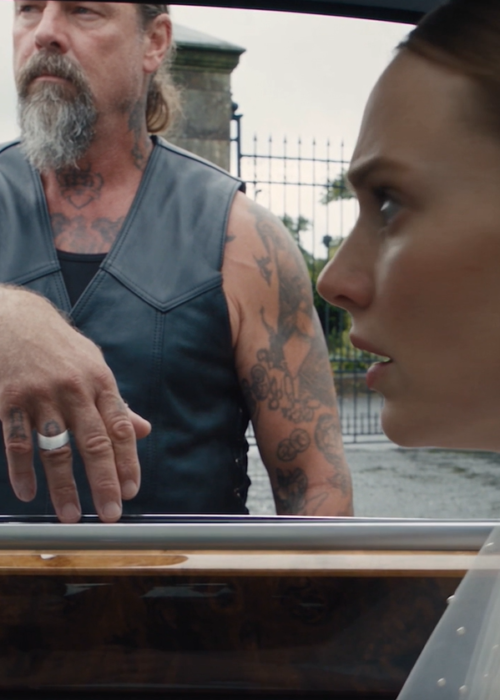
He wasn’t trapping us.
He was making us stop.
My daughter, Mae, sat beside me holding a basket of petals. She looked from my father to the driver and quietly put the basket on the floor.
“Is this about Grandma?”
Nobody answered quickly enough.
I had told her Grandma died in a road accident before she was born. I had never told her about the man who drove away.
My father stepped toward the open window.
“That man is trying to get money out of us.”
He meant the driver.
Caleb Price.
Thirty-one years old. Dark suit. A pale crescent scar beneath his right ear.
I had seen that scar at company picnics.
My father had been employing my mother’s killer where I could hand him a paper plate.
Then a colder thought arrived.
I didn’t actually know Caleb had killed anybody.
Jack had said it.
Caleb had accused my father.
Neither was proof.
Twelve years earlier, a witness had described a dark pickup leaving the curve outside Marietta. A second witness remembered a damaged mirror. That was the part of the case everyone repeated.
Caleb wasn’t driving a pickup now.
He was driving me to my wedding.
Ben came down the church steps, loosening his tie.
“What happened?”
My father answered before I could.
“Jack’s having another one of his episodes.”
My uncle’s hand left the hood.
For years after his sister died, he had called investigators, followed leads, and turned up at my father’s office demanding records. Eventually, even I stopped answering every call.
At twenty, I had told him I couldn’t grieve forever.
I remembered saying it now.
I remembered his face.
Jack looked at me through the window.
“I gave the detective what he sent me. She’s coming. I wasn’t going to let you ride off with him before you knew.”
A church volunteer had already called police about the blocked entrance.
My father pointed at the motorcycle.
“This is what he does.”
Caleb switched off the limousine.
Then he placed the keys on the dashboard.
“I won’t drive her anywhere,” he said.
His hands were shaking.
Ben opened my door.
The officer asked whether I wanted the driver kept away from me. I said yes. Then, after looking at my father, I asked her to give us space from him too.
He didn’t ask whether the wedding was canceled. He helped me stand without stepping on my dress.
My father reached for my elbow.
I moved before he touched me.
That surprised both of us.
Behind him, the church doors stood open. Inside were flowers, music, and a hundred people waiting for the version of our family he had paid to celebrate.
Outside stood a man I had barely noticed for years.
Why was the driver more willing to wait for police than my father was?
The last truly ordinary photograph of my mother was taken beside a yellow garage door.
I was seventeen, annoyed about braces, and she was teaching Jack how to sew a split seam in his motorcycle glove.
He kept pulling the thread too hard.
“Easy, bull,” she told him.
My father stood behind the camera.
Caleb was nineteen then, a junior employee who washed company vehicles and ran errands. He carried a broken side mirror through the background, pretending he wasn’t listening.
My mother tied a narrow yellow ribbon through the zipper of her canvas document pouch.
“So I can find it in that cave I call a purse.”
Then she asked Dad to stop saying his favorite line.
Keep it moving.
He used it when dinner ran late, when employees complained, when anybody wanted to sit with an uncomfortable subject.
“Some things need stopping for, Tom.”
He kissed her forehead.
We all laughed.
That was six weeks before she died.
The ribbon and those four words survived in my memory without seeming important.
At the church, a patrol officer asked Jack to move his motorcycle once the limousine keys were secured and everyone agreed to stay.
Jack moved it.
No argument.
No performance.
He parked beside the rectory and took off his gloves.
Mae looked at his tattooed hands.
She had met him only three times. My father had made sure of that, though I had called it keeping things peaceful.
“Did you know Grandma?” she asked.
Jack nodded.
“Before anybody else here did.”
“Was she funny?”
“Mean at cards.”
Mae almost smiled.
Then Detective Rosa Bell arrived in an unmarked car.
She had reopened contact with Jack two weeks earlier, after he forwarded a message Caleb sent from an account my father didn’t control.
Caleb hadn’t supplied a dramatic confession.
He had asked whether the old case file still existed.
Then he sent a photograph of a repair invoice.
Jack called him.
Caleb stopped answering.
When Jack learned he would be driving our wedding car, he came to the church.
Bell listened while my father explained that a disgruntled employee was exploiting a bereaved family.
She asked him to stop speaking for Caleb.
It was the first time I had ever heard anybody do that.
Dad had spent years introducing himself before I could introduce myself. At school. At work. At medical appointments. I had called it devotion because nobody offered me another word.
Aunt Ruth took Mae into the parish kitchen. Ben went with them after asking where I wanted him.
“With her,” I said.
He kissed my forehead and went.
My father watched.
“You don’t need to discuss this in public.”
I looked at the limousine.
There was a small white bow tied around the door handle. Somebody had straightened its tails for photographs.
“Then where should I discuss it?”
“At home.”
“Your home?”
“Our home.”
I hadn’t lived there in years.
He still said it that way.
Bell asked Caleb whether he wanted an attorney before giving a formal statement.
He said yes.
My father’s shoulders relaxed.
Then Caleb handed her his phone.
“The email and the original photograph are there,” he said. “My attorney knows I’m giving you those.”
My father stopped looking relieved.
What was in a twelve-year-old repair bill that frightened him more than an accusation?
The first document appeared to clear Caleb.
That was the part nobody expected.
Three days after the wedding that didn’t happen, Detective Bell showed me the limits of what she could discuss.
She did not hand me an open criminal file. She explained that the pickup identified on the invoice had been examined during the original investigation and ruled out.
Different paint.
Different damage.
Its mirror had broken in a loading-yard accident reported before my mother’s death.
I sat in her office wearing jeans that still had wedding glitter caught in the pocket.
“Then Jack got it wrong?”
“The invoice doesn’t establish which vehicle struck your mother’s car.”
“What about Caleb?”
“He says he was driving. We are checking his account.”
I wanted something firm enough to lean against.
Instead, I had a confession attached to a document that proved the wrong thing.
My father called that afternoon.
He already knew about the truck.
“I tried to protect you from this.”
I closed my eyes.
For one second, I wanted protection more than truth.
Then he said Jack had been drinking at the church.
I had stood beside my uncle.
I had smelled rain, leather, and the peppermint gum he chewed because his dentist nagged him.
Not alcohol.
Small lies are sometimes easier to recognize than large ones.
I wrote that conversation down afterward. Exact words where I remembered them. Gaps where I didn’t. I was learning that certainty and honesty were not always the same thing.
I asked Bell about something else.
“Did Caleb call for help?”
She was quiet.
Then she said investigators had located an anonymous emergency call from a roadside business shortly after the collision.
The caller reported a vehicle down an embankment.
He gave the correct curve.
He left before responding officers arrived.
Caleb said that caller was him.
The original recording had not been retained, but the dispatch entry existed. So did the time and the location.
He had not simply hit my mother and forgotten her.
He had stopped.
He had tried to get help.
Then he had fled anyway.
That distinction did not excuse him. It changed the shape of what happened.
At Jack’s garage, I found my uncle sitting beside a cold cup of coffee.
His Harley was covered with an old bedsheet.
“You knew he called?”
“He told me.”
“Why didn’t you say?”
“At the church? You were already trying to hold five things at once.”
I sat on a stool.
“Did he see her?”
Jack nodded.
“Did he know who she was?”
“After they stopped.”
They.
I looked up.
My uncle stared at his coffee.
“That’s his account, Hannah. Not something I can prove.”
“Who was with him?”
He rubbed his palms together.
“Ask your father where he was that night.”
My father had always told me he was home.
I remembered coming downstairs after a police officer knocked.
His shirt had been tucked in crookedly.
I had thought he dressed too quickly.
Memory is dangerous when it starts offering answers on demand.
I told Bell what I remembered without telling her what I thought it meant.
Then I called my father.
“Was somebody else in the pickup?”
For the first time in my life, I heard him hang up before I finished speaking.
Why would an innocent man need silence before he needed an answer?
The payments began the month after the funeral.
I learned that from records Caleb provided through his attorney and from old household statements I was entitled to access as the representative handling an unresolved portion of Mom’s estate.
Most of the business records came later, through investigators.
At first, all I saw was a pattern.
Regular wages.
Extra transfers.
An apartment leased through a company my father controlled.
A loan for Caleb’s sister.
Nothing labeled hush money.
Of course not.
My father said he supported an employee who had suffered after a difficult period.
He had a story ready for every transfer.
The problem was the messages.
Caleb had kept an old phone.
Not because he was brave.
Because he was afraid.
In the preserved exchange, he asked whether he could leave the company.
My father answered that they both knew what would happen if old matters were misunderstood.
Another message referred to the truck kept off the regular fleet schedule.
A third told him never to contact Jack.
Those messages didn’t prove a collision.
They helped explain twelve years of employment that Caleb described as a room without a lock.
He could leave.
He would lose the paycheck, the apartment, and the person who promised his worst act would remain buried.
He stayed.
I asked Jack why Caleb chose now.
My uncle put a printed photograph on the workbench.
It showed me outside the library with Mae, holding a wedding-planning folder.
Caleb had driven my father there for a meeting.
He saw us.
Then my father assigned him to the wedding.
Something about placing his hands on the wheel of my car finally broke the arrangement he had lived inside.
He contacted Jack.
Then he panicked.
My father noticed.
The extra wedding assignment, Caleb believed, was less a job than a reminder of how close he could be kept.
I wanted to hate him without complication.
It would have been easier.
Instead, I found myself thinking about nineteen-year-old hands on a steering wheel, followed by twelve years of adult choices nobody else had made for him.
Bell later confirmed what Caleb said about the vehicle.
It wasn’t the fleet pickup originally examined.
It was a privately registered truck my father occasionally used for business.
A repair shop had replaced its damaged front corner days after Mom died.
The shop’s archived ledger survived because its owner kept bound books for tax records.
The truck itself was gone.
The invoice wasn’t.
Payment came from a business account.
Authorization came from my father.
At the bottom was a note recording that the customer wanted the work completed without an insurance claim.
The detective warned me that each document needed checking against another source. I appreciated her care. I also went home furious that my father had enjoyed twelve years without being checked at all.
Still not proof of everything.
Enough to stop calling it nothing.
That night, Dad came to my apartment carrying the wedding album we’d never filled.
He had already spoken to the photographer about credits.
“I can fix most of this,” he said.
I looked at the empty album.
“Which part?”
He didn’t answer.
Then I asked whether he had been in the truck.
He set the album down very carefully.
“If I tell you, you won’t understand.”
What had he done that required my ignorance more than his forgiveness?
By Monday, my father had a different explanation.
My mother had been planning to leave.
He told Ben first.
Then Aunt Ruth.
Then me.
Not because he wanted us to understand her, he said. Because Jack had spent years encouraging her to see the worst in him.
“Ask your uncle what was in the yellow pouch.”
I remembered it instantly.
The ribbon.
The canvas.
Mom pulling it from her purse to find a grocery receipt.
“What does that have to do with the accident?”
“More than he’ll tell you.”
Dad’s attorney sent a letter asking that I preserve communications with Jack and refrain from repeating allegations publicly.
That part sounded official enough to make my stomach tighten.
Then the company payroll office notified me that a small monthly education payment Dad had been making for Mae would stop.
There was a budget review.
Of course there was.
My father had paid our wedding vendors directly. Canceling arrangements meant speaking to people who treated him as the customer and me as an emotional complication.
The florist asked whether we could sort out the family disagreement before discussing credits.
I stood in the parking lot behind the grocery store and cried into my veil’s garment bag.
Not because of flowers.
Because he had built help into every corner of my life, and now every kindness seemed to have a handle he could turn.
Ben found me there.
He sat on the curb in his work trousers.
He was an electrician. He had taken time off for our honeymoon and spent it calling vendors, returning rented chairs, and making toast nobody ate.
“Dad spoke to you,” I said.
“Yes.”
“What did he say?”
“That your uncle wants his money. That you’re not sleeping. That this could ruin our marriage before it starts.”
I waited.
Ben picked a thread off his knee.
“I told him he doesn’t get to be the person who decides whether we’re okay.”
I leaned against him.
For a minute, that was all.
Then my phone stopped working.
It was still on the family business plan.
An account administrator had removed the line.
Dad called Ben’s phone twenty minutes later and said it was a billing mistake.
Maybe that specific interruption was.
I no longer knew which accidents were accidents.
We got our own plan that afternoon.
I wrote the new number on a receipt for Mae’s backpack. She asked whether Grandpa would have it. I said yes, eventually, but he wouldn’t be deciding when it worked.
Jack offered to pay.
I said no.
He nodded.
Then he drove behind us to the store anyway, parked the Harley, and waited outside while we filled out forms.
Not taking over.
Just being somewhere I could see him.
That evening, he brought Mom’s old notebook.
He had kept it with papers she gave him before the collision.
Until now, he said, he had thought the pages concerned work disagreements.
They were more than that.
On the first page, Mom had written a name I recognized from Caleb’s messages.
Then an admission.
I read it standing beneath my kitchen light.
I had spent twelve years trying to find out what someone did to my mother.
Why had she been keeping a record of what she had done herself?
My mother had signed Caleb’s training paperwork.
She worked part-time in my father’s office then, handling payroll and filing.
The form said an experienced supervisor had completed his road assessment.
No supervisor had.
Dad told her the assessment would happen later.
He needed Caleb available immediately.
She signed.
There were other shortcuts.
Hours moved between sheets.
Complaints described as misunderstandings.
A damaged vehicle kept in service until a quieter week.
Mom’s notebook did not claim those things caused her collision.
Neither did investigators.
It showed a woman who had helped make a business look safer than it was, then started writing down the difference.
I sat at the kitchen table.
Mae’s spelling list lay beside the notebook.
Words like honest.
Words like promise.
I moved the list away.
Jack watched me.
“You knew she was leaving?”
“She said she was considering it.”
“And you didn’t tell me?”
“You were seventeen.”
“Everybody keeps saying that like I wasn’t there.”
He lowered his eyes.
Mom had made an appointment with an attorney. She had also arranged to meet a retired compliance manager who knew how to organize the records for investigators.
That was where she was driving.
Not to see another man.
Not to disappear without me.
But she hadn’t told me what was happening.
She had planned to explain after she knew where we could live and what she would have to admit.
I could understand the reason.
I still hated being the last person allowed into my own life.
For days I carried that anger like something disloyal. Then Ben asked whether I would want Mae to forgive every mistake I ever made simply because I loved her. I said no.
“Was she scared of Dad?”
“Of what he’d do with the business. With money. With you caught between them.”
“Was she scared of herself?”
Jack looked at the notebook.
“Probably.”
He had once signed a repair statement he shouldn’t have signed, years before, to keep his own employer out of trouble.
It cost him his job when the truth came out.
Mom knew that.
She went to him because he would understand shame without calling it innocence.
That was why they had grown close again.
My father called it interference.
Jack called it answering the phone.
The notebook led Bell to the retired compliance manager.
She still had an email from Mom.
An appointment time.
A short description of records.
Proof that the yellow pouch had held something more important than family receipts.
Caleb’s account filled in the rest.
My father had been beside him in the pickup.
They were returning from a delivery problem, arguing about Mom’s intended disclosure.
Caleb approached the curve too fast.
He crossed the center line.
After the collision, they stopped.
Dad reached Mom’s car first.
Caleb ran to the roadside business to call for help.
When he returned, Dad was carrying the yellow pouch.
He said rescuers were coming.
He said staying would destroy both their lives.
Then he said the words Caleb remembered more clearly than the impact.
Keep it moving.
I read the account with both hands flat on the table.
My mother had been trying to stop something she had helped set in motion.
Had my father left the road with her papers because he feared losing his company more than losing her?
My father chose the public room.
That matters.
He could have let attorneys speak.
Instead, eight weeks after the church, he went ahead with the annual scholarship dinner named for my mother.
The foundation had commitments. Students had been selected. Canceling would punish the wrong people.
All true.
He also wanted a microphone.
He called and asked whether I would attend.
“We need to stop letting rumors tell your mother’s story.”
I said I would come if I could ask questions.
His pause lasted long enough for me to hear the television in his office.
Then he agreed.
Before the dinner, I gave Bell everything Jack had provided. The notebook, emails, and copies were documented. Caleb had given a formal statement with counsel.
Nothing depended on a family argument becoming a confession.
Ben came with me.
Jack sat at the back in a clean black shirt, his leather vest folded over the empty chair beside him.
Mae stayed with Ruth.
Students received their awards first.
There were photographs.
A young woman thanked her grandmother for driving her to night classes.
I almost left.
Then Dad stood beneath Mom’s portrait.
He spoke about service.
About loss.
About allegations that wounded innocent families.
When he invited questions, I stood.
My voice sounded ordinary.
That surprised me.
“Why did you keep paying Caleb?”
“He was an employee.”
“Why did you tell him not to contact Jack?”
“Because your uncle had become obsessive.”
“Why was Mom carrying business records that night?”
He looked toward the foundation director.
“Hannah, this isn’t appropriate.”
“You said I could ask.”
People stopped moving their forks.
I held Mom’s notebook, its copies already preserved elsewhere.
A narrow yellow ribbon marked the page.
Dad saw it.
His hand tightened around the microphone.
“Don’t turn that into some kind of symbol.”
I looked down.
“She put it on her pouch so she could find it.”
“I know why she put it there.”
“Then what happened to the pouch?”
He said police returned her belongings.
That was the account he’d given me for twelve years.
I asked why Caleb remembered him carrying it before officers arrived.
Dad shook his head.
“That boy will say anything.”
“Was he wrong about the ribbon?”
“No, he was wrong about why I took it.”
The room went still.
My father heard himself.
I watched the moment reach his face.
Then, horribly, he kept explaining.
“I took her papers. I didn’t cause the crash.”
Somebody near the front set down a glass.
I asked one more question.
“Were you there?”
His mouth opened.
For a moment, I saw the man who used to fix my bicycle chain.
Then he looked past me at Jack.
“You don’t understand what she was about to do.”
Jack didn’t move.
“She was going to tell the truth,” he said.
Dad’s microphone picked up his breathing.
The dinner was routinely recorded for the foundation. There were witnesses, but nobody applauded.
The director ended the event.
A scholarship recipient quietly moved her certificate away from an overturned water glass. I remember that because ordinary people were still trying to protect ordinary things while our family came apart.
Ben stood beside me while people found reasons not to meet my eyes.
My father had finally placed himself on that road.
What could he possibly say now to make leaving it sound like love?
The recording went to investigators.
So did statements from people who heard him.
My father’s words did not replace the records, the vehicle history, Caleb’s account, or the work Bell had been doing.
They joined them.
The cases took more than a year.
Caleb admitted his driving caused the collision and that he left afterward. His call for help mattered. It did not cancel leaving.
He accepted a plea.
My father faced consequences for his part in the cover-up and for evidence he concealed. He also lost control of the business he had spent twelve years claiming to protect.
I won’t pretend every question received the answer I wanted.
The investigation could not tell me exactly what Mom heard in those final moments.
It could not tell me whether my father touched her hand before taking the pouch.
I stopped asking Caleb to give me details he couldn’t honestly remember.
He wrote once.
Not asking forgiveness.
He said he had mistaken being paid for being unable to leave, then used that mistake to excuse another year, and another.
I kept the letter.
I did not answer.
Dad wrote too.
His first letter explained.
The second defended.
The third said he had been afraid.
I put that one away without finishing it.
I knew.
Fear was not the missing fact.
Jack never asked me to stop loving him.
That would have been another person telling me what my family was allowed to mean.
He came when the kitchen sink leaked.
He taught Mae how to check her bicycle tires.
He let silence last without stuffing it full of advice.
One afternoon, I apologized for all the calls I hadn’t answered.
He kept working a patch onto an inner tube.
“You had a life.”
“So did you.”
He looked up.
Then he nodded.
We let that be enough for the afternoon.
Ben and I married the following spring.
At the courthouse.
Ruth came.
Mae wore the same flower-girl dress, let down at the hem.
Jack waited outside with the Harley because the weather was good and he disliked paying for downtown parking.
He did not give me away.
Nobody did.
Ben and I walked through the door together.
Afterward, we ate lunch at a diner where the waitress brought Mae extra cherries because she looked important.
She was.
I tied Mom’s yellow ribbon around my bouquet.
The original pouch had eventually been recovered among business papers my father retained. The ribbon was faded, with one stiff place near the knot.
I didn’t try to make it new.
Mae asked whether the stain meant the ribbon was ruined. I told her it meant we could recognize it. She considered that, then helped me turn the knot toward the flowers.
At the diner, Jack picked up the little paper sleeve from his straw.
He rolled it between his fingers.
“You okay, Wren?”
Mom’s name for me.
Not a word he’d used in years.
I looked through the window at Ben helping Mae straighten a crooked bow on the car.
Then I looked at the ribbon.
“I think I will be.”
Jack nodded toward the door.
For once, he didn’t stand first.
He waited.
When we stepped outside, Mae took his scarred hand.
“Are we going now?”
The traffic light changed.
Nobody hurried.
“Whenever you’re ready,” he said.
What would it feel like to stop without being afraid?