Part 2: A 60-Year-Old Biker Sang Every Weekend In A Hospice Room For Five Years — Then One Dying Woman Asked For “Amazing Grace” And Revealed Why His Broken Voice Sounded So Familiar
Part 2
Sam did not move for several seconds after Eleanor said those words, and in hospice, where silence is usually treated with respect, even that silence felt different. It was not the quiet of a man thinking. It was the quiet of something old being pulled out from under a locked floorboard.
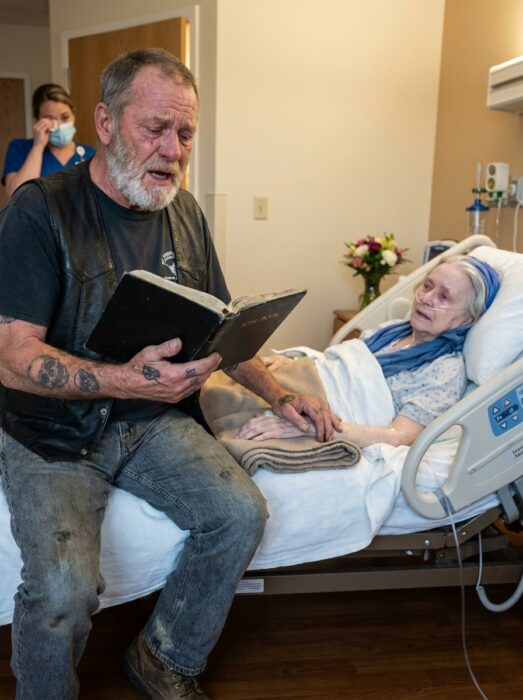
I had known Sam for almost four years by then, but only in the narrow way hospital staff know regular volunteers. I knew he took coffee black, never ate from the family snack basket unless someone insisted, and always removed his gloves before entering a room. I knew he spoke softly to dying patients and almost never spoke about himself. I knew he had a habit of standing near doorways instead of inside rooms until he was invited farther in, as if some part of him still believed comfort had to be earned.
What I did not know was why he sang.
Most volunteers have a reason, even if they do not share it at first. Some lost a spouse. Some survived illness. Some are retired and afraid of being useless. Some are religious. Some are lonely and dress their loneliness up as service because it hurts less that way.
Sam had never explained his reason.
He simply arrived every Saturday afternoon, rain or heat or football season, with that old songbook and a voice that should have embarrassed him but never did. When families thanked him, he nodded. When nurses praised him, he shrugged. When a patient asked if he had ever sung professionally, he actually laughed once and said, “Ma’am, I barely sing legally.”
That was Sam.
Dry. Gentle. Guarded.
Outside the hospital, he belonged to a small riding club called the Cumberland Sons, older men mostly, veterans, mechanics, widowers, one retired mailman, and a former high school principal who had more tattoos than any principal I ever met. They rode the mountain roads outside Knoxville, did charity toy runs, raised money for burn victims, and gathered at a roadside diner where the coffee tasted like rust and the biscuits could make a grown man forgive Tennessee humidity.
Sam was their quiet center.
Not president. Not loudest. Not the one who told stories.
But when he stood, men paid attention.
His past was full of pieces nobody pressed too hard. There had been an accident when he was young. A mother who died. Foster homes for a while. A teenage runaway stretch. A bad marriage. A daughter he saw every Thanksgiving and called every Sunday. He had worked road construction, truck dispatch, security, and later ran a small motorcycle repair shop until arthritis made the wrenches harder to hold.
He did not drink anymore.
He did not talk about when he did.
Five years before Eleanor arrived, Sam had walked into St. Mary’s Hospice with a paper application folded in half. He looked so out of place at the volunteer desk that the receptionist almost asked if he was there for security. Instead, he cleared his throat and said he wanted to sing for patients.
The volunteer coordinator asked if he had musical training.
Sam said no.
She asked if he sang in church.
He said not where anyone could hear.
She asked, carefully, why hospice.
Sam looked down at his boots.
“People shouldn’t leave quiet unless they want to.”
That answer got him through the door.
At first, some families refused him. Some patients did too, and he never took offense. The first few months were awkward, the way mercy can be awkward when it arrives wearing black leather. But then word spread on the floor. The biker could sit with the restless ones. The biker did not flinch at oxygen masks, swollen hands, or silence. The biker sang badly, but he stayed.
And staying is a language the dying understand.
By the time Eleanor Whitaker arrived in room 214, Sam had become part of the hospice wing’s strange ecosystem. The chaplain prayed. The nurses medicated. The volunteers brought blankets and magazines. Sam sang.
That Saturday, however, the song did something none of us expected.
It reached backward.
Part 3
Eleanor’s daughter, Karen, was the first to speak after her mother said she knew Sam from fifty years earlier. Karen was forty-eight, white American, exhausted in the way adult children become when they are trying to lose a parent politely. She had been sitting beside the bed with a sweater over her knees, holding a paper cup of ice chips her mother no longer wanted.
“Mom,” she said softly, “are you sure?”
Eleanor did not look at her daughter.
She kept looking at Sam.
“I’m sure of the song,” she said. “And I’m sure of the boy.”
Sam swallowed hard. “Ma’am, I don’t remember you.”
“That doesn’t surprise me,” Eleanor said, and her voice was weak but steady. “You weren’t remembering much then.”
I saw his hand tighten around the songbook again. His thumb pressed into the cracked black cover until the skin blanched around the nail. The old biker, who had sung through death rattles and last breaths and families falling apart, looked suddenly like a man standing too close to a cliff edge in the dark.
Eleanor asked for water.
I helped her sip through a straw, and when she settled back against the pillow, she closed her eyes. For a moment, I thought the conversation had drained her. Then she began again, speaking slowly, with long pauses where breath had to be gathered like loose thread.
She had been twenty years old in 1974, a new nurse at a small hospital outside Chattanooga. Back then, she wore white shoes, a white dress, and a cap pinned so tightly to her hair that she had headaches by lunch. She was young enough to believe skill could save everyone and old enough, after six months on night shift, to know it could not.
One rainy night in October, an ambulance brought in a ten-year-old boy after a crash on a two-lane road. His mother had been driving. A truck had crossed the center line. She died before they could get her out. The boy survived with a broken arm, bruised ribs, a concussion, and the kind of silence doctors did not know how to chart properly.
He would not speak.
Not to doctors.
Not to police.
Not to the social worker.
Not to the aunt who arrived smelling like cigarettes and panic.
For three days, he lay in a hospital bed staring at the wall. He ate if someone lifted the spoon. He slept in pieces. When nurses changed bandages, he did not complain. When someone mentioned his mother, he blinked once and turned his face away.
Eleanor was assigned to him on nights.
“I was too young to know what to say,” she told Sam. “So I stopped trying.”
Instead, she sat beside him after midnight, when the halls were dim and the ward settled into machine hums, distant coughs, rubber soles, and whispered pages. She hummed at first because she was nervous. Then she sang the only song her grandmother used to sing when fear entered a room.
Amazing Grace.
Not beautifully.
Eleanor admitted that with the faintest smile.
“I had a thin little voice,” she said. “Shaky. Always too low at the start and too high by the end.”
Sam’s face changed at that.
Just slightly.
But I saw it.
So did Eleanor.
She kept singing to the boy every night, one verse, sometimes two, never asking him to respond. On the fourth night, halfway through the line “was blind, but now I see,” the boy whispered something.
She leaned close.
He said, “She sang that.”
His mother.
Those were his first words after the accident.
Eleanor sat with him until morning. After that, he began answering small questions. Yes. No. Water. Hurts. Mom. He did not heal all at once, because children do not become fine just because adults are relieved. But he came back far enough for the world to reach him again.
When Eleanor finished, Sam was staring at the floor.
His eyes were red.
His face was dry.
“I don’t remember your face,” he said.
Eleanor nodded. “I didn’t expect you to.”
“I remember the song.”
“I know.”
His voice roughened. “I remember somebody singing it when the lights were low.”
Eleanor smiled, and for a second, seventy years fell away from her face.
“That was me, sweetheart.”
No one in the room moved.
Outside the door, two nurses had stopped pretending not to listen. Karen had one hand over her mouth. The oxygen machine gave its soft, steady hiss. Sam stood there in his leather cut, holding the songbook like it had suddenly become evidence.
Then Eleanor said the sentence that broke him without making him cry.
“You sing like I did back then.”
Sam looked up.
She nodded. “Not pretty. Just there.”
Part 4
The next three days became something none of us could have planned.
Eleanor declined quickly, which hospice workers can sometimes feel before the numbers confirm it. Her breathing changed. Her hands cooled. Her words became fewer, then came in small windows, as if she were opening a door only briefly before the effort became too much. Karen stayed beside her. Her grandchildren visited once, two teenagers who tried to be brave and failed in the honest way teenagers do when death is too close to pretend around.
Sam came every day.
Not only Saturday.
He arrived Monday afternoon without the songbook at first, which surprised me. He stood outside room 214 for nearly a minute, one hand resting on the doorway, leather cut creaking softly when he shifted his weight. I asked if he needed anything.
He shook his head.
“Just trying to be ten and sixty at the same time.”
That was the most he had ever given me in one sentence.
When he entered, Eleanor was awake. Barely, but awake. Her eyes moved toward him, and her mouth curved a little.
“Brought the motorcycle choir?” she whispered.
“No, ma’am. Just me.”
“Good. One of you is plenty.”
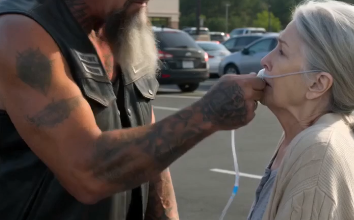
He sat beside her bed, not in the family chair, but on the smaller visitor stool that put him lower, closer to where a patient’s hand could reach if she wanted. Eleanor did reach. Her fingers were thin and cool against his tattooed hand. The contrast was almost too much to look at: the dying nurse and the old biker, connected by one song crossing half a century.
He sang “Amazing Grace” again.
The first verse only.
His voice broke twice. Eleanor closed her eyes and mouthed one line with him, though no sound came out. When he finished, she squeezed his hand with what little strength she had.
“Better,” she whispered.
Sam huffed, almost a laugh. “No, it wasn’t.”
“Never said prettier.”
The next day, he brought something wrapped in a bandana. It was an old hospital bracelet, yellowed with age, sealed inside a clear plastic sleeve. His name was printed on it in faded type: Samuel Cole. Age 10. Date: October 1974.
He had gone home after Eleanor’s revelation and searched through a shoebox his daughter had once told him to throw away. Inside were papers from foster placements, his mother’s funeral card, an old photograph of a boy with a cast on his arm, and that bracelet.
Eleanor looked at it for a long time.
“I wondered what happened to you,” she said.
Sam’s jaw worked once before he answered.
“Mostly bad. Then some good.”
“That counts.”
“Does it?”
She opened her eyes fully then, with the authority of a nurse who had seen too many lives to accept easy self-condemnation.
“Yes.”
He looked away first.
For men like Sam, forgiveness often feels more dangerous than judgment. Judgment is familiar. Forgiveness asks them to put down weapons they have carried so long their hands have shaped around them.
On Wednesday morning, Eleanor asked Karen to call Sam. He came within the hour, his Harley still ticking in the parking lot when he walked in. The hospice wing was quiet, the way it gets before rain, though the sky outside was clear. Eleanor was breathing in longer spaces by then. Karen sat on one side. Sam stood on the other.
Eleanor opened her eyes.
“Sing me out,” she whispered.
Sam bent closer.
“Now?”
“If you don’t mind.”
His mouth tightened.
“No, ma’am.”
He sang.
This time, he did not look at the songbook. He knew the words, of course. He had known them all along, though until that week, he had never understood where the knowing came from. His voice was rough, uneven, and low. It scraped on the higher notes. It shook on the word “home.” But he stayed with it, line after line, while Eleanor’s breathing grew softer.
She did not die during the song.
Real life rarely times itself that cleanly.
But she slept after it, and three hours later, with Karen holding her hand, Eleanor Whitaker died.
Sam was in the chapel when I found him.
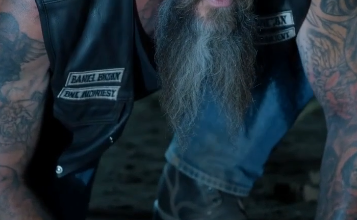
He was sitting in the back row, elbows on knees, hands folded, staring at nothing. His leather cut was still dry. His beard was dry. His eyes were red enough that I did not need to ask whether he had cried somewhere no one could see.
I told him she was gone.
He nodded once.
Then he said, “She gave me my first words back.”
I sat beside him.
He added, after a long minute, “I spent fifty years thinking I was the one singing to them.”
He looked toward the chapel doors.
“Turns out I was just returning it.”
Part 5
Eleanor’s funeral was held five days later in a small Baptist church outside Maryville, tucked between green hills and a two-lane road where late summer heat shimmered above the asphalt. The church was the kind with wooden pews, ceiling fans that clicked at uneven intervals, and stained glass that painted soft color across the hymnals. It smelled like lilies, floor polish, and old paper.
Sam almost did not go.
He told me that later.
He sat on his Harley in his driveway for twenty minutes wearing his black leather cut and holding his helmet, unable to decide whether a man from one forgotten hospital room had any right to stand among Eleanor’s family. Then his daughter called him, because daughters know when fathers are pretending not to need permission.
“She remembered you,” his daughter told him. “Go remember her.”
So he went.
The Cumberland Sons went with him, not roaring into the church lot like a scene from a movie, but quietly, one bike at a time, engines cut early, helmets removed, boots softened as much as boots can soften on gravel. They stood at the back in leather and denim, hands folded, heads bowed, making space for family first. Nobody performed grief. Nobody tried to own it.
Karen saw Sam near the door and came straight to him.
She hugged him before he could brace for it.
“My mother talked about that boy,” she whispered.
Sam’s hand hovered awkwardly, then rested once against her shoulder.
“I didn’t know.”
“She wondered if you made it.”
He looked down.
“Some days, barely.”
Karen pulled back and looked him in the face.
“She would’ve liked that answer.”
During the service, the pastor spoke about Eleanor’s forty-seven years of nursing, about babies delivered, hands held, night shifts worked, families comforted, and patients remembered long after their charts disappeared. Her grandchildren read a letter. A former coworker told a story about Eleanor singing to patients when the hospital had no policy for such things, only need.
Then Karen walked to the microphone.
“My mother asked for one song,” she said.
Sam’s shoulders stiffened.
Karen looked directly at him.
“She asked for Sam to sing it.”
The church turned.
Not dramatically. Just enough.
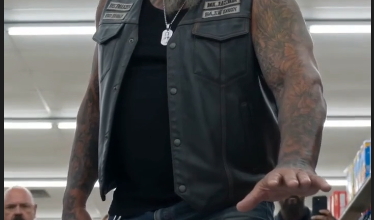
Sam stood in the back pew, large and rough and suddenly exposed. His brothers stepped aside without a word. He walked down the aisle carrying no songbook. His boots sounded too heavy against the old wood floor, but no one flinched. At the front, he stopped beside Eleanor’s casket, where a folded nurse’s cap rested among white flowers.
He placed one tattooed hand on the edge of the casket.
Not for show.
For balance.
Then he sang “Amazing Grace.”
Badly, if we are measuring by music.
Beautifully, if we are measuring by truth.
His voice cracked on the first line, just as it had in her hospice room. It wavered in the second verse. Twice he had to pause because breath would not come evenly. Nobody helped him. Nobody needed to. The whole church seemed to understand that the brokenness was part of the offering.
By the final line, Karen was crying into both hands.
Eleanor’s grandchildren held each other.
At the back, a row of bikers stood absolutely still, eyes forward, jaws tight, every one of them pretending they had allergies in a church with no open windows.
Sam finished.
He did not say anything.
He touched the nurse’s cap once, turned, and walked back down the aisle.
Outside after the service, Karen gave him a small envelope. Inside was a photograph none of us had seen before. Eleanor at twenty years old, standing beside a hospital bed in a white nurse’s uniform, smiling shyly at the camera. In the bed was a ten-year-old boy with a cast on his arm, looking tired, suspicious, and alive.
On the back, in Eleanor’s handwriting, were five words.
He spoke today. Thank God.
Sam held that photo for a long time.
Then he folded it carefully and tucked it inside his leather cut, against his chest.
Part 6
After Eleanor died, Sam did not stop singing at hospice.
For a few weeks, some of us wondered whether he would. Sometimes revelations open old doors, and sometimes old doors lead to places a person cannot keep visiting every Saturday afternoon. I would not have blamed him if he quit. Nobody would have. Learning that the song you give away was first given to you can make the whole act heavier.
But the next Saturday at 2:15, the elevator doors opened.
Sam stepped out with his songbook under one arm.
Same boots. Same leather. Same rough beard. Same quiet nod toward the nurses’ station.
I looked at him, and he looked at me.
“Who needs music today?” he asked.
That was it.
The ritual continued, but something in it deepened. Sam still sang for patients, still accepted refusals, still joked that his voice came with no warranty. But now, tucked inside the back cover of his songbook, he carried Eleanor’s photograph. Not where everyone could see it. Just where he could touch it before certain rooms.
I saw him do it often.
Before singing to a child’s grandfather who had not opened his eyes all day. Before singing to a woman whose daughter was running late from Atlanta. Before singing to a veteran who asked for silence first, then changed his mind as Sam reached the door.
He touched the photograph.
Then he sang.
The Cumberland Sons noticed too. Men like that pretend not to be sentimental, but they track changes in one another the way riders track weather. One Saturday, Bishop, their oldest member, followed Sam into the hospice lobby with a guitar case. Sam stopped dead.
“No.”
Bishop, seventy-one and stubborn as a fence post, shrugged. “Didn’t ask.”
“I don’t need backup.”
“Never said you did.”
“You any good?”
Bishop smiled. “Worse than you.”
That was how the hospice singing became two men some Saturdays, then three on holidays, then a quiet little group in the chapel once a month for families who wanted music but not a formal service. They were careful. No loud engines under patient windows. No crowding rooms. No turning grief into a biker parade. Sam made those rules clear.
“This ain’t about us,” he told them.
And they listened.
Ten years passed that way.
Sam turned seventy. His beard went nearly white. His hands stiffened with arthritis, and some Saturdays he had to sit while he sang because his knees did not like long hallways anymore. He kept coming. Rain, heat, December sleet, football Saturdays, birthdays, and once, two days after surgery on his shoulder when the nurses threatened to call security if he did not sit down.
He sat.
He sang anyway.
Every year, on the anniversary of Eleanor’s death, Sam rode to the little Baptist church outside Maryville. He brought no flowers. He only stood near her grave, removed his gloves, and sang one verse of “Amazing Grace” in that rough, shaking voice.
Then he rode back to St. Mary’s.
There was always someone waiting.
Part 7
The last time I heard Sam sing, he was seventy-four and smaller than he used to be, though still broad enough to make the hospice hallway seem narrow around him.
His leather cut hung looser. His steps were slower. His Harley stayed parked closer to the entrance now because none of us would let him pretend the long walk was easy. He grumbled about it, of course, but he parked there anyway.
That afternoon, a man in room 207 had asked for a hymn but could not remember the name. His wife hummed two notes, embarrassed, and Sam nodded like that was plenty.
“Amazing Grace,” he said.
He sat beside the bed, opened the old black songbook, and before he began, I saw his fingers slip to the photograph tucked inside the back cover. Eleanor at twenty. Sam at ten. One nurse, one silent boy, one song crossing fifty years and then another ten after that.
His voice was worse by then.
Thinner. Rougher. More air than sound in places.
But the room did not need pretty.
The dying man’s wife closed her eyes. The patient’s breathing slowed. In the hallway, two young nurses stopped to listen, not because anyone told them to, but because some sounds make people pause without knowing why.
Sam sang the first verse, then the second.
When he reached “was blind, but now I see,” his voice cracked exactly where it always did.
He smiled a little.
Maybe at the crack.
Maybe at the memory.
Maybe at a young nurse from 1974 who had once sat beside a silent boy and offered the only thing she had.
When he finished, the wife whispered, “Thank you.”
Sam closed the book.
“No, ma’am,” he said softly. “I’m just passing it on.”
Then he stood slowly, one hand on the chair, boots steadying beneath him, and walked back toward the elevator while the hallway held the last fading note.
Outside, somewhere beyond the glass doors, his Harley waited in the Tennessee light.
The song stayed behind.
Follow the page for more stories about the people we almost judge too quickly.