Part 2: A 280-Pound Biker Sat In A Tiny Plastic Chair At His Daughter’s Parent-Teacher Conference For Two Hours — Then Said One Sentence That Made The School Rewrite Its Bullying Policy
Part 2
Before that conference, I believed I was a good teacher.
That is not easy to admit now, because it sounds like the beginning of an excuse, but it matters to the story. I cared about my students. I bought extra snacks when families forgot. I stayed late cutting construction paper into shapes that would be torn apart in twenty minutes. I learned which children needed movement before circle time and which ones needed a quiet warning before transitions. I was not cruel, lazy, or indifferent.
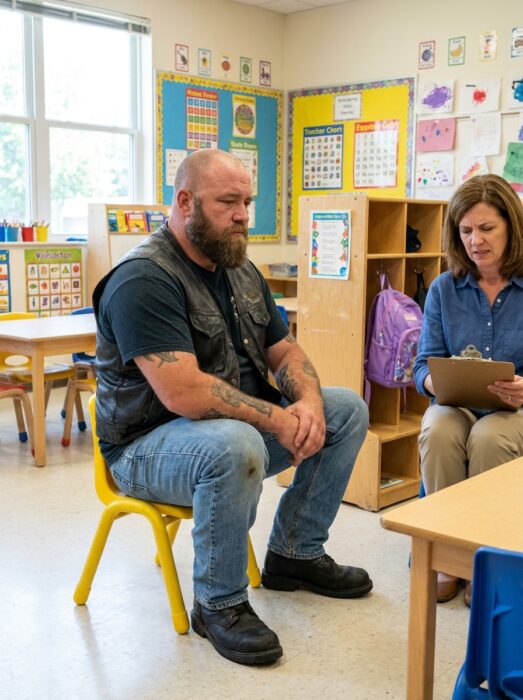
But I had become trained in soft language.
Schools are full of it.
We said “peer conflict” when one child was afraid to go to recess. We said “hands-on behavior” when a child was shoved. We said “unkind choices” when a group of children targeted the same small girl every day because her father came to pickup in leather, because her boots were secondhand, because she spoke quietly and did not know how to fight back.
Soft language made adults feel manageable.
It did not make children safer.
Grace Mercer had been in my class since August, and from the first week, I knew she was tender in a way classrooms can either protect or devour. She liked rules because rules made the world predictable. She asked permission before sharpening pencils. She smiled with her lips closed. When other children ran, she walked near the wall and watched their feet so she would not get knocked down.
Her father picked her up every afternoon at 2:40.
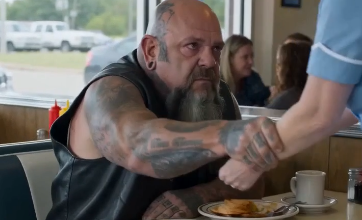
The first time I saw Caleb Mercer, I understood why some parents stared. He was massive, tattooed, and quiet, with a leather biker vest that looked out of place beside cartoon backpacks and laminated lunch menus. His boots made a heavy sound on the sidewalk. His motorcycle rumbled near the curb once or twice a week, though he usually parked far from the pickup line so the noise would not scare the children.
Grace never ran to him loudly.
She walked fast.
There is a difference.
She would hold up a drawing, or a leaf, or a sticker she had earned, and that huge man would crouch down until his knees cracked, take whatever treasure she offered, and study it like she had handed him a legal document. He did not talk much. He mostly nodded, listened, and asked one question every day.
“Did your heart feel safe today?”
I thought it was sweet.
I did not understand it was a warning system.
Later, I learned Caleb had grown up in foster homes where adults called violence “roughhousing” until someone got badly hurt. He had been the boy teachers described as “angry” after years of being made afraid. He had fought too much as a teenager, ridden with men who mistook intimidation for strength, and spent half his twenties learning that being feared was sometimes easier than being ignored.
Then Grace was born.
Her mother, Angela, left when Grace was two, not because Caleb was violent, but because grief and money and exhaustion had broken parts of their marriage neither knew how to repair. Caleb got primary custody after Angela moved out of state for work and, to his credit, never taught Grace to hate her mother. He learned ponytails, lunch packing, bedtime stories, pediatric forms, and how to sit through school events while other parents judged his tattoos before his patience.
He was not perfect.
No parent is.
But he was present in a way that made excuses unnecessary.
The three children hurting Grace were not monsters either. That made everything harder. They were five and six years old, still learning empathy, still shaped by homes, screens, siblings, and adults who sometimes laughed at meanness before realizing children were recording it. But the harm was real even if the children were young.
That was what Caleb understood before I did.
Intent mattered for discipline.
Impact mattered for safety.
And Grace had been unsafe.
Part 3
The false climax happened three days after the conference, when I believed a simple classroom meeting would fix what had gone wrong.
I had spoken with the principal, written incident summaries, contacted the other parents, and used the phrase “pattern of targeted behavior” because Caleb’s words had already started changing the way I heard myself. The principal, Dr. Anita Lewis, was a Black American woman in her early fifties, sharp-eyed, calm under pressure, and exhausted by the endless balance between policy, parents, and children who needed more than the school could always give. She listened carefully when I repeated what Caleb had said.
If three adults did to you what those three kids did to Grace, you wouldn’t call it conflict.
Dr. Lewis sat back in her chair.
“He said that?”
“Yes.”
“And you wrote it down?”
I nodded.
“Good,” she said. “Because he’s right.”
We held a morning circle that Friday. Not to shame anyone by name, but to talk about bodies, safety, kindness, and the difference between an accident and something repeated. I thought Grace would feel reassured. I thought naming the harm would make it stop.
For one hour, it seemed to work.
Then came recess.
I was inside helping a student with a bathroom accident when the playground aide radioed for me. Her voice was tight. By the time I reached the fence, Grace was sitting on the bench with wood chips stuck to her leggings and both hands pressed over one ear. Her braid had come loose. Her purple backpack was upside down near the slide, emptied into the mulch. Crayons, a folder, a small horse drawing, and her lunchbox were scattered everywhere.
The three children stood near the climbing wall.
One looked scared.
One looked defiant.
One was crying because the aide had raised her voice.
Grace was silent.
That silence scared me more than tears would have.
I crouched in front of her and asked if she was hurt. She shook her head, but the red mark on her wrist said otherwise. When I asked what happened, she looked past me toward the pickup gate, even though it was only 10:35 in the morning.
“I want Daddy,” she whispered.
I called him.
That call remains one of the hardest I have ever made.
Caleb answered from the garage where he worked. I could hear metal tools, an air compressor, and the rough sound of men talking in the background. When I told him there had been another incident, the line went quiet.
Not angry quiet.
Worse.
Controlled quiet.
“Is she hurt?”
“Her wrist is red, and she’s very upset.”
“I’m coming.”
He hung up without saying goodbye.
Twenty minutes later, his Harley turned into the school lot, not roaring, not dramatic, just present. He parked, cut the engine, removed his gloves, and walked toward the office with his leather vest over a gray work shirt. Every adult in the front office became aware of him at once.
Grace was sitting beside my desk.
When she saw him, she did not cry harder. She simply stood, walked to him, and pressed her face into his stomach. His tattooed hand hovered over her hair for half a second before settling gently on her back.
He looked at me.
“What happened after I left that chair?”
That question was not accusation.
It was accountability.
And I did not have a good enough answer.
We sat in the principal’s office with Dr. Lewis, the counselor, the playground aide, and eventually the parents of the three children. The room became tense quickly. One parent insisted her son was “just energetic.” Another said children were too young to understand consequences. A third became defensive and asked whether Grace might be exaggerating because “some kids are sensitive.”
Caleb’s face did not change.
But his hand tightened once around Grace’s backpack strap.
Dr. Lewis explained the pattern, the previous incidents, the conference, and the morning’s escalation. The parents listened the way many parents listen when shame is too close: partly defensive, partly frightened, partly unable to see their own child as someone who could cause real harm.
Then one father made the mistake of saying, “They’re kindergarteners. It’s not like it’s assault.”
Caleb looked at him.
The room stopped breathing.
He did not stand. He did not raise his voice. He did not threaten anyone.
He only slid the tiny yellow chair note from his pocket, the one where he had written his own words after the conference, and placed it on the principal’s desk.
“My daughter is five,” he said. “That doesn’t make pain pretend.”
That became the second sentence Dr. Lewis wrote down.
And this time, everyone heard it.
Part 4
The real change did not happen because Caleb was intimidating.
That is what people outside the school liked to believe later because it made the story simpler. Big biker scares school into protecting daughter. It sounded dramatic. It sounded clean. It was also wrong.
Caleb changed the school because he refused to let anyone hide behind language.
He asked for written incident classifications. He asked who was responsible during transitions. He asked whether repeated physical targeting triggered a different response than name-calling. He asked why parents received softer summaries than what teachers documented internally. He asked whether Grace’s fear of recess had been treated as emotional sensitivity instead of evidence.
Every question was calm.
Every question landed.
Dr. Lewis did not fight him. That mattered too. A weaker principal might have protected the school’s image first. She protected the child. She opened the district policy binder, called the assistant superintendent, and admitted in front of everyone that their categories were too broad. “Bullying” was covering too much, and when a word covers everything, it can hide the worst things inside it.
The three children were formally disciplined, but not in a theatrical way. They were removed from Grace’s recess group, assigned supervised social skills intervention, required to make age-appropriate repair, and their parents had to attend meetings with the counselor. One child’s father resisted until Dr. Lewis asked him to describe, out loud, what he would call it if three coworkers blocked his wife’s path, dumped her bag, pulled her hair, and shoved her down.
He did not answer.
That silence did more than argument could have.
Grace was given a safety plan, not because she was responsible for preventing harm, but because adults needed a visible map of what protection looked like. She got a check-in adult, a safer line position, monitored recess zones, and permission to come directly to my desk if she felt unsafe without asking another child’s permission to leave.
Most importantly, I changed.
I wish I could say it happened instantly when Caleb spoke, but real change is more humiliating than that. It happened in layers. I reread my own notes and saw how many times I had softened what Grace had endured. I had written “backpack misplaced” when it had been hidden. I had written “rough play” when she had been shoved. I had written “peer teasing” when three children had repeated insults about her father’s job, her clothes, and her quietness until she stopped raising her hand.
Words had failed her before policy did.
That realization hurt.
Caleb never demanded my resignation. He never called me a bad teacher. In fact, two weeks after the office meeting, he brought me a coffee during pickup and set it on my desk without a speech.
I said, “I’m sorry.”
He looked at the classroom, where Grace was showing another child how to draw horse legs.
“I know.”
“I should have understood sooner.”
“Yeah.”
That was Caleb. No false comfort. No cruelty either.
Then he added, “But you heard me eventually.”
I nodded.
He looked back at Grace.
“Make sure you hear the next kid faster.”
That sentence stayed with me longer than any professional development training ever had.
Part 5
The school board meeting happened six weeks later.
I did not expect Caleb to attend, and I definitely did not expect him to bring the yellow chair. But he walked in carrying it under one tattooed arm like evidence from a trial. The room was full of adults in business casual clothing, district staff, a few parents, and two reporters from a local online news page because word had spread that the district was reviewing its bullying response after a kindergarten case.
Caleb looked painfully out of place.
He wore his black leather cut, dark jeans, boots, and the same calm expression he had worn in my classroom. Some people stared at the tattoos. Some stared at the chair. One board member looked nervous enough to reorganize his papers twice.
When public comment opened, Caleb stood.
He placed the tiny yellow chair beside the podium but did not sit in it this time.
“My name is Caleb Mercer,” he said. “My daughter is in kindergarten.”
His voice filled the room without needing volume.
He told them he was not there to shame children. He said five-year-olds could learn, parents could learn, schools could learn, and he had once been a boy people gave up on too quickly because they did not know what to do with his anger. Then he put one hand on the back of the plastic chair.
“I sat in this chair for two hours,” he said, “because my daughter sits in chairs like this every day, and I needed to remember how small the world feels from down there.”
No one moved.
He continued, “When adults make the words smaller, kids feel smaller too. If a child is repeatedly shoved, cornered, grabbed, humiliated, or kept afraid, don’t bury it under a word that lets everybody breathe easier. Name the harm, then stop it.”
That was the part the reporter quoted.
But the part I remember came after.
Caleb looked down at the chair and said, “I’m not asking you to treat children like criminals. I’m asking you to treat hurt like it counts before somebody grows up believing it doesn’t.”
The district changed the policy that spring.
Not perfectly. Schools rarely change perfectly.
But they created clearer categories: verbal harassment, social exclusion, repeated intimidation, physical aggression, targeted physical harm, and assault-level behavior requiring immediate administrative review. They changed parent notification language. They required documentation patterns to be reviewed weekly when the same child was repeatedly involved, either as target or aggressor. They trained teachers to stop using “conflict” when there was a power imbalance or repeated harm.
Grace’s case did not become famous nationwide.
There was no viral video, no dramatic lawsuit, no television interview with Caleb sitting beside his Harley looking noble. He would have hated that. But inside our district, people remembered the biker with the yellow chair.
So did the children.
Months later, Grace began raising her hand again. She played near the swings. She still startled sometimes when someone moved too fast behind her, but less often. One of the children who had hurt her eventually apologized in a way that sounded coached at first and real later. Grace did not become best friends with them. She did not have to.
Safety is not the same as forced forgiveness.
Caleb understood that too.
Part 6
Years passed, and classrooms changed the way classrooms do.
Students moved up. Teachers transferred. The alphabet rug was replaced after juice stains defeated every cleaning attempt. Dr. Lewis retired with more gray in her hair and more respect in the district than any plaque could properly hold. I stayed at the school, older, better, less certain in the ways that make teachers more useful.
Grace grew.
By third grade, she wore her hair in one long braid down her back and carried sketchbooks full of horses that finally had the correct number of legs. By fifth grade, she helped younger students find their buses. By middle school, she joined art club and once told me, with the dry seriousness of a thirteen-year-old, that kindergarten had been “a lot.”
Caleb still came to school events.
Still too large for the chairs.
Still quieter than people expected.
He came to art nights, winter concerts, parent breakfasts, and one anti-bullying assembly where Grace read a short paragraph about how adults should listen before children have to scream. Caleb stood at the back of the gym the whole time, arms folded, leather vest creaking softly when he shifted.
He did not clap loudly.
He just pressed two fingers to his mouth and nodded once when Grace looked his way.
After Dr. Lewis retired, the staff held a small ceremony in the library. Caleb came near the end, carrying flowers and looking uncomfortable because bikers and school libraries do not naturally understand each other. Dr. Lewis saw him and laughed.
“I wondered if you’d show.”
He handed her the flowers.
“Wouldn’t miss it.”
Then she disappeared into the storage room and came back holding the yellow plastic chair.
The same one.
I had not known she kept it.
She gave it to him without ceremony.
“I think this belongs with you,” she said.
Caleb stared at it for a long moment.
“That chair did more work than most adults that year,” she added.
He ran one tattooed hand over the backrest, where the plastic had a faint stress mark from the day it held him for two hours.
“Grace might want it,” he said.
Dr. Lewis smiled.
“Maybe. But I think you know where to put it.”
He did.
That chair went into his garage beside the Harley, under a shelf of oil cans and riding gloves, looking absurd and perfect against the concrete wall. I saw it once when Grace invited me to her high school graduation party. The Road King stood on one side, black and heavy. The tiny yellow chair sat on the other, bright as a warning sign.
Someone had written on the back in black marker.
HEAR THEM FIRST.
Caleb said Grace wrote it.
He pretended not to be proud.
No one believed him.
Part 7
Grace is grown now.
She is studying child psychology at Arizona State, which surprised nobody who watched her become the kind of teenager younger kids trusted with secrets. Caleb says she chose that field because she likes “making adults use the right words,” and when he says it, his beard hides most of his smile but not all of it.
The yellow chair is still in his garage.
Not displayed like a trophy.
More like a tool.
It sits beside the Harley, near the workbench, beneath a row of hooks where his leather cut hangs after long rides. Sometimes bikers from his club ask about it when they come by for repairs, and Caleb tells the story if Grace allows it. Not the dramatic version. Not the heroic version. Just the true one.
“My kid was getting hurt,” he says. “School called it smaller. We fixed the words first. Then we fixed the room.”
That is usually all.
But once, I watched a younger father hear the story while standing in that garage with his own son’s backpack in his hands. His face changed the way mine had changed years earlier. Like shame had become instruction instead of weight.
He left with the school principal’s number written on a receipt.
Caleb sat in the yellow chair after he was gone.
He barely fit, same as before.
His knees rose too high. His boots planted wide. The plastic creaked under him, but it held.
Outside, the Harley cooled in the evening air.
Inside, the chair stayed bright.
Follow the page for more stories about the people we almost judge too quickly.