Part 2: A Heavily-Tattooed 290-Pound Biker Spent Eight Hours Building A Fairy Garden In His Backyard — But His Daughter Would Never Get To See The Promise He Finally Kept
Part 2
Before Rosie got sick, Bear’s backyard had been nothing special.
It was a patch of stubborn grass, a leaning fence, an old grill with one missing wheel, two rusty lawn chairs, and a maple tree that dropped more leaves than shade. The garage was where Bear seemed most alive. He was a motorcycle mechanic, the kind of man who could hear an engine cough and know which part was lying. Neighbors brought him lawnmowers, old bikes, stuck bolts, and once, a broken wheelchair ramp latch, because Bear fixed things without making people feel foolish for needing help.
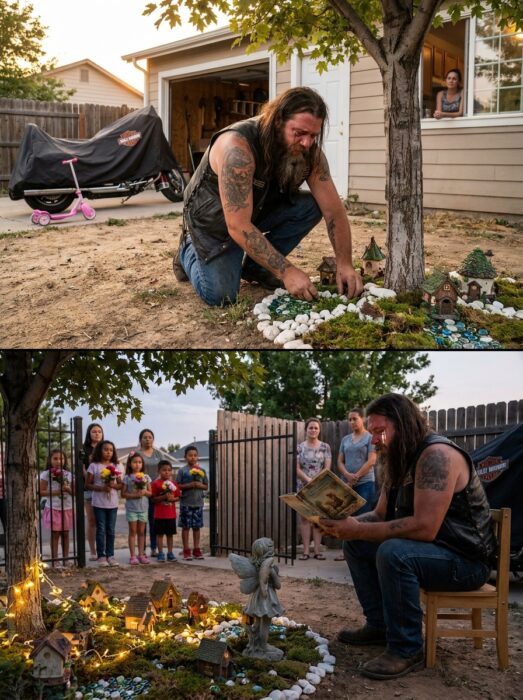
But children knew another version of him.
They knew the man who kept sidewalk chalk in a coffee can for Rosie and anyone who wandered close enough. They knew he let kids sit on his Harley when it was off, as long as they wore his giant helmet for the picture. They knew he could braid badly, paint tiny nails with surprising patience, and make dinosaur pancakes that looked more like injured turtles but tasted good enough that Rosie bragged about them anyway.
Rosie had changed the shape of him.
People like to say children soften rough men, but I do not think that is quite right. I think Rosie revealed the softness already trapped inside him and gave it somewhere safe to go. Bear still looked the way he looked. He still wore leather, still had tattoos down to his wrists, still scared delivery drivers by answering the door too quickly. But when Rosie called his name, his whole body changed direction.
She had been four when she discovered fairies.
It started with a cheap picture book from a thrift store, the kind with glitter on the cover and pages that had been turned by many small hands before hers. Rosie decided immediately that fairies lived everywhere adults forgot to look. Under porch steps. Behind mailboxes. Inside cracks in sidewalks. In the hollow behind Bear’s garage, where weeds grew and one old clay pot had broken in half.
She built her first fairy house there out of popsicle sticks, bottle caps, and a screw she stole from Bear’s workbench.
When he found the missing screw in the dirt, he asked what it was doing there.
Rosie said, “That’s the doorbell.”
Bear nodded as if that made perfect sense.
After that, he kept a small jar on the workbench labeled FAIRY PARTS. Inside were spare washers, buttons, beads, polished stones, old keys, broken jewelry, and any tiny thing Rosie declared useful. On good days, she would sit beside him in the garage while he repaired motorcycles and organize fairy parts by “sparkly,” “door stuff,” and “things they might sit on.”
During treatment, the jar followed them.
Bear brought it to hospital rooms in a plastic container because Rosie said fairies probably visited sick kids more if they had building supplies. Nurses found bottle caps under pillows, beads in blanket folds, and one tiny painted door taped inside the window facing the parking lot. Bear apologized every time. Rosie did not.
She told one nurse, “They need entrances.”
That nurse cried in the hallway later.
The fairy garden promise came during one of Rosie’s better weeks, when medicine had given her enough energy to sit outside, but not enough to play. Bear had been trying to keep the yard alive because Rosie still liked watching butterflies. The dirt under the maple tree was ugly, dry, and bare. Rosie pointed at it like a contractor inspecting land.
“That’s where it goes.”
“What goes, Bug?”
“My fairy garden.”
Bear leaned on the hose.
“What kind of fairy garden?”
Rosie described it with the seriousness of a person planning a city. Flowers for hiding. Lights for nighttime. A tiny path so fairies would not get muddy feet. Mushroom houses. One brave fairy. No scary fairies because “sick kids already have enough scary.”
Bear listened to every word.
Then he promised.
The promise had been meant for a future where Rosie got better.
Grief changed the deadline.
It did not cancel the promise.
Part 3
The false climax came the first night Bear read to the finished garden.
I thought that would be the end of it.
A private ritual. A father keeping a promise one time because the date demanded it, because anniversaries make grief gather itself into tasks. Build the garden. Set the statue. Read the book. Go inside. Close the door. Survive another year.
But Bear came back the next evening.
And the next.
Every night at 7:15, he walked into the backyard carrying Rosie’s favorite book, the one with glitter worn off the cover and a page near the middle repaired with tape. He would lower himself into the same old lawn chair beside the fairy garden, open the book, and read out loud in that deep rough voice that made fairy dialogue sound like truck drivers arguing politely.
At first, I tried not to listen.
Then I realized he did not care who heard.
He read to the garden the way some people pray. Not loudly. Not performatively. Just steadily, as if somewhere past the maple leaves, porch lights, and evening traffic, Rosie might still be able to catch the sound.
Sometimes he added commentary.
“Your fairy queen is making bad decisions here, Bug.”
Or, “I still think the dragon should get a sandwich before the battle.”
Or, “Don’t roll your eyes. I know you liked this part.”
The first time I heard him say, “Don’t roll your eyes,” I had to leave my kitchen.
Not because it was too dramatic.
Because it was too ordinary.
That is where grief hides best. Not in grand speeches, but in the tiny habits that continue reaching for someone who is no longer in the room.
A week after he finished the garden, a little girl from two houses down wandered over while Bear was reading. Her name was Hannah, five years old, Black American, with two puff ponytails and pink glasses that slid down her nose. Her mother, exhausted from chasing her younger brother, did not notice at first. Hannah stood at the fence gate, staring at the fairy lights.
Bear stopped reading.
Hannah asked, “Is that for fairies?”
Bear looked at the garden, then at the little girl.
“Mostly.”
“Can they hear stories?”
“I hope so.”
Hannah considered that.
“Can I hear too?”
Any other man might have said no. Not cruelly, maybe, but from pain, from fear, from the shock of another child standing too close to a space built for the one he had lost.
Bear looked at Rosie’s winged statue in the center of the garden.
Then he opened the gate.
“You can sit on the grass,” he said. “Don’t step on the thyme. Fairies are picky about landscaping.”
Hannah sat.
Bear started the page over.
That was how it began.
One child.
Then two.
Then four.
No invitation went out. No sign appeared. But children notice magic faster than adults notice boundaries, and by the end of that summer, several neighborhood kids knew that if they stood quietly near Bear’s gate at 7:15, the big biker would let them sit near the fairy garden while he read.
Parents were nervous at first.
Of course they were.
A heavily tattooed biker inviting children into his backyard is not an image people understand without context. But they stayed near the fence, watched, listened, and slowly realized what I had already learned from my window.
Bear was not replacing Rosie.
He was refusing to let the place built from loving her become silent.
Part 4
The real change started with flowers.
Mrs. Alvarez from across the street brought the first plant. She was a seventy-two-year-old Mexican American widow with bad knees, sharp opinions, and the prettiest porch geraniums on Willow Creek Lane. She walked to Bear’s gate one Tuesday evening with a small pot of marigolds and said, “For color.”
Bear looked at the flowers like he did not know whether accepting them would violate something sacred.
Mrs. Alvarez pointed her cane toward the garden.
“Your girl liked bright things, yes?”
He nodded.
“Then move.”
He moved.
She planted the marigolds herself because she did not trust his spacing.
After that, people began bringing small things. Not all at once. Not in a way that overwhelmed him. A packet of seeds left on the porch. A miniature bench. A tiny bridge made from popsicle sticks by Hannah and her older brother. Solar lights from a retired schoolteacher. A birdbath no taller than a boot. Smooth painted stones with messages on the bottom, where only someone kneeling would see them.
For Rosie.
For hope.
For small brave things.
Bear accepted each offering with the same awkward tenderness. He never made speeches. He rarely said more than thank you. But he placed every item carefully, sometimes moving it three or four times until it seemed to belong.
The garden grew.
By the second year, it had spread beyond the maple tree into a curved bed along the fence. Bear built little paths between sections, each one wide enough for small feet to follow but narrow enough to keep the world tiny. He added a sign near the gate, hand-painted on a piece of wood.
ROSIE’S FAIRY GARDEN. CHILDREN MAY ENTER. GROWN-UPS MUST WALK SLOW.
That sign changed everything.
Parents started bringing children on purpose. A boy with autism who hated crowded playgrounds came on Sunday mornings to line up smooth stones. A little girl going through chemotherapy at the children’s hospital visited after her aunt heard about the garden from a nurse who had known Rosie. She wore a mask, carried a stuffed rabbit, and stared at the fairy lights like someone had built a piece of childhood that illness had not touched yet.
Bear knelt beside her, enormous and careful.
“You want to add something?”
She held out a purple bead.
He placed it near the brave fairy statue.
“Good choice,” he said. “Purple’s royal.”
The girl smiled.
Her mother cried behind the fence.
By the third year, the garden had become too large to call a backyard project. It was still Bear’s property, still his grief, still Rosie’s promise, but it had taken on a life that belonged partly to the street. On warm evenings, families came with juice boxes, blankets, and storybooks. Bear read some nights. Other nights, children read to the fairies. The Harley remained in the garage, oil-dark and powerful, while just beyond it, small lanterns glowed over miniature bridges and flower beds.
The contrast never stopped stunning me.
A giant biker with tattooed hands, repairing a fairy roof with tweezers.
A grieving father showing children where to step so they would not crush moss.
A man who had lost the one child he built it for, making room for every child who came after.
Part 5
Five years after Rosie died, the city sent a letter.
That was the part none of us expected.
Someone had complained about “public foot traffic” at Bear’s house. The letter was polite, official, and cold in the way only municipal language can be cold. It mentioned zoning, liability, unauthorized community use, and potential code concerns related to repeated neighborhood gatherings.
Bear read it once.
Then he folded it and set it on the kitchen table.
I know because he brought it to me that evening, something he almost never did. I was on my porch watering hanging baskets when he crossed the street with the letter in one hand and Rosie’s book in the other. He looked older than forty-eight that day. Grief had not crushed him, but carrying love publicly for five years had taken a toll people did not always notice.
“They want me to stop letting kids come,” he said.
I read the letter.
“They want paperwork.”
“That’s stopping, just dressed nicer.”
He was not wrong.
For the first time since the garden began, Bear considered closing the gate. Not because he wanted to, but because the thought of a child getting hurt on his property terrified him. Losing Rosie had made him allergic to risks involving children. He could face engines, rain, bad roads, and his own sadness. But the idea that the garden could become a danger to someone else’s child nearly made him dismantle the lights.
The neighborhood did not let him.
Mrs. Alvarez called the council office. Hannah’s mother organized signatures. The retired schoolteacher found a lawyer who volunteered weekends. Parents wrote statements. Children drew pictures. The mother of the little girl with cancer sent a letter saying Rosie’s garden had given her daughter one afternoon where nobody asked about pain, appetite, or blood counts.
At the city meeting, Bear wore his black leather vest.
He also carried the winged girl statue.
Not to manipulate anyone.
To remember why he was there.
When his turn came to speak, he stood before the council members, tattooed hands wrapped around the little statue, and looked more uncomfortable than he ever looked beside a motorcycle.
“My daughter never got to see the garden I promised her,” he said. “So I read to it. Then one kid listened. Then another. I didn’t build a park. I built a promise.”
He paused.
The room waited.
“If the rules say I need insurance, forms, fences, hours, whatever, I’ll do it. I’m not asking the city to ignore safety. I’m asking you not to confuse a living thing with a problem just because it grew bigger than my yard.”
The council approved a compromise.
Limited hours. Parent supervision. A simple neighborhood association agreement. A small liability policy funded by donations Bear tried to refuse and failed. The garden stayed open.
That night, the children returned with paper lanterns.
Bear read Rosie’s book under the maple tree, voice rough as gravel, while tiny lights flickered across fairy houses, flowers, and the statue of a little girl with wings.
For the first time in five years, he did not read alone because he was grieving.
He read because the garden was listening back.
Part 6
By the seventh year, people outside Willow Creek Lane knew about Rosie’s Fairy Garden.
Not because Bear advertised it. He disliked attention so much that when a local reporter asked for an interview, he said, “Talk to the flowers,” and went back to fixing a loose hinge on a fairy door. But stories travel anyway, especially stories that give people a place to put tenderness they do not know what to do with.
Families came quietly.
Always during the posted hours.
Always with parents nearby.
Some came after funerals. Some came after hospital appointments. Some came because their children loved fairies and their parents loved free places where wonder had not been commercialized. Some came because they had heard a biker read stories in a voice so rough it made the brave fairy sound like she rode a Harley through enchanted woods.
Bear added benches.
Then stepping stones with children’s handprints.
Then a small lending box filled with picture books, most of them donated, some of them Rosie’s favorites in new copies because the original stayed with him. The old book he read from was kept inside his house now, too fragile for rain, tape, and small hands. But every year on Rosie’s birthday, he brought it out, sat beside the original garden bed, and read the first story he had ever read to the empty space.
I asked him once if it hurt less with all the children there.
He thought about that for a long time.
“No,” he said. “But it hurts wider.”
I understood what he meant.
Pain had not shrunk. It had spread into something with paths, flowers, laughter, and little rules about walking slowly. It still began with Rosie. Every stone did. Every light. Every mushroom house. Every miniature chair tucked under a leaf. But the grief no longer sat alone in the dirt. It had company.
That may be the kindest thing time can do.
Not erase.
Make room.
Bear never remarried. He never had another child. People sometimes talked about that like it was a tragedy stacked on top of the first one, but I never heard him speak that way. He had been Rosie’s father. He was still Rosie’s father. The garden did not make him less lonely, exactly, but it gave his fatherhood a place to keep moving.
On the tenth anniversary of Rosie’s death, the neighborhood held a small evening gathering. No speeches were planned, because Bear hated speeches, but children made enough paper fairies to cover the fence. Mrs. Alvarez, older and slower now, supervised marigold planting from a chair. Hannah, the first child who had ever asked to listen, came back from college and brought a new sign she had painted herself.
It said: THE BIGGEST LITTLE FAIRY GARDEN.
Bear stared at it.
Then he laughed once, rough and surprised.
Rosie’s words.
Still here.
Part 7
Bear is older now.
His beard is mostly gray, and his knees do not like kneeling as much as they used to, so the neighborhood kids have learned to help with low things. They plant flowers, sweep paths, replace tiny doors, and report fairy house damage with the seriousness of building inspectors. Bear keeps a toolbox near the garden gate labeled FAIRY REPAIRS, filled with glue, twine, paintbrushes, wire, beads, and the kinds of tiny objects Rosie would have sorted into categories only she understood.
The Harley is still in the garage.
The fairy garden is still beside it.
That contrast has become the image most people remember. Chrome and moss. Leather and lavender. A black motorcycle waiting in shadow while warm little lights glow under the maple tree. The man who looks too rough for delicate things, bending carefully over the smallest ones.
Every evening he can, Bear sits beside the garden.
Sometimes he reads.
Sometimes children read.
Sometimes nobody says anything, and the garden makes its own quiet with wind chimes, bees, leaves, and small feet on stone paths. The winged girl statue still stands at the center, weathered now, softened by rain and sun. Bear cleans it by hand every spring.
Last summer, a little boy asked him if the statue was a fairy.
Bear looked at it for a long moment.
“Sort of.”
“Does she live here?”
Bear’s tattooed hand rested on the bench beside him.
“Yeah,” he said. “In the parts people keep gentle.”
The boy accepted that, because children are better than adults at understanding true things without needing them explained flat.
On Rosie’s birthday, the whole street still brings flowers. Not too many at once. Bear taught everyone that gardens need space to breathe. Each child places one small flower near the path, and every year, new children come who never knew Rosie’s name before their parents brought them there.
They learn it.
They say it.
They laugh in the place her father built because he could not bear for his promise to die with her.
Sometimes, after the families leave, I see Bear through my kitchen window again. He sits under the maple tree with the old book open in his lap, fairy lights glowing around his boots, leather vest hanging over the back of the chair, and the garden bright enough to look like a small piece of heaven that somehow landed in a biker’s backyard.
He always reads the same final line to her.
“You didn’t get to see it, Bug. But I think you would’ve liked what it became.”
Follow the page for more stories about the people we almost judge too quickly.