Part 2: An Elderly Mother Was Passed Between Her Children’s Homes Because She Was “Too Much Trouble” — But When She Vanished in the Middle of Winter, They Discovered Who She Had Been Quietly Helping All Along
Part 2
Evelyn Porter had spent the last two years living in other people’s spare rooms, though all three of those rooms belonged to children she had once carried through fever, heartbreak, broken bones, and the loud, ordinary storms of growing up.
After her husband, Henry, died, the old yellow house on Briar Lane became too expensive for her to keep. There was a roof leak over the pantry, property taxes she did not fully understand anymore, and a furnace repairman who looked at her with too much pity when he handed her the estimate.
Mark said selling was sensible.
Denise said it would be safer.
Paul, the youngest, said, “Mom, you can’t be alone forever.”
So the house was sold in September, just as the maple tree in the front yard began dropping red leaves onto the porch Henry had built with his own hands. Evelyn moved out with five boxes, one suitcase, a framed wedding photo, and an old canvas tote bag that her children joked she guarded like a bank vault.
At first, everyone said the arrangement would be temporary.
One month with Mark. One month with Denise. One month with Paul.
Then back again.
They made a shared calendar, color-coded by household. They discussed medications, doctor appointments, heating pads, bathroom safety rails, and which grandchild would have to give up a room for a few weeks at a time. No one said the words “burden” at that first meeting, but the shape of the word sat at the table between the coffee mugs.
Evelyn smiled through all of it.
She had become very good at making herself smaller.
At Mark’s house, she folded towels wrong and was corrected. At Denise’s house, she watered a plant that was not supposed to be watered and was gently scolded for “not listening.” At Paul’s apartment, she woke too early and made toast before his night-shift wife had finished sleeping, filling the kitchen with crumbs and the smell of butter.
Each home had its own quiet rules.
No television after ten. No opening windows. No rearranging pantry shelves. No giving the grandchildren candy without asking. No saving containers. No talking to delivery drivers too long. No using the stove when no one else was awake.
Evelyn tried.
But trying, at eighty-two, did not always look graceful.
Her hands trembled when she poured coffee, so brown drops dried on clean counters. Her hearing faded in crowded rooms, so she answered the wrong question and made teenagers exchange glances. She moved slowly near doorways, so busy people had to wait behind her while she reached for balance.
The family began speaking about her as if she were not always in the next room.
“She left the back door unlocked again.”
“She mixed up the laundry.”
“She asked the same thing three times.”
“She keeps disappearing for walks.”
The walks became the biggest problem.
Even in winter, Evelyn insisted on going out with her canvas tote bag over her arm. Sometimes she returned with snow on her shoes and color high in her cheeks. Sometimes she smelled faintly of cigarette smoke, though she had never smoked in her life. Sometimes her pockets held little hotel soaps, plastic spoons, or folded napkins she claimed she found useful.
Mark hated the walks because they made him look irresponsible.
Denise hated them because they made her anxious.
Paul, who loved his mother but had become exhausted by bills and babies and double shifts, hated them because they always seemed to happen when someone needed her to stay put.
No one asked where she went.
They only asked why she could not stop.
Then came the soup pot.
It was a Tuesday in January, the kind of winter evening when the cold pressed against windows as if trying to get inside. Mark had come home late from the office, his jaw tight from traffic and conference calls, and found his wife, Allison, standing in the kitchen beside a large dented pot simmering on the stove.
The soup was simple: chicken broth, rice, carrots, and too much pepper.
Evelyn stood near the sink, wearing oven mitts too large for her hands.
Allison’s smile was thin. “Your mother used the stove after I asked her not to.”
“I was careful,” Evelyn said.
“You were alone.”
“I made soup.”
“For whom?” Mark asked, more sharply than he intended.
Evelyn opened her mouth, then closed it.
That was something she had begun doing often, as if every answer had to pass through a place of private weighing before she decided whether it was worth the trouble.
“For tomorrow,” she said.
Allison lifted the lid with a dishtowel. “There’s enough here for ten people.”
Evelyn looked at the steam. “It keeps well.”
The argument did not explode. It sagged, which was worse. Mark told her she had to respect house rules. Allison said they could not spend every evening worrying about burns, messes, and mysterious errands. Evelyn nodded through it, eyes lowered, her hands folded so tightly the blue veins rose beneath her thin skin.
Later that night, Mark saw her by the back door.
She was wearing her thin winter coat, the one with a missing button near the collar, and she held the canvas tote bag in one hand. The bag looked heavier than usual.
“Mom,” he said from the hallway.
She turned slowly.
“Where are you going?”
“Just outside.”
“It’s sixteen degrees.”
“I know.”
He stared at the tote. “What’s in the bag?”
Her grip tightened.
That one small movement irritated him more than it should have. He was tired. He was worried. He was embarrassed by the strange feeling that his mother had a life he had not been invited into.
“You can’t keep sneaking around,” he said. “If you need something, tell us.”
Evelyn looked at him for a long moment.
Then she said, very softly, “Some people stop asking when they have been told no too many times.”
Mark frowned. “What does that even mean?”
She shook her head, as if regretting the sentence the moment it left her mouth.
“Nothing, honey.”
He hated when she called him honey in that tone. It made him feel like a boy and a stranger at the same time.
The next morning, she was gone.
At first, Mark was angry before he was afraid.
That was the part he would regret most.
He checked the bathroom, the guest room, the kitchen, the porch, then the coat closet, muttering under his breath about stubbornness and guilt trips. Allison called Denise. Denise called Paul. Paul asked whether anyone had checked the nearby pharmacy, because Evelyn liked to browse the greeting cards there.
Then Mark found the receipt under her pillow.
It was from Miller’s Market, dated the previous afternoon. Bread, rice, canned peaches, cough drops, baby formula.
The formula was circled.
On the back, in Evelyn’s shaky handwriting, were three words.
Not enough left.
That was when Mark stopped being angry.
Outside, snow had started again.
And for the first time in two years, Evelyn’s children realized they did not know where their mother went when she left their houses.
Part 3
By noon, the search had spread beyond the family.
Denise called the police with a voice that kept cracking on the word elderly. Paul drove past the pharmacy, the library, the old church thrift store, and the senior center where their mother had gone twice before deciding everyone there looked too lonely. Mark walked the six blocks around his neighborhood in dress shoes that filled with slush, calling “Mom” into alleys, bus stops, and the frozen silence behind closed garages.
No answer came.
Fairview Heights was not a big city, but winter could make even familiar streets feel unknown. Snow softened the edges of everything. Footprints blurred quickly. The sky lowered until the houses looked smaller, pressed beneath the weight of weather and worry.
The first clue came from a bus driver named Carla Ruiz.
She recognized Evelyn from the photo Mark showed her on his phone, though she did not know her name.
“The little lady with the tote bag,” Carla said. “She rides the 14 sometimes.”
“When?” Mark asked.
“Usually afternoons. Gets off near St. Agnes.”
“The church?”
“Not the main church,” Carla said, pointing through the windshield. “The old community hall behind it. The one they use for winter overflow.”
Mark felt something shift in his stomach.
Overflow meant shelter.
He had driven past St. Agnes for years without noticing the side door where people lined up on cold nights, waiting for soup, cots, blankets, and a little warmth no one had to earn first.
Denise and Paul met him there.
For a moment, the three siblings stood outside the old brick hall like children caught doing something wrong. The windows were fogged from the inside. A handwritten sign near the entrance read: Warming Center Open After 6 P.M.
Denise hugged her coat around herself. “Why would Mom come here?”
Paul did not answer.
Inside, the air smelled of coffee, damp wool, disinfectant, and the kind of tiredness that belongs to people who have carried everything they own across too many miles. Folding tables lined one wall. Metal cots were stacked near the back. A volunteer in a red sweater looked up from sorting socks.
Mark showed the photo again.
The volunteer’s face changed.
“Oh,” she said. “Mrs. Evelyn.”
Denise gripped the edge of a table.
“You know her?”
The volunteer smiled sadly. “Everyone here knows Mrs. Evelyn.”
That was the first twist.
Not that Evelyn had come there once.
That she belonged there in a way her own family had never imagined.
Her children learned the truth in pieces, because that was how Evelyn had lived it: not as one grand secret, but as small acts scattered carefully across ordinary days.
She had first come to St. Agnes the winter after Henry died, back when she still owned the yellow house on Briar Lane. She had brought leftover soup in jars and apologized because it was not much. Then she came again with knitted hats. Then with grocery coupons. Then with children’s books from the library sale.
When she lost the house and began rotating among her children, the visits did not stop.
They only became harder.
“She said she couldn’t bring much anymore,” the volunteer said, leading them toward a bulletin board covered in announcements. “But she always found something.”
On the board were photographs from holiday meals, coat drives, school supply nights, and free haircuts. Evelyn appeared in the corner of one picture, tying a scarf around a little girl’s neck. In another, she sat beside an older man with a paper cup of coffee, both of them laughing at something out of frame. In a third, she held a baby while a young woman filled out paperwork at a folding table.
Denise touched the photo with two fingers.
“That’s Mom’s blue sweater.”
No one spoke for a moment.
Then Paul saw the tote bag.
It sat beneath a chair near the office door, damp at the bottom, familiar and suddenly unbearable. Mark picked it up carefully, as if touching it too roughly might cause the last piece of his mother to disappear.
Inside were wool socks, cough drops, a jar of coins, two peanut butter sandwiches wrapped in wax paper, a baby bottle, and a folded list of names.
Not family names.
Other names.
Tanya — formula
Mr. Brooks — gloves
Nina — bus fare for appointment
Eli — blue book, trucks
Ruth — no cinnamon, allergy
Denise pressed her hand to her mouth.
The volunteer, whose name tag read Karen, looked at the list and nodded.
“She remembered everything.”
Mark sat down hard on a folding chair.
For months, he had been irritated by the scraps his mother saved: napkins, plastic spoons, hotel soaps, containers, loose change. He had seen clutter. She had seen inventory.
For months, Denise had complained that Evelyn spent too long talking to strangers. She had seen inconvenience. Evelyn had seen people who had not heard their own names spoken kindly in days.
For months, Paul had thought his mother wandered because she was confused. She had been walking a route.
A route of need.
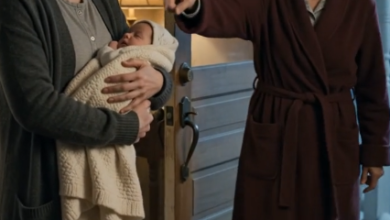
The second twist came when a young woman entered from the side hallway holding a baby wrapped in a donated blanket.
She was maybe twenty-three, with tired eyes, a thin coat, and hair pulled back in a messy knot. The baby fussed against her shoulder until she saw the tote bag in Mark’s lap.
“That’s Mrs. Evelyn’s,” she said.
Mark stood. “Do you know where she is?”
The young woman’s face tightened. “She didn’t come this morning?”
Denise stepped closer. “You were expecting her?”
“She said she’d try.” The woman looked down at the baby. “She was bringing formula.”
Mark’s throat closed.
The woman’s name was Tanya. She had been living in her car with her six-month-old son after leaving a dangerous relationship two towns away. Evelyn had met her at a bus stop in November, when the baby was crying and Tanya was pretending not to cry with him.
Evelyn had sat beside her and said, “Sometimes babies just need someone calm nearby.”
That was all.
A week later, she found Tanya again and brought a blanket. Then socks. Then the number for St. Agnes. Then formula whenever she could manage it.
“My mom knew about you?” Denise asked, though the answer stood in front of her.
Tanya nodded. “She said she had children too. Said they were good people, just busy.”
That sentence hurt because it was generous.
Evelyn had not complained about them.
Not even there.
Paul turned away, wiping at his eyes with the back of his hand.
The third twist arrived from Mr. Brooks, an old veteran with a silver beard and a limp, who overheard the conversation from the coffee table.
“She’s not lost,” he said.
Everyone turned.
“What do you mean?” Mark asked.
Mr. Brooks tapped his cane once against the floor. “She knows this neighborhood better than most of you. If she’s out in this weather, it’s because she went after somebody.”
“Who?” Denise asked.
He looked at Tanya’s baby.
“Or something somebody needed.”
Karen checked the office phone log. Evelyn had called St. Agnes at 5:12 that morning from a pay phone near Miller’s Market, because she did not own a cell phone and refused to ask her children for one after Mark once joked she would lose it in a week.
The message was short.
Tell Tanya I’m bringing the small can. Don’t let her walk with the baby. Too cold.
The fourth twist was the pay phone.
It stood outside an old gas station two blocks from the bus stop, nearly hidden beneath a broken awning. Security footage showed Evelyn at dawn, bundled in her thin coat, tote bag over her arm, speaking into the receiver while snow blew sideways.
Then the footage showed her turning away from the bus stop.
Not toward St. Agnes.
Toward the underpass.
Carla the bus driver explained why.
A city crew had blocked the usual walkway with orange cones because of ice. Anyone trying to reach the shelter from the gas station would either wait for the next bus or cut beneath the railroad overpass, where people sometimes slept out of the wind.
Mark watched the grainy footage on the gas station monitor and felt his mother become visible in a way she had not been when she lived under his roof.
The slight bend in her back. The careful step. The tote bag heavier on one side. The stubborn turn of her head into the snow.
Not confused.
Determined.
The police found her at 2:37 p.m.
She was beneath the railroad overpass, sitting on a flattened cardboard box beside a teenage boy named Eli, who had a fever and no coat warm enough for the storm. Evelyn’s own coat was wrapped around his shoulders. Her hands were tucked beneath her arms, pale from the cold, and the tote bag lay open beside her with the baby formula still inside.
She was conscious when Mark reached her.
Barely.
“Mom,” he said, dropping to his knees in the dirty snow.
Evelyn blinked at him as if he had arrived somewhere she had not expected him to come.
“Oh, honey,” she whispered. “You’ll ruin your shoes.”
That was what broke him.
Not the ambulance lights. Not the cold. Not the crowd gathering under the overpass. That sentence.
Because even half-frozen, even after being spoken to like an inconvenience for months, she was still thinking about the cost of his shoes.
Mark took her hand between both of his. Her fingers felt like paper wrapped around ice.
“I’m sorry,” he said.
Evelyn looked confused.
“For what?”
He could not answer because the list was too long.
Denise arrived next, running in boots she had not zipped all the way. Paul came behind her carrying a blanket from his car. Tanya stood near the ambulance holding her baby, crying silently as Karen from St. Agnes placed a hand on her shoulder.
The teenage boy, Eli, kept trying to give the coat back.
Evelyn turned her head toward him. “You keep it until you stop shivering.”
The paramedic gently lifted her onto the stretcher.
As they carried her toward the ambulance, Evelyn reached for the tote bag.
Mark picked it up.
“I’ve got it,” he said.
For the first time in two years, he did not say it like he was managing her.
He said it like he was honored to carry something that mattered.
Part 4
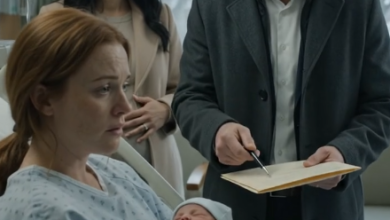
Evelyn spent three nights in the hospital with mild hypothermia, a bruised hip, and a stubborn insistence that everyone was making too much fuss over “a little cold.”
Her children stayed.
Not rotated.
Stayed.
Mark took the vinyl chair by the window the first night, Denise the second, Paul the third, and none of them slept much. They watched nurses adjust blankets around their mother’s thin shoulders. They watched her wake and ask whether Tanya got the formula. They watched her worry about Eli’s cough, Mr. Brooks’s gloves, Ruth’s allergy, and the soup pot left in Mark’s kitchen.
She never once asked whether anyone was angry.
That made it worse.
On the second afternoon, Mark brought the canvas tote bag to the hospital and placed it on the chair beside her bed. He had washed the outside gently with warm water, though the stain at the bottom would not come out.
Evelyn touched it with her fingertips.
“You didn’t throw anything away?”
“No,” he said. “I thought maybe you could show us where everything goes.”
She looked at him for a long time.
Then her eyes moved to Denise and Paul, who stood near the end of the bed like children waiting to be called into the principal’s office.
Evelyn’s voice was quiet. “You all have enough to do.”
Denise shook her head.
“Mom, we didn’t even know what you were doing.”
Evelyn smiled faintly. “You didn’t ask.”
No one defended themselves.
The room did not need more excuses. It needed the quiet that follows truth when people finally stop trying to step around it.
After Evelyn came home, nothing changed perfectly, but everything changed honestly.
Mark’s house was still clean, but now there was a shelf in the pantry labeled St. Agnes. Allison, who had once complained about the soup pot, bought a larger one and left it on the stove one Saturday morning with a note that said, “Chicken is in the fridge. I can chop carrots.”
Denise stopped correcting the way Evelyn folded towels. Instead, she started driving her to the thrift store on Wednesdays, where Evelyn chose children’s coats by touching the sleeves and saying things like, “This one will hold heat,” or “This zipper is trouble.”
Paul added a prepaid phone to her tote bag and spent an afternoon teaching her how to use it. She forgot twice, then remembered, then accidentally called him from the living room while he was sitting beside her. They both laughed until Paul had to wipe his eyes.
The grandchildren changed too.
At first, they had seen their grandmother through the impatience of their parents. Slow. Repetitive. In the way. But one Saturday, Mark’s teenage daughter, Emily, asked if she could come along to St. Agnes for volunteer hours.
Evelyn looked at her over the rim of her tea.
“Only if you don’t write about people like they are sad little projects.”
Emily flushed. “I won’t.”
“Good,” Evelyn said. “Then bring gloves.”
At St. Agnes, Emily watched her grandmother become someone larger than the old woman who misplaced reading glasses and asked the same question twice at dinner. People called her Mrs. Evelyn with warmth in their voices. Children ran to her. Mr. Brooks saluted her with two fingers. Tanya handed her baby over without hesitation, and Evelyn held him as naturally as breathing.
Emily saw the bulletin board.
She saw the photos.
She saw her grandmother’s name written on masking tape across a box of donated scarves.
On the ride home, Emily did not put in her earbuds.
“Grandma,” she said, “why didn’t you tell us?”
Evelyn looked out the window at the winter trees.
“Some things are easier to do when nobody is measuring them.”
Emily did not fully understand that yet.
But she remembered it.
In February, the family organized a dinner at St. Agnes. Not a polished charity event with matching centerpieces and speeches, but a real dinner with steaming soup, bread, donated coats, coloring books, and enough chairs for people to sit without feeling rushed.
Mark served coffee.
Denise sorted baby supplies with Tanya.
Paul fixed the broken hinge on the storage room door.
Allison stood beside Evelyn at the stove, learning that too much pepper was not always too much when the weather was bitter.
At one point, Mark looked across the room and saw his mother sitting beside Eli, the teenage boy from the underpass. He was wearing her old coat, the missing button replaced with one that did not quite match. Evelyn had a bowl of soup in front of her, but she was not eating yet. She was listening to him speak with the full attention of someone who had never treated another person’s pain as an interruption.
Mark thought of all the times he had rushed her through stories.
All the times he had sighed when she moved slowly.
All the times he had mistaken inconvenience for emptiness.
He walked over and placed a folded blanket beside her.
“You warm enough, Mom?”
She looked up, surprised by the question.
Then she smiled.
“I am now.”
That spring, when the maple trees began to bud, the old yellow house on Briar Lane came back into conversation. Not because they could buy it back; they could not. A young family lived there now, and Evelyn liked knowing children were climbing the porch steps again.
But Mark drove her past it one Sunday after church.
They parked across the street.
The porch had been repainted white. The maple tree still leaned slightly toward the driveway. Someone had hung a wind chime where Henry’s old bird feeder used to be.
Evelyn sat quietly, hands folded over the canvas tote bag in her lap.
“Do you miss it?” Denise asked from the back seat. She had come along because Sundays had become family days without anyone officially announcing it.
Evelyn watched a small boy run across the porch in socks.
“I miss who we were there,” she said.
Mark swallowed.
Paul, sitting beside Denise, looked out the window.
After a moment, Evelyn patted the tote bag.
“But houses are funny things. Sometimes you leave one, and it takes people a while to realize you were still carrying home around with you.”
No one answered.
They did not need to.
By summer, the family had stopped using the word rotated.
Evelyn still spent time with each child, but now she chose her days, her errands, her visits, and her work at St. Agnes. Her children built schedules around her life instead of fitting her into the empty spaces of theirs.
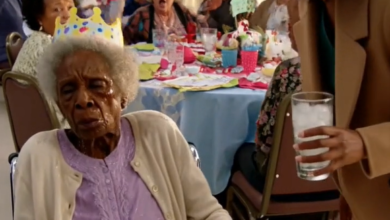
On her eighty-third birthday, they held a small party at the community hall.
There was no fancy cake, because Evelyn preferred peach cobbler. Tanya’s baby, now walking unsteadily, grabbed at the hem of her floral dress. Eli gave her a drawing of the underpass, but in his version, it was covered with spring flowers. Mr. Brooks presented her with a pair of gloves and said, “For once, try keeping these for yourself.”
Evelyn promised nothing.
Near the end of the evening, Mark stood to make a toast, but his voice failed after the first sentence. He looked at his mother, at the tote bag beside her chair, at his siblings standing close instead of checking their watches.
“I thought we were taking care of her,” he said finally. “Turns out she was still teaching us how to see.”
Evelyn shook her head gently, embarrassed by public tenderness.
But her hand reached for his.
That was the image people remembered: not the speech, not the applause, not even the birthday candles flickering over peach cobbler, but an old woman’s thin hand resting inside her grown son’s palm while a canvas tote bag leaned against her chair, full of cough drops, socks, bus tokens, and the quiet proof that a person can look fragile while carrying more love than a room knows how to hold.
Follow this page for more heartfelt stories about family, quiet sacrifice, and the people we almost understand too late. 🌷