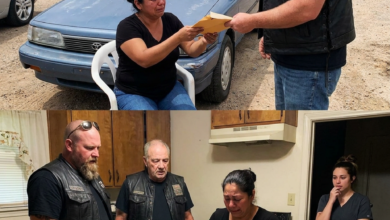
Part 2: An Officer Drew His Taser When a Bloodstained Biker Carried a Homeless Man Into the ER — Then a Torn Shirt Explained What Everyone Had Misunderstood
Part 2 — The Things Leonard Was Trying to Tell Us
I didn’t stay in the entrance to hear the phone call.
Leonard needed the people on my side of the treatment doors, and whatever explanation Russell Keene owed the officer could wait until my patient was being cared for.
Andre steered the stretcher. I walked beside it with one hand on the rail, close enough that Leonard could hear me without my raising my voice.
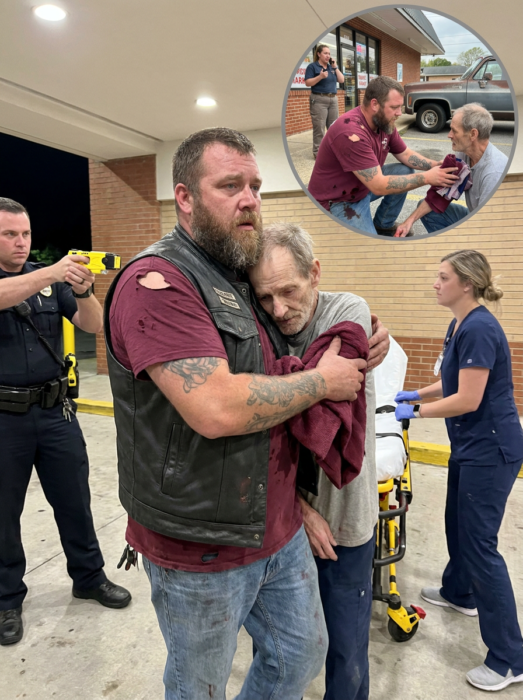
“It’s Elena. You’re at Southbank.” He opened his eyes a little.
“Bag,” he said.
“We’ll ask about it.”
His fingers moved against the sheet, searching for a strap that wasn’t there. I had seen that movement before in people who owned so little that every missing object could mean starting over.
The room filled around us. A physician, another nurse, equipment rolling into place. We worked while someone asked brief questions Leonard could answer, and I put the concern about his belongings where it belonged: on a list of things to solve, not a reason to dismiss him.
The injury was in his forearm. I won’t give you the details. What mattered was that it needed urgent treatment, and the cloth wrapped around it had not come from a hospital supply cabinet.
“Who put this on?” Dr. Shah asked.
“Possibly the man who brought him.”
“Find out what happened when you can.”
There was no pause in care while we waited for an explanation. No demand for identification before someone touched him. The questions and the work happened together, because that was what the room was for.
Leonard kept trying to tell me something. I leaned closer. “One thing at a time.”
“He’ll leave it.”
“The bag?”
A faint nod.
“I heard you,” I said. “I’ll find someone to check.”
That was a promise I could keep. Not that every possession would be recovered, not that the rest of his life would become easier. Just that somebody would look instead of assuming it didn’t matter.
When another nurse took my place, I went back toward the entrance.
Russell sat on the edge of a plastic chair with his elbows on his knees. The officer stood several feet away. Neither man was speaking.
The woman with the helmet had introduced herself as Tess Calder. She was fifty-two, a mechanic, and a member of the same riding club as Russell. She had parked her pickup after helping get Leonard out of it.
His Harley was still somewhere else.
That answered the first question I hadn’t had time to ask. The injured man hadn’t been balanced on a motorcycle. He had arrived in a truck, and Russell had carried him only from the passenger side to our entrance.
Not far on a map. Far enough when your arms were failing.
Tess held up her phone. “I called emergency services. The ambulance was delayed. They’re aware we reached the hospital.”
Bennett asked when she had first called. She gave him the time. He wrote it down.
“What happened to his arm?”
“He caught it on broken glass,” she said. “Near the loading entrance behind the old market. I saw him just after.”
“Just after?”
“I didn’t see the glass cut him. I saw Russ on the ground beside him.”
I noticed the correction. She wasn’t adding something she hadn’t witnessed just because it would make the story easier.
Russell looked up. “He told me he was getting his bag out from under a broken window frame.”
Bennett turned toward him.
“I heard him call out,” Russell continued. “Went around the corner. He was sitting against the wall. His arm was bleeding.”
“Did anyone else touch him?”
“Not that I saw.”
Russell had grease under one thumbnail and a raw patch across the heel of his hand. The rest was mostly blood that had dried while we worked on Leonard.
I asked whether he was hurt.
“Don’t think so.”
“We should check.”
“After you check him.”
“He has a team with him.”
Only then did Russell look at his own hands.
He seemed surprised by them. I had watched people reach that moment before, when the immediate job was over and their bodies finally delivered everything they had postponed feeling.
“Could I wash?” he asked.
I pointed out the sink in an empty room nearby and asked him to wait until we had looked at the scrape. He nodded, not arguing.
Bennett said he still needed a statement. “You’ll get one,” Russell told him. “I’m not leaving.”
The officer glanced toward the treatment doors.
For the first time since he entered, Russell asked me a question that wasn’t about what someone needed to do next.
“Is he going to make it?”
I could hear the answer he wanted. I wasn’t going to manufacture it.
“He’s getting treatment. I’ll tell you what I can when we know more, if he wants us to.”
Russell rubbed one thumb against his palm. There was a pale strip beneath his ring where the blood hadn’t reached.
“All right.”
Tess sat down beside him. She didn’t hug him or tell him he was a hero. She put his helmet on the chair between them and rested her hand on its scratched shell.
“Your bike’s locked,” she said. “Dale’s staying with it.”
Russell nodded.
A small fact. A solved problem.
Sometimes that was the kindest thing you could hand somebody while the larger question stayed behind a closed door.
Part 3 — Where the Blood Came From
Twenty minutes later, I came back out and found Russell standing.
He hadn’t moved toward the treatment area. He was facing a vending machine with a dollar folded lengthwise in his hand, trying to flatten it against his thigh.
The machine kept refusing it.
Tess said, “Let me.”
“I can buy a bottle of water.”
“I know you can.”
Neither of them was talking about water.
I told him Leonard had been taken for further treatment and that the team was still working. I kept the details inside the boundary Leonard had given us when he was able to answer questions.
He had said we could update the man who carried him.
“The big one,” he’d added, which had made Andre glance at me despite the tension in the room.
Russell listened without interrupting. Then he asked whether Leonard had said anything about family.
“Not yet.”
“He kept asking for somebody named Rosa. Might have been a person. Might’ve heard him wrong.”
I wrote it down.
Behind us, Bennett was speaking to a supervisor. The Taser was back in its holster, but that didn’t erase what had happened at the door. I had already written down what I saw, including the fact that Russell stopped when ordered and never threatened anyone.
The supervisor asked whether I would provide a statement after my immediate patient work was covered.
“Yes.”
I didn’t know what the review would conclude. I wasn’t going to decide it for them. I was going to describe the room accurately.
While we waited, Tess walked me through the route.
They had finished repairing a club member’s motorcycle at a rented garage a few blocks away. Russell was riding home when he heard Leonard call from behind the old market. He stopped his Harley near the curb and went to look.
Tess was following in her pickup with tools they had borrowed.
“She pulled up when she saw my bike sitting there,” Russell said.
“He was already helping him,” she added. “Asked me to call.”
An ambulance was dispatched. The approach from its direction had backed up behind a collision on a divided road, and Tess was told there was a delay.
She called again when Leonard became harder to keep engaged.
Southbank was close by, reachable from the local streets on their side of the blockage. They decided to drive him. Tess updated the dispatcher about where they were going.
It wasn’t a story about an ambulance crew refusing to come. They had been on their way. It was a story about two people on a pavement, frightened by what was happening in front of them, making a decision before help arrived.
I wasn’t there. I couldn’t tell them what would have happened if they’d waited.
I could tell them we would have brought a stretcher to the truck if someone had called into the entrance.
Russell looked down. “I know that now.”
He didn’t make a speech about breaking rules to save lives. He admitted that when Tess stopped near the doors, all he had seen was the distance between Leonard and the people who could help him.
“I thought I could manage it.”
“You did get him to us,” I said. “And your arms were giving out.”
“Yes.”
Both things were true.
Bennett returned and asked Tess a few more questions. Later, his supervisor confirmed that their account of the emergency calls and the traffic delay had checked out. Nothing we had learned supported the fight people in the lobby had been describing.
The rumor had come from people watching an arrival, not from anyone who had seen an assault.
Russell wasn’t cleared by a dramatic confession. There wasn’t another villain hiding in the parking lot. The explanation accumulated in ordinary pieces: a call time, a route, a witness who separated what she knew from what she assumed.
And a shirt.
When we had removed the makeshift dressing, the fabric matched the torn burgundy cotton under Russell’s vest. He had used part of his own shirt to help cover the injury and stayed with Leonard while Tess called for help.
That was why he was bloodstained.
Not because he had struck Leonard. Because he had been close enough to hold something against the bleeding before anyone in scrubs got there.
I told Bennett what we’d found. The officer looked toward Russell, then back at me.
“I understand.”
I hoped he did. Understanding after the fact was useful, but it hadn’t made those seconds in the entrance any less dangerous.
Russell didn’t ask me to explain that to him. He knew.
His dollar finally went into the vending machine. The bottle dropped with a hollow thud, and he bent to retrieve it more slowly than a man his size wanted anyone to notice.
I asked again whether he needed to be examined. This time, he said yes.
We checked the scrape, helped him clean up, and gave him a plain spare shirt. He folded the ruined one with its torn edge inward.
“Want us to dispose of that?” I asked.
He looked at it, then shook his head. “Not yet.”
Before I could ask why, his phone rang. He listened for a few seconds without speaking.
Then he closed his eyes.
“Dale,” he said, “don’t throw anything away. I don’t care what it looks like. Bring the whole bag.”
Part 4 — What Was Worth Bringing Back
Dale arrived after I had handed the department over to the night charge nurse.
He came through the same doors slowly, carrying a black backpack with a broken zipper and a motorcycle key on a red cord. His gray riding jacket smelled of cold air.
Russell stood up.
“Found it under the frame,” Dale said. “Some of it got wet.”
“Thanks.”
“There wasn’t much in it.”
“There was all he had.”
Dale looked at the bag again. Then he handed it over without another comment.
I stayed long enough to help get Leonard’s belongings documented and stored. We didn’t spread them across a waiting-room table for strangers to inspect. There were clothes, glasses in a hard case, papers, and a small radio wrapped in a clean sock.
The radio’s plastic battery cover had been replaced with a neatly cut piece of cardboard.
I remembered Leonard listening to baseball through a single earbud during a previous visit. He had apologized when he thought the sound bothered another patient, even though I could barely hear it.
Russell asked whether we had found anything with the name Rosa.
There was an appointment card. Rosa Delgado, an outreach worker at a day center, had written a time on the back.
Tuesday. Ten thirty.
“That might be her,” I said.
Russell let out a breath. It wasn’t relief exactly, but it gave his worry somewhere to go.
Tess offered to take him home. His motorcycle could stay with Dale until morning.
He asked if visiting was allowed.
“Not yet. Call before you come back.”
“Then I’ll call.”
I watched him pick up the folded burgundy shirt. The torn cotton was stiff now, nothing like a thing anyone would want to save.
“You keeping that for a reason?” Tess asked.
“Didn’t know if somebody would need to see it again.”
The officer had already documented what he needed. I told Russell that, and he handed the shirt over for disposal.
No souvenir. No trophy from a night that had nearly gone wrong in several directions.
He stood in the plain gray shirt we’d given him, holding his vest over one arm, and suddenly looked older than he had at the door.
I asked whether somebody was waiting for him at home.
“No,” he said. “But I’ve got somewhere to go.”
There was an emphasis on somewhere that I didn’t understand until later.
Leonard was awake and able to talk when I returned for my next shift. He was exhausted, and there was still more recovery ahead, but he recognized me.
“Did they find my bag?”
“Yes.”
“The radio?”
“Yes.”
He turned his face toward the pillow and stayed like that for a moment.
We arranged for his things to be brought where he could see them. He didn’t open the papers first. He put on his glasses and checked the cardboard on the back of the radio.
“I cut that twice before I got it right,” he said.
Then he asked what day it was. I told him.
“Rosa’s Tuesday.”
“We found the card. Would you like someone to contact her?”
He nodded.
Only after those two matters were settled did he ask about Russell.
“Big fellow get home?”
“I believe so.”
“He looked scared.”
I thought of the room full of people who had found Russell frightening. Leonard had seen the other direction of it.
“He was worried about you.”
“Yeah,” Leonard said. “Kept telling me his name.”
Russell had done that while they waited behind the market. Not asked where Leonard lived or how he ended up there. Just repeated that his name was Russ and that Tess was on the phone.
Leonard told me about the broken window frame. Someone had leaned it near the wall where he sheltered from the wind. When he pulled his backpack away, a loose piece shifted against his arm.
That was the accident. No hidden robbery, no gang fight, no reason for him to have to prove he deserved treatment.
He had been moving his belongings out of the way.
“I thought it’d quit,” he said, looking toward his bandaged arm. “Then it didn’t.”
Russell had come when he called.
I asked whether he wanted to see him.
“Yes.”
“Anybody else you’d like us to contact?”
“My son. But let me do the talking.”
We helped him make the call. I stepped out before the conversation moved beyond hello.
He was not a missing-person puzzle for us to solve behind his back. Whatever history sat between him and his son belonged to them.
Russell visited the next afternoon. I saw him standing outside the room, holding a grocery-store bag with a toothbrush, reading glasses, and two pairs of new socks.
He’d asked what was permitted before buying anything.
Leonard looked at the socks. “You don’t know my size.”
“I guessed.”
“Dangerous habit.”
Russell grinned for the first time.
He sat in the visitor’s chair, which was too narrow for him, and listened while Leonard complained about the radio picking up more static than baseball. They talked about a repair shop that used to stand near the river.
Leonard had worked there years before.
Not a famous surgeon. Not a wealthy man in disguise. A repairman who could still remember which old washing machines were worth fixing.
When I came back past the doorway, he was explaining a faulty motor to a man with tattooed hands.
Russell wasn’t looking at the bandage. He was listening to the explanation.
Before leaving, he asked Leonard whether there was anything else he needed.
Leonard thought about it.
“You could come back when there’s a game on,” he said. “Gets boring arguing with the radio.”
Russell checked the clock, then the small schedule folded beside it.
“What time?”
And Leonard told him.
Part 5 — Promises They Could Keep
The next part didn’t happen in one room, and I didn’t witness all of it.
Tess told me about the club meeting later. Leonard told me what he wanted, and our social worker helped him sort through the choices that actually existed.
Those were not the same as the choices people liked to imagine.
A hospital bed wasn’t housing. A bag of socks wasn’t a discharge plan. Leonard needed somewhere suitable to recover, follow-up appointments, and a way to get to them without losing the rest of his belongings.
Rosa was already trying to arrange help before the accident. With Leonard’s permission, the hospital team contacted her and worked toward a place in a short-term recovery program.
It took calls. Forms. Waiting for an answer that changed once before it became reliable.
Russell wanted to cover whatever was missing.
At the Mason River Riders meeting, he asked whether the club could pay for several weeks of temporary lodging if the recovery placement fell through.
Their emergency account looked large enough until Tess put the commitments beside the balance.
Some money was already promised to a member whose injured hand had kept him off work. Another portion covered the workshop lease, the place where several riders repaired motorcycles for extra income.
It wasn’t spare money just because it hadn’t left the bank.
“We can’t promise it twice,” Tess told him.
Russell heard no. What she had said was more complicated, but fear wasn’t helping his hearing.
Dale offered a small donation. Another rider offered to store Leonard’s bag while he recovered. Neither answer felt big enough to Russell that night.
“You saw him,” he told Dale.
“I did.”
“And we’re talking about a lease?”
“We’re talking about promises we already made.”
Tess said the room went quiet. Russell stood up, and for a moment she thought he would leave.
Instead, he sat back down.
Years earlier, before I knew him, he had served time for an assault outside a bar. He didn’t tell that story as something the other man had earned. He told me he had lost control and hurt someone.
After his release, a string of temporary jobs kept him fed but didn’t immediately put a roof over his head. He slept in a pickup for part of that year and kept his important papers in a plastic grocery bag.
One night, rain got through a damaged window seal.
He spent the next morning drying those papers under the hand dryer in a gas-station bathroom while a clerk kept knocking.
That was why he had called Dale about the backpack. Why there wasn’t much in it had sounded to him like a reason someone might decide it wasn’t worth bringing.
He knew how much work could fit inside a ruined bag.
He also knew Tess was right about the money.
So the club made a smaller plan they could keep.
Two riders offered transportation on specific days. Dale cleared a locked shelf in the workshop for belongings Leonard didn’t want moved from place to place. Russell paid for replacement clothes, and Tess handled a short list of things the recovery program said would actually help.
No one promised Leonard a house. No one told him he could sleep in a workshop that wasn’t set up for it.
When the recovery placement was confirmed, the club’s support fit around that plan instead of replacing it with an idea that sounded generous for one evening.
I saw Russell the day Leonard was discharged to the program.
He had brought his truck, not the Harley. Tess came too, and the transportation arrangement had been checked with the team.
Leonard carried his radio in the front pocket of his bag.
“Russ wanted to buy me a new one,” he told me.
“Did you want one?”
“No.”
Russell lifted both hands. “Then we didn’t buy one.”
Leonard looked pleased with that.
While Tess went to bring the truck around, Officer Bennett approached us from the entrance corridor. He had asked earlier whether Leonard would be willing to speak with him.
Leonard had said yes.
Bennett didn’t bring a supervisor to make the apology look official. He stood where Leonard could see him and kept his hands away from his belt.
“I made a wrong assumption when you came in,” he said. “I drew the Taser before I understood what was happening. That put both of you in a frightening position.”
Russell didn’t rescue him from the sentence.
Leonard asked, “You thought he did it?”
“Yes.”
“He was trying to keep me here.”
“I understand that now.”
I watched Russell’s face. He wasn’t smiling, but he wasn’t looking away either.
The review of the incident was separate from that conversation. I had given my account, and both men had information about how to raise concerns. An apology at the door didn’t settle every question about it.
But Bennett didn’t ask them to say it was all right.
That mattered.
Russell finally said, “When somebody’s carrying a man, help get the man down safe first.”
Bennett nodded.
Leonard had a different request.
“When you write it up,” he said, “my name’s Leonard. Not just the homeless guy.”
“I’ll use your name.”
“Price.”
“Leonard Price.”
Then Tess came through the doors and said the truck was ready.
Russell reached for the backpack and stopped himself.
“You want me to carry that?”
Leonard shook his head. “I’ve got this one.”
So Russell carried the extra bag of clothes instead, and the three of them left without anyone in the waiting room needing to understand the whole story.
Part 6 — Learning When to Leave the Hood Closed
Six weeks later, I saw Russell in the outpatient waiting area with a paper cup balanced on one knee.
I was cutting through on my way to the cafeteria. He had come for one of Leonard’s follow-up appointments and was holding a black backpack by its repaired strap.
The stitches were bright blue against the old fabric.
“Tess?” I asked.
He nodded. “Said she wasn’t wasting good thread trying to match ugly.”
Leonard was inside with his clinician. His recovery had been slower than he wanted, and there were still things his injured arm couldn’t comfortably do.
Russell didn’t tell me the details. He said Leonard could explain if he felt like it.
I appreciated that.
“How’s the radio?”
“Still terrible.”
“You offered again?”
“No, ma’am. I have been educated.”
He took a sip of coffee and made a face.
I told him which machine on the second floor made a tolerable cup. It was the first conversation we had that could have belonged to any two people killing time in a hospital.
When Leonard came out, he was wearing the same brown coat, now washed, with a dark knitted cap tucked in one pocket.
He saw me and lifted his good hand.
“Still working here?”
“They keep finding things for me to do.”
He grinned.
Russell stood but didn’t take the bag automatically. Leonard hooked the repaired strap over his shoulder and adjusted it himself.
The room at the recovery program was temporary. Rosa was helping him work toward the next place, and the uncertainty wore on him even while other things improved.
Some mornings he told Russell not to bother visiting. Once he missed a call and Russell drove over, worried enough to sound angry when he finally found him.
Leonard told him he wasn’t a job site that needed checking.
Russell apologized.
They made a simpler arrangement afterward: ask before coming, call the program if there was a specific concern, and don’t mistake an unanswered phone for permission to take over a person’s afternoon.
I learned that from Leonard, who told it with enough humor that I knew the friendship had survived.
“He’s used to engines,” he said. “Something makes a noise, he wants the hood up.”
Russell looked at the ceiling.
“I’m standing right here.”
“I know. Saves me telling you twice.”
There was warmth in it, but a line too. Leonard could be grateful and still say no.
That afternoon, he told me he’d spoken to his son again.
Darius lived in St. Louis. Work, children, and a strained history had made their conversations difficult long before the accident.
“He asked what happened,” Leonard said. “I told him this time.”
He wasn’t ready to explain every year between them. I didn’t ask him to.
Darius had mailed photographs of his children to the recovery program. Leonard showed me one on his phone: two kids leaning over a birthday cake, both apparently trying to blow out the same candles.
Their grandfather looked at it longer than he needed to.
Then he put the phone away and asked Russell what time the game started.
I went back to work.
A week later, Tess invited me to the club’s Saturday breakfast, a public gathering they held to help cover workshop expenses. Leonard was coming, and he had asked whether “the nurse who knew the good coffee” might be there.
I wasn’t on shift. I went.
The motorcycles stood in a row along the fence, their engines ticking after the ride in. Inside, somebody was burning toast while Dale argued that black edges were a preference, not a mistake.
Leonard sat at a workbench with his radio open in front of him.
Russell sat beside him, sorting tiny screws into a jar lid under instructions. The big man’s hands moved slowly, careful not to knock anything away.
Leonard wasn’t doing heavy repair work. His arm wasn’t ready. He was explaining what he thought the problem was, and Russell was following directions.
Tess put a plate beside me.
For a while, I watched them work.
Nobody introduced Leonard by describing how he’d arrived at the hospital. Nobody asked Russell to reenact carrying him.
When the radio finally produced a clear voice, Dale raised his coffee cup.
Leonard smiled.
Then the sound dissolved into static, and he swore with enough precision to make Tess laugh.
Russell didn’t reach to fix it.
He waited for Leonard to tell him what to try next.
Part 7 — The Same Doors
By spring, Leonard had moved into a room in a shared transitional house.
It wasn’t permanent housing, and he didn’t describe it that way. There were rules, appointments, and more paperwork ahead. But his bag could stay beside a bed instead of being packed before sunrise.
He told me the window faced a brick wall.
“Terrible view,” he said. “Window locks, though.”
Russell had helped carry a small dresser up the stairs. Dale had found a lamp at a yard sale and checked the cord before bringing it over. Tess made sure everyone asked where things belonged instead of arranging the room for him.
The radio went on the dresser. The cardboard battery cover stayed.
I heard these things in pieces, usually when one of them stopped by the Saturday breakfast or when Leonard had an appointment on our campus. The story didn’t keep building toward a larger reveal.
He was recovering. Some days went better than others.
That was plenty.
One afternoon, Russell and Leonard appeared at the emergency department’s reception desk. I saw the leather vest first and felt my stomach tighten before I understood why.
Then Leonard stepped around him.
He was upright, holding a paper envelope in his good hand.
“No emergency,” he said quickly.
Andre came out of the corridor and grinned. “That’s my favorite kind.”
Leonard had brought a note for the staff who treated him. He asked whether we could put it somewhere they would see it without hanging it in the public waiting room.
Of course we could.
Inside, he’d written the names he remembered and left space for the ones he didn’t. There were a few crossed-out words. It looked like something he’d taken time over at a small desk.
He hadn’t written that we were angels.
He thanked Andre for finding his glasses, the night nurse for explaining where he was when he woke, and the person who kept his backpack from being misplaced.
Then there was a line for me.
You kept saying my name until I could answer.
I folded the note along its original crease and put it back in the envelope before my face gave me away.
Russell stood beside him wearing a new burgundy shirt beneath the same old vest. No stains. No torn edge. There was a little grease on one cuff.
I asked whether his shoulder still bothered him.
“Only when Tess asks me to move something.”
From behind him, Tess said, “Then stop volunteering the truck.”
I hadn’t seen her come in. She held three takeaway coffees and looked as if she’d already heard the argument twice.
Bennett wasn’t there that day. The entrance didn’t need to reproduce itself so everyone could have a better ending.
A child slept against her father’s coat near the vending machines. Registration called another patient forward. The automatic doors opened, and a gust of damp air moved across the floor.
Leonard glanced toward the mat.
“I remember those doors,” he said.
Russell stopped smiling.
“Not much else,” Leonard added. “You kept saying almost there.”
“We were.”
“Didn’t feel like it.”
“I know.”
For a moment, neither man spoke.
Then Leonard nudged Russell’s arm with his elbow.
“Come on. You’ve got my coffee.”
Russell took a cup from Tess and handed it over, checking which lid she’d marked by folding its little tab. Leonard tucked the envelope’s empty outer sleeve into his backpack.
I walked them as far as the entrance.
The same doors slid apart. Russell moved ahead, then stopped at the edge to make room.
This time, his hands were empty.
Leonard walked through on his own.
Follow our page for more biker stories about misunderstood moments, unlikely friendships, and the people who stay after the emergency is over.