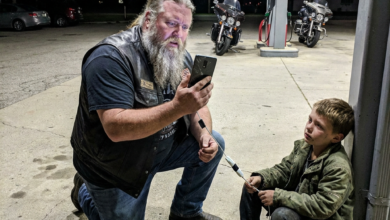
An Eight-Year-Old Walked Four Kilometers to Surrender Her Dog With a Three-Page Letter — Then His Microchip Revealed Which Biker Owed Him a Life
My phone call lasted twenty-seven seconds.
“Brick,” I said when he answered over the metallic clatter of his repair shop. “Get to Willow Creek.”
“Got three bikes open.”
“Close the shop.”
A pause followed. Brick and I had ridden together for seventeen years, long enough that he could measure trouble by how many words I wasted explaining it.
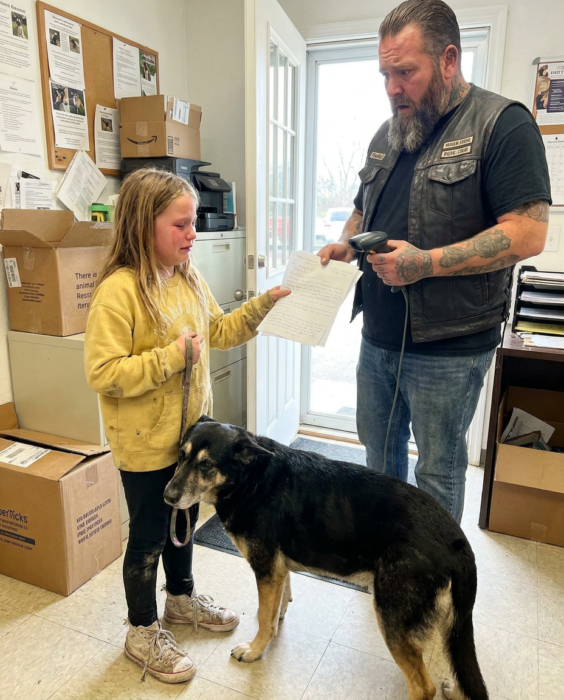
“What happened?”
“I found the dog.”
He did not ask which dog.
Every man in Iron Hollow knew the forest story. Five years earlier, Brick had ridden alone toward Roan Mountain after an argument with his older brother. Rain came down before dusk. His rear tire lost traction on a leaf-covered bend, and the Harley went through a low barrier. Brick landed nearly forty feet below the road.
His phone shattered. His right leg became pinned beneath a fallen limb. Two ribs broke, and a deep cut along his side would not stop bleeding. Search crews passed above him twice without hearing his voice through the storm.
On the third morning, a dog appeared.
Brick remembered amber eyes, wet fur, and a red search harness. He remembered the animal licking rainwater from leaves, returning to him, and barking toward the ridge until its voice became hoarse. He remembered waking whenever a warm body leaned into his chest.
Then came ropes, orange jackets, and a blue emergency tarp spread above the ravine.
Brick was carried out.
The dog disappeared into the machinery of the rescue operation before anyone gave him a name. Weeks later, Brick tried to find him, but the regional program had been reorganized. Records were sealed after a contract dispute, handlers moved, and the only answer he received was that the animal had been injured and retired.
Brick kept searching for two years.
He carried a photograph clipped from a local newspaper inside his vest. It showed only part of the rescue: a stretcher, three responders, rain turning the hillside into mud, and the blurred rear half of a shepherd in a red harness.
At the shelter, I ended the call and sat beside Emily while Claire contacted her parents and asked the police to send someone to the Carter home. Emily’s face tightened when she heard the word police.
“I’m not stealing him,” she whispered.
“I know.”
“He’s mine.”
“I know that too.”
“I’m just giving him away.”
That sentence hit harder than it should have.
Ranger remained pressed against her. Whenever the shelter door opened, his ears lifted and his body angled toward the sound. His left leg shook when he stood too long, yet he refused the blanket Claire brought.
It was blue.
Emily immediately pulled it away.
“I wrote that down.”
Claire apologized and returned with a brown one. The girl arranged it carefully beside Ranger, although the dog would not lie on it until she sat first.
We learned the rest in fragments. Emily’s father, Ben, had worked concrete and framing jobs around Knox County until a steel beam crushed two fingers and damaged his lower back. Workers’ compensation covered less than expected. His employer replaced him before he finished physical therapy.
Her mother, Rachel, cleaned motel rooms and worked weekend shifts at a diner. One car had already been repossessed. The electricity remained on only because a church paid the last bill. Their landlord wanted three months of overdue rent plus late fees by Friday.
They owed $4,860.
Emily had heard every number through the thin wall between her bedroom and the kitchen.
Children always hear the numbers adults whisper.
Claire let Emily use the office phone. Rachel answered on the first ring, breathless and terrified. Emily said, “Mom, I’m safe,” and then began to cry without sound.
Ranger placed one paw across her shoe.
I stepped outside because some pain deserves a closed door. Rainwater dripped from the shelter roof, and the air smelled of wet pavement, motor oil, and the paper mill downriver. I could hear Emily apologizing through the glass.
Then the Harleys came.
First one engine. Then four. Then the deep, staggered V-twin rumble of nearly two dozen motorcycles turning off Highway 321 and filling the shelter driveway.
Customers backed away from the windows. A young volunteer stopped carrying food bowls. The shelter dogs erupted into barking as black leather, rain gear, gray beards, bandannas, and heavy boots crossed the parking lot.
Brick arrived first.
He killed his engine before the bike had fully settled, left his helmet hanging from one grip, and came through the door limping on the leg the forest had nearly taken.
Ranger stood.
The old dog’s ears moved forward. His nose lifted once.
Brick froze ten feet inside the lobby.
The newspaper clipping was already in his hand.
For several seconds, neither of them moved. Then Brick gave two soft whistles—the sound the missing biker had used in the ravine whenever the search dog wandered uphill.
Ranger’s tail struck the counter.
Once.
Twice.
The dog crossed the tile as quickly as his bad leg allowed and pressed his head into Brick’s chest. Brick dropped to both knees. His leather cut folded around Ranger’s shoulders while the old dog licked the scar along his jaw.
I had seen Brick stitch his own forearm after a wreck because the emergency room wait was too long. I had watched him carry his mother’s coffin without bending.
That morning, he broke.
Not loudly. Brick simply buried his face in Ranger’s neck and held on while twenty-two bikers removed their hats behind him.
Emily stared at them, frightened and confused.
Then she reached for the leash.
“I’m sorry,” she said. “Are you the new owner?”
Brick lifted his head. Rain and tears had darkened his beard.
“No, sweetheart.”
He looked at the three-page letter in my hand, then at the child who had walked four kilometers to keep his rescuer from sleeping outdoors.
“I’m the man who owes your dog everything.”
Part 3
Rachel and Ben Carter reached the shelter twelve minutes later in a borrowed pickup with a cracked windshield and one working headlight.
Rachel entered first. She still wore the burgundy uniform from the Riverside Motor Lodge, and one plastic cleaning glove hung from her back pocket. Ben followed with a cane he was clearly embarrassed to use.
They saw Emily between two rows of bikers.
Rachel ran.
She dropped to the floor, wrapped both arms around her daughter, and checked her face, hands, knees, and feet as if counting pieces. Relief lasted three seconds. Then fear turned into anger.
“You walked here alone?”
Emily nodded against her shoulder.
“Four kilometers? Across the highway?”
“I used the crossing.”
“You could have been hit. You could have disappeared. We thought—”
Rachel’s voice collapsed. Ben lowered himself beside them, pain tightening his face. Ranger moved into the circle and leaned against all three.
For a moment, they were still a family.
Then Ben noticed the leash on the counter.
His eyes shifted to the papers in my hand, the intake form beside Claire’s computer, and the brown shelter blanket on the floor.
“You brought him here to surrender him?”
Emily looked at her father.
“The motel won’t let him come.”
Ben’s face emptied.
“We hadn’t decided that.”
“You said they don’t take dogs.”
“We were finding another place.”
“You called six places.”
Rachel closed her eyes.
“I heard you,” Emily continued. “I heard Dad say we might sleep in the truck. Ranger’s leg hurts when it gets cold. He can’t sleep outside.”
She said it gently, almost apologetically, and that made it worse.
Ben turned away. His work-roughened hand closed around the top of his cane. I recognized the shame in his posture because most men recognize the version that belongs to them.
Years earlier, after my divorce and a string of bad decisions, I had lived six weeks in the back room of Brick’s repair shop. I called it helping with night security. Everyone knew the truth. Brotherhood was the only reason I ate warm food.
Poverty has a sound.
It is the refrigerator humming in a nearly empty kitchen. It is parents whispering after midnight. It is a child placing a leash on a counter before the adults are ready to admit that every door has closed.
Ben looked at us and saw judgment.
Twenty-three bikers. A shelter manager. His daughter’s three-page letter displayed like evidence. He straightened as far as his damaged back permitted.
“If you called us here to tell me I failed my family, save it.”
Brick stood slowly beside Ranger.
“No one said that.”
“You didn’t have to.”
Ben looked at Brick’s cut and the motorcycles outside. His jaw hardened.
“We don’t need trouble.”
“Neither do I,” Brick said. “My knees are shot.”
No one laughed.
Brick took the old newspaper clipping from his pocket and handed it to Ben. The photograph was weather-damaged after five years of being carried near sweat and rain. Brick pointed to the stretcher.
“That’s me.”
Then he pointed to the blur behind the rescuers.
“That’s your dog.”
Rachel read the archived microchip record on Claire’s screen. Ben read it next, leaning close because his glasses were still in the truck. Emily listened as Claire explained Ranger’s service history: certified search dog, four wilderness recoveries, injured during his final mission, transferred to a foster handler, later adopted after that handler died.
The Carter family had adopted him from a county event three years earlier.
They had never known.
To them, he was only Ranger—the dog who waited at the bus stop, slept outside Emily’s bedroom, and placed his body between her and every thunderstorm.
That was enough.
Brick crouched before Emily and asked permission to touch the scar on Ranger’s rear leg. Emily nodded. His thick fingers parted the fur, revealing the pale line left by the injury suffered during the forest rescue.
“He got that finding me,” Brick said.
Emily’s eyes widened.
“Was he scared?”
“Probably.”
“Did he leave?”
“Not once.”
Brick spoke four words after that.
“Neither are we, kid.”
Ben’s expression sharpened. “What does that mean?”
It should have meant a simple collection. The Iron Hollow Riders maintained a small hardship fund funded through charity rides, repair-shop donations, and poker nights. We could have paid enough to buy the family time.
But brotherhood is easy when every man agrees.
The trouble began when our treasurer, Nolan “Sparks” Avery, pulled me aside near the kennel hallway. Sparks had guarded the fund for eleven years. He kept receipts in labeled envelopes and treated every dollar as if it had been earned by a dead brother.
“We can cover one month,” he said. “Maybe two. Not five grand plus moving costs.”
“The club has twelve thousand.”
“Six of that is committed to Maria Denton’s roof. Two is for Tommy’s prosthetic. We drain the rest, the next family gets nothing.”
“This is Ranger.”
“I know who the dog is.”
“Then you know what we owe.”
Sparks lowered his voice. “We owe the dog. Paying somebody’s rent forever isn’t helping the dog.”
I nearly answered with my fists. Old instincts arrive before wisdom, especially when a child is involved. Brick stepped between us, not aggressively, just enough that I could smell wet leather and shop grease.
Sparks was not cruel. That was what made him difficult.
He was right about the numbers.
We could pay the overdue rent and still leave the Carters in a house they could no longer afford. Ben’s injury would not vanish. Rachel’s wages would not double. In another two months, Emily could be standing at another shelter counter with another letter.
A loud knock struck the glass door.
The landlord had arrived.
Walter Kessler was a narrow man in a tan raincoat, accompanied by a property manager carrying a folder. Rachel had apparently told him where they were during her frantic calls. He said he needed Ben to sign acknowledgment of the eviction before the courthouse closed.
He did not raise his voice. He did not need to.
The papers contained a deadline: noon Friday.
Brick asked whether animals were permitted in any of Kessler’s other properties.
“No.”
“What if the arrears are paid today?”
Kessler looked at the packed lobby, then at our cuts.
“The lease still ends Friday. I’ve already promised the house to another tenant.”
Ben gripped his cane.
Emily gripped Ranger.
Sparks looked down at the club ledger on his phone. The shelter staff watched us as though twenty-three motorcycles guaranteed a miracle.
They did not.
Noise is not power. Leather is not money. Loyalty cannot force a landlord to renew a legal lease.
For the first time that morning, Ranger moved away from Emily. He walked to Brick, placed his head beneath the biker’s hand, and waited.
Brick stared at the eviction notice.
Then he looked at our treasurer.
“Don’t empty the fund,” he said.
Sparks exhaled.
Brick removed a ring of keys from his belt.
“I’ve got another idea.”
Part 4
The keys belonged to the building behind Brick’s repair shop.
Calling it an apartment would have been generous. It was a two-story brick structure built in 1948, with storage on the ground floor and three rooms upstairs that had once housed mechanics who worked late shifts. The roof leaked near the stairwell. Half the windows were painted shut. A family of raccoons had occupied the attic the previous winter.
It also allowed dogs.
Brick had purchased the property with the shop but left the upstairs untouched. He planned to convert it into office space someday, the kind of someday that arrives only after every customer pays on time and every old Harley stops needing parts.
“It isn’t ready,” Sparks said.
“It can be.”
“By Friday?”
Brick looked through the shelter window at the line of motorcycles.
“Plenty of hands.”
Ben rejected the offer immediately.
“No charity.”
Brick nodded as if he expected that answer.
“Good. I hate charity.”
He explained that his shop needed a parts manager. The work required ordering components, logging invoices, answering phones, and occasionally telling impatient riders that a thirty-year-old carburetor could not be teleported from Wisconsin.
Ben had managed inventory for a construction supplier before returning to fieldwork because it paid better. The position could be performed seated. The shop bathroom needed remodeling, the stockroom shelves needed repairing, and Brick was willing to count Ben’s labor toward rent once his back improved.
It was not a gift.
It was a door.
Rachel looked at Ben, but he remained silent. Pride can keep a man upright. It can also keep his family cold.
Then Emily asked the question none of us had considered.
“Can Ranger come to work?”
Brick scratched the dog’s right side, exactly where the letter instructed.
“He’s got seniority.”
That cracked something in Ben. Not surrender. Not gratitude. Just the recognition that he was being offered a way to remain useful.
He asked about the wage.
Sparks answered before Brick could invent a number that would bankrupt the shop. They argued for five minutes, settled on a fair hourly rate, and added health coverage after a probationary period. Rachel asked whether the upstairs unit had two bedrooms.
“Not yet,” I said.
She looked toward the rain.
“How bad is it?”
We rode there together.
Emily sat between her parents in the pickup with Ranger across her feet. Claire temporarily suspended the intake. Twenty-three Harleys followed them from the shelter, engines rolling through the wet Tennessee morning like distant thunder.
At the shop, Brick unlocked the rear building.
The smell hit first: dust, damp wood, mouse droppings, old oil, and plaster. Rachel covered her nose. Ben stared at the cracked ceiling. Emily climbed the stairs and found faded wallpaper printed with tiny yellow flowers.
Ranger limped behind her.
The upstairs contained two bedrooms, though one lacked a door. The kitchen sink worked after Rook—the name everyone used for me—kicked the pipe beneath it. Brown water coughed out, then ran clear. There was heat, but the furnace sounded like a coffee can full of bolts.
No child should have been asked to call it home.
Not yet.
Sparks walked through with his calculator. Mack “Ox” Donnelly, a retired electrician, checked the wiring. Two brothers who installed drywall for a living tapped the walls. Our youngest prospect climbed onto the roof without being asked and shouted that the leak needed flashing, not replacement.
The impossible began shrinking.
We needed permits for some work, but the city inspector owed Brick a favor after Brick’s crew had rebuilt the wheelchair ramp at his mother’s house. A plumbing supplier offered fixtures at cost. Claire called a pet-friendly furniture bank. Rachel’s diner manager promised a donated refrigerator if someone could haul it.
Then Walter Kessler arrived again.
He had followed the motorcycles.
He stepped out of his sedan holding Emily’s surrender letter. In the confusion, one of the shelter volunteers had accidentally placed a photocopy with the eviction papers. He had read all three pages.
Kessler stood beneath the leaking gutter, staring at Ranger.
His expression was different.
“I didn’t know there was a child,” he said.
Ben’s face went hard. “The lease application lists her.”
“I mean—I didn’t understand.”
“That’s usually what people say after paperwork becomes a person,” Sparks muttered.
Kessler admitted that a management company had recommended the eviction after his insurance costs rose. He had promised the house to his niece, who was returning to Tennessee with two children. He could not reverse that, but he offered to return the security deposit early.
Ben laughed without humor.
“You deducted that for carpet damage last year.”
Kessler looked at Ranger’s paws.
“I’ll return all of it.”
It was $1,200. Not enough, but real.
Then the strangest part happened.
Kessler asked if he could touch Ranger.
Emily studied him for a long moment. She was still carrying the authority of the leash even though it lay coiled in her mother’s truck.
“Are you good?”
The landlord swallowed.
“I’m trying to be better than I was this morning.”
Emily permitted one pat.
Ranger accepted it without enthusiasm.
By noon, work had started. Boots struck stairs. Hammers hit framing. Motorcycle engines carried loads from hardware stores. Rachel scrubbed cabinets beside three shelter volunteers. Ben sat at a folding table creating the first accurate inventory Brick’s shop had possessed in years.
Emily remained on the upstairs landing, writing something on a fourth sheet of paper.
I assumed she was adding instructions for Ranger.
I was wrong.
At two o’clock, Claire called from the shelter.
She had discovered another page in Ranger’s archived file: the original handler’s incident report. The forest mission had not ended when Ranger found Brick. The dog had disobeyed a recall command, bitten through his own damaged harness, and returned down the ravine after rescuers tried to lead him away.
He would not abandon the injured man.
That decision worsened the tear in his rear leg and ended his career.
Brick had survived because Ranger stayed.
And Ranger lost the only life he knew because of it.
Brick listened with the phone against his ear, one hand resting on the old dog’s head. When Claire finished, he walked behind the shop alone.
I followed far enough to see him remove his glasses.
Not farther.
Some debts cannot be paid with rent, jobs, or fresh paint. They can only be carried.
When Brick returned, Emily held out her new page.
At the top, she had written:
RANGER’S IMPORTANT PEOPLE.
Brick’s name was second.
Hers was first.
Part 5
We worked until after midnight Tuesday, all day Wednesday, and most of Thursday.
The Iron Hollow Riders were not graceful men. We argued over measurements, lost three drill bits, installed one cabinet upside down, and discovered that Ox had been pretending to understand modern thermostats for at least a decade.
But we knew how to arrive.
Sparks protected the hardship fund by turning the renovation into a town effort. He posted a simple message through the shelter’s social page without using Emily’s name: a local family needed pet-friendly housing after job loss and injury; labor and building materials were welcome.
Donations came in before lunch.
A flooring company supplied discontinued vinyl planks. A retired teacher brought curtains. Two high school students painted the smaller bedroom a warm cream color. Nobody used blue.
The club paid the overdue rent so the Carters could leave their old house without a court judgment following them. Kessler waived the remaining fees and gave Ben ten extra days to move their belongings. The hardship fund covered deposits, groceries, and the repair of Rachel’s failing car.
No one paid forever.
We built a bridge.
Ben began working at Brick’s shop Thursday morning from the folding table. Within two hours, he found $3,700 in parts Brick had ordered twice, three unpaid invoices, and a box of vintage carburetor components worth more than the club’s entire hardship fund.
Sparks looked almost happy.
Almost.
Rachel kept her motel job but reduced her double shifts. The Riverside Diner offered her weekday breakfast hours, allowing her to be home when Emily returned from school. Claire arranged counseling through a family support program, because a child who quietly plans to surrender her dog has been carrying adult fear too long.
And Emily?
She supervised us.
She placed labels on Ranger’s food container. She tested every door latch. She made Ox move the dog bed away from the heating vent because Ranger became too warm at night. When I set a folded blue moving blanket near the stairs, she stared at me until I removed it.
The letter was law.
On Friday morning, the family returned to their old rental for the final load. What they owned filled one pickup, a borrowed trailer, and two motorcycle sidecars packed with kitchen pans and toys.
Emily’s room held a mattress, four library books, a lamp without a shade, and a drawing of Ranger wearing a red cape. Ben stood in the doorway while she took it down.
“I’m sorry you heard us,” he said.
Emily rolled the drawing carefully.
“You talk loud when you whisper.”
“I’m sorry you thought you had to fix it.”
She looked at Ranger, who waited in the hallway.
“I didn’t fix it.”
“You tried.”
Ben lowered himself using the doorframe. Pain crossed his face, but he stayed at her height.
“Next time, you tell us. Even if we don’t have the answer.”
“What if the answer is bad?”
“Then we hear it together.”
Emily considered this, then pressed the drawing into his hands.
Outside, Brick was fastening a box to the trailer when Ben approached him.
“I know what you’re doing,” Ben said.
Brick tightened the strap.
“Good. Explain it to me.”
“You’re making it look like work so I’ll accept help.”
Brick pulled the strap once more.
“No. I’m giving you work because the shop needs you. The help is because your kid walked four kilometers in busted shoes while grown men were still talking.”
Ben flinched.
Brick’s voice softened.
“I’m not saying that to cut you. I’m saying none of us gets to wait anymore.”
He showed Ben the scar along his ribs, the place where branches had opened his side in the ravine.
“I spent three days waiting for somebody to hear me. Ranger didn’t wait. He came down.”
Ben nodded once.
Men like them do not make speeches after that. They lift boxes.
By Friday afternoon, the upstairs rooms smelled of fresh paint, coffee, sawdust, and Rachel’s tomato soup. A donated couch sat against the living-room wall. Emily’s books were stacked beside her new bed. Ben’s cane leaned near the kitchen table, where shop invoices waited for Monday.
Ranger crossed the threshold last.
Everyone became quiet.
Emily unclipped his leash. Ranger moved through the apartment slowly, nose working. He checked the kitchen, both bedrooms, and the stairs. Then he returned to the front door and lay across it.
Guarding his people.
Emily dropped beside him and buried her face in his neck. For the first time since arriving at the shelter, she cried like an eight-year-old instead of holding herself together like the head of a household.
Rachel knelt behind her. Ben rested one hand on both of them.
Brick turned toward the window.
I pretended not to see his shoulders move.
Later, Claire arrived carrying the original three-page letter in a clear protective sleeve. She had made a copy for Emily, but she wanted permission to keep the original at the shelter.
“Why?” Emily asked.
“So every person behind that counter remembers that surrender doesn’t always mean someone stopped loving an animal.”
Emily studied the pages.
“Will people read all of it?”
“Every word.”
“Even the part about the blue blanket?”
“Especially that part.”
Emily signed the bottom with a purple marker.
Claire later had the letter professionally laminated and mounted beside the intake desk. Beneath it, she placed a small photograph: Emily sitting on the new apartment steps, Ranger against her shoulder, and twenty-three bikers standing behind them.
No names. No heroic caption.
Only one sentence from the letter:
“Please don’t let anyone bad adopt him.”
Visitors began stopping to read it. Some cried. Some asked about pet-friendly emergency housing. One landlord added his properties to the shelter’s referral list. A church started a temporary foster network so struggling families would not have to permanently surrender animals during eviction, hospitalization, or job loss.
The three pages kept working long after Emily took Ranger home.
So did the archived rescue file.
Brick contacted Ranger’s former handler’s daughter and learned what happened after the forest. Ranger’s injured leg ended his search career, but he spent two years helping veterans and trauma survivors before retirement. When his handler died, the daughter had surrendered him to a county program under instructions that he go to a quiet family with a child.
She mailed Brick Ranger’s old red harness.
When the package arrived, Brick did not open it at the shop.
He carried it upstairs.
Emily unfastened the box. Ranger sniffed the faded harness, backed away once, then returned and touched it with his nose. Brick sat on the floor beside him.
“I looked for you, brother,” he whispered.
Ranger leaned into his chest.
This time, nobody turned away.
Part 6
The Carters did not become wealthy.
Ben’s back still hurt. Rachel still counted grocery prices. The apartment furnace still rattled, and Brick’s shop still produced more profanity than profit.
But the door remained theirs.
Ben transformed the parts department within three months. He built a digital inventory system, negotiated supplier discounts, and discovered that Brick had been undercharging labor for seven years. Sparks started visiting every Tuesday with coffee and what he called “financial supervision,” though everyone understood he enjoyed having someone who respected receipts.
Rachel planted herbs in boxes beneath the upstairs windows. Emily painted a small wooden sign for the stairwell.
RANGER LIVES HERE.
The letters were uneven. The statement was permanent.
Every morning before school, Emily measured one cup of food. Every evening, she added warm water. During the first thunderstorm of spring, Ranger crawled beneath the kitchen table. Emily sat on the floor without touching him until his shaking stopped.
Brick sat there too.
He had learned every instruction.
The blue blanket rule remained mysterious until Ranger’s former handler’s daughter sent photographs from the forest mission. One showed the emergency crew unfolding a bright blue tarp over Brick’s bloody stretcher while Ranger strained against his damaged harness.
For Ranger, blue meant the moment someone tried to take his person away.
Emily added the explanation to the copy of her letter.
Claire kept the original untouched.
Once a month, the Iron Hollow Riders held an adoption day outside the shelter. The Harleys were parked at the far end so their engines would not frighten the animals. Giant men with tattoos carried food bags, cleaned kennels, repaired fences, and sat quietly with dogs nobody else wanted.
Brick always worked the microchip table.
He scanned each animal twice.
Ranger became the unofficial club elder. He slept near the workbench during the day, greeted customers without rising unless necessary, and followed Emily home when school ended. His leg grew stiffer, but Ben built a ramp over the apartment stairs.
No one carried him unless he asked.
On the anniversary of the forest rescue, Brick took Ranger and Emily to the trailhead. The club rode behind them, then shut off the motorcycles before entering the trees.
They walked only as far as Ranger wished.
At one bend, the dog stopped beside a weathered search marker. Brick knelt and pressed his palm against the ground. Emily stood on Ranger’s other side, holding neither leash nor letter.
The old dog looked from the man he had saved to the child who had saved him.
Then he continued up the trail.
Part 7
Ranger lived three more years above Brick’s repair shop.
By then, Emily was eleven and almost tall enough to look over the shelter counter where she had once placed his leash. She volunteered there every other Saturday, reading surrender notes carefully and asking questions adults sometimes forgot.
“Does he fear storms?”
“Where does she sleep?”
“What makes him feel safe?”
Claire never removed the laminated letter.
The corners could no longer bend. The pencil could no longer fade. Ranger’s feeding schedule, favorite scratching spot, fear of thunder, dislike of blue blankets, and Emily’s final warning remained visible to every person entering the shelter.
Brick visited the letter often.
He never called it inspiring. That word felt too clean for what happened. A child had been forced to make an unbearable choice because adults, bills, contracts, injuries, and housing rules had narrowed her world to a leash and a four-kilometer walk.
The ending did not erase that.
It only proved that someone could widen the road again.
When Ranger’s muzzle turned completely white, the club built a low platform beside the shop entrance so he could watch the motorcycles arrive. Engines rolled into the lot, then quieted one by one. Every rider touched two fingers to his brow before going inside.
Ranger still recognized them.
He always recognized Brick.
One autumn afternoon, Emily returned from school and found Brick sitting beside the platform. Ranger’s head rested on the biker’s boot, his breathing slow but peaceful.
Emily sat on the other side.
They stayed until sunset.
No speeches. No promises they could not keep. Just a girl, an old biker, and the dog who had refused to abandon either of them.
Years later, people still asked why twenty-three bikers rebuilt an apartment for a family they had never met.
I always gave them the same answer.
“That little girl walked four kilometers to give away the thing she loved most so he would not suffer. That dog once dragged one of my brothers back toward life after three days in the forest. There was no chance we were leaving either of them behind.”
If this story stayed with you, comment RANGER and follow the page for more true-hearted biker stories about loyalty, dignity, and unexpected family.
Some brothers find us on the road.