A Twelve-Year-Old Boy Walked Ten Miles Every Night to Charge an Old Phone — Then a Biker Recognized the Forgotten Wallpaper
My name is Caleb “Grinder” Hayes, and I was standing beside Rook when he recognized Michael’s face on Noah’s phone.
People like to imagine objects carry destiny.
Usually they carry fingerprints, dirt, bad batteries, and whatever memories we refuse to erase.
Rook bought that phone seven years earlier. Michael was seventeen then and still worked afternoons at his father’s motorcycle garage. He planned to study electrical engineering, though Rook believed college was an expensive way to avoid real work.
The photograph came from a good day.
Michael had repaired his first complete wiring harness without help. Rook took the picture while pretending to document the work for insurance. Michael leaned against the red toolbox, grease on his cheek, smiling because he knew his father was proud even when the words never came.
Years later, the phone became slow.
Rook replaced it and threw the old one into his truck console. It stayed there until the Iron Lanterns held a charity ride for displaced families.
A cardboard box accepted used electronics.
Rook dropped it inside.
He did not reset it. He did not remove the wallpaper. He forgot about it before starting his Harley.
Three years passed.
The device traveled through the charity’s sorting warehouse, where a volunteer wiped most personal data but left the offline wallpaper. It went to a church outreach office, then to a rural senior-assistance program.
Evelyn Bennett received it.
When Noah’s mother entered treatment, Evelyn gave the phone to him because he needed the calls more.
Rook asked Noah to describe the house.
The boy did.
An old white farmhouse beyond Miller Road. Rusted electrical mast. Fuse box in the pantry. Water from a private well, pumped manually since the power shutoff. A wood stove that smoked whenever the wind turned east.
The past-due amount was $684.
Rook said we could cover it that night.
Noah shook his head.
The utility had inspected the property and found the service line unsafe. Reconnection required a new weather head, meter base, grounding system, panel repairs, and inspection.
The estimate exceeded four thousand dollars.
Evelyn’s Social Security check covered property taxes, medicine, food, and very little else. Laura’s treatment had consumed the family’s remaining savings.
Noah worked small jobs.
He stacked firewood for a farmer. Returned bottles. Swept the gas station lot in exchange for permission to use the outlet.
The station owner, Cole Ramsey, knew about the walk. He offered rides, but Noah accepted only when storms made the highway dangerous. Evelyn feared accepting too much from strangers because previous “help” had arrived with conditions.
Rook asked why Noah did not use a portable battery.
“I had one.”
“What happened?”
“Grandma uses it for her hearing device.”
Noah said it plainly.
Every solution had already been divided.
Rook examined his shoes. The soles were worn through beneath the heels. An open seam along the right toe exposed two socks layered together.
He removed a hundred-dollar bill.
Noah stepped back.
“I’m not selling the phone.”
“Didn’t ask.”
“I don’t need money.”
“You need shoes.”
“My feet still work.”
Rook folded the bill and returned it to his wallet.
Direct charity would fail.
He understood stubborn pride because he carried enough for three families.
Instead, he asked Cole whether the parking lot needed work. Cole said the trash bins required cleaning and the windshield-fluid containers needed refilling.
Rook offered Noah one hour’s wages in advance.
Noah accepted.
That distinction mattered to him.
While Noah worked, Rook called the club. Within forty minutes, six brothers stood around a gas-station picnic table studying photographs of an electrical system none of us had seen.
One member, Daniel “Sparks” Turner, was a licensed electrician. Another worked for the county inspection office. A third knew the utility director from high school.
The work could be done.
But not without Evelyn’s permission.
We followed Noah home after his call ended. He refused a motorcycle ride, so we moved at walking speed along the shoulder while he walked beside us.
Six Harleys idling for five miles attracted attention.
Noah found it embarrassing.
At the farmhouse, Evelyn waited on the porch holding a kerosene lantern and an unloaded hunting rifle.
She was eighty-four, five-foot-two, and unimpressed by motorcycles.
“You the men following my grandson?”
Rook shut off his engine.
“Yes, ma’am.”
“Why?”
“He walks too fast.”
Evelyn almost smiled.
Almost.
She allowed Sparks to inspect the service equipment the following morning. She refused free labor. Rook proposed a trade: Noah and Evelyn could cook one meal for the club after reconnection.
She asked how many bikers.
“Thirty.”
“That’ll cost more than electricity.”
“Chili.”
She considered it.
“Beans?”
Mason said yes.
Evelyn pointed the rifle toward him.
“No beans.”
The agreement was made.
Then Rook asked the question nobody wanted to ask.
“How much does Laura know?”
Evelyn looked toward Noah.
“Nothing.”
That was the real danger inside the house.
Not darkness.
The secret.
The following night, Laura did not call.
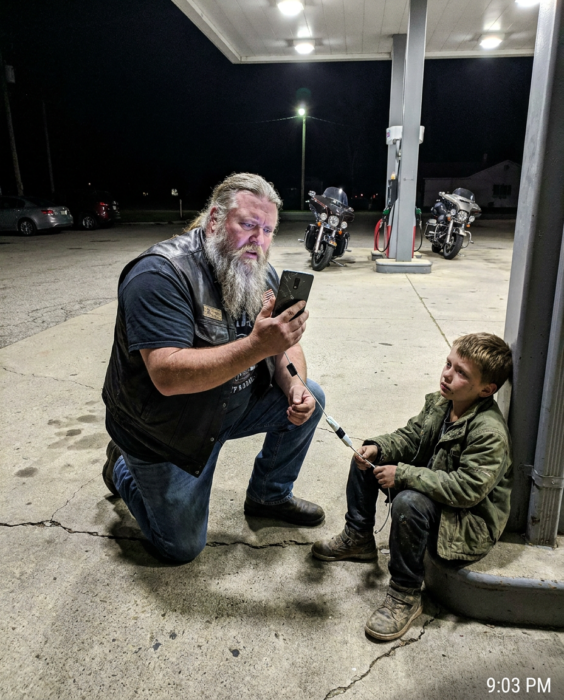
At eight fifty-five, Noah sat beneath the gas-station awning with the phone charged to thirty-one percent. Rook and I stood near the ice freezer, pretending not to watch.
At nine, the screen remained dark.
Noah waited.
At nine-oh-five, he checked the volume. At nine-ten, he restarted the device. At nine-fifteen, he called Laura.
Voicemail.
He called again.
Nothing.
His breath changed.
Children do not always cry when fear arrives. Sometimes they become organized.
Noah checked the cable. He opened the contacts. He tried the hospital’s main number but hung up when an automated menu asked him to choose a department.
Rook crouched beside him.
“What ward?”
“Oncology. Sixth floor. Room changed last week.”
“Doctor’s name?”
“Dr. Patel.”
Rook called the hospital.
Privacy rules blocked information. The operator transferred him twice, then asked whether he was immediate family.
“No.”
The line ended.
Noah called from his own phone. He gave his mother’s full name and date of birth. A nurse came on after twelve minutes.
Laura had experienced a reaction during treatment. She had been moved for monitoring and could not use her phone.
Stable.
That word did not calm him.
“Can I talk to her?”
“Not tonight.”
“You don’t understand. She calls.”
The nurse promised someone would update him.
Noah lowered the phone.
“She thinks I didn’t answer.”
Rook reminded him the nurse knew he called.
“She’ll wake up and think something happened at home.”
“We’ll tell her.”
“No.”
The secret tightened.
Rook had promised not to reveal the power shutoff. Now that promise prevented him from speaking honestly to a sick mother about her son’s safety.
I told him we needed to contact Laura.
Noah stepped between us.
“If she comes home, she misses treatment.”
“She’s your mother,” I said.
“That’s why.”
His voice cracked.
He had become the adult in every conversation because the adults around him were either sick, elderly, distant, or frightened.
Rook saw it.
He placed both hands on his knees and looked Noah directly in the eye.
“You don’t carry this alone tonight.”
“I already do.”
“No, son. You don’t.”
The word son changed the air.
Rook rarely used it.
Noah looked away.
At ten-thirty, the temperature dropped below freezing. Cole closed the store, but he left the outdoor outlet active. Noah prepared to walk home.
Rook blocked the shoulder with his motorcycle.
“You’re riding in the truck.”
“No.”
“Road’s icing.”
“I walked it before.”
“That was before I knew.”
Noah tried passing him.
Rook did not move.
The confrontation grew quiet and dangerous in a different way. One man possessed size and authority. The boy possessed the only control left in his life.
Evelyn settled it by phone.
“Put him in the truck,” she told Rook. “He gets foolish when scared.”
We drove home.
Noah sat in the rear seat holding the phone against his chest. Its wallpaper remained visible: Michael at seventeen, frozen inside a good day Rook had thrown away.
At the farmhouse, Sparks had already arrived with temporary equipment. The club decided to begin emergency work early because freezing temperatures threatened Evelyn’s health.
Portable lights illuminated the yard. Extension cables ran from a generator to essential devices. The V-twin rumble had been replaced by the steady mechanical drone of borrowed power.
Noah saw electric light through the kitchen window.
For one second, he looked twelve.
Then a truck from the utility company arrived and shut down the work.
The crew supervisor said no repairs could proceed until an easement dispute was resolved. The service line crossed a narrow strip of property owned by Evelyn’s estranged brother, who had died the previous year. His estate remained unsettled.
No approved access.
No permanent connection.
The physical repair was only half the problem.
Rook swore.
Evelyn heard him from the porch and told him not to use that language near her house.
He apologized.
At midnight, the hospital called.
Laura was awake.
Noah answered immediately.
“Hi, Mom. Everything’s good.”
The generator roared behind him.
Laura heard it.
“What’s that noise?”
Noah looked at Rook.
Rook looked at the dark utility pole, the temporary lights, and the boy who had walked sixteen kilometers every day to maintain one lie.
Noah covered the microphone.
“Please.”
Rook had three choices.
Lie with him.
Tell the truth.
Or remain silent and force a child to keep carrying it.
He took the phone.
“Ms. Bennett, my name is Dean Mercer. Your son is safe. Your mother is safe. But things at home aren’t good, and we need to tell you why.”
Noah struck Rook’s arm.
“Give it back!”
Rook held the phone away, not angrily, but firmly.
Laura heard her son shouting.
“What happened?”
Noah grabbed for the device again.
The screen flickered.
The damaged charging port sparked.
The phone went black.
Dead.
No call.
No truth.
Only silence.
Noah stared at Rook as if he had destroyed the single thing holding his family together.
Then he ran into the dark.
We found Noah two miles from the farmhouse.
He had followed the road toward the gas station on instinct, as though another charge could repair what had happened. His torn shoes slid on frozen gravel. He wore no hat.
Rook stopped the truck but did not approach immediately.
“Let me,” Evelyn said.
She climbed down slowly, leaning on her cane. Eighty-four years bent her back but not her voice.
Noah stood in the ditch with both fists clenched.
“You told him,” he accused her.
“I allowed him to help.”
“You promised Mom wouldn’t know.”
“I promised we would protect her.”
“Same thing.”
“No.”
Evelyn crossed the frozen grass.
“Protection without truth becomes a cage.”
Noah shook his head. “She’ll come home.”
“Maybe.”
“She’ll die.”
The words landed in the ditch between them.
Evelyn reached him and wrapped her coat around his shoulders.
“She may die there too,” she said. “And you cannot spend whatever time remains walking roads in the dark so she can believe a lie.”
Noah began crying then.
Not loudly.
His body folded toward hers, and the old woman held him with one arm while balancing on her cane.
Rook watched through the windshield.
The dead phone rested in his palm.
When the screen briefly flashed under the charger, Michael’s face appeared again. Rook stared at the photograph and understood the second truth the phone had carried to us.
He and Michael had also used silence as protection.
Their argument happened four years earlier when Michael accused Rook of choosing the club over family. Michael wanted his father to attend an engineering-award ceremony. Rook missed it because a club brother broke down two states away.
Rook claimed brotherhood required him.
Michael said family should have required him too.
The argument ended with words neither could retrieve.
Rook never called because he believed Michael needed space.
Michael never called because he believed his father did not care.
Both men protected themselves from rejection.
The result was four years without a voice.
Noah had recognized it immediately beneath the gas-station awning.
“Then your phone works worse than mine.”
At two in the morning, Rook drove to Cincinnati.
I went with him.
Michael lived in a narrow townhouse with his wife and young son. We arrived before dawn, six-foot-five worth of regret standing beneath a porch light.
Michael opened the door wearing sweatpants, one hand gripping a baseball bat.
He lowered it when he saw his father.
“What happened?”
Rook held up the cracked phone.
“Remember this?”
Michael looked at his seventeen-year-old face on the screen.
“You donated it.”
“Yeah.”
“Why do you have it?”
Rook explained Noah’s walk, Laura’s treatment, the dark farmhouse, and the failed call. He did not make the story about himself.
When he finished, Michael asked the obvious question.
“Why come to me?”
Michael was now an electrical engineer specializing in hospital infrastructure and rural energy systems.
That was the part of his life Rook had missed.
Michael had contacts with nonprofit utility programs, legal-aid groups, and a hospital network operating both St. Matthew Medical Center and a regional cancer center forty kilometers from Beckford.
The treatment transfer might be possible.
The property easement might be solved through an emergency access order.
The phone might be repairable.
But Rook had not driven three hours only for expertise.
“I should’ve called,” he said.
Michael folded his arms.
“Four years ago?”
“Every day since.”
“Why didn’t you?”
“Cowardice.”
Michael’s expression changed because Rook had not disguised the word.
No excuses.
No club.
No pride.
Just the part that failed.
Michael looked at the broken phone.
Then at his father.
“Let’s go help the kid.”
By eight, we were driving back to Beckford with Michael’s laptop open between us. He contacted the hospital network’s patient-navigation director. He located an energy-assistance grant capable of covering materials. He found a temporary legal mechanism allowing repair access across the disputed property.
Most importantly, he repaired the phone.
The charging port required replacement, but he recovered its data and installed the battery from another compatible device.
At the farmhouse, Noah sat at the kitchen table beneath generator light.
He would not look at Rook.
Michael placed the repaired phone in front of him.
The wallpaper appeared.
Noah glanced from the teenage face to the adult man standing across the table.
“That’s you?”
Michael nodded.
“You got old.”
“Phones do that to people.”
Noah almost smiled.
Michael then opened a video call with Laura.
She looked pale beneath hospital lighting. A nasal tube crossed one cheek.
Noah started to repeat his usual line.
Everything’s good.
He stopped.
Then he turned the camera toward the generator cables, the dark ceiling fixture, Evelyn wrapped in two sweaters, and thirty bikers standing quietly outside.
“The power’s been off four months,” he said.
Laura closed her eyes.
Noah waited for anger.
It did not come.
“I’m sorry,” he whispered.
Laura shook her head.
“No, baby. I’m sorry you thought you had to protect me alone.”
The lie ended there.
The work began.
Restoring electricity took nine days.
The club could have paid only the overdue balance and called the story finished. That would have changed nothing. The unsafe service line, failed panel, disputed easement, and damaged meter base would still keep the farmhouse dark.
Michael coordinated the project.
Sparks replaced the weather head, service mast, panel, grounding rods, and damaged interior circuits. The county issued an emergency repair permit. Legal aid obtained temporary access across the estate property.
The utility forgave part of the penalties after learning the household qualified for medical-hardship protection that no one had helped Evelyn request.
The Iron Lanterns paid the remaining balance.
Evelyn recorded every dollar in a notebook.
She intended to repay us through chili.
No beans.
While repairs continued, Noah no longer walked to the gas station. Rook drove him there anyway at nine because the hospital connection worked better beneath the canopy than through the farmhouse’s weak signal.
The routine mattered.
Noah sat by the outlet.
Rook sat several feet away.
Michael joined from Cincinnati when he could.
Laura called.
Now the conversations contained truth.
The house was still cold. Evelyn’s hip hurt. Noah failed a math quiz. Rook’s beard frightened a hospital volunteer during one video call.
Laura laughed.
Truth did not destroy her treatment.
It made room for help.
The transfer proved harder.
Laura’s cancer required a clinical protocol available only at St. Matthew. The regional hospital forty kilometers from Beckford offered oncology services, but not the exact trial medication she received.
Michael found a physician willing to coordinate locally. St. Matthew retained oversight while routine infusions, blood tests, and monitoring moved closer to home.
Insurance rejected the plan.
Then rejected the appeal.
Rook wanted to visit the office.
Leah Ortiz, our attorney, said intimidation would not improve medical authorization. Rook asked whether standing silently counted as intimidation.
She told him yes.
The club instead gathered documentation: Noah’s caregiving burden, Evelyn’s age, transportation barriers, the unsafe home conditions, and the treatment network’s existing affiliation.
Laura’s oncologist wrote a medical-necessity letter.
The third appeal succeeded.
Her care moved to Beckford Regional Cancer Center, forty kilometers away.
But not before the club bought bus tickets for Noah and Evelyn to visit her.
The first trip happened on a Saturday.
Noah wore new boots he had earned by cleaning the gas-station lot. Evelyn carried sandwiches, medication, and a list of questions long enough to qualify as a legal document.
Rook drove them to the station.
Noah held the old phone.
“You coming?”
Rook shook his head. “Family visit.”
“You’re family enough to fix the lights.”
“That ain’t the same.”
Noah considered him.
“You should come.”
Rook sat three rows behind them on the bus.
At St. Matthew, Laura waited in a wheelchair near the oncology entrance. She was forty-one, though illness had removed the easy markers of age. Her scarf covered thinning hair. Her hands trembled in her lap.
Noah stopped walking.
Four months of nine o’clock calls had reduced his mother to a voice on a cracked screen. The woman before him looked smaller.
Laura opened her arms.
He ran.
Evelyn reached them more slowly. She placed one hand over her daughter’s head and the other over Noah’s back.
Rook turned away.
Michael stood near the entrance.
He had driven separately.
“You always do that,” Michael said.
“What?”
“Leave before anybody sees you feel something.”
Rook kept his eyes on the parking lot.
“Habit.”
“Bad one.”
Rook nodded.
Michael remained beside him.
That afternoon, Laura asked to meet the man who donated the phone.
Rook sat at the edge of her hospital room while she held the device.
“You left your son’s picture on it.”
“Forgot to clear it.”
“Noah said seeing it made him feel less alone.”
Rook looked confused.
The wallpaper showed Michael smiling beside a toolbox. Noah imagined the unknown boy had once owned the phone and survived whatever hardship caused his family to donate it.
“He thought Michael was proof things could improve,” Laura said.
Rook studied his son’s seventeen-year-old face.
The photograph he considered evidence of distance had become hope for someone else.
Laura handed back the phone.
Rook shook his head.
“It belongs to Noah.”
Noah refused.
“It’s yours.”
Rook answered, “I threw it away.”
“You donated it.”
“Same motion. Different word.”
Noah placed the phone against his chest.
“Then I’m keeping it until you learn the difference.”
Three weeks later, electricity returned to the farmhouse.
The utility crew connected the new service at 4:47 in the afternoon. Interior lights came on one room at a time.
Kitchen.
Hallway.
Bedroom.
Porch.
Evelyn stood beneath the ceiling fixture and cried without hiding it.
Noah plugged the phone into a wall outlet.
At nine, Laura called.
For the first time in four months, he answered from home.
Laura returned to Beckford two months later.
Treatment continued forty kilometers away. The club arranged transportation, but she refused motorcycles, telling Rook she planned to remain alive.
He said that was fair.
Laura lived three more years.
Some months were good enough for school concerts, grocery shopping, and arguments about homework. Other months belonged to hospitals, fatigue, and quiet rooms.
But she was home.
At nine each evening, Noah still called her phone from the kitchen even when she sat in the next room. It began as a joke and became a ritual.
The old device rang.
Laura answered.
“Everything good?”
Noah looked around at working lights, Evelyn’s hearing charger, the refrigerator humming, and a homework page beneath the lamp.
“Everything’s true.”
When Laura became too weak to walk upstairs, the club built a bedroom on the first floor. Michael designed its electrical system. Rook installed outlets under supervision and received criticism from both Sparks and his son.
They had begun speaking regularly.
Not perfectly.
Regularly.
Michael brought his own son to the farmhouse. The boy recognized his father’s teenage face on Noah’s phone and asked why Dad lived inside another person’s screen.
Noah told him phones take strange roads.
After Laura died, the nine o’clock ritual continued for thirty nights.
Noah charged the phone, sat at the kitchen table, and watched the screen remain silent.
Rook joined him on the first night.
Michael joined by video on the second.
Evelyn sat nearby every night.
On the thirtieth, Noah changed the wallpaper for the first time.
He chose a photograph of Laura sitting on the farmhouse porch between him and Evelyn. The repaired electric mast rose behind them.
He did not delete Michael’s photograph.
He moved it into a folder named BEFORE.
The phone remains with Noah.
Its screen is scratched. The casing is held by tape. Replacement parts have become nearly impossible to find, but Michael keeps it alive.
Every winter, the Iron Lanterns inspect electrical systems for elderly residents and families in medical crisis. Cole’s Fuel Stop hosts the applications.
Noah helps.
He always checks whether each household has a reliable way to charge a phone.
Because sometimes electricity is not only light.
Sometimes it is a mother hearing her child say goodnight.
Noah is nineteen now.
He studies electrical technology at a community college and works weekends with Sparks. His boots no longer split at the toes, though he keeps the old pair inside a box beneath his bed.
Evelyn is ninety-one.
She still makes chili for the club.
Still no beans.
Rook and Michael rebuilt the red toolbox from the wallpaper together. It now stands inside the Iron Lantern garage beneath a framed copy of Michael’s teenage photograph.
Beside it hangs another picture.
Noah at twelve, sitting under the gas-station awning with dust-covered shoes, the old phone charging near his knee.
Cole took it on the third night.
Noah once hated that photograph. Now he says it reminds him how far a voice can travel when someone refuses to let the battery die.
The farmhouse has new wiring, working heat, and a porch light visible from Miller Road.
Every year on Laura’s birthday, Noah turns it on at nine and leaves it burning until morning.
The old phone remains in his desk.
Michael’s photograph stays inside the BEFORE folder. Laura’s portrait remains on the wallpaper. Her smile is tired but real.
Rook asks occasionally whether Noah wants a new phone.
Noah owns a new one.
He simply refuses to discard the old.
Three years before meeting us, Rook dropped that device into a donation bin and forgot it before his motorcycle engine started.
Three years later, he found Noah walking sixteen kilometers a day to charge it.
The phone connected a mother to her son.
Then it connected Rook to his.
Metal, plastic, cracked glass.
Nothing sacred by itself.
Yet at nine each night, it carried one family across three hundred kilometers and pulled another family across four years of silence.
Follow our page and comment ROOK if you want more biker stories about forgotten things that become somebody else’s lifeline.
The porch light still burns at nine.