An Old Man Repaired Shoes for Free Every Sunday for Eighteen Years — Then a Biker Recognized the Stranger Who Started It All
Rook said nothing about Elijah during the ride back to the clubhouse.
That told us the encounter had cut deep.
He normally led funerals in silence, then spoke after the last motorcycle entered the garage. He would say the dead brother’s name, assign someone to check on the family, and make certain grief had practical work to do.
That afternoon, he parked his Harley and stayed seated.
The engine cooled beneath him with small metallic ticks. Rainwater from the morning funeral remained trapped in the seams of his boots.
I stood beside him.
“You believe it was Walter?”
Rook looked toward the garage door.
“My father had that eagle.”
“A lot of men had eagle tattoos.”
“Not with a broken left talon.”
He dismounted.
“Not with that sentence.”
Walter Mercer had been dead for twenty years, yet the Iron Lanterns still used his phrases. He founded the club as a place for mechanics, veterans, factory workers, and men rebuilding lives after mistakes. Walter disliked speeches, rules written for appearances, and anyone who confused poverty with character.
He trusted hands.
If a man helped clean the garage after everyone left, Walter noticed. If a woman arrived with a dead battery and no money, he fixed the car before discussing payment. If a teenager needed work, Walter found something worth doing.
Rook grew up resenting it.
His father gave strangers rides while arriving late to dinner. He repaired other people’s motorcycles while his own kitchen roof leaked. He once loaned a coworker the family’s winter heating money, then worked double shifts to replace it before Rook’s mother discovered what he had done.
Walter’s kindness was real.
So were its costs.
Rook loved his father but spent most of his youth believing the whole town received the better part of him.
When Walter died from a sudden heart attack at sixty-three, people filled the funeral home. Men Rook had never seen told stories about jobs, tools, rent, and second chances.
Rook listened until the stories became unbearable.
He did not want evidence that his father had belonged to everyone.
For two decades, he kept Walter’s final boots locked away.
They were brown leather work boots, size twelve, with steel toes and a worn spot along the right heel. Walter had removed them beside his bed on his last night. Rook’s mother placed them in a grocery bag after the funeral, unable to bear the sight.
When she died, Rook inherited the bag.
He moved the boots into a cedar cabinet.
Twice a year, he rubbed them with conditioner. Not polish. Walter hated shiny work boots.
Nobody knew about the ritual except me.
That evening, Rook unlocked the clubhouse office and called an emergency meeting. He put no agenda on the board.
Twenty-three members arrived.
He told Elijah’s story without embellishment. When he repeated the sentence about shoes and chances, older members looked down.
Cole “Grinder” Maddox remembered Walter saying it to a parole officer who refused to recommend a young mechanic for employment.
Tank Callahan heard him use it after buying interview shoes for a dishwasher.
I remembered Walter telling it to Rook himself when Rook complained that a homeless teenager had been allowed to sleep inside our garage.
The phrase was his.
The stranger was Walter.
Rook asked what we should do.
Nobody answered immediately.
Elijah had not asked for help. His line had moved steadily. His tools were worn but maintained. His stool was old, not broken. Offering money might insult the purpose behind eighteen years of unpaid work.
“We could replace his supplies,” Tank suggested.
“He’ll refuse,” Rook said.
“Donate through the church.”
“He’ll find out.”
Cole folded his arms. “What does he need?”
Rook’s gaze shifted toward the office cabinet where we stored records from the club’s earliest years.
“I don’t know.”
That was the problem.
We knew what Elijah did.
We did not know the man.
The next Sunday, only Rook and I returned. No procession. No show. We parked across the street and carried two coffees into the churchyard.
Elijah was already working.
He repaired a nurse’s cracked clog, reinforced a boy’s school shoe, and replaced the heel cap on a widower’s only pair of dress shoes.
Rook waited until the line disappeared.
“Can I sit?”
Elijah nodded toward the grass.
Rook lowered his enormous frame beside the stool.
For the next two hours, they talked.
Elijah had worked at the machine shop for thirty-six years. He married a church pianist named Ruth and raised three daughters. After retirement, he rented a narrow storefront and repaired shoes until arthritis made full-time work impossible.
Ruth died nineteen years earlier.
One year later, Elijah began the Sunday service.
The timing was not accidental. Grief had left him with too many silent hours. Repairing shoes gave those hours edges.
“Why eighteen years?” Rook asked.
“Because Monday keeps following Sunday.”
It sounded like something Walter would have understood.
Before leaving, Rook asked about the boots the stranger had given him.
Elijah’s expression softened.
“I wore them until the soles failed twice. Repaired them both times. Then our apartment flooded and ruined what was left.”
“You remember them?”
“Every stitch.”
Rook stood.
“I may have something you should see.”
The boots looked smaller inside the box.
Memory does that to objects. It gives them weight, then steals their size.
On Saturday night, Rook carried the box from his house to the clubhouse. He set it on the workbench but did not open it.
Twelve members stood nearby.
“Those are Walter’s?” Cole asked.
Rook nodded.
“You sure you want to take them?”
“No.”
Nobody laughed.
Rook rested both palms against the box.
“This is the last thing he wore.”
“Then keep them,” I said.
He looked at me.
“I kept them twenty years.”
“That doesn’t create an obligation.”
“No. But maybe I kept them for the wrong reason.”
He opened the lid.
The leather had darkened with age. Fine cracks crossed the vamp. The laces were not original. Walter had tied knots at both ends to prevent fraying.
Rook lifted the right boot.
Something rattled inside.
He reached in and withdrew a folded scrap of paper.
We stared.
Rook had cleaned those boots many times, but he never pushed his hand deep into the toes. The paper had remained beneath the insole or wedged along the side.
He unfolded it carefully.
The ink was faded, but one line remained readable.
“E.B. — machine shop gate — needs a chance.”
Below it was a date from sixty-three years earlier.
Elijah Brooks.
Walter had written his initials.
Rook sat down hard on the nearest chair.
His father had remembered.
Maybe he intended to return. Maybe he hoped to check whether Elijah got the job. Maybe the note was no more than a reminder shoved into an empty boot while Walter walked home barefoot.
We would never know.
But Walter had not forgotten the boy.
Rook folded the paper along its original creases.
“Tomorrow,” he said.
We arrived at Saint Matthew’s before the morning service. Twelve motorcycles rolled into the parking lot, engines low, then silent.
Rook carried the box.
Elijah sat beneath the oak tree arranging brushes and thread. He watched the bikers approach without fear.
“Got something broken today?” he asked.
Rook placed the box on Elijah’s work surface.
“Maybe.”
Elijah lifted the lid.
His hands stopped.
The church bell rang once. People crossed the yard behind us, but Elijah appeared not to hear them.
He touched the right boot along the ankle. Then the toe. Then the line of stitching where the upper met the sole.
“These were his?”
“My father’s last pair.”
Elijah looked up slowly. “Your father?”
“Walter Mercer.”
The name meant nothing to him.
Rook showed him a photograph.
Walter stood beside an old motorcycle, sleeves rolled above his elbows. The eagle tattoo spread across his right forearm. Its left talon ended in a broken line.
Elijah removed his glasses.
He wiped them.
Then he looked again.
“That’s him.”
Rook’s throat tightened.
“He died twenty years ago.”
Elijah closed his eyes.
The stranger he had carried in memory for more than six decades finally had a name. That name arrived with a son who had inherited Walter’s height, his hands, and the guarded expression he used when emotion became too large for speech.
Elijah placed both hands around one boot.
“He got home?”
Rook did not understand.
“That day,” Elijah said. “Walking barefoot. Did he get home safely?”
Sixty-three years had passed, and that was Elijah’s first question.
“Yes,” Rook answered. “He got home.”
Elijah nodded.
“Good.”
Rook handed him the folded note.
Elijah read the initials, date, and five remaining words.
His thumbs trembled against the paper.
“He remembered me.”
“He did.”
For several minutes, Elijah said nothing.
Then he reached into the box, removed the left boot, and turned it toward the light.
“These need work.”
Rook looked at the polished but cracked leather.
“They’re not for wearing.”
“All shoes are for wearing.”
“My father is dead.”
“Leather doesn’t know that.”
Elijah drew his stool closer.
Rook touched his wrist.
“You don’t have to.”
“Yes,” Elijah said. “I do.”
The first brushstroke sounded soft against the leather.
Elijah cleaned each boot with a damp cloth, using small circles that followed the grain. He worked conditioner into the cracks with his thumbs. He replaced a loose eyelet, reinforced the heel stitching, and removed the old laces.
A line formed behind him.
He asked everyone to wait.
For the first time in eighteen years, Elijah worked on one pair before all others.
Rook remained standing.
The church service began and ended. People emerged, saw the bikers gathered beneath the tree, and stayed.
Elijah worked for nearly three hours.
His hands cramped twice. I offered to stop.
He refused.
While the conditioner settled, he told Rook about the day at the machine shop. He described Walter’s boots as they had looked new: scuffed toes, oil near the ankle, left lace shortened by a break.
Rook smiled faintly.
“Dad tied knots in everything instead of replacing it.”
“He tied one lace three times.”
“That was him.”
Elijah brushed polish into the seams. Rook had told us Walter disliked shine, so Elijah used only enough to restore the leather, leaving the boots dull and honest.
Then he lifted the right insole.
Beneath it, faintly pressed into the leather, were the words “W. MERCER.”
Elijah touched the imprint.
His breathing faltered.
Rook crouched beside him.
“You all right?”
Elijah nodded, but his face had gone pale.
A nurse waiting in line stepped forward and checked his pulse. It was irregular. Elijah admitted he had felt chest pressure since morning.
We tried to call an ambulance.
He refused until the boots were finished.
The nurse did not negotiate.
An ambulance arrived twelve minutes later.
As paramedics approached, Elijah pulled the final lace tight and handed both boots to Rook.
“One pair returned,” he whispered.
Then he collapsed.
Elijah survived the ambulance ride.
Doctors diagnosed advanced heart failure complicated by an abnormal rhythm. He had been hiding shortness of breath and swelling in his legs for months because he feared the church would stop allowing him to repair shoes.
Rook sat beside his hospital bed that night.
Walter’s boots rested between them.
“You knew you were sick,” Rook said.
Elijah looked toward the window. “Knew I was old.”
“Different thing.”
“Not always.”
The doctors recommended medication, monitoring, and rest. Elijah could return home, but sitting outdoors for hours every Sunday was no longer safe.
He heard only the last part.
“No.”
“Elijah.”
“People come.”
“Somebody else can help them.”
“Who?”
Rook had no answer.
The church pastor stored Elijah’s toolbox inside a supply room. The following Sunday, fourteen people arrived with shoes needing repair.
They found an empty stool.
Some left quietly. Others placed their shoes near the locked door, hoping Elijah would return.
Rook watched from his motorcycle across the street.
Guilt is strange.
He had not caused Elijah’s illness. Bringing Walter’s boots did not create heart failure. The nurse said the timing might have saved Elijah from dying alone later.
Rook knew all that.
Still, the last thing Elijah repaired before collapsing belonged to his father.
It felt like taking.
On Monday, Rook visited Elijah again.
The old man was furious.
Not loud. Elijah did not waste energy shouting. His anger lived in the set of his jaw and the way he refused to look at Rook.
“They locked the box away,” he said.
“Until you recover.”
“My hands still work.”
“Your heart doesn’t agree.”
Elijah turned toward him. “People need shoes.”
Rook placed Walter’s boots beside the bed.
“Teach me.”
Elijah stared.
“I said teach me.”
“You?”
“Something funny?”
“You got hands like fence posts.”
“They turn wrenches.”
“Leather isn’t steel.”
“Then teach slower.”
The first lesson happened at Elijah’s kitchen table.
Rook brought the wooden toolbox home from the church with the pastor’s permission. Elijah sat in a padded chair while Rook occupied most of the space opposite him.
They began with cleaning.
Rook used too much soap.
Elijah made him start again.
Then polishing.
Rook pressed too hard.
“Boot didn’t insult your mother,” Elijah said. “Stop attacking it.”
By the third lesson, Rook could replace laces properly. By the fifth, he understood how to roughen a surface before applying adhesive. Stitching came harder. His scarred fingers were built for thick tools, not fine waxed thread.
Elijah made him practice on scraps.
Again.
Again.
Again.
Other club members joined.
Cole learned heel replacement. Tank became good at resoling work boots. Marcus handled orthopedic modifications under guidance from a local cobbler. I recorded Elijah’s instructions because his strength faded quickly.
The clubhouse changed.
One workbench held motorcycle parts. Another held shoe lasts, brushes, glue, thread, and leather.
Oil mixed with polish.
Harley engines rumbled beside the sound of small hammers.
Some members resisted.
“We’re a motorcycle club,” one man said during a meeting.
Rook placed a child’s torn shoe on the table.
“We’re men with hands.”
“That doesn’t make us cobblers.”
“No. Practice does.”
The disagreement split the room. Several members believed the project should remain personal to Rook. Others worried that untrained repairs could fail and injure someone. They were not wrong.
Brotherhood was being tested by good intentions.
Rook refused to turn sentiment into sloppy work.
He contacted a professional cobbler named Rosa Martinez, whose family had operated a repair shop in Dayton for forty years. She agreed to train volunteers if the club paid for proper materials and accepted strict limits.
We did.
Repairs involving structural damage went to Rosa’s shop. Volunteers handled cleaning, polishing, simple stitching, heel caps, laces, and basic sole work only after passing her tests.
Rook failed his first test.
Then his second.
On the third, he repaired a split work boot that held through fifty thousand flexes on Rosa’s machine.
She signed his training card.
“Good enough for Sunday.”
Four weeks after Elijah collapsed, the wooden stool returned to the churchyard.
Rook sat on it.
The image stopped people cold.
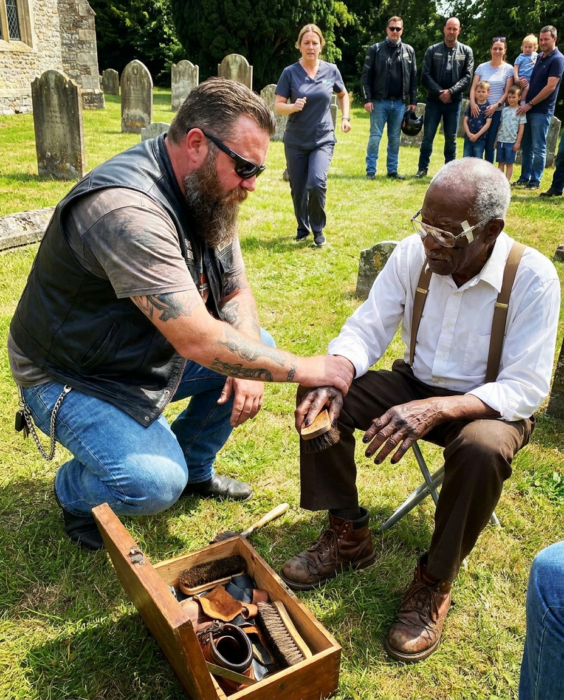
A nearly three-hundred-pound biker with sleeve tattoos and a gray beard leaned over a little girl’s red shoe, guiding waxed thread through a torn strap. Six Harley-Davidson motorcycles stood behind him. Cole organized the waiting line. Tank cleaned brushes. I labeled completed repairs.
Nobody charged money.
A woman tried to tip Rook.
He closed her fingers over the bill.
“No charge.”
Elijah watched through a video call on Marcus’s phone.
He smiled once.
Then he corrected Rook’s stitch.
“Too loose.”
Rook tightened it.
“Better?”
“Barely.”
Four months after meeting us, Elijah’s condition worsened. He entered hospice care at his eldest daughter’s house.
On his final Sunday, Rook brought Walter’s boots to him.
Elijah ran one blackened thumb over the leather.
“Still holding?”
“Like iron.”
“That’s the stitching.”
“That’s the man.”
Elijah shook his head.
“No. Man walked barefoot. Stitching came later.”
Rook understood.
Walter’s gift had lasted one day as footwear.
Its consequence had lasted a lifetime.
Elijah died on Monday morning.
The boots were beside his bed.
Elijah’s funeral filled Saint Matthew’s beyond capacity.
People stood along the walls and beneath the windows. They carried repaired shoes in grocery bags, cardboard boxes, and bare hands.
A nurse brought the clogs Elijah saved during her first month at the hospital. A construction worker wore boots resoled three times. A teacher displayed the shoes in which she had attended her job interview.
The barefoot boy from our first Sunday arrived wearing the sneaker Elijah had stitched.
His mother held the other one.
Rook sat in the front row beside Elijah’s three daughters. Walter’s boots rested beneath his chair.
The pastor read part of Elijah’s will.
He left no money. His modest savings went to his grandchildren. His repaired watches went to his daughters. His cobbler’s stool, wooden toolbox, and remaining supplies went to Saint Matthew’s Church.
One handwritten condition followed:
“The box stays open on Sundays.”
No person was named.
Elijah had left the duty to whoever understood it.
After the service, his eldest daughter, Lorraine, carried the toolbox into the yard. She set it beneath the oak tree.
Rook approached.
Lorraine handed him the key.
“My father said you would know what to do.”
Rook looked at the line already forming near the gate.
“How?”
“He said your father taught him.”
She pointed at the boots beneath Rook’s arm.
“He taught you.”
Rook sat on Elijah’s stool.
The first customer was an elderly man whose shoe had separated at the toe. Rook inspected it, selected the correct adhesive, cleaned both surfaces, and worked slowly.
His hands shook.
Lorraine noticed.
“Too much coffee?” she asked.
Rook shook his head.
He was afraid.
Not of failing to repair the shoe. Rosa stood nearby and would stop him if he made a mistake.
He feared turning Elijah’s life into a ceremony that lasted one emotional week.
Anybody could show up once.
Eighteen years were made of ordinary Sundays: rain, heat, holidays, headaches, family arguments, sore hands, empty lines, and mornings when staying home would have been easier.
Rook pressed the sole into place.
He held it.
He waited.
When the adhesive set, he handed the shoe back.
The man tried to pay.
Rook used Elijah’s words.
“No charge.”
That afternoon, the club voted on a permanent schedule. At least two trained members would serve every Sunday. A third would remain on call. Holiday weekends counted. Snowstorms counted unless the church closed. Funerals, rides, football games, and personal plans would be arranged around the stool.
We created a supply fund.
Elijah had refused money for himself, but materials still cost something. Donations went directly to leather, thread, adhesive, replacement soles, and professional repairs beyond our skills.
Rook refused to put the club logo on the toolbox.
“This isn’t recruiting.”
He also refused press interviews for the first year.
“This isn’t advertising.”
The stool became part of our road calendar.
Cole took the first Sunday of every month. Tank took the second. Marcus and I covered the third. Rook sat whenever his health and club duties allowed, which meant he appeared more often than anyone.
We learned the people behind the shoes.
A hotel cleaner walked five miles per shift because her employer prohibited sitting. A widower wore the same dress shoes to church because his wife had bought them forty-two years earlier. A teenager needed polished shoes for court and expected judgment from the tattooed men serving him.
Rook repaired them without questions.
When finished, he handed the teenager a small brush.
“Keep them clean.”
The boy returned two months later.
Not for a repair.
To help.
Six years passed.
Not one Sunday was missed.
We worked during rain beneath a canvas awning. We worked through August heat with fans connected to the fellowship hall. During a winter storm that closed the roads, Rook slept inside the clubhouse Saturday night and reached the church on a three-wheeled utility vehicle.
Nobody arrived with shoes that morning.
He opened the box anyway.
At noon, a woman from the shelter crossed the snow carrying two pairs of children’s boots.
Rook repaired both.
Walter’s final boots remained in the clubhouse inside a glass-fronted cabinet. Elijah’s last coat of polish had softened, but the stitching held.
The folded note rested beside them:
“E.B. — machine shop gate — needs a chance.”
Every new club member heard the story before receiving a patch.
Not because Walter was our founder.
Because a man can perform the most important act of his life and never know what followed.
The Sunday ritual developed its own sounds.
Harley engines approached along Route 40 shortly before eight. Kickstands struck pavement. The toolbox latch clicked open. Brushes tapped against jar rims. Small hammers answered the church bell.
Tap. Tap. Tap.
Children stopped fearing the bikers.
They brought shoes and questions.
“Why is your beard so long?”
“Why do you have a skull ring?”
“Can motorcycles get cold?”
Rook answered the last question seriously.
“Everything gets cold.”
Some people came without damaged shoes. They sat beneath the oak tree because Elijah’s corner had become a place where asking for help did not require a formal explanation.
A woman escaping an abusive household needed nonslip shoes for restaurant work. A veteran needed boots wide enough to accommodate a brace. A homeless man needed nothing repaired but remained for coffee and left with dry socks.
The club learned its limits.
We could fix leather.
We could not repair every life placed in front of us.
So Saint Matthew’s built partnerships with shelters, employment programs, veterans’ services, and community clinics. A shoe line became a doorway into other kinds of assistance.
Elijah’s daughters visited every anniversary.
Lorraine brought his old white shirt, the cuffs permanently stained by polish. She refused to wash it again.
Rook hung it from the back of the stool for one morning, then returned it carefully.
On the sixth anniversary, the church installed a small brass plate beneath the oak tree. Rook insisted it contain no grand language.
It carried two names:
WALTER MERCER
ELIJAH BROOKS
Below them appeared the sentence joining their lives.
“Shoes can be bought. Chances can’t.”
Rook stood before it after everyone left.
He wore Walter’s boots.
For twenty-six years, he had believed putting them on would mean pretending to become his father. Elijah had shown him something different.
Shoes were never identities.
They were only enough protection to take the next step.
Rook walked across the churchyard in them once.
Then he returned them to the cabinet.
The wooden toolbox is still opened every Sunday.
Its corners have worn smooth. One brass hinge has been replaced. Elijah’s initials remain scratched beneath the lid where nobody sees them unless they kneel.
Rook is older now.
His knees no longer tolerate the low stool, so the church provided a higher chair. He complained for three weeks, then added a cushion without admitting he needed it.
Young members do most of the bending.
Rook watches their hands.
“Less glue.”
“Straight stitch.”
“Let it cure.”
He sounds like Elijah.
Sometimes a stranger asks why a motorcycle club repairs shoes outside a church. The newest members usually begin with Elijah’s eighteen years of service.
Rook corrects them.
“Start with the gate.”
So they tell the whole thing.
A barefoot nineteen-year-old needed work. A supervisor measured decency by shoes. An unknown biker heard him and removed his own boots. The young man got the job, became a cobbler, and returned that one gift to thousands of feet.
Then the stranger’s son found him.
One Sunday, a boy arrived holding a pair of motorcycle boots several sizes too large. They had belonged to his father, who died before teaching him to ride.
The leather was dry. One heel was loose.
Rook took them.
He cleaned the dust, conditioned the cracks, replaced the heel, and tied knots at the ends of both old laces.
The boy asked what he owed.
Rook closed the toolbox.
“Nothing.”
“Why?”
Rook glanced toward the brass plate beneath the oak tree.
“Somebody already paid.”
The boy carried the boots home against his chest.
Church bells rang above us.
Behind the fellowship hall, motorcycles waited in the sun. Their engines were silent, but the repaired heels struck the pavement with every departing step.
Tap. Tap. Tap.
The box stays open.
Want another full biker story? Drop WALTER in the comments and follow the page—more unforgettable stories of brotherhood are coming soon.