Part 2: A 6’4″ Tattooed Biker Walked Down a Hospital Hallway Carrying a Tiny Pink Backpack — What Was Inside Explained Why the Nurses Stopped to Watch
Part 2 — The Girl Who Applauded Everybody
The first time Maisie Hale arrived on our floor, she refused to let anyone take off her rain boots.
They were yellow, although there was no rain outside. She had chosen them herself, and changing her mind would have meant admitting that someone else had authority over her feet.
She was two and a half. That explained more about her than anything written in her chart.
Caleb stood beside the bed with an overnight bag over one shoulder and a pink backpack dangling from two fingers. Erin held their daughter’s hand and listened as we explained what would happen next.
They had already heard the word cancer.
What they needed now was someone to tell them where to put their coats, how to call us, and whether Maisie could keep wearing the boots until we absolutely needed them off.
She could.
Caleb watched me say that. Then he looked at his daughter and gave one solemn nod, as if she had won a negotiation that would be studied in law schools.
Maisie offered me a cracker. That was our introduction.
The pink backpack came from a discount store near their house. Erin told me Maisie had chosen it because the rabbit looked sleepy, and she believed sleepy things should be taken home.
Inside were a sock monkey, a coloring book, and a yellow spoon. Over the following months, the contents changed according to priorities known mostly to Maisie.
The spoon stayed. So did the monkey, whose name was Pickles despite not looking remotely like one.
During that first admission, Caleb startled people without intending to. He had a voice that carried through closed doors and shoulders that made our room entrances look narrow.
His forearms were covered in ink. More showed above the collar of his shirt. When he folded his arms to listen, strangers sometimes thought he was angry.
Usually he was trying to remember everything.
He kept a small notebook in his vest. Not a symbol, not a secret. Questions went in it because fear had made his memory unreliable, and he didn’t want Erin carrying every detail alone.
At night, he wrote down things Maisie said, too.
I discovered that when he handed me the notebook to check a question and I saw, beneath an appointment time, a sentence about the moon needing somewhere to sit.
I asked what that meant.
“She’s worried it gets tired.”
“Does it?”
He looked toward the bed. “Apparently.”
He wasn’t always gentle with the world outside that room. Once, a vending machine took his money and he swore loudly enough that Maisie lifted her head.
He apologized to her, then to the mother sitting nearby. The machine received no apology.
Maisie later told every nurse that Daddy had said a parking-lot word. That was how the phrase entered our vocabulary.
For eighteen months, treatment brought them back to us in stretches. There were admissions, clinic visits, and periods at home when the backpack held snacks for a park instead of things to get through a hospital night.
We learned the family’s rhythms.
Erin worked remotely when she could, sitting by the window with headphones on until her daughter needed her. Caleb repaired commercial kitchen equipment and arranged jobs around appointments until arranging was no longer enough.
Neither parent performed bravery for us.
They got tired. They argued quietly about bills, meals, whose turn it was to sleep. Sometimes Erin went downstairs simply to hear a conversation that wasn’t about their child.
Sometimes Caleb stood in the stairwell for five minutes with his eyes closed.
Then they came back.
Maisie liked to supervise his return. She would point toward the chair and announce that he had missed a meeting, though the meeting generally involved deciding which stuffed animal deserved the blanket.
When her hair thinned, she wanted to know whether her father could give her some of his beard.
He considered this seriously.
“It’s scratchy.”
“I’ll put conditioner.”
Erin laughed into her sleeve. Caleb bent his head so Maisie could test a patch beneath his chin.
She decided against it.
There were hard days that had no funny ending. On those days, Caleb learned to sit still while she was angry, even when her anger landed on him.
“Go away,” she told him once. He moved his chair toward the door.
“Not that far.”
He moved it back.
That was fatherhood on our floor more often than speeches or promises: finding the distance a frightened child could bear, then staying there.
The applause began on an otherwise forgettable afternoon.
Our housekeeper, Denise, retrieved Maisie’s yellow spoon from behind a cabinet without moving the bed. Maisie clapped as though Denise had completed a daring rescue.
Caleb joined in. Erin did too.
After that, everybody got applause for something. A nurse fixing a squeaky wheel. A technician bringing a warm blanket. Her father finally peeling an orange without leaving the white strings she disliked.
“Good job,” Maisie would say, with the generous authority of someone who had never paid a mortgage.
She didn’t reserve it for good news.
That was the thing I remembered later.
She applauded people for showing up and doing small jobs properly, even on days when the important news was bad.
Caleb always waited for her to start.
Then those enormous tattooed hands would meet carefully, softly, while she watched to make sure he was doing it right.
Part 3 — The Things They Could Still Do
By the last admission, we no longer spoke about the next one as if it were guaranteed.
The medical team had explained that treatment was no longer controlling the cancer. I was in the room for part of that conversation, standing near the sink while Erin asked questions and Caleb wrote down only three words.
What happens now.
There was no question mark. He told me later he had forgotten how to make one.
We talked about comfort, time together, and the choices the family still had. Maisie slept through most of it, one foot outside the blanket because she disliked having both covered.
When she woke, she wanted a purple ice pop.
I brought one.
Her parents sat on either side of the bed while she complained that purple didn’t taste the same as it looked. For a few minutes, the problem in the room was an ice pop that had failed to be properly purple.
Those minutes mattered.
Caleb belonged to the Hollow Creek Riders, a club whose members had brought meals, repaired Erin’s car, and quietly taken over some of the work he could no longer finish.
They had been useful for eighteen months.
Now useful was getting harder to define.
A man named Miles, the club president, called me through the number the family had given him and asked whether there was anything they hadn’t tried. Another hospital. Another doctor. A vehicle to get there.
I told him the parents had discussed the medical options with the team. What they needed from friends now was something only they could name.
He was silent.
Later, he told me he’d been holding a set of motorcycle keys during that call, turning them over in his hand as though there must be a destination that would make them useful.
He and Caleb had known each other for twenty years.
Miles had been there through Caleb’s drinking, through the separation it nearly caused, and through the long stretch of sober mornings that followed. He had driven him to meetings before Maisie was born.
By the time I met Caleb, he had rebuilt a life he was determined not to damage again.
Knowing that didn’t protect him from this.
One night, I found him outside the family lounge holding his phone so tightly that his knuckles had gone pale.
He wasn’t asking someone for a miracle.
“Can you stay on?” he said.
Miles stayed on.
Caleb sat in the hallway until his breathing settled, then went back to his daughter’s room. I didn’t ask what he had almost done or thought about doing. He had reached for somebody who knew him.
That was enough for me to see.
The club struggled anyway.
One rider wanted to bring every motorcycle to the hospital so Maisie could hear them. Another suggested a farewell ride through the parking lot. They were men accustomed to answering fear with movement.
Erin asked for quiet.
Not because she disliked them. Because Maisie startled easily now, and because her husband couldn’t manage a crowd waiting for him to say the right thing.
Miles passed the request along.
Most understood immediately. One didn’t. He’d spent the weekend repairing a small wooden step stool for Maisie’s bathroom at home and couldn’t accept that there might not be a homecoming for it.
“So we just sit?” he asked.
Miles told me he had answered yes, then gone over to sit with him.
The stool stayed in the workshop. Nobody carried it into the room to make the parents explain their grief around it.
Instead, two men came at a time when invited. They brought food in containers that didn’t need returning. They took laundry home. They drove Erin’s mother from the airport.
And when Caleb called after midnight, somebody answered.
On Maisie’s last good afternoon, she asked for the backpack.
Caleb lifted it onto the bed, and she examined the contents with the seriousness of a traveler who suspected poor packing.
Pickles needed to stay. The spoon needed to stay. A coloring book with only two untouched pages was somehow essential.
She found a crumpled sticker and pressed it against the inside of Caleb’s vest.
“For your pocket,” she said.
It was a yellow star. One point wouldn’t stick.
He smoothed it with his thumb and told her he would keep an eye on that.
Then she asked whether Denise was working.
Denise came when she could. Maisie was too tired to clap, so she lifted two fingers from the blanket instead.
Denise touched them gently.
The next evening, the room became quiet in a different way.
Her parents were with her. The team made sure they weren’t alone, while leaving space for them to be her mother and father without an audience.
I remember Erin moving a curl away from her daughter’s forehead even though there was almost nothing there to move.
I remember Caleb saying her name.
I will not pretend I know which of those moments belonged to her last awareness. I only know that the people she knew were close, and nobody asked her to be brave.
After she died, there were things to do, because hospitals do not stop needing forms when families stop understanding language.
We did them slowly.
Caleb asked if he could hold her. He did, for as long as the family needed.
Later, Erin placed Pickles and the yellow spoon inside the backpack. Caleb took it from her, slung it over his shoulder, and turned toward the door out of habit.
Then he stopped.
For eighteen months, someone had usually said, Don’t forget her blanket, or I’ll bring her coat, or Wait, she’s not ready.
Nobody said any of those things.
He stood there until Erin put her hand on his back.
Then they left together.
Part 4 — What the Pink Canvas Held
Thirteen days later, Erin called while I was putting groceries into my car.
I recognized her number and answered before the second ring. For half a second, I expected a question about a symptom or an appointment, something practical that would let me be useful without feeling everything first.
Instead, she asked whether the room at the end of our hallway was still empty.
She was asking about the following morning. I told her I would check with the unit before promising anything.
“Caleb wants to bring her back,” she said.
I stood beside my open trunk.
“The funeral home called yesterday. We’ve brought her home.”
I knew then what she meant.
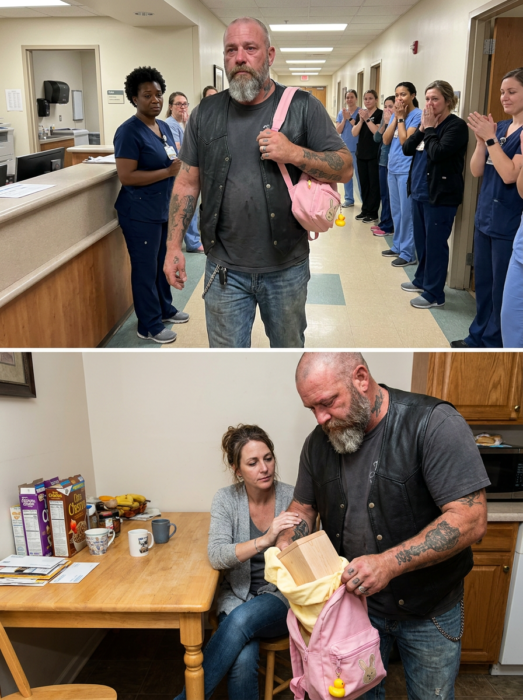
Maisie’s ashes were in a small sealed wooden urn, wrapped in a piece of the soft yellow blanket that had followed her through treatment. The urn fit inside the pink backpack.
That was what Caleb would be carrying.
Not a collection for other children. Not forgotten toys from their last admission. His four-year-old daughter, in the only bag she had ever insisted on packing herself.
Erin told me he had spent much of the previous evening at the kitchen table with the bag in front of him.
He had taken out the coloring book and put it on the shelf. The spoon went in a drawer. Pickles sat on Maisie’s pillow upstairs.
Then he wrapped the urn, eased it into the main compartment, and checked that it wouldn’t shift.
He hadn’t asked Erin to help.
She had sat beside him anyway.
“He wants to say goodbye to you all,” she said. “I think he needs her to come with him.”
We made the arrangements carefully. A short visit, familiar staff where possible, no entry into occupied rooms, and time in the empty room if it remained available.
Nothing announced to other families. Nothing expected from them.
I asked whether Erin wanted to come upstairs.
She said no.
“I can drive to the hospital. I can wait for him. But I can’t walk past that chair yet.”
I knew which chair.
Caleb had slept in it more often, but Erin had sat there while hearing things no parent should have to translate into plans for the next day.
I told her she didn’t have to explain.
Miles offered to drive them both.
He had originally imagined bringing several riders, not a parade, just company. Caleb shook his head when he mentioned it.
So Miles brought the car.
The other men stayed away because that was what their friend needed. The support that morning wasn’t measured in engines or leather vests outside the entrance.
It was one person being ready to drive home.
Erin called again from downstairs. They had arrived.
I went to the secured doors.
Now, walking beside Caleb, I understood why his hand stayed under the backpack. The strap could carry its weight. That wasn’t the point.
He had spent eighteen months supporting her whenever moving hurt, whenever she was sleepy, whenever the distance from bed to bathroom felt too long.
His hand still had somewhere to go.
At the first doorway, Marisol touched his wrist. She had been one of the nurses Maisie wanted whenever her parents needed a break.
At the next alcove, our night nurse, Beth, waited in her coat. Her shift had ended, but she’d stayed a little longer after hearing the family had arranged a visit.
Caleb recognized her and stopped.
Beth had once taught Maisie to make a shadow rabbit on the wall. Neither of us mentioned it then, but I saw Beth look toward the patch on the bag.
She touched two fingers to the loose cloth ear.
Caleb closed his hand around hers for a second.
Then we continued.
Denise stood near the supply room with her cart moved out of the way. Her uniform was clean, her reading glasses hooked at the collar.
Maisie had called her the Spoon Finder for almost a year.
When she saw the bag, Denise put a hand against her own chest and looked down.
Caleb waited.
It was the same patience I’d seen when Maisie took too long to finish a sentence. He gave Denise enough time to look up again without making her feel watched.
A call light came on down the hall. Marisol went to answer it.
The floor was still a hospital. Children still needed their nurses, parents still had questions, and someone in the playroom was arguing over a plastic dinosaur.
Caleb heard that argument.
For the briefest moment, the corner of his mouth moved.
Maisie had been fiercely opposed to sharing the purple dinosaur despite having no interest in it until another child picked it up.
I knew he remembered.
Near the last room, our newest nurse quietly asked me what he was carrying. I guided her into an alcove and told her only what she needed to understand.
Her eyes filled.
She started to say something, stopped, and asked whether she should get tissues.
“Have them nearby,” I said.
She did.
There was no shame in not knowing what to do. I had been a nurse for nearly three decades, and I was still learning how little useful language could remain after a child died.
Caleb stood at the last doorway.
The room was clean and empty, ready to belong to someone else when it was needed. The chair had been pushed beneath the window.
He shifted the backpack into both hands.
I opened the door farther and moved aside.
He entered without a word, crossed to the bed, and lowered the pink bag onto the fresh sheet.
I glanced at the clock.
Nine forty-two.
Part 5 — Ten Minutes Beside an Empty Bed
He placed the backpack near the middle of the mattress, where Maisie used to sit with her legs folded beneath her.
The bag tipped slightly. Caleb caught it before it fell onto its side, then adjusted the blanket inside through the canvas until it rested securely.
He did not open it.
He turned the rabbit toward the window.
That small movement nearly finished me.
Maisie had liked the morning light. When she felt well enough, she would press colored plastic shapes against the glass and insist the patches on the floor were stepping-stones.
Caleb had crossed that room in ridiculous little jumps because she said the plain tiles were water.
Now he stood beside the bed with both boots on the floor.
The door remained open. He had wanted me nearby, and I stayed outside it, far enough back that he didn’t have to remember my face.
His hands dropped to his sides.
Then one rose again.
He rested his palm against the top of the backpack, not pressing down, just keeping contact.
I don’t know what he said to her in his head. I don’t know whether he prayed. There are things people imagine when they witness grief, and then there are the things they actually see.
I saw a father standing beside his daughter’s bag.
I saw him move his thumb once over the seam.
I saw him look toward the chair.
That chair had held him through fevers, long conversations, and mornings when he’d woken before his body was ready because Maisie wanted to know where Mommy was.
It had held Erin while she answered work emails with one hand and stroked her daughter’s ankle with the other.
Once, the two of them had fallen asleep leaning against each other in it, and Maisie had announced that they were squishing the chair.
We found a second chair after that.
Only one was there now.
Caleb touched its back but didn’t pull it out.
He remained standing.
At nine forty-four, a cart passed behind me. Its wheel caught on a join in the floor and made the familiar little knock that had always preceded breakfast trays.
Caleb turned his head toward the door.
For a moment, I thought he wanted something.
Then he looked back at the bed, and I understood that he had heard a sound attached to a habit.
Maisie had never liked the toast. She had demanded it anyway because she wanted the little packet of jelly.
Eighteen months could teach a parent to turn toward the same noise hundreds of times.
Two weeks could not teach his body that it no longer needed to.
I leaned against the wall and looked at my own hands.
Those hands had held Maisie’s while she complained, while she laughed, while she tried to bargain her way out of things she disliked. They had changed sheets and carried cups and placed a sticker on a forehead because she insisted that was where it belonged.
They had also been there at the end.
I had gone home afterward and found my seventeen-year-old son’s shoes blocking the kitchen doorway.
Usually I would have called him to move them.
That evening, I stood looking at those enormous shoes and couldn’t speak until he came downstairs and asked what was wrong.
I hadn’t told him another family’s private story. I had said we’d lost a child at work, and he had stayed beside me while I made tea I didn’t drink.
Now I wished there were some ordinary job I could give Caleb that would last long enough to get him through the next minute.
There wasn’t.
The work in that room belonged to him.
He reached inside his vest and touched the yellow star.
It was still there.
The loose point had been secured with a tiny piece of clear tape. I remembered him asking for the tape days before Maisie died, embarrassed by the request until I understood he wasn’t trying to repair anything medical.
He had promised to watch that corner.
He was still watching it.
At nine forty-seven, he bent his head.
No tears fell onto the backpack. His face had tightened around the mouth, and the red around his eyes seemed darker under the overhead light.
I kept the tissues in my hand.
He didn’t ask for them.
On the bed, the yellow duck lay against the pink canvas. Its bill had a small scrape from an afternoon Maisie dropped it between the chair and the wall.
Caleb had retrieved it with a ruler and a piece of tape while she directed the rescue from her pillows.
We had applauded that too.
I could almost hear her correcting him afterward, telling him the duck needed a rest and mustn’t be asked to do anything else.
He straightened the zipper pull now, leaving the duck where she would have wanted it.
Then he took his hand away.
That was the hardest movement to watch.
Not arriving. Not setting the bag down. Taking his hand away and letting the space remain between his fingers and the canvas.
He stood like that for another minute.
The room was quiet enough that I heard the ventilation switch to a different hum.
At nine fifty-two, he reached for the backpack.
He slid one hand underneath and lifted it with the other, bringing it against his chest before settling the strap over his shoulder.
Ten minutes.
No one had counted aloud. No one had told him his time was up.
He looked once toward the window, once toward the chair, and then turned to leave.
I stepped back.
Beyond me, the hallway was no longer empty.
Part 6 — The Applause She Had Taught Us
They stood along one side, leaving the middle clear.
Beth was still in her coat. Marisol had returned from the room where she was needed. Denise stood with her hands folded at her waist, and our newest nurse held a box of tissues she had forgotten to put down.
Other staff stayed at their posts. The children on our floor were still being cared for.
But the people who could be there had come.
Nobody had lined them up. Nobody had told them what to say. One person had stepped out, then another, until Caleb opened the door and found familiar faces all the way to the corner.
He stopped.
I saw his hand tighten around the strap.
For a second, I worried we’d made it harder. Erin had asked for no gathering, and this wasn’t supposed to become something Caleb had to endure for our sake.
I looked at him, ready to offer the quieter route past the staff room.
He looked down the line instead.
Then he moved toward it.
Denise was the first to clap.
One soft clap, then another.
The sound was so small that it could have been someone brushing dust off their hands. But Caleb looked straight at her, and I knew he recognized it.
She had the same expression she’d worn when Maisie awarded her applause for finding the spoon: half embarrassed, half delighted to have been included.
Only now her eyes were full.
Beth joined her. Then Marisol.
I set the tissues down on a nearby counter and brought my hands together.
The sound traveled gently along the hall.
We weren’t celebrating a death. We weren’t congratulating a father for managing not to fall apart where other people could see him.
We were answering the little girl who had spent eighteen months noticing what we did.
The spoon, the blanket, the chair wheel, the orange.
She had made us feel useful on days when the work left us frightened by how much we couldn’t control.
Now her father was carrying her past us, and for a few seconds we used the language she had given us.
Caleb understood.
I could see it in the way he lifted his chin, then had to lower it again.
His eyes were red. His cheeks stayed dry.
The loose ear of the rabbit rested against his wrist.
He passed Beth, who had sat with Maisie while Erin showered and Caleb went downstairs for coffee. Beth didn’t reach for the bag. She put a hand on her own heart and mouthed his daughter’s name.
He nodded.
He passed Marisol, who had once allowed Maisie to inspect her lunch and pronounce it insufficiently crunchy.
Marisol laughed through a breath that almost became a sob.
He paused long enough to look at her.
Not to comfort her. We weren’t asking him to do that.
Just to recognize that she had known a part of his child he might not have been there to witness.
That was what eighteen months had done.
Maisie had a way of greeting the night staff, a preferred seat in the playroom, an opinion about the crackers in the family lounge. She had jokes with people who were not her parents.
Her life had happened here, too.
The new nurse moved aside as Caleb approached. She hadn’t known Maisie, but she’d heard about a four-year-old who believed a rabbit needed a duck for company.
She looked at the little zipper charm and wiped her cheek.
Caleb gave her the same small nod he’d given everyone else.
Denise was last around the bend.
When he reached her, she stopped clapping and opened one hand, not toward the backpack but toward his wrist.
He let her touch him again.
There was something almost unbearable about the scale of it: her fingers across the edge of his tattoo, the huge shoulder beneath a child’s strap, the careful way neither of them moved too quickly.
Then she let go.
The applause faded behind him instead of following him toward the doors.
That felt right.
He didn’t have to keep walking inside it.
I went ahead to release the secured door while he stood near the last stretch of window.
From there, he could see the parking area below.
Miles’s car waited near the entrance.
Erin was beside it.
Caleb looked down at her, then back at the people standing behind him.
Until that moment, he had not spoken once on the floor.
He drew in a breath.
We waited.
Part 7 — The Ride Home
“Thank you for loving her like she was one of your own.”
That was all he said.
His voice wasn’t loud. It wasn’t steady either. The last few words came slowly, as though each one required a little more air than he had expected.
Then he nodded and turned toward the door.
Nobody answered with a speech.
Beth put her hand over her mouth. Marisol looked at the floor. Denise stood with her palms still slightly apart, as if she’d forgotten where to put them after the clapping ended.
I opened the door for him.
For eighteen months, we had watched Caleb leave the floor to get coffee, take phone calls, collect clothes, or stand somewhere he could breathe without his daughter seeing his face.
Those departures had all pointed toward coming back.
This one didn’t.
He stepped through with the pink backpack held against his side, and I followed because he had nodded when I asked whether he wanted company to the elevator.
We waited beside a window overlooking the road.
A delivery truck was reversing near the loading entrance. Someone hurried across the parking lot with a paper bag held over their lunch to keep it warm.
Caleb watched the ordinary movement below us.
I wondered what it would be like for him to pass the exit he’d taken so many times without turning back toward the hospital. I didn’t ask.
The elevator arrived with a soft chime.
He moved aside for a mother pushing a stroller. She thanked him without knowing anything about the bag.
He nodded.
Inside, he stood near the back wall and kept one hand underneath the pink canvas.
I pressed the button for the lobby.
There were things I wanted to tell him. That I’d remember Maisie’s parking-lot words. That Denise would never find a spoon behind a cabinet without thinking of her. That the little duck had made our newest nurse cry even though she’d never heard Maisie’s voice.
But he had already seen us standing there.
He didn’t need to carry my explanation too.
When the doors opened, Erin was waiting just inside the entrance. She had come in from the car after Miles called to say he could see us through the upstairs window.
She didn’t ask whether the visit had helped.
She looked at Caleb’s face, then at the backpack, and held out her hand.
He took it.
For a moment they stood together between the elevator and the doors, two people holding the same loss from different sides.
Erin touched the rabbit’s loose ear.
Then she looked at me.
“Was he alone in the room?”
I told her I had stayed just outside.
She nodded, and the relief in her face was so small I might have missed it if I hadn’t spent eighteen months learning how this family spoke without words.
Miles came in to meet them. He carried no helmet and wore no expression that demanded Caleb reassure him.
He simply took Erin’s overnight tote and went ahead to open the car.
I stopped at the entrance.
Caleb glanced back once.
He had no tears on his cheeks. His vest was dry. His eyes were still red.
He lifted his fingers from the strap just enough to acknowledge me, and I lifted mine back.
Then he went outside.
I watched him settle into the back seat beside Erin, the little bag kept upright between them. Miles waited until they were ready before closing the door.
There was no motorcycle escort waiting at the curb. The Harley would still be in Caleb’s garage when he got home, along with Maisie’s rain boots and a hundred decisions nobody needed to make that day.
For now, there was only the ride home.
Erin’s hand rested beside his beneath the backpack.
As Caleb adjusted the strap, the little zipper charm moved.
The duck tapped softly against his ring.
Follow our page for more biker stories about the people we carry, the love that stays, and the quiet ways we keep going.
PROMPT 1 — Ảnh bài đăng, hai cảnh trên/dưới
Create a vertical 4:5 two-scene photographic diptych with two stacked rectangular scenes and strict character consistency. TOP SCENE: An ordinary pediatric hospital hallway in Nashville during a quiet morning, photographed candidly from a slightly awkward position beside the nurses’ station. Caleb Hale, a 47-year-old white American male biker, walks slowly toward the foreground carrying an extremely small pink preschool backpack over one shoulder, his large left palm carefully supporting its bottom and his other hand holding the short strap near his chest. He is six foot four, approximately 275 pounds, burly, barrel-chested and broad-shouldered, with a shaved head, thick salt-and-pepper beard, weathered sun-beaten skin, clearly visible sleeve tattoos, knuckle tattoos and a neck tattoo. He wears a plain unbranded black leather vest over a faded charcoal T-shirt, worn blue jeans, heavy motorcycle boots, a chain wallet and a plain silver ring. His eyes are visibly red and tired, but his cheeks and leather vest remain dry; his expression is restrained grief, not anger or exaggerated sobbing. The tiny pink canvas backpack has a simple floppy-eared rabbit patch without lettering, a yellow plastic duck zipper charm and a slightly worn strap. Several female nurses of different ages and ethnicities stand along one side of the hallway, leaving the walking path clear; some are softly applauding, others hold a hand over their mouth or wipe their eyes. Joanne Bennett, a 51-year-old Black American nurse with short natural dark hair and navy scrubs, stands near Caleb with a deeply affected expression. The intimidating size of the biker contrasted with the delicate backpack is the dominant visual relationship. BOTTOM SCENE: An earlier private moment at a modest home kitchen table, showing the same Caleb in the same clothes carefully settling a small sealed maple-wood cremation urn wrapped in soft yellow cotton into the open pink backpack; the urn remains closed and contains no visible ashes, with no engraving or label. His wife Erin, a 41-year-old white American woman with brown hair loosely tied back, wearing an ordinary gray cardigan and jeans, sits beside him with one hand resting quietly near his wrist. Both adults are visible, with Caleb central; show simple kitchen clutter and ordinary household lighting, not candles, funeral decorations or symbolic effects. These are two separate candid moments assembled into a diptych, not a fantasy or cinematic montage. raw candid smartphone photography, authentic unedited Facebook snapshot, accidentally captured by an ordinary bystander, imperfect framing, awkward natural angle, consumer phone camera auto-exposure, natural deep focus, harsh everyday lighting, realistic skin and fur imperfections, mild digital noise, subtle JPEG compression, limited dynamic range, ordinary colors, unstaged real-life atmosphere, not cinematic, not polished, not professional, no HDR, no bokeh, no studio lighting, no artificial AI appearance. No animals required. No text, no logo, no captions, no dates, no watermarks, no readable hospital signs, no readable badges or patches, no readable urn inscription, no visible ashes, no deceased child, no supernatural imagery.
PROMPT 2 — TWO-SCENE CIRCULAR INSET LAYOUT, không caption
Create a vertical 4:5 image using a TWO-SCENE CIRCULAR INSET LAYOUT: one large main photograph filling the canvas and one smaller circular photographic inset in the upper-right corner, occupying approximately one quarter of the image without covering the main character’s face, hands or pink backpack. MAIN SCENE: Capture the most emotionally paradoxical moment in an ordinary pediatric hospital hallway: a towering tattooed biker walks carefully past a line of tearful nurses while carrying a tiny pink preschool backpack as gently as he once carried his daughter. Caleb Hale is a 47-year-old white American man, six foot four and approximately 275 pounds, imposing and broad-shouldered, with a shaved head, thick salt-and-pepper beard, weathered skin, visible forearm sleeve tattoos, knuckle tattoos and a neck tattoo. He wears a plain black leather vest over a faded charcoal T-shirt, blue jeans, heavy motorcycle boots, a chain wallet and a silver ring. His eyes are red, his cheeks dry, his expression exhausted and restrained; avoid dramatic crying or heroic posing. The backpack is visibly too small for his frame, pink canvas with a floppy-eared rabbit patch and a yellow plastic duck zipper charm; its strap is extended over one broad shoulder, with one large hand supporting its bottom. Several nurses stand naturally along the hallway wall, some softly clapping, one pressing her fingertips to her mouth, with an ordinary nurses’ station and closed patient-room doors in the background. Keep the biker and small bag as the unmistakable center of attention; no child is beside him. CIRCULAR INSET: The same biker stands alone beside a freshly made, empty hospital bed in a plain pediatric room, his posture still and heavy, one tattooed palm resting gently on top of the same closed pink backpack placed on the white sheet near the middle of the mattress. The rabbit faces an ordinary window, an empty visitor’s chair sits beneath it, and the man looks down without opening the bag. Show his face, broad torso, supporting hand and the backpack clearly within the circular crop. This is a separate moment from the same visit, not a reflection, thought bubble, ghost image or dream; use a simple thin neutral circular border without arrows or decorative effects. Both scenes must resemble imperfect ordinary phone snapshots rather than staged memorial photography. raw candid smartphone photography, authentic unedited Facebook snapshot, accidentally captured by an ordinary bystander, imperfect framing, awkward natural angle, consumer phone camera auto-exposure, natural deep focus, harsh everyday lighting, realistic skin and fur imperfections, mild digital noise, subtle JPEG compression, limited dynamic range, ordinary colors, unstaged real-life atmosphere, not cinematic, not polished, not professional, no HDR, no bokeh, no studio lighting, no artificial AI appearance. No animals required. No text, no logo, no captions, no dates, no watermarks, no readable hospital signs or badges, no readable vest patches, no visible ashes, no deceased child, no angel wings, no supernatural glow.