A 79-Year-Old Man Sold His Wedding Ring to Pay a Stranger’s Electric Bill — Then a Biker Followed Him Across Town
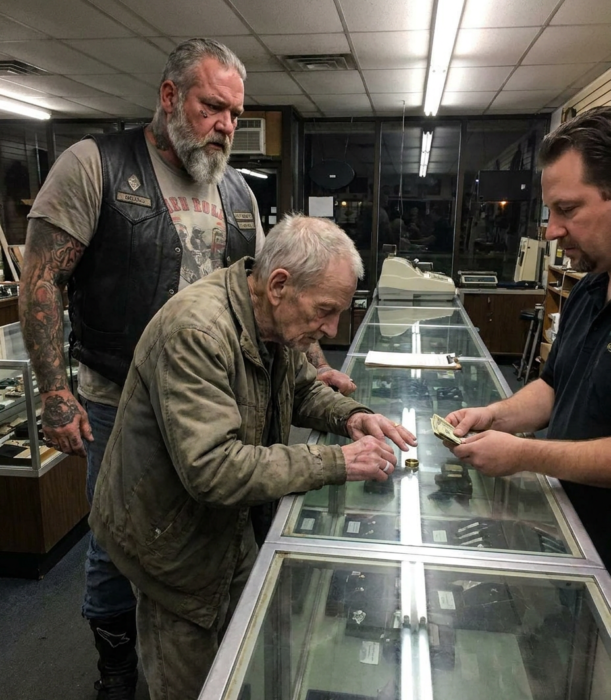
My name is Caleb “Grinder” Hayes. I had been Rook’s road brother for twenty-seven years when we followed Walter Bennett out of that pawnshop.
I knew Rook well enough to recognize the signs.
His shoulders had gone rigid beneath his leather cut. He kept touching the empty pocket where he used to carry his father’s watch chain. He was not thinking only about Walter’s ring.
He was remembering what it felt like to lose something irreplaceable because a bill had demanded payment before grief was ready.
Rook’s son, Michael, crashed on Interstate 71 twelve years earlier. The hospital was ninety miles from Beckford. Rook slept in a motel nearby because the intensive-care waiting room closed overnight, and the charges accumulated faster than club brothers could collect money.
On the fourth night, he pawned his father’s railroad watch.
His father had carried it through thirty-eight years of night shifts. The case bore a dent from a freight-yard accident, and the inside cover was engraved with one sentence: Be home before the light changes.
Rook planned to redeem it after payday.
Michael’s recovery took longer. Medical bills swallowed everything. By the time Rook returned, the watch had been sold.
He never complained.
But whenever we entered a pawnshop, he searched the cases.
That history explained why Walter’s pale ring mark affected him. It did not explain why he became so determined to interfere in an old man’s private decision.
Walter lived in a tired three-story apartment building on Willow Street. The brick had dark water stains, one gutter hung loose, and the entry door required a hard shoulder in winter.
His apartment contained almost nothing unnecessary.
A narrow sofa. Two wooden chairs. A small television. A bookcase filled with repair manuals and gardening books. June’s photograph stood beside an artificial Christmas tree no taller than Rook’s boot.
She had kind eyes.
Walter let us inside only because Rook still held the redeemed ring. He did not offer coffee. He did not remove his coat.
“I sold that,” he said.
“We bought it,” Rook answered.
“Then it belongs to you.”
“Not my size.”
Rook placed the ring on the table.
Walter did not reach for it.
He explained that June had made him promise not to confuse possession with love. During her final illness, she asked what he would do with the ring after she died.
“Wear it,” he had said.
“For how long?”
“Forever.”
June shook her head. “Until it can do more good somewhere else.”
Walter believed that morning had finally arrived.
If Rook simply returned the ring, the sacrifice would become theater. Walter had traded something precious so Marissa’s children would have heat. He would not accept a refund that made the trade painless.
Rook understood.
He hated it.
“What if you earn it back?” he asked.
Walter gave him a dry smile. “At seventy-nine?”
“You know engines?”
“I maintained factory presses for forty-one years.”
Rook looked around the small apartment. A toolbox sat beneath the window. Every wrench had its own slot.
“You know old carburetors?”
“Better than you, probably.”
That insult opened the door.
Rook offered Walter temporary work at our repair garage. The pay would equal the ring’s redemption cost, no more. Walter could inspect donated motorcycle parts, clean tools, and teach our youngest prospect how not to strip brass fittings.
Walter considered it.
Then he asked whether the work was real.
Rook promised it was.
“Charity gets you thrown out,” Walter warned.
“Bad work gets you thrown out faster.”
Walter arrived the next morning at seven, although the shop opened at eight.
By noon, he had identified three mislabeled parts, repaired a bench grinder, and told twenty-six-year-old Cody that his workspace resembled “a junk drawer after an earthquake.”
The brothers liked him immediately.
Walter did not return the favor.
He called Mason “Mustache” because he disliked the road name Grizzly. He called me “Calvin” for two weeks despite being corrected. He referred to Rook as “the large one.”
He did good work.
At the end of the week, Rook paid him exactly what the ring had cost.
Walter counted the bills.
Then he walked back to Miller’s Pawn and purchased his own ring from Rook for the same amount.
Nobody had erased the price.
He had earned it twice.
When he slid the gold band over the pale mark, his hand trembled harder than it had when he removed it. Rook looked away to give him privacy.
Walter wore the ring again.
That should have ended the story.
Instead, Marissa’s children spent Christmas morning beneath lights paid for by a man upstairs whose name they still did not know—and Rook began asking whether one hidden act could be repeated without turning it into publicity.
The twelve-month payment was Mason’s idea.
He proposed it during a club meeting on December 23, while Walter sat near the garage heater cleaning a carburetor bowl. The remaining brothers crowded around the long table with paper coffee cups and jackets smelling of snow.
“We cover the woman’s power for a year,” Mason said.
Walter did not look up.
“No.”
Mason blinked. “Wasn’t asking you to pay.”
“That’s why the answer’s no.”
Rook folded his arms. “Explain.”
Walter placed the carburetor part on a towel. He said one anonymous payment had restored his dignity fifty years earlier because it solved a specific crisis without creating a relationship of dependence.
Twelve months could feel different.
It might make Marissa believe someone was watching her. It might interfere with energy assistance programs. It might create tax or account complications. Most of all, it might replace her authority with ours.
“You don’t save people by owning their next year,” Walter said.
Mason’s face reddened. He had meant well.
Rook asked what Walter suggested.
“Ask the utility office how to do it properly.”
That sounded simple.
It was not.
The municipal utility could accept third-party payments, but account details were confidential. Staff could not tell us which customers were at risk, why they were delinquent, or whether they qualified for state aid.
The director, Elaine Porter, also disliked the idea of thirty bikers arriving with cash and no organization behind them.
“You need rules,” she said.
“We’ve got rules,” Rook replied.
“Written rules.”
He glanced at me.
We did not have those.
Elaine explained that an anonymous assistance fund required administration, fraud controls, eligibility standards, and a system preventing donors from selecting recipients for personal reasons. Otherwise, generosity could become favoritism—or harassment.
Walter listened carefully.
Then he returned six dollars to the counter.
It was the change from Marissa’s bill.
“Start with that.”
Elaine nearly laughed.
Walter did not.
Rook placed three hundred dollars beside it. Mason added two hundred. I emptied my wallet and contributed eighty-four. By closing time, the envelope held $2,190.
Elaine still refused to accept it without a structure.
So we built one.
A local accountant volunteered after hearing Walter’s story from her husband, who worked at the pawnshop. Leah Ortiz, an attorney who had helped the club with charity filings, drafted a simple nonprofit agreement. The utility established a protected account that could receive donations without disclosing customers’ identities.
Recipients would be selected using clear criteria: imminent disconnection, children, elderly or medically vulnerable residents in the home, documented temporary hardship, and prior use of available public assistance when applicable.
No donor would learn a recipient’s name.
No recipient would learn who paid.
Walter insisted on that rule.
The club wanted to call it June’s Light.
He refused.
June would have hated her name printed on donation jars, he said. The stranger who helped them in 1974 left no name. The fund should honor that silence.
We called it The Unnamed Light.
Then Marissa’s situation worsened.
The first payment stopped the immediate disconnection, but she owed additional charges from previous months. Her oldest daughter had asthma, and the apartment’s unreliable electric heaters made the cold harder to manage.
Elaine could not reveal those details.
Walter heard them through the floor.
Two nights after Christmas, he woke to children crying again.
The electricity remained on. The problem was the heating system.
Walter knocked on apartment 2B for the first time.
Marissa opened the door with the security chain attached. She was thirty-two, exhausted, and still wearing a grocery-store uniform after a late shift.
When she saw an elderly man with a toolbox, she tightened the chain.
“I live upstairs,” he said. “Your heater is making the pipes shake.”
She looked embarrassed. “I’m sorry. I’ll turn it down.”
“Don’t. I want to inspect it.”
“I didn’t call maintenance.”
“No. That’s why it hasn’t been fixed.”
Marissa started closing the door.
Rook stepped into view behind Walter.
That made everything worse.
A six-foot-five biker with tattoos and a leather cut standing in a dim apartment hallway did not resemble a heating specialist. Marissa reached for her phone.
Rook immediately backed down the stairs.
“Bad presentation,” he muttered.
Walter convinced her to call the landlord. The landlord claimed repairs were delayed until the following week. Overnight temperatures were expected to fall below ten degrees.
Walter returned to his apartment and dragged down two space heaters.
Marissa refused them.
He told her they belonged to his late wife and were occupying closet space.
That was only partly true.
The heaters had belonged to June. Walter had kept them because they were the same ones they used after the mysterious Christmas payment restored their electricity fifty years earlier.
Giving them away meant releasing another piece of that night.
Marissa accepted one.
At 2:13 a.m., an overloaded outlet began smoking behind her sofa.
The oldest child smelled it first.
She woke Marissa, who pulled the plug and called the fire department. Damage remained limited to the outlet, but officials declared the electrical circuit unsafe and ordered power disconnected from that section of the apartment.
By sunrise, Marissa and her children had nowhere warm to stay.
Walter blamed himself.
He sat on the hallway floor beside the blackened outlet while firefighters carried equipment downstairs.
“I gave her the heater.”
Rook crouched in front of him.
“You gave her heat. Bad wiring did the rest.”
“Three children could’ve died.”
“They didn’t.”
The landlord arrived and accused Marissa of misusing appliances. Rook rose slowly. Leather creaked. His chain wallet struck his thigh.
Walter caught his sleeve.
“Not that way.”
Rook stopped.
The landlord threatened eviction.
That changed the problem.
Paying the bill was no longer enough. Repairing the outlet was not enough. Marissa needed protection from retaliation, temporary housing, and proof that the building’s electrical system—not her actions—caused the danger.
The Unnamed Light had six dollars, several promises, and no legal existence yet.
The children stood in the snow wearing pajamas beneath winter coats.
Walter looked at them.
Then at us.
“Names or no names,” he said, “today we show up.”
The Iron Lanterns did not solve Marissa’s crisis by writing one dramatic check.
Real trouble rarely fits inside a single gesture.
Leah Ortiz arrived before nine and photographed the damaged outlet, the electrical panel, and every extension cord in the apartment. A licensed electrician from our riding group inspected the building with the fire marshal’s permission.
The wiring predated three of us.
Insulation had cracked. Several outlets were improperly grounded. Breakers had been replaced with higher-rated ones that allowed unsafe loads instead of tripping.
The space heater exposed the danger.
It did not create it.
The landlord still blamed Marissa until Leah showed him the inspection report and explained the penalties for retaliatory eviction. His tone improved.
Slowly.
We paid for two motel rooms from the club’s emergency fund. Walter insisted on one condition: Marissa had to believe assistance came through the fire department, not from him.
“She’ll find out eventually,” I said.
“Eventually lets her breathe first.”
Rook respected that.
For three days, club members moved furniture away from unsafe walls, installed smoke detectors under electrician supervision, and carried damaged belongings to a dry storage room. We wore plain work coats instead of leather cuts because the task was not about the club.
Walter directed everything.
He could no longer lift much, but he knew buildings. He sat on an overturned bucket with a clipboard, calling out wiring routes and correcting anyone who confused old cloth cable with harmless discoloration.
Marissa watched him through the doorway.
“You’ve done this before,” she said.
“Long ago.”
“Why are you helping me?”
Walter replied without looking up.
“Because the ceiling is thin.”
That answer made her laugh for the first time.
On the fourth day, she discovered the truth.
The utility office mailed a receipt for the $174 payment. It did not identify Walter, but her account showed an in-person cash transaction at the exact time a neighbor had seen him leave the building.
Marissa went upstairs.
Walter opened the door wearing a white undershirt and suspenders. His wedding ring had returned to his finger.
“Was it you?” she asked.
“What?”
“My electric bill.”
Walter looked past her toward the stairwell.
She stepped inside without being invited.
“You sold something.”
He said nothing.
Marissa saw the pawnshop receipt on his table. Beside it lay June’s photograph.
The receipt described a fourteen-karat wedding band.
Her face changed.
“You sold your wife’s ring for me?”
“For the bill.”
“You don’t know me.”
“I know you have three children.”
“That isn’t knowing me.”
“No.”
“Then why?”
Walter asked her to sit.
He told her about Christmas Eve in 1974.
At twenty-nine, he worked at a Dayton tire plant. June was seven months pregnant with their only child, a daughter they planned to name Rebecca. A strike reduced his hours, and rent consumed their savings.
The electric company issued warnings.
Walter ignored them because ignoring paper sometimes delayed the fear, even when it did nothing to delay the deadline.
On Christmas Eve, the power disappeared at five seventeen.
Their apartment became cold within hours. June wore two sweaters and sat beneath blankets while Walter heated canned soup over a camping burner near an open window.
He tried calling relatives.
One had no room. Another lived too far away. Pride stopped him from calling the rest.
By midnight, ice formed inside the bottom corners of the bedroom window. Walter placed his hands against June’s stomach and felt their daughter kick.
He promised the baby she would wake under warm lights.
It was a lie.
At six the next morning, the ceiling fixture flickered on.
The furnace rumbled.
Walter ran downstairs, expecting a mistake. Instead, a utility employee told him the account had been paid in full by someone who refused to leave a name.
The employee handed him a small piece of paper.
No repayment. Pass it on when you can.
Walter carried that note for fifty years.
Marissa asked why he waited so long.
“I didn’t.”
He told her about the smaller acts: repairing a widow’s porch, leaving grocery money beneath a windshield wiper, paying a young mechanic’s certification fee, shoveling walks before neighbors woke.
“But the note said when you can,” Marissa replied. “You could.”
Walter shook his head.
Those acts came from what he could spare.
The stranger in 1974 paid during Christmas, when Walter’s family had nowhere else to turn. To repay that debt honestly, Walter believed he needed to give something that hurt to lose.
Then he heard Marissa’s youngest child crying through the floor because the apartment had gone cold.
He looked at June’s ring.
“The right debt found me.”
Marissa covered her face.
Walter did not touch her. He did not tell her to stop crying. He waited.
When she lowered her hands, she noticed the ring on his finger.
“You got it back.”
“I worked for it.”
“Who bought it?”
“The large one.”
Downstairs, Rook was carrying a damaged bookcase through the hallway. Marissa looked through the open door at him.
She thought the club had rescued Walter’s ring.
That was only partly true.
Walter had rescued something in Rook too.
For twelve years, Rook believed losing his father’s watch meant he had failed to honor the man who gave it to him. Walter showed him another possibility: an object could be lost while its promise kept moving.
The watch said to return before the light changed.
Rook had spent twelve years searching pawnshop cases.
That afternoon, he stopped.
Instead, he donated the money he had saved to repurchase the watch if it ever appeared.
The Unnamed Light received its first major contribution.
The fund became official in February.
By then, Marissa and her children had returned home. The landlord rewired the damaged apartment and three adjacent units under municipal supervision. Leah negotiated protections preventing rent increases tied directly to the required repairs.
Walter resumed his quiet life upstairs.
Marissa ruined that plan.
She began bringing him dinner twice a week. He complained that her chili contained too many beans. She ignored him. Her children started calling him Mr. Walter and knocking on his door whenever a toy needed repair.
The youngest, Noah, asked about the pale line beneath Walter’s wedding ring.
Walter told him it was where sunlight could not reach.
Noah considered that answer for several days.
Then he drew a yellow circle around Walter’s finger with a washable marker “so the light could find it.”
Walter left the ink there until it faded.
The Unnamed Light paid its first official account for an elderly woman whose refrigerator held temperature-sensitive medicine. The second helped a family after their father lost wages during surgery. The third protected a motel room occupied by a mother and teenage son awaiting permanent housing.
We learned quickly that helping without humiliating required discipline.
Donors wanted stories.
Walter refused.
People gave more when they saw photographs, names, and grateful families holding oversized checks. The club could have raised thousands that way.
But the stranger who helped Walter had asked for no gratitude.
So the fund published numbers instead of identities: amount received, amount distributed, households assisted, administrative costs, and remaining balance.
No faces.
No names.
No staged handshakes.
Some residents distrusted us. They assumed the club used the fund to launder money or improve its reputation. Rook invited an independent accountant to inspect every transaction.
Others tried nominating friends who did not qualify. A local businessman offered ten thousand dollars if the fund carried his company’s name.
Walter declined.
The businessman raised the offer.
Walter declined again.
“You’re turning down enough to help fifty families,” I told him.
“He isn’t buying fifty families,” Walter answered.
The club nearly split over that decision.
Mason argued that money kept electricity on regardless of the donor’s ego. Tucker believed the naming deal violated the entire point. I understood both sides.
Rook called the vote.
Before we cast it, Walter placed the original 1974 note on the table. The paper was yellow and soft along its folds.
No repayment. Pass it on when you can.
“No name,” Walter said. “That’s why I could accept it.”
The vote rejected the sponsorship.
Two brothers resigned from the fund committee. One returned later. One did not.
Brotherhood was not agreement. Sometimes it was accepting that a man who rode beside you could walk away from the same table believing you were wrong.
The fund grew anyway.
A school nurse organized a coin drive without revealing beneficiaries. A diner added an optional dollar to breakfast checks. Miller’s Pawn donated ten percent of December ring sales, though Walter disliked the symbolism.
The electric company allowed customers to round up monthly payments.
Fifty cents became five dollars.
Five became fifty.
The small account reached twenty thousand dollars by its first anniversary.
Walter never chaired a meeting. He did not want a title. He sat near the back and corrected our arithmetic.
Then, fourteen months after selling the ring, he suffered a stroke.
Marissa found him.
The ceiling between their apartments carried sound both ways. She heard his cane fall, followed by a long silence. She used the emergency key Walter had reluctantly given her and discovered him beside the kitchen table.
He survived.
His right side weakened, and speech became difficult. During his first week in rehabilitation, he repeatedly tried to remove his wedding ring.
The nurse thought swelling made it uncomfortable.
Rook understood.
Walter wanted it sold again.
“No,” Rook said.
Walter struck the bedrail with his left hand and forced out two words.
“Someone. Cold.”
Winter temperatures had fallen below zero. The fund had received eleven emergency requests, but its balance could cover only seven.
Walter wanted the ring used for the difference.
Rook leaned close.
“You paid that debt.”
Walter shook his head.
He pointed toward the window, then toward the ring.
The promise was not finished because promises like that never finished. They passed from hand to hand.
Rook did not take the ring.
Instead, he photographed the pale line beside it—only Walter’s hand, no face—and published the fund’s first public appeal.
He told the story without identifying Marissa or the original stranger. He wrote about a seventy-nine-year-old widower who once sold fifty-two years of marriage to keep three unknown children warm.
Beckford responded overnight.
A teacher gave twenty dollars.
A truck driver gave two hundred.
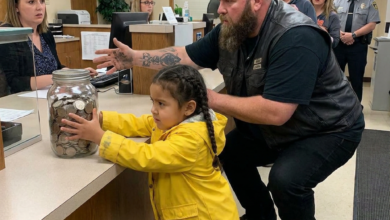
A child delivered a jar containing nineteen dollars and thirty-seven cents.
Miller’s Pawn returned the $180 Walter had originally received and called it overdue interest.
All eleven households kept their electricity.
When Rook showed Walter the deposit report, the old man touched his ring.
Then he pointed at Rook.
“Large one,” he whispered.
It was the first joke he made after the stroke.
Walter recovered enough to return home, but he no longer lived upstairs alone.
Marissa moved his chair into her apartment during the day. Her children carried his cane, fetched his newspaper, and argued over who could press the elevator button during medical visits.
He complained constantly.
That was how we knew he was happy.
Every December 24, the Iron Lanterns gathered at the electric office after closing. We brought no cameras. Elaine gave us the number of urgent qualifying accounts without names or addresses.
We covered as many as the fund allowed.
Walter pressed the final payment key.
After his stroke, his hand moved slowly. Nobody rushed him.
The first year, we helped twelve households.
The second year, thirty-eight.
By the fourth anniversary, The Unnamed Light had paid all or part of the electric bills for 190 families across Beckford and neighboring counties.
None knew Walter’s name.
He preferred it that way.
Marissa eventually joined the fund committee. She never disclosed that her household had inspired it. When applicants apologized for needing help, she told them assistance was not ownership.
“No one gets to buy your shame,” she said.
Rook repeated that sentence often.
Walter kept working at our garage twice a week. He could no longer handle small tools with his right hand, so he inspected finished work and criticized everyone’s coffee.
His wedding ring remained on his finger.
Rook had the inside engraving restored where decades of wear had almost erased June’s name. He paid Walter one dollar to inspect an old carburetor, then charged one dollar for the engraving so neither man could call it charity.
Walter approved.
On Christmas Eve, we parked our Harleys outside Willow Street and shut the engines down together. The children placed battery candles in the windows—soft lights with no names attached.
Walter sat beneath June’s photograph.
The pale line around his ring had disappeared after years of wearing it again, but he remembered it. So did we.
He once told me that kindness should leave a mark nobody could photograph.
I reminded him that we had photographed his hand.
He frowned.
“Then you did it wrong.”
Maybe we had.
Still, no face appeared in the picture. No recipient was exposed. There was only an old hand, a worn band, and the white trace of fifty-two years.
Enough to move a town.
Walter died at eighty-four.
It happened five years after the morning at Miller’s Pawn. He fell asleep in his chair beneath June’s photograph while Marissa’s children decorated the apartment for Christmas.
His ring remained on his finger.
Walter’s funeral was small because he had outlived most relatives. Marissa sat in the first row with her three children. The Iron Lanterns filled the back of the chapel, leather cuts dark against the pale walls.
Rook carried the ring.
Walter’s instructions requested that it be buried with June, whose grave stood outside Dayton. He wrote that the gold had completed its final job.
Rook disagreed.
For once, he followed orders anyway.
We rode to June’s grave beneath a gray December sky. Rook placed the ring inside a small wooden box and lowered it into the soil beside her marker.
No speech.
No club patch.
No photograph.
That evening, The Unnamed Light paid Walter’s own final electric bill. Marissa tried covering it, but Elaine refused to identify the donor.
We never learned who did.
Four years after the fund began, 190 families had received help. By Walter’s death, the number had passed three hundred. Some later donated. Others could not.
Repayment was never required.
Only continuation.
Miller’s Pawn keeps an empty ring stand in the corner of its display case. It carries no name, photograph, or explanation. Each December, the owner places $180 beneath it and sends the money to the fund.
Rook still checks the case when we enter.
He no longer looks for his father’s watch.
He looks at the empty stand, nods once, and leaves.
Fifty years before Walter sold his ring, a stranger restored the heat for a pregnant woman on Christmas morning. Walter never discovered the person’s name.
He stopped needing to.
The stranger’s payment moved through him, through Marissa, through thirty bikers, and through hundreds of people who never met one another.
That was the receipt.
Follow our page and comment LIGHT if you want more biker stories about quiet promises that keep traveling long after names disappear.
Outside, the windows stayed warm.