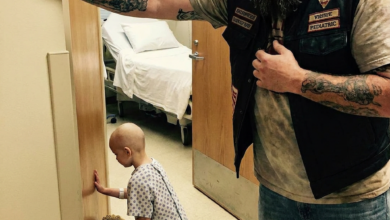
My Daughter Drew a Lipstick Heart on a Biker’s Scarred Face in Court—He Refused to Wipe It Away Until the Verdict Came
My daughter was drawing a crooked lipstick heart across a biker’s scarred cheek when the courtroom deputy reached for her, and the enormous man whispered something that stopped me from calling her back.
“Let her finish.”
He didn’t say it like a threat. That would have been easier to understand. He said it like a man asking someone not to interrupt a prayer.
Lucy stood between his boots in her blue courthouse dress, holding my lipstick with both hands. She was eight years old, small enough that the hem of her cardigan still slipped over her wrists. The man had lowered himself into a gallery seat so she could reach him.
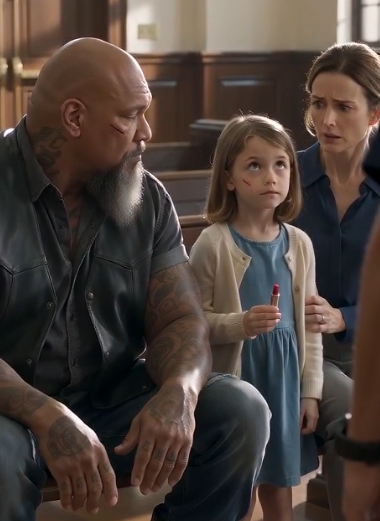
There was already one red line across the pale scar beside his mouth.
Around us, people had begun turning.
The jury was still out. The judge had left the bench. We had been waiting through a recess long enough for the water in my paper cup to go warm, and until that moment, the loudest sound in the courtroom had been a clock I couldn’t see.
Then somebody whispered, “What is that child doing?”
The deputy took another step.
I was halfway out of my seat, caught between embarrassment and a fear I had carried so long it now answered every unexpected movement before I did.
“Lucy.”
She didn’t look at me.
The biker did.
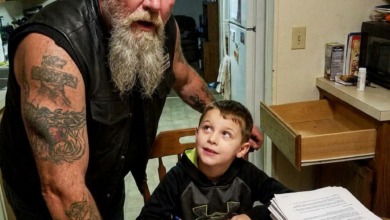
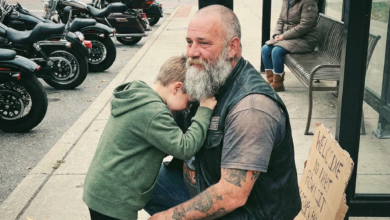
He was nearly sixty, with a shaved head, a gray beard, and a face that made strangers look away too quickly. Old scars crossed his left cheek and pulled slightly at the corner of his mouth. Tattoos disappeared beneath the sleeves of a dark shirt, and his plain leather vest hung open over a chest wider than the back of the chair.
I had spent seven months being afraid of men whose appearances gave me no reason to be.
Somehow, I had still saved a separate little fear for this one.
He looked at me now, asking permission without moving his hands.
I should have understood that.
Instead, I saw my daughter touching the face of a stranger in the room where another man’s future was being decided, and I felt every protective instinct in my body collide.
Lucy drew the second curve.
Her hand shook. The red line wandered over the scar and stopped near his beard.
The biker held completely still.
A woman behind me made a small disapproving sound. Across the aisle, one of the other riders sat forward, then settled back when the biker gave the slightest shake of his head.
“No pictures,” the deputy told someone reaching toward a bag.
There were no phones raised. No audience on the internet yet. Just a room full of adults watching a child do something none of us had expected.
Lucy closed the bottom of the heart.
Then she stepped back and examined her work with the solemn concentration she used when deciding whether a bandage covered an entire scrape.
“It’s crooked,” she whispered.
“So am I,” he said.
She almost smiled.
That nearly broke me.
Seven months earlier, I would have known exactly what made my daughter smile. I knew the songs she invented while brushing her teeth and the particular nonsense that could make her laugh milk through her nose.
Now a stranger had found his way to that place before I had.
The deputy looked at me again.
“Ma’am?”
I should have answered. Instead, I watched Lucy put the cap on the lipstick and place it carefully in the biker’s open palm.
“Don’t take it off yet.”
He closed his fingers around the little gold tube.
“I won’t.”
Then my daughter looked at the scar beneath her red heart and said something so quietly that I had to lean forward to hear it.
“I knew it was you.”
I thought she meant his scars, until she covered her own eyes with both palms and the biker’s hand began trembling against his knee.
My name is Claire Bennett. Before the day Lucy disappeared from beside me outside a grocery store, I believed being a good mother meant paying attention.
I noticed loose shoelaces. I checked the back seat before reversing. I cut grapes long after other parents stopped, and I knew which classroom window belonged to my daughter even though I had never needed that information.
Then I turned to lift a bag into my trunk.
The world I understood ended in the time it took to move six cans of soup.
A man we did not know took Lucy toward a van parked beyond the shopping-cart return. I heard her make a sound that didn’t belong in an ordinary afternoon, and when I turned, she was no longer where I had left her.
I remember the dropped loaf of bread.
That is the detail my mind preserved before everything else. A loaf of wheat bread lying beneath the bumper, its plastic twisted tight around slices nobody would eat.
People moved. Someone shouted. I ran in the wrong direction first.
By the time I reached Lucy, another man was kneeling with her behind a low concrete planter. He had his back turned toward the disturbance near the van and one enormous hand held between her eyes and whatever was happening beyond him.
She was crying into his shirt.
Police arrived quickly because several people had called. The man who had taken her was detained nearby. There were witnesses, cameras, details investigators would later explain in rooms where the air always felt too cold.
At that moment, I wanted only my child.
The big man lowered his hand when an officer said my name. Lucy saw me and reached so hard that I stumbled catching her.
Somebody told me he had intervened.
I said thank you.
I said it to his shoulder.
That is something I remember with shame now. He was kneeling in a parking lot after helping my daughter, and I thanked the black leather at the edge of my vision because looking directly at his damaged face unsettled me.
He didn’t ask for anything more.
His name was Gabriel Reed. Everybody in his motorcycle club called him Bear, but he introduced himself to the officers as Gabriel and answered their questions in a quiet, measured voice.
He was fifty-nine, a Black American man with broad shoulders and hands marked by years of mechanical work. His Harley was parked near the market entrance, a dark touring bike with a faded canvas bag strapped behind the seat.
I learned those details later.
At the time, all I retained was the scar and the hand that had covered Lucy’s eyes.
For several weeks, I misunderstood even that.
I thought he had been preventing her from seeing him.
Perhaps he knew his face frightened children. Perhaps he had turned her toward his chest because of the scars. My mind supplied that explanation without ever asking him.
It fit an ugly little assumption I had not examined.
Lucy stopped wanting the curtains open after dark. She asked where I was going when I walked from the living room to the kitchen. At night, she wanted my hand on the mattress until she fell asleep.
We found a counselor who worked with children.
I learned to stop asking the same questions in different words. I learned that remembering was not a performance Lucy owed me because I was frightened.
The prosecutor’s victim-support coordinator, Elena, explained the court process in small pieces. There would be waiting. There might be changes. Lucy would receive preparation appropriate to her age, and nobody should practice answers with her.
Gabriel’s name appeared in the case updates.
He had given a statement. He had returned for follow-up questions. He would testify about what he had seen and done.
I mailed him a thank-you card through the investigating officer.
Inside, I wrote four sentences I revised for an hour.
He replied on a plain sheet of paper.
Glad she’s home. You don’t owe me anything. Tell her the motorcycle still starts.
I did not understand the last sentence.
When I read it to Lucy, she asked whether the motorcycle was black.
“Yes.”
She nodded and went back to her coloring.
I mistook that for indifference.
A month before the trial, Elena asked whether I wanted to be introduced properly to Gabriel before we all arrived at court.
I said I thought it would be better to keep things simple.
What I meant was that every person connected to that afternoon made it harder to pretend we had moved beyond it.
Gabriel accepted my answer.
He did not contact Lucy. He did not send presents or turn himself into a necessary part of our lives. He waited where the court asked him to wait and came when they asked him to come.
That patience should have told me something about him.
I was still too busy watching doors.
Lucy had already completed her testimony earlier in the week. The questions had been difficult, but the court had used the arrangements made for her, and Elena stayed close whenever we were outside the courtroom.
Afterward, Lucy slept for twelve hours.
I thought she would never want to return.
But when Elena told us the jury had begun deliberating, Lucy asked whether Gabriel would be there when they came back.
“Probably,” I said.
“Can we go?”
“You don’t have to.”
“I know.”
We discussed it with the people supporting her. There was a quiet room available, and we could leave whenever she wanted. I packed crackers, a sweater, and the little sketchbook she carried everywhere.
I did not know she had put my lipstick in her cardigan pocket.
It was an ordinary red lipstick, the kind I wore to weddings and then forgot in a drawer. Lucy had watched me use it that morning because I was trying to look like a woman who could manage whatever happened next.
She asked whether lipstick came off.
“Yes.”
“Even if you don’t do it right?”
“Yes, sweetheart.”
I assumed she wanted to try it someday.
At court, Gabriel sat two rows behind us with three members of his club. They wore clean jeans and plain shirts beneath their leather vests. No one spoke loudly.
A younger rider named Luis had a folded paper in his hand. An older woman called Ruth carried peppermint candies in a tin she opened as quietly as possible.
Gabriel nodded when I looked back.
I nodded too.
That should have been the entire exchange.
Instead, during the recess, Lucy slipped from the seat beside me while I was speaking to Elena. She walked directly to him, opened the lipstick, and lifted it toward his face.
By the time I understood what she intended, he had bent his head.
The deputy’s concern was reasonable. A child had crossed the gallery toward an adult without an explanation, and courtrooms were not places where people could assume an unexpected movement was harmless.
He moved to guide her back.
Gabriel asked him to let her finish.
Then he looked at me.
I saw that look differently now, with Lucy’s palms over her eyes and his hand trembling against his knee.
He had been waiting for my permission. He still was.
“It’s all right,” I told the deputy.
My voice sounded like someone else’s.
“I’m her mother. I’m right here.”
The deputy paused, then stepped back enough to give us room. Elena moved beside Lucy without interrupting her.
“Sweetheart,” I said, “what do you mean, you knew?”
Lucy lowered her hands.
“His voice.”
Gabriel swallowed.
The heart sat unevenly on his left cheek, bright against the pale lines of old scar tissue. He kept his eyes on my daughter.
“He said the same thing.”
“What thing?”
Lucy’s mouth tightened.
Elena touched my elbow gently. A reminder. We did not need to turn the moment into another questioning.
I stopped.
Gabriel leaned forward only slightly.
“You don’t have to explain.”
Lucy looked at his boots.
“I wanted the heart where he put his hand.”
Nobody spoke for a moment.
Then she lifted one palm beside her own face, showing us without touching anyone.
“Here.”
I remembered the parking lot. The concrete planter. Gabriel’s enormous back between my daughter and the man near the van.
For seven months, I had carried that picture with the meaning arranged incorrectly.
“You were covering her eyes,” I said.
Gabriel nodded.
“So she couldn’t see what was happening.”
“Yes.”
“Not because of your face.”
His expression shifted, but he did not rescue me from what I had said.
“No, ma’am.”
Heat climbed my neck.
Lucy reached toward the lipstick in his hand.
“Can Mommy have that back?”
He gave it to her.
She returned it to me as carefully as if we had borrowed it for a school project and needed to prove we had looked after it.
Behind Gabriel, Luis turned his face toward the wall. Ruth pressed her closed candy tin between both hands.
The deputy glanced toward the courtroom doors, giving us what privacy he could.
Gabriel said, “She wanted to turn around. I didn’t want that man’s face to be the last thing she kept seeing.”
There was no speech in his voice. He was explaining a choice made in a few seconds, one he had apparently considered ordinary enough not to include in his letter.
“She needed something else to listen to.”
My knees felt unreliable.
I sat in the chair beside him.
For months, I had asked myself why my daughter sometimes covered her eyes when she was frightened but did not always want the room dark. I had wondered whether it was another symptom I needed to understand.
It had also been a memory of being protected.
Lucy leaned against my arm.
“Can he keep it?” she asked.
I looked at the red heart.
“If he wants to.”
Gabriel nodded once.
“Until they’re done,” he said.
Gabriel had testified the previous day. I had heard him describe seeing a man pulling a resisting child toward a vehicle, approaching, and intervening while other witnesses called for help.
He spoke plainly.
The prosecutor asked what he had observed, what he had done, and what he could identify from the footage. He answered only those questions.
The defense attorney challenged his timing, his view, and his interpretation of the situation. Gabriel did not raise his voice. When he could not remember a detail precisely, he said so.
I had appreciated his restraint.
I had not understood how much of the afternoon lived outside the questions.
Now, during the recess, Elena guided us to the quieter waiting room. Gabriel came only after Lucy asked and I agreed. The deputy reminded us that we would be called when court resumed.
There were four chairs, a water cooler, and a faded landscape print mounted crookedly above a table.
Lucy sat beside me with her sketchbook.
Gabriel chose the chair farthest from the door, leaving the path open.
I noticed that.
“What did you say to her?” I asked.
He rubbed his palms slowly against his jeans.
“Talked about the bike.”
Lucy nodded without looking up.
“I figured she could hear it idling when she first got away. Told her it sounded like a washing machine full of boots.”
My daughter smiled at the paper.
There it was again. That little private doorway.
“He said it was old and complained,” she added.
“Still does.”
I could feel tears gathering, but I kept my voice level.
“And then?”
Gabriel looked at Lucy before he answered.
“Told her she could look at my shirt. Or close her eyes. Whatever was easier.”
The man near the van had been shouting. Gabriel did not repeat the words in front of her, and I did not ask him to. Other adults had been handling that part while he kept himself between Lucy and the commotion.
“He said I didn’t have to look,” Lucy told me.
I nodded.
Her pencil moved across the page.
“Then he said, ‘Let the grown-ups finish.’”
That was why his voice in the courtroom had stopped her.
Let her finish.
Not the exact words, but the same low sound. The same patience beneath them.
Gabriel had given her permission to be a child while other people handled what a child should never have been responsible for.
I looked at his hands.
“You stayed on the ground with her.”
“Seemed best.”
Even after the police arrived. Even when people asked whether he was hurt. Even while other witnesses were standing, talking, making themselves useful in ways someone could see.
He stayed where Lucy could hear him.
I thought of how many times I had told her she was brave since then.
She was brave. But perhaps she was also tired of bravery being the thing adults praised most about the worst day of her life.
Lucy turned a page.
“Did your face hurt that day?”
Gabriel shook his head.
“No, honey. These are old.”
“Older than me?”
“Quite a bit.”
She considered that.
“Did somebody help you?”
The question changed him.
His shoulders dropped a fraction, and he glanced toward the door where Ruth stood waiting. She had followed with the candy tin but had not come inside.
“Eventually,” he said.
Lucy accepted that answer and returned to her drawing.
I didn’t.
Later, when she went with Elena to get water, Gabriel told me the rest in the careful outline people use when they have learned how much of their past a stranger can carry.
The scars came from a workshop fire in his thirties. Afterward, pain medication became something he needed even when the worst of the physical pain had changed. He lost work. He lied to people who loved him. He missed years of his son’s life while insisting he was getting things under control.
“I wasn’t,” he said.
He had been sober for twelve years now.
Ruth had helped him find a support meeting. Luis had hired him at a repair shop when his résumé contained a gap nobody wanted explained. The club had not cured anything, but its members had kept asking where he was supposed to be and whether he needed a ride there.
“People stayed,” he said.
His relationship with his son was better, though better did not mean repaired beyond recognition. He accepted calls when they came. He did not demand holidays as proof of forgiveness.
I looked at the lipstick heart on his scarred cheek.
“Did Lucy remind you of somebody?”
He thought before answering.
“She reminded me of a kid.”
That answer mattered.
My daughter had not needed to resemble a lost child or carry a name from his past to deserve what he did.
She had simply been there.
When Lucy returned, she held out her sketchbook. She had drawn his motorcycle with two wheels of different sizes and a heart where the headlight should have been.
“It’s not right,” she said.
Gabriel studied it.
“Starts better than mine.”
She laughed.
I pressed my thumb into my palm, keeping myself in the room.
Not everyone in Gabriel’s club had wanted him to attend the trial in his vest.
I learned that from Ruth while Lucy sat with Elena at the far end of the waiting area. Gabriel had stepped outside for air, and Luis followed him with two paper cups of coffee.
“There was an argument,” Ruth admitted.
“About the clothes?”
“About what people would see before he opened his mouth.”
The Iron Lantern Riders raised money for heating bills, drove meals to older members, and spent an unreasonable amount of time arguing about who had borrowed which tools. They were also accustomed to being mistaken for something more threatening.
Some members thought Gabriel should wear a jacket that covered his tattoos. Others thought several riders should fill the gallery so he would not sit alone.
Neither idea came entirely from vanity.
Gabriel had already received ugly comments after his name appeared in an early news report. Somebody posted an old photograph and speculated about his past. Another person suggested that a man who looked like him should never have approached a child in the first place.
Ruth’s jaw tightened as she told me.
“He said the girl didn’t need another room full of big men.”
So three riders came.
They sat quietly.
And Gabriel wore the plain vest he felt comfortable in, without trying to turn the courtroom into a club event.
Then there had been another disagreement.
A local supporter wanted to publish Gabriel’s story in detail before the trial ended. It would help the club, he argued. It would show people what kind of man they had judged.
Gabriel refused.
The case involved Lucy. The facts belonged in the court process before they became somebody’s inspirational post.
One donor withdrew support after being told they could not use a photograph of my daughter.
“That cost you money,” I said.
Ruth shrugged.
“Some money costs more to keep.”
She offered me a peppermint.
I took one, grateful for the ordinary movement of opening its wrapper.
Across the corridor, Gabriel stood by a window while Luis talked. A woman passing with a folder glanced at the red heart on his cheek, then looked again.
He did not wipe it off.
His hand moved toward it once, perhaps out of habit. Then he lowered his hand.
I understood suddenly that keeping it was not effortless.
He had spent years learning to tolerate people looking at his face. Now Lucy had placed a bright red reason for them to look again.
He accepted it because she had asked.
When he returned, I stood.
“I owe you an apology.”
He looked uncomfortable immediately.
“You don’t owe me—”
“I know. You wrote that.”
He waited.
“I thanked you without looking at you. And I thought you covered her eyes because you were worried about your scars.”
The corridor noise seemed to grow around us.
“I made your face the problem in a moment when you were the person helping her.”
Gabriel looked down at the coffee in his hands.
Then he said, “People get things wrong.”
“That doesn’t make it fair.”
“No.”
I appreciated that he let the answer stand.
There are apologies people rush to forgive because they want the room comfortable again. Gabriel did not do that for me.
He gave me something better: a chance to remain responsible for what I had said without making it the only thing between us.
“I’m looking now,” I told him.
He raised his eyes.
I held them.
At the other end of the corridor, Lucy called my name. She had drawn a second heart in her sketchbook and wanted to know whether she could give the page to Gabriel.
“Ask him.”
She did.
He accepted it with both hands.
The court clerk appeared a few minutes later and spoke quietly to Elena.
The jury had reached a verdict.
My entire body tightened before I understood the words.
Lucy noticed. She slipped her fingers into mine and looked at Gabriel.
“Are you coming?”
“If your mom says it’s okay.”
I nodded.
We returned to the courtroom together, walking slowly enough that Lucy did not have to hurry.
Before taking his seat, Gabriel looked toward me.
“If she wants out, take her out. Don’t wait for anybody.”
I nodded again.
It was strange how much permission I still needed to protect my daughter in a room built around deciding what had happened to her.
Gabriel sat behind us.
The red heart remained.
The courtroom rose when the judge entered.
Lucy stood beside me, holding my hand with both of hers. Her cardigan sleeve had slipped over her fingers again. I wanted to fix it, but she was gripping too tightly.
The jurors returned.
I searched their faces even though Elena had warned me that expressions would tell me nothing reliable. One woman looked exhausted. A man near the end of the row kept his eyes on the papers in front of him.
The foreperson handed over the verdict.
There are moments people later describe as though the entire world stopped. Mine did not. The air vent rattled. Someone coughed. A pen rolled a short distance across a table and was caught before it fell.
Life continued being ordinary around words that would divide our lives.
The guilty verdict was read.
I heard it.
Then I needed to hear it again inside my own head before I understood.
The jury had found the defendant guilty of the charges arising from taking Lucy. The judge gave further instructions and explained that sentencing would occur later.
I did not cheer.
Lucy looked up at me.
“Is that the answer?”
“Yes.”
Her eyes searched my face.
“Can we go home?”
“Yes, sweetheart.”
Behind us, Gabriel exhaled.
It was not a dramatic sound. It was the sound of someone finally setting down something heavy enough that he had forgotten he was still carrying it.
The judge finished speaking. We waited until we were permitted to leave.
I kept one hand against Lucy’s back, careful not to steer her faster than she wanted to walk. Elena stayed beside us. Gabriel and the other riders followed at a distance.
In the corridor, Lucy turned.
“You can take it off now.”
Gabriel touched the edge of the heart with one finger.
“You sure?”
She nodded.
“They’re done.”
Ruth produced a clean tissue, but he did not use it immediately.
He crouched far enough to be closer to Lucy’s height without blocking the corridor.
“Can I keep your picture?”
“The motorcycle one?”
“Both.”
“They’re yours.”
He nodded solemnly.
Then Lucy asked whether she could hug him.
He looked at me.
“Yes,” I said.
He waited for her to come to him.
She wrapped her arms around his neck, and he rested one broad hand lightly against her back. His eyes closed for a moment.
I stood beside them with the lipstick in my coat pocket, feeling the shape of its small gold tube through the fabric.
When Lucy stepped away, one red mark had transferred to her cardigan.
I almost reached to clean it.
Then I left it alone.
Outside, the afternoon was bright enough to make us blink. There were people on the courthouse steps, cars moving past, a delivery driver checking an address.
Our private earthquake had not stopped the town.
Gabriel stood beneath the stone awning and finally wiped his cheek.
The lipstick came away unevenly. A trace remained along one scar.
He looked at the tissue, folded it inward, and put it in his pocket until he could find a trash can.
I was grateful he did not turn it into a relic.
What mattered was standing beside us.
Lucy took my hand and asked for pancakes.
The verdict did not make every night easy.
Lucy still woke sometimes. She still wanted to know who was coming to the house before anyone knocked. We kept her counseling appointments, and I kept learning when to answer a question and when to sit quietly beside her.
But other things returned.
She began singing while she brushed her teeth. She complained about homework with an energy that felt almost festive. One afternoon, she shut her bedroom door because she wanted privacy, and I stood in the hallway smiling at a piece of painted wood.
Gabriel did not assume the verdict made him family.
He called me before sending anything. He asked before attending Lucy’s school art show. He never arrived at our house without being invited.
Trust grew in ordinary measurements.
Coffee on a Saturday. A conversation beside the church tables. Lucy showing him a drawing while I stood nearby, no longer measuring every second until I could take her home.
At the art show, another child looked at Gabriel’s scars and asked what happened.
The child’s mother hurried forward, embarrassed.
Gabriel answered simply.
“An old accident.”
“Did it hurt?”
“It did.”
Lucy stood beside him holding a paper cup of juice.
“His face is his face,” she said.
Then she pointed to her painting and asked whether he thought the motorcycle needed more blue.
I remembered all the months I had spent wanting to return her to the child she had been before.
There she was, becoming someone I could not have planned.
The lipstick eventually wore down from weddings, birthdays, and one evening when Lucy insisted we both dress up for dinner at home. I did not keep the tube in a drawer as evidence of what we had survived.
When it was empty, I threw it away.
By then, we had photographs we had chosen to take: Gabriel beside Lucy’s art display, Ruth holding a cake, Luis laughing while trying to fold a table with its legs locked.
None showed the courtroom.
One spring afternoon, Gabriel visited with the repaired front wheel from Lucy’s bicycle. He set it beside the porch and asked whether she wanted to help put it back.
She brought her helmet before he finished the question.
While they worked, I noticed a tiny red heart on the corner of his tool pouch. Lucy had drawn it there with a fabric marker weeks earlier.
It was crooked.
So was the paper heart taped inside our kitchen cupboard.
When the bicycle was ready, Lucy rode a small circle in the driveway and called for us to watch. Gabriel stood beside me, his scarred face turned toward the sun.
She rang the bell twice.
He waved with both hands.
Follow our page for more biker stories about quiet courage, unexpected friendships, and the people whose kindness helps families find their way back to ordinary life.