The Woman Threw the Wedding Bouquet Back at the Bride — Minutes Later, One Small Brass Key Silenced the Entire Ballroom
When Margaret Bell threw the bridal bouquet back at Julia Hart before two hundred guests, the white roses struck the bride’s chest, scattered across the ballroom floor, and exposed a small brass key that had been hidden beneath a faded ribbon for nine years.
The string quartet stopped in the middle of a note. One violin continued whining for half a second before its player lowered the bow. Even the children near the dessert table seemed to understand that something had broken which could not be repaired by gathering the flowers.
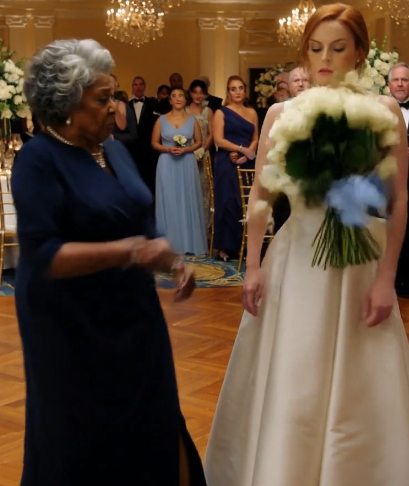
Julia did not cry out. She stood beneath the warm chandelier light in a plain satin gown, her auburn hair pinned into a loose bun, one hand still resting against the place where the bouquet had touched her. At thirty-two, she had spent nine years teaching second grade and had learned how to remain calm while twenty frightened children watched her face for instructions. But the guests were not children, and the woman staring at her was not merely angry.
Margaret was Marcus’s mother. In less than an hour, if the ceremony continued, she would become Julia’s family.
She was sixty-one, a Black American woman who had managed the cafeteria at Franklin Middle School in Richmond for almost three decades. Silver streaked the short curls around her temples. Her navy dress was carefully pressed, but one hem had been repaired with thread slightly lighter than the fabric. She wore no necklace, only a narrow silver ring that had belonged to her daughter, Simone.
Margaret pointed at the bouquet lying between them.
“That ribbon belonged to my daughter,” she said. “And this woman has lied about it for nine years.”
Marcus moved first. He was thirty-five, tall and lean, dressed in a dark suit he had purchased instead of rented because Julia had teased him about returning rented trousers after dancing in them. The humor had gone from his face.
“Mom, stop.”
Margaret looked at him, and for one terrible moment she seemed older than she had when she entered the ballroom.
“No,” she said. “I stopped for nine years.”
Two hotel security employees approached from beside the service doors. Julia’s father, Richard Hart, was already striding toward them. At sixty-four, Richard had the commanding manner of a man accustomed to being obeyed. His charcoal suit cost more than Julia’s dress, and his silver hair was combed so precisely that not even the humid afternoon had disturbed it.
“Remove her,” Richard ordered. “Now.”
Julia raised one hand.
“No.”
Richard turned toward his daughter. “Julia, she just assaulted you.”
“She threw flowers.”
“She disrupted your wedding.”
Julia looked at Margaret instead of answering. Margaret’s hands were trembling. That detail frightened Julia more than the accusation. The older woman was known for carrying hot cafeteria trays with steady hands while hundreds of children shouted around her. She could separate fighting teenagers with one look and frost forty cupcakes without spilling a drop.
Now she could not keep her fingers still.
Julia knelt and began gathering the roses.
“Don’t touch it,” Margaret warned.
Julia’s hand paused above the ribbon. It had once been blue, though time had faded it toward gray. Seven uneven stitches ran near one edge. They were not decorative. They looked like repairs made by someone working at a kitchen table with poor light and a needle too large for the fabric.
“I know where it came from,” Julia said.
Marcus stared at her. “You told me it came from your mother’s sewing box.”
“It did.”
Margaret took a step forward. “Your mother never owned that ribbon.”
A murmur moved through the guests. Several people had already lifted their phones. Julia saw them from the corner of her eye, tiny black rectangles aimed toward her humiliation. Her father noticed them too.
“Put those away,” Richard snapped.
Nobody listened.
Julia carefully lifted the bouquet. Something metallic slipped from beneath the central rose and struck the floor with a small, clear sound.
A brass key.
It was no longer than Julia’s thumb. Its round head had been worn smooth, but a number—214—remained faintly visible near the teeth.
Near the service doors, an elderly hotel employee made a sound as if the air had been knocked from him.
His name was Walter Finch. He had worked at the Jefferson House Hotel for thirty-eight years, first carrying luggage, then supervising banquets. At seventy-two, he had thin white hair, a careful mustache, and a burgundy jacket whose left cuff had been mended twice.
Walter stared at the key.
“Where did you get that?” he asked.
Julia rose slowly. “It was given to me.”
“By whom?” Marcus demanded.
She looked at Margaret.
“Simone.”
The groom’s face changed. Margaret’s anger did not disappear, but something colder moved beneath it.
Simone Bell had been Margaret’s daughter and Marcus’s older sister. She had died nine years earlier, at twenty-nine, after a winter illness that most people in the room knew only through shortened versions: sudden decline, hospital, funeral, unbearable loss.
Julia had met Marcus three years after Simone’s death. She had never told him they had known each other.
That omission now stood between them like another person.
Marcus stepped away from her. It was only one step, but Julia felt it.
“You knew my sister?”
“Yes.”
“How well?”
Julia tightened her fingers around the key. “Well enough for her to make me promise two things.”
Margaret’s voice dropped. “What things?”
“The first was to keep something safe until Marcus had built a life that was his own.”
Marcus looked from Julia to his mother. “What does that mean?”
“The second,” Julia continued, “was to bring this key back to this hotel when your mother was ready to hear what Simone couldn’t tell her.”
“I was ready nine years ago,” Margaret said.
“No,” Julia replied quietly. “You were grieving. And you hated me.”
Margaret’s eyes narrowed. “I didn’t know you existed.”
“You knew my name.”
For the first time, Richard Hart lost his composure. He turned toward Julia so quickly that the white pocket square in his jacket shifted.
“That is enough.”
Julia looked at him. Her father’s face had gone pale.
Walter moved closer. He kept his attention on the key marked 214.
“That key belongs to a room in the old east wing,” he said. “The wing was closed after the pipe damage. Room 214 hasn’t been rented in nearly a decade.”
Richard’s jaw tightened. “This has nothing to do with the wedding.”
Walter did not look at him.
“It has everything to do with it,” Julia said.
Marcus’s voice sounded raw. “Why would my sister give you a key to a hotel room?”
Julia opened her mouth, but Margaret interrupted.
“Ask her father.”
Every face turned toward Richard.
He glanced at the service entrance. It was brief, almost involuntary, but Marcus noticed. So did Julia.
Walter walked to the door and closed it.
Richard’s expression hardened. “You have no right to detain me.”
“No,” Walter said. “But before you leave, Mr. Hart, perhaps you should tell your daughter why you paid the hotel nine years ago to keep Room 214 locked.”
The ballroom fell so quiet that the brass key could be heard shifting against Julia’s wedding ring.
Richard denied Walter’s accusation immediately, but his voice lacked the force that had made judges, contractors, and even his own family step aside for years.
“This is absurd,” he said. “I have never paid this hotel to conceal anything.”
Walter’s gaze remained steady. “You paid the storage fee every January until last year. A cashier’s check arrived from Hart Development. I processed several myself.”
The name of Richard’s construction company produced another movement among the guests. A few employees were present. Two exchanged nervous glances.
Julia had expected her father to be angry when the truth began surfacing. She had not expected him to look afraid.
Marcus approached her, though he did not reach for her hand.
“Start at the beginning.”
Julia looked at the bouquet. “I can’t do that here.”
“You let me stand at an altar without telling me you knew Simone.”
“I know.”
“You let my mother walk into this room and find her dead daughter’s ribbon tied around your flowers.”
“I didn’t know the florist would use it.”
Margaret gave a bitter laugh. “It climbed out of your drawer by itself?”
Julia flinched. She deserved that.
Six months earlier, when she and Marcus had begun planning the wedding, Julia had taken the ribbon to a small alterations shop owned by Evelyn Shaw, a seventy-year-old white widow who had been a friend of Julia’s late mother. Julia wanted the ribbon sewn inside her dress where nobody would see it. It was supposed to be something private—a promise carried close to her heart.
But Evelyn’s arthritis had worsened. Her assistant, not knowing the ribbon’s history, sent it to the florist with the other heirloom fabric. By the time Julia saw the bouquet before the ceremony, the ribbon had already been wrapped around the stems.
She could have removed it.
She did not.
“That was my mistake,” Julia admitted. “I saw it this morning. I should have told Marcus and Margaret before anyone entered this room.”
“Why didn’t you?” Marcus asked.
“Because I was afraid the wedding would stop.”
“It has.”
The words were quiet, but they struck harder than the flowers had.
Julia’s nine-year-old niece, Olivia, began crying near the first row of tables. Julia’s sister took the child into the hallway. That small departure broke the frozen spell. Guests whispered again. The musicians put down their instruments. A server quietly moved a champagne tray away from an unsteady table.
Margaret walked forward and took the ribbon between her fingers. Her expression changed when she touched the seven crooked stitches.
“I made these,” she said.
Marcus studied them. “Why seven?”
“Because Simone tore the ribbon the night before her high-school graduation. She tried to repair it herself and made a mess. I put in seven stitches because she was impatient, and I was tired.”
A memory softened Margaret’s face for only a second.
“She wanted blue ribbon around her graduation bouquet,” Margaret continued. “She said everyone else would have red school colors, so blue would make her easier to find in photographs. Afterward, she kept it around a box of letters.”
Julia knew the box.
Simone had kept it beneath her bed in a small apartment above a laundromat. Inside were letters Marcus wrote during college, recipes copied from Margaret’s kitchen, receipts from every money order Simone secretly sent home, and a single photograph of the Bell family before grief rearranged them.
But Julia could not explain that yet.
Margaret examined the bouquet more closely. Her fingers found a dark mark near the ribbon’s edge.
“This isn’t from age,” she said.
Julia’s throat tightened.
It was a tea stain.
Nine years earlier, Simone had knocked over a paper cup while trying to make Julia promise she would not tell Margaret the truth too soon. Simone had laughed weakly at the stain and said her mother would recognize it before she recognized any signature.
Margaret now pressed her thumb over that mark.
“You were with her near the end.”
“Yes.”
“At the hospital?”
“Sometimes.”
“Why didn’t I see you?”
“Because I came after visiting hours.”
Margaret’s expression sharpened. “Who let you in?”
“Simone’s night nurse.”
“And why would she do that?”
Julia hesitated.
Because Julia had not entered as a friend. She had entered carrying envelopes, bank documents, and the keys to a hotel room where Simone had hidden proof capable of destroying Richard Hart’s company.
Marcus heard the hesitation.
“What were you doing for her?”
Julia looked toward her father.
“I was helping her protect your family from mine.”
The guests nearest them stopped whispering.
Richard took one step forward. “Julia is confused. Her mother died that year. She was emotionally unstable, and this woman—Simone—took advantage of her.”
Margaret’s face went still.
“Do not use my daughter’s name as an insult.”
“I am stating a fact.”
“No,” Julia said. “You’re repeating the story you paid people to believe.”
Marcus closed his eyes briefly. When he reopened them, he looked less like a groom than an architect examining a building after finding a crack in its foundation.
“What proof is in Room 214?”
“I don’t know everything,” Julia answered.
“You carried the key for nine years.”
“I carried it because Simone asked me not to open the room alone.”
“Why?”
“She said if I saw what was inside before Margaret did, my father would convince me to destroy it.”
Richard’s face tightened.
Margaret noticed.
“What did my daughter know about Hart Development?”
Richard spoke before Julia could answer. “Nothing. She was a temporary bookkeeper who misunderstood routine transactions.”
That was the first time he admitted knowing Simone.
Marcus slowly turned toward him.
“You just said she took advantage of Julia. Now you know where she worked?”
Richard looked around the room as if searching for a safer answer.
Walter removed a small hotel ledger from beneath the service podium. The leather cover was cracked, and several pages had loosened with age.
“I brought this because Room 214 was listed on today’s event inspection,” he said. “There are two authorized names beside it.”
He opened the ledger and placed it on a nearby table.
The first name was Simone Bell.
The second was Eleanor Hart, Julia’s mother.
Julia stared at the handwriting. She had not seen her mother’s signature in years.
Margaret’s fingers released the ribbon.
“You told us your mother died before you met Simone,” she said.
“I believed she had.”
Richard reached for the ledger, but Walter closed it first.
Then Margaret saw a date written beside Eleanor’s name.
It was three months after the day Richard had told Julia that her mother was dead.
Julia’s mother had not died when Richard said she did.
That truth did not arrive with thunder or screaming. It entered the ballroom through a faded line of ink, dated in Eleanor Hart’s familiar hand, and sat silently among the wedding flowers.
Julia had been twenty-three when Richard called her at college and said Eleanor had suffered a fatal stroke while traveling in Arizona. He claimed she had been cremated according to instructions left in a sealed letter. There had been no hospital viewing and no traditional funeral, only a private memorial at the family home.
Julia had questioned the speed of it. Richard told her grief was making her irrational.
At the time, Julia was already carrying another wound. Three weeks earlier, she had been dismissed from a paid internship at Hart Development after accusing a supervisor of falsifying housing inspection records. Richard said she had embarrassed the family and misunderstood paperwork beyond her experience.
She believed him often enough to doubt herself.
“Mom signed that?” Julia asked.
Walter nodded. “I saw her in this hotel. Not often. Three or four times.”
Richard’s voice sharpened. “Eleanor was ill. She experienced periods of confusion.”
Walter looked at him. “She knew her own name.”
Julia touched the back of a chair to steady herself. Marcus instinctively reached toward her, then stopped before making contact. That unfinished gesture hurt more than anger would have.
Margaret remained focused on the ledger.
“What was Simone doing here with Eleanor?”
Julia finally told them how she had met Simone.
Nine years earlier, Simone worked as a contract bookkeeper for a company that managed several older apartment buildings owned by Hart Development. She noticed recurring charges for repairs that had never been performed: fire doors that remained broken, electrical systems marked as replaced, mold removal billed for apartments still damp with black stains.
One building housed mostly elderly tenants and single-parent families. Simone lived there too.
She started keeping copies.
When she raised questions, her contract ended. A week later, her landlord claimed she owed six months of rent, though Simone possessed receipts proving otherwise. She contacted Eleanor, who had quietly handled community relations for Hart Development before Richard pushed her out of company decisions.
Eleanor believed her.
They rented Room 214 because it was close to the county records office and because neither woman trusted their homes, offices, or telephones. Walter remembered them arriving with banker’s boxes and leaving with fewer papers each time.
“Why a hotel room?” Marcus asked.
“Your sister believed someone had entered her apartment,” Julia said. “Nothing valuable was taken. Only the drawer with her copied records had been opened.”
Margaret frowned. “She told me the lock was sticking.”
“She didn’t want you frightened.”
Margaret looked down. Simone had always softened danger before carrying it home. As a teenager, she described an attempted robbery as “a man being rude near the bus stop.” When she lost a job, she told Margaret she wanted a longer weekend.
Protecting people through omission was a Bell family habit, though Margaret had never seen it that way.
Julia continued. Eleanor began helping Simone organize the records. Before they could submit them, Richard discovered what they were doing. According to Simone, he threatened to have Eleanor declared mentally incompetent and to destroy Julia’s career before it began.
“Did he?” Marcus asked.
Julia glanced at her father.
“He did more than threaten.”
Richard shook his head. “You are relying on the claims of a desperate employee.”
“No,” Julia said. “I’m relying on what happened to Mom.”
After Eleanor disappeared, Julia returned home for the memorial. She found no death certificate. Richard said administrative delays were common when someone died out of state. He refused to discuss it further.
Two nights later, Simone appeared outside Julia’s apartment.
Julia had never met her. Simone was thin from an illness she was still hiding, wearing a yellow coat despite the warm evening. She carried a grocery bag containing Eleanor’s red address book, a hotel receipt, and the faded blue ribbon around a box of documents.
“She told me Mom was alive,” Julia said.
Richard’s face remained expressionless, but his right hand curled against his jacket.
“Where?” Marcus asked.
“Simone didn’t know. Mom had checked herself into a private treatment center after a breakdown. My father told the center that contact with me worsened her condition. Then he told me she was dead.”
A shocked sound came from Julia’s aunt near the second table.
Richard turned on Walter. “This has become defamation. Open the door.”
Walter did not move.
Margaret’s anger shifted toward Richard, but she was not ready to release Julia.
“If Simone gave you proof, why didn’t you go to the police?”
“Because the box she brought me was almost empty.”
Richard spoke quickly. “Because there was no proof.”
Julia ignored him.
“Simone had moved the original records to Room 214. She planned to return with my mother. But her illness worsened before they could do it.”
“What illness?” Margaret asked, though grief in her face suggested she already knew the answer.
Simone had an autoimmune condition that damaged her kidneys. She had been hiding symptoms for months because she lacked reliable insurance after losing her contract. By the time she entered the hospital, she was dangerously ill.
Margaret had believed the illness came without warning. The truth was more painful: Simone had known she was sick and had delayed treatment while sending money home.
“Money for what?” Marcus asked.
Margaret lowered her head.
Three months before Simone’s hospitalization, Marcus had almost withdrawn from graduate school. Margaret’s house needed a new roof, and he intended to use his tuition savings to repair it. Then an anonymous scholarship covered his final year.
Marcus looked at his mother.
“You said the university found emergency funding.”
“That’s what Simone told me.”
Julia swallowed.
“There was no scholarship. Simone paid the tuition.”
Marcus’s face emptied.
“She didn’t have that kind of money.”
“She cashed out her retirement account. Then she borrowed against her car.”
Margaret sat down.
That was the first hidden sacrifice. Simone had delayed her own care not because she was careless, but because she had been protecting Marcus’s future and Margaret’s home at the same time. Her secrecy had not caused her illness, but it had narrowed the time in which doctors could help her.
Julia went to the hospital each night because Simone needed someone outside the Bell family to carry the key. She made Julia promise not to tell Marcus about the tuition until he had built a career that could not be abandoned out of guilt.
“She said Marcus would throw away everything she bought for him if he learned too soon,” Julia said.
Marcus’s eyes filled, but he did not look away.
“And the second promise?”
“To bring Margaret to Room 214 when the documents could no longer be used to take away her home.”
Margaret looked up sharply. “My home?”
Richard’s company had held an old lien against it—one Margaret had never knowingly signed.
Walter reopened the ledger and removed a folded photocopy tucked into its back cover. It showed the room’s storage agreement.
At the bottom was a handwritten note from Eleanor:
If Richard reaches the room first, the blue ribbon is not the proof. It only tells Julia whom she can trust.
Beneath the sentence, Eleanor had written one more name.
Marcus read it aloud.
“David Bell.”
Margaret stared at the page. David had been her husband. He had died twelve years earlier after falling from scaffolding at a Hart Development renovation site.
Richard had always insisted the accident was David’s fault.
The wedding did not officially end, but it stopped behaving like a wedding.
The hotel moved the children and elderly guests into an adjoining lounge. The caterers covered the hot dishes. The musicians packed their instruments without being asked, moving carefully through the ballroom as if sound itself might cause further damage.
About seventy guests remained. Some stayed from concern. Others stayed because curiosity can disguise itself as loyalty when people dress it in solemn faces.
Julia noticed the phones still pointed toward them.
“Please put them away,” she said.
This time, most people did.
One woman continued recording until Marcus walked toward her and held out his hand. He did not threaten or shame her. He simply waited. After several seconds, she lowered the phone.
Walter led Julia, Marcus, Margaret, Richard, and two neutral witnesses toward the old east wing. One witness was Judge Helen Morris, a longtime family friend who had performed the legal marriage ceremony earlier that morning. The other was Nathan Cole, Hart Development’s retired accountant.
Nathan was seventy, white, narrow-shouldered, and so uncomfortable that he seemed to fold inward with each step. He had been invited by Richard. Now he walked beside Margaret.
The east wing smelled of closed rooms, dry plaster, and old carpet. Water damage had left pale stains along the ceiling. Walter unlocked a fire door, then stopped outside Room 214.
The brass key shook in Julia’s hand.
Marcus noticed.
“Do you want me to do it?”
“No,” she said. “I promised.”
She inserted the key.
It turned with resistance, then released the lock.
Room 214 had not been preserved like a shrine. Dust covered the dresser. A sheet had been placed over the mattress. Two banker’s boxes sat inside the wardrobe beside an old portable tape recorder. On the desk rested a small tin sewing box tied with another strip of faded blue ribbon.
Margaret went to the sewing box first.
Inside were Simone’s silver thimble, three needles, a spool of blue thread, and David Bell’s union identification card.
Margaret picked up the card with both hands.
“Why did she have this?”
Nathan answered.
“Because David gave it to Eleanor.”
Everyone turned.
Nathan looked toward Richard, then down at his own shoes.
Twelve years earlier, David Bell had worked as a safety supervisor on Hart Development’s renovation of a downtown apartment tower. He discovered that a subcontractor had substituted cheaper anchoring equipment for the approved system. He documented missing guardrails, altered inspection sheets, and materials that did not meet code.
David intended to report the violations.
The day before his scheduled meeting with the city inspector, he fell from scaffolding on the twelfth floor. The official investigation blamed an improperly fastened harness.
Margaret’s voice was barely audible. “They said he forgot to secure it.”
“He didn’t,” Nathan replied.
David’s harness had been signed out to another worker that morning. The equipment David received had a damaged locking hook, previously removed from service. Someone placed it back in circulation.
Nathan had known the inventory records were altered after the accident.
“Did Richard order that?” Marcus asked.
“No,” Nathan said quickly. “I never saw evidence that anyone intended David to be hurt. But the company knew the equipment was defective before the accident. Afterward, Richard approved a settlement that required Margaret to sign several documents.”
Margaret’s face hardened. “He said they were insurance forms.”
One of them placed a lien on her house to recover an alleged advance that Hart Development claimed David had received. Another restricted her ability to sue.
Richard finally spoke.
“The company was close to insolvency. Hundreds of workers would have lost their jobs. I followed counsel’s advice.”
“You lied to a widow,” Judge Morris said.
“I protected a business that supported families.”
Margaret looked at him. “Was mine not a family?”
Richard had no answer.
Julia opened the first banker’s box. Inside were copies of inspection reports, photographs, repair invoices, David’s notes, and Nathan’s original inventory ledger. The second box contained letters from Eleanor and Simone.
One envelope was addressed to Margaret.
Her hands shook too badly to open it, so Marcus did.
Eleanor’s letter explained that David had found her crying in a stairwell two weeks before his death. Richard had discovered she was copying company records and threatened to cut Julia off financially if Eleanor spoke publicly. David gave Eleanor his union card and told her that fear grew strongest in locked rooms.
“He said evidence needed daylight,” Eleanor had written. “I failed to bring it into the light while he was alive.”
Eleanor also confessed that she had signed papers allowing Richard to place her in a private psychiatric facility. She had been exhausted, frightened, and dependent on him. What she believed would be a brief rest became months of isolation.
When Simone located her, Eleanor was physically safe but emotionally fragile. Simone visited without telling Margaret because she feared Richard would retaliate through the lien on Margaret’s house.
Then came the connection none of them expected.
Years before Julia and Marcus met, David Bell had saved Julia’s life in a smaller, quieter way.
Julia had been fourteen when she ran away from home after hearing Richard threaten Eleanor. She spent one rainy night in the lobby of an unfinished Hart building, too frightened to call anyone. David found her during an early safety inspection.
He did not call Richard first.
He bought Julia breakfast, listened without interrupting, and called Eleanor privately. Before Eleanor arrived, David gave Julia his clean work jacket and told her that being afraid of someone she loved did not make her disloyal.
Julia had never learned his full name.
She remembered only the union card clipped to his pocket and seven blue stitches repairing one torn cuff.
Margaret sat on the covered bed.
“I sewed that jacket,” she whispered. “David always tore the cuff on exposed wire.”
The stitching on the ribbon had not merely helped Margaret recognize Simone’s property. Simone chose it because the uneven repair matched the stitches on David’s jacket—the same jacket he wrapped around a frightened girl in an empty building.
Julia looked at Margaret.
“Your husband helped me before anyone knew I needed help.”
Margaret’s grief broke without spectacle. She covered her mouth and bent forward while Marcus placed one arm around her shoulders.
Richard stood near the doorway, increasingly alone.
Margaret eventually lifted her head.
“Where is Eleanor now?”
Julia looked at her father.
“I don’t know.”
Nathan did.
He removed an envelope from inside his jacket. He had carried it to the wedding because Eleanor had contacted him six weeks earlier after seeing Julia and Marcus’s engagement announcement.
Eleanor Hart was alive.
She lived less than forty miles away.
Julia read her mother’s address three times.
The house was in Ashland, a town she had driven through dozens of times. Forty miles. Less than an hour without traffic. For nine years, Julia had imagined Eleanor as ashes scattered in a desert she had never visited.
Richard watched her absorb the distance.
“She chose not to contact you,” he said.
Nathan shook his head. “That isn’t true.”
He explained that Eleanor had written Julia repeatedly during her first years away from the treatment center. Every letter was returned. Later, she received a cease-and-desist notice claiming Julia wanted no contact.
Richard called it a misunderstanding created by attorneys.
Julia stared at him. “You held a memorial.”
“I was trying to give you closure.”
“You made me mourn a living woman.”
Richard’s face finally cracked. “Your mother was not well. Every conversation made you question your education, your work, your future. I believed separating you was necessary.”
“You believed you were the only person allowed to decide what was necessary.”
“I paid your tuition. I built your life.”
“No,” Julia said. “You built walls around it.”
Marcus stood beside her now. He had not forgiven the secrecy between them, and Julia could feel the distance. But he was no longer leaving her alone inside it.
Margaret folded Eleanor’s letter and returned it to the envelope.
“Did Simone meet Julia’s mother?”
Nathan nodded. “Many times.”
That relationship explained another secret. Simone had not spent every borrowed dollar on Marcus’s education. A portion paid for Eleanor’s first apartment after she left treatment. Simone used her own name on the lease because Eleanor feared Richard would find her.
Even while ill, Simone worked evenings entering invoices for small businesses. Eleanor begged her to stop, but Simone insisted that a woman learning to live independently should not begin with another debt.
Margaret’s eyes closed.
“My daughter was paying rent for a woman I didn’t know while she was hiding symptoms from me.”
“She didn’t want pity,” Nathan said. “And she believed Eleanor would testify about David’s accident once she was strong enough.”
“Why didn’t she?”
“Because Simone died.”
After Simone’s death, Eleanor relapsed. She moved twice and stopped opening mail. Julia, believing Eleanor dead, never searched for her.
Nathan had known part of the truth, but fear kept him silent. Richard held evidence that Nathan had altered company accounts under pressure. If the records surfaced, Nathan expected prosecution and the loss of his pension.
“I told myself I was protecting my wife,” he said. “She had dementia. I needed the insurance. After she died, I told myself it was too late to help anyone.”
Margaret regarded him without warmth.
“Fear explains why you waited. It doesn’t return those years.”
“I know.”
It was not forgiveness, but it was honest.
Judge Morris examined the documents. Some civil deadlines had passed. Others might be extended because of concealment and fraud. Criminal responsibility was uncertain. The evidence could damage Hart Development, but it could also affect employees who had no part in the wrongdoing.
Richard seized on that possibility.
“If you release those files, innocent workers lose pensions. Current projects stop. Families suffer.”
Marcus looked at the boxes.
The moral choice was not as simple as burning the company down. Simone had understood that. Her final letter contained instructions that changed the direction of the room.
She did not ask Julia to expose everything publicly.
She asked Margaret, Marcus, and Eleanor to decide together what justice should look like.
Simone wanted the lien removed from Margaret’s house. She wanted the families in the unsafe buildings compensated through a protected fund. She wanted David’s personnel record corrected so Marcus would never again read that his father died through negligence.
Most surprisingly, she did not want Richard imprisoned merely to satisfy grief.
“I want him unable to hide behind the company,” Simone had written. “But I do not want our family to become another thing he can call collateral damage.”
Margaret read the sentence twice.
Then she turned to Richard.
“You will transfer the lien today.”
“My attorneys—”
“Today.”
Judge Morris added, “And you will preserve every company record pending independent review.”
Richard looked at Julia as if expecting her to rescue him from the consequences.
For most of her life, she had.
Not that day.
He agreed to contact his attorney.
Back in the ballroom, guests waited without music. The cake remained uncut. An empty chair stood in the front row where Julia had planned to place a photograph of her supposedly deceased mother.
Julia walked to it and removed the framed photograph.
Marcus followed.
“Are we still getting married?” he asked.
She looked at him. “Do you want to?”
“I want the truth. I don’t know whether I can trust you yet.”
“I understand.”
“That isn’t an answer.”
“No,” Julia said. “It’s the first honest thing I can give you.”
She told him she had recognized his surname during their third date. By then, she knew he was Simone’s brother. She planned to explain, but every month made the confession harder. She feared Marcus would believe she had chosen him to settle a debt to Simone.
“Did you?” he asked.
“At first, I stayed for one more cup of coffee because you sounded like her when you laughed. Then you argued with a parking meter for ten minutes and apologized to it when you realized you were using the wrong space number.”
Marcus almost smiled.
“I fell in love with you,” she continued. “But I let fear become dishonesty. You deserved the truth before today.”
He nodded. “I did.”
Julia removed her wedding ring and placed it on the table—not as rejection, but as a refusal to hide the damage beneath ceremony.
“We don’t have to finish this today.”
Margaret approached them carrying the repaired bouquet. She had gathered the roses herself and retied the ribbon. The arrangement was smaller now. Several stems had broken.
“I was wrong to throw it at you,” she told Julia. “I wanted the room to see your shame before I understood it.”
“I should have told you.”
“Yes,” Margaret said. “You should have.”
She did not offer easy forgiveness. Instead, she handed Julia the bouquet.
The hotel doors opened.
An older white woman stood in the entrance wearing a soft gray dress and holding the sleeve of Nathan’s daughter, who had driven to Ashland.
Julia knew her before anyone spoke.
Time had thinned Eleanor’s hair and curved her shoulders, but she still pressed her thumb against the side of her index finger when frightened.
Julia did the same thing.
Eleanor looked at the empty chair, the broken roses, and the daughter who had mourned her.
“I’m sorry I’m late,” she said.
Nobody in the ballroom moved.
Then Julia set down the bouquet and walked toward her mother.
Julia did not run into Eleanor’s arms.
Real reunions rarely obey the music people imagine for them. She stopped several feet away, close enough to see the fine tremor in her mother’s hands and far enough to protect herself from another truth arriving too quickly.
“You’re alive,” Julia said.
Eleanor nodded.
“You let me believe you were dead.”
“I wrote to you.”
“I never received anything.”
“I know that now.”
Julia wanted to embrace her. She also wanted to demand every lost birthday, every Christmas, every moment she had stood beside an urn that contained nothing. Both desires were real, and neither canceled the other.
Eleanor did not ask for immediate forgiveness.
“I was ill,” she said. “Then I was ashamed of being ill. Later, I was ashamed that so much time had passed. Your father used those feelings, but they were still mine. I should have kept trying.”
Richard stood at the far end of the ballroom.
Eleanor looked at him only once.
“You told me she was safer without me.”
Richard lowered his gaze. “I believed it.”
“That belief was convenient.”
Judge Morris asked the remaining guests to leave the family space. Most obeyed. A few offered quiet words before departing. No one applauded. No music rose to soften what happened next.
The caterers served dinner to those who remained because people still needed to eat, even when a wedding collapsed into an accounting of grief. Margaret sat beside Eleanor. At first, they spoke only about Simone.
Eleanor described Simone arriving at her apartment with groceries she could not afford. Margaret described Simone at seven, cutting the blue ribbon from a church decoration because she wanted it around her doll’s waist.
They laughed once.
Both women looked surprised by the sound.
Marcus and Julia sat at a smaller table near the windows. Her ring remained between them.
“I don’t want to marry you today,” Marcus said.
Julia’s face tightened, but she nodded.
“I also don’t want to end us today.”
She looked up.
He told her love could survive postponed vows more easily than vows spoken over unanswered questions. They would begin counseling. They would learn which truths belonged to privacy and which had become lies through silence.
Julia accepted that without bargaining.
The unused wedding license remained in Judge Morris’s folder.
During the following weeks, the story threatened to become public spectacle. Short videos from the ballroom appeared online before Marcus persuaded several guests to remove them. One clip showed only Margaret throwing the bouquet, making her look cruel. Another showed Julia holding the key, making her look manipulative.
Neither contained the room upstairs.
Julia refused interview requests. Margaret rejected money from people who wanted to turn David into a symbol before learning his name. Marcus asked the family attorney to communicate through written statements that focused on corrective action, not personal humiliation.
An independent review began.
Hart Development removed Richard from daily management. A temporary board preserved payroll and pension accounts while investigators separated viable projects from fraudulent ones. The unsafe properties were transferred into a supervised repair program funded partly through the sale of Richard’s personal holdings.
Margaret’s lien disappeared within eleven days.
David’s employment file was corrected two months later. The new record did not call him perfect. It called him what he had been: a trained safety supervisor who reported hazardous conditions and was given defective equipment after those reports.
Nathan provided testimony. He lost his honorary company title and part of his consulting income. He did not lose everything, nor was he praised as a hero. On Tuesdays, he volunteered with the legal team organizing old tenant claims because that was where his knowledge could repair something.
Richard faced civil penalties and an ongoing investigation. Julia visited him once.
He told her the company had been his way of making sure the family would never become powerless.
“You made everyone around you powerless,” she said.
He did not understand immediately. Perhaps he never fully would.
Still, he surrendered records his lawyers had not yet found. It was not redemption. It was the beginning of accountability.
The largest change came from Simone’s final instructions.
The recovered settlement money did not become a memorial statue or a charity gala. Margaret refused both. Instead, the family established the Open Door Housing Desk inside a neighborhood library. Tenants could receive private help reading leases, documenting repairs, locating legal aid, and applying for emergency housing without being photographed or required to tell their stories publicly.
The desk employed two former Hart Development clerks who had tried to report problems internally. Eleanor volunteered twice a month, sitting beside older tenants who felt ashamed of paperwork they did not understand.
Margaret brought lunch on Fridays.
Julia helped children complete homework while their parents met with advocates.
Marcus redesigned the library’s unused storage wing at cost. Above the doorway, he placed no family name. Only a small brass key was mounted inside a shadow box beside seven blue stitches.
The inscription beneath it contained five words:
Evidence needs an open door.
Julia and Marcus postponed their wedding for almost a year.
Their relationship did not heal in a straight line. Marcus sometimes questioned harmless omissions because one great omission had taught him to fear the rest. Julia sometimes became defensive when he asked where she had been or whom she had called.
They learned to pause before turning fear into accusation.
Margaret took longer.
For months, she remained polite but guarded with Julia. Then, one cold afternoon, she arrived at Julia’s school carrying a paper bag. Inside was David’s old work jacket, the cuff still repaired with seven crooked stitches.
“It belongs to you too,” Margaret said.
Julia shook her head. “I can’t take this.”
“I didn’t say keep it. The lining is torn. You know anyone who can fix it?”
They took it to Evelyn’s alterations shop together.
That was how forgiveness began—not with a declaration, but with two women choosing new lining for an old coat.
Eleven months after the bouquet landed on the ballroom floor, Julia and Marcus returned to the Jefferson House Hotel.
They did not invite two hundred guests.
There were twenty-six chairs in the small garden room. Walter sat in the first row wearing his repaired burgundy jacket. Judge Morris carried the license. Nathan came without Richard, who remained under court supervision and had not been asked to attend.
Margaret wore the same navy dress, though the hem had been resewn with matching thread.
Eleanor sat beside her.
The two women were not best friends, and neither pretended they were. They shared Simone’s letters, argued about whether she had been too stubborn or too generous, and sometimes sat together without needing to agree.
Julia wore her original satin gown after Evelyn removed the blue ribbon from the bouquet and stitched it inside the left sleeve. The seven uneven stitches rested near Julia’s wrist.
She carried six white roses rather than forty.
Before the ceremony, Marcus asked whether she was certain.
“No,” Julia said.
He raised an eyebrow.
“I’m certain I love you. I’m certain I want to marry you. I’m not certain we’ll never hurt each other again.”
“That sounds inconveniently honest.”
“You requested honesty.”
“I did.”
They married without speeches about destiny. Marcus promised to ask difficult questions before inventing answers. Julia promised not to call silence protection when it was really fear. Neither promised perfection.
Afterward, Margaret approached Julia with the bouquet.
For a moment, the image resembled the previous wedding: Margaret holding white roses, Julia facing her, guests watching.
Margaret extended the flowers.
“I believe these belong to you.”
Julia accepted them.
“No throwing?”
“I considered it.”
They both laughed, though tears stood in Margaret’s eyes.
The old Room 214 was no longer sealed. The hotel had repaired the east wing, but Walter persuaded management to preserve the room’s desk and wardrobe. The space became a private document room available to local legal-aid groups once a week.
People brought leases, letters, medical bills, and employment papers they were afraid to open alone. Nothing was photographed. No one had to explain their need before receiving help.
The two banker’s boxes remained locked in an archive, available to investigators and families whose lives had been affected by Hart Development. Simone’s sewing tin went home with Margaret.
She placed it on the kitchen shelf above the table where she had once repaired the blue ribbon. Beside it sat David’s corrected work record and a photograph of Simone laughing in her graduation gown.
Years passed.
The Open Door Housing Desk expanded into three libraries, though it remained deliberately ordinary. There were no ceremonial walls of donors and no cameras waiting for grateful families. People signed in with first names if they wished. Children received crackers and colored pencils. Adults received chairs, time, and help understanding the words placed in front of them.
Richard eventually pleaded guilty to falsifying records and obstruction. He avoided prison because of his age, cooperation, and declining health, a result Margaret found unsatisfying but not surprising. He was required to fund additional repairs and could never again manage housing property.
Julia spoke to him occasionally.
She did not restore the old relationship, because the old relationship had depended on her obedience. They built something smaller. In time, Richard learned to answer certain questions without explaining why his choices had once seemed reasonable.
Eleanor did not move in with Julia. She rented a small apartment near the library and filled its windows with plants. Independence mattered to her more than comfort. Julia visited on Sundays, sometimes staying for dinner and sometimes leaving after twenty minutes when old pain made the room too crowded.
Their love returned in pieces.
Marcus kept Simone’s letters in a wooden box. He no longer resented the tuition she had paid, though gratitude remained tangled with anger over the cost to her. On the anniversary of her death, he and Margaret cooked Simone’s favorite peach cobbler and always disagreed about the cinnamon.
Five years after the second wedding, Walter retired.
At his farewell dinner, he returned the original brass key to Julia. The hotel had replaced the lock on Room 214, making the key useless for any practical purpose.
Julia tried to give it to Margaret.
Margaret closed Julia’s fingers around it.
“Simone trusted you to carry it.”
“I waited too long to use it.”
“Yes,” Margaret said. “And then you used it.”
By then, Julia and Marcus had a daughter named Elena Simone Bell. At six, Elena asked too many questions to accept the shortened family story.
“Why did Grandma throw Mommy’s flowers?”
“Because she was angry,” Marcus said.
“Was Mommy bad?”
“Mommy hid something important.”
“Was Grandma bad?”
“Grandma threw something when she should have used words.”
Elena considered this.
“Did Grandpa Richard do bad things?”
“Yes.”
“Is he only bad?”
Marcus looked toward Julia.
“No,” Julia answered. “But the things he did still mattered.”
That satisfied Elena for approximately twelve seconds.
Then she asked about the blue ribbon.
Margaret retrieved Simone’s sewing tin and showed the child the spool of thread. Elena demanded to learn how to sew. Her first attempt produced four enormous stitches, two knots, and a small puncture in Margaret’s tablecloth.
Margaret laughed until she had to remove her glasses.
On Julia and Marcus’s tenth anniversary, the family returned to the hotel garden room for dinner. Walter joined them, walking with a cane. Eleanor moved slowly and needed Julia’s arm on the stairs.
After dessert, Elena brought out a small bundle.
David’s work jacket had torn again at the cuff.
Elena had repaired it herself.
The new stitches were crooked, bright blue, and far too large. There were exactly seven of them.
Margaret touched each one with her fingertip.
“You could make these smaller,” she told Elena.
“I know,” the girl said. “But then you couldn’t see them.”
No one corrected her.
Julia folded the jacket and placed it beside the old bouquet ribbon, the brass key, and Simone’s sewing tin. None of those objects had saved the family. They had only opened what people had tried to keep closed.
Outside the hotel windows, guests from another wedding crossed the garden carrying fresh white flowers. Inside, Elena reached for Margaret’s hand, and seven bright stitches held an old cuff together in plain sight.
Follow this page for more heartfelt stories about families, hidden sacrifices, misunderstood people, and the quiet moments that finally bring long-buried truths into the light.