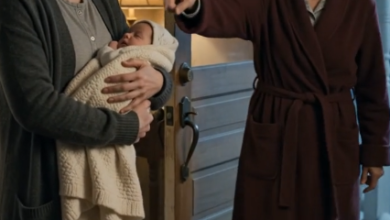
The Husband Brought His Mistress Into the Maternity Ward and Asked His Wife for a Divorce — Then a Nurse Recognized His Name in the Baby’s DNA File
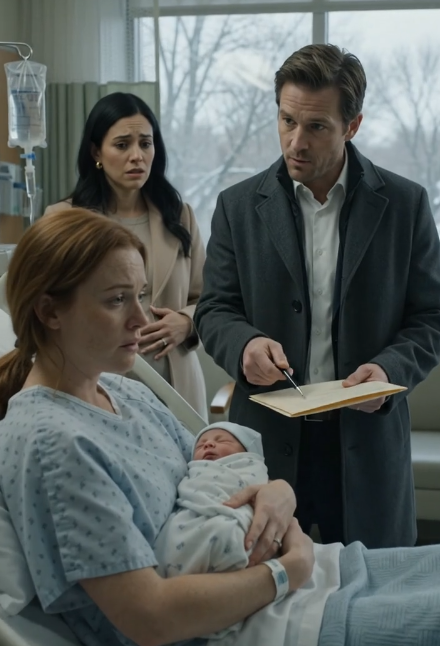
At 8:17 on a sleeting Tuesday morning in Columbus, Ohio, Daniel Mercer entered his wife’s maternity room carrying divorce papers in one hand while his pregnant mistress walked beside him, and for several silent seconds Claire believed the medication had made her mistake cruelty for a dream.
Claire Mercer was thirty-three, white, freckled, and usually composed enough to manage twenty-four fifth-graders without raising her voice. That morning, however, her auburn hair clung damply to her temples, her green eyes were swollen from a night without sleep, and every muscle beneath her pale blue hospital gown seemed to ache independently. Her daughter, Lily Grace, had been born six hours earlier after a difficult labor and now slept against Claire’s chest, wrapped in a white blanket printed with tiny yellow moons.
Daniel had missed the birth.
He had sent one message at 1:42 a.m.—Still at the Cleveland meeting. Roads are bad. I’m trying. Claire had watched the screen until another contraction forced the phone from her hand. Her older sister, Megan, had driven through freezing rain to sit beside her instead.
Now Daniel stood inside the room in a charcoal wool coat without a drop of sleet on its shoulders. Vanessa Cole stood half a step behind him, visibly pregnant beneath a fitted beige coat, one hand resting protectively over her stomach.
Claire recognized her at once. Vanessa had worked as the marketing coordinator at Daniel’s property-development company. She had attended the Mercers’ Fourth of July cookout the previous summer and brought Claire a jar of expensive peach preserves.
For one irrational moment, Claire remembered washing that empty jar and saving it.
“Why is she here?” Claire asked.
Daniel closed the door. At thirty-four, he was tall, clean-shaven, and practiced in the quiet confidence that made clients trust him before he had earned it. This morning, that confidence looked rehearsed. His dark blond hair was neatly combed, and the knot in his silver tie was perfect.
“Claire, we need to discuss something before you go home.”
“I’m not going home today.”
“I know. That gives us time.”
Vanessa looked toward the window. The hospital glass reflected all four of them: the new mother, the absent husband, the pregnant woman, and the infant none of the adults seemed brave enough to name.
Daniel placed a cream-colored packet on Claire’s blanket. Its bottom edge brushed Lily’s covered feet.
Claire saw the heading before he turned it facedown. Petition for Dissolution of Marriage.
“You brought divorce papers into my recovery room?”
“I didn’t want this dragged out.”
“You didn’t want it dragged out?”
Lily stirred at the change in her mother’s voice. Claire lowered her chin and whispered until the infant settled. That small reflex—comforting her child while her own life cracked open—made something move across Vanessa’s face. Shame, perhaps. It disappeared quickly.
Daniel pulled the visitor chair closer but did not sit. “Vanessa is thirty-two weeks pregnant.”
Claire stared at him.
Vanessa’s fingers tightened around her coat.
“We’ve been together for eleven months,” Daniel continued. “I should have told you sooner. I didn’t know how, and then you became pregnant.”
“I became pregnant?” Claire’s laugh held no humor. “You make it sound like I caught a virus.”
“That isn’t what I meant.”
“Were you with her last night?”
The pause answered before Daniel did.
“There was no Cleveland meeting,” Claire said.
“I panicked.”
“You missed your daughter’s birth because you panicked?”
Daniel’s jaw tightened. He disliked scenes he could not manage. Claire had seen that expression when subcontractors challenged his figures or his mother questioned a decision at Sunday dinner. He would lower his voice and call it reason, as if calmness made every demand fair.
He opened the packet and exposed tabs marked Property, Custody, and Support. “My attorney prepared a generous arrangement. You keep the house for eighteen months. I cover the mortgage during that period. We can establish a temporary parenting schedule after the paternity paperwork is completed.”
Claire looked down at Lily. “Paternity paperwork?”
Vanessa spoke for the first time. “Daniel wants both babies tested.”
Her voice was quiet and younger than Claire remembered.
Daniel glanced at her with irritation. “That was private.”
“You brought me here,” Vanessa replied. “Nothing about this is private now.”
Claire’s nausea had nothing to do with childbirth. During her pregnancy, Daniel had repeatedly accused her of becoming emotionally distant. Two months earlier, he had quietly ordered a prenatal paternity screen after claiming his family medical history required additional testing. Claire had protested, but he had said certainty protected everyone. The result had listed Daniel as Lily’s biological father with a probability exceeding 99.9 percent.
He had framed the page as an apology and hung it jokingly in his home office for one night before filing it away.
“You already tested Lily,” Claire said.
“That laboratory reported several irregular markers,” Daniel replied. “My attorney wants confirmation after birth.”
Before Claire could answer, Nurse Evelyn Shaw entered carrying a newborn-screening folder and a small plastic cup of ice chips. She was fifty-eight, Black, broad-shouldered, and steady in the unhurried manner of someone who had spent decades entering rooms at their worst moments. Silver threaded through the braids gathered at the back of her head. A brass locket rested above the neckline of her navy scrubs.
Evelyn looked from Claire to Daniel, then to Vanessa.
“I can come back.”
“No,” Claire said immediately. “Please stay.”
Daniel gathered the divorce pages into a neat stack. “We’re having a family discussion.”
Evelyn’s gaze rested on Vanessa’s stomach before returning to Claire. “It appears your family discussion may need a larger room.”
Vanessa flinched. Daniel did not.
“I’m Daniel Mercer, the baby’s father,” he said. “We’ll only be a minute.”
Evelyn had begun checking the identifying label on Lily’s folder. At Daniel’s full name, her thumb stopped.
“Daniel Mercer?”
“Yes.”
“Date of birth?”
Daniel gave it: August 14, 1992.
The folder shifted in Evelyn’s hands. Its metal clip struck the bed rail with a sharp sound.
She looked at Daniel’s face differently now—not as a nurse assessing an agitated visitor, but as someone comparing a living man to a memory.
“What?” he demanded.
Evelyn opened the newborn folder just far enough to check an attached laboratory sheet. Lily had undergone additional testing because of a possible blood-antigen incompatibility detected after birth. The panel included parental samples previously submitted during the pregnancy.
Evelyn read one line twice.
Then she saw the secondary notation beneath Daniel’s archived profile, a rare mitochondrial association flagged for manual verification. Her eyes moved to his date of birth again.
“Where was your mother living when you were born?” she asked.
Daniel gave an incredulous laugh. “What does my mother have to do with this?”
“Her name is Ruth Mercer?”
Claire noticed that Evelyn did not phrase it as a question.
Daniel reached for the file. Evelyn closed it before he touched it.
“That contains my daughter’s medical information.”
“It contains your wife’s and daughter’s protected information,” Evelyn said. “You don’t remove it.”
“I authorized the original test.”
“That does not make this folder yours.”
He pointed toward the divorce packet. “Then witness her signature so we can leave.”
Claire looked at him. “You thought a nurse would witness this?”
“You need an independent adult.”
“You need a conscience.”
Daniel slid the pen onto the blanket. It rolled toward Lily.
Evelyn caught it, set it aside, then placed her palm over the divorce packet.
“No signatures,” she said.
Daniel’s face reddened. “You have no authority over my legal documents.”
“Mrs. Mercer delivered six hours ago, has received medication, and is under acute emotional pressure. I will not witness anything, and I will document the circumstances if you force the issue.”
Vanessa stepped back. “Daniel, maybe we should go.”
“We’re not going anywhere until she signs.”
Lily began to cry. Claire drew her closer, though her hands had started trembling.
Evelyn took both the medical folder and the divorce packet. “These will remain at the nurses’ station until the patient requests them.”
“You cannot confiscate my property.”
“Then your attorney may collect the packet after speaking with hospital counsel.”
For the first time since entering, Daniel appeared uncertain.
Evelyn turned toward the door, but an old photograph slipped halfway from the inner pocket of the medical folder. It showed three young women standing outside a small brick clinic. Evelyn, perhaps twenty-four, stood at one edge. Ruth Mercer stood in the middle, recognizable despite her feathered hair and oversized glasses.
The third woman’s face had been torn away.
Daniel saw it.
“Why do you have a picture of my mother?”
Evelyn pushed the photograph back inside. Her composure remained, but the hand holding the folder had begun to shake.
She looked at Daniel, then at the newborn pressed against Claire’s heart.
“Because,” she said, “I was there the week you were born.”
Evelyn left the room, locked both packets in the steel drawer at the nurses’ station, and dialed a number she had carried for thirty-four years without once having the courage to use it.
Ruth Mercer answered on the fourth ring.
“Ruth,” Evelyn said, watching Daniel through the glass. “The testing found it. You need to come to the hospital before your son learns the truth from someone who doesn’t know how much it cost.”
Ruth Mercer arrived forty-three minutes later wearing a burgundy winter coat over house slippers. She was sixty-three, white, small-boned, and usually so careful about her appearance that she applied lipstick before collecting the newspaper. That morning, her silver bob was uncombed, and one earring was missing.
Daniel met her outside Claire’s room.
“What did you do?” he asked.
Ruth stopped as if he had struck her. “Is the baby healthy?”
“Lily is fine. Answer me.”
Vanessa had moved to a waiting-area chair near the vending machines. She watched Daniel and Ruth while pretending to study her phone. Claire remained inside with Megan, who had returned after receiving a three-word message from her sister: Please come back.
Evelyn stood behind the nurses’ station, speaking quietly with Dr. Priya Nair, the hospital’s genetics consultant. The steel drawer remained locked.
Ruth looked toward Evelyn. Their eyes met across the corridor, and thirty-four years seemed to pass between them without a word.
“You kept the photograph,” Ruth said.
“I kept what was left of it.”
Daniel stepped between them. “Someone needs to explain why my mother is in a hospital file connected to my daughter.”
Dr. Nair approached. She was forty-six, Indian American, with rectangular glasses and a calm, precise voice. “Mr. Mercer, no one will discuss your daughter’s protected results in the corridor. Mrs. Mercer must consent, and you will need to agree before we address findings related specifically to your sample.”
“I already agreed to testing.”
“You agreed to a paternity analysis. The laboratory identified something outside the original question.”
Daniel folded his arms. “Is Lily mine?”
Dr. Nair glanced toward Claire’s closed door. “The test supports that you are Lily’s biological father.”
Relief crossed his face so quickly that even Vanessa noticed it.
“Then this is finished.”
“No,” Evelyn said. “That is the one question the result answered simply.”
Claire asked to hear the discussion, but she did not want Vanessa in the room. Vanessa accepted the boundary without protest. Daniel called it childish until Ruth told him, quietly, to stop.
Inside, Claire sat near the window with Lily sleeping in the bassinet. Megan occupied the chair beside her. At thirty-seven, she had the same auburn hair as Claire but none of her sister’s instinct to soften hard truths.
“If he raises his voice,” Megan told Evelyn, “I’m rolling him into the hallway myself.”
Under different circumstances, Claire might have smiled.
Dr. Nair explained that Lily’s postnatal blood work had shown an uncommon antigen pattern. It was not currently dangerous, but confirming its origin could matter during future transfusions or pregnancies. The hospital compared Lily’s profile with the prenatal samples already on record.
Lily had inherited the relevant marker from Daniel.
That should have been unremarkable. Instead, the laboratory’s database linked Daniel’s profile to an unresolved historical sample submitted by a rural Ohio clinic in 1992. The original patient identifier had been restricted after an infant-placement investigation that was never completed.
Ruth’s hands closed around the strap of her purse.
Daniel noticed. “You knew.”
“I knew there were records.”
“What records?”
Ruth did not answer.
Dr. Nair continued carefully. The inherited marker alone could not establish identity. However, Daniel’s mitochondrial sequence—the genetic line generally passed from mother to child—did not match a sample stored under Ruth Mercer’s name during a later family-screening program.
Daniel stared at her. “That’s impossible.”
“The current result must be independently repeated,” Dr. Nair said. “Sample errors and historical labeling problems do happen. We do not draw life-changing conclusions from one comparison.”
“But if it isn’t an error?”
Ruth looked at Lily instead of her son.
Daniel’s voice grew louder. “If it isn’t an error, what does it mean?”
Claire watched the woman who had been her mother-in-law for nine years. Ruth had brought soup when Claire was sick, folded baby clothes during the third trimester, and insisted Daniel’s restlessness was merely fear of fatherhood. She had protected him reflexively, sometimes painfully. Now Ruth appeared not protective, but cornered.
“It would mean,” Dr. Nair said, “that Mrs. Ruth Mercer is unlikely to be your biological mother.”
The room became still except for the soft mechanical breath of the heater.
Daniel laughed once. “No. She gave birth to me.”
Ruth closed her eyes.
“You gave birth to me,” he repeated.
“I came home from the clinic with you.”
“That isn’t what I asked.”
Evelyn placed the faded photograph on the bedside table. This time Claire saw it clearly. Young Evelyn wore white nursing shoes. Young Ruth held a folded blue blanket. The faceless woman between them had one hand resting over a pregnant stomach.
On the back, in faded ink, someone had written three names: Evelyn Shaw, Ruth Hale, and Marisol Vega.
Daniel took the photograph. “Who is Marisol?”
Ruth’s face collapsed in a way Claire had never seen. “Your mother.”
Daniel looked at her for several seconds, waiting for her to retract the words.
Instead, Ruth began to speak.
In the summer of 1992, Ruth Hale and her husband, Thomas Mercer, had lived near the small town of Bellwether, ninety miles southeast of Columbus. Ruth worked as a receptionist at St. Anne’s Community Clinic. Evelyn was a newly licensed nurse. Marisol Vega, a twenty-year-old Mexican American waitress with long black hair and a crescent-shaped birthmark near her left ear, arrived late in pregnancy with no insurance and very little English.
The three women became friends because Ruth translated paperwork with a Spanish dictionary, and Evelyn refused to let the clinic turn Marisol away.
Ruth had been pregnant too.
“I lost my son at thirty-eight weeks,” she said. “His name was supposed to be Daniel.”
Claire looked toward the man standing beside her bed. Daniel’s face had emptied.
Ruth continued. A week after her stillbirth, Marisol went into labor during a storm that flooded the main road to the county hospital. The clinic stabilized her until an ambulance could arrive. She delivered a healthy boy, but severe complications followed.
“Did she die?” Daniel asked.
“No,” Ruth whispered. “Not then.”
Marisol survived the night. She also learned that the child’s father, a married local businessman, intended to challenge her custody and claim she was unfit. Terrified and heavily medicated, she asked Ruth to hide the baby for a few days.
Thomas Mercer agreed to take the infant temporarily.
Temporary became three weeks. Then six.
Before Marisol could reclaim him, she disappeared.
“What do you mean, disappeared?”
Evelyn answered. “Her apartment was emptied. The clinic received a note saying she had left voluntarily. I never believed it.”
Daniel turned on Ruth. “And you kept me.”
Ruth’s lips trembled. “I loved you.”
“You kept me.”
“We were trying to protect you.”
“From whom?”
Ruth reached into her purse and removed a small brass key tied to a faded blue ribbon. She placed it beside the photograph.
“From your biological father,” she said. “And from the truth about what Thomas did after Marisol came back.”
Daniel did not touch the key.
He stood with both hands pressed against the windowsill, staring at the parking garage through streaks of sleet. The city beyond the glass continued as if his childhood photographs had not just become evidence.
Claire recognized the posture. Daniel used it whenever an argument threatened his preferred version of events. He turned his back, became very still, and waited for the other person to feel unreasonable.
This time, no one rescued him.
Ruth explained that the brass key belonged to a storage locker at the old Bellwether bus station. Marisol had rented it under Ruth’s maiden name shortly before she vanished. Ruth had kept paying the annual fee even after the station became a private storage facility.
“You’ve had access to her belongings all this time?” Daniel asked.
“I had the key. I never opened the locker.”
“Why not?”
“Because Thomas made me promise.”
Thomas Mercer had died from pancreatic cancer three years earlier. Daniel had delivered the eulogy, describing him as a principled father who believed a man’s word mattered. Ruth had sat in the front pew holding the same blue ribbon now lying beside the hospital photograph.
In September 1992, six weeks after leaving, Marisol returned to the Mercer house shortly after midnight. She was thin, bruised along one wrist, and carrying an envelope of legal papers. She said the child’s father had confined her in a motel outside Dayton until she signed a custody surrender. She escaped before the paperwork could be filed.
“She came for me,” Daniel said.
“Yes.”
“And you refused her.”
Ruth looked down. “Thomas did.”
The truth had not begun as an abduction in Ruth’s mind. It began as a frightened mother asking for safety, a grieving woman holding a baby through one sleepless night, and a husband insisting they could resolve everything once the roads cleared. Each decision made the next one easier to justify.
Thomas told Marisol that authorities would arrest her for abandonment if she attempted to take Daniel. He claimed the papers she had signed surrendered her rights. They did not.
Ruth knew that only later.
“What did you do when she came to the door?” Claire asked.
Ruth’s answer barely carried across the room. “I stood behind Thomas and held the baby.”
Daniel turned. “You held me while he sent her away?”
“You were crying. She was crying. Thomas kept saying she was unstable. I had just buried my son, and I was afraid that if I handed you over, I would lose another child.”
“You were supposed to lose me. I wasn’t yours.”
Ruth flinched, but she did not dispute it.
Evelyn added what Ruth had omitted. She had visited the Mercer home the following morning after Marisol came to the clinic asking for help. Thomas met Evelyn on the porch and threatened to report the clinic for mishandling a birth if she interfered.
Evelyn was twenty-four, newly employed, supporting a younger brother, and afraid.
“I told myself I needed proof,” she said. “By the time I went back with the clinic director, Marisol was gone again.”
“Everyone keeps saying she was gone,” Daniel replied. “Where did she go?”
Ruth looked toward the photograph. “I don’t know.”
That was the first answer Daniel refused to accept.
He demanded the locker be opened immediately. Dr. Nair reminded him that the hospital still needed new samples to confirm the genetic finding. Daniel accused the laboratory of incompetence, then accused Evelyn of creating the entire crisis to punish Ruth. When neither accusation restored order, his anger shifted toward Claire.
“This has nothing to do with our divorce.”
Claire stared at him. “You brought those papers here because you believed I was too weak to say no.”
“I brought them because delaying helps no one.”
“You missed Lily’s birth and arrived with another pregnant woman.”
“I made mistakes.”
“A mistake is forgetting the car seat. You planned this.”
Daniel lowered his voice. “Don’t use my family history as leverage.”
“You used my labor as leverage.”
For the first time, Daniel looked toward the bassinet. Lily slept with one fist near her cheek, untouched by the adults rearranging her family.
Claire felt an old tenderness toward him surface and then recede. She had loved Daniel since they met at a teachers’ charity auction nine years earlier. He had been attentive, witty, and hungry to build a safe life. She now wondered how much of that hunger had been inherited from fear rather than ambition.
Understanding it did not excuse what he had done.
Vanessa knocked softly and entered only after Claire permitted it. Her mascara had smudged beneath one eye.
“I need to say something,” she told Claire.
Daniel stepped forward. “Not now.”
“Yes, now.”
Vanessa revealed that Daniel had not merely promised to leave Claire. He had told Vanessa the marriage had been functionally over for two years and that Claire knew about the relationship. He claimed Claire’s pregnancy resulted from one failed reconciliation attempt and that she had agreed to an amicable separation after delivery.
Claire almost admired the architecture of the lie.
“Did he also tell you Lily might not be his?” she asked.
Vanessa’s face answered.
“He said there were questions,” she admitted.
Daniel moved between them. “I wanted testing so no child would grow up under uncertainty.”
Ruth made a small, wounded sound.
The irony reached everyone at once.
Vanessa took an envelope from her handbag. It contained results from a private prenatal paternity test. Daniel was listed as the probable father of her unborn son, but the report included a warning: the paternal sample demonstrated an unusual hereditary marker requiring clinical confirmation.
The same marker found in Lily.
Dr. Nair compared the laboratory code. “These tests were processed by the same parent company.”
Evelyn asked Vanessa why she had brought the result.
“Daniel told me to keep it with me until Claire signed,” she said. “He said it would protect our custody arrangement.”
Claire looked at Daniel. “You planned to use two DNA reports as weapons against two women on the same morning.”
Daniel’s expression hardened. “I planned to create clarity.”
“No,” Vanessa said, stepping away from him. “You planned to be the only person who knew what was happening.”
That minor rebellion unsettled him more than Claire’s anger.
Evelyn placed Vanessa’s report beside Lily’s file. “The marker may help us locate relatives in the historical database, but only with proper consent.”
“I consent,” Vanessa said.
Daniel did not.
He insisted no further testing would occur until he spoke with an attorney. Dr. Nair agreed that he could refuse analysis of his own new sample, but the existing lawful records and the babies’ medically necessary tests would remain.
Claire watched him calculate.
He had arrived intending to divide property, parenthood, and blame into labeled sections. Now every label carried a question.
Ruth picked up the brass key. “I’ll go to the locker.”
“I’m coming,” Daniel said.
“You should stay with your daughter.”
“You lost the right to tell me what a father should do.”
He turned toward the door, but Claire stopped him with one sentence.
“If you leave again, Daniel, do it knowing Lily will eventually learn exactly where you chose to be on the first day of her life.”
He looked back at the bassinet.
For several seconds, Claire thought he might remain.
Then his phone rang. His attorney’s name appeared on the screen, and Daniel stepped into the corridor to answer it.
Ruth closed her fingers around the key.
Vanessa began crying without sound.
Evelyn lifted the old photograph and noticed something written beneath the torn edge, concealed for decades by a strip of yellowed adhesive. She carefully loosened it.
Only part of the message remained:
If anything happens to me, ask Thomas about the boy named Gabriel.
Ruth read it and went pale.
Claire asked who Gabriel was.
Ruth looked toward the corridor where Daniel was arguing into his phone.
“Thomas’s first son,” she said. “The son Daniel was never told existed.”
Gabriel Vega was forty-one and alive.
The hospital database did not provide his address, but the historical file contained a consent form allowing contact if a genetic relative were identified. Dr. Nair called the listed number while Daniel spoke with his attorney.
A man answered from Tucson, Arizona.
He identified himself as Gabriel Luis Vega, an emergency-helicopter mechanic and the son of Marisol Vega. His voice changed when Dr. Nair mentioned Bellwether.
“My mother had another child there,” he said. “A boy they told her had died.”
Ruth gripped the bed rail.
Gabriel had been seven when his mother traveled to Ohio for seasonal work, leaving him temporarily with her older sister in Texas. Marisol sent postcards every week until September 1992. Then the cards stopped.
She returned months later without the infant she had carried. She told the family the baby had died after birth. She rarely spoke of Ohio again.
“She didn’t know I lived?” Daniel asked when Dr. Nair put the call on speaker with consent from everyone present.
Gabriel was silent for a long moment. “If you’re the baby from Bellwether, no. She believed someone at the clinic changed the records.”
Evelyn sat down.
“Where is she?” Ruth asked.
“My mother died eight years ago.”
Ruth pressed her fist to her mouth.
Marisol had spent the last twenty years of her life as a nursing-home cook in southern Arizona. She raised Gabriel, cared for her sister after a stroke, and kept a blue baby blanket folded inside a cedar box. She never married.
Gabriel knew nothing about Thomas Mercer until he opened Marisol’s belongings after her death. Inside the box, he found letters addressed to Daniel, a copy of an unsigned custody petition, and photographs of a blond infant taken through the window of a house in Ohio.
“She came back,” Daniel said. His voice was thin.
“More than once,” Gabriel replied.
The first time, Thomas threatened her. The second time, no one answered the door. The third time, she watched Ruth place the baby into a car and followed them to church. Marisol approached a deputy afterward, but Thomas had already reported her as an unstable stranger stalking his family.
“She was arrested?” Claire asked.
“Held overnight. No charges. But she was terrified they’d keep Gabriel from her too.”
Daniel looked at Ruth. “Did you know?”
“Not about the arrest.”
“Did you know she came back again?”
Ruth’s silence was enough.
She confessed that she had seen Marisol standing across from the church. Their eyes met over Daniel’s infant carrier. Ruth could have crossed the street. Instead, she turned away and asked Thomas to drive home by another route.
“I told myself you needed stability,” she said. “I told myself love could make the way we got you less important.”
Daniel laughed bitterly. “That sounds familiar.”
Claire heard what he meant. Daniel had used similar language about the divorce: speed would create stability; controlled paperwork would spare everyone greater pain; his preferred ending would eventually justify the way he forced it.
Gabriel agreed to travel to Ohio. He had already completed commercial genetic screening years earlier, which explained the historical database association. With his consent, Dr. Nair compared the available markers. The preliminary kinship pattern supported a close maternal relationship between Gabriel and Daniel—most likely half brothers.
But one inconsistency remained.
Gabriel’s records listed his father as Luis Vega, a man who died before Gabriel was born. Daniel’s archived profile contained several paternal markers strongly associated with a separate sample collected in Ohio during a cardiac study.
That sample belonged to Thomas Mercer.
Ruth stared at Dr. Nair. “No.”
Daniel’s face went rigid. “Thomas was my biological father?”
The finding required confirmation, but the probability was strong.
Ruth stood too quickly and caught the chair. “Thomas told me Marisol’s baby belonged to another man.”
Evelyn’s expression hardened. “Thomas told all of us that.”
The shape of the old story changed again.
Thomas had not simply agreed to shelter a stranger’s child for his grieving wife. He had fathered Marisol’s baby during an affair, then taken advantage of Ruth’s stillbirth and Marisol’s vulnerability to bring that baby into his marriage.
Marisol had come to Bellwether because Thomas promised work and support. When she became pregnant, he concealed her from Ruth. After Ruth lost her baby, Thomas saw a terrible opportunity: keep his biological son, preserve his marriage, and remove the young mother who could expose him.
Ruth sank into the chair.
“I thought I was the one stealing you,” she whispered. “But he arranged everything.”
“That doesn’t make you innocent,” Daniel said.
“No.”
The direct answer disarmed him.
Ruth had spent thirty-four years defending Thomas because admitting his crime would also expose her choices. She had not engineered the deception, but she maintained it long after fear ceased to be an excuse.
The brass key opened more than a storage locker. It opened the part of Ruth’s life she had kept untouched because she suspected that anything inside would destroy the family she had protected.
Daniel finally agreed to accompany her to Bellwether, but hospital policy prevented Claire from leaving, and Dr. Nair urged everyone to wait for confirmation before drawing further conclusions.
Daniel refused.
He and Ruth drove ninety miles through sleet in separate cars. Evelyn stayed with Claire while Megan went home to collect clothes and a proper infant carrier. Vanessa remained in the waiting area, making calls to cancel the nursery furniture Daniel had arranged to deliver to his new apartment.
“He signed the lease two months ago,” she told Claire when invited back into the room. “He said it was temporary housing while you sold the house.”
Claire looked at Lily’s sleeping face. Another planned detail.
Vanessa did not ask forgiveness. She explained that she had grown up with a father who came and went, and Daniel’s promises of permanence had appealed to the frightened part of her that still watched doorways. She had ignored contradictions because she wanted her son to be chosen.
“I knew you existed,” she said. “Even if I believed his version, I knew.”
Claire appreciated that she did not disguise accountability as victimhood.
“What will you do?” Claire asked.
“I don’t know. But I won’t live with him.”
Claire believed her, though she was not ready to offer comfort.
Near dusk, Daniel called from the storage facility. His voice came through Evelyn’s phone because Claire had blocked his number.
The locker contained Marisol’s cedar box, twelve unopened letters, infant clothing, and a cassette recorder wrapped in the blue blanket.
There was also a notarized statement signed by Thomas Mercer in 2001.
Daniel read the first sentence aloud:
I, Thomas Alan Mercer, acknowledge that Daniel Mercer was born to Marisol Elena Vega and that I used false statements to prevent her from reclaiming him.
He stopped there.
Claire could hear Ruth sobbing in the background.
“Bring everything back,” Evelyn said.
Daniel’s answer came after a long silence.
“There’s a recording addressed to me.”
“Then listen when you’re ready.”
“I already pressed play.”
A woman’s voice emerged faintly through the phone, softened by tape hiss and years.
Daniel, if you ever hear this, please know that I did not leave because I stopped looking for you.
Then the recording clicked off.
Daniel had paused it.
For the first time that day, the man who had planned every exit admitted he was afraid to hear what came next.
Daniel returned to the hospital after nine that evening carrying the cedar box against his chest. The sleet had turned to snow, melting in his hair and darkening the shoulders of the coat that had been immaculate that morning.
No attorney accompanied him. Ruth followed with Marisol’s letters in a grocery bag because the leather handle of the original case had broken.
Claire had moved to a private consultation room with Lily. Vanessa sat at the far end, not beside Daniel. Evelyn and Dr. Nair joined them after receiving permission from all three expectant or new parents.
Daniel placed the cassette recorder on the table.
“I want Claire to hear it,” he said.
Claire was surprised. “Why?”
“Because I used uncertainty against you. I don’t want to control this part.”
It was not an apology, but it was the first honest acknowledgment he had offered.
Ruth pressed play.
Marisol’s recorded voice was quiet and careful, her English fluent by then but still touched by Spanish vowels. She said she had made the tape in 2001 after Thomas contacted her unexpectedly. He claimed Daniel had begun asking questions about his birth because none of his school photographs resembled Ruth’s family.
Thomas offered Marisol money in exchange for a permanent surrender and silence.
She refused the money. She asked for one photograph each year and the right to send letters that Daniel could open after turning eighteen.
Thomas agreed in writing, then never mailed the photographs and locked Marisol’s letters in the storage unit.
Marisol spoke directly to the child she imagined might someday become a man.
I do not know what they will tell you about me. I was frightened, and I trusted the wrong person. I left you with Ruth because I believed it would be three days. When I returned, your father made my fear sound like proof that I was dangerous.
Daniel covered his mouth.
Ruth held you as if she loved you. That was the hardest part, because I could hate what she did but still see that you were warm, fed, and safe in her arms. I wanted to break the door. I also wanted you never to hear two women fighting over you as if you were property.
Ruth bent forward, weeping.
Marisol described visiting Ohio one final time when Daniel was nine. She watched him play baseball from beyond the outfield fence. He struck out twice, then helped a smaller child retie his shoe before returning to the dugout.
You looked kind, she said. I decided that if I could not be your mother in your life, I would not let my grief enter it like a storm.
The tape turned softly.
Her last request was not that Daniel reject Ruth or forgive Thomas. It was simpler.
When the truth finds you, do not use it to punish another child. Children should not pay for the fear, pride, or loneliness of adults. If you become a father, stay when the room becomes difficult. That is where a child learns whether love is real.
The cassette ended.
No one moved.
Lily made a small sound against Claire’s chest. Daniel looked toward her but did not approach.
The confirmed laboratory results arrived the following afternoon. They supported all three critical relationships: Daniel was Lily’s biological father; Gabriel was Daniel’s maternal half brother; and Thomas Mercer was almost certainly Daniel’s biological father.
Marisol had told the truth.
A separate confirmation involving Vanessa’s unborn child established Daniel as that baby’s biological father as well. Two children, due eight weeks apart, would share a father whose own identity had been constructed through deception.
The revelation did not repair Claire’s marriage. It clarified why Daniel feared ambiguity, but fear was not fidelity. Childhood wounds could explain the shape of a person’s defenses; they could not sign away the harm those defenses caused.
Claire retained a family-law attorney recommended by Megan. She filed her own divorce petition after leaving the hospital and requested a structured custody plan, financial disclosure, and counseling before Daniel could have unsupervised overnight care.
Daniel initially objected to counseling. Then Gabriel arrived from Tucson.
He was shorter than Daniel, with black hair touched by gray, brown skin, and Marisol’s crescent-shaped birthmark near his left ear. At the hospital entrance, the brothers stood facing each other without embracing.
Gabriel noticed the cedar box in Daniel’s hands.
“You found her letters,” he said.
“You knew about them?”
“I knew she wrote. I didn’t know where they went.”
Daniel asked the question he had been carrying since the phone call. “Did she hate me for having a good life?”
Gabriel shook his head. “She hated the people who took her choices. She never hated the baby.”
Their relationship did not become immediate brotherhood. Gabriel was angry that Ruth had raised Daniel in comfort while Marisol worked two jobs. Daniel resented Gabriel for possessing memories of their mother. Both emotions embarrassed them, and neither disappeared simply because they shared blood.
But Gabriel stayed in Ohio for a week.
Together they opened the twelve letters. Marisol had written about ordinary things: a kitchen job she finally enjoyed, Gabriel’s graduation, a cactus blooming outside her apartment. She asked whether Daniel still hated peas and whether the small scar beneath his chin had faded. That detail proved she remembered holding him before Ruth took him home.
The final letter was dated six months before her death.
I no longer expect the past to become fair, she wrote. I only hope that when you discover it, you will become more truthful than the people who loved you badly.
Daniel read that sentence several times.
Meanwhile, Vanessa moved into her sister’s apartment. She ended her romantic relationship with Daniel but agreed to participate in a future co-parenting plan. She and Claire did not become friends. Their conversations remained short and practical, usually through attorneys or a shared family counselor after Vanessa’s son, Noah, was born.
Claire set one boundary immediately: the children would not be raised as secrets from one another.
Ruth offered Claire money from Thomas’s estate. Claire refused a private payment that could later be described as generosity.
“Use it to correct the records,” she said. “Marisol deserves her name restored.”
That request changed the direction of everything.
With Gabriel’s consent, Ruth hired an attorney to petition the county court to unseal and amend the fraudulent custody documents. She surrendered Thomas’s notarized statement and provided a sworn account of her own involvement. The statute of limitations prevented some consequences, and Thomas was dead, but the official record no longer described Marisol as an abandoning mother.
Ruth also contacted the clinic’s successor organization. Evelyn gave a statement about the intimidation she witnessed. The clinic conducted a review and discovered that several informal infant placements during the early 1990s had been handled without adequate oversight.
The hospital and county established a patient-advocacy protocol requiring independent consultation whenever birth mothers faced private custody pressure. It was not a monument, a foundation, or a public spectacle. It was a set of procedures, translated forms, and access to legal assistance before signatures could be witnessed.
Evelyn helped write the section concerning coercion.
Daniel attended the first planning meeting but did not speak. He sat beside the door holding Marisol’s brass key. When a social worker asked why waiting twenty-four hours before signing mattered, he looked at Claire.
“Because exhaustion can be used as a weapon,” he said.
Afterward, he approached her in the parking lot.
“I’m sorry.”
Claire waited.
“I’m sorry I cheated. I’m sorry I lied to both of you. I’m sorry I brought those papers into the room where Lily was born. What happened to me doesn’t reduce what I did to you.”
It was the apology Claire had needed, but receiving it did not obligate her to return.
“I believe you’re sorry,” she said. “The divorce is still happening.”
Daniel nodded. His eyes filled, yet he did not argue.
Ruth’s redemption proved slower. Daniel would not call her Mom for months. He addressed her as Ruth in therapy and sometimes refused her calls. She accepted each consequence without claiming that Thomas had forced every choice.
On Lily’s first Christmas, Ruth gave Daniel the blue baby blanket after repairing one torn corner. She did not ask him to forgive her.
“This belonged to Marisol,” she said. “It should have followed you.”
Daniel touched the uneven stitches. Ruth admitted Marisol had taught her that pattern during the weeks they worked together at the clinic. The two women connected by one child had each sewn part of the blanket.
Daniel folded it carefully and placed it in the cedar box.
Then he asked Ruth to tell him one good memory that did not belong to Thomas’s version of events.
Ruth described Marisol laughing in the clinic kitchen because Daniel kicked whenever someone played an old radio. It was a small memory, offered without defense.
For that evening, it was enough.
The divorce became final eleven months after Lily’s birth.
Claire kept the house, not for eighteen months under Daniel’s proposed arrangement, but after buying out his share with help from a conventional loan and a modest inheritance from her grandmother. Daniel moved into a two-bedroom apartment ten minutes away, close enough for parenting and far enough for boundaries.
His first supervised visit with Lily lasted ninety minutes.
He arrived carrying three bags of supplies, two kinds of formula, six pacifiers, and a printed schedule. Lily ignored every carefully selected toy and played with the zipper on his sweater.
The family counselor, Denise Carter, watched Daniel repeatedly check the clock.
“You don’t need to optimize the visit,” she said.
“I don’t want to do anything wrong.”
“You will.”
Daniel looked alarmed.
Denise smiled. “Every parent does. The task is to remain present long enough to repair it.”
That sentence stayed with him.
He continued therapy and eventually admitted that his obsession with proof had begun long before he learned the truth of his birth. Thomas had treated affection like a contract. Praise followed obedience; silence followed disappointment. Daniel grew up believing the safest person in any room was the one holding all the information.
With Claire, he had concealed debt from an early business failure because he feared looking weak. With Vanessa, he controlled the narrative so she would not leave. During both pregnancies, he ordered tests not because evidence suggested betrayal, but because certainty made him feel less vulnerable.
He had become skilled at preventing abandonment by giving others reasons to abandon him.
Vanessa delivered Noah in April. Daniel attended the birth, but only after Vanessa established rules: he would not speak for her, invite Ruth without permission, or bring legal papers of any kind.
When complications extended the labor into a second night, Daniel remained in the uncomfortable chair beside the window. At 3:00 a.m., Vanessa asked why he kept staring at the door.
“My mother said to stay when the room becomes difficult,” he replied.
“Which mother?”
Daniel considered the question. “Both of them, in different ways.”
Noah was born healthy.
Claire brought Lily to meet him two weeks later, accompanied by Megan. The encounter was awkward. Vanessa cried. Claire nearly left when Daniel attempted to explain everyone’s feeding schedule. Then Lily sneezed, Noah startled, and the adults laughed before remembering they were still angry.
That brief laughter did not erase anything. It simply proved the children could occupy the same room without carrying the full weight of their parents’ choices.
As the months passed, Daniel learned to stop asking Claire for emotional absolution. He arrived on time, paid support without negotiation, attended pediatric appointments when invited, and accepted when Claire said no.
Reliability replaced performance slowly.
Ruth moved out of the large house she had shared with Thomas. She sold most of his business holdings and divided a portion of the proceeds between Daniel and Gabriel after accounting for legal costs related to correcting Marisol’s records.
Gabriel initially refused the money.
“It came from the man who hurt her,” he said.
Ruth answered, “Then decide whether using it for something she valued gives him the final word or takes it away.”
Gabriel used part of his share to establish a small certification scholarship for nursing-home kitchen workers. It bore Marisol Vega’s name but contained no description of her tragedy.
The first recipient was a fifty-six-year-old dietary aide training to become a licensed practical nurse.
Evelyn retired the following summer. At her quiet farewell luncheon, Claire gave her a framed copy of the hospital’s new coercion-prevention protocol. No photograph of Claire, Lily, or Daniel accompanied it. Evelyn had asked that their private lives remain private.
“I should have acted in 1992,” Evelyn told Ruth after the others left.
“So should I.”
“I was afraid.”
“So was I.”
They did not declare themselves forgiven. They sat together folding paper napkins after everyone else had gone, two older women cleaning a room that had already been cleaned.
Daniel and Gabriel continued speaking by video call. Some conversations lasted five minutes. Others ended in arguments about Ruth. Once, Gabriel accused Daniel of treating Marisol’s letters like an inheritance rather than a relationship.
“You’re trying to study her,” Gabriel said. “She wasn’t a case file.”
Daniel ended the call angrily.
Three days later, he called back and asked Gabriel to teach him Marisol’s recipe for cinnamon rice. The first batch burned. Gabriel laughed so hard he had to set down his phone.
That was the beginning of something more honest than instant forgiveness.
On Lily’s second birthday, Claire hosted a small gathering in her backyard. Noah toddled after bubbles while Lily wore a yellow paper crown. Daniel attended for two hours under the parenting plan. Vanessa came separately.
Ruth stood near the fence, unsure whether she was welcome to approach.
Claire carried Lily over.
“She knows you as Grandma Ruth,” Claire said. “Someday she’ll know the whole story in language she can understand. If you want a place in her life, there can be no more protected lies.”
Ruth nodded. “No more.”
Lily reached for the brass locket Ruth now wore. Inside were two tiny photographs: one of Marisol at twenty and one of Ruth holding Daniel as an infant.
Neither woman had been cropped out.
Before leaving, Daniel handed Claire a slim folder. Her shoulders stiffened at the sight of it.
“It isn’t legal paperwork,” he said.
Inside was a copy of Lily’s corrected family medical history. It included Marisol’s heritage, Gabriel’s contact information, Thomas’s cardiac history, Ruth’s non-biological parental role, and Noah as Lily’s paternal half brother.
No one had been reduced to a blank space.
Claire closed the folder. “Thank you.”
Daniel looked toward Lily and Noah. “I thought facts would protect me. Mostly, I used them to protect myself from people.”
“That sounds like progress.”
“It doesn’t feel like it.”
“Progress rarely does while you’re paying for it.”
He accepted that without asking her to make it kinder.
Five years after the morning Daniel entered the maternity ward with his mistress and a packet of divorce papers, Lily Mercer began kindergarten carrying a lunchbox decorated with yellow moons.
Claire walked her to the classroom. Daniel arrived separately and waited near the entrance with Noah, now four, holding his hand. Their custody arrangements were no longer supervised, but they remained precise. Precision had become useful once it stopped being a weapon.
Lily hugged both parents before entering.
She knew that Daniel lived in another home and that Noah was her brother. She knew Grandma Ruth had raised her father, while a woman named Marisol had given birth to him. She did not yet know every betrayal hidden inside those facts.
Children deserved truth, Claire believed, but truth needed language strong enough to carry it.
Daniel had become less polished over the years. Gray had appeared near his temples, and he often wore sweaters instead of business suits. His development company survived, though he resigned from two leadership positions during the divorce and adopted disclosure procedures his younger self would have considered excessive.
He still made mistakes.
He once missed Lily’s school performance after entering the wrong date in his calendar. His first instinct was to blame Claire’s message. He stopped before speaking, apologized to Lily, and attended her ordinary Tuesday rehearsal the following week without pretending it replaced what he missed.
Staying, he learned, did not mean never failing to leave. It meant returning without rewriting why you had gone.
Ruth’s relationship with Daniel remained imperfect. Some weeks he called her twice. Sometimes a month passed. She did not pressure him through Claire or send gifts as substitutes for accountability.
She volunteered three mornings a week with the hospital’s patient-advocacy office. Her role involved explaining forms and reminding families that they could wait before signing non-urgent documents.
Whenever someone asked why the policy mattered to her, she said only, “Because a frightened person should not lose a lifetime in one exhausted hour.”
Gabriel moved to Ohio after accepting a maintenance-management position near Columbus. He did not move for Daniel, he insisted, but he rented an apartment only twelve minutes away.
The brothers argued about baseball, food, and which of them had inherited Marisol’s habit of tapping a spoon twice against the side of a pot. Their resemblance became clearer with time, not in their faces but in gestures neither had learned from the other.
On the anniversary of Marisol’s death, they cooked cinnamon rice and took two bowls to Ruth’s house.
Ruth almost refused to open the door when she saw Gabriel. He had never visited her before.
“I don’t forgive you,” he said.
“I know.”
“But my mother spent enough of her life outside doors.”
Ruth stepped aside.
They ate at the small kitchen table. No one offered a speech. Gabriel asked Ruth what Marisol wore during her pregnancy. Ruth remembered a red cardigan with a missing pearl button.
The following week, she found that button in the cedar box.
Claire encountered Evelyn occasionally at the grocery store. Evelyn always asked about Lily but never claimed credit for exposing the truth. She had simply recognized a name, closed a folder, and refused to let a vulnerable woman be hurried into signing.
The old steel drawer remained at the nurses’ station. New staff knew it only as the place where sensitive paperwork could be held until patients felt safe enough to make decisions.
On Lily’s sixth birthday, Daniel gave her the blue blanket.
Ruth had repaired one edge using the pattern Marisol taught her. Years later, Gabriel added a second row of stitching in a darker blue thread. The blanket carried the hands of the mother who lost Daniel, the mother who raised him, and the brother who found him.
“What happened here?” Lily asked, tracing the uneven seam.
“It tore,” Daniel said.
“Did you fix it?”
“Several people did.”
Lily considered the answer, then wrapped the blanket around herself and Noah. It was barely large enough for both children, so they stood shoulder to shoulder beneath it, laughing when one side slipped.
Daniel watched them from Claire’s porch.
Vanessa was inside cutting birthday cake. Ruth arranged paper plates. Gabriel repaired the loose wheel on Lily’s toy wagon while Evelyn, invited as a family friend, argued with Megan about the correct amount of frosting for a six-year-old.
The people gathered there were not one healed family. Some wounds had closed unevenly. Some relationships depended on boundaries that would never disappear. Claire did not take Daniel back. Gabriel did not call Ruth his mother. Vanessa never asked Claire to forget how their lives became connected.
Yet Lily and Noah knew one another from the beginning.
No adult forced either child to discover a sibling through an accidental laboratory result. No letter remained unopened because truth threatened someone’s image. No one stood outside the window believing love belonged only to the people who controlled the door.
As evening approached, Daniel found Claire alone near the kitchen sink, washing blue frosting from a serving knife.
“I used to think the worst thing that happened that day was learning Ruth wasn’t my biological mother,” he said.
Claire dried the knife. “It wasn’t?”
“No. The worst thing was who I chose to be before I learned it.”
She studied him, then nodded once.
“And the best thing?” she asked.
Daniel looked through the window. Lily and Noah had fallen asleep on opposite ends of the couch, still clutching corners of Marisol’s blanket.
“That Evelyn locked the papers away long enough for everyone else to have a choice.”
Claire placed the clean knife in the drawer.
Years earlier, Daniel had laid a document across her newborn daughter’s feet and expected exhaustion to resemble consent. Now he waited for answers. He accepted closed doors. He understood that love without another person’s freedom was only possession dressed in softer language.
Before leaving, he lifted Noah from the couch. Claire carried Lily upstairs. The blue blanket stretched between the sleeping children until Daniel gently folded it and placed it over Lily’s chair.
The repaired seam remained visible beneath two shades of blue thread.
It was not beautiful because no damage had occurred. It was beautiful because no one had hidden where the fabric had torn.
Follow this page for more heartfelt stories about family secrets, hard-earned second chances, and the quiet moments when truth finally gives ordinary people room to choose differently.