The Trash-Collecting Father Called an Embarrassment at the Ceremony — His Son’s Speech Left the Entire Hall Frozen
They stopped him halfway down the aisle—one raised hand, one sharp whisper, one humiliating glance—and in that instant, the celebration lost its breath.
“Sir, you’re… disrupting the image.”
The words were polite. Almost gentle. That made them worse.
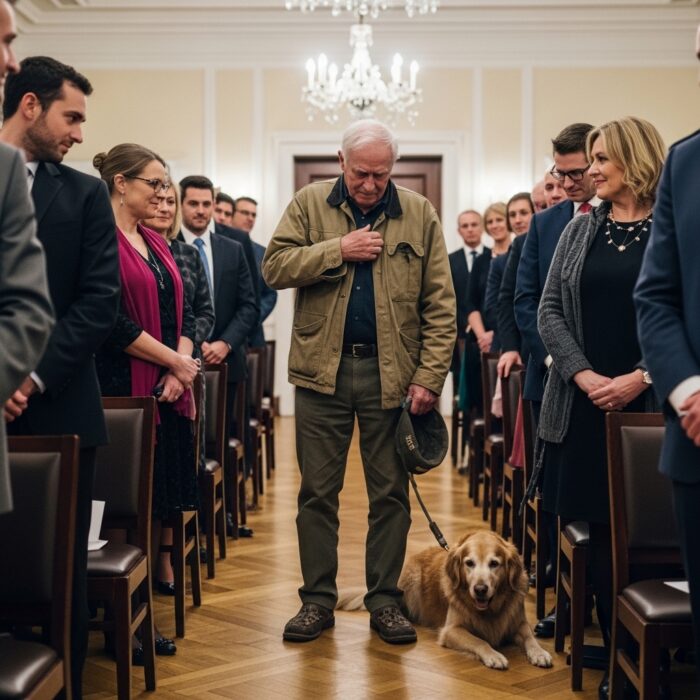
The old man froze under the chandelier’s pale light, a battered canvas jacket hanging loose on his thin frame, the faint smell of rust, rainwater, and last night’s bottles still clinging to him. His hands—callused, shaking, permanently stained—clutched a crumpled cap against his chest. He had taken it off the moment he stepped inside, instinctively, the way you do when you know you don’t belong.
The hall went still.
Rows of guests in dark suits and pressed dresses turned as one. Forks hovered mid-air. Conversations collapsed into a single, thick silence that pressed against the walls.
Near the stage, a young man in a tailored suit tightened his grip on the microphone. His jaw set. His eyes locked onto the figure in the aisle.
Someone whispered, “Is he homeless?”
Another murmured, “Why would they let him in like that?”
A third voice sighed, “This is supposed to be a dignified ceremony.”
The father’s breath shortened. In. Out. In. Out. His shoulders curled inward, as if he could fold himself smaller, disappear between the polished chairs. At his feet lay an old Golden Retriever, muzzle gray, ribs faint beneath damp fur, one hind leg trembling. The dog lifted its head weakly and thumped its tail once, twice—uncertain.
Security stepped forward.
“Sir,” the guard said, lower now but firm, “we’ll need you to wait outside.”
The old man nodded immediately. Too quickly. Too obediently. Used to being moved along. Used to being told where he didn’t fit. He crouched with effort, whispering to the dog, fingers brushing its head.
“I’m sorry,” he murmured. “We’ll wait.”
The young man on stage swallowed hard.
No one knew it yet—but the room had already crossed a line it could never uncross.
The father turned toward the exit.
Every step felt heavier than the last. The carpet swallowed the sound of his worn shoes, but it couldn’t swallow the stares—curious, annoyed, decisive. People watched him the way you watch a problem being removed.
The Golden Retriever struggled to stand. Its back legs shook violently. The dog whimpered, a thin, broken sound that cut through the quiet.
The father stopped. Kneeling slowly, painfully, he slid one arm beneath the dog’s chest.
“Easy,” he whispered. “Easy, boy.”
The dog collapsed again.
A ripple of discomfort spread through the room.
“Is the dog sick?”
“Why bring an animal here?”
“This is getting inappropriate.”
The father pressed his forehead to the dog’s neck, eyes squeezed shut. His shoulders trembled—not with sobs, but with containment, with years of learning how to hold pain quietly.
“He’s tired,” the father said, voice cracking. “He just needs a minute.”
On stage, the young man closed his eyes.
He remembered those hands.
Those hands had once dragged him from a flooded ditch.
Those hands had wrapped him in cardboard and coats during winter nights.
Those hands had learned every recycling route in the city so he could get to school on time.
A woman in the front row leaned to her husband. “This is uncomfortable.”
Another guest muttered, “Why ruin a beautiful moment?”
The security guard hesitated, unsure whether to intervene. The father tried to lift the dog again and failed. His breathing grew ragged now, the fight slipping.
Then the young man spoke.
“Please,” he said into the microphone. “Wait.”
The single word echoed.
All eyes snapped to him.
“That man,” he continued, pointing—not accusing, but claiming—“is my father.”
The room inhaled sharply.
The father looked up, eyes wide, panicked. “No,” he whispered. “It’s okay. I’ll go. I didn’t mean to—”
“No,” the son said again, firmer now. “You won’t.”
He stepped down from the stage.
Each step toward the aisle felt like walking through years of silence—years of hiding, years of letting assumptions stand, years of believing dignity meant staying quiet.
He knelt beside his father and the dog.
Up close, the smells were stronger. Metal. Sweat. Wet fur. The father flinched, shame flashing across his face.
“I told you not to come like this,” the father whispered. “I didn’t have time to change.”
The son placed his hand over his father’s—over the scars, the cracks, the evidence of a life spent lifting what others discarded.
“You came,” he said softly. “That’s what matters.”
The dog stirred faintly. The son slipped off his suit jacket and draped it over the animal, careful, protective. He pressed two fingers to its side, feeling a heartbeat—weak, but there.
The hall wasn’t frozen anymore.
It was listening.
Whispers didn’t stop. They evolved.
People leaned back in their chairs, reassessing—not apologizing, just recalculating. A father, yes—but what kind? A father who embarrassed his son. A father who couldn’t even dress for the moment. A father who brought a dying dog to a formal ceremony.
The assumptions stacked neatly, one on top of another.
He must be irresponsible.
He must be dependent.
He must be the kind of man who drags others down.
Someone near the aisle crossed their arms. “Family is family,” they said quietly, “but standards still matter.”
Another voice followed, “The son made it out. Why didn’t the father?”
The son heard it all.
He stood, one hand still resting on the dog, the other steadying his father. He looked out across the room—at the polished shoes, the controlled smiles, the people who believed success erased sacrifice.
“You see a man who collects trash,” he said. His voice was calm. Clear. Unforgivingly honest. “I see the man who taught me how to survive.”
A murmur moved through the crowd, skeptical, defensive.
The father tried to stand again, embarrassed. The son gently pressed him back down.
“Sit,” he said. “You’ve stood your whole life.”
The words landed harder than any accusation.
Somewhere in the back, someone began to cry. Another guest stared at the floor. A third looked away, jaw tight, refusing to reconsider.
Because prejudice doesn’t collapse all at once.
It cracks.
It resists.
It clings to the comfort of being right.
The son took a breath.
And prepared to tell the story the room had never wanted to hear—
the story that would turn judgment into shame,
and silence into something much heavier.
The son took a slow breath.
Then he spoke—not loudly, not angrily—but with a steadiness that forced the room to stay quiet.
“You think he embarrassed me,” he said. “But you don’t know what it costs to stand where I’m standing today.”
He gestured gently toward his father.
“This man didn’t collect trash because he failed,” he continued. “He collected what the city threw away so I wouldn’t be.”
A ripple moved through the hall. Not applause. Not outrage. Something heavier.
The son knelt lower, eye level with his father now. He took the microphone with one hand, his other still resting on the dog’s frail back.
“When I was eight,” he said, “this dog found us behind a grocery store dumpster.”
The audience shifted.
Some leaned forward.
Some stiffened.
“He was starving. Sick. Shaking. My father wrapped him in his jacket and said, ‘If we leave him, we’ll never forgive ourselves.’”
The father’s eyes brimmed with panic. “You don’t have to—” he whispered.
“Yes, I do,” the son replied, quietly but firmly.
“When I was ten, I got pneumonia. We couldn’t afford the hospital.”
The hall held its breath.
“So my father walked through the snow all night, pushing a cart, selling bottles, until his fingers bled, because he said breathing was not optional for his child.”
A woman in the front row covered her mouth.
“When I was fifteen, my teachers told him college wasn’t realistic.”
The son’s voice tightened.
“He nodded. Then he worked longer routes.”
The son straightened.
“And tonight,” he said, “you looked at him and decided he was a problem.”
Silence crashed down.
The father’s shoulders shook now—not with shame, but with something breaking open. He stared at the floor, unable to meet the room’s eyes.
The son turned to the security guard. “We’re not leaving.”
No one stopped them.
The dog coughed weakly. The son pressed his ear to its chest. His face changed.
“We need help,” he said.
That was the moment everything flipped.
A woman stood. Then another. Someone shouted for a doctor. A man tore off his jacket and laid it beneath the dog. Chairs scraped. The room surged forward—not to judge, but to act.
For the first time that night, the man they had rejected was no longer invisible.
An ambulance arrived ten minutes later.
Bright lights washed the hall white. Paramedics knelt on the carpet where champagne had spilled minutes before. The dog was lifted carefully, oxygen fitted over its muzzle.
The father clutched the stretcher rail, hands shaking violently. “Please,” he whispered. “He’s all I have left.”
The son stood beside him, arm firm around his shoulders.
“He’s not alone,” the son said. “He never was.”
In the weeks that followed, the story spread—not the version people first believed, but the one they wished they had asked about sooner.
The dog survived. Old. Weak. But alive.
The father was invited back—to dinners, to meetings, to moments people had once decided he didn’t deserve. Some apologies were spoken. Others stayed silent, heavy and incomplete.
The son returned to his life, his work, his future—but something in him had changed.
He no longer softened the truth to protect other people’s comfort.
As for the father, he still collected what others discarded. But now, when people looked at him, they didn’t see an embarrassment.
They saw a man who had paid the price quietly.
Still, not everyone learned.
Some guests later said, “It was moving, but still inappropriate.”
Others said, “He could have changed clothes.”
The son heard those comments and understood something important:
Truth doesn’t erase prejudice. It exposes it.
And maybe that was enough.
Because every now and then, when he thought back to that night—the frozen hall, the shaking hands, the dog’s weak breath—one question stayed with him, unresolved, waiting to be answered:
When someone doesn’t look like they belong…
do we ask why…
or do we decide who they are before they ever get the chance to speak?
👉 What do you think? Share your thoughts in the comments.