The Single Mother Asked to Leave the Parent Meeting — What Happened Next Left Everyone Ashamed
She was asked to stand up, escorted toward the door, and labeled “not the right fit” for the room—yet the silence that followed didn’t feel like victory; it felt like shame crawling up everyone’s spine.
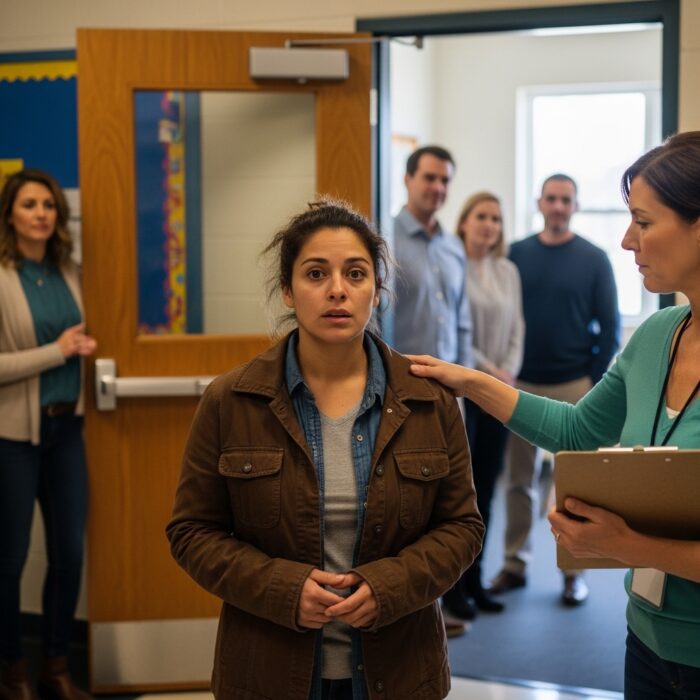
Maya Torres hadn’t expected applause. She hadn’t expected kindness, either. But she also hadn’t expected to be singled out, measured by her clothes, and dismissed with a polite smile that carried the weight of judgment. The parent-teacher meeting had barely begun when a woman with a clipboard leaned in and whispered that Maya should step outside—“This session is for certain parents.”
The words hung in the air, heavy and precise. Maya felt her pulse thud in her ears, her hands turn cold, and her face heat with confusion. She glanced around the room—rows of pressed blazers, wedding bands catching the fluorescent light, phones face-down like quiet shields. No one met her eyes.
She stood anyway. Not because she agreed—but because she had learned, over years of being misread, misplaced, and misunderstood, that resistance often came with a price she couldn’t afford.
As she walked toward the door, her daughter’s name—Elena—echoed in her mind like a promise she refused to break.
The hallway outside the conference room smelled faintly of lemon cleaner and old paper. Inside, the meeting continued, muffled voices drifting through the closed door as if Maya had never existed. She leaned against the wall, breathing shallow, counting tiles, steadying herself.
Back in the room, discomfort spread in quiet ways. A father shifted in his chair. A mother adjusted her scarf. Someone coughed—too loud, too deliberate. The principal, Mr. Harlan, cleared his throat and resumed the agenda with careful neutrality. Academic benchmarks. Fundraising goals. Volunteer rotations.
Yet eyes kept drifting to the door.
Maya’s absence was loud. It pressed against the room like a question no one wanted to ask. A teacher paused mid-sentence, then continued. A hand went up, then fell. Whispers fluttered, quick and sharp, like birds startled from a wire.
Outside, Maya checked her phone. A message from her supervisor blinked: Can you cover the late shift tonight? She typed back, Yes. She always said yes. Yes to overtime, yes to extra hours, yes to less sleep—because no one else would say yes for her.
She thought of Elena waiting in aftercare, backpack too big for her shoulders, braids slightly undone, smile brave but tired. Maya pictured her daughter’s report card folded neatly in her bag—all A’s, teacher comments glowing, a note about leadership. She wondered if any of that mattered now.
Inside, tension thickened. A parent finally spoke. “I thought this meeting was for all parents.”
The woman with the clipboard smiled—tight, professional, final. “This session is for families involved in the enrichment program.”
The word families landed hard.
Assumptions filled the gaps like water finds cracks.
Maya didn’t look like the others. Her coat was frayed at the cuffs. Her shoes were practical, scuffed. She wore no ring. Her posture—guarded, alert—read as defensive to those who had never needed armor.
Someone thought she was there by mistake. Someone else assumed she was seeking help, not partnership. Another believed—quietly, confidently—that she was out of place.
Mr. Harlan told himself it was about efficiency. The enrichment program required commitments—time, money, consistency. He told himself he was protecting standards, not judging a woman. He didn’t ask questions because questions took time, and time felt scarce.
A mother leaned toward her friend and whispered, “Single, I think.” The word single carried a shadow it didn’t deserve.
A teacher rationalized the decision as policy, procedure, protocol—three words that often hid fear of discomfort. No one noticed how quickly labels replaced curiosity, how convenience became cruelty.
Outside, Maya’s phone buzzed again. A voicemail—from the school nurse. Maya listened, heart tightening. Elena had complained of a headache earlier. The nurse said she was fine now. Maya exhaled, slow and deliberate.
She closed her eyes and counted to ten. She had learned how to swallow humiliation, fold it small, and keep going. But something about tonight pressed deeper. This wasn’t about her. It was about who got to be seen.
The door opened.
Not for Maya—but for Elena.
She stood small and steady in the doorway, backpack slipping off one shoulder, eyes searching. The nurse stood behind her, apologetic. “She insisted,” the nurse said. “Said she needed her mom.”
The room stilled.
Maya turned, startled. “Elena?”
Elena crossed the hallway and wrapped her arms around Maya’s waist, pressing her face into the familiar fabric. “They said you weren’t allowed in,” she whispered, confused, hurt, brave. “But you’re my parent.”
The words cut clean.
Mr. Harlan stood, color draining from his face. Teachers exchanged looks. The woman with the clipboard froze, pen hovering uselessly over paper.
Elena pulled back and looked at the room—rows of adults, eyes suddenly unsure. “She helps me with my homework,” Elena said, voice clear. “She reads with me every night. She comes to every meeting. She’s the reason I got into the enrichment program.”
A pause. Then another.
Maya felt the room tilt. Not in her favor—but toward the truth.
Mr. Harlan asked, quietly now, “Ms. Torres… would you come back inside?”
Maya hesitated. Pride warred with protection. Then Elena squeezed her hand.
They walked in together.
Maya didn’t raise her voice. She didn’t accuse. She spoke the way she always had—measured, honest, tired but steady.
She explained her schedule. Two jobs. Night shifts. Weekends. She explained why she missed bake sales but never missed conferences. She explained how Elena studied at the kitchen table while Maya graded papers for a community college she attended part-time—years ago, before money ran out, before life narrowed.
She didn’t mention the divorce papers signed in a hospital waiting room. She didn’t talk about the nights she slept in her car so Elena could keep her room. She didn’t say how often she chose gas over groceries, sleep over tears.
She didn’t need to.
The room listened now. Really listened. Not because of guilt—though there was plenty—but because something fragile had cracked open. The story they told themselves no longer fit the facts.
When Maya finished, she didn’t ask for an apology. She didn’t ask for inclusion. She asked one thing: “Will my daughter be treated the same tomorrow?”
Silence answered first. Then nods. Then a few quiet yeses.
After the meeting, people lingered. A mother approached, eyes downcast. “I’m sorry,” she said. Others followed. Some said nothing at all.
Maya gathered her things. Elena slipped her hand into her mother’s, warm and certain.
As they walked out, Maya wondered which version of her would be remembered—the one asked to leave, or the one who walked back in. She wondered how many others had been turned away quietly, without a daughter brave enough to speak.
Outside, the night air felt cool and unfinished.
And somewhere between the parking lot lights and Elena’s steady steps, a question lingered—not answered, not resolved, waiting: