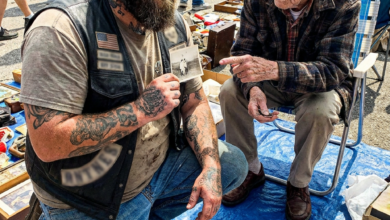
Part 2: The Photograph I Found Hidden In A $2,200 Used Saddlebag — And The Two Years It Took Me To Knock On The Right Door
I should tell you about my father before I tell you about somebody else’s.
My old man rode a 1978 Shovelhead until the week he died. He was a steel worker, an alcoholic, and the most stubborn human being I have ever met. He left me three things when he went: the Shovelhead, a leather cut he wore for thirty-one years, and a saying he used to mutter under his breath every time he kicked that bike to life — a man’s bike remembers him longer than his children will. I thought it was just something he said. I was twenty-two and I didn’t know yet how much a man can hide inside a motorcycle.
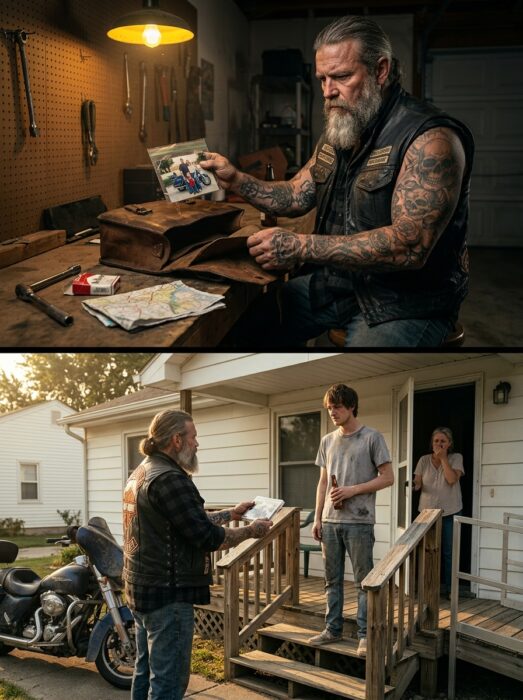
He died in 2008. Heart attack on a Tuesday morning. He was sixty-one. I rode his Shovelhead home from the hospital parking lot with my hands shaking so hard I couldn’t feel the grips. That bike still sits in my garage. I have never once cleaned out the saddlebags.
So when I found that photograph in October of 2022, stitched into somebody else’s leather with somebody else’s fishing line — Dad’s last ride. 2003. Don’t forget us. — something in my chest tightened that I had spent fourteen years not letting tighten.
I told the club about it the next Thursday night. We meet at a place called The Pony off the 287, a roadhouse with a gravel lot and a smoking porch and a bartender named Della who has been pouring our drinks since the Clinton administration. I laid the photograph on the bar under the yellow light and four of my brothers leaned in.
Big Tom — six foot six, retired roughneck, twenty-three years patched — picked it up by the corners the way you handle an old letter. He looked at it for a full minute without speaking. Then he said, quiet: “Wade. You gotta find them.”
Nobody disagreed.
We started with what we had. The bike was a 2003 Road King, factory blue, sold new with a chrome luggage rack visible in the photo. The driveway in the background had a specific concrete pattern — a poured slab with a hairline crack running diagonal across it — and a piece of white fencing in the right margin. The man in the photo looked maybe thirty-two. The woman maybe thirty. The boy maybe two. Which meant, if the photo was taken in 2003 and the boy was two, he’d be twenty-three or twenty-four by the time we started looking.
Ray, the swap meet guy, didn’t know anything except that the wrecked carcass had come out of a barn auction north of Casper in 2021. He gave me the auction company’s name. I called them on a Monday morning and got a woman named Trish who pulled the lot records and told me the barn had belonged to an estate sale out of a town called Riverton — and the deceased property owner had bought the wrecked Road King in 2003 at a salvage auction outside Cheyenne.
Which meant the bike had been wrecked the same year the photo was taken.
Which meant the man in the photograph had not just stopped riding that bike.
Which meant the words on the back of the picture — Dad’s last ride — were not figurative.
I want to be clear about something here. I am not a private investigator. I am a guy who installs HVAC systems in Laramie, Wyoming, and rides a Harley on the weekends. But I have a club, and a club is fifteen brothers in eleven states, and fifteen brothers in eleven states is a lot of people who know a lot of people.
We started making calls.
Big Tom’s old riding partner in Colorado knew a guy who knew the salvage auction records from 2003 in Cheyenne. A prospect named Diego in our charter spent six weekends running the VIN number through every database his cousin at the DMV could legally access. A retired sheriff’s deputy in Casper named Earl owed Big Tom a favor from 1997, and Earl pulled the original accident report from the Wyoming Highway Patrol archives.
It took fourteen months.
In December of 2023, I finally had a name.
His name was Daniel Hollis. He was thirty-three years old. He died on June 11th, 2003, on a stretch of Highway 26 outside Shoshoni, Wyoming, when a pickup truck pulling a horse trailer crossed the centerline at sixty miles an hour and hit him head-on. The accident report said Daniel was wearing a helmet. The accident report said the Road King was a total loss. The accident report said Daniel was pronounced at the scene at 3:47 in the afternoon.
The accident report said he was survived by his wife Karen, age thirty, and his son Cody, age twenty months.
I had a name. I had a town — they’d been living in Riverton at the time of the accident. I had everything I needed to drive eight hours east and knock on a door.
So I did.
I rode out of Laramie on a Saturday morning in January of 2024 with the photograph in a hard plastic case inside my breast pocket. It was nine degrees. The wind on the 287 was the kind of wind that gets inside your jacket no matter what you wear. I rode straight through. I got into Riverton at four in the afternoon.
The house on the records was a small ranch on the east side of town with a poured concrete driveway and a piece of white fencing along the side yard.
The hairline crack was still there. Diagonal. Right where it was in the photograph.
I stood in that driveway for ten minutes before I walked up to the door. I could hear my own breathing. I could feel the plastic case against my chest under three layers. I rang the bell.
A man in his fifties opened the door. He was not Daniel Hollis, obviously. He was wearing a Carhartt jacket and holding a cup of coffee and he looked at me — six foot one, two-forty, beard down to my chest, cut on my back — the way people who don’t ride look at people who do.
I asked if Karen Hollis lived there.
He said no. He said Karen had sold the house in 2008. He said he didn’t know where she’d moved. He said he was sorry, brother, and he closed the door.
I rode home through a snowstorm outside Rawlins with my hands so cold I had to stop three times to put them on the engine block to feel my fingers again. I got back to Laramie at one in the morning and I sat in my garage with the photograph on the workbench and I told my dead father, out loud, that I had failed.
I almost stopped looking.
I want you to understand that. I almost put the photograph in a drawer and let it stay there. Two years from now, ten years from now, it would have been one of those things I’d remember on a long ride and feel bad about for thirty seconds before I turned up the music.
But Big Tom came by the garage three nights later. He didn’t say anything for a long time. He just looked at the photograph on the bench. Then he said: “Brother. We don’t quit on this. That kid’s twenty-three years old. He’s been missing a piece of his old man for twenty years. We don’t quit.”
So we didn’t.
It took another eight months.
Karen Hollis had remarried in 2009 to a man named Frank Mercer, and they had moved twice — first to Lincoln, Nebraska, then in 2017 to a small town in southwest Missouri called Aurora. A brother of mine in the Lincoln charter, a guy named Hoss, tracked her through a VFW hall where Frank had been a member. Hoss called me on a Friday night in August of 2024.
He said: “Wade. I got her. I got an address.”
He also said something else.
He said: “Frank Mercer passed away in February. Karen’s a widow again. Her son Cody is living with her right now. He’s twenty-three. He’s not doing real good, brother. Word is he hasn’t been doing real good for a long time.”
I rode out the next Tuesday morning. Fourteen hundred miles from Laramie to Aurora, Missouri, on a Street Glide, in August, the kind of heat that makes the chrome too hot to touch at gas stations. I rode through Nebraska on the 80, cut down through Kansas on the 35, crossed into Missouri at Joplin on a Wednesday afternoon. I slept four hours at a motel outside Aurora. I shaved in the bathroom mirror. I put on a clean shirt under my cut.
The house was a small white ranch on a quiet street. There was a wheelchair ramp on the front porch — Frank’s, I figured later. There was a young man sitting on that porch in a folding chair with a beer in his hand and a face that had not been outside for a while.
He stood up when he saw me coming up the walk.
He was tall. Twenty-three. Brown hair that needed cutting. Eyes I recognized from a photograph I had been carrying in my chest pocket for almost two years.
I stopped at the bottom of the steps. I took off my sunglasses. I took the hard plastic case out of my pocket.
I said: “You Cody Hollis?”
He said yes.
I said: “My name’s Wade. I rode out from Wyoming. I have something that belongs to your dad.”
And then I handed him the photograph of a man he could not remember, standing in a driveway he had never seen, holding a little boy in red overalls who was looking up at him like he had hung the moon.
Cody Hollis sat down on the top step of his mother’s porch and he held that photograph in two hands for a long time without saying anything.
His mother came to the door. Karen. She was fifty-one now. Gray in her hair. She saw me first — and I watched her face do exactly what every woman’s face has ever done when an unannounced biker shows up on her property — and then she saw what her son was holding.
She put her hand on the door frame and she didn’t move.
The thing she said, when she finally said anything, was not what I expected.
She said: “I knew that picture existed. I never knew where it went.”
It was Daniel who’d taken it. Daniel and Karen had gotten the bike new in May of 2003. The blue Road King. Their first big purchase as a married couple. Daniel had set up a tripod in the driveway and put the camera on a ten-second timer and run back to stand with his wife and son. He’d printed two copies the next day at a one-hour photo. He’d kept one in his wallet.
The other one, the one I was holding, he had stitched into the lining of the left saddlebag on the morning of June 11th, 2003 — the day he died — with four loops of fishing line and a note on the back in his own handwriting. Karen knew about the note because Daniel had told her that morning, half-joking, that if anything ever happened to him on a ride he wanted his family to be the last thing the bike remembered.
He’d said it as a joke. He’d written the note as a joke. Five hours later he was dead on Highway 26.
The bike went to the impound. Karen, twenty-eight years old and a widow with a twenty-month-old, never had the strength to go retrieve it. The Road King got sold at salvage auction. The saddlebags went with it. The photograph went with the saddlebags.
For twenty years.
Cody didn’t say anything for a while. He kept looking at the photograph. He kept tracing his own face in the red overalls with his thumb. He had no memory of his father. None at all. He had three photographs that his mother had saved — two from their wedding and one from the hospital the day he was born. That was the entire visual record of Daniel Hollis that his son had ever known.
Until I handed him the fourth.
He looked up at me eventually. His eyes were wet but he was not letting them spill, and I understood that — that’s a thing some sons learn from fathers and some sons learn from the absence of them.
He said: “He wrote ‘don’t forget us.'”
I said: “I know, brother.”
He said: “I don’t remember him.”
I said: “He remembered you. Long enough to hide a picture in a place he hoped you’d find it.”
I rode home the long way.
I took Highway 26 on the way back through Wyoming. I’d never ridden that stretch before. I’d avoided it on purpose for two years. The accident happened at a mile marker between Shoshoni and Riverton — I’d written the coordinates on the back of a gas receipt the day I read the report.
I pulled over at that mile marker on a Thursday afternoon in late August. I shut the engine off. The only sound was wind in the sage and a meadowlark somewhere behind the fence line.
I stood next to the road for about ten minutes.
I didn’t say anything out loud. I’m not the kind of man who talks to strangers, dead or alive. But I stood there long enough that a passing trucker slowed down to make sure I wasn’t broken down, and I waved him on, and I got back on the bike, and I rode the last six hours into Laramie with the sun going down behind me in the rearview.
Every June 11th since, I ride out to that mile marker. Just for a minute. Just to stand next to the road.
Cody and I talk on the phone now. Once a month, give or take. He got a job last spring at a small engine shop in Aurora. He’s saving up to buy a used Sportster. He says when he gets it running, he’s going to ride it to Wyoming.
I told him I’d meet him at the state line.
My father used to say a man’s bike remembers him longer than his children will.
He was wrong about that. I know that now.
Some bikes hold on to a man until the right brother comes along. Some sons get their father back twenty years late, on a porch in Missouri, from a stranger with a beard.
The picture is in a frame on Cody’s wall now.
The fishing line is in my garage drawer.
I keep it there.
Follow the page for more stories about the bikers America thinks it knows — and the strangers they ride a thousand miles to find.