Part 2: A 55-Year-Old Biker Talked to a 10-Foot Cactus Named Stan Every Night for 30 Years — Until His New Neighbor Knocked and Told Him Her Plant Had a Name Too
PART 2 — STAN FROM 1995
Ray did not invite Avery in right away. He stood in the doorway with one hand on the frame, boots planted like he was guarding a bar door instead of a sunroom full of plants. He was used to people laughing before they understood him, and he had spent too many years learning that loneliness is safer when no one is close enough to make fun of it.
Avery did not push. She stood on his porch holding a small clay pot against her chest, wearing a faded green cardigan, jeans, and muddy sneakers. Inside the pot was a slightly crooked plant with glossy leaves and a wooden marker that read Lucy in careful handwriting. She noticed Ray looking at it and tilted the pot forward like she was introducing a shy friend.
“This is Lucy,” she said. “She’s dramatic, needy, and almost died in my apartment twice, but she listens better than most people.”
Ray blinked.
“You named your plant?”
Avery gave him a look.
“You named yours Stan.”
That was the first time Ray laughed in front of her. Not loud, not relaxed, but real enough that his shoulders dropped. He looked back into the house, where Stan stood in the sunroom, a tall desert-green shape against the amber light, its spines catching the last gold of evening like old armor.
“Stan’s different,” Ray said.
Avery waited.
Ray cleared his throat and stepped aside.
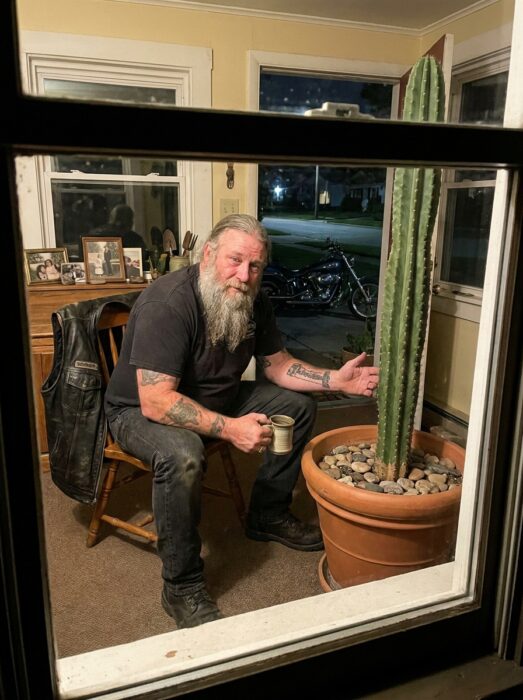
The sunroom smelled like dry soil, cedar, and old coffee. Stan stood in a massive terracotta pot near the window, almost ten feet tall, supported carefully by discreet wooden stakes Ray had stained dark so they would not look ugly. Around the base were smooth river stones, a tiny metal motorcycle charm, and a faded photo tucked into a frame: Ray at twenty-five, younger and black-haired, holding the same cactus when it was barely bigger than his hand.
Avery walked toward it slowly, as if approaching something sacred.
Ray scratched his beard.
“Bought him in 1995,” he said. “Bad year. Lost my dad, lost my apartment, lost a woman I thought I’d marry. Found him on clearance at a grocery store with a cracked pot and a tag that said ‘damaged.’ Felt familiar.”
Avery looked at him.
He shrugged like the words embarrassed him.
“Figured if he could survive being ignored on a shelf, maybe I could survive being ignored too.”
That was when Avery stopped smiling.
PART 3 — THE THINGS STAN HAD SEEN
Ray did not mean to tell Avery everything. He only meant to explain enough so she would stop thinking he was crazy, or perhaps so she would leave before the explanation became too honest. But once he started, the years came out in pieces, and Avery sat in the old wicker chair beside Stan as if she had nowhere better to be.
Stan had moved with Ray through four apartments, two rented trailers, one bad winter in a friend’s garage, and finally the yellow house on Maple Ridge Lane. Stan had watched Ray bury his mother, quit drinking for good, lose two club brothers, break his ankle, rebuild his Harley engine on the kitchen floor, and spend Christmas Eve eating canned soup because a snowstorm shut down every diner in town.
“I told him things I couldn’t tell people,” Ray said. “Sounds stupid when I say it out loud.”
“It doesn’t,” Avery answered.
Ray gave her a doubtful look.
She touched one leaf of Lucy’s plant gently.
“When my marriage ended, I talked to Lucy every night. I told her I was fine, then cried while repotting her because she was the only living thing in my apartment that didn’t ask me what went wrong.”
Ray stared at her.
Avery laughed once, softly.
“I know. It sounds ridiculous.”
“No,” he said. “It sounds familiar.”
Outside, a motorcycle passed somewhere far away. Inside, the room settled into a quiet that did not feel awkward. For the first time in years, Ray was sitting in his own house with another person and did not feel like he had to become smaller, tougher, or funnier to be tolerated.
He pointed at Stan.
“He’s seen everything in my life. I don’t have much family left. Stan’s family.”
Avery’s eyes filled before she could hide it.
“I think Lucy is too,” she said. “I just never said it to anyone because I thought people would think I was broken.”
Ray looked at the cactus, then the small plant in her arms.
“Maybe we’re all broken,” he said. “Some of us just grow spines.”
Avery cried then.
Ray panicked for half a second, because he was better with dead batteries and oil leaks than tears. But Avery waved him off, wiping her face with her sleeve.
“I’m okay,” she said. “That was just… too accurate.”
Ray nodded toward Stan.
“He does that.”
PART 4 — THE NEIGHBORS WHO STOPPED LAUGHING
After that night, Avery came over more often. Sometimes she brought Lucy and sat in the sunroom while Ray watered Stan with a measuring cup because he insisted the cactus hated “sloppy hydration.” Sometimes Ray helped Avery fix shelves, hang plant hooks, and carry bags of soil from her car. Sometimes they sat on the porch with coffee and said almost nothing, which both of them discovered could be more comforting than conversation.
The neighbors noticed.
Of course they did.
Mrs. Helen Brooks, a seventy-two-year-old Black American widow across the street, told her sister that the biker had “finally found someone who understood his cactus situation.” A teenage boy two houses down whispered that Ray had a plant girlfriend now. One of Ray’s club brothers, Mick “Hammer” Doyle, a sixty-year-old white American biker with a red beard and no talent for subtlety, saw Lucy sitting beside Stan one afternoon and said, “Well, I’ll be damned. Stan got himself a lady.”
Ray nearly threw a wrench at him.
Avery laughed so hard she had to sit down.
Instead of being cruel, the club began treating Stan and Lucy like part of Ray’s household. When the Iron Hollow Riders came by for weekend rides, they started greeting the plants first just to annoy him.
“Morning, Stan.”
“Looking sharp, Lucy.”
“Ray, your cactus is better company than you.”
Ray pretended to hate it, but Avery noticed he never told them to stop.
One Saturday, the club helped build a long planter bed in Ray’s front yard. Not because he asked, but because Avery had mentioned the soil near the porch got good afternoon sun. Twenty bikers showed up with shovels, gloves, mulch, and an argument about whether lavender was “too fancy” for a biker yard.
By evening, the front of Ray’s house was full of desert plants, herbs, flowers, and two old motorcycle tires repurposed as planters. Stan remained in the sunroom because he was too tall to move often, but Lucy began spending warm afternoons on the porch beside him.
The neighborhood changed its mind slowly.
At first, they had thought Ray was the lonely biker who talked to a cactus.
Then they saw Avery talking to Lucy.
Then they saw the plants multiply, the porch fill with color, and Ray smiling more than anyone remembered.
Strangeness, it turned out, looked different when it made someone less alone.
PART 5 — TWO YEARS LATER
Ray did not know when friendship became love. There was no thunderclap, no dramatic confession, no movie moment in the rain. It happened quietly, the way plants grow when no one is staring directly at them.
It happened when Avery learned Ray liked his coffee black but secretly enjoyed the cinnamon syrup she bought by accident. It happened when Ray noticed Avery forgot to eat dinner on hard workdays and started leaving soup containers on her porch. It happened when she called Stan “our old man” and Ray did not correct her. It happened when Lucy caught a fungus and Ray drove across town at nine at night for plant spray because Avery sounded scared on the phone.
Two years after she first knocked on his door, Avery came over on a warm June evening and found Ray standing in the sunroom in his motorcycle vest, holding a small black box.
Stan stood behind him like a witness.
Lucy sat beside Stan in a matching pot Avery had painted dark green with tiny gold stars.
Avery looked from the box to Ray.
“Oh.”
Ray’s face went red before he even spoke.
“I had a whole speech,” he said. “It was bad.”
Avery smiled.
“How bad?”
“Compared you to a cactus.”
“That could go either way.”
“I know. That’s why I’m skipping it.”
He opened the box. Inside was a simple ring with a tiny green stone set beside a small diamond. Not flashy. Not traditional. Perfect.
Ray took a breath.
“You made my house less quiet,” he said. “You made me feel like talking to Stan didn’t mean I was crazy. You brought Lucy over and somehow brought sunlight with her. I’m fifty-seven now, and I don’t want to act like I’ve got forever to ask the one person who understands my kind of lonely.”
Avery was crying before he finished.
Ray swallowed.
“So… marry me?”
Avery looked at Stan.
Then at Lucy.
Then at him.
“What do they think?”
Ray glanced over his shoulder.
“Stan says yes. Lucy seems cautiously optimistic.”
Avery laughed through tears and said yes.
PART 6 — THE RING BEARERS
The wedding was held in Ray’s front yard beneath string lights, between the porch and the new garden the bikers had helped build. It was small, but not quiet. Nothing involving the Iron Hollow Riders was ever fully quiet, even when they tried.
Ray wore a black suit jacket over a white shirt, though he kept his motorcycle boots because Avery said she wanted to marry the real man, not a rented one. Avery wore a simple cream dress with lace sleeves and tiny embroidered green leaves along the hem. Her auburn hair was pinned back with a cactus-shaped hair clip Ray had found online and nearly thrown away because he thought it was too silly. She wore it anyway.
Stan and Lucy were the ring bearers.
Technically, the rings were tied with soft ribbon to two small wooden picks placed carefully in their pots, because nobody wanted to injure a plant or create a wedding disaster involving cactus spines. Stan stood in his massive pot at the edge of the aisle like a silent grandfather. Lucy sat beside him on a wooden stand, leafy and proud.
Mick “Hammer” Doyle was supposed to carry the pots forward, but Stan was far too heavy, so the club built a little rolling platform decorated with flowers. Four bikers pushed it slowly down the aisle while everyone laughed and cried at the same time.
Ray looked mortified.
Avery looked radiant.
When the officiant asked for the rings, Hammer said, “Stan and Lucy, you’re up.”
No one teased after that.
Not really.
Because when Ray took Avery’s hands, every biker there saw something they had not seen in their brother for decades. They saw him happy without pretending not to be. They saw him loved without flinching. They saw the lonely man who talked to a cactus standing beside a woman who had understood that loneliness before anyone else did.
Ray’s vows were short.
“I thought family had to be people you were born with or people who stayed forever,” he said. “Then I spent thirty years with a cactus, met a woman with a plant named Lucy, and learned family is also whoever keeps growing beside you.”
Avery squeezed his hands.
The whole yard went silent.
Even Hammer.
PART 7 — WHAT STAN TAUGHT THEM
After the wedding, Stan and Lucy remained side by side on the front porch during warm months, earning the neighborhood nickname the grandparents. Children waved at them. Mrs. Brooks claimed Stan looked “protective.” Hammer insisted Lucy had softened him. Ray told everyone to stop assigning emotional arcs to houseplants, but he watered them both with the care of a man tending history.
Ray and Avery built a life that looked small from the outside and enormous from within. Coffee on the porch. Rides on Sunday afternoons. Plant sales on Saturdays. Club cookouts in the yard. Quiet winter nights in the sunroom with Stan looming by the window and Lucy thriving beside him.
Sometimes people still laughed when they heard the story.
Ray did not mind anymore.
He had spent too many years afraid that tenderness would make him look foolish. Now he understood that tenderness had saved him long before he knew it had a name.
Stan had not loved him back in the way a person loves. A cactus does not answer the phone, hold your hand, or tell you when you are being stubborn. But Stan had given Ray somewhere to place the words that would have rotted inside him if he had never spoken them. Stan had stood there through grief, silence, anger, recovery, bad holidays, and the kind of loneliness that can make a man disappear while still paying his bills.
Lucy had done the same for Avery.
That was why they understood each other.
Not because plants replaced people.
Because sometimes a living thing in the corner keeps you alive long enough to meet the person who finally understands why you needed it.
At the reception, Hammer lifted a plastic cup and gave the shortest speech of the night.
“I ain’t saying a cactus made our brother fall in love,” he said. “But I am saying none of us are ever making fun of Stan again.”
Everyone laughed.
Then he looked at Ray, and his voice softened.
“A cactus helped him keep talking until someone answered.”
Ray looked down.
Avery reached for his hand.
Thirty years earlier, he had bought a damaged cactus because he recognized himself in it. He did not know that tiny three-dollar plant would one day stand at his wedding like an old witness to survival. He did not know the neighbors’ jokes would become garden parties, or that a woman next door would knock on his door and say, “I thought I was the only one.”
He only knew, back then, that he did not want to come home to a silent room.
So he talked to Stan.
And one evening, because the window was open and the right person was listening, loneliness finally answered back.
Follow the page for more unforgettable biker stories about quiet loneliness, strange little miracles, and the rough-looking hearts that find love in the most unexpected places.