The Grandmother Tore Her Granddaughter’s Wedding Portrait in Front of Everyone—Then a Face in the Background Silenced Both Families
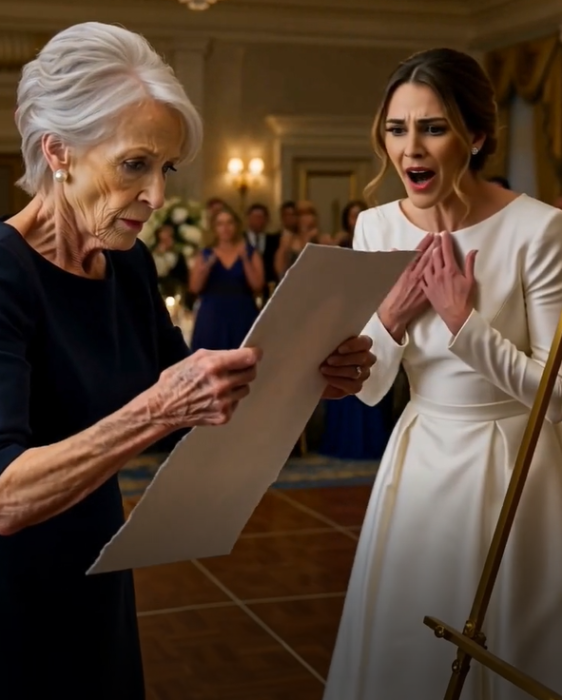
Margaret Hale destroyed her granddaughter’s first wedding portrait at 7:43 on a Saturday evening, just as the band prepared to announce the newlyweds’ first dance. Nearly two hundred guests watched the seventy-four-year-old woman pull the photograph from its white wooden easel, study one corner with widening eyes, and tear the glossy paper straight through the smiling faces of the bride and groom.
The sound was not loud. It was only the crisp surrender of heavy photographic paper. Yet it cut through the ballroom more effectively than a shattered glass.
Emily Carter stood beneath an arch of white roses in an ivory satin gown, one hand still resting in that of her new husband, Noah Whitmore. Her smile disappeared as two halves of the portrait curled in Margaret’s hands.
“Grandma?”
Margaret did not answer. She tore the left half again.
A collective gasp moved between the tables. One fragment fluttered downward and landed beside Emily’s shoes, covering them with half of Noah’s smiling face. Another slid beneath the cake table.
Noah stepped in front of his bride. He was thirty, tall and fair-skinned, with dark blond hair and the patient expression that had first made Emily trust him. That patience now strained beneath confusion.
“Mrs. Hale, please give me the picture.”
Margaret clutched the remaining fragment to her navy dress. Her fingers trembled, but her eyes were painfully clear.
“Who hired the woman serving the head table?”
Noah looked toward the servers. “The hotel did.”
“The woman with the silver brooch.”
Several guests turned. Black-uniformed catering employees moved among the tables, but no one wore visible jewelry.
Emily’s father, Richard Carter, approached with an apologetic smile intended for the Whitmore family. He was fifty-seven, broad-shouldered, and usually able to calm a room with a lowered voice. That evening, the voice emerged too quickly.
“Mom, let’s go somewhere quiet.”
Margaret moved away from his hand.
“I asked who hired her.”
Richard’s expression tightened. “You’ve had a long day.”
“I know exactly what kind of day I’ve had.”
Guests exchanged uncomfortable glances. A cousin lifted a phone. An aunt whispered that Margaret had never recovered from losing her daughter. Someone near the bar said the wedding excitement might have confused her.
Emily heard every word.
Her wedding had been planned around Margaret’s comfort. She had selected the hotel because it had elevators, quiet rooms, and a garden where her grandmother could rest. She had placed Margaret beside the aisle because Margaret had been the person who raised her after her mother’s death.
Now that same woman had destroyed the first formal portrait of Emily’s marriage.
“Grandma, look at me,” Emily said.
Margaret did, and the pain in her expression frightened Emily more than anger would have.
“I am looking at you, sweetheart. That is why I tore it.”
Before Emily could respond, Daniel Whitmore stepped forward. Noah’s father was fifty-nine, silver-haired, careful in speech, and so reserved that Emily had initially mistaken his distance for disapproval. He stared at the photograph in Margaret’s hand.
For less than a second, his face changed.
Margaret saw it.
“You recognize her.”
Daniel recovered quickly. “I don’t know what you mean.”
Margaret lifted the torn photograph toward the chandelier. The picture had been taken twenty minutes earlier beside the floral arch. Emily and Noah filled the foreground. Their parents stood behind them, with Margaret slightly to Emily’s right. Waiters, musicians, and early arrivals appeared as blurred shapes in the background.
One woman stood near the ballroom doors.
Only part of her face was visible. She appeared to be in her early fifties, with auburn-brown hair tucked beneath a service cap. Her left cheek showed the pale curve of an old scar. A silver bird-shaped brooch was fastened above her heart.
Margaret touched that tiny image.
“I bought this brooch in Santa Fe in 1997,” she said. “It was the last birthday present I gave my daughter.”
The room fell quieter.
Emily stared at the photograph. Her mother, Laura Hale Carter, had died when Emily was two. The family rarely discussed the details because Laura’s rental car had burned after leaving a mountain road during heavy rain. Authorities had identified her through personal belongings and dental records supplied by the family. Richard had been widowed at thirty-one. Margaret had buried an empty closed casket because officials said there was too little to view.
Emily possessed only scattered memories: lavender soap, a song without words, and a woman hiding her left hand inside the sleeve of a blue cardigan.
“No,” Richard said. “It’s someone wearing similar jewelry.”
Margaret’s gaze remained fixed on Daniel. “Then why did his face change?”
Daniel gave a controlled exhale. “Because you tore my son’s wedding portrait and accused a stranger of being a dead woman.”
“You reached for the photograph before I said Laura’s name.”
Noah looked at his father. “Dad?”
Daniel did not answer immediately.
That pause changed the room. It was small, but two families felt it.
Margaret turned the fragment over. Four words had been written across the white back in blue ink:
Please let Emily dance.
Her knees weakened.
The hotel photographer, twenty-six-year-old Maya Ortiz, pushed carefully through the gathering guests. She had printed the photograph at a small station near the ballroom entrance and insisted the back had been blank when she placed it on the easel.
“Who touched it afterward?” Margaret asked.
Maya looked toward the service corridor. “One of the catering women moved the easel because a spotlight was reflecting off the glass. I thought she worked here.”
“What did she look like?”
Maya studied the image. “Like her.”
Emily took the photograph from Margaret before anyone could stop her. She stared at the woman in the background until the ballroom disappeared around her.
The brooch was shaped like a bird in flight, one wing slightly higher than the other. Emily had seen it before, not in a family album but inside Margaret’s cedar box. There, beneath old letters and a lock of Laura’s hair, was an empty velvet indentation shaped exactly like that bird.
“Dad,” Emily whispered, “was Mom’s brooch recovered from the accident?”
Richard’s mouth opened, but no answer came.
Margaret already knew the truth. She had asked him the same question after the funeral. Richard had said the brooch was lost in the fire.
At the edge of the ballroom, a service door swung softly shut.
Emily lifted her skirt and ran toward it.
Noah followed, calling her name. Margaret moved after them, slower but determined. Behind her came Richard, Daniel, Maya, and several guests who had abandoned restraint for curiosity.
The corridor beyond the door was empty except for a wheeled cart, a linen bag, and a half-full glass of water. A black service jacket lay folded over a chair.
Pinned to its collar was the silver bird.
Emily reached for it, but Margaret caught her wrist.
“Wait.”
A small strip of medical tape had been wrapped around the pin. Written on it in the same blue ink were the initials L.H.
Emily looked toward the exit at the far end of the corridor.
“Mom?”
No one answered.
Daniel bent to pick up the service jacket. A keycard slipped from its pocket. He moved faster than a man seeing an unfamiliar object should have moved, covering the card with his shoe.
Margaret noticed.
So did Noah.
“Move your foot, Dad.”
Daniel remained still.
Noah’s voice hardened. “Move.”
When Daniel finally stepped back, Emily picked up the card. It was not a hotel employee pass. It belonged to a room registered on the sixth floor under the name Helen Lawson.
Richard went pale.
Margaret looked from Richard to Daniel, understanding that each man recognized the name.
“You both knew she was alive.”
Richard shook his head. “Not alive. Not until today.”
Daniel said nothing.
From the ballroom came the uncertain beginning of music. The band had apparently been instructed to continue. A romantic melody drifted through the corridor, absurdly gentle beneath the silence.
Emily held the keycard so tightly its edge marked her palm.
“I’m going upstairs.”
Richard blocked her path. “Not in your wedding dress. Not like this.”
“She may be my mother.”
“You don’t know who she is.”
Margaret stepped between them. “That is exactly what we are going to find out.”
Richard looked at her with a fear she had not seen since the night police reported Laura’s accident.
“Margaret, if that woman is who you think she is, finding her will not return the daughter you remember.”
Margaret’s voice remained quiet.
“No. But it may tell us who took her away.”
The elevator arrived with a soft chime. Its doors opened on an empty car lined with mirrors. Emily entered first, still holding the torn wedding photograph. Margaret followed. Noah joined her, although his gaze remained on his father.
Daniel stayed in the corridor.
Then Emily turned the picture toward him and pointed to the blurred woman in the background.
“If you know why my dead mother came to my wedding, you have until we reach the sixth floor to tell me.”
Daniel looked toward Richard. The two men shared another glance, one burdened by a history neither bride nor groom understood.
Finally, Daniel entered the elevator.
As the doors closed, he said, “Laura did not disappear because she wanted to leave you.”
Emily’s eyes filled.
Daniel looked at the silver bird in her hand.
“She disappeared because one of us asked her to.”
Room 614 appeared untouched when hotel security opened it. The bedspread remained smooth, the bathroom towels were folded, and no suitcase waited in the closet. Yet the room was not truly empty.
A pair of inexpensive reading glasses rested beside the lamp. A cup of tea had gone cold on the desk. In the trash lay the paper wrapper from a pharmacy bottle. The label had been peeled away carefully.
Emily entered with Margaret, Noah, Richard, Daniel, and a hotel security manager named Patrice Coleman. Everyone else had been instructed to remain downstairs.
Maya had surrendered her camera long enough to send the original photograph to Emily. The image on Emily’s phone was sharper than the print. When enlarged, the woman’s face showed details no one could dismiss: the faint scar beneath her left eye, the narrow Hale nose, and one eyebrow rising higher than the other.
Emily shared all three features.
Margaret sat on the edge of the bed because her legs would no longer support her. “It’s Laura.”
Richard stood beside the window. “It looks like her.”
“You knew the name Helen Lawson.”
Richard rubbed his wedding band, a habit he had maintained despite Laura’s supposed death. “Helen was a name Laura once used.”
“When?”
He looked at Daniel, but Daniel offered no rescue.
“Before Emily was born.”
Emily lowered her phone. “Why would Mom need another name?”
Richard’s answer came slowly. “Because she was frightened.”
The first part of the truth emerged through fragments. Laura had met Richard while working at a nonprofit legal clinic in Albuquerque. She was twenty-three, idealistic, and known for helping women prepare emergency documents before leaving controlling partners. Helen Lawson was an alias the clinic used when volunteers transported clients to safe housing.
Margaret had never known. Laura told her that she worked in ordinary office administration because she feared Margaret would worry.
Daniel knew the name because his younger sister, Rebecca, had been one of Laura’s clients.
Noah looked at his father. “Aunt Rebecca?”
Daniel nodded.
Noah had grown up believing Rebecca died from an accidental overdose at twenty-six. The Whitmore family rarely spoke about the man she had married.
Rebecca’s husband, Carl Mercer, was charming in public and controlling at home. Laura helped Rebecca leave him. Daniel provided money and transportation. Richard allowed both women to stay briefly in a vacant property managed by his construction company.
Carl found them.
Rebecca returned to him after he threatened Daniel’s family. Six months later, she died. Police accepted the overdose explanation despite bruises noted by the funeral director. Daniel blamed himself for failing to push for an investigation.
Laura continued gathering records against Carl. She used the name Helen Lawson whenever she met witnesses.
“What does that have to do with her accident?” Emily asked.
Daniel looked at Richard. “Tell her.”
Richard turned from the window. His face had aged in the hour since the portrait was torn.
“Two days before Laura disappeared, she told me Carl had begun following her. She wanted to take you to a safe location. I told her she was overreacting.”
Margaret rose from the bed. “You let her drive into the mountains while someone was following her?”
“I didn’t know she was leaving that night.”
“You told us she went to meet a client.”
“That was what police told me.”
Daniel interrupted. “The police told you what you asked them to say.”
Noah stared at his father. “What does that mean?”
Daniel crossed to the desk and opened a drawer. Inside lay a white envelope addressed to Emily in handwriting Margaret recognized instantly.
Emily reached for it, but the envelope was empty.
“She was here,” Margaret whispered.
Patrice checked the electronic lock record. The room had been opened at 8:11 that morning, again at 4:22 that afternoon, and a final time seven minutes before the wedding portrait was taken. No one had entered afterward.
A soft knock came from the adjoining-room door.
Patrice positioned herself between the family and the door before opening it.
The next room was also empty. On its bed lay a garment bag containing an ordinary green dress, a pair of low heels, and a small wrapped wedding present. The gift label read For Emily and Noah, from someone who never stopped counting your birthdays.
Emily sat down before opening it.
Inside was a wooden music box. When she lifted the lid, a familiar wordless melody began to play—the tune from her earliest memory.
Margaret covered her mouth.
Laura had sung that melody while rocking Emily to sleep.
Beneath the music box was a stack of twenty-six birthday cards, one for each year Laura had missed. None had stamps. None had been mailed.
Emily opened the card marked for her fifth birthday.
You lost your first tooth today, although I only know because your father mentioned it in the newspaper column about the school carnival. I hope the tooth fairy understood that you prefer quarters to bills.
The detail was accurate. Emily had insisted coins felt more magical.
The card for her thirteenth birthday mentioned a blue dress visible in a school website photograph. The card for her college graduation described the yellow ribbon Margaret wore in the audience.
Laura had watched from a distance.
Emily closed the box sharply. “She followed my life but never spoke to me?”
Richard sat beside her. “If Carl believed she was dead, you were safe.”
“Carl died eleven years ago.”
Richard said nothing.
The room chilled despite its controlled temperature.
Emily turned toward him. “Why didn’t she come back after that?”
“She couldn’t.”
“Couldn’t—or you told her not to?”
Margaret saw the answer before Richard gave it. Her son-in-law had not merely kept an old secret. He had maintained it.
Daniel removed his jacket and placed it over a chair. “Carl was not the only danger.”
After the mountain crash, Laura entered a federal witness-protection arrangement connected to financial crimes Carl committed with several business partners. The accident was staged using an abandoned vehicle and personal effects. A body recovered from another incident was incorrectly linked to Laura through dental records provided by a corrupt official.
Laura was expected to testify.
She never appeared in court.
The case collapsed, and Laura vanished beyond the protection program itself.
Daniel had received one message from her seventeen years earlier. It contained only three words:
Richard knows why.
Emily stared at her father.
Richard’s composure finally broke. “Your mother was ill.”
“What kind of illness requires pretending to be dead?”
“She had periods when she became terrified and confused. She believed strangers were watching. She stopped trusting the agents assigned to protect her.”
Daniel shook his head. “You told me she had died overseas.”
“I believed she had.”
“You received her cards,” Emily said.
Richard looked toward the stack.
That was another silence that answered too much.
He admitted that the birthday cards had arrived in batches through anonymous post office boxes. He kept them from Emily because each envelope violated the safety arrangement Laura had once demanded.
“You could have told me she loved me.”
“And then you would have searched for her.”
“Yes.”
“That is what she feared.”
Margaret’s grief sharpened into anger. “No, Richard. That is what you feared.”
A folded paper protruded from the garment bag pocket. Emily opened it and found a schedule of the wedding day. Several moments had been circled: Margaret’s arrival, the ceremony, the family portrait, and the first dance.
Beside the last circle, Laura had written:
Leave before Emily sees me. She deserves joy without my history entering the room.
The handwriting weakened near the bottom.
A final line had been added:
If Margaret recognizes me, tell her the photograph was never the real secret.
Noah read over Emily’s shoulder. “What secret?”
From the hallway came the sound of an elevator bell. Patrice checked the corridor, but whoever had arrived had already entered the stairwell.
Margaret looked down and noticed a corner of paper beneath the adjoining door. Someone had slid it into the room while they were talking.
It was an old hospital identification bracelet.
The printed surname was Hale.
The mother’s first name was Laura.
The infant’s name was not Emily.
It was Noah.
No one spoke for several seconds.
Noah took the bracelet from Margaret and read it twice. His wedding ring clicked softly against the plastic.
“That isn’t possible.”
Emily stepped away from him instinctively, then hated herself for doing it. “What does it mean?”
Daniel’s face had become colorless. Richard looked equally stunned, but Margaret noticed a difference between their reactions. Daniel appeared afraid of what the bracelet suggested. Richard appeared afraid of what it might expose.
The hospital bracelet was dated thirty years earlier, two years before Emily’s birth. Laura Hale’s name appeared beneath the word Mother. Noah’s full name was printed in the infant field.
Emily removed her wedding ring, not because she had decided anything, but because her finger suddenly felt trapped.
“No,” Margaret said firmly. “A bracelet is not proof of parentage.”
Noah looked at her. “It says my name.”
“It says a name. We find out why before we destroy two lives with assumptions.”
Her words carried bitter irony while pieces of the torn portrait remained downstairs.
Daniel sat near the desk. “Noah was born at St. Catherine’s Hospital in Santa Fe. My wife, Susan, had an emergency delivery. She was unconscious for almost a day.”
“Was Laura there?” Emily asked.
Daniel looked toward Richard. “Apparently.”
Richard admitted that Laura volunteered at St. Catherine’s through the legal clinic. On the night Noah was born, she had been helping Rebecca document injuries after another assault. Rebecca went into premature labor at the clinic and was taken to the same hospital.
Noah stared at Daniel. “Aunt Rebecca was pregnant?”
Daniel nodded.
The Whitmore family had hidden that pregnancy because Rebecca remained legally married to Carl. The infant, a boy, was born severely underweight. Hospital records later indicated that he died before dawn.
On the same night, Susan Whitmore gave birth to Noah.
Laura had been present in the maternity unit.
The bracelet did not prove Laura was Noah’s biological mother. It suggested something had happened during a night when two baby boys were born into the same extended family.
Margaret examined the plastic carefully. The clasp had been cut and resealed with clear adhesive. Someone had altered or reused it.
“Laura wants us to ask questions,” she said. “Not accept the first answer.”
Patrice contacted hotel management and discreetly placed security staff at the exits. Emily refused to call the police until they understood whether Laura was hiding from danger or from them.
Maya brought her laptop upstairs and searched every photograph taken since the ceremony. Laura appeared in seven images.
In the first, she stood near the service entrance watching Margaret arrive.
In the second, she looked toward Richard with unmistakable fear.
In the third, taken during the vows, her hand covered her mouth.
In the fourth, Daniel appeared in the background turning toward her.
In the fifth, Laura watched Noah sign the marriage license.
The sixth captured her speaking to a white-haired hotel guest nobody recognized.
The seventh was the torn portrait.
Maya enlarged the sixth image. The white-haired man wore a tan suit and leaned on a cane. A dark red birthmark spread across the back of his right hand.
Daniel whispered, “Dr. Warren.”
Samuel Warren had supervised St. Catherine’s maternity ward thirty years earlier. He had also signed Rebecca’s infant death certificate.
Daniel had believed him dead.
Patrice searched the event list and found no Samuel Warren among the guests. Hotel cameras showed the man arriving through a side entrance with a catering delivery. Laura met him in the lobby. They argued quietly before entering separate elevators.
“He came because of her,” Noah said.
Margaret returned to the stack of birthday cards. The card for Noah and Emily’s engagement had no greeting inside. It contained only a newspaper clipping announcing their planned wedding and a sentence written repeatedly across the page:
Before they marry, tell them about St. Catherine’s.
Richard claimed he had never seen that card.
Laura had sent all the others to his private mailbox. This one was addressed to Daniel.
Daniel removed his wallet. Behind an old family photograph was a folded clipping identical to the one in the card.
“You received it,” Noah said.
“Six months ago.”
“And said nothing?”
“I hired someone to investigate.”
“Did you tell Mom?”
Daniel shook his head.
Susan Whitmore had died four years earlier after a long illness. Noah could no longer ask the woman who raised him what she remembered about his birth.
The investigator found that St. Catherine’s destroyed many records after a basement flood. Two surviving nurses recalled confusion during a power failure on the maternity floor. Identification bracelets were rewritten by hand because printers stopped working. Dr. Warren later amended several files.
Daniel had been waiting for DNA results from preserved family belongings. The laboratory reported insufficient samples.
“So you let us marry while wondering whether Noah was Laura’s son?” Emily asked.
Daniel stood. “There was no evidence you were related.”
“You had the bracelet.”
“I received a photograph of a bracelet. Not the original.”
Margaret noticed a tiny bloodstain inside the plastic band. Modern testing might produce an answer.
Noah stepped toward his father. “You could have told us.”
“I watched you both. I saw how happy you were. I told myself Laura was trying to punish our family because we failed Rebecca.”
Margaret’s voice turned cold. “You decided silence was kinder because truth might cost you something.”
Daniel lowered his eyes.
Richard moved toward Emily. “You cannot stay married until this is resolved.”
She recoiled. “You don’t get to decide that.”
“I am trying to protect you.”
“You have used that sentence for twenty-six years.”
Noah stood beside her without touching her. Both had removed their rings. Their marriage was less than three hours old, yet every memory leading toward it had become evidence in someone else’s buried history.
A knock came from the corridor.
Patrice opened the door to find the wedding planner holding a cream envelope. A catering employee had asked her to deliver it to Margaret.
Inside was a small brass key and an address on the west side of Denver.
Margaret recognized the location. It had once belonged to a women’s shelter Laura helped establish before her disappearance.
Beneath the address, Laura had written:
The bracelet was created to hide a child, but not the child you think. Come without Richard.
Richard read over Margaret’s shoulder.
For the first time that evening, he looked not merely frightened but defeated.
“She knows,” he whispered.
Margaret folded the message. “What does she know?”
Richard sat on the edge of the bed and covered his face.
“The baby who died at St. Catherine’s was not Rebecca’s son.”
Richard’s confession began with a truth Laura had discovered too late.
Rebecca’s premature baby survived.
Dr. Warren falsified the death record because Carl Mercer had threatened to take the infant and force Rebecca to return. Laura, Rebecca, Daniel, and Warren constructed a temporary plan: the baby would be listed under Laura’s name and moved to a protected foster placement until Rebecca reached safety.
The bracelet bearing Laura’s name and Noah’s name belonged to that arrangement. The infant’s temporary hospital identity had been Noah Hale.
He was not Noah Whitmore.
The shared first name was not coincidence. Rebecca had whispered “Noah” after delivery, and Susan Whitmore later chose the same name when she heard it. For one night, two babies in the maternity unit carried versions of that name.
The bracelet had been intended to confuse anyone searching hospital records.
“What happened to Rebecca’s baby?” Noah asked.
Richard looked at Margaret. “Laura brought him to us.”
Margaret’s hand tightened around the bedpost.
At the time, Richard and Laura had been married less than a year. They kept the infant for nine days in a small apartment owned by Richard’s company. Laura fed him, photographed him, and searched for a secure placement. Richard did not tell Margaret because Carl watched relatives and friends.
Then Rebecca returned to Carl.
The baby could not safely return to her.
Dr. Warren arranged a private adoption under sealed records. Laura objected because Rebecca had not legally surrendered parental rights. Richard argued that an adoption was the only way to keep the infant alive.
The baby went to another family.
“Who?” Daniel demanded.
“I never knew their names.”
“Laura knew,” Margaret said.
Richard nodded. “She kept a copy of the placement file.”
Years later, when Laura built a case against Carl, she planned to reveal the falsified records. She believed Rebecca’s son deserved his true identity. Richard feared the disclosure would expose Dr. Warren, destroy the adoptive family, and lead Carl directly to the boy.
Their marriage fractured over that argument.
The supposed mountain accident occurred six months later.
Margaret listened without interruption. When Richard finished, she asked the question he had avoided.
“Did you ask Laura to disappear?”
Richard’s eyes filled. “I asked her to delay her testimony.”
“That is not what Daniel said downstairs.”
Daniel faced him. “You told me she entered protection because Carl threatened Emily.”
“He did.”
“But Laura’s message said one of us asked her to leave.”
Richard’s shoulders collapsed. “I drove her to the safe house.”
Emily stepped backward.
Richard explained that Laura had been exhausted, frightened, and increasingly convinced that people inside the protection system were leaking information. Someone entered their home while Emily slept and placed Rebecca’s hospital photograph beside her crib.
Laura believed Carl would harm Emily unless she vanished completely.
The initial separation was supposed to last six months.
Then Carl produced evidence suggesting Richard had participated in the illegal adoption. He threatened to send Richard to prison and expose Laura’s location unless Richard kept her away from Emily and surrendered the placement file.
Richard gave him a copy. Laura discovered the betrayal and disappeared from everyone, including the agents assigned to protect her.
“She thought I chose myself over her,” Richard said.
“Did you?” Emily asked.
He looked at his daughter. “For one terrible hour, yes.”
That hour became twenty-six years.
Margaret felt grief rearranging itself inside her. Richard had not murdered Laura or forced her into hiding alone. He had made a frightened, selfish decision, then allowed silence to harden around it. He raised Emily with devotion, never remarried, attended every school event, and sat beside her through childhood fevers. Those acts were real.
So was his betrayal.
The brass key opened the former shelter shortly before midnight. Margaret went with Emily, Noah, Daniel, and Patrice. Richard remained at the hotel after Laura’s message specifically excluded him.
The building now served as a community legal center. Its director guided them to a basement records room where Laura waited beside a green metal cabinet.
She was fifty-two.
Her auburn hair had faded, and the scar beneath her eye appeared deeper than it did in the photograph. She wore the green dress from the hotel room. Her left hand remained curled against her body, two fingers stiff from an old injury.
Margaret stopped on the final stair.
For twenty-six years, she had imagined what she would say if death returned her daughter. None of those imagined words survived the sight of Laura’s face.
Laura whispered, “Mom.”
Margaret crossed the room and struck her once across the cheek.
The sound shocked everyone.
Then Margaret pulled her daughter into her arms.
“You let me bury you.”
Laura clung to her. “I’m sorry.”
“You let your child grow up without you.”
“I know.”
“You were at her graduation.”
“Yes.”
“At the hospital when she had surgery?”
“In the parking lot.”
“At my house last Christmas?”
“Across the street.”
Margaret pushed her away. “Do not tell me that as if watching was the same as staying.”
Laura accepted the words without defense.
Emily remained near the stairs. She looked at her mother with a child’s longing trapped inside an adult woman’s judgment.
“You wrote birthday cards.”
“I did.”
“You never sent them.”
“I was afraid.”
“Of Carl? He has been dead eleven years.”
“Of what came after Carl. Of what I had become. Of what you would ask.”
Emily’s voice broke. “I would have asked why you did not love me enough to come home.”
Laura began crying. “And I had no answer that would not sound like cowardice.”
That admission moved Emily more than any excuse could have. She did not embrace Laura, but she stepped closer.
Noah placed the hospital bracelet on the table.
“Why bring this to our wedding?”
Laura opened the green cabinet. Inside were sealed adoption files, photographs, letters from Rebecca, and a recording Dr. Warren made before his death had been falsely reported years earlier.
“He is still alive,” Laura said. “He came tonight because he wants the file destroyed.”
“Why?” Daniel asked.
“Because Rebecca’s son was never adopted by strangers.”
Laura removed a photograph of the infant being carried through a hospital corridor. Beside the nurse walked a young couple.
Margaret recognized the woman first.
It was Susan Whitmore.
Daniel stared at the photograph. “Susan took Rebecca’s baby?”
Laura shook her head.
“Susan helped move him.”
She placed a second photograph beside the first. It showed Richard holding the same infant nine days later.
The child had been hidden under a false adoption, but he had never left the Carter family’s reach.
Laura turned toward Emily.
“Rebecca’s son grew up believing Richard was his biological father.”
Emily understood before anyone said the name.
Her older brother, Michael Carter, had died in a boating accident at nineteen.
The child hidden at St. Catherine’s had been Michael.
Michael had been three years older than Emily. He taught her to ride a bicycle, terrified her with ghost stories, and once sold his baseball cards to replace a violin she accidentally broke at school. Emily remembered him as protective, impatient, and incapable of passing a stray dog without stopping.
Richard told everyone Michael was his son from a brief relationship before he met Laura. No mother appeared in family photographs. When Emily asked questions, Richard said the woman chose not to participate.
Margaret had accepted that explanation because Michael resembled Richard: brown hair, broad shoulders, and the same uneven smile. Now she understood that resemblance had been interpreted through repetition rather than blood.
Michael had been Rebecca’s child.
That meant Michael and Noah were first cousins, not brothers. Emily and Noah shared no biological parent. Their marriage had never placed them inside the relationship everyone feared.
Yet relief did not enter the basement cleanly. It arrived beside another loss.
Daniel sat heavily in a folding chair. “Rebecca had a son, and nobody told me.”
Laura faced him. “She asked me not to tell you until she was safe.”
“She died believing her baby was gone.”
“No. She saw Michael twice.”
Laura produced two letters written in Rebecca’s hand. In the first, Rebecca thanked Laura and Richard for keeping her son beyond Carl’s reach. In the second, written six weeks before her death, she asked them to raise Michael without the Mercer name.
Rebecca had not been deceived about her child. She had surrendered the right to be publicly known as his mother so he could survive.
Daniel pressed the letter to his mouth.
For years, he believed he had failed to save his sister entirely. Now he learned that she had left behind a son who lived nineteen years, played baseball, complained about broccoli, and once stood beside Daniel at a Whitmore family picnic without either knowing their connection.
Emily remembered that picnic. Michael and Daniel spent an hour repairing a broken boat motor together.
“They liked each other,” she whispered.
Daniel wept without trying to hide it.
The second major truth did not excuse the adults who maintained the secret after Carl’s death. Laura admitted she could have returned. Richard admitted he could have exposed the false records. Dr. Warren could have petitioned a court to unseal the adoption. Daniel could have told Noah about the threatening card before the wedding.
Each person had called silence protection because the word made fear sound noble.
Laura revealed why she finally appeared.
Dr. Warren had contacted her after seeing Emily’s engagement announcement. At ninety-one, ill and increasingly frightened of legal consequences, he demanded the St. Catherine’s records be destroyed. He warned that if the files surfaced, Richard might face prosecution for falsifying Michael’s parentage.
Laura initially agreed to meet him at the wedding hotel. She planned to take the files, disappear again, and allow Emily to marry without disruption.
Then she saw Margaret in the ballroom.
She had not expected her mother to recognize her after so many years. The catering uniform, cap, and service entrance were meant to make her invisible. She stayed only because she wanted to see Emily walk down the aisle.
The photographer’s flash captured her.
After Margaret tore the portrait, Laura considered leaving permanently. Instead, she wrote on its back and placed clues in the hotel rooms.
“You could have walked toward me,” Emily said. “You created a mystery because you still wanted someone else to make the first move.”
Laura lowered her eyes. “Yes.”
It was her greatest flaw. She had risked herself for frightened women, challenged dangerous men, and preserved records others wanted erased. Yet with her own daughter, she remained unable to cross a ballroom.
Emily did not forgive her that night.
She did ask her to return to the hotel.
The two families gathered after midnight in a smaller dining room away from the ballroom. Most guests had gone home. White roses drooped around half-cleared tables. The cake remained untouched except for one missing corner cut for the kitchen staff.
Richard stood when Laura entered.
He did not approach her.
“I thought you were dead twice,” he said.
Laura set Michael’s file on the table. “You told our daughter I was dead every day.”
“I believed I was keeping her safe.”
“And I let you because it kept me from facing her.”
Their reunion contained no embrace. Too much history stood between them. They acknowledged that neither had carried the entire blame and neither could place it wholly on the other.
Margaret brought the torn wedding photograph from upstairs. One rip divided Emily and Noah. Another passed through Laura’s blurred image.
“I destroyed this because I thought the picture contained the danger,” she said. “The danger was what all of you kept outside it.”
Noah found clear tape in the front-desk office. He and Emily placed the photograph face down and joined the largest sections. The missing strip through Noah’s shoulder could not be recovered. Margaret had torn it too finely.
They did not pretend the portrait looked new.
Emily returned her wedding ring to her finger. Noah followed. Their marriage remained valid, but the relief on both families’ faces made Emily angry.
“You’re relieved we are not related,” she said. “I am relieved too. But that cannot become the ending. My brother lived and died without knowing who his mother was.”
Daniel looked toward Michael’s file. “We need to tell the truth about him.”
Laura hesitated. Rebecca’s letters contained painful details that belonged to her, not to the public. Michael’s memory also belonged to the young man he had been, not merely the secret surrounding his birth.
They agreed to tell close relatives first. Any public correction would include only what was necessary to restore Michael’s identity. Rebecca’s private descriptions of abuse would remain sealed unless Daniel, as her closest surviving sibling, believed disclosure served a legal purpose.
Dr. Warren arrived at the hotel at 1:36 in the morning.
Patrice escorted him into the dining room. He leaned heavily on a cane, the red birthmark visible on his hand.
“You do not understand what those records will do,” he said.
Margaret studied the old physician. “They will tell the truth.”
“They will destroy reputations.”
“Whose?”
“Mine. Richard’s. The hospital’s.”
Emily answered him. “You listed a living baby as dead.”
“I kept him from a violent father.”
“And then you let the lie outlive the danger.”
Warren insisted that difficult choices had been made under pressure. Laura agreed. Then she placed a digital recorder on the table and asked him to explain every choice in his own words.
He refused.
Daniel produced Rebecca’s letter. “My sister thanked you for helping her child. I can honor that. But she never asked you to erase him forever.”
Warren looked at the assembled family and realized nobody intended to burn the files.
He left without another threat.
At two in the morning, Emily and Noah finally danced.
Only their parents, Margaret, Laura, Maya, Patrice, and a handful of close relatives remained. The band had gone, so Maya played the planned song from her phone. Emily danced in stockinged feet because her shoes hurt. Noah’s tie hung loose.
Laura watched from the doorway.
Emily saw her and stopped.
Everyone expected her to invite Laura closer.
Instead, Emily walked to the door and said, “If you want to be in my life, you cannot keep standing at the edge of rooms.”
Laura swallowed. “May I come in?”
“You may start.”
It was not forgiveness, but it was a door left open.
The morning after the wedding, images of Margaret tearing the portrait appeared online. Several guests had recorded only the most dramatic seconds. Captions described a jealous grandmother, a family feud, and an elderly woman objecting to her granddaughter’s marriage.
Maya asked whether the family wanted her to issue a statement.
Emily declined.
She did not want Laura’s history converted into public entertainment. She also refused Richard’s suggestion that they release enough information to restore Margaret’s reputation.
“Grandma does not need strangers to declare her innocent,” Emily said. “She needs us to stop lying.”
Margaret agreed, although watching herself portrayed as cruel still hurt. The video showed her tearing a treasured photograph but not the face that caused her to do it. It showed Emily’s shock but not the bracelet, the records, or Rebecca’s letters.
It resembled the family’s history: a visible action separated from its hidden cause.
Jordan Bell, one of Noah’s cousins, admitted posting the first clip. He apologized and removed it, but copies remained. Margaret did not demand punishment. She asked him to attend the family meeting where Michael’s identity would be explained.
“You recorded before you understood,” she told him. “Now sit still long enough to understand.”
The meeting took place one week later in Margaret’s living room. Richard described Michael’s birth without protecting himself. Daniel read part of Rebecca’s letter. Laura answered questions until her voice became hoarse.
Some relatives were compassionate. Others were furious. One uncle accused Laura of abandoning Emily. A Whitmore aunt blamed Richard for stealing Rebecca’s child. Neither accusation was entirely false, but neither held the whole story.
Margaret stopped the discussion when people began turning Michael into evidence against one another.
“He was not a secret wearing a boy’s face,” she said. “He was my grandson. Speak about him as someone who lived.”
They remembered Michael instead.
They recalled his terrible singing, the scar on his chin, the summer he painted Margaret’s fence the wrong shade of green, and the night he drove three hours to help Noah after a college car breakdown.
Noah stared at Daniel. “Michael helped me?”
Daniel nodded. Noah had been seventeen. Daniel was out of state and called Richard for assistance. Michael drove through heavy rain, repaired the loose battery cable, and refused gas money.
Neither young man knew they were cousins.
Their connection had existed without the truth, but the truth gave it a different tenderness.
Richard petitioned the court to amend Michael’s sealed records. The process took months. Because Michael was deceased and Rebecca had also died, officials questioned what practical purpose the correction served.
Emily answered in a written statement: A person’s identity does not become unimportant because he can no longer ask for it himself.
Daniel added Rebecca’s letters. Laura surrendered the original hospital file. Dr. Warren eventually provided a sworn account through his attorney.
The corrected birth record listed Rebecca Whitmore as Michael’s biological mother. Richard remained recognized as the father who raised him.
No one was prosecuted. Too much time had passed, several statutes had expired, and authorities acknowledged that the original falsification occurred amid a credible threat. The legal result did not declare the choices right. It merely recognized that punishment decades later would not repair the family.
The hospital established a review process for identity records affected by domestic-violence protection cases. The legal center created secure methods for preserving a child’s history without exposing protected locations. Survivors could decide when and how sealed family information would reach their children.
The change extended beyond one family, fulfilling the promise Laura had once tried to keep alone.
Laura began counseling. She moved into a small apartment fifteen minutes from Margaret, not Emily. She understood that proximity to her mother was not automatic access to her daughter.
She and Emily met every Thursday at a quiet diner. Their first conversations stayed on safe subjects: work, recipes, neighborhood changes. Later came harder questions.
“Did you hold me the night before you left?” Emily asked.
“Yes.”
“Did I cry when you put me down?”
“Yes.”
“Did you hear me ask for you after that?”
Richard had sent Laura one recording during the first year of separation. In it, three-year-old Emily asked when Mommy would return.
Laura answered honestly. “Yes.”
“Why didn’t that bring you home?”
“Because by then I believed returning would place you in danger. Later, when the danger passed, shame kept doing the work fear had started.”
Emily wrote the sentence in a notebook. She needed to see it outside her mother’s voice.
Noah attended some meetings and skipped others. The story belonged to him through Michael and Rebecca, but he refused to make Emily’s reunion about his need for answers.
Richard accepted responsibility differently. He provided documents, answered questions, and stopped saying that everything had been done for Emily. Some decisions had protected her. Others had protected him.
Margaret remained angriest with Laura because love made the anger precise.
“You were brave for strangers,” she said during one argument. “Why were we the people you could abandon?”
Laura replied, “Because strangers did not know enough to break my heart.”
“That is an explanation. It is not an excuse.”
“I know.”
Their repair happened through ordinary tasks rather than declarations. Laura drove Margaret to medical appointments. Margaret taught Laura the correct way to make the cinnamon cake Emily loved. Sometimes they argued. Sometimes Laura left early. She always returned the next day instead of disappearing.
Six months after the wedding, Maya offered to recreate the destroyed portrait free of charge. Everyone could dress formally and stand beneath a similar floral arch.
Emily refused.
She framed the repaired photograph instead.
The tape on its back had yellowed slightly. A gap remained through Noah’s shoulder, and one corner never lay flat. Laura appeared in the background, half hidden near the doors.
Emily placed it in her hallway beside a childhood photograph of herself and Michael.
When visitors asked why the wedding picture was torn, she answered, “Because that was the moment our family stopped protecting itself with silence.”
She never gave further details unless the story belonged to the person asking.
Five years later, Margaret celebrated her eightieth birthday in the same hotel ballroom.
The family chose the venue deliberately. The roses were gone, the carpet had been replaced, and a different company managed the catering service. Yet Margaret recognized the service corridor immediately.
Laura arrived through the main entrance.
She wore a blue dress and the silver bird brooch. She no longer hid her left hand. The injured fingers remained stiff, but she allowed them to rest naturally against her side.
Emily met her near the doors with a six-month-old daughter named Rebecca Margaret Whitmore. The name had been discussed carefully. It honored two women without pretending their histories were simple.
Laura held the baby only after asking.
Noah stood beside them, older around the eyes and gentler in his silences. He and Emily had endured a difficult first year of marriage. Secrets uncovered at a wedding did not vanish when the music resumed. They attended counseling, argued about trust, and learned not to confuse withholding with protection.
Richard attended the birthday alone. He and Laura had not reunited romantically. Too much had changed, and affection could not restore the people they had been. They did, however, share meals with Emily’s family and visit Michael’s grave together each year.
Daniel brought a box containing Michael’s corrected birth certificate, Rebecca’s preserved letters, and photographs gathered from both families. He had spent years assembling a record of the nephew he unknowingly knew.
The collection did not focus solely on hidden parentage. It included school reports, baseball pictures, drawings, and the receipt from the battery cable Michael purchased for Noah’s stranded car.
Michael’s history had become larger than the secret.
Dr. Warren died two years after the wedding. Before his death, he funded a confidential records program at the legal center. Laura accepted the contribution only after ensuring his name would not dominate the project.
Margaret called it an imperfect act from an imperfect man. She had learned to distrust endings in which one donation erased decades of harm.
The program helped dozens of families preserve truthful records while escaping dangerous situations. Children received age-appropriate letters explaining their histories when it became safe. Parents could not use protection orders as excuses to erase identities permanently.
Laura volunteered there three days each week. She never presented herself as a hero. She told new staff that courage in a crisis did not guarantee courage afterward.
At Margaret’s birthday, Maya returned with her camera. Before taking the family portrait, she asked where everyone wanted to stand.
Margaret sat in the center. Emily and Noah stood behind her with the baby. Laura stood beside Emily. Richard took the other side. Daniel remained close to Noah.
No one was pushed into symbolic reconciliation. They simply occupied the same frame.
Maya counted down.
Just before the shutter clicked, baby Rebecca grabbed Margaret’s pearl necklace. Everyone reacted at once. Margaret laughed, Emily tried to rescue the strand, Noah reached for the baby, and Laura instinctively placed a hand beneath Margaret’s elbow.
The photograph captured no perfect poses.
It showed movement, concern, and faces turned toward one another.
Maya printed a copy during dessert. She carried it to Margaret with a nervous smile, remembering what happened to the previous wedding portrait.
“Would you like to inspect the background first?”
Margaret put on her glasses.
Near the ballroom doors stood a teenage catering employee holding a tray. A few relatives appeared between tables. Nothing waited in the shadows.
Margaret turned the print over. The back was blank.
She handed it to Emily.
“You should keep this one.”
Emily studied the image, then glanced toward the framed torn portrait displayed on a memory table beside photographs of Michael and Rebecca.
“I’ll keep both.”
Margaret nodded.
That evening, after most guests left, Laura helped gather gifts. She found Margaret alone near the dance floor, looking toward the service door where she had vanished five years earlier.
“I almost left through there again,” Laura said.
“I know.”
“How?”
“You had the same look you wore as a child whenever you broke something and hoped distance would repair it.”
Laura smiled sadly. “Distance never repaired much.”
“No. It only kept the pieces from meeting.”
Laura offered her arm. Margaret accepted it, and they crossed the ballroom slowly.
At the memory table, Emily had placed the new portrait beside the old one. The first showed a family smiling before it knew the truth. The second showed a family no longer able to pretend it had never been broken.
Neither photograph told the entire story.
But together, they no longer lied.
Before leaving, Margaret noticed one loose strip of tape on the back of the wedding portrait. Age had weakened the adhesive. She pressed it down with her thumb, but it lifted again.
Laura found a roll of archival tape in Maya’s equipment case. Emily held the photograph steady while Margaret and Laura repaired the seam together. Their hands overlapped briefly across the tear that divided the bride from the groom.
Baby Rebecca slept nearby. Noah stacked chairs with Daniel. Richard stood before Michael’s photograph, tracing the edge of its frame.
No crowd watched. No phones rose. Nobody announced forgiveness.
When the final strip held, Margaret turned the portrait upright. The missing section remained missing, Laura still stood blurred in the background, and the damage could never be mistaken for part of the original design.
Emily placed it back on the table.
This time, her grandmother did not tear it.
She only straightened the frame and left the scar where everyone could see it.
Follow this page for more heartfelt stories about family secrets, misunderstood choices, quiet courage, and the imperfect ways people find their way back to one another.