Part 2: The Garbage Collector Dad His Daughter Called a Failure — Until Career Day Changed Everything
Madison had not always been ashamed of her father.
When she was little, she used to run to the window every Tuesday morning and wave at the green sanitation truck. Frank would honk twice, never too loud, just enough to make her jump and laugh in her pajamas.
He called her “Maddie-girl” back then.
She called him “Captain Clean.”
Then middle school happened.
Middle school had a way of turning love into something children hide for survival.
By eighth grade, Madison knew which shoes were expensive, which houses had pools, and which parents spoke at school events with smooth confidence. Her best friend’s mother was a dermatologist. Another girl’s father worked in commercial real estate and drove a silver SUV that smelled like leather.
Frank came home smelling like diesel, rain, and other people’s garbage.
He never complained about it.
That somehow made Madison angrier.
When he washed his hands at the kitchen sink, scrubbing black lines from under his nails, she saw only what the world might mock. She did not see the heating bill paid on time, the lunch money in her account, or the secondhand winter coat he made sure looked new before she wore it.
So when Career Day forms came home, she hid his.
Frank found it in the recycling bin.
That was the first small wound.
He taped the wrinkled paper flat and signed his name.
Madison refused to speak to him the rest of the night.
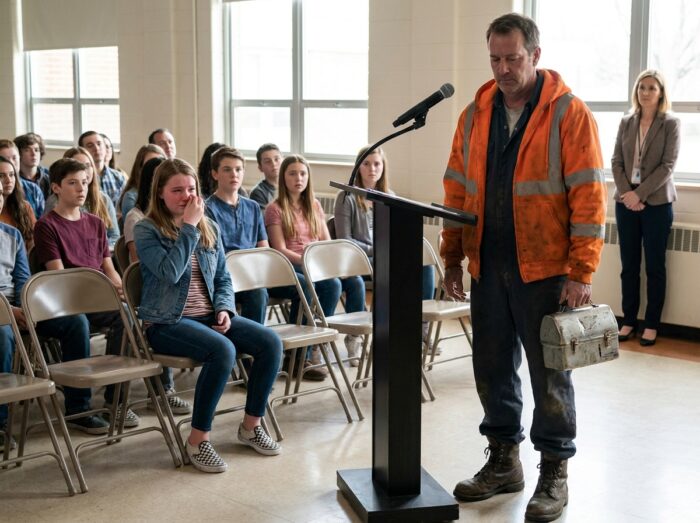
Now, in the auditorium, Frank placed his lunchbox on the podium. It made a small metallic sound that seemed louder than it should have.
He did not open with a joke.
“I know what some of you think when you see this jacket,” he said.
A few students shifted in their seats.
“You think dirty. You think low pay. You think someone does this because nothing better worked out.”
Madison’s cheeks burned.
Frank did not look at her.
“That’s fair,” he continued. “I used to think that too.”
That was the first crack.
He reached into his jacket pocket and pulled out a folded photograph.
The guidance counselor glanced at it but said nothing.
“This was me at nineteen,” Frank said.
He held it up.
The picture showed a young man in a baseball uniform, one arm around a laughing young woman. He looked nothing like the tired father onstage.
“I had a scholarship offer to play at a state college,” he said. “Small one, but real.”
Madison sat up slightly.
She had never heard that.
Frank looked at the photo for a moment longer.
“Then my father got sick.”
The room quieted.
“He had been a sanitation worker for twenty-eight years. When he couldn’t lift anymore, the city gave me a temporary route while I figured things out.”
A boy in the front row frowned.
“So you just stayed?” he asked.
Frank nodded.
“I stayed.”
There was no bitterness in his voice.
That made it harder to dismiss.
“I stayed because medicine costs money. Because my mother cried when bills came. Because my little sister still needed braces and prom shoes and someone to pretend everything was normal.”
Madison looked down at her hands.
The second crack came when Frank opened the dented lunchbox.
Inside was not food.
Inside were objects wrapped in napkins.
A child’s purple glove.
A small silver bracelet.
A folded photograph.
A house key on a red string.
“These are things people almost lost,” he said.
The students leaned forward.
“I keep them until I can return them.”
The laughter was gone now.
Frank picked up the bracelet.
“This belonged to Mrs. Patel on Grove Street. Her husband gave it to her before he passed. It fell into a bag of wrapping paper after Christmas.”
He set it down gently.
“Trash teaches you something strange,” he said. “People throw away things they meant to keep.”
Frank Dawson’s route started every morning at 4:40.
Before Madison’s alarm rang, before school buses moved, before coffee shops opened, he was already lifting what the town no longer wanted.
He knew which houses had new babies because diaper boxes appeared by the curb. He knew when someone was grieving because flowers dried in trash cans a week after funerals. He knew who lived alone and who was too proud to ask for help.
He knew more about the town than anyone realized.
Not because he looked through people’s lives.
Because people left pieces of themselves at the curb.
Frank reached into the lunchbox again and pulled out a faded blue envelope.
“This one,” he said, “I almost didn’t save.”
Madison’s eyes narrowed.
The envelope looked familiar.
Frank’s thumb moved over the corner.
“It was in our own trash.”
Madison went cold.
“This was Madison’s science camp application,” he said.
A soft murmur moved through the room.
Madison wanted to disappear.
Frank looked at her then.
Not angrily.
Sadly.
“She threw it away last year because it cost four hundred dollars, and she didn’t want to ask.”
Madison’s eyes filled before she could stop them.
“I saw it at the bottom of the kitchen bag,” Frank said. “Covered in coffee grounds. I dried it on the dashboard of my truck.”
A few students looked at Madison differently.
“I signed her up anyway.”
Madison whispered, “How?”
Frank smiled a little.
“I took weekend shifts.”
That was the second twist.
Madison thought the camp scholarship came from school.
It had come from Saturday routes, sore shoulders, and a father pretending not to know she had stopped herself from wanting something.
Frank continued.
“That camp is where she built a water filter out of charcoal and sand. She came home talking so fast I thought she might float away.”
Some students laughed softly.
Madison wiped her face with her sleeve.
Frank picked up the child’s purple glove.
“On my route, there’s a little girl named Sophie. She waits every Thursday in a wheelchair by her porch because she likes the truck.”
The auditorium softened.
“She lost this glove in February. Her mother had searched everywhere. I found it stuck to a frozen bag behind the bin.”
He paused.
“It was twenty degrees, and that little girl clapped like I had brought her the moon.”
The guidance counselor looked down, blinking hard.
Then Frank lifted the house key.
“Mr. Alvarez on Pine Street has early dementia. He threw this away by accident with his mail. If I hadn’t noticed, he would’ve been locked outside in the rain.”
The students were silent now.
Madison glanced toward the row where her friends sat.
No one was laughing.
Frank placed the key back inside the lunchbox.
“I don’t save the world,” he said. “I pick up what people leave behind. Sometimes that’s garbage. Sometimes it’s a wedding ring. Sometimes it’s a person’s dignity.”
The main twist came when the side doors opened.
An older Black American woman in a cardigan walked in with the principal. Beside her was a Latino American man in his seventies holding a cane. A little white American girl in a wheelchair rolled in next, pushed by her mother.
Madison stared.
Frank looked surprised.
The principal stepped to the microphone.
“Mr. Dawson doesn’t know we invited a few people from his route.”
Frank blinked.
The little girl waved.
“Hi, Mr. Frank.”
His face changed.
The room changed with it.
Mrs. Patel, the woman whose bracelet he had saved, walked to the stage.
“This man returned the last gift my husband ever gave me,” she said. “He would not accept money. He said, ‘Just wear it somewhere nice.’”
Mr. Alvarez lifted the red key.
“He checks my porch when I forget the bins,” he said. “Sometimes he brings them back up because I cannot.”
Sophie’s mother touched her daughter’s shoulder.
“When our ramp broke,” she said, “Frank and two other sanitation workers fixed it after their shift. He told us not to tell anyone.”
Madison turned toward her father.
He looked embarrassed.
Truly embarrassed.
Not proud. Not hungry for applause.
He looked like someone whose private kindness had been dragged into the light before he was ready.
That was the third twist.
The man she had called a failure had been showing up for people all over town while she was busy being ashamed of his uniform.
Frank leaned toward the microphone.
“I didn’t do those things for a speech.”
Principal Harris nodded.
“We know.”
Then Madison stood.
Everyone turned.
Her heart beat so hard she could hear it in her ears.
She walked down the aisle slowly, past her friends, past the parents, toward the stage where her father stood in his stained orange jacket.
Frank stepped away from the podium.
“Maddie,” he said softly.
She could barely speak.
“I’m sorry,” she whispered.
He shook his head.
But she did not let him rescue her from the words.
“No,” she said, louder this time. “I called you a failure because I was scared people would laugh at me.”
The auditorium was silent.
“And they did,” she said. “But I was the one who should’ve known better.”
Frank’s eyes filled.
Madison reached for his rough hand.
It smelled faintly of soap and metal.
“I didn’t know you saved my application.”
He gave a small shrug.
“You would’ve done the work if I got you through the door.”
She cried then.
Not pretty crying.
Fourteen-year-old crying, the kind that has nowhere to hide.
Then someone began clapping.
It was Sophie.
Her small hands clapped slowly from the wheelchair.
Mrs. Patel joined.
Then the class.
Then the parents.
Within seconds, the whole auditorium was standing.
Frank did not lift his chin like a man being honored.
He only put one arm around his daughter and held her while she finally stopped caring who was watching.
After Career Day, Madison did not become a different person overnight.
She still cared what people thought. She still checked mirrors too much. She still hated the smell of diesel when it clung to the laundry room after her father washed his work clothes.
But something had shifted.
A week later, she woke early on a Thursday.
The kitchen was dim. Frank stood by the counter, pouring coffee into a dented thermos. His orange jacket hung over the chair, patched at one sleeve.
Madison walked in wearing jeans, sneakers, and her old hoodie.
Frank looked up.
“You’re awake early.”
“I know.”
“You sick?”
“No.”
He waited.
She nodded toward the door.
“Can I ride with you?”
Frank stared at her.
“You want to ride on the route?”
“Only before school. Just a little.”
He looked down at his thermos, then back at her.
“It smells bad.”
“I know.”
“It’s cold.”
“I know.”
He tried not to smile.
“You’ll have to wear gloves.”
She held up a pair.
For two hours, Madison sat in the passenger seat of the sanitation truck while the town slowly woke.
She watched her father wave to Mrs. Patel. She watched him carry Mr. Alvarez’s bin back up the driveway. She watched Sophie clap from her porch when the truck stopped in front of her house.
At one corner, Frank pulled over and picked up a picture frame leaning against a trash can.
The glass was cracked, but the photograph inside showed a young couple holding a newborn baby.
“Someone meant to keep that,” he said.
Madison looked at him.
“How do you know?”
Frank shrugged.
“You learn.”
He placed the frame carefully behind the seat.
Later, when he dropped her at school, some students saw the truck.
Madison felt the old fear rise.
Then she saw Sophie’s purple glove clipped to the dashboard, the red key on the hook, and her own science camp photo tucked above the visor.
Her father had made a museum out of things people almost lost.
She opened the door.
Before stepping down, she turned back.
“Bye, Dad.”
He smiled.
“Bye, Maddie-girl.”
She did not correct him.
She did not look around first.
She simply closed the truck door and walked toward school while the green sanitation truck rumbled away behind her, louder than any car in the lot and somehow no longer embarrassing.
Follow the page for more heartfelt stories that stay with you long after the final line.