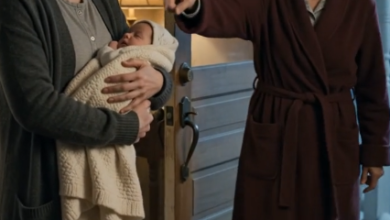
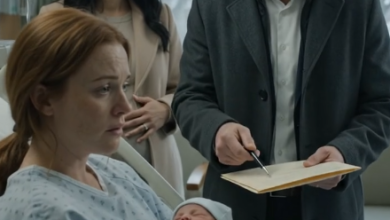
The Father Who Left After a Prenatal Diagnosis Returned Ten Years Later Demanding to Be Called Dad—Then His Son Unveiled an Invention Built from the Machine He Had Thrown Away
Ten-year-old Theo Ortiz was halfway through explaining why ordinary emergency alarms failed ordinary people when the man who had abandoned him walked into the gymnasium and demanded to be called his father.
The regional science competition occupied two basketball courts at Franklin Middle School outside Nashville. Folding tables stood in straight rows beneath championship banners, crowded with homemade water filters, solar ovens, robotic arms, plant-growth experiments, and poster boards whose glitter continued migrating onto everyone’s clothes.
Theo’s booth was number forty-seven.
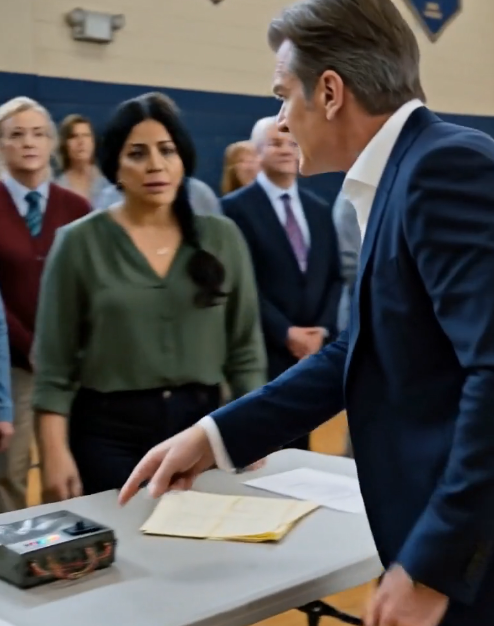
His project looked less polished than most. At its center sat a dented gray receiver nearly twice his age, its metal casing scratched and one corner repaired with a strip of red electrical tape. Copper wires ran toward three colored lights, a vibration motor, a palm-sized speaker, and a large switch Theo could press comfortably with his shortened left arm.
Theo had been born with a congenital limb difference. His left forearm ended several inches below the elbow, and his hand had three small fingers with limited grip. He also had moderate bilateral hearing loss that fluctuated when he was sick or tired.
Neither fact prevented him from arguing about bedtime, forgetting his library books, or secretly eating the marshmallows from breakfast cereal.
His mother, Lena Ortiz, stood six feet away pretending not to rearrange the display for the ninth time. At thirty-eight, Lena had medium-brown skin, dark eyes, and black hair tied in a loose braid. She worked as an equipment technician at St. Catherine’s Hospital, cleaning, testing, and repairing infusion pumps, monitors, and transport devices before they returned to patient floors.
A small burn mark near her right thumb came from the first soldering iron she bought after Theo was born.
His science teacher, Dr. Simone Carter, stood beside the judges. Simone was forty-seven, Black, short natural curls above rectangular glasses, and wore a rust-colored blazer over a T-shirt printed with a diagram of the solar system.
“Theo,” one judge asked, “what problem are you trying to solve?”
Theo touched the hearing aid behind his right ear.
“Most alarms ask everyone to hear the same way.”
He activated a recorded door knock. The receiver captured the sound and estimated its direction. A blue light illuminated on the left side of the display, and Theo’s red wristband pulsed twice.
“If somebody takes out their hearing aids to sleep, or a machine stops working, they might miss the knock,” he said. “My device changes sound into light and vibration. It doesn’t decide people are broken. It changes the message.”
Lena lowered her eyes.
That sentence had taken Theo three weeks to write. He originally called his project “The Better Ear.” Then a student in his class asked why an ear needed to be better.
Theo went home irritated and returned the following morning with a new name.
Signal Bridge.
He had painted the words by hand on his presentation board, the letters leaning slightly uphill.
The gym doors opened during his second demonstration.
A tall man entered wearing a tailored navy jacket over an open-collar white shirt. His brown hair had turned gray at the temples, but Lena recognized his walk before she saw his face. Nolan Pierce still moved as though every room contained a person he needed to impress and a door he might need to use quickly.
For one suspended second, Lena heard nothing inside the crowded gym.
Not the students.
Not the basketball bouncing in the adjoining court.
Not the rising feedback from Theo’s speaker.
Nolan was forty-two now. Ten years earlier, he had been a talented product designer with pale blue eyes, restless hands, and a workshop filled with unfinished devices. He could make Lena laugh while standing in a grocery-store line and make her feel alone while sitting beside her at dinner.
The last time she saw him, she was twenty-eight weeks pregnant.
A maternal-fetal specialist had explained that their unborn son appeared to have a shortened left forearm. Additional imaging suggested possible hearing loss and a heart condition, though the doctors could not predict the degree of impairment before birth.
Nolan sat silently during the appointment.
That evening, he dismantled half his workshop.
He threw the gray receiver into the apartment dumpster, packed two suitcases, and told Lena he was not “built for a life organized around hospitals.”
By morning, he was gone.
Now he crossed the gym directly toward Theo’s table.
Lena stepped in front of him.
“No.”
Nolan stopped. His attention moved past her to the old receiver.
“You kept it.”
“That is what you came to say?”
A local education reporter noticed the tension and raised her camera. Parents began turning. Dr. Carter moved closer to Theo.
Nolan placed a large white envelope on the display table.
“I contacted the competition director this morning,” he said. “That receiver contains circuitry from a prototype I designed. The project cannot be judged or published until ownership is clarified.”
Theo looked at Lena.
“Mom?”
“It’s okay,” she said, though nothing in her body believed it.
Nolan finally looked at the boy.
His gaze paused at the shortened arm, then moved to Theo’s hearing aids. Shame passed across his face, followed quickly by something harder.
“You must be Theo.”
Theo did not answer.
“I’m Nolan Pierce.”
“I know.”
The man seemed surprised. “You know who I am?”
“Mom kept one picture.”
Lena had chosen a photograph taken before the prenatal appointment. Nolan stood on a riverbank holding a small radio antenna while Lena laughed behind him. She kept it in an envelope with Theo’s birth certificate, not on a wall.
When Theo asked at eight, she told him the truth in plain language.
His biological father had become frightened and left.
She did not say Nolan was dead, traveling, confused, or waiting for the correct time. Children built hope from any material adults gave them, and Lena refused to give false hope a foundation.
Nolan faced the judges.
“I am Theo’s father. I am also the original designer of the core technology in this machine. Before anyone interviews him or discusses licensing, my involvement needs to be recognized.”
The reporter asked whether he and Theo had worked together.
“No,” Lena said.
Nolan answered at the same moment.
“Not yet.”
Theo watched him.
Then Nolan turned back to the boy and lowered his voice, though the microphone on the table remained active.
“Whatever your mother told you, you got this ability from somewhere.”
Theo’s three fingers curled against the large switch.
“You want me to call you Dad?”
Nolan hesitated. “I am your father.”
“That wasn’t my question.”
Several adults looked away.
Lena wanted to end the demonstration and take Theo home. She had spent ten years preparing for medical appointments, school meetings, insurance denials, broken hearing aids, inaccessible classroom tools, and strangers who addressed questions to her when Theo was standing beside them.
She had not prepared for Nolan to appear beneath fluorescent gym lights and turn biology into a public claim.
Dr. Carter asked Theo whether he wanted to stop.
“No,” he said. “The judges haven’t seen the alarm test.”
He removed his right hearing aid and placed it inside its case. Then he activated a simulated smoke alarm at a safe volume. The device translated the tone into rapid red flashes and a repeating vibration in the wristband.
Theo felt it immediately.
One judge leaned closer to inspect the receiver. She was Dr. Helen Park, an Asian American electrical-engineering professor with cropped gray hair and a habit of holding her glasses by one arm when thinking.
“Did you design the signal-processing board?” she asked.
“I changed an old one,” Theo said. “Grandpa helped me figure out which pieces were dead.”
Nolan stepped forward. “The original board is mine.”
Helen turned the receiver over.
Two sets of initials had been scratched into the underside.
One read NP.
Beneath it, nearly erased by a later gouge, were the letters MP.
Nolan’s face changed.
Theo noticed.
“There’s more,” he said.
Using a flat plastic tool, he opened a narrow compartment behind the battery housing. Inside were several folded circuit diagrams drawn on yellowed graph paper.
The handwriting was not Nolan’s.
Across the first page, beside a row of carefully sketched switches, someone had written a name.
Mara Pierce.
Nolan reached for the papers.
Lena caught his wrist.
“Who was Mara?”
For the first time since entering the gym, Nolan looked less like a man claiming something than a man watching something buried return.
“My sister,” he said.
Theo held the diagrams against his chest.
Nolan stared at them and whispered, “Those were never supposed to survive.”
Part 2, The Machine Lena Took from the Trash
The competition director moved the discussion into an empty classroom while judging continued in the gym.
Theo refused to leave Signal Bridge unattended, so Dr. Carter disconnected the battery, locked the receiver in a transparent equipment case, and carried it with them. Nolan objected until Dr. Park reminded him that possession and ownership were separate questions.
The white envelope Nolan brought contained a letter from a technology law firm. It did not establish that he owned Theo’s project. It requested that the competition preserve all photographs, code, and documentation until questions concerning intellectual property could be resolved.
“You sent a legal threat to an elementary-school science competition?” Lena asked.
“It is a preservation notice.”
“He’s ten.”
“His age does not determine who owns the underlying technology.”
Theo sat beside Dr. Carter. His hearing aid case remained open on the table, but he had not replaced the device in his right ear. When stressed, he sometimes preferred a quieter world.
Dr. Park examined the old diagrams without removing them from their protective sleeve. Mara’s pages showed a basic system converting selected sounds into colored lights and mechanical vibration. The components were decades old, and much of Theo’s digital processing method was independently designed.
Still, the conceptual similarity was undeniable.
“Who was your sister?” Dr. Park asked Nolan.
“Mara died twenty-six years ago.”
“How old was she?”
“Seventeen.”
“Did she build this receiver?”
“We built it together.”
Lena remembered Nolan mentioning a sister only twice during their four-year marriage. He said she died young after a complicated illness. He kept no photographs of her in the apartment.
“Why are her initials beneath yours?” Theo asked.
Nolan looked at the child’s three-fingered hand resting beside the equipment case.
“She had muscular weakness and used braces. Later, she had difficulty speaking clearly. I helped her build switches she could operate.”
“Did she have hearing aids?”
“No.”
“Then why did she make lights for sounds?”
Nolan’s expression closed. “That is complicated.”
Dr. Carter spoke gently. “Children can understand complicated things when adults stop using complexity as a wall.”
Nolan looked at her but offered no answer.
Lena explained how she found the receiver.
On the night before Nolan left, she saw him carry a box of equipment toward the parking lot. After he drove away, she went to the dumpster because one of her prenatal folders was missing. Inside the top bag, beneath cables and broken plastic cases, lay the gray receiver.
She did not know why she took it.
Perhaps she wanted evidence that Nolan had once stayed long enough to finish something. Perhaps she was angry that a functioning machine could be discarded while doctors were describing her unborn child as a set of possible failures.
She placed it in the hall closet.
For seven years, it gathered dust.
Theo found it after a storm knocked out power to their apartment. His grandfather, Luis Ortiz, came with flashlights and discovered the boy turning the receiver’s tuning knob.
Luis was sixty-eight, Mexican American, a retired transit electrician with thick white hair, a stiff right knee, and a canvas tool roll he had owned since 1979. He tested the machine and found that the power supply had failed but several internal boards remained intact.
Theo asked whether they could fix it.
Lena said no.
That was her mistake.
She had hidden the receiver because she feared anything connected to Nolan would make Theo want the man more than the people who stayed. When Theo discovered it, Lena initially claimed she bought it at a thrift store.
Luis knew she was lying.
He waited until Theo left the room and said, “You cannot teach a boy to build honest machines with dishonest parts.”
Lena told Theo the truth the following morning.
The receiver belonged to Nolan. Nolan had thrown it away. She did not know who originally built it.
Theo cried—not because the machine came from his father, but because his mother had lied.
Then he asked Luis to help repair it anyway.
Over three years, the receiver became Signal Bridge. Theo added a programmable controller, directional microphones, modular lights, and a vibration transmitter. Lena found discarded hospital equipment approved for recycling. Dr. Carter arranged access to the school’s fabrication lab. Luis taught Theo how to test before soldering.
Nolan had contributed nothing.
When asked why he appeared now, Nolan said a photograph of the project had been posted on the competition’s website two nights earlier. He recognized the receiver.
“That still doesn’t explain why you walked in calling yourself his father,” Lena said.
Nolan looked toward the reporter waiting in the hallway.
“My company develops accessibility products. If this project contains one of our legacy designs, I have a responsibility to address it.”
“Your company,” Dr. Park asked, “or Mara’s?”
Silence followed.
Theo had been studying the first diagram. Near the bottom, beneath Mara’s name, was a small symbol shaped like a bird with one uneven wing.
The same symbol appeared inside Nolan’s legal envelope, printed faintly beside the letterhead of Pierce Adaptive Systems.
Theo pointed at it.
“Why does your company use her bird?”
Nolan pulled the envelope toward himself.
Before anyone could stop him, a second sheet slipped out.
It was an investor memorandum describing Signal Bridge as a “potential youth-originated extension” of a Pierce Adaptive Systems platform.
The date was three days earlier.
Nolan had been preparing to claim Theo’s project before he ever introduced himself to his son.
Part 3, The Father Who Wanted His Name on the Board
The competition suspended judging of Signal Bridge for forty-eight hours.
Theo was not disqualified. Dr. Park explained that science competitions routinely paused projects when ownership, safety, or adult contribution became unclear. The delay protected Theo as much as the event.
Theo heard only that the other finalists would be announced without him.
In the parking lot, he kicked the tire of Lena’s twelve-year-old hatchback.
“It’s his fault.”
“Yes.”
“And yours.”
Lena swallowed. “Yes.”
“You should’ve told me everything about the machine.”
“I told you what I knew.”
“You knew he threw it away.”
“I told you that.”
“You didn’t tell me you were scared I would like him.”
Lena looked at her son.
Children noticed the truths adults kept outside sentences.
“I was scared,” she admitted.
“I can know him and still know you.”
“You’re right.”
Theo climbed into the back seat and closed the door harder than necessary. Lena did not tell him to be gentle with the car. Some anger needed to make one harmless sound.
That evening, Nolan came to their apartment.
Lena refused to let him inside.
He stood beneath the flickering hallway light holding the white legal envelope and a paper grocery bag.
“I brought Theo’s favorite cereal,” he said.
“You don’t know his favorite cereal.”
Nolan looked into the bag as though it had betrayed him.
A public-relations adviser had probably selected the brightly colored box after viewing photographs online.
“What do you want?” Lena asked.
“To resolve this before the competition makes a public statement.”
“Withdraw the letter.”
“I can’t.”
“You sent it.”
“My board approved it.”
“Your board did not abandon a pregnant woman.”
Nolan looked past her toward the living room. Theo sat at the table pretending to work on homework.
“I handled that badly.”
Lena nearly closed the door.
“You did not mishandle a conversation. You disappeared for ten years.”
“I paid support.”
“After the court found you.”
“I never contested it.”
“You never visited.”
Nolan’s voice lowered. “I didn’t think you wanted me around.”
“You left before Theo was born. You did not know what he wanted.”
Theo appeared behind Lena.
“I want to ask something.”
Lena moved aside but remained in the doorway.
Theo wore neither hearing aid. He looked directly at Nolan so he could read his lips.
“Did you come because you saw me or because you saw the machine?”
Nolan hesitated too long.
“Both.”
“Which first?”
“The machine.”
Theo nodded as if confirming a measurement.
“Okay.”
Nolan tried to continue. “But when I learned who built it—”
“You already knew my name.”
“I knew your name. I had never seen—”
“My arm?”
Nolan’s face tightened.
“You,” he said. “I had never seen you.”
“That was your choice.”
The sentence sounded like Lena, but Theo delivered it without anger. That made it land harder.
Nolan set the grocery bag on the floor.
“Mara had a degenerative neuromuscular condition,” he said. “By fourteen, she could not reliably press ordinary buttons. She started designing larger switches and light-based notifications because she hated needing someone in the room every time a timer rang or the doorbell sounded.”
Theo glanced toward the locked equipment case on their table.
“She invented the first version.”
“We did it together.”
“Whose bird was it?”
“Hers.”
“Why is it your company’s logo?”
Nolan rubbed a thumb over his expensive watch.
“After Mara died, my parents let me take the notebooks. I developed several ideas into commercial products.”
“Did you put her name on them?”
“She was a minor. Nothing was patented.”
“That’s not what I asked.”
Nolan’s controlled tone broke.
“I was nineteen. My sister was dead. My parents could barely pay the funeral bill. A professor told me the designs could become something useful. I did not know how to carry her name into every room.”
“So you carried yours.”
Lena touched Theo’s shoulder. “That’s enough for tonight.”
“No,” Nolan said quietly. “He’s right.”
He explained that Pierce Adaptive Systems had grown from one of Mara’s switch designs. The company was now struggling. A larger medical-technology corporation had offered to purchase it, but due diligence uncovered gaps in the origin records for its earliest patents.
If Mara’s notebooks surfaced and showed that Nolan falsely described himself as sole inventor, the sale could collapse. Several investors could sue.
Signal Bridge had publicly revealed the missing receiver.
Nolan did not merely want credit for Theo’s work.
He needed control of the evidence inside the machine.
“Were you going to take it?” Theo asked.
“I wanted to negotiate.”
“With me?”
“With your mother.”
“Because I’m a kid.”
“Because legal decisions require an adult.”
Theo looked at Lena. “Can my decision be no?”
“Yes,” she said.
Nolan offered to fund Theo’s education, manufacture Signal Bridge, and create a royalty account in his name. In return, Lena would acknowledge that the project derived from Pierce Adaptive Systems and transfer the receiver and Mara’s diagrams to company custody.
Lena refused.
Nolan looked at Theo.
“I can make your invention reach thousands of people.”
Theo’s fingers tightened around the red wristband.
“Will you put Mara’s name on it?”
Nolan did not answer.
Theo picked up the grocery bag and handed it back.
“You bought the wrong cereal.”
As Nolan turned to leave, Luis Ortiz emerged from the stairwell carrying his old canvas tool roll.
He stopped when he saw Nolan.
Then he stared at the expensive watch.
Its leather band was new, but the face was distinctive: square, silver, with a small blue bird engraved beneath the twelve.
Luis’s expression changed.
“I repaired that watch twenty-seven years ago,” he said.
Nolan looked at him.
Luis whispered one name.
“Mara.”
Part 4, The Girl Behind the Blue Bird
Luis Ortiz had met Mara Pierce only once.
In 1998, before he became a transit electrician in Nashville, Luis repaired appliances and radios from a narrow storefront in Louisville, Kentucky. The sign above the door said ORTIZ ELECTRIC, though the business consisted of one counter, two stools, and a back room that smelled permanently of solder.
One rainy afternoon, a sixteen-year-old girl entered wearing metal leg braces beneath loose jeans. Her brown hair reached her waist. Beside her walked a thin eighteen-year-old boy carrying a gray receiver and speaking fast enough for both of them.
The boy was Nolan.
The receiver’s vibration motor had stopped working. Nolan asked how much the repair would cost. Luis named a small fee.
Mara opened her wallet and counted seven dollars.
It was not enough.
Nolan became embarrassed and said they would return later. Mara refused to leave. Her speech was slow and uneven, but her meaning was clear.
“Let me fix it.”
Luis brought them behind the counter.
For four Saturdays, Mara and Nolan worked at his bench. Luis showed Mara how to stabilize a soldering iron using a weighted cuff. Nolan read resistor colors aloud. Mara drew diagrams and marked each improvement with a bird whose left wing tilted downward.
“She said birds didn’t need matching wings in a drawing,” Luis told Lena and Theo. “They only needed enough sky.”
On the final Saturday, Mara gave Luis the square watch because its clasp was broken. She wanted to give it to Nolan for his nineteenth birthday.
Luis repaired the clasp without charging her.
In return, Mara left him a copy of one diagram.
It showed a sound-to-light system designed for hospital rooms. Her note explained that patients who could not call loudly or reach standard controls needed more than one way to summon help.
Six months later, Luis learned from a newspaper obituary that Mara had died following respiratory complications.
He never saw Nolan again.
Until the apartment hallway.
Nolan looked down at the watch.
“My father gave me this.”
“No,” Luis said. “Your sister did.”
Luis unrolled the old canvas tool pouch on Lena’s table. Inside a narrow pocket, beneath decades of replacement screws and transit diagrams, lay Mara’s copied page.
The blue bird matched those inside the receiver.
The handwriting matched too.
Nolan sat without being invited.
“My parents told me she bought the watch from a pawnshop,” he said.
“She traded repair work for it.”
“I didn’t know.”
Luis studied him. “There seems to be much you did not know after you stopped asking.”
Nolan did not defend himself.
The copied diagram established that Mara had originated the sound-to-light concept before Nolan’s company existed. It also contained Luis’s dated repair stamp and notes describing both teenagers’ contributions.
Dr. Park reviewed it the next morning. She warned that authorship, patent law, and commercial ownership were different questions. Mara’s early work might not automatically invalidate Nolan’s later patents.
But it destroyed his claim that she had merely assisted him.
The science competition reinstated Theo’s project after confirming that his current processor, directional algorithm, modular output system, and accessible controls were independently developed with properly documented adult guidance.
Nolan’s attorneys withdrew the preservation demand.
His company’s board did not.
They requested access to Mara’s diagrams and offered Lena two hundred thousand dollars for the receiver, Theo’s prototype code, and a confidentiality agreement.
Lena read the number three times.
Two hundred thousand dollars could replace their car, erase medical debt, fund hearing-aid upgrades insurance repeatedly denied, and allow Theo to attend summer engineering programs without scholarships.
Luis expected her to consider it.
Theo expected her to refuse instantly.
She did neither.
She met with an independent attorney, Renee Wallace, a fifty-two-year-old Black woman who specialized in intellectual property and disability-access law. Renee explained that selling the physical receiver did not necessarily transfer every right, but the proposed agreement was written broadly enough to silence them about Mara.
“What would you do?” Lena asked.
“I would not confuse my answer with yours,” Renee said.
At home, Lena showed Theo the offer.
“We could use this money.”
“You said the machine isn’t theirs.”
“I said they don’t get to decide that alone.”
“If we sell it, will they put Mara’s name back?”
“The contract says they can describe the history however they choose.”
“Then no.”
“Theo, two hundred thousand dollars is not pretend money.”
“I know.”
“No, you know the number. You don’t know what it feels like to choose between replacing your hearing aids and fixing the car.”
Theo looked down.
Lena regretted the sentence immediately. She had turned adult fear into a weight and placed it on a ten-year-old.
“I’m sorry,” she said. “Money is my responsibility.”
“It’s my project.”
“Yes.”
“And Mara’s old machine.”
“Yes.”
“Then we ask what she wanted.”
They returned to the diagrams.
On the final folded page, beneath component notes, Mara had written a short statement:
If this works, give the pattern to anyone who needs another way to be heard. Do not make them prove they deserve it.
It was not a legal license.
It was a seventeen-year-old girl’s instruction to her future.
Lena rejected the offer.
She agreed to something smaller. Renee would help establish clear ownership of Theo’s new work, document Mara’s prior contribution, and create a limited open license allowing nonprofit schools and disability organizations to build Signal Bridge units at cost.
Nolan’s company could seek a commercial license later, but only if Mara was credited and an independent accessibility board approved pricing.
Nolan called Lena personally.
“You are giving away the only leverage you have.”
“No,” she said. “We are deciding what the leverage is for.”
The following day, the science competition announced a new demonstration time for booth forty-seven.
Nolan arrived before the doors opened.
He brought no attorney.
In his hands was a cardboard box containing the rest of Mara’s notebooks.
Part 5, What Nolan Had Buried with His Sister
Nolan placed the box on the competition director’s desk and stepped back.
Inside were eleven spiral notebooks, a bundle of photographs, two early switch prototypes, and letters Mara had written during her final hospital stay. The materials had been stored for twenty-six years in a climate-controlled unit under Nolan’s company name.
“You said the notebooks were missing,” Lena said.
“I said I didn’t know what survived.”
“You knew these survived.”
“Yes.”
“Why bring them now?”
Nolan looked toward Theo, who stood beside Dr. Carter holding the red vibration wristband.
“Because keeping them is the reason I came.”
He told the story without asking anyone to excuse him.
After Mara died, Nolan’s college professor encouraged him to develop their projects. Nolan submitted a university innovation application naming himself as lead designer and Mara as “informal user consultant.”
She had designed most of the adaptive controls.
Nolan justified the wording by telling himself that dead people could not sign contracts, attend meetings, or build companies. He planned to establish a foundation in her name after becoming successful.
The company grew.
The foundation remained an idea.
Every year, correcting the record became more expensive. Investors had relied on his claims. Employees depended on the company. Products based partly on Mara’s work were helping people.
Nolan turned usefulness into permission.
When Lena’s prenatal specialist described their son’s possible disabilities, Nolan did not imagine hospital bills first.
He remembered Mara.
More specifically, he remembered the final argument they had before her death. Mara wanted to publish the receiver diagrams through a disability newsletter. Nolan refused because he believed they could sell the design later.
She accused him of caring more about being called an inventor than about whether anyone used the invention.
Nolan left the hospital angry.
Mara died two days later.
He never answered her.
“The doctor said our child might need adaptive devices,” Nolan told Theo. “I thought about every device Mara needed and every way I failed her. Then I looked at your ultrasound and felt like I was being sent back into the same room.”
“So you left the room,” Theo said.
“Yes.”
“Mom was still there.”
“Yes.”
“And I was.”
Nolan’s eyes lowered. “Yes.”
His fear explained the speed of his departure. Shame explained the ten years that followed.
During Theo’s first year, Nolan drove to Nashville twice. He sat across from Lena’s apartment building but never approached. Later, he followed court updates through his attorney and paid child support automatically.
He told himself that arriving late would create confusion.
The truth was simpler.
Every year he stayed away made the next year harder to explain.
He had not returned because he suddenly developed courage. The photograph of the receiver frightened him into action. The pending company sale, the notebooks, and the risk of public exposure brought him to the science fair.
Seeing Theo changed what he wanted.
It did not change why he first came.
“I wanted the machine before I wanted the conversation,” he admitted.
Theo considered this.
“Do you want the conversation now?”
“Yes.”
“That doesn’t mean you get one.”
“I know.”
It was the first time Nolan accepted a boundary without negotiating.
Renee cataloged Mara’s notebooks. Dr. Park assembled an independent technical-history panel. The competition delayed the final award for another week, not because Theo’s work was invalid, but because the judges wanted to separate the quality of his project from the public family dispute surrounding it.
When the judging resumed, Theo demonstrated Signal Bridge without Nolan beside him.
He showed how it identified the direction of a knock, distinguished a smoke alarm from a microwave timer, and transmitted different vibration patterns. He also explained its limits. Crowded rooms confused the directional microphones. The low-cost motor was too weak through heavy clothing. It could not replace certified emergency equipment.
“I don’t want people trusting it before it’s ready,” he said.
That sentence impressed Dr. Park more than the flashing lights.
Theo received the competition’s Inclusive Design Award, not first place overall. The top award went to a twelve-year-old who developed a more accurate method for measuring lead in garden soil.
Theo was disappointed.
He congratulated her anyway, then complained about the judging during the entire drive home.
Lena let him.
Children did not need to respond to every meaningful experience with perfect wisdom.
News coverage of Signal Bridge attracted manufacturers, schools, disability organizations, and opportunists. One company offered to market a “hero child edition.” Lena ended the call.
Instead, Renee helped establish the Mara Open Circuit Project. Its purpose was not to manufacture one miracle product. It created accessible instructions, component lists, safety warnings, and small grants allowing students with disabilities to design tools for problems they understood personally.
Mara received credit as the originator of the old receiver’s adaptive concept. Theo retained ownership of his new system. Luis was listed as a technical mentor. Dr. Carter led educator training.
Lena handled no money alone.
A five-person board included disabled engineers, a parent, an intellectual-property attorney, and one student representative with voting rights.
Theo could not serve until he was older.
He disliked that rule.
“It has my project in it.”
“It also has rent, insurance, and legal responsibility,” Lena said.
“I know math.”
“You leave milk on the counter.”
“That is unrelated.”
“It is evidence.”
Nolan’s company sale collapsed after investors reviewed Mara’s notebooks. Several board members resigned. An internal investigation found that Nolan had overstated his sole authorship in early filings, though later products included substantial independent development.
He was not arrested. The matter became civil and professional rather than criminal.
Nolan resigned as chief executive.
He transferred the blue-bird trademark to a trust benefiting the open-circuit program and Mara’s legacy archive. He also offered the royalties from two early products.
Lena accepted the rights only after independent counsel confirmed that the transfer did not conceal debts or purchase access to Theo.
Nolan began attending supervised meetings with a family therapist.
Not because a court ordered him.
Because Lena did.
Their first meeting lasted twenty minutes.
Nolan brought a remote-controlled car.
Theo brought no gift.
“What am I supposed to call you?” he asked.
“Nolan is fine.”
“You said Dad at the competition.”
“I wanted a word I hadn’t earned.”
Theo rolled the red wristband between his fingers.
“Can people earn it late?”
“I don’t know.”
“That’s a bad answer.”
“It’s the honest one.”
Theo nodded.
At the end of the session, he did not hug Nolan. He did ask whether Mara liked thunderstorms.
Nolan smiled before grief reached his face.
“She loved counting the seconds between lightning and thunder.”
“Why?”
“She said sound was easier when she knew when it was coming.”
Theo looked at the receiver beside him.
Inside its hidden compartment, beneath Mara’s diagrams, Dr. Park had found one last object: a tiny cassette tape labeled in Nolan’s nineteen-year-old handwriting.
The recording had never been played.
Part 6, The Voice Inside the Receiver
The cassette contained Mara’s voice.
Time had softened the recording with hiss, but her words remained understandable. She spoke slowly, pausing for breath between phrases.
“If Nolan tells people he made this alone, he is lying.”
Theo glanced at Nolan.
Nolan did not look away.
Mara continued.
“But he did stay when my hands stopped working. He held wires where I pointed. He learned my bad diagrams. He made the vibration stronger because I could not feel the first one.”
The tape clicked.
Then Mara laughed.
“Being wrong about credit does not make him wrong about every wire.”
Luis lowered his head.
The recording did not absolve Nolan. It did something more difficult: it preserved a version of him that existed before fear, ambition, and shame hardened into abandonment.
Mara described her hope that the receiver would be rebuilt by someone who needed it.
“Change everything you can,” she said. “If you keep one part, keep the blue light. It was the first thing that worked.”
Signal Bridge’s blue directional light came from Mara’s original circuit.
Theo had almost replaced it because newer LEDs were brighter. Luis persuaded him to keep the old housing.
Nolan cried quietly at the recording’s end. He did not ask Theo or Lena to comfort him.
Over the next year, he attended monthly sessions. Sometimes Theo refused to go. Sometimes he arrived with questions written on index cards.
Why didn’t you call on my birthdays?
Did you know my heart was okay?
Would you have stayed if I had two arms?
Do you wish I was different?
Nolan’s answers were not always good.
He admitted looking at hospital records his attorney obtained during the child-support case. He knew Theo’s suspected heart condition had not developed into a serious defect. He knew about the hearing aids and limb difference.
Still, he stayed away.
When Theo asked whether two typical arms would have changed his decision, Nolan initially said no.
Theo stared at him until Nolan corrected himself.
“It might have made leaving easier to avoid,” he said. “But the problem was never your arm. It was what your arm made me remember about myself.”
Theo replied, “That still made it my arm’s fault in your head.”
“Yes.”
“It wasn’t.”
“No. It wasn’t.”
Lena made mistakes during the process too. She read one of Theo’s private question cards before a session. She justified it as protection and then admitted what she had done.
Theo locked his notebook for three months.
Trust did not grow cleanly merely because the better parent had stayed.
Luis’s health began declining. His stiff knee required replacement surgery, and tremors developed in his right hand. He could no longer hold a soldering iron steadily.
Theo designed a weighted brace based partly on Mara’s original cuff. The first version was too heavy. Luis wore it for ten minutes before saying his arm felt like a bag of wet cement.
Theo sulked.
Luis made him test again.
By the fifth version, the brace reduced enough tremor for Luis to guide a component into place. Theo still performed the soldering.
The roles changed without ceremony.
At school, Dr. Carter created an accessible-invention lab. Students were not asked to design “for disabled people” based on assumptions. They interviewed users, tested prototypes, and recorded failures.
The first semester produced few elegant machines.
A student made a jar opener that broke two jars.
Another created a visual timer whose lights were too bright for the autistic student testing it.
Theo built a backpack alarm that activated whenever he ran.
The lab kept each failed prototype on a shelf labeled TRY AGAIN.
Nolan volunteered only after Dr. Carter established boundaries. He could teach circuit safety but could not photograph students, promote Pierce products, or discuss Theo’s family publicly.
During his first visit, a student asked if he was Theo’s father.
Nolan answered, “I’m his biological father. We’re still working on the rest.”
Theo heard him from across the room.
He did not correct him.
Three years after the science competition, the first certified version of Signal Bridge entered a small manufacturing trial. It was no longer built inside Mara’s dented receiver. Modern safety standards required new housing, tested batteries, and professionally fabricated boards.
The old machine remained in the lab beneath clear protective glass.
The Mara Open Circuit Project refused an exclusive licensing deal. Instead, nonprofit schools could build educational versions, while commercial manufacturers paid capped royalties into accessibility grants.
Nolan’s transferred rights covered the first two years.
He received no control over Theo’s design.
He also never recovered the career he had before the science fair. Some companies would not hire him. Others wanted to use his family story as a redemption campaign.
He refused those offers.
Eventually, he took a technical documentation job at a small rehabilitation-equipment manufacturer. He checked diagrams other people designed and made sure contributors were named correctly.
The work was quieter than leadership.
That was partly why he chose it.
When Theo turned fourteen, he invited Nolan to his birthday dinner.
It was the first invitation not arranged through a therapist.
Nolan arrived early with no gift.
Theo looked behind him. “You didn’t bring anything?”
“You said not to.”
“I didn’t think you’d listen.”
“I’m practicing.”
At dinner, Theo called him Nolan.
Before dessert, he accidentally said, “Can you pass that, Dad?”
The room became still.
Theo’s face tightened.
Nolan passed the bowl without reacting.
Theo did not repeat the word.
Nolan did not claim it.
Part 7, Another Way In
Seven years after booth forty-seven, Theo Ortiz graduated from high school using the full name printed on his birth certificate.
He had considered changing Pierce to Ortiz legally. Lena told him she would support either choice. Nolan said the same.
Theo kept Ortiz because it belonged to the family that raised him and the grandfather who taught him how to test a wire before trusting it.
His left arm had not become a symbol of victory. It remained an arm with three fingers that performed some tasks well and made others irritating. His hearing aids still whistled at the worst moments. He still forgot to charge the Signal Bridge wrist unit he helped design.
He planned to study electrical engineering and disability studies.
Luis attended graduation using a cane. Lena adjusted his collar because his trembling hands could not fasten the top button. Dr. Carter sat beside him carrying the original red wristband.
Nolan waited several rows behind them until Theo turned and pointed to the empty chair beside Lena.
The invitation was small.
Nolan accepted it carefully.
After the ceremony, they returned to the school lab. The dented gray receiver had been removed from its display case for transfer to a university archive dedicated to disabled inventors whose work had been overlooked.
Theo wanted to inspect it once more before it left.
He opened the battery compartment and ran three fingers along the scratched initials underneath.
NP.
Below them, still faint but visible:
MP.
Nolan stood across the workbench.
“I tried to erase those once,” he said.
“You didn’t do a good job.”
“I did many things badly.”
Theo glanced at him. “That sounded like you wanted me to say you’re better now.”
Nolan considered the accusation.
“Maybe part of me did.”
“You are better at catching yourself.”
“I’ll take that.”
Together, they removed the blue light housing. The archive planned to preserve the receiver, but the original bulb had finally failed. Theo installed a new light inside Mara’s old blue lens.
Nolan held the casing steady.
Luis watched from a chair, his canvas tool roll resting across his knees. Lena stood beside him rather than hovering over Theo’s shoulder.
When the repair was complete, Theo activated the machine.
A knock against the left side of the workbench produced a blue glow pointing toward the sound. The vibration motor rattled weakly inside the receiver.
It still worked.
Not well enough to protect anyone.
Not accurately enough to sell.
But well enough to show where Signal Bridge began.
The Mara Open Circuit Project had funded sixty-three student inventions by then. Some failed. Twelve reached extended testing. Four became practical devices used in schools and community centers.
Each grant application included one unusual question:
Who understands this problem because they live with it?
Applicants could not answer by naming only an investor, engineer, doctor, or parent if the intended user had never been consulted.
That rule came from Mara’s notebooks.
The project also established a repair library where families could borrow adaptive switches, communication tools, and sensory devices rather than purchasing each one during a short stage of a child’s life. No family had to appear in promotional photographs.
Lena served as an equipment-safety adviser but never controlled the grants. Dr. Carter trained teachers. Luis repaired what his hands still allowed.
Nolan reviewed contributor credits.
Theo designed.
One afternoon before leaving for college, Theo found Nolan beside the TRY AGAIN shelf repairing the backpack alarm that had activated whenever Theo ran at age twelve.
“Why that one?” Theo asked.
“It bothered me.”
“It was supposed to bother me.”
“It bothered both of us.”
Nolan replaced a loose sensor and handed it over.
Theo ran three steps.
The alarm remained silent.
He jumped once.
It chirped.
“Still wrong,” Theo said.
“Closer.”
Theo placed it back on the shelf.
Nolan looked at him. “Do you want help packing tomorrow?”
“Mom and Grandpa are coming.”
“I know.”
Theo let the silence remain long enough to be a choice.
“You can come too.”
Nolan nodded.
He did not ask where he would sit in the car or whether Theo would introduce him as his father.
The next morning, Lena carried clothes downstairs. Luis guarded a box of tools as though college dormitories frequently stole soldering irons. Nolan loaded the old desk lamp into the trunk.
Theo came last, wearing the red vibration wristband from his newest Signal Bridge model.
Before closing the apartment door, he tested the hallway knock sensor. Lena tapped the wood from outside.
The wristband pulsed twice.
A blue arrow pointed toward her.
Theo opened the door.
Three people waited in the hall: the mother who had stayed, the grandfather who had taught him, and the father who had finally learned that arriving did not guarantee entry.
Theo stepped aside.
This time, he chose to let all three of them in.
Follow this page for more heartfelt stories about family, accountability, quiet courage, and the truths that return through the things people once threw away. 🌷
#FamilyDrama #QuietCourage #DisabilityInclusion #SecondChances #HiddenTruths