The Boy Was Drenched by Classmates for Wearing Old Clothes – His Response Left the Teacher Speechless
The water hit him before the laughter did.
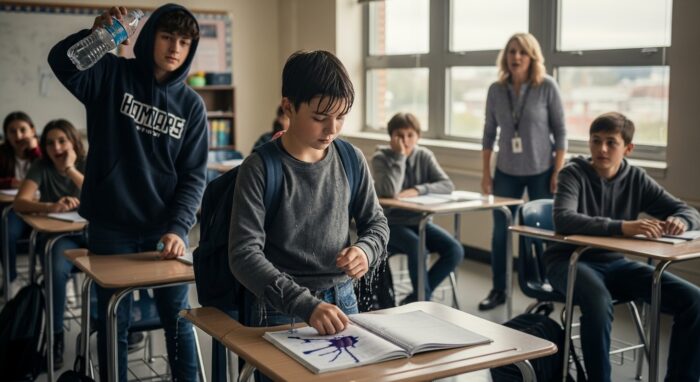
A plastic bottle, half full, tipped deliberately over his head in the middle of math class—clear liquid running down a faded gray sweatshirt that had already seen too many winters.
No one screamed.
No one rushed.
They just watched.
And for a moment, so did I.
He stood there—small frame, soaked sleeves, sneakers splitting slightly at the seams—while the other boys leaned back in their chairs, grinning as if they’d just completed a harmless joke.
“It’s just water,” one of them said.
But it wasn’t.
It was public humiliation, poured slowly and carefully, meant to leave a mark that didn’t stain the floor—but did stain something deeper.
The teacher looked up from her desk.
And what happened next… none of us were prepared for.
His name was Caleb.
Twelve years old. Quiet. The kind of child who carried his backpack with both straps on and never spoke unless called on.
He had transferred to our district mid-year.
The school was in a comfortable suburb outside Chicago. Brick houses. Two-car garages. PTA fundraisers that raised more money than some families earned in months.
Caleb didn’t come from that world.
His mother worked nights at a nursing home. His father—absent, though no one knew the details at first. They lived in a small apartment above a laundromat. You could sometimes smell detergent clinging to his clothes.
His sweatshirt—the one soaked that afternoon—was two sizes too big. The cuffs were frayed. The elbows thin. His jeans were clean, but faded in a way that suggested they’d belonged to someone else first.
Children notice those things.
They always do.
The whispers had started weeks earlier.
“Why does he wear the same shoes every day?”
“Doesn’t he have anything else?”
I watched him endure it quietly. Head down. Shoulders slightly curved inward. Hands folded neatly on his desk.
He never retaliated.
He never complained.
And that silence—oh, that silence—was misread.
Some saw it as weakness.
Some as strangeness.
No one saw what I would later learn it truly was.
The day of the incident, it was warmer than usual for early spring. The classroom windows were cracked open. A breeze drifted in. Kids were restless.
One of the more popular boys—Tyler, tall for his age, confident in the careless way children can be—decided to make a show of it.
“Hey Caleb,” he called out, shaking his water bottle lightly. “Does your mom wash this too?”
Laughter.
And then the bottle tipped.
Water cascaded over Caleb’s hair, down his forehead, across his too-large sweatshirt.
For a heartbeat, the room froze.
Even the air seemed to pause.
Caleb didn’t shout.
He didn’t lunge.
He didn’t cry.
He simply closed his eyes.
And then he did something that unsettled the entire room.
Mrs. Henderson stood abruptly from her desk.
“Tyler! That’s enough!”
Her voice echoed sharper than usual. The class shifted uneasily.
Tyler shrugged. “It’s just water.”
But it wasn’t just water.
Caleb’s notebook was soaked. The pages curled instantly. Ink bleeding into blue-gray rivers across his homework.
Mrs. Henderson approached Caleb’s desk. “Are you okay?” she asked gently.
He nodded once.
Water dripped from his hair onto the floor.
A few students exchanged glances. Some looked amused. Others uncomfortable.
And then—unexpectedly—Mrs. Henderson turned to Caleb instead of Tyler.
“Why didn’t you say something when this started?” she asked, not harshly, but pointedly. “You’ve been teased before. You need to speak up.”
There it was.
Not cruel. But misplaced.
As if silence meant consent.
As if endurance meant complicity.
Caleb lifted his eyes for the first time.
They were not angry.
They were not broken.
They were steady.
Tyler leaned back in his chair, confident the attention had shifted.
A murmur rippled through the room.
Mrs. Henderson sighed softly. “We cannot solve problems if you don’t advocate for yourself, Caleb.”
I remember feeling a tightening in my chest.
Because something about the way he sat there—soaked, humiliated, yet unshaken—did not feel like weakness.
It felt like restraint.
Caleb reached into his backpack slowly.
Not rushed.
Not dramatic.
The class watched.
Tyler smirked, expecting maybe a crumpled tissue. Maybe a surrender.
Instead, Caleb pulled out a neatly folded towel.
And placed it calmly on his desk.
He began patting his notebook dry with careful, deliberate movements.
The room quieted again.
Mrs. Henderson opened her mouth—to continue, perhaps to lecture—but stopped.
Because Caleb finally spoke.
And what he said next changed everything.
But that is where I will pause.
Because sometimes, before truth rises, it gathers its breath.
Caleb didn’t raise his voice.
He didn’t glare at Tyler.
He didn’t even look angry.
He simply kept dabbing the water from the pages of his notebook, pressing the towel down gently as though the paper were something fragile and worth saving.
Then he looked up at Mrs. Henderson.
“I didn’t say anything,” he began, his voice soft but clear, “because my mom told me not everyone who throws something at you deserves to see you throw something back.”
The room stilled.
Even Tyler shifted slightly in his seat.
Caleb swallowed once, as if deciding whether to continue. Then he did.
“She works nights,” he said. “At a nursing home. She comes home tired. Sometimes she still smells like disinfectant.” A few students glanced at one another. “She tells me when people are mean, it usually means they’re hurting about something else.”
His sweatshirt clung damply to his shoulders, but he didn’t seem to notice.
“I didn’t want to make it worse,” he added. “For him.”
He nodded slightly toward Tyler.
The boy who had poured the water.
There was no sarcasm in Caleb’s voice. No accusation.
Just fact.
Mrs. Henderson’s expression shifted.
“You don’t want to make it worse?” she repeated quietly.
Caleb shook his head. “I know what it feels like when people look at you like you don’t belong,” he said. “I don’t want anyone else to feel that. Even if they do it to me.”
You could hear the heating system click on in the corner of the room.
That’s how silent it became.
Tyler’s smirk had faded.
He looked down at his desk.
Mrs. Henderson blinked once. Then twice. The words she had prepared—about advocacy, about standing up for oneself—seemed to dissolve.
“Why do you carry a towel in your bag?” someone from the back whispered.
Caleb answered without embarrassment.
“In case the roof leaks again at home,” he said. “Sometimes it drips near my desk.”
No drama.
No plea for sympathy.
Just truth laid flat on a classroom floor.
The girls near the windows lowered their eyes.
One boy cleared his throat loudly, pretending to cough.
Mrs. Henderson straightened slowly. “Tyler,” she said gently, “would you like to say something?”
For the first time that year, Tyler looked unsure.
“I… I didn’t know,” he muttered.
Caleb shrugged slightly. “You didn’t ask.”
It wasn’t a rebuke.
It was an invitation.
And that was what left Mrs. Henderson without words.
Because discipline could correct behavior.
But this—this kind of grace—could not be taught from a textbook.
I have spent enough years around children to know that cruelty often travels in packs.
But so does courage.
That afternoon, something shifted in that classroom.
Not loudly. Not dramatically.
Just subtly.
The next day, Caleb arrived wearing the same faded sweatshirt.
But no one commented.
Tyler handed him a fresh notebook without making eye contact. He mumbled something about “extra supplies.”
Caleb accepted it with a simple nod.
No scoreboard kept.
No victory declared.
Mrs. Henderson, I noticed, began paying closer attention—not just to Caleb, but to the spaces between her students. The small glances. The unspoken hierarchies.
Sometimes, it takes a child to remind an adult what strength actually looks like.
It does not always roar.
Sometimes it stands soaked in the middle of a classroom, chooses not to retaliate, and offers empathy where retaliation would have been easier.
Years later, I still remember the way Caleb held that towel.
Careful.
Deliberate.
As if drying paper mattered.
As if dignity could be preserved with steady hands.
We talk often about teaching children to stand up for themselves.
But that day, a twelve-year-old boy taught a room full of adults something else entirely—
That the quietest person in the room may be carrying the heaviest lessons.
And that sometimes, the greatest response to humiliation… is refusing to become its echo.