Part 2: The Biker Heard One Question — And Answered Like a Father Who Lost His Son
I didn’t know much about Mason before that night.
Nobody did.
In a small town, people know your truck, your dog, your church, your ex-wife, and whether you pay your bills late. But Mason somehow stayed blurry. Present, but untouched.
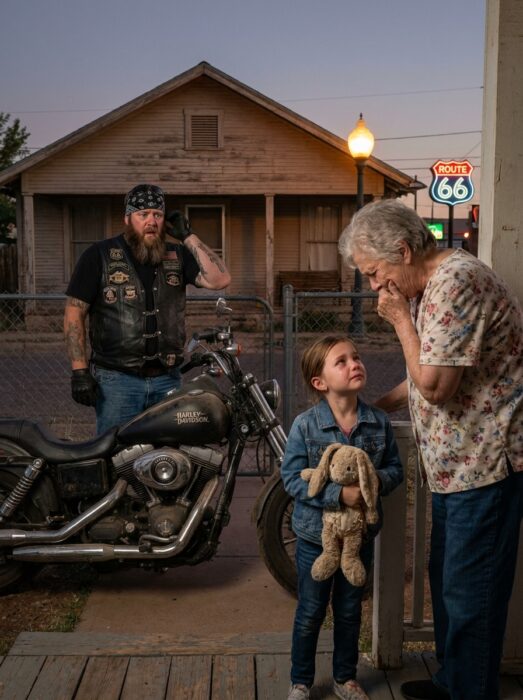
He rented the tan house beside the alley behind Mrs. Whitaker’s place. He worked at a machine shop near the highway, fixing farm equipment and old engines with the patience of a man who had broken enough things in his life to respect anything still running.
He didn’t throw parties. Didn’t drink. Didn’t bring women home. Didn’t sit outside trying to be seen.
Every morning before sunrise, he rolled the Harley out of the garage by hand so the engine wouldn’t wake Lily.
That was the first thing I should have noticed.
A man everybody feared was careful with noise.
My mother noticed more than I did. She always did.
“He cuts Mrs. Whitaker’s weeds when she’s at church,” Mom told me once.
“Mason?”
“Who else?”
“He doesn’t seem like the flower-bed type.”
Mom looked over her glasses. “That’s because you look with your eyes too much.”
There were other things.
When Mr. Alvarez’s truck died outside the gas station, Mason spent two hours under the hood in 102-degree heat and refused payment. When a teenage cashier at the diner dropped a tray and started crying, Mason was the only person who didn’t stare. He quietly helped her pick up the broken plates, left twenty dollars under his coffee cup, and walked out before she could thank him.
On Saturdays, three or four bikers would stop by his house.
Men with gray beards, faded cuts, and road-burned faces. They called him “Preacher,” which made no sense to me because Mason didn’t seem like the kind of man who saved anybody.
One of them was named Duke. Big belly, white mustache, laugh like gravel in a coffee can.
Another was Slim, who wasn’t slim.
There was also a younger man they called Prospect, though he looked nearly thirty. He mostly listened, carried boxes, and got teased.
They weren’t loud the way I expected bikers to be. They sat in Mason’s garage, drank gas-station coffee, and talked low while the summer heat pressed down on the street.
I caught pieces sometimes.
“Meeting still at seven?”
“Yeah.”
“Twelve years next month, brother.”
“Don’t make a thing of it.”
“We’re making a thing of it.”
That was the second thing I should have noticed.
Twelve years.
The same number stitched inside Mason’s leather cut, hidden under the left flap in small white thread.
12 CLEAN.
At the time, I thought it was some club thing.
A road thing.
A biker code.
I didn’t know it was a grave marker for the man he used to be.
And I didn’t know Lily’s question had reached him like a hook under the ribs.
That night, Mrs. Whitaker didn’t let him in right away.
I was still on Mom’s porch, pretending to wrap extension cord while listening like a sinner.
“Mason,” Mrs. Whitaker said, voice tight. “It’s late.”
“Yes, ma’am.”
“She’s had a hard day.”
“I know.”
“You heard?”
He looked down.
“Yes, ma’am.”
Mrs. Whitaker held the door only half open. I could see Lily behind her in yellow pajamas, clutching the rabbit.
The porch light hit Mason’s face. For the first time, he didn’t look dangerous.
He looked ashamed.
“I won’t scare her,” he said. “I’ll sit on the floor if you want.”
That line stayed with me.
A man that size asking permission to make himself lower.
Mrs. Whitaker looked at Lily.
Lily looked at Mason.
Then, in the tiny voice kids use when they know adults are upset, she asked, “Are you the donut man?”
Mason blinked.
“Yes, ma’am.”
“I like the pink ones.”
“I know.”
Mrs. Whitaker opened the door.
And Mason Cole stepped inside like a man entering a church he wasn’t sure would let him pray.
I heard most of it from Mrs. Whitaker later.
Some parts I saw through the kitchen window, because I’m not proud, and because sometimes a person knows history is happening but doesn’t know what kind.
Mason didn’t sit on the couch.
He didn’t take the chair Mrs. Whitaker offered.
He lowered himself to the faded linoleum floor, crossed his legs with a grunt, and set the pink donut on the table.
Lily sat across from him, rabbit tucked under her chin.
Mrs. Whitaker stood by the sink, one hand gripping a dish towel like it was the only thing keeping her upright.
For a while, Mason didn’t talk.
That surprised me.
Most adults rush to fill pain with words. They panic when a child asks something true.
Mason just sat there.
The refrigerator hummed. A clock clicked. Outside, his Harley cooled in the driveway, making soft metal ticks like it was listening too.
Finally, Lily asked him, “Do you know my daddy?”
Mason swallowed.
“No, ma’am.”
“Do you know my mommy?”
“No.”
“Then how do you know what to say?”
His hands were resting on his knees. Big hands. Scarred hands. One thumb rubbed the side of his index finger over and over.
“I know the sickness,” he said.
Lily frowned. “Grandma says they make bad choices.”
Mrs. Whitaker closed her eyes.
Mason nodded slowly. “They do.”
“So they choose not to love me?”
His jaw moved once.
That question landed hard. I saw it in his shoulders.
“No,” he said. “That ain’t what it means.”
Lily stared at him.
Mason looked toward Mrs. Whitaker, as if asking whether to continue. She gave the smallest nod.
He leaned forward, elbows on his knees.
“Your mom and dad love you,” he said. “But they’re sick with something that lies to them. It tells them the next pill, the next drink, the next whatever, matters more than food, more than sleep, more than coming home.”
Lily’s eyes filled.
“That sounds like they don’t love me.”
“I know.”
“Then why say they do?”
Mason’s voice got rougher.
“Because love can be real and still not be strong enough to drive the body home.”
That was too much for a six-year-old.
He knew it.
So he tried again.
“You ever wanted to run really fast?”
Lily nodded.
“What if your leg was broke?”
“I couldn’t.”
“Even if you wanted to?”
“No.”
“Even if you loved somebody waiting at the finish line?”
Lily looked down at the rabbit.
Mason tapped his own chest once.
“That sickness is like a broken leg inside the wanting part.”
Mrs. Whitaker turned away. Her shoulders shook, but she didn’t make a sound.
Lily whispered, “Can doctors fix it?”
“Sometimes.”
“Can grandmas?”
Mason glanced at Mrs. Whitaker.
“Grandmas can keep porch lights on.”
Lily thought about that.
Then she asked the question that broke the room open.
“Did you have that sickness?”
Mason’s hand stopped moving.
For a long moment, nobody breathed.
Then he said, “Yes, ma’am.”
Lily tilted her head.
“Did you get better?”
Mason looked at the old photograph in his hand.
“I got clean.”
“That means better?”
He stared at the photo like it had teeth.
“Not always.”
I thought that was the climax.
I thought the whole story was about a scary biker telling a little girl her parents loved her.
I was wrong.
The real story was in the photograph.
And Mason hadn’t shown it to her yet.
The photograph was old, folded twice, soft at the corners from being handled too many times.
Mason placed it on the kitchen floor between them.
Lily crawled closer.
In the picture was a younger Mason, maybe twenty-two, no beard, thinner face, same hard eyes trying to look happy. Beside him stood a woman with tired beauty and a baby boy in a blue hospital blanket.
“Is that your baby?” Lily asked.
Mason nodded.
“My son.”
“What’s his name?”
“Caleb.”
“Where is he?”
Mason breathed in through his nose.
“Phoenix.”
“Does he come visit?”
“No, ma’am.”
“Why?”
Mrs. Whitaker whispered, “Lily…”
But Mason raised one hand gently.
“It’s okay.”
He looked at Lily, but his voice sounded like it had gone somewhere far away.
“When Caleb was little, I had the same sickness your mom and dad got. I loved him. I did. But I missed birthdays. I missed fevers. I missed school mornings. I missed the first time he rode a bike.”
He pressed his lips together.
“I missed so much he quit saving space for me.”
Lily didn’t understand all of it.
But she understood enough.
“Did you say sorry?”
Mason gave a small laugh with no humor in it.
“Many times.”
“Did he forgive you?”
“No.”
The kitchen went still.
That was Twist One, though we didn’t know to call it that.
Mason wasn’t there because he knew Lily’s parents.
He was there because he had been Lily’s parents.
Because somewhere in Phoenix, an eighteen-year-old boy carried the same question Lily had asked through the fence.
Why didn’t my dad love me enough?
Mason touched the photo with one finger.
“I keep thinking somebody should’ve told Caleb this when he was small,” he said. “Somebody should’ve told him I was sick, not empty. Wrong, but not empty.”
Lily stared at him.
“So you’re telling me?”
Mason nodded.
“Yes, ma’am.”
“Because your boy won’t listen?”
His eyes shone, but he didn’t cry.
“Because my boy shouldn’t have had to.”
That was the moment Mrs. Whitaker finally sat down.
Not in a chair.
On the floor.
Right beside them.
After that night, the neighborhood changed.
Not loudly.
Small things shifted first.
Lily started waiting on the porch Thursdays, not for the donut exactly, though she still loved the pink ones. She waited because Mason had begun knocking.
He never came in unless Mrs. Whitaker invited him.
Never stayed long.
Sometimes he fixed a drawer. Sometimes he carried groceries. Sometimes he sat on the porch steps while Lily explained kindergarten politics to him like she was briefing a general.
He listened seriously.
That was Mason’s gift.
He made a child feel like her words had weight.
One afternoon, I saw Lily ask about the patch inside his vest.
The little white thread.
12 CLEAN.
“What does clean mean?” she asked.
Mason looked at Mrs. Whitaker.
Then he said, “It means I fight the sickness every day, and today I won.”
“Every day?”
“Every day.”
“Even Thursdays?”
“Especially Thursdays.”
That became Twist Two.
The pink donut wasn’t random.
Thursday was the day Mason used to visit Caleb when the court still allowed supervised visits. Every Thursday, he would promise to show up with a treat.
Most Thursdays, he didn’t.
By the time he got clean, the boy was eight and done waiting.
So Mason bought a pink donut every Thursday and gave it to a child who still came to the porch.
Not because Lily replaced his son.
No child replaces another.
But because regret needs somewhere to put its hands, or it starts tearing the walls down.
Twist Three came in August.
Duke rode up with Slim and Prospect just before sunset. The three of them parked outside Mason’s house, engines cutting one after another until the street felt too quiet.
I thought something bad had happened.
It had, in a way.
Caleb had turned eighteen.
Mason had written him a letter. Not the first one. Maybe the hundredth.
This time he had put no excuses in it. No explanations. No “I was sick.” No “I’m different now.” No “please understand.”
Just six lines.
Mrs. Whitaker showed it to me later because Mason had asked her to read it before he mailed it.
Caleb,
You did not fail me.
I failed you.
You were always worth coming home for.
I was sick, and I was wrong.
You do not owe me forgiveness.
I will keep the porch light on anyway.
Dad.
That was all.
Duke and Slim had come not to celebrate twelve clean years, but to ride with him to the post office on Route 66 while he mailed it.
Brotherhood, I learned, isn’t always men charging into a fight.
Sometimes it’s three old bikers standing beside one mailbox while a fourth man lets go of the only thing he still wants.
Mason held the envelope for nearly five minutes.
His hands shook.
Duke didn’t rush him.
Slim didn’t joke.
Prospect took off his sunglasses and looked at the ground.
Finally, Mason slid the letter through the slot.
The metal flap clanged shut.
He stood there like he had buried someone.
Then Lily, who had walked over with Mrs. Whitaker, stepped forward and took his hand.
Mason looked down.
She said, “Maybe somebody will say it to him too.”
Mason couldn’t answer.
He just nodded once.
A biker’s nod can carry more than a speech if you know how to read it.
That was the revelation.
All the seeds had been there from the start.
The soft engine mornings.
The hidden recovery patch.
The Thursday donut.
The photograph.
The way he lowered himself to the floor before speaking to Lily.
Mason wasn’t trying to look kind.
He was trying not to waste the pain.
September came with cooler mornings and school buses coughing yellow dust down the street.
Lily started first grade.
On her first day, she wore a blue dress, white shoes, and a backpack almost bigger than her whole body. Mrs. Whitaker took pictures until Lily complained.
Mason stood across the fence, pretending to check the oil on his Harley.
Lily saw him.
“Mason!”
He looked up.
She ran to the fence. “Do I look brave?”
He leaned on the handlebar, leather vest creaking.
“You look ready.”
“That’s not the same.”
“No,” he said. “It’s better.”
She grinned.
Then, from inside his saddlebag, he pulled out a small patch.
Not a biker patch. Not a club patch.
A tiny cloth rectangle with a crooked yellow porch light stitched on it.
“My old lady made this years ago,” Duke said from behind him, though nobody had heard him walk up. “Figured the kid earned colors.”
Mrs. Whitaker laughed and cried at the same time.
Mason handed the patch to Lily.
“For your backpack,” he said. “Means somebody’s keeping the light on.”
Lily hugged him around the waist.
He froze at first.
Then one hand, careful as a man handling broken glass, rested on the top of her head.
Every Thursday after that, Mason still brought the donut.
Sometimes Lily ate it.
Sometimes she split it with him.
Sometimes they just sat on the porch while traffic hummed out on Route 66 and the sun dropped behind the old motel sign.
He never talked much about Caleb.
But every evening, after work, he checked his mailbox before he opened his garage.
Every evening.
Even when it was empty.
Especially then.
The letter came in November.
No return address.
Just Mason Cole written in careful block letters.
I watched him pull it from the mailbox.
He didn’t open it right away.
He sat on the porch steps until the sky went copper and the first cold wind moved down the street.
Lily was beside him, swinging her legs.
Mrs. Whitaker stood in her doorway.
Duke, Slim, and Prospect waited by their bikes without saying a word.
Finally, Mason opened the envelope.
Inside was one photograph.
Caleb, eighteen now, standing beside an old pickup in Phoenix.
On the back, one sentence:
I don’t forgive you yet.
Then another, smaller:
But I read it.
Mason pressed the photo to his chest.
No speech.
No lesson.
Just a man, a porch light, and a Harley cooling in the dark.
The engine ticked softly.
Like a heart still trying.
Follow the page for more stories that make you look twice before judging someone.