A Nine-Year-Old Carried $62 in Coins to Open a Savings Account for Her Injured Father — Then a Biker Asked Where He Had Worked
Rachel closed her teller window.
Not because the bank was shutting down. She simply understood that whatever happened next required more privacy than a line of customers could provide.
She led Sophie, Rook, and me into a small office near the vault. The bank manager joined us. He brought a cup of water for Sophie and placed a chair beneath her feet because they did not reach the floor.
The jar remained on the desk.
Nobody counted it.
Sophie had written her father’s name on masking tape and stuck it crookedly across the lid.
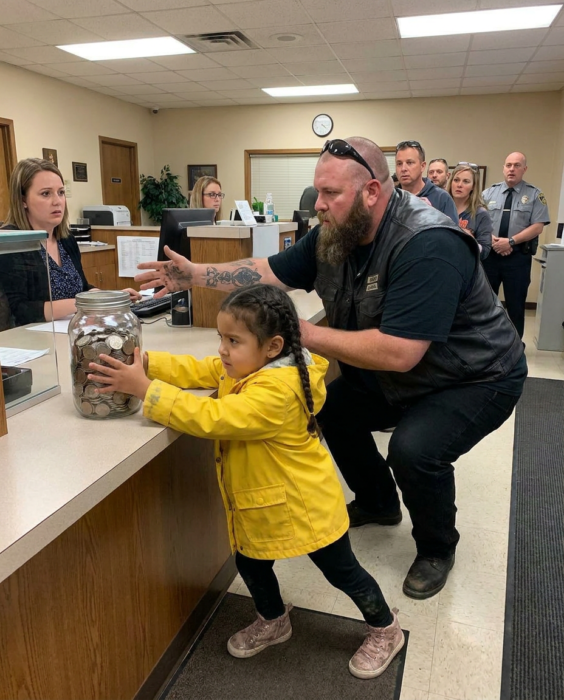
FOR DAD.
Below that, in smaller letters:
TO WALK AGAIN.
Rook stared at those words.
“What time does your mother finish work?”
“Five.”
“What’s her phone number?”
Sophie knew it by memory.
Elena Ramirez answered on the second call. At first she could not understand why the president of a motorcycle club was calling from a bank. Then Rook said Sophie’s name.
The line went silent.
“What happened to her?”
“She’s safe.”
“Where is she?”
“Beckford Community Bank.”
Elena’s voice rose. “She’s supposed to be at Mrs. Hanley’s house.”
Rook moved the phone away from his ear.
“She walked here.”
Three seconds later, Elena said she was leaving work.
Rook sent Cole to pick her up so she would not lose time waiting for a bus. Meanwhile, the manager contacted local police because a missing-child report might already have been filed.
It had.
Mrs. Hanley believed Sophie had gone home. Mateo believed she remained with Mrs. Hanley. By the time anyone realized she was gone, she had walked more than halfway to the bank.
An officer arrived.
Sophie began crying.
Not because she feared punishment.
Because she thought the police would take her money.
Rook slid the jar closer to her.
“Still yours.”
“Can Dad use it?”
“We’ll talk to him.”
“He’ll say no.”
Rook’s mouth tightened. “Smart man.”
When Elena entered the bank, she crossed the office in three steps and dropped to her knees. She checked Sophie’s face, arms, knees, and feet before pulling the girl against her.
Then she saw the jar.
Elena closed her eyes.
“You heard us.”
Sophie nodded against her mother’s shoulder.
“You weren’t supposed to hear that.”
“Dad needs it.”
“Oh, baby.”
Elena held her harder.
Rook stood near the wall, giving them what privacy a man his size could.
When Elena finally looked at him, recognition came slowly.
“I know that vest.”
“Your husband rebuilt our roof.”
Her face changed.
“That was years ago.”
“Five.”
“He never took your money.”
“He should have.”
“No.” Elena wiped her eyes. “You had already paid.”
She told us about the storm nine years earlier.
Mateo had been working a late shift at a fabrication plant outside town. Elena, nine months pregnant, had driven to pick him up because tornado warnings had shut down public transportation.
Her labor began on County Road 8.
Minutes later, a tree fell across the road behind them and floodwater covered the intersection ahead. Their car stalled. Cell service failed.
Then four motorcycles appeared through the rain.
Two bikers helped Mateo move Elena into a club support pickup traveling behind them. Another cleared branches from an access road using a chain saw. The driver took them to Saint Anne’s Hospital while motorcycles blocked flooded intersections.
Sophie was born forty-one minutes after arrival.
“Who drove?” Rook asked.
Elena shook her head.
“It was dark. He had a black beard and a red bandana. Everyone called him something like Sparrow.”
Thomas “Sparrow” Reed.
The brother we had buried only months earlier.
Sparrow had never mentioned the delivery.
That was typical.
He considered remembering favors a kind of bookkeeping, and he disliked keeping accounts against people.
Mateo learned the club’s name from Sparrow’s vest. Years later, when the tornado damaged our clubhouse, he recognized the Iron Lanterns in a news photograph.
He arrived the next morning with welding equipment.
Three weeks.
No invoice.
Now he lay inside his living room, unable to stand, while the insurer rejected a surgery his neurologist considered essential.
Rook asked to see the denial letter.
Elena carried a copy in her work bag.
Three pages of polished language said the procedure lacked sufficient evidence for Mateo’s specific condition. An internal reviewer—whose specialty was not spinal surgery—had decided less invasive treatment should continue.
Mateo had already completed eight months of it.
His condition was deteriorating.
Rook folded the letter.
“How much for the surgery?”
Elena named a number that made the bank manager inhale sharply.
Even if we emptied the club’s emergency fund, sold several motorcycles, and mortgaged the clubhouse, we could not cover all of it.
Rook looked at the deposit slip in his hand.
It represented money raised for Sparrow’s widow.
Untouchable.
Brotherhood was about helping.
It was also about honoring the purpose of money already promised.
Rook did not make dramatic pledges.
He called Marcus.
“Find a lawyer who fights insurance companies.”
Then he called the surgeon.
“Ask what it takes to keep Mateo’s operating date alive.”
Finally, he turned toward Sophie.
“Your dad welded our roof?”
“Yes.”
“Then we start there.”
Mateo’s house smelled of antiseptic, welding leather, and soup.
A hospital bed occupied the center of the living room. Metal grab bars had been bolted beside it. A wheelchair waited near the window, though the doorway to the hall was too narrow for easy turns.
Mateo Ramirez lay beneath a gray blanket.
He was forty-two, broad through the shoulders, with callused hands and a welder’s pale burn marks across both forearms. Eight months of pain had hollowed his cheeks and turned every movement into a calculation.
When Sophie entered carrying the coin jar, Mateo understood.
His face collapsed.
“You heard us talking.”
She placed the jar on his bedside table.
“I fixed it.”
“No, mija.”
“It’s sixty-two dollars.”
“I know.”
“And seventeen cents.”
Mateo reached toward her, but the movement sent pain through his lower back. His hand stopped in the air.
Sophie climbed carefully onto the bed and hugged his chest.
“I don’t need toys.”
“That’s not what this is.”
“You need it more.”
Mateo looked over her shoulder at Rook.
“Please tell her.”
Rook removed his sunglasses.
“Tell her what?”
“That this won’t pay for surgery.”
Rook pulled a chair beside the bed.
“She knows sixty-two dollars is a lot because it’s everything she has.”
“It’s still not enough.”
“No,” Rook said. “But that’s an adult problem.”
Mateo recognized him then.
“The roof.”
“Still standing.”
“You paid for the steel.”
“You donated three weeks.”
Mateo glanced toward Sophie. “I owed your club.”
“No. You didn’t.”
“Sparrow drove my wife.”
“He never collected.”
“I did.”
Rook leaned forward.
“Then let us collect from the people who owe you.”
Mateo showed us his medical records, claim notices, appeal documents, pay stubs, and accident report. Barton Steel had filed the workplace injury correctly. Workers’ compensation covered some treatment, but a separate health insurer was responsible for the disputed spinal procedure under the plan’s coordination rules.
Each organization blamed the other.
Between them lay Mateo.
The club’s first attempt was money.
We organized a ride, contacted contractors who knew Mateo, and opened a verified medical fund. Within ten days, people donated $48,000.
It kept the surgery date alive.
It did not cover the complete cost.
The second attempt was negotiation.
Our attorney, Grace Holloway, submitted an expedited appeal with letters from two spinal surgeons. The insurer denied it in forty-eight hours using nearly identical language.
“Nearly?” Rook asked.
Grace placed both letters side by side.
The sentences matched except for Mateo’s name, claim number, and dates.
“That’s a template,” she said.
“So?”
“So they may not be reviewing these cases individually.”
Grace requested the reviewer’s records.
The insurer delayed.
She requested internal treatment guidelines.
They sent heavily redacted pages.
She requested data showing how often the procedure was approved.
They claimed it was proprietary.
Rook wanted to visit the insurer’s regional office with the entire club.
Grace stopped him.
“Thirty leather vests outside their building will give them a security story. We need a medical-denial story.”
Rook disliked it.
He listened.
That was harder.
The false climax came six weeks later when an independent review board overturned the denial. We received the email at the clubhouse. Men shouted. Tank lifted Sophie into the air. Elena cried against Mateo’s shoulder.
The surgery would proceed.
We believed we had won.
Two days before the scheduled operation, the hospital called.
The insurer had authorized the procedure but denied the specialized implant and postoperative rehabilitation facility. Without both, the surgeon would not operate.
Approved on paper.
Impossible in practice.
Mateo asked everyone to stop.
“No more rides,” he said. “No more lawyers. We’re draining people for a chance.”
Elena argued.
He turned away.
Rook stood beside the hospital bed, both hands clenched at his sides.
Mateo continued.
“I built a roof. That’s all.”
“You worked three weeks.”
“You saved my wife.”
“Sparrow did.”
“You were his club.”
“And you were Barton’s welder when you fell. Does that mean Barton gets to walk away?”
Mateo’s eyes flashed.
“This isn’t your fight.”
Rook pointed toward the jar on the dresser.
“She walked three kilometers because every adult institution failed this house.”
His voice remained low.
“That made it our fight.”
Mateo looked at Sophie.
The girl was arranging coins by size on the carpet. She believed nobody noticed she was listening.
Rook saw.
So did Mateo.
“Put them back,” Mateo said gently.
Sophie returned every coin to the jar.
Sixty-two dollars and seventeen cents.
Still untouched.
The surgery was postponed.
The insurer expected delay to exhaust us.
Instead, Grace found thirty-nine more families.
The pattern began with a welder in Toledo.
His wife had posted online about a denied spinal procedure using the same phrase that appeared in Mateo’s letter: “insufficient evidence for the member’s particular functional presentation.”
Grace searched the exact wording.
More cases surfaced.
A roofer in Akron. A warehouse worker in Dayton. A crane operator in Columbus. Construction laborers, factory workers, drivers, and machinists injured on the job.
Different diagnoses.
Different doctors.
Different requested treatments.
Same denial language.
Forty workers in total.
Some had abandoned appeals. Some lost homes while waiting. Several accepted cheaper procedures their physicians considered less effective. One man died from unrelated complications before his case was resolved.
Grace built a file for each person.
The club divided the work.
Marcus reviewed medical timelines. I interviewed families. Cole traced employers and plan administrators. Tank created a spreadsheet despite insisting computers were designed by cowards.
Rook carried Sophie’s jar to every meeting.
He placed it in the center of the table.
Not as decoration.
As evidence.
The insurer’s lawyers saw forty claim numbers.
The jar reminded us those numbers lived inside houses where children listened through walls.
Grace filed suit alleging the company used an automated denial process and inadequate medical review to reject medically necessary treatment. She requested internal communications, reviewer contracts, and algorithmic guidelines.
The insurer moved to dismiss.
We lost the first hearing.
Then a former claims nurse contacted Grace.
She had seen the local news photograph of Sophie holding the jar beside Rook. The nurse said reviewers were expected to process hundreds of cases each week. Some denials were issued within minutes of submission.
“They couldn’t have read the files,” she said.
“Can you prove that?” Grace asked.
The woman possessed emails, productivity targets, and internal training material instructing staff to use standardized language whenever certain expensive procedures appeared.
That changed everything.
The insurer attacked her credibility.
They called her disgruntled.
They threatened legal action.
She nearly withdrew.
Rook asked to meet her in a public diner.
He arrived alone, without his vest.
“My people can stand outside if that helps,” he said.
“It doesn’t.”
“Then they won’t.”
The nurse stirred coffee for several minutes.
“I have children,” she said.
“So does Mateo.”
“That’s not fair.”
“No.”
Rook let the word remain between them.
She looked through the window at Sophie sitting in Elena’s car with the coin jar on her lap.
“Why is the child here?”
“She asked to come.”
“You use her at every meeting?”
Rook’s expression hardened.
“No. We protect her from most of them.”
“Then why today?”
“Because you wanted to know who gets hurt if you stay quiet.”
The nurse signed a sworn statement.
Discovery forced the insurer to release records. The evidence showed a system designed to delay high-cost cases. Reviewers sometimes copied conclusions before receiving full physician documentation.
Mateo’s claim had been denied in eleven minutes.
Eleven minutes.
Sophie had spent longer counting pennies.
The lawsuit became a class action involving all forty workers. News organizations picked up the story. State regulators opened an investigation.
Public pressure grew.
So did personal pressure.
The insurer hired investigators who photographed club members, searched criminal histories, and suggested the Iron Lanterns were using an injured child to extort payment.
One television report displayed old arrest photos of two members.
The claim was obvious: dangerous bikers versus a respectable corporation.
Sponsors withdrew from our charity ride.
A local business canceled a fundraiser.
Several club members wanted revenge—not violence, but confrontation. They wanted motorcycles outside the insurer’s headquarters and cameras waiting.
Rook called a meeting.
“Our faces are helping them,” he said.
“So we hide?” Cole asked.
“We step back.”
“We found the families.”
“Grace represents them.”
“We raised the money.”
“The case isn’t about us.”
The room divided.
Some believed retreat meant surrendering the story to lawyers and public-relations teams. Others recognized that the insurer wanted the club to become the distraction.
Rook removed his cut.
Then he placed Sophie’s jar beside it.
“Which one belongs in court?”
Nobody answered.
“The jar,” he said. “Every time.”
The club stopped giving interviews.
We transported patients, repaired ramps, paid utility bills, and left legal strategy to Grace.
Nine months after Sophie entered the bank, settlement negotiations began.
The insurer agreed to cover Mateo’s surgery, implant, rehabilitation, and lost treatment-related expenses.
But Grace refused an individual settlement.
“All forty,” she said.
Negotiations nearly collapsed.
Rook backed her.
So did Mateo.
“I waited this long,” he said. “I can wait until nobody gets left behind.”
The final agreement covered medically necessary treatment for all forty workers, required independent review of future denials, reimbursed families for certain expenses, and funded external audits for three years.
The company admitted no wrongdoing.
Corporations rarely do.
They paid anyway.
Mateo’s surgery took six hours.
The Iron Lanterns waited inside the hospital cafeteria because Elena refused to let thirty motorcycles block patient access. Sophie sat between Rook and Marcus with the coin jar beneath her chair.
She had brought it from home.
“For luck,” she said.
Rook nodded.
Nobody corrected her.
When the surgeon entered, Elena stood so quickly her chair tipped backward.
The procedure had gone as planned. Pressure on the spinal nerves had been reduced. The implant was secure. Recovery remained uncertain, and nobody could promise how much movement Mateo would regain.
Sophie asked the only question that mattered to her.
“Will he walk?”
The surgeon knelt.
“We gave his body a better chance.”
Sophie considered this.
Then she touched the jar.
“Chances are good.”
Rook looked away.
The word carried history.
Mateo woke that evening. His pain was different—sharp from surgery, but no longer carrying the same deep pressure that had tormented him for months.
Rehabilitation began slowly.
First, sitting upright.
Then moving from bed to chair.
Then activating muscles that had not answered properly in nearly a year.
Some days brought progress.
Others brought nothing.
Mateo learned that recovery was not a straight road. A good Monday could be followed by a terrible Tuesday. Hope could exhaust a person as effectively as pain.
The club created a schedule.
Two members drove him to therapy. One helped Elena repair the house. Another widened the hallway and installed accessible rails. A retired carpenter rebuilt the front steps into a ramp.
Nobody called it charity.
Mateo had rebuilt our roof.
We were working lower.
Sophie attended therapy whenever allowed. She sat near the parallel bars and counted seconds while her father stood with support.
At first, three.
Then seven.
Then twelve.
After four months, Mateo took his first assisted step.
His left leg moved.
Then the right.
His hands squeezed the bars so hard his knuckles whitened.
Sophie forgot the therapist’s instruction to remain seated. She ran forward, stopped herself, and covered her mouth with both hands.
Mateo took another step.
He cried.
Not dramatically.
A single tear moved down his cheek while every muscle in his body fought to keep him upright.
One year after surgery, he walked into the Iron Lanterns clubhouse using forearm crutches.
The roof he had rebuilt stood above him.
Rook waited beneath the central beam.
Mateo looked up.
“No leaks?”
“One near the office.”
“I told you to maintain the flashing.”
“You were busy.”
Mateo laughed.
The sound filled the garage.
Sophie entered behind him carrying the coin jar. The club had placed it inside a glass display case mounted beside the original storm photograph.
Not one coin had been spent.
A small card beneath the jar gave only the facts:
$62.17
SAVED FROM AGE FOUR
CARRIED THREE KILOMETERS
No names.
No self-congratulation.
Rook handed Sophie the key to the display case.
“It’s still yours.”
She shook her head.
“It’s Dad’s.”
Mateo rested one crutch against the wall.
“No. It was never money for me.”
Sophie frowned.
“What was it?”
Mateo looked toward the roof, then at the motorcycles parked beneath it.
“It was a knock on the door.”
The other thirty-nine families came to the clubhouse that afternoon. Some used wheelchairs. Some wore braces. Some carried folders thick with medical records. A few had already completed treatment under the settlement.
The claims nurse attended quietly.
Grace stood beside her.
There were no speeches until Rook was pushed toward a microphone.
He disliked microphones.
He looked at Sophie.
“Nine years ago, we drove a pregnant woman through a storm and forgot it by morning,” he said. “Five years ago, her husband rebuilt our roof and remembered for all of us. Then their daughter carried sixty-two dollars into a bank.”
He paused.
“That’s the whole story.”
It wasn’t.
But it was enough.
Sparrow’s widow approached Elena afterward. She carried her late husband’s red bandana.
“Elena,” she said, “Thomas drove you.”
Elena pressed the cloth to her mouth.
Sparrow had died never knowing that the baby survived, that Mateo repaired the clubhouse roof in gratitude, or that Sophie’s jar later pulled forty families into the light.
His widow placed the bandana beside the coins.
Two artifacts.
One ride.
One jar.
Neither intended to become important.
Both did.
The storm ride became an annual tradition, but not the kind people expected.
Every spring, on the anniversary of Sophie’s birth, Iron Lantern riders escorted families to medical appointments. No fundraising spectacle. No loud procession near hospitals.
Just transportation.
Motorcycles led. Support vehicles carried patients. Volunteers brought wheelchairs, blankets, food, and medical paperwork.
Mateo returned to welding in a limited capacity. He could no longer climb scaffolding, so Barton Steel moved him into inspection and training. He taught younger workers how to identify weak joins before they became failures.
He also taught them to appeal denied claims.
Grace held free workshops inside the clubhouse twice a year. She explained deadlines, documentation, independent medical reviews, and why families should never assume the first denial was final.
Sophie sat in the front row.
She grew taller.
The yellow raincoat stopped fitting, but Elena kept it inside a box. Dust from the three-kilometer walk still marked its hem.
At thirteen, Sophie started volunteering at a children’s hospital. At sixteen, she helped build a website connecting injured workers with legal and medical resources.
The jar stayed locked inside the clubhouse.
Occasionally, someone asked why we did not donate its contents. Sixty-two dollars could buy groceries, medicine, or fuel.
Rook always answered the same way.
“We’ve spent it a thousand times.”
The coins had purchased no surgery.
They had moved people.
Every new club member heard the story before receiving a patch. They stood beneath Mateo’s roof while Rook pointed to the jar and Sparrow’s faded bandana.
“Debts don’t always return to the same door,” he told them.
Some members understood immediately.
Others needed years.
Mateo continued arriving after storms to inspect the clubhouse roof. He used a ladder only from the lowest steps while younger men climbed.
Rook protested every time.
Mateo ignored him.
Sophie usually came too.
She would stand beneath the beam where the display case hung, count the coins through the glass, and make sure all $62.17 remained inside.
They always did.
Nine years after Sophie walked into the bank, she returned wearing a navy dress and carrying no jar.
Rachel still worked there, now as branch manager.
She recognized Sophie before Sophie recognized her.
“You wanted an account for your father,” Rachel said.
Sophie smiled. “I brought identification this time.”
She opened her first adult savings account with money earned from a summer internship at a patient-advocacy organization. Her father stood beside her on two forearm crutches.
Mateo still needed them for long distances.
He considered that a victory.
Rook waited behind them in line, older now, his gray beard almost white. The security guard no longer reached for his radio when Iron Lanterns entered.
Afterward, they rode to the clubhouse.
Sophie placed her new bank receipt inside the display case beside the coin jar. The sixty-two dollars remained untouched. Sparrow’s red bandana rested beneath it.
Mateo looked up at the steel roof supports he had welded.
“They kept the rain out,” he said.
Rook shook his head.
“You kept us dry.”
“You drove Elena.”
“Sparrow did.”
“You all wore the same patch.”
Rook considered arguing.
He didn’t.
Outside, thunder moved beyond the county line. Members began covering motorcycles and checking weather alerts. Old habits returned quickly whenever clouds darkened.
Sophie stood beneath the doorway where rain had poured through years earlier.
Her life had moved through that building before she ever entered it: first as an unborn child in a storm, then as the reason her father donated three weeks of labor, then as the girl whose coins forced a club to remember.
Rook closed the glass case.
“How much was in there again?” he asked.
Sophie knew he remembered.
“Sixty-two dollars and seventeen cents.”
“Enough?”
She looked at her father, the roof, and the forty workers’ names framed on the opposite wall.
“Enough to start.”
Rain struck the metal overhead.
The roof held.
Want another full biker story? Drop SPARROW in the comments and follow the page—more unforgettable brotherhood stories are coming soon.