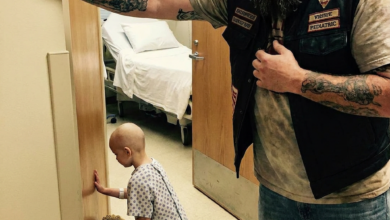
My Son Set a Biker’s Beard on Fire in Front of the Whole Town—Weeks Later, That Same Man Asked Him to Lead the Parade
My son touched a lighter to a biker’s gray beard in front of forty waiting motorcycles, and before I reached him, strangers were already shouting what kind of mother must have raised him.
The biker slapped at his beard and turned.
I expected him to strike back. I expected my child to run. Instead, nine-year-old Oliver stood frozen beside the motorcycle, pointing past the man’s shoulder with a hand that wouldn’t stop shaking.
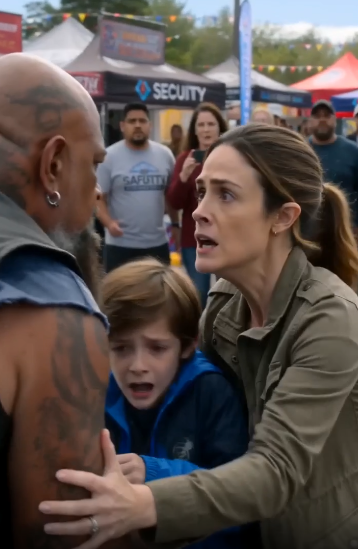
Nobody looked where he was pointing.
They looked at the lighter.
It was a small green one. I remember that absurdly clearly, though for weeks afterward I could not remember what I had eaten that morning or where I had left the car.
Green plastic. A silver top. Something that should never have been in my son’s hand.
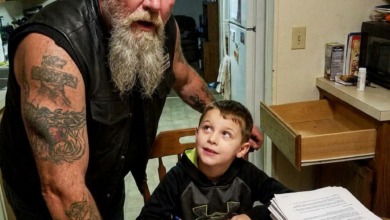
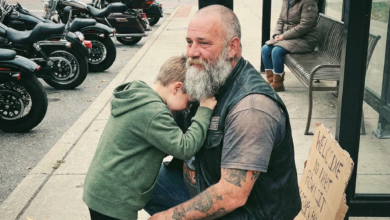
The man he had burned was enormous, with a shaved head, a beard that reached his chest, and tattooed arms stretching the sleeves of a faded blue shirt. His leather vest creaked when he moved. One side of his beard had curled into a blackened edge.
Around us, the waiting motorcycles were quiet.
That made the shouting worse.
“What is wrong with that kid?”
“Somebody get security.”
A woman lifted her phone. A rider stepped toward Oliver, and I pushed through the gap between two folding chairs so fast that one fell behind me.
“Oliver!”
He did not turn.
His mouth opened, but the first sound caught. It caught again. The same hard beginning that sometimes trapped him when he was tired or frightened, only now his entire face was working against it.
“B-b-b—”
The biker reached down.
I grabbed my son’s shoulders before the man’s hand came near him.
“Don’t touch him.”
He stopped immediately.
For one breath, we stared at each other over Oliver’s head.
There was something terrifying about that man’s stillness. He had every reason to be angry, and he was not moving like an angry person. His eyes were searching.
My son pointed again.
The biker followed his finger.
Then his expression changed.
“Clear this space,” he said.
I thought he meant us.
I began apologizing because that was the only useful thing my mouth seemed capable of doing. I said Oliver’s name, said I was his mother, said I would pay for whatever needed paying for, as though there were a receipt that could make this moment smaller.
The biker wasn’t listening anymore.
He had turned toward the narrow space behind the staging chairs.
A man in a red volunteer shirt started running.
Someone shouted for the fire crew.
Only then did I hear a sharp, unfamiliar hiss beneath the other sounds.
The biker looked back once.
“Take him with you.”
I pulled Oliver away.
He stumbled against me, still trying to speak. The lighter was no longer in his hand; an adult had picked it up from the pavement after he dropped it.
Across the crowd, more phones appeared.
I knew what those cameras had seen.
A little boy walking up to a stranger and putting a flame against his face.
There was no explanation in that picture. There was no room for the child who fed the neighbor’s cat or cried when I threw away a dead houseplant.
There was only what he had done.
Then the people behind the biker began moving, and I saw an older man in a wheelchair staring down at something beside his feet.
I tightened my arms around Oliver.
He buried his face in my jacket and finally forced out one whole word.
“Behind.”
When the biker finally followed my son’s finger, he shouted for everyone to move, and I realized the cameras had been facing the wrong direction.
My name is Mara Ellis. Before that Saturday, the worst thing Oliver had done in public was spill an entire strawberry milkshake into a stranger’s open tote bag.
He apologized to the woman’s library books.
That was my son.
He was nine, thin through the shoulders, with a stubborn piece of brown hair that never stayed flat. He liked road maps, mechanical pencils, and telling me which intersections had the longest pedestrian crossings.
He also stuttered.
Not every sentence. Not every day. Sometimes he could explain the entire history of a steam locomotive without getting stuck once, then struggle over his own name when a cashier asked it.
We were working with a speech-language professional who treated him like a person instead of a problem. At home, I tried to give him time and stop finishing his sentences.
I did better on quiet evenings than on mornings when we were late.
That is a confession, not an excuse.
The event was a community safety fair followed by a short charity parade through town. There were fire trucks, school buses, a bicycle course, and a line of Harley-Davidsons belonging to the Iron Lantern Riders.
Oliver had wanted to go for weeks.
He had a little notebook with questions about traffic signals. He wanted to ask the fire crew why their trucks sometimes stayed at intersections after the other vehicles moved.
We arrived before the parade.
The motorcycles were parked near the edge of the square, engines off while the riders checked the route. Beyond them, volunteers had arranged chairs for older residents who wanted to watch without standing.
One of those residents was a retired mechanic named Arthur Bell.
He used supplemental oxygen and sat in a wheelchair beside his daughter. His equipment rested behind the chair, near a display table that should have had more space around it.
Later, people would investigate exactly how that area had been arranged and how an ignition source had reached material near the tubing. In the moment, nobody had the whole picture.
Oliver saw something I didn’t.
I was buying two bottles of water from a table perhaps twenty feet away. He had my permission to stand beside the motorcycle display where I could still see him.
The biker was showing another child the shape of a worn motorcycle glove.
His name was Jonah Reed.
He was fifty-eight, a Black American man with a broad chest, a silver-gray beard, and a voice that seemed to settle people when he used it carefully. Old scars crossed two knuckles. A small blue ribbon was stitched inside his vest.
Oliver told me later that he tried to get a volunteer’s attention first.
The man was moving equipment and said, “One second, buddy.”
Then Oliver tried Jonah.
There were announcements coming from the loudspeaker. People were talking. His words jammed.
He pointed behind Jonah.
Jonah thought he meant the motorcycle and answered, “We’ll get to yours.”
That sentence would haunt him afterward.
The lighter was sitting on a nearby vendor table, where it had been left within reach. Its owner had turned away.
That was another failure people had to account for.
But none of it put the lighter in Oliver’s hand except Oliver.
He picked it up.
He had seen the small fire behind the chairs, seen adults fail to look, and made a terrible, frightened leap in his thinking: if he created something they could not ignore, somebody would finally turn around.
It was not a plan.
It was a dangerous decision by a child who understood urgency much better than consequences.
He held the lighter near the end of Jonah’s beard.
The hair caught.
Then everything moved too fast.
As I carried him away from the staging area, I did not know any of that. I knew what I had seen, and what I had seen made me afraid of my own child for the first time.
That thought shamed me almost immediately.
Oliver was sobbing against my shoulder.
“I tried,” he kept saying.
At first, I thought he meant he had tried to light the beard.
Then he pointed over my shoulder again.
“Mom. I tried to tell.”
I stopped beside the first-aid tent and lowered him carefully onto a chair.
His hands were shaking so hard that he could not hold the water bottle.
“Tell me what?”
He looked toward the crowd.
And this time, I waited.
By the time Oliver got the words out, the emergency response was already underway.
Jonah had seen the burning material near Arthur’s chair and alerted the crew stationed at the fair. He had training through his industrial workplace and responded using equipment from the event’s emergency station while the firefighters moved in.
I could not see the details from where we were.
I saw people being guided back. I saw Arthur’s daughter walking quickly beside his chair as another volunteer helped move him away. I saw a firefighter kneel near the equipment, then stand and signal to a colleague.
There was no explosion.
There was no wall of flame.
It was a small fire in a place where a small fire mattered enormously, and the people trained to handle it treated it that way.
Later, one of them explained the distinction carefully: oxygen itself was not fuel, but it could make other materials burn much more fiercely. The tubing and nearby material had been involved.
That was enough for me to understand how close we had come without needing to turn it into something larger.
Jonah helped knock down the visible fire before the crew completed the response and made the area safe.
Then he allowed someone to inspect his face and hands.
His beard had taken the worst of the brief flare. There was a small reddened area near his chin, but he had avoided the serious injury I kept imagining.
That did not make Oliver’s action harmless.
It meant we had been fortunate.
An officer approached the first-aid tent while a volunteer checked my son.
I stood immediately.
He introduced himself as Officer Bennett and asked whether we could talk somewhere quieter. His tone was calm. He did not reach for Oliver or announce anything to the people watching.
I was grateful enough for that to nearly cry.
Oliver sat between us while I explained what I had witnessed.
Then the officer asked what had happened before the lighter.
My son’s face tightened.
The first word would not come.
Officer Bennett waited.
He did not say slow down. He did not look at me to answer for him. He waited through the blocked sound and the breath afterward.
Oliver told him about the thing burning behind the chairs.
He told him about the volunteer.
He told him about Jonah not turning.
Finally, he looked at his shoes.
“I thought he would see.”
The officer nodded, writing something down.
“Did you understand that you could hurt him badly?”
Oliver’s eyes filled again.
“Not like that.”
It was an honest answer, and it terrified me more than a lie would have.
Officer Bennett explained that there would be follow-up. The adults needed to understand the incident, the unattended lighter, and the response at the fair. We would work with the appropriate people on Oliver’s use of fire and what had led to it.
He did not promise there would be no consequences.
He also did not call my son cruel.
Across the square, the organizers announced that the parade was delayed while the area was checked.
I heard disappointed voices.
Then another sound reached us.
“They ought to take that kid out of here.”
A woman stood near the edge of the tent holding her phone.
I recognized her from beside the motorcycles.
She had filmed the beard catching fire.
Officer Bennett asked her to give us space.
She looked offended.
“I’m just saying what everybody’s thinking.”
My son lowered his head.
Before I could answer, Jonah appeared behind her.
His beard was uneven now, one side shortened and curled. Someone had given him a clean cloth, which he held loosely in one hand.
“No,” he said.
The woman turned.
“You’re the one he—”
“I know who I am.”
His voice stayed low.
He looked toward Oliver, then at me.
“May I come over?”
I nodded.
He pulled up a chair far enough away that my son did not have to lean back, then lowered himself into it with a tired breath.
For several seconds, he said nothing.
Oliver stared at the damaged beard.
“I’m sorry.”
“I heard you.”
“I didn’t—”
Jonah lifted one open hand, not to stop him, but to tell him there was time.
Oliver took another breath.
“I didn’t want your face to burn.”
Jonah nodded.
“But it could have.”
My son began crying harder.
“I know.”
The big man sat quietly until Oliver could look at him again.
“You saw something important,” Jonah said. “You used something dangerous to tell me. We’ve got to keep both of those true.”
I pressed my hand over my mouth.
It was the first sentence anyone had spoken that made room for my whole child.
Arthur’s daughter came over after the crew finished checking him.
Her name was Denise. She still wore the volunteer badge that had been swinging against her chest when she helped move the chair.
She crouched beside Oliver, leaving space between them.
“My dad is all right.”
He looked up.
“The man?”
“Yes.”
She swallowed.
“I wanted you to know.”
Oliver nodded, but he did not smile.
Jonah watched him carefully.
Denise thanked the responders, the volunteers, and Jonah. She did not tell Oliver that burning someone had saved the day. I would have stopped her if she had.
Instead, she said, “I’m glad you noticed something was wrong.”
Then she left us with that.
The woman with the video had moved farther away, but the clip was already circulating.
A friend sent it to my phone before we got home.
The caption said a child had attacked a biker at a family event.
For once, I could not dismiss a caption as completely false. He had put fire against another person. What the clip left out was why, and the absence changed everything people believed about who he was.
I did not let Oliver see it.
That evening, he asked whether Jonah would hate him forever.
I told him I didn’t think so.
I did not say everyone would understand.
The following Tuesday, Jonah called.
He had obtained my number through the event coordinator after asking whether I was willing to hear from him. That small step mattered. By then, the sound of an unfamiliar phone notification made my stomach tighten.
He asked whether he could meet us with the fire educator assigned to the follow-up.
No cameras. No club gathering.
“Oliver doesn’t owe me a performance,” he said.
We met at the community room behind the fire station.
Jonah arrived wearing a clean dark shirt beneath his vest. His beard had been trimmed evenly, much shorter than before. Without it covering his chin, he looked both younger and more exposed.
Oliver noticed immediately.
“You cut all of it.”
“Had to even things up.”
“Did you like it long?”
“Yes.”
My son looked down.
Jonah did not pretend he had wanted a haircut.
I appreciated that, though I knew the answer hurt.
The fire educator, Ms. Alvarez, spoke with us about what happened. She listened to Oliver describe the warning he had tried to give. Then she worked with him on ways to get an adult’s attention without creating another emergency.
She treated the lighter as serious.
She treated Oliver as teachable.
There were more meetings afterward, and a plan I followed at home. I reviewed where matches and lighters were kept, spoke with his school, and made sure the people helping him understood both the dangerous act and the communication difficulty.
His stutter did not cause this.
Plenty of children who stutter never do anything remotely similar. We were careful not to make it a villain in his story.
What mattered was helping Oliver recognize that panic could push him toward a choice he would never make when calm, and that he needed alternatives he could use even when words were hard.
After the meeting, Jonah stayed while Oliver examined a display of old helmets with Ms. Alvarez.
I offered to cover his medical expenses and anything else connected to the incident.
He accepted my offer to discuss the actual costs.
He did not turn forgiveness into a refusal to acknowledge harm.
Then I asked why he had come.
“Because somebody came for me once.”
He leaned back against the wall.
Years earlier, Jonah’s younger brother had died. Grief became drinking. Drinking became fights, missed work, and a long list of people who stopped believing him when he said he was fine.
One night, he swung at a man outside a bar and hurt him.
There was no noble reason for it.
Jonah said that plainly.
He served his sentence, got treatment, and returned home to a son who had learned to keep his expectations low.
“I thought being sorry should get me through the door,” he said.
“Did it?”
“No.”
His son needed time. His employer needed consistency. The man he injured did not owe him forgiveness, and Jonah had eventually stopped asking other people to turn his regret into a clean ending.
But an older rider named Ruth had kept showing up.
She drove him to appointments when his truck failed. She told him when his excuses sounded like excuses. She invited him to help with small jobs before trusting him with larger ones.
“She didn’t call me good,” he said. “She gave me work I could do right.”
Across the room, Oliver was listening intently to Ms. Alvarez.
Jonah followed my gaze.
“Your boy needs to learn what he did. He doesn’t need to become it.”
I cried in the parking lot after he left.
Oliver thought it was because I was still angry.
I told him it was because I had been very frightened, and because someone had said something kind that did not ask us to forget the truth.
The Iron Lantern Riders argued about Oliver.
Jonah told me that himself.
Some members were furious. One had watched the flame catch and imagined Jonah’s eyes being injured. Another had a young daughter and worried about sending the message that hurting someone brought attention and praise.
They were not wrong to worry.
When Jonah first suggested inviting Oliver to help lead the rescheduled safety procession, Owen, the club president, refused.
“Not as a reward.”
“Agreed.”
“Then what are you proposing?”
Jonah did not have an answer ready.
That was one of the details that made me trust the invitation later. It had not arrived fully formed from a man certain his compassion made every idea wise.
They discussed it with the event organizers and Ms. Alvarez. I was included. Oliver’s counselor was consulted with my permission.
We all had different responsibilities.
The club wanted to support a child without minimizing what happened. The educators wanted his learning to be real. I wanted him to stop thinking the entire town would recognize him as the boy with the lighter for the rest of his life.
Oliver wanted to know whether he could stay home.
So we paused.
For the next several weeks, nobody promised him a parade.
He attended the sessions arranged for him. At home, we practiced asking for help in ordinary situations, including when speech was difficult. We made sure he knew he could point, use a clear gesture, or bring a nearby adult’s attention to a problem without touching dangerous objects.
Sometimes practice went well.
Sometimes he became angry because he felt everyone was teaching him something he should already have known.
One evening, he pushed a worksheet away.
“I was trying to help.”
“I believe you.”
“Then why do I have to keep doing this?”
“Because trying to help didn’t keep Jonah from getting hurt.”
He stared at me.
I wanted to soften it immediately.
Instead, I stayed beside him.
After a while, he pulled the paper back.
He wrote Jonah a letter too.
I did not dictate it.
The first version said, Sorry about your beard.
He looked at it for a long time, then crossed out the sentence and started again.
I am sorry I put the fire on you. I was scared, but I should not have done that. I am learning other ways.
He drew a motorcycle beneath it.
When Jonah read the letter, he asked whether he could keep it.
Oliver nodded.
Then Jonah showed him something inside his vest.
The small blue ribbon I had noticed at the fair had a child’s uneven stitches along one edge.
“My granddaughter made this.”
“Why?”
“Said I looked too plain.”
Oliver glanced at the tattoos covering Jonah’s arms.
For the first time since the incident, he laughed in Jonah’s presence.
The sound surprised all three of us.
As the weeks passed, the organizers changed parts of the event plan. They reviewed the equipment area, access routes, volunteer communication, and the unattended lighter. Adults had responsibilities in what happened, and they needed to carry them.
The first public statement explained that Oliver had been attempting to alert people to another fire and had done so dangerously. It credited the responders and made clear that the boy was receiving support and education.
It did not name him.
That protected what privacy remained, though people who had seen the clip already knew his face.
Jonah refused requests to recreate the moment on camera.
He would not pose with a lighter.
He would not let anyone call the beard incident a clever rescue trick.
Only after the follow-up work was underway and Oliver had begun to feel steadier did the invitation return.
This time, it was specific.
The event included a short walking safety procession before the motorcycles departed on their separate escorted route. Oliver could carry the lead banner beside Ms. Alvarez and an adult volunteer, at walking pace, on the closed section.
He would not ride a motorcycle.
He would not be introduced as a hero.
He would help lead something about paying attention and asking for help.
Jonah came to our house to explain.
He stood on the porch until I invited him inside, then sat at the kitchen table where Oliver could see the entire doorway.
“I’d like you to help us lead,” he said.
Oliver looked at me.
“Because of what I did?”
“Because of what you’ve been learning.”
“What if I get stuck?”
“Then we wait.”
The boy rubbed his thumb over a mark on the table.
“What if I say no?”
Jonah nodded.
“Then we’ll have pancakes some other day.”
Oliver thought about that for almost a minute.
Then he asked what color the banner was.
The new event took place on a cool morning six weeks later.
I almost turned the car around twice.
Oliver sat beside me holding his water bottle in both hands. He wore a blue jacket and sneakers he had cleaned himself the night before.
At the square, the motorcycles stood in a different arrangement. The paths were wider. Volunteers wore matching bright shirts, and the area for seated guests was separated from the displays more carefully.
The changes were not all because of Oliver.
That mattered.
He was not carrying the town’s entire lesson on his narrow shoulders.
Jonah met us near the entrance with Ms. Alvarez.
His beard had begun growing back.
Oliver looked at it, then at his face.
“Does it still hurt?”
“No.”
The answer was simple and, this time, true.
Arthur was there with Denise, seated comfortably in the designated viewing area. Oliver had asked beforehand whether he would come.
Now he stopped several feet away.
Arthur smiled.
“I hear you’re helping out today.”
Oliver nodded.
“Important job.”
The boy looked down at the banner folded over Ms. Alvarez’s arm.
“I’m still nervous.”
Arthur adjusted the blanket across his knees.
“So am I, sometimes.”
It was a better answer than telling him there was nothing to fear.
When the procession gathered, Jonah stood with the other riders along the side of the closed street. They would join the later motorcycle portion, after the walking group was finished and clear.
The loudspeaker crackled.
Oliver flinched.
Ms. Alvarez asked whether he wanted a moment.
He nodded.
And everyone waited.
No one joked about being late. No one told him the crowd was watching. Jonah leaned against his parked Harley and looked as though he had nowhere else to be.
Oliver took the corner of the banner.
The adult beside him took the other.
They walked.
That was the whole miracle, if you want to call it one. A boy who had spent six weeks remembering the worst seconds of his life took ordinary steps down an ordinary street while people made room.
I walked near the side with the other parents.
A woman raised her phone, and my stomach tightened.
Then she asked whether photographs were allowed.
Ms. Alvarez explained the event’s arrangement, and the woman lowered it where needed.
Permission. A pause. A question before an assumption.
Such small things.
At the end of the walking route, Oliver helped fold the banner. He had not needed to speak into a microphone. Nobody asked him to explain himself in front of strangers.
Jonah came over after the children were clear.
“How’d it go?”
Oliver considered.
“I didn’t drop it.”
“Good start.”
Then my son looked toward the motorcycles.
“Did you wait the whole time?”
Jonah nodded.
“Said we would.”
People sometimes ask whether Oliver became confident after that.
I never know how to answer a question that expects a child to finish becoming himself in one afternoon.
He still stutters.
He still hates being rushed. He still gets embarrassed when someone laughs before he knows whether they are laughing at him.
He also asks questions at the library now without making me stand at the desk for him. Sometimes the question takes a while. We let it.
The follow-up work ended when the people responsible agreed he had completed what was needed. The lessons remained part of home life without becoming a punishment we repeated forever.
Jonah kept visiting.
Not constantly. He had a job, a granddaughter, a son he was still learning how to know. Our lives met over pancakes, community events, and the occasional bicycle adjustment.
His beard grew long again.
Oliver noticed one afternoon while they were sitting on our porch sorting a box of donated bike reflectors for the church.
“It’s the same now.”
Jonah ran a hand through it.
“Close.”
“Can you tell where?”
“A little.”
Oliver looked at his own hands.
“I still think about it.”
Jonah set down the reflector he was holding.
“Me too.”
I stood just inside the screen door, waiting to see whether either of them needed me.
After a while, Oliver asked, “Are you still mad?”
“Not today.”
It was such an honest answer that I loved him for it.
Forgiveness did not have to pretend nobody had been frightened. It could sit on a porch beside a box of reflectors and answer the question that had actually been asked.
That winter, Oliver made Jonah a card.
On the front, he drew a motorcycle with a crooked headlight. Inside, he wrote a sentence he revised three times.
Thank you for waiting until I could tell you.
Jonah read it without speaking.
Then he folded it carefully and put it inside his vest beside the blue ribbon.
At the next safety fair, Oliver volunteered at the bicycle table. He showed younger children where to bring questions and who the event helpers were.
He did not tell them the story of the lighter.
That story belonged in the places where it could be understood, not offered as entertainment beside a display.
Near closing time, I heard him call Jonah’s name.
The first sound caught.
Jonah turned.
He did not hurry him.
My son tried again, then pointed toward a little boy holding a broken helmet strap.
This time, everybody looked.
Follow our page for more biker stories about accountability, second chances, and the patient people who help others find a safer way forward without giving up on them.